


Партнерка на США и Канаду по недвижимости, выплаты в крипто
- 30% recurring commission
- Выплаты в USDT
- Вывод каждую неделю
- Комиссия до 5 лет за каждого referral
Total synonyms are those members of a synonymic group which can replace each other in any given context, without the slightest alteration in denotative meaning or emotional meaning and connotations. They are very rare. Examples can be found mostly in special literature among technical terms and others, e. g. fatherland - motherland, suslik - gopher, noun - substantive, functional affix -flection, inflection, scarlet fever - scarlatina Relative Synonyms
Some authors class groups like ask - beg - implore, or like - love - adore, gift -talent - genius, famous - celebrated- eminent as relative synonyms, as they denote different degree of the same notion or different shades of meanings and can be substituted only in some contexts.
Contextual or context - dependent synonyms are similar in meaning only under some specific distributional conditions. It may happen that the difference between the meanings of two words is contextually neutralised, E. g. buy and get would not generally be taken as synonymous, but they are synonyms in the following examples: I'll go to the shop and buy some bread.
I'll go to the shop and get some bread.
The verbs bear, suffer, stand are semantically different and not interchangeable except when used in the negative form: I can't stand it, I can't bear it.
One of the sources of synonymy is borrowing. Synonymy has its characteristic patterns in each language. Its peculiar feature in English is the contrast between simple native words stylistically neutral, literary words borrowed from French and learned words of Greco-Latin origin.
Native English
to ask to end to rise teaching belly
French Borrowings
to question to finish to mount guidance stomach
Latin borrowings
to interrogate to complete to ascend instruction abdomen
30
There are also words that came from dialects, in the last hundred years, from American English, in particular, e. g. long distance call AE - trunk call BE, radio AE - wireless BE.
Synonyms are also created by means of all word - forming processes productive In the language.
Synonymic differentiation
It must be noted that synonyms may influence each other semantically in two diametrically opposite ways: one of them is dissimilation or differentiation, the other - the reverse process, i. e. assimilation.
Many words now marked in the dictionaries as "archaic" or "obsolete" have dropped out of the language in the competition of synonyms, others survived with a meaning more or less different from the original one. This process is called synonymic differentiation and is so current that is regarded as an inherent law of language development.
The development of the synonymic group land has been studied by A. A. Ufimtseva. When in the 13 century soil was borrowed from French into English its meaning was "a strip of land".
OE synonyms eorpe, land, folde ment "the upper layer of earth in which plants grow".
Now, if two words coincide in meaning and use, the tendency is for one of them to drop out of the language.
Folde became identical to eorpe and in the fight for survival the letter won. The polysemantic word land underwent an intense semantic development in a different direction and so dropped out of this synonymic series.
It was natural for soil to fill this lexical gap and become the main name for the notion "the mould in which plants grow". The noun earth retained this meaning throughout its history whereas the word ground, in which this meaning was formerly absent, developed it. As a result this synonymic group comprises at present soil, earth, ground.
The assimilation of synonyms consists in parallel development. This law was discovered and described by G. Stern,, H. A. Treble and G. H. Vallins in their book "An ABC of English Usage", Oxford, 1957, p. 173 give as examples the pejorative meanings acquired by the nouns wench, knave and churl which originally ment "girl", "boy", and "labourer" respectively, and point out that this loss of old dignity became linguistically possible because there were so many synonymous words of similar meaning. As the result all the three words underwent degradation in their meanings:
wench - indecent girl knave - rascal churl - country man. Homonymy
The problem of polysemy is closely connected with the problem of homonymy. Homonyms are words which have the same form but are different in meaning. "The same form" implies identity in sound form or spelling, i. e. all the three aspects are taken into account: sound-form, graphic form and meaning.
31
Both meanings of the form "liver'' are, for instance, intentionally present in the following play upon words; "Is life worth living ? - It depends upon the liver",
The most widely accepted classification of homonyms is that recognising homonyms proper, homophones and homographs.
Homonyms proper (or perfect, absolute) are words identical in pronunciation
аnd spelling but different in meaning, like back n. "part of the body" - back adv. "away from the front" - back v. "go back"; bear n. "animal" - bear v, "carry, tolerate".
Homophones are words of the same sound but of different spelling and meaning: air - heir, buy - by, him - hymn, steel - steal, storey - story.
Homographs are words different in sound and in meaning but accidentally identical in spelling: bow [bou] - bow [bau], lead [li:d] - lead [led].
Homoforms - words identical in some of their grammatical forms. To bound (jump, spring) - bound (past participle of the verb bind); found ( establish) -found (past participle of the verb find).
Paronyms are words that are alike in form, but different in meaning and usage. They are liable to be mixed and sometimes mistakenly interchanged.
The term paronym comes from the Greek para "beside" and onoma "name". Examples are: precede - proceed, preposition - proposition, popular - populous.
Homonyms in English are very numerous. Oxford English Dictionary registers 2540 homonyms, of which 89% are monosyllabic words and 9,1% are two-syllable words.
So, most homonyms are monosyllabic words. The trend towards monosyllabism, greatly increased by the loss of inflections and shortening, must have contributed much toward increasing the number of homonyms in English.
Among the other ways of creating homonyms the following processes must be mentioned:
conversion which serves the creating of grammatical homonyms, e. g. iron -to iron, work - to work, etc.;
polysemy - as soon as a derived meaning is no longer felt to be connected with the primary meaning at all (as in bar - балка; bar - бар; bar - адвокатура) polysemy breaks up and separate words come into existence, quite different in meaning from the basic word but identical in spelling.
From the viewpoint of their origin homonyms are sometimes divided into historical and etymological.
Historical homonyms are those which result from the breaking up of polysemy; then one polysemantic word will split up into two or more separate words, e. g. to bear /терпіти/ - to bear /народити/ pupil /учень/ - pupil /зіниця/ plant / рослина/ - plant /завод/
Etymo1ogiсal homonyms are words of different origin which come to be alike in sound or in spelling (and may be both written and pronounced alike).
Borrowed and native words can coincide in form, thus producing homonyms (as in the above given examples).
In other cases homonyms are a result of borrowing when several different words become identical in sound or spelling. E. g. the Latin vitim - "wrong", "an
immoral habit" has given the English vice - вада "evil conduct"; the Latin vitis -"spiral" has given the English ''vice" - тиски "apparatus with strong jaws in which things can be hold tightly"; the Latin vice - "instead of", "in place of" will be found in vice - president.
It should be noted that the most debatable problem in homonymy is the demarcation line between homonymy and polysemy, i. e. between different meanings of one word and the meanings of two or more homonymous words.
Tasks and Exercises
Exercise І.
Read the following two passages and discuss the difference between the two points of view on synonymy.
Jacobson R. Selected Writings. - P. 656 : In any language instances may occur where two words are synonyms i. e. semantically coinciding with each other while differing in their phonemic constitution (though cases of total semantic coincidence and unrestricted permutability within the same code are most uncommon, and often close semantic approximation is mistaken by students for a complete identity), It is obvious that as a rule a distinctive feature in any language serves to differentiate words (or their grammatical constituents) which are semantically distinct, and, above all. language has no other way to convey a semantic difference than through the distinctive features. (Mednikova E. M. Seminars in English Lexicology. - M., 1978. - p. 649).
Lyons John. Introduction to Theoretical Linguistics. - P. 447; "Total Synonymy" and "Complete Synonymy". - P. 448:
It is a widely-held view that there are few, if any, "real" synonyms in natural languages. To quote Ullmann, it is almost a truism that total synonymy is an extremely rare occurrence, a luxury that language can ill afford. As argued by Ullmann this view rests upon two quite distinct criteria: only those words can be described as synonymous which can replace each other in any given context without the slightest change either in cognitive or emotive import. The two conditions for total synonymy are therefore: (1) interchangeability in all contexts and (II) identity in both cognitive and emotive import. We will discuss the validity of the distinction between "cognitive" and "emotive" sense presently. For the moment we take it for granted.
The condition of interchangeability in all contexts reflects the common assumption that words are never synonymous in any context unless they can occur (and have the same sense) in all contexts. We have already referred to and rejected this assumption. Like all sense-relation synonymy is context dependent: we will return to this point The main objection to the definition of synonymy proposed by Ullmann (and others) is that it combines two radically different criteria and prejudges the question of their interdependence. It will be helpful to introduce a terminological distinction at this point. Granted the validity of the distinction between "cognitive" and "'emotive" sense, we may use the term complete synonymy for equivalence of both cognitive and emotive sense; and we may restrict the term total synonymy to those synonyms (whether complete or not)
which are interchangeable in all contexts. This scheme of classification allows for four possible kinds of synonyms (assuming that only two values are attributed to each of the variables):
(1) complete and total synonymy: (2) complete, but not total; (3) incomplete, but total; (4) incomplete, and not total.
(2) It is complete and total synonymy that most semanticists have in mind when they talk of "real'' (or "absolute") synonymy. It is undoubtedly true that there are very few such synonyms in language. And little purpose is served by defining a notion of 'absolute1 synonymy which is based on the assumption that complete equivalence and total interchangeability are necessarily connected. Once we accept that they are not, and at the same time abandon the traditional view that synonymy is a matter of the identity of two independently determined 'senses', the whole question becomes much more straightforward. /Mednikova E. M., op. cit. - p. 64-65/.
Exercise 2.
Study the list of the synonyms given below and classify them into the following groups:
a) synonyms which display an obvious difference in denotational component of meaning (ideographical); b) synonyms which differ in connotational component of meaning (stylistic).
b) Lazy, Idle, Indolent:
The words mean "not active", "not in use or operation", "doing nothing".
Lazy - can be used without implying reproach or condemnation, e. g. lazy afternoon, the boy is too lazy to learn, I'm looking for a helper who is not incurably lazy.
Idle - suggests temporary inactivity or doing nothing through necessity, and hence carries no implication of faultfinding; e. g. The machines are idle during the noon hour Because supplies did not arrive that day, the work crew was idle for seven hours.
Indolent - is applied to someone who not only avoids effort but likes to indulge in relaxation. E. g. John was a contented, indolent fisherman. Selling from door to door is no occupation for an indolent person.
Home. House
These words identify any kind of shelter that serves as the residence of a person, family or household. House lacks the associated meanings attributed to home, a term that suggests comfort, peace, love and family ties. It may be said that what a builder erects is a house which, when lived in, becomes a home. Such a statement may be considered sentimental, echoing the lines of Edgar A. Guest ("It takes a heap v'livin' in a house t' make it home).
Sentiment or not, one usually speaks of "buying home" and "selling a house". But firemen put out a fire in a house, not a home, and reference is always made to a house and let; not a home and let. Conversely, one usually refers to a home for the aged, not a house for the aged. Since home and house are so subtly different in
34
use, why not sometimes resort to Residence and Dwelling and save confusion? (Harry Show. Dictionary of Problem Words and Expressions, 1975).
Exercise 3.
Define the stylistic colouring of the underlined words, substitute them with a neutral synonym from the list given below.
1. Their discourse was interrupted. 2. He was dressed like a toff. 3. She passed away. 4. The old man kicked the bucket. 5. Where is Daddy ? e on, let's put on steam. 7. Meet my better half. 8. He must have gone off his rodder,
11. Come down to brass tacks. 12. Jack took his departure. 13. Well, let's drift. 14. Somebody has nailed my bag. 15. This is a case for a vet 16. He is a joiner.
A doctor, to steal, to go, to leave, to go on, please, to put out, come to the point, to go out of one's mind, a wife, a father, to die, to talk, a gentleman, good company.
Exercise 4.
Using a dictionary state the main semantic differences between the members of the following synonymic groups. Say, whether these differences lie within the denotational or connotational components of meaning. Gather, collect, assemble, congregate; discuss, argue, debate, dispute; help, aid, assist; employ, hire; mend, repair, patch, rebuild; occupation, calling, vocation, business; position, place, situation, post.
Exercise 5.
In the following word combinations substitute the italicised word with a synonym. 1. Brisk pace, celebrated painter, changeable weather, improper story, inconstant lover, juicy fruit, succinct answer. 2. Convene the delegates, decide the question, describe the beauty of the scene, mislead the teacher, muster all the men, hasten them along. 3. Too delicate for the job; lively for his years. /E. M. Mednikova. OP. p.64/.
Exercise 6.
Fill in the blanks with a suitable paronym. Campaign, company. 1. The election, ... in England lasts about a month. 2. It was Napoleon's last.When... stays too long, treat them like members of the family and they'll soon leave. 4. Misery lovesCome along forTwo are..., three are none. 7. The film... merged. 8. Don't talk about your diseases in....
Exercise 7.
Translate the following sentences. Find homonyms and define their types. 1. Excuse my going first, I'll lead the way. 2. Lead is heavier than iron. 3. He tears up all letters. 4. Her eyes filled with tears. 5. In England the heir to the throne is referred to as the Prince of Wales. 6. Let's go out and have some fresh air. 7. It is not customary to shake hands in England. If the hostess or the host offers a hand, take it; a bow is sufficient for the rest. 8. The girl had a bow of red ribbon in her hair. 9. Mr. Newlywed: Did you see the button on my coat, darling? Mrs. Newlywed: No, love. I couldn't find the button, so I just sewed up the button hole,
35
10. Do not sow panic. 11. He took a suite at the hotel. 12. No sweet without sweat. 13. What will you have for dessert? 14. The sailors did not desert the ship. 15. He is a soldier to the core. 16. The enemy corps was routed. 17. The word 'quay' is a synonym for Embankment'. 18. The guests are supposed to leave the key with the receptionist. 19. When England goes metric, flour will be sold by the kilogram. 20. The rose is the national flower of England. 21. In England monarchs reign but do not rule. 22. The rain in Spain stays mainly in the plain.
Exercise 8.
Read the following jokes and say what linguistic phenomenon they are based on. A Scotchman was going on an excursion to New York. He handled the agent a ten-dollar bill as the agent called "Change at Jersey City". " No jokes now - I want my change right away," said the frightened Scotchman.
She: Now that we're engaged, dear, you'll give me a ring, won't you? He: Yes, dear, certainly. What's your telephone number?
"When rain falls, does it ever get up again?" "Yes, in dew time!"
"What's the difference between soldiers and girls?" "The soldier faces powder. Girls powder faces".
Recommended Literature
1. R. S. Ginsburg and others. A Course in Modern English Lexicology. M., 1979,
pp.55-59.
2. I. V. Arnold. The English Word. M. 1986, pp.
3. N. M. Rayevska. English Lexicology. Kiev, 1979, pp.
4. . Лексикология английского языка. Минск, 1992, с. 100
- 105.
5. . Английские синонимы и синонимический словарь.
//Англо-русский синонимический словарь. М., 1979. С.
36
SEMINAR No. 6
The vocabulary of a language as a System (continued)
Topics for discussion
1. The English vocabulary as an adaptive system. Neologisms.
2. Traditional lexicological grouping. Lexico-grammatical groups. Word-families.
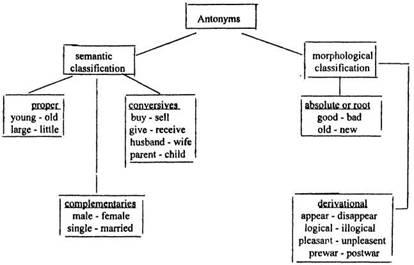
3. The concept of polarity of meaning. Antonyms. Morphological classification of antonyms: absolute or root antonyms and derivational antonyms. Semantic classification of antonyms: antonyms proper, complementaries, conversives.
4. The theory of the semantic mon semantic denominator.
5. Thematic or ideographic mon contextual associations,
6. Hyponymy, paradigmatic relation of inclusion. Hyponyms, hyperonyms, equonyms.
Working Definitions of Principal Concepts
Being an adaptive system the vocabulary is constantly adjusting itself to the changing requirements and conditions of human communication and cultural and other needs. This process of self-regulation of the lexical system is a result of overcoming contradictions between the state of the system and the demands it has to meet. The speaker chooses from the existing stock of words such words that in his opinion can adequately express his thought and feeling. Failing to find the expression he needs, he coins a new one. It is important to stress that the development is not confined to coining new words on the existing patterns but in adapting the very structure of the system to its changing functions.
The concept of adaptive system permits us to study language as a constantly developing but systematic whole, The adaptive system approach gives a more adequate account of the systematic phenomena of a vocabulary by explaining more facts about the functioning of words and providing more relevant generalisations, because we can take into account the influence of extra-linguistic reality. The study of the vocabulary as an adaptive system reveals the pragmatic essence of the communication process, i. e. the way language is used to influence the addressee.
The adaptive system approach to vocabulary is still in its infancy, but it is already possible to give an interim estimate of its significance. The process may be observed by its results, that is by studying new words or neologisms. New notions constantly come into being, requiring new words to name them. New words and expressions or neologisms are created for new things irrespective of their scale of importance. They may be all important and concern some social relationships such as a new form of state (People's Republic), or the thing may be quite insignificant and shortlived, like fashions in dancing, clothing, hairdo or footwear (rollneck). In every case either the old words are appropriately changed in meaning or new words are borrowed, or more often coined out of the existing language material either according to the patterns and ways already productive in the language at a given stage of its development or creating new ones.
Thus, a neologism is a newly coined word or phrase or a new meaning for an existing word, or a word borrowed from another language.
37
The intense development of science and industry has called forth the invention and introduction of an immense number of new words and changed the meaning of old ones, e. g. aerobics, black hole, computer, hardware, software, isotope, feedback, penicillin, pulsar, super-market and so on.
For a reliable mass of evidence on the new English vocabulary the reader is referred to lexicographic sources. New additions to the English vocabulary are collected in addenda to explanatory dictionaries and in special dictionaries of new words.
One should consult the supplementary volume of the English-Russian Dictionary edited by I. R.Galperin, the three supplementary volumes of The Oxford English Dictionary, The Longman Dictionary of New Words and the dictionaries of New English which are usually referred to as Barnhart Dictionaries. The first volume covers words and word equivalents that have come into the vocabulary of the English-speaking world during the period and the second-those of the 70s.
There is a considerable difference of opinion as to the type of system involved, although the majority of linguists nowadays agree that the vocabulary should be studied as a system. Our present state of knowledge is however, insufficient to present the whole of the vocabulary as one articulated system, so we deal with it as if it were a set of interrelated systems.
By a lexico-grammatical group we understand a class of words which have a common lexico-grammatical meaning, common paradigm, the same substituting elements and possible characteristic set of suffixes rendering the lexico-grammatical meaning. These groups are subsets of the parts of speech, several lexico-grammatical groups constitute one part of speech. Thus English nouns are subdivided approximately into the following lexico-grammatical groups: personal names, animal names, collective names ( for people), collective names (for animals), abstract nouns, material nouns, object nouns, proper names for people, toponymic names.
Another traditional lexicological grouping is known as word-families in which the words are grouped according to the root-morpheme, for example: dog, doggish, doglike, dogg), to dog, dogged, doggedly, doggedness, dog-days, dog-biscuit, dogcart, etc.
Antonyms аrе words belonging to the same pan of speech different in sound, and characterised by semantic polarity of their denotational meaning. According to the character of semantic opposition antonyms are subdivided into antonyms proper, complet and conversitives. The semantic polarity in antonyms proper is relative, the opposition is gradual, it may embrace several elements characterised by different degrees of the same property. They always imply comparison. Large and little or small denote polar degrees of the same notion, i. e. size.
Complementaries are words characterised only by a binary opposition which may have only two members; the denial of one member of the opposition implies the assertion of the other e. g. not male means female.
Conversives are words which denote one and the same referent as viewed from different points of view, that of the subject and that of the object, e. g. buy-sell, give-receive.
Morphologically antonyms are subdivided into root (absolute) antonyms (good - bad) and derivational antonyms (apper - disapper).
38
Semantic field is a closely knit sector of vocabulary characterised by a common concept (e. g. in the semantic field of space we find nouns (expanse, extent, surface); verbs (extend, spread, span); adjectives (spacious, roomy, vast, broad)). The members of the semantic fields are not synonymous but all of them are joined together by some common semantic component. This semantic component common to all the members of the field is sometimes described as the common denominator of meaning, like the concept of kinship, concept of colour, parts of the human body and so on. The basis of grouping in this case is not only linguistic but also extra-linguistic: the words are associated, because the things they name occur together and are closely connected in reality.
Thematic (or ideographic) groups are groups of words joined together by common contextual associations within the framework of the sentence and reflect the interlinking of things and events in objective reality. Contextual association are formed as a result of regular co-occurrence of words in similar repeatedly used contexts.
Thematic or ideographic groups are independent of classification into parts of speech. Words and expression are here classed not according to their lexico-grammatical meaning but strictly according to their signification, i. e. to the system of logical notions (e. g. tree - - grow - green; journey - train, taxi, bass - ticket; sunshine - brightly - blue - sky).
Hyponomy is the semantic relationship of inclusion existing between elements of. various levels. Thus, e. g. vehicle includes car, bus, taxi; oak implies tree, horse implies animal; table implies furniture. The hyponymic relationship is the relationship between the meaning of the general and the individual terms.
A hyperonym is a generic term which serves as the name of the general as distinguished from the names of the species-hyponyms. In other words the more
specific term is called the hyponym. For instance, animal is a generic term as compared to the specific names wolf, dog or mouse (these are called equonyms) Dog, in its turn, may serve as a generic term for different breeds such as bull-dog, collie, poodle, etc.
Tasks and exercises
Exercise 1.
Read the following passage. What is understood by semantic fields?
Part of the power and flexibility of a language lies in the ability of the speakers to multiply their vocabulary in any given field in the interests of greater precision and clarity. It follows that the more words that are closely associated in meaning the more specific each one's meaning may be in the particular field (irrespective of its uses in other fields). As an organisation becomes more complex and its members more numerous, new ranks and grades appropriately named may be devised, restricting the holders to an exact. Occupations whose operations involve much colour discrimination (paint manufacture, textile manufacture, etc.) develop an extensive technical vocabulary, partly from existing colour words, partly by adding new and specialised meanings to words having reference to coloured things (e. g. magnolia, cream), partly by adapting other words and phrases to give them a definite place in the technical field of colour terms (summer blue, mistletoe green, etc.). Such technical vocabulary may sometimes employ numbers of words unknown to non-technical speakers of the language and devise meanings for other quite different from those they bear outside these specialised contexts.
The supreme example of this infinite flexibility is in the use of numerical terms with reference to measurable features of the world, Between any two adjacent number terms another may be added for greater precision; between eleven and twelve may be put eleven and a half, and between eleven and eleven and a half may be put eleven and a quarter, and so on indefinitely.
(R. H. Robins. General Linguistics. An Introductory survey.- p. 48-49.)
Exercise 2.
Comment on the way of formation of the following neologisms: accessorise, aeroneurosis, astrogation, built-in, de-orbit, gadgeteer, laseronic, robotics, sanforise, urbanologism, vitaminise.
Exercise 3.
Arrange the following units into three semantic fields - feelings, parts of the body, education.
Academy, affection, arm, back, belly, body, bood, brow, calf, calmness, cheek, chest, classes, classmate, coaching, college, contempt, contentment, correspondence, course, curriculum, day-student, delight, don, drill, ear, education, elbow, encyclopedia, enthusiasm, envy, erudition, excitement, exercise, exhilaration, eye, face, faculty, finger, foot, forehead, frustration, grammar, hair, hand, happiness, head, headmaster, heel, homework, ignorance, impatience, indifference, indignation, instruction, jealousy, joint, kindness, knee, knowledge, knuckle, learning, lecturer, leg, limb, love, malice, master, neck, nose, passion, pedagogy, primer, rapture, relief, restlessness,
satisfaction, scholar, science, temple, tenderness, textbook, tight, thrill, thumb, toe, torso, tutor, undergraduate, university, unrest, waist, wrath.
Exercise 4.
Classify the following pairs of antonyms given below:
slow - fast, post-war - pre-war, happiness - unhappiness, above - below, asleep awake, appear - disappear, late - early, ugly - beautiful, distraction - attraction, spend - save,
Exercise 5.
Put the following words into thematic groups according to their contextual associations:
air, challenger, transaction, championship, classification, profit, dig, flower, globalisation, garden, green, marketing, grow, juice, competitive, jump, language, match, preconditions, meaning, outrun, restructuring, overrun, participate, diversifier, principles, race sports, bargaining, system, water, weed, ward, relaunch.
Recommended Literature:
1. Харитончик английского языка. Минск, 1992.- с,
2. Arnold I. V. The English Word.- M., 1986.- p. 196-197, 216-229.
3. Ginsburg R. S. and others. A Course in Modern English Lexicology.- M., 1979.- p.46, 57-63.
4. Palmer F. R. Semantics. A New Outline.- M, 1982.- p.67-69.
5. Rayevska N. N. English Lexicology.- K., 1979.-p.200-203.
41
SEMINAR No. 7
Free Word-Groups Topics for discussion
1. The problem of definition of free word-groups. Various approaches to the definition of the term "word-group". Difference between a word-group and a set phrase.
2. Structure of free word-groups: syntactic connection as the criterion of classification (subordinative, coordinative, predicative), classification of subordinative free word-groups according to their head-words (nominal, adjectival, verbal etc.).
3 Meaning of free word-groups: lexical meaning, structural meaning, Interrelation of structural and lexical meanings in word-groups. Motivation in word-groups.
4 Lexical and grammatical valency.
Working Definitions of Principal Concepts
Every utterance is a patterned, rhythmed and segmented sequence of signals. On the lexical level these signals building up the utterance are not exclusively words. Alongside with separate words speakers use larger blocks consisting of more than one word.
Words combined to express ideas and thoughts make up word-groups.
The degree of structural and semantic cohesion of words within word-groups may vary. Some word-groups are functionally and semantically inseparable, e. g. rough diamond, cooked goose, to stew in one's own juice. Such word-groups are traditionally described as set-phrases or phraseological units. Characteristic features of phraseological units are non-motivation for idiomaticity and stability of context. The cannot be freely made up in speech but are reproduced as ready-made units.
The component members in other word-groups possess greater semantic and structural independence, e. g. to cause misunderstanding, to shine brightly, linguistic phenomenon, red rose Word-groups of this type are defined as free word-groups for free phrases. They are freely made up in speech by the speakers according to the needs of communication.
Set expressions are contrasted to free phrases and semi-fixed combinations. All these are but different stages of restrictions imposed upon co-occurance of words, upon the lexical filling of structural patterns which are specific for every language. The restriction may be independent of the ties existing in extra-linguistic reality between the object spoken of and be conditioned by purely linguistic factors, or have extralinguistic causes in the history of the people. In free word-combination the linguistic factors are chiefly connected with grammatical properties of words.
Free word-groups of syntactically connected notional words within a sentence, which by itself is not a sentence. This definition is recognised more or less universally in this country and abroad. Though other linguistics define the term word-group differently - as any group of words connected semantically and grammatically which does not make up a sentence by itself.

|
Из за большого объема этот материал размещен на нескольких страницах:
1 2 3 4 5 |
