

Партнерка на США и Канаду по недвижимости, выплаты в крипто
- 30% recurring commission
- Выплаты в USDT
- Вывод каждую неделю
- Комиссия до 5 лет за каждого referral
Astronomical Photometry (1982, New York: Van Nostrand Reinhold),
pp. 301-302. [ICQ 9, 99]
CD Open star cluster NGC 225 (R. A. = 0h43m.8, Decl. = +61 47', equinox
2000.0) photometry; star chart with magnitudes given (9.2 < V < 16.0)
as published in Visual Astronomy of the Deep Sky (see ref. 'CL',
below), p. 250.
CE Open star cluster NGC 1647 photometry (8.5 < V < 16.4), in Visual
Astronomy of the Deep Sky, p. 252 (see ref. 'CL', below).
CF Open star cluster NGC 2129 photometry (11.2 < V < 16.1), in Visual
Astronomy of the Deep Sky, p. 254 (see ref. 'CL', below).
CG Open star cluster NGC 2422 (M47) photometry (7.7 < V < 14.3), in
Visual Astronomy of the Deep Sky, p. 256 (see ref. 'CL', below).
CH Open star cluster NGC 6494 (M23) photometry (9.3 < V < 13.9), in
Visual Astronomy of the Deep Sky, p. 258 (see ref. 'CL', below).
CI Open star cluster NGC 6823 photometry (9.4 < V < 16.0), in Visual
Astronomy of the Deep Sky, p. 260 (see ref. 'CL', below).
CJ Open star cluster NGC 6910 photometry (9.9 < V < 14.9), in Visual
Astronomy of the Deep Sky, p. 262 (see ref. 'CL', below).
CK Open star cluster NGC 7031 photometry (11.2 < V < 16.5), in Visual
Astronomy of the Deep Sky, p. 264 (see ref. 'CL', below).
CL Photometry by Hoag et al. (1961) from one of the open-star-cluster
charts as published in Visual Astronomy of the Deep Sky, by Roger
N. Clark (Cambridge Univ. Press, 1990), pp. 250-266.
CM Photovisual and photoelectric-V magnitudes from Cape Mimeograms
(Royal Observatory, Cape of Good Hope). [ICQ 9, 142]
CN Open star cluster NGC 7235 photometry (8.7 < V < 16.4), in Visual
Astronomy of the Deep Sky, p. 266 (see ref. 'CL', above).
CO UBV photometry for 39 stars in the range 11.7 < V < 18.7, from
"A New Stellar Standard Sequence in the Comet Cluster of Galax-
ies" (F. Boerngen and N. Richter 1978, Astron. Nach. 299, 117)
CR V magnitudes of 13 stars surrounding NGC 3627 (M66), as given by
Ciatti and Rosino (1977, A. Ap. 56, 62). The range in V is
13.8-16.9, and the stars are fairly red. [ICQ 11, 30]
CS Catalogue of Stellar Identifications (1979, Strasbourg). Large
compilation of many catalogues. For information, see F.
Ochsenbein et al. (1981), A. Ap. Suppl. 43, 259, and Ochsenbein
(1974), A. Ap. Suppl. 15, 215. The visual magnitudes with colons
(:) should be avoided if possible. [ICQ 10, 35]
D Dutch Comet Halley Handbook (E. P. Bus) [ICQ 7, 96]
E One of Everhart's 3 Selected Area charts (1984, Sky Telesc. 67, 28)
EA Selected Area 51: From Everhart (1984, Sky Telesc. 67, pp. 28-30).
EB Selected Area 57: From Everhart (1984, see EA, above) [ICQ 7, 51]
EC Selected Area 68: From Everhart (1984, see EA, above) [ICQ 7, 51]
40 АстроКА – Кометы и методы их наблюдений
FA V photometry by Harold Ables, U. S. Naval Observatory, Flagstaff,
"Region No. 6", unpublished (stellar V magnitude range 11.1-15.8
photoelectric and 13.7-21.6 electronographic). [ICQ 9, 99]
GA Guide Star Photometric Catalog - I, in Astrophysical Journal
Supplement Series, Volume 68, Number 1 (1988 September).
Contains nearly 1500 stars with V magnitudes and convenient
finder charts throughout the sky. [ICQ 10, 124; 15, 60]
*** NOTE: this is VERY different from the GSC on CD, which has
reference code 'HS' and which is a POOR source of comparison-star
magnitudes! ***
GP [apparently same as 'HE'; see below]
HD Henry Draper Catalog (Harvard Coll. Obs. Annals) [ICQ 2, 39]
HE Harvard E Regions (declination -45 deg), Kron-Cousins V photometry
for nine fields; stars range generally between 7 < V < 16
(Graham 1982, P. A.S. P. 94, 244) [ICQ 10, 124]
HI Hipparcos Input Catalogue (C. Turon et al. 1992, European Space
Agency Special Publication SP-1136; derived V magnitudes
(118,000 stars brighter than mag 13, with the distribution
peak around V = 9); see also HJ
HJ magnitudes in the Hipparcos photometric system, Hp (see code
HI, above); peak of Hp is closer to true visual than to
Johnson V, though it has a long red wing
HK H_p magnitudes from the Hipparcos Catalogue (ESA SP-1200).
HP Harvard Photometry (Harvard College Obs. Annals) [ICQ 4, 8]
HR Harvard Revised Photometry (H. C.O. Annals) [ICQ 1, 42; 4, 8]
HV Johnson V magnitudes from Hipparcos Catalogue, ESA SP-1200.
JT Cousins VRI magnitudes of stars in M67 (M. Joner and B. Taylor
1990, PASP 102, 1004)
L Landolt V Photoelectric Sequences (AJ 78, 959) [ICQ 6, 37]
LA Landolt photoelectric sequences (1992, AJ 104, 340)
LB Landolt (1983, AJ 88, 439 and 853) sequences as published by
Christian Buil in ASTRONOMIE CCD (1989, Societe d'Astronomie
Populaire), p. 261
LC Landolt (1975, PASP 87, 379) magnitude sequence for 33 stars
near V1057 Cyg (V magnitude range 5.5-15.5)
MC Carlsberg Meridian Catalogue (1989). Volume 4. La Palma.
More than 50,000 stars with visual magnitudes down to V = 13;
do not use stars with magnitudes given to less than 0.01 mag.
ME V photometry by Tedesco, Tholen, and Zellner (1982, A. J. 87, 1585);
mag range 6-13 [ICQ 8, 77]
MK V magnitudes for M67 in LE GUIDE PRATIQUE DE L'ASTRONOMIE CCD
P. Martinez and A. Klotz 1994; Adagio press), p. 270
MP McCormick Photovisual Sequence (Univ. of Virginia) [ICQ 3, 15]
MS From "McCormick Photovisual Sequences", by C. A. Wirtanen and
A. N. Vyssotsky (1945, Ap. J. 101, 141-178). [ICQ 9, 142]
MT Visual magnitudes of stars in M67 as published by B. E. Schaefer
(1989, SKY TEL. 77, 332); after work by Racine and Gilliland.
MV From Publ. Leander McCormick Obs., Vol. VI, Part II, pp. 201-306
("Magnitudes and Coordinates of Comparison Stars in Regions of
Long-Period Variables, by S. A. Mitchell, 1935) or Vol. IX, Part
V, pp. 59-88 ("Sequences for Fifty Variable Stars", by Mitchell
and C. A. Wirtanen, 1939). [ICQ 9, 142]
NH North Polar Sequence as published by Henden and Kaitchuck (1982,
Astronomical Photometry, NY: Van Nostrand Reinhold), p. 305.
NN NGC 2129/6531/1342 cluster photometry, in Publ. U. S.N. O. Vol.
АстроКА – Кометы и методы их наблюдений 41
XVII, parts VII, VIII (1961), pp. 406, etc.. [ICQ 8, 130]
NO U. S.N. O. Photoelectric Photometry Catalogue [ICQ 2, 6; 4, 8]
NP North Polar Sequence ( the A. A.V. S.O.); 3 charts showing
stars w/ useful range mv = 5.0 and fainter [ICQ 1, 17; 3, 7]
NS "Magnitudes and Colors of Stars North of +80 ", by Seares, Ross,
and Joyner (1941, Carnegie Inst. Publication 532) [ICQ 4, 80]
PA M45 sequence, Johnson & Mitchell (1958, Ap. J. 128, 31) [ICQ 8, 77]
PB Pleiades chart in Sky and Telescope 70, [ICQ 8, 77]
PC Pleiades sequence, Henden and Kaitchuck (1982, Astronomical Photo-
metry; N. Y.: Van Nostrand Reinhold), pp. 298-300 [ICQ 8, 130]
PI IC 4665 sequence as found in Henden and Kaitchuck (1982,
Astronomical Photometry, New York: Van Nostrand Reinhold),
pp. 302-304. [ICQ 10, 35]
RB "Photoelectric Magnitudes and Colours of Southern Stars",
A. W. J. Cousins and R. H. Stoy (1963), in Royal Observatory
Bulletin No. 64 (Royal Greenwich Obs.), Series E3, pp. E101-E248.
[ICQ 9, 142]
RC "Standard Magnitudes in the E Regions", A. W. J. Cousins and R.
H. Stoy (1962), in Royal Observatory Bulletin No. 49 (Royal
Greenwich Obs.), Series E2, pp. E1-E59. [ICQ 9, 142]
SD V magnitudes of members of the globular cluster M15 in the range
13 < V < 22 [and also nearby field stars for 40 stars
of mag 7.64, 10.42-11.15, and 12.9 < V < 18.8],
by A. Sandage (1970, Ap. J. 162, 841)
SE V magnitudes of 134 stars of the II Persei Association (stars of
spectral types A and B, mag range 5.1-11.4;
C. K. Seyfert et al., Ap. J. 132, 58). [ICQ 11, 30]
SM V magnitudes from "A Visual Atlas of the Small Magellanic Cloud",
by Mati Morel (1989), Rankin Park, N. S.W., Australia
SP Skalnate-Pleso Atlas Catalog (Atlas Coeli Cat.) [ICQ 2, 6; 4, 10]
SS Various regions covering declination -60 deg to +10 deg, with
stars having general range 12 < V < 24; Stobie et al. (1985),
Astron. Astrophys. Suppl. Ser. 60, 503
SW Four half-degree fields with finder charts and UBV photometry,
range 10 < V < 15 (except field IV, which has a gap between
11.5 < V < 13.5), published by W. Saurer et al. (1992) in
Astron. Astrophys. Suppl. Ser. 93, 553. The four fields
average about 40 stars each, roughly centered at the following
R. A. and Decl. (B1950.0): I, 1h27m, +58.2 deg; II, 3h24m,
+45.2 deg; III, 7h15m, -10.1 deg; IV, 21h31m, +50.2 deg.
TG CCD magnitudes on the Thuan-Gunn system; comparison standard
stars in Thuan and Gunn (1976, PASP 88, 543).
TI Tycho Input Catalogue; more than three million stars brighter
than V = 12.1 prepared for the needs of the Tycho mission
(Hipparcos satellite; see D. Egret et al. 1992, Astron.
Astrophys. 258, 217); available upon request from the
Strasbourg Data Center (France; e-mail address
*****@***u-strasbg. fr)
TJ Tycho Catalogue Johnson V magnitudes from ESA SP-1200.
TK Tycho-2 Catalogue (Hog et al. 2000, A. Ap., in press);
NOTE: *only* Tycho-2 V_T magnitudes (labeled VT)
from the *main* catalogue should be used. The
supplements contain a mix of V-like magnitudes
from the original Tycho catalogue and should not
be taken from here.
42 АстроКА – Кометы и методы их наблюдений
TS Field of 13 stars (R. A. 22h02m, Decl. -19.1 deg, equinox 1950.0),
V magnitudes with finding chart, 9.7 < V < 19.2, by Tritton
et al. (1984), MNRAS 206, 843-847.
TT Tycho/Hipparcos Catalogue V_T magnitudes from ESA SP-1200.
VG Japanese variable-star charts edited by K. Gomi and based on
charts drawn by Y. Kawanishi, publ. in 1970 by Koseisha Co.
as a spiral-bound book; its preface states that the magnitudes
of comparison stars are taken from Harvard Annals (Vols. 37,
50, 54, and 57) and from Skalnate Pleso II (Atlas Coeli).
Akimasa Nakamura, who reported this reference to the ICQ,
says that his comparison of Gomi charts with AAVSO charts
show that the comparison-star magnitudes are very close to
each other.
Y Yale Bright Star Catalogue [ICQ 1, 42; 4, 8]
YF Yale Bright Star Catalogue, fourth edition (should now be used
instead of earlier editions)
YG Yale Bright Star Catalogue, fifth edition
Стандарты звезд сравнения и карты окрестностей для оценки блеска комет.
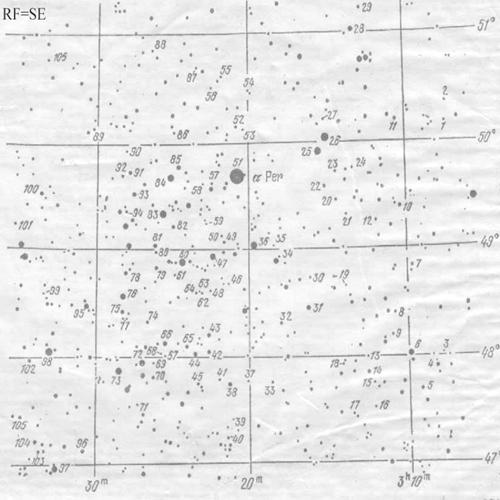
Область альфа Персея.
АстроКА – Кометы и методы их наблюдений 43
Я не стал указывать все 114 звезд, так как здесь довольно много градаций по звездной величине: 8.17, 8.36..., ... , 11.16, 11.20,...11.4 Английскими буквами обозначен спектральный класс звезды. Лучше всего при оценках блеска использовать звезды класса G, но пойдет и класс F, так как он близок к классу G, и при необходимости, все остальные звезды.
Номер звезды | Блеск | Спектр | Примечание |
1 | 11.16 | F | - |
2 | 11.20 | G | - |
3 | 10.52 | G | - |
4 | 8.60 | F | - |
5 | 9.02 | F | - |
6 | 6.05 | G | - |
7 | 7.95 | A | - |
8 | 9.19 | A | - |
9 | 10.02 | A | - |
10 | 7.95 | B | - |
11 | 9.02 | F | - |
12 | 10.19 | F | - |
13 | 10.81 | F | - |
14 | 8.12 | A | - |
15 | 10.03 | F | - |
16 | 10.5 | F | - |
17 | 10.6 | G | - |
18 | 10.61 | F | - |
19 | 11.11 | G | - |
20 | 7.75 | F | - |
21 | 10.01 | F | - |
22 | 7.94 | A | - |
23 | 9.97 | F | - |
24 | 10.41 | F | - |
25 | 5.02 | B | - |
26 | 5.14 | B | - |
27 | 10.37 | F | - |
28 | 7.19 | B | - |
29 | 9.31 | F | - |
30 | 9.30 | F | - |
31 | 7.65 | A | - |
32 | 9.22 | A | - |
33 | 8.38 | A | - |
34 | 9.63 | F | - |
35 | 9.19 | A | - |
36 | 5.24 | B | - |
37 | 9.89 | F | - |
38 | 7.64 | A | - |
44 АстроКА – Кометы и методы их наблюдений
Номер звезды | Блеск | Спектр | Примечание |
39 | 11.22 | F | - |
40 | 9.78 | F | - |
41 | 9.31 | A | - |
42 | 8.51 | A | - |
43 | 7.49 | A | - |
44 | 6.82 | B | - |
45 | 7.71 | A | - |
46 | - | G-K | - |
47 | 6.04 | B | - |
48 | 10.63 | G | - |
49 | 8.15 | A | - |
50 | 8.45 | A | - |
51 | 1.86 | F | альфа Персея! |
52 | 9.28 | F | - |
53 | 10.07 | F | - |
54 | 9.14 | G | - |
55 | 9.31 | A | - |
56 | - | G | - |
57 | 9.00 | A | - |
58 | 10.04 | G | - |
59 | 11.4 | G | - |
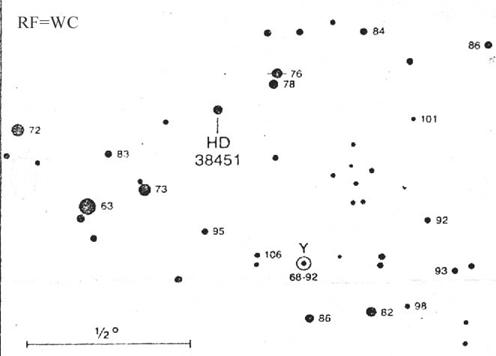
Окрестности звезды Y Тельца.
АстроКА – Кометы и методы их наблюдений 45
Номер звезды | Блеск |
1 | 2.7 |
2 | 3.4 |
3 | 3.7 |
4 | 3.9 |
5 | 4.2 |
6 | 4.3 |
7 | 5.1 |
8 | 5.4 |
9 | 5.8 |
10 | 6.2 |
11 | 6.4 |
12 | 6.7 |
13 | 7.0 |
14 | 7.3 |
15 | 7.6 |
16 | 7.8 |
17 | 7.8 |
18 | 8.2 |
19 | 8.3 |
20 | 8.4 |
21 | 8.6 |
22 | 8.8 |
23 | 9.0 |
24 | 9.1 |
25 | 9.3 |
26 | 9.5 |
27 | 10.0 |
28 | 10.1 |
29 | 10.2 |
30 | 10.4 |
31 | 10.6 |
32 | 11.0 |
33 | 11.1 |
34 | 11.4 |
35 | 11.5 |
36 | 11.5 |
37 | 11.7 |
38 | 11.8 |
39 | 12.3 |
40 | 12.3 |
41 | 12.6 |
42 | 12.7 |
43 | 13.1 |
44 | 13.5 |
45 | 13.8 |
46 | 13.8 |
47 | 14.8 |
46 АстроКА – Кометы и методы их наблюдений
Проведение наблюдений комет.
(Виталий Невский)
 |
Наблюдение за кометами весьма увлекательное занятие.. Дело в том, что кометы очень непостоянные объекты по своей природе. Вид их может изменяться от ночи к ночи и весьма значительно, особенно это касается ярких комет, видимых простым глазом. У таких комет, как правило, развиваются приличные хвосты, побуждавшие предков к различным предрассудкам. Подобные кометы в рекламе не нуждаются, это всегда событие в астрономическом мире, но довольно редкое, а вот слабые телескопические кометы, доступны для наблюдений практически всегда. Замечу так же, что результаты наблюдений комет имеют научную ценность, и наблюдения любителей постоянно публикуются в американском журнале Internatoinal Comet Quarterly, на сайте C. Morris и не только.
На что следует обращать внимание при наблюдении кометы? Одна из самых важных характеристик - звездная величина кометы, ее необходимо оценивать по одному из методов описанных ниже. Затем - диаметр комы кометы, степень конденсации, а при наличии хвоста - его длина и позиционный угол. Это те данные, которые представляют ценность для науки.
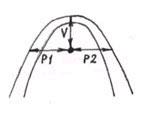
Более того, в комментариях к наблюдениям следует отметить, наблюдалось ли фотометрическое ядро (не путайте с истинным ядром, которое невозможно увидеть в телескоп) и как оно выглядело: звездообразное или в виде диска, яркое или слабое. Для ярких комет возможны такие явления как галосы, оболочки, отрыв хвостов и плазменных образований, наличие сразу нескольких хвостов. Кроме того, уже более чем у полусотни комет наблюдался распад ядра! Нужно быть осторожным, чтобы не спутать распад ядра с отрывом плазменного облака, что случается более часто. Распад ядра обычно сопровождается резким увеличением блеска кометы. Оболочки - возникают на периферии кометной атмосферы (см. рис.), затем начинают сжиматься, как бы схлопываясь на ядре. При наблюдении этого явления необходимо замерить в угловых минутах высоту вертекса (V) - расстояние от ядра до вершины оболочки и поперечник Р = Р1 + Р2 (Р1 и Р2 могут быть не равны). Эти оценки необходимо делать несколько раз в течение ночи. При наблюдении комет под рукой желательно иметь несколько инструментов и крупномасштабный атлас, но обычно достаточно хорошего бинокля и телескопа средних размеров с апертурой 150-250мм. Оценки параметров кометы следует проводить на наименьшем (!) инструменте, в который видна комета и с минимальным увеличением. А вот уже более детальное изучение на наибольшем и с большими увеличениями.
Оценка блеска кометы.
Точность оценки должна быть не ниже +/-0.2 звездной величины. Для того чтобы добиться подобной точности наблюдатель в процессе работы в течение 5 мин должен производить несколько оценок блеска желательно по различным звездам сравнения, находя среднее значение звездной величины кометы. Именно таким образом, полученное значение можно считать достаточно точным, но никак не то, которое получено в результате лишь одной оценки! В подобном случае, когда точность не превышает +/-0.3, после значения звездной величины кометы ставится двоеточие (:). Если наблюдателю не удалось найти комету, то он оценивает предельную звездную величину для своего инструмента в данную ночь, при которой он еще смог бы наблюдать комету. В этом случае перед оценкой ставится левая квадратная скобка ([).
О наиболее часто применяемых методах оценки блеска Бобровникова, Морриса и Сидгвика рассакзано выше.
АстроКА – Кометы и методы их наблюдений 47
При оценках блеска комет, в случае, когда комета и звезды сравнения находятся на разной высоте над горизонтом, обязательно должна вводиться поправка на атмосферное поглощение! Особенно это существенно, когда комета находится ниже 45 градусов над горизонтом. При использовании поправки нужно быть внимательным, чтобы не ошибиться, следует ли ее прибавлять или вычитать. Допустим, комета находится ниже звезд сравнения, в этом случае поправка вычитается из блеска кометы; если комета выше звезд сравнения, то поправка прибавляется. Для оценок блеска комет используются специальные звездные стандарты.
Если у вас нету рекомендуемых каталогов, их можно загрузить из инета. Прекрасным инструментом для этого является программа Cartes du Ciel.

|
Из за большого объема этот материал размещен на нескольких страницах:
1 2 3 4 5 6 7 |
