


Партнерка на США и Канаду по недвижимости, выплаты в крипто
- 30% recurring commission
- Выплаты в USDT
- Вывод каждую неделю
- Комиссия до 5 лет за каждого referral
Предисловие
Настоящее пособие является составной частью учебно-методического комплекса по английскому языку для кадетов школы-интерната.
Его цель – сформировать у кадетов основные умения и навыки чтения и устной речи, аннотирования и реферирования прочитанных текстов.
Пособие содержит тексты и упражнения, предназначенные как для развития навыков различных видов чтения (ознакомительного, изучающего, просмотрового, поискового), так и для развития навыков устной речи. В конце пособия имеется краткий грамматический справочник, в котором даются таблицы и пояснения по некоторым грамматическим темам.
Данное пособие предназначено для практических занятий с кадетами I – V курса.
Section I
Report
I. Active Vocabulary
1. to be ready for – быть готовым к …
2. to be present at – присутствовать на …
3. to be absent from – отсутствовать на …
4. to be on duty – быть в наряде
5. to be ill – болеть
6. to be on leave – быть в отпуске
7. to be on mission – быть в командировке
8. to report – докладывать
9. at ease – вольно
10. dismissed – разойтись
II. Text
Report
Comrade teacher!
Group 11 is ready for the English lesson.
10 cadets are present and correct.
5 cadets are absent.
Cadets Petrov, Orlov and Ivanov are on duty.
Cadets Sokolov and Levin are ill.
Cadet Betin is reporting.
----
At ease! Sit down!
At ease! Dismissed.
III. Exercises
I. Translate the sentences:
1) All cadets are present and correct.
2) Two cadets are ill.
3) Four cadets are on mission. They take part in sport competitions.
4) Who is absent?
5) We are not at the lecture.
6) I am a cadet.
7) My friend is a cadet too.
8) Our school is in Tambov.
9) Yesterday we were in the theatre.
10) Tomorrow the cadets will go to the museum.
II. Answer the questions:
1) Are you a cadet?
2) Is your group in the classroom?
3) Is your brother a cadet?
4) Are the cadets at the English lesson?
5) Is this cadet on duty?
6) Is it interesting to study at this school?
7) Are you ready for the lesson?
8) Are all the cadets present at the lesson?
9) Were you at the lecture yesterday?
10) Was this cadet absent from the lesson?
III. Complete the sentences:
1) My name … Oleg.
2) I … a first-year cadet.
3) Last year we … not cadets yet.
4) These boys … cadets.
5) My brother … a student.
6) … your sister a schoolgirl?
7) We … at the lesson now.
8) Cadet N … absent from the lesson.
9) They … on mission.
10) … you at the lecture yesterday?
IV. Translate into English
1) Я – кадет.
2) Они на уроке.
3) Эти кадеты отсутствуют на уроке.
4) Мы были в кино вчера.
5) Мой брат не был на лекции.
6) Эти книги интересные.
7) Все кадеты присутствуют.
8) 4 кадета в наряде.
9) Моя сестра – студентка.
10) 10 кадетов присутствует на занятии.
My Visit Card
I. Active Vocabulary
1) housewife – домохозяйка
2) secondary school – средняя школа
3) to enter – поступать
4) cadets’ boarding school – кадетская школа-интернат
5) to take part in – принимать участие в …
6) social – общественный
7) to attend – посещать
8) subject circle – факультатив
9) to become – стать
10) to be found of – увлекаться
11) to go in for – заниматься чем-либо
12) to hope – надеяться
13) dream – мечта
14) to come true – сбываться
15) card – карточка
My Visit Card
Text
My name is Alex. My surname is Romanov. I live in Tambov. I was born on December 4, 1987 in the town of Monino. My address is Russia, Tambov, Sovetskaya Street 191, flat 90. My telephone number is .
My family is not large. We are four: my father, mother, sister and me. My father is an engineer. My mother is a housewife. My sister is a schoolgirl.
I began to study at school in 1994. It was a secondary school. But in 2000 I entered the cadets’ boarding school in Tambov. Now I am a fifth-year cadet of this school. I like to study at school. We learn many interesting subjects. They are: Physics, Literature, Mathematics and some military subjects. My favourite subject is Mathematics. I take an active part in social life, attend sport sections and subject circles.
I am found of computer technology, modern foreign music and historical novels. I go in for boxing and running.
I finish school this year. I want to become a military man. That’s why I want to enter the Military Academy in Moscow. I hope my dream will come true.
III. Exercises
I. Give the equivalents:
1. to enter 1.принимать участие
2. to become 2.общественный
3. to be fond of 3. надеяться
4. to hope 4. поступать
5. to attend 5. мечта
6. to take part in 6. увлекаться чем-либо
7. subject circle 7. посещать
8. favourite 8. любимый
9. dream 9. считать
10. social 10. факультатив
II. Answer the questions:
1. What is your full name?
2. Are you a student?
3. Where do you study?
4. How old are you?
5. Where do you live?
6. Where does your family live?
7. Is your family large?
8. Does your sister (brother) study or work?
9. Whom do you want to become?
10. Where do you want to enter?
III. Translate into English
1. Меня зовут …
2. Я живу …
3. Мой адрес …
4. Я кадет … курса.
5. Я учусь в кадетской школе-интернате.
6. Моя семья состоит из … человек.
7. Я принимаю активное участие в …
8. Я увлекаюсь (мое хобби) …
9. Я хочу стать …
10. Мне нравится учиться в кадетской школе-интернате.
Our Cadets’ Boarding School
I. Active Vocabulary
1. to found - основывать
2. to be named after - быть названным в честь кого-либо
3. field training - полевые учения
4. language laboratory - лингафонный кабинет
5. to be fitted with - быть оборудованным
чем-либо
6. drill training - строевая подготовка
7. windowsill - подоконник
8. table - зд. таблица
9. chart - диаграмма
10. famous - знаменитый
11. military leader - военачальник
12. to take military training - проходить военную начальную подготовку
13. to devote - посвящать
14. banner - знамя
15. temple - храм
Our Cadets' Boarding School
II. Text
Our cadets' boarding school was founded in 1996 in Tambov. It is named after a famous military pilot-cosmonaut L. C. Demin.
There are many special classrooms for literature, physics, mathematics, history, chemistry, biology and other subjects in our school. We have got two english classrooms. One of them is a language laboratory which is fitted with modern equipment. There are also two computing classrooms in our school. All classrooms are big and light, each of them has got two or three windows with flower pots on the windowsills, a bookcase and the blackboard on the wall. There are maps and portraits, tables and charts on the walls of the classrooms. There are many portraits of famous Russian military leaders on the walls of the corridor. You can also see nice pictures devoted to Russian churches and temples there. In the hall there is the banner of our cadets' boarding school. Our school has got a library. It is not very large but the cadets can get books, textbooks, magazines and newspapers there.
The cadets study five years at our school. They study many interesting subjects, attend sport sections and subject circles and take an active part in social life. They also have military training which includes lessons, lectures, drill training and field training. Many cadets want to become military men and they prepare to enter different military schools, academies, institutes and universities.
III. Exercises
I. Translate into English
1) Our school is named after a famous military pilot-cosmonaut L. Demin.
2) There is a language laboratory in our school.
3) It is fitted with modern equipment.
4) The cadets attend sport sections and subject circles.
5) We have military training.
6) Military training includes drill training, lessons, lectures and field training.
7) Many cadets want to become military men.
8) They prepare to enter military institutes.
9) There is the banner of our cadets' boarding school in the hall.
10) Many cadets enter different military schools.
II. Give the equivalents
1. equipment 2. drill training 3. military leader 4. to become 5. to be fitted with 6. banner 7. military training 8. field training 9. language laboratory 10. to found | 1. военная начальная подготовка 2. знамя 3. основывать 4. быть оборудованным 5. военачальник 6. лингафонный кабинет 7. стать 8. строевая подготовка 9. оборудование 10. полевые учения |
III. Complete the sentences
1) Our cadets' boarding school was founded …
2) It is named after …
3) There are computing … and …
4) They are fitted with …
5) You can see …
6) Military training includes …
7) The cadets prepare …
8) They attend …
9) In the library the cadets …
10) Many cadets want …
IV. Translate into English
1) Наша кадетская школа-интернат была основана в 1996 году.
2) В нашей школе есть много кабинетов.
3) Компьютерные классы и лингафонный кабинет оснащены современным оборудованием.
4) Все кабинеты – большие и светлые.
5) На стенах коридора вы можете увидеть портреты знаменитых военачальников.
6) В кадетской школе-интернате кадеты учатся 5 лет.
7) Они проходят военную начальную подготовку.
8) Она включает уроки, лекции, строевую подготовку и полевые учения.
9) Многие кадеты хотят стать военными.
10) После окончания школы они поступают в различные военные институты.
Our Daily Routine
I. Active Vocabulary
1. strict – строгий
2. daily routine – распорядок дня
3. to form up (for) – строиться
4. morning inspection – утренний осмотр
5. mess – столовая
6. to return – возвращаться
7. to be over – заканчиваться
8. quarter – четверть
9. barracks – казарма, казармы
10.independent work – самоподготовка
11.during – во время
12.to prepare – готовиться
13.to listen to – слушать
14.roll-call – перекличка
15.lights-out signal – сигнал отбоя
Our Daily Routine
II. Text
We study at a cadets’ boarding school. The cadets of our boarding school have strict daily routine.
At half past 8 in the morning the cadets form up for morning inspection. Then they go to school. Lessons begin at 10 minutes to 9. Every day the cadets have three lessons. We study many different subjects: mathematics, physics, foreign languages (English and German), literature, history of our Motherland and other subjects. At a quarter past 12 we form up and go to the mess for dinner.
After dinner the cadets return to the classrooms. Lessons are over at a quarter past 2. In the afternoon the cadets who live in the barracks have 2 hours of independent work. During these hours they prepare for the next day lessons.
At 7 o’clock in the evening the cadets form up and go to the mess for supper. After supper they have free time. They listen to music, read books, watch TV programmes. Then they form up for a roll-call. At 10 o’clock in the evening they go to bed after the “lights-out” signal.
III. Exercises
I. Give the equivalents
1. daily routine | 1. утренняя проверка |
2. to go to bed | 2. готовиться |
3. to listen to | 3. самоподготовка |
4. morning inspection | 4. столовая |
5. roll-call | 5. возвращаться |
6. lights-out signal | 6. распорядок дня |
7. mess | 7. сигнал отбоя |
8. to return | 8. слушать |
9. independent work | 9. столовая |
10. prepare | 10. идти спать |
II. Choose the correct word in the brackets and translate the sentence:
1. At half past 8 in the morning the cadets form up for (a roll-call, morning inspection)
2. At a quarter past 12 we form up and go to the (barracks, mess) for dinner.
3. In the afternoon the cadets have (free time; independent work).
4. At 7 o’clock in the evening the cadets go to the mess for (breakfast, supper).
5. The cadets go to bed (before, after) the lights-out signal.
6. The cadets (have, has) strict daily routine.
7. Lessons begin at 10 minutes (to, past) 9.
8. The cadets study many (different, difficult) subjects.
9. In the evening they can (watch, listen to) music.
10. The cadets (go to; form up) for a roll-call.
III.Translate into Russian.
1. Мы учимся в кадетском корпусе.
2. Распорядок дня в кадетском корпусе – строгий.
3. В 830 утра кадеты строятся на утреннюю перекличку.
4. Уроки начинаются в 850.
5. Кадеты изучают много различных предметов.
6. Это – литература, математика, история, иностранные языки.
7. В 1215 кадеты строятся и идут в столовую на обед.
8. После обеда они возвращаются в классы.
9. Вечером кадеты строятся на вечернюю перекличку.
10. Они идут спать после сигнала отбоя.
Us armed forces organization
I. Active Vocabulary
1. Army (Land Forces) – сухопутные войска
2. Navy – ВМС
3. Air Force (AF) – ВВС
4. Marine Corps – корпус морской пехоты
5. Coast Guard – береговая охрана
6. to be responsible for – нести ответственность за что-либо
7. combat – бой, боевой
8. Commander-in-Chief – главнокомандующий
9. Department of Defense – Министерство обороны
10. civilian – гражданский
11. Secretary of Defense – министр обороны
12. Department – министерство
13. Chief of Staff – начальник штаба
14. Joint Chiefs of Staff – комитет начальников штабов
15. employment – применение
16. training – обучение
17. to assist – помогать
18. Joint Staff – объединенный штаб
19. intelligence – разведка
20. logistics planning – материально-техническое планирование
Us Armed Forces Organization
II. Text
The Armed Forces of the USA consist of the Army, Navy, Air Force, Marine Corps and Coast Guard.
The Army is responsible for preparing forces for combat operations on land. The Navy and Marine Corps are responsible for preparing forces for combat operations at sea. The Air Force is responsible for preparing forces for combat operations in the air.
The President of the USA is the Commander-in Chief.
The Armed Forces of the USA are controlled by the Department of Defense. It is headed by the civilian Secretary of Defense and consists of the Department of the Army, Department of the Navy and Department of the Air Force.
The military heads of the Departments are their Chiefs of Staff. They form the Joint Chiefs of Staff. It is responsible for strategic planning, the joint employment and training of the Armed Forces. The Joint Chiefs of Staff is assisted by the Joint Staff. It is responsible for strategic, intelligence and logistics planning. All these departments are housed in Pentagon.
III. Exercises
I. Give the equivalents.
1. Armed Forces | 1. бой, боевой |
2. Navy | 2. начальник штаба |
3. to be responsible for | 3. ВВС |
4. Army | 4. размещаться |
5. employment | 5. сухопутные войска |
6. assist | 6. разведка |
7. combat | 7. министерство обороны |
8. civilian | 8. ВМС |
9. Department of Defense | 9. вооруженные силы |
10. Air Force | 10. гражданский |
11. Chief of Staff | 11. материально-техническое планирование |
12. Joint Chiefs of Staff | 12. помогать |
13. intelligence | 13. применение |
14. logistics planning | 14. комитет начальников штабов |
15. to be housed | 15. отвечать за что-либо |
II. Choose the English equivalents of the Russian words given in brackets.
1. The Armed Forces of the USA consist of (сухопутные войска, ВМС, ВВС).
2. The Army (несут ответственность) for combat operations on land.
3. The Navy is responsible for (боевые операции) at sea.
4. The Air Force is responsible for combat operations (в воздухе).
5. The President is the (главнокомандующий).
6. The Armed Forces of the USA are controlled by (министерство обороны).
7. The Department of Defense is headed by the civilian (министр обороны).
8. The Chiefs of Staff form the (комитет начальников штабов).
9. The Joint Chiefs of Staff is responsible for strategic planning, joint (применение) and training of the (вооруженные силы).
10. The Joint Staff is responsible for strategic (разведывательное и материально-техническое планирование).
III. Complete the sentences.
1. The Armed Forces of the USA consist of … .
2. The Army is responsible for … .
3. The Navy is responsible for … .
4. The Air Force is responsible for … .
5. The President is … .
6. The Armed Forces are controlled by … .
7. The Department of Defense is headed by … .
8. The military heads of the Departments are … .
9. The Joint Chiefs of Staff is responsible for … .
10. The Joint Staff is responsible for … .
Aircraft Classification and Armament
I. Active Vocabulary
1. bomber – бомбардировщик
2. fighter – истребитель
3. attack-aircraft – штурмовик
4. reconnaissance – разведка
5. cargo aircraft – грузовой самолет
6. interceptor – перехватчик
7. escort fighter – истребитель сопровождения
8. helicopter – вертолет
9. tanker – заправщик
10. to be designed for (to) – предназначаться для чего-либо
11. to be used for (to) – использоваться для чего-либо
12. to be armed with – быть вооруженным чем-либо
13. to be equipped with – быть оборудованным чем-либо
14. to be characterized by – характеризоваться
15. to be classified as – классифицироваться на …
16. enemy – враг
17. target – цель
18. nuclear armament – ядерное оружие
19. mission – задача
20. close air support – непосредственная поддержка в воздухе
21. to carry out – выполнять
22. range – дальность
23. destructive power – разрушительная сила
24. cruising speed – крейсерская скорость
25. high rate of climb – большая скороподъемность
26. degree of maneuverability – степень маневренности
27. to destroy – уничтожать
28. to protect – защищать
29. take-off distance – разбег
30. landing distance – пробег
31. to carry – перевозить
32. in-flight refueling – заправка в воздухе
33. gun – пушка
34. missile – управляемая ракета
35. rocket – неуправляемая ракета
Aircraft Classification
and Armament
II. Text
Military aircraft are bombers, fighters, fighter-bombers, attack aircraft, tankers, cargo aircraft, helicopters, transport aircraft.
Bombers are designed for bombing enemy targets. They are used to carry out strategic reconnaissance. Bombers are armed with bombs, missiles, guns. They can use nuclear armament. Bombers are characterized by great range, high cruising speed, great destructive power.
Fighter-bombers and attack aircraft are designed to destroy enemy land and sea targets. They are used for close air support missions and operate over battles areas near their ground forces. Fighter-bombers are armed with guns, machine-guns, rockets. They are characterized by high rate of climb and high degree of maneuverability.
Fighters are designed to attack and destroy enemy aerial targets. They are classified as escort-fighters and interceptors. Escort fighters are designed to protect friendly bombers. Interceptors are designed to intercept, attack and destroy enemy aircraft. Fighters also are used to carry out tactical reconnaissance. They are characterized by great maximum speed, small take-off and landing distances.
Cargo aircraft are designed for carrying cargo. Helicopters are designed for combat support of ground forces and logistics missions.
Tankers are designed for in-flight refueling other aircraft. All military aircraft can carry out combat missions under any weather conditions.
III. Exercises
I. Give the equivalents.
1. attack aircraft | 1. непосредственная поддержка в воздухе |
2. cargo | 2. выполнять |
3. escort fighter | 3. заправка в воздухе |
4. interceptor | 4. груз |
5. to carry out | 5. уничтожать |
6. to protect | 6. враг |
7. range | 7. защищать |
8. close air support | 8. пулемет |
9. to destroy | 9. истребитель сопровождения |
10. rate of climb | 10. разбег |
11. in-flight refueling | 11. скороподъемность |
12. enemy | 12. цель |
13. target | 13. штурмовик |
14. machine-gun | 14. перехватчик |
15. take-off distance | 15. дальность |
II. Say whether the statement is right or wrong.
1. Bombers are used to carry out tactical reconnaissance.
2. Fighter-bombers are designed to attack and destroy land and sea targets.
3. Fighters are designed for close air support missions.
4. Fighters are characterized by long take-off distance.
5. Tankers are used to protect friendly bombers.
6. Bombers can be armed with nuclear armament.
7. Fighters are classified as escort fighters and interceptors.
8. Fighters are designed to bomb enemy targets.
9. Bombers are characterized by great destructive power.
10. Military aircraft can not carry out combat missions under any weather conditions.
III. Translate into English.
1. Бомбардировщики предназначены для бомбежки вражеских целей.
2. Они вооружены бомбами, ракетами и пушками.
3. Бомбардировщики используются для выполнения стратегической разведки.
4. Они характеризуются большой дальностью, скоростью и разрушительной силой.
5. Истребители предназначены для уничтожения вражеских воздушных целей.
6. Истребители классифицируются на перехватчики и истребители сопровождения.
7. Штурмовики используются для непосредственной поддержки с воздуха.
8. Истребители-бомбардировщики вооружены пушками, пулеметами и ракетами.
9. Вертолеты выполняют разведку, поддержку войск и материально-технические задачи.
10. Все военные самолеты могут выполнять боевые задачи в любых метеоусловиях.
Air Force Organization
I. Active Vocabulary
1. aircraft – самолет
2. unit – единица, подразделение
3. crew – экипаж
4. flight – звено
5. to make up; to compose; to form – составлять
6. flight leader – командир звена
7. to subdivide – подразделять
8. pair – пара
9. main, essential, basic – главный, основной
10. leader – ведущий
11. wingman – ведомый
12. squadron – эскадрилья
13. headquarters (HQ) – штаб, штабы
14. flying – летный
15. Commanding Officer (CO) – командир эскадрильи
16. capable – способный
17. wing – крыло
18. formation – соединение
19. air force – воздушная армия
20. troop carrier – перевозка войск
21. Air Combat Command (ACC) – боевое авиационное командование (БАК)
22. Air Mobility Command (AMC) – командование воздушных перебросок (КВП)
Air Force Organization
II. Text
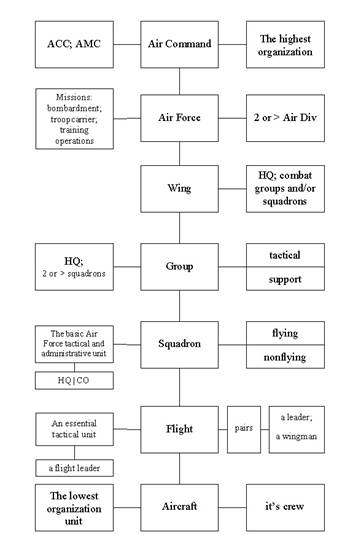
Aircraft. The lowest organization unit of the Air Force is an aircraft and its crew.
Flight. Four or more aircraft make up a flight. The flight is commanded by a flight leader. The flight is subdivided into pairs. It is an essential tactical unit. There is a leader and a wingman in the pair.
Squadron. Two or more flights make up a squadron. It has a headquarters. The squadron is the basic Air Force tactical and administrative unit. Squadrons may be flying and nonflying (supporting). The squadron is commanded by a Commanding Officer (CO).
Group. The group has a headquarters and two or more squadrons and may be tactical or support.
Wing. The wing is composed of a headquarters and combat groups and/or squadrons. It is capable of completely independent operations.
Air Division. An Air Division may be both operational and administrative. It has from two to five wings and a Division Headquarters.
Air Force. An Air Force is composed of two or more Air Divisions. It is designed to carry out the following missions: bombardment, troopcarrier or training operation.
Air Command. The highest organization (formation) of the Air Force is an Air Command. It includes two or more air forces. The main USAF Commands are the following: Air Combat Command and Air Mobility Command.
Air Force Organization
III. Exercises
I. Give the equivalents.
1. crew | 1. ведущий |
2. wing | 2. КВП |
3. wingman | 3. звено |
4. CO | 4. ведомый |
5. flight leader | 5. подразделять |
6. headquarters | 6. командир эскадрильи |
7. leader | 7. штаб |
8. to subdivide | 8. крыло |
9. ACC | 9. БАК |
10. AMC | 10. командир звена |
II. Choose the correct answer.
1) What is the lowest organization unit?
a) an aircraft;
b) a crew;
c) a flight;
d) a squadron.
2) What is a flight?
a) an administrative unit;
b) a tactical unit;
c) a basic unit;
d) a supporting unit.
3) What is a squadron commanded by?
a) a flight leader;
b) a Commanding Officer;
c) a wingman;
d) a leader.
4) What squadrons may be?
a) non-flying;
b) flying;
c) support;
d) tactical.
III. Give an additional information.
1) A wing is composed of combat squadrons.
2) An air division may be administrative.
3) An air force carries out different missions.
4) An Air Command is the highest organization.
Aircraft Structure
I. Active Vocabulary
1. airframe – планер самолета
2. power plant – силовая установка
3. fuselage – фюзеляж
4. flight control surface – плоскость управления полетом
5. landing gear – шасси
6. to develop – развивать
7. thrust – тяга
8. engine – двигатель
9. piston – поршневой
10.turboprop – турбовинтовой
11.turbofan – турбовентиляторной
12.turbojet – турбореактивный
13.to accommodate – размещать
14.device – устройство
15.instrument – прибор
16.to provide – обеспечивать
17.lift – подъемная сила
18.according to – в соответствии с
19.shape – форма
20.swept-wing – стреловидное
21.tapered wing – трапециевидное
22.to change – изменять
23.taxing – руление
24.take-off – взлет
25.conventional – обычный
26.tricycle – трехопорное
27.bicycle – двухопорное
28.ski-wheel combination type – лыжно-колесное
29.purpose – назначение
30.movable – подвижный
31.aileron – эйлерон
32.elevator – руль высоты
*****dder – руль направления
34.to climb – набирать высоту
35.to dive – пикировать
36.to turn – разворачиваться
37.fin – киль
38.stabilizer – стабилизатор
Aircraft Structure
II. Text
The basic components of the aircraft are the airframe and the power plant.
The elements of the airframe are the fuselage, the wing, the flight control surfaces and the landing gear.
The function of the power plant is to develop thrust, which causes the aircraft to fly. Engines are classified as piston, turbojet, turboprop, turbofan, etc.
The function of the fuselage is to accommodate the crew, cargo, control devices, necessary instruments and equipment, fuel, power plant and armament: bombs, missiles and other weapons.
The functions of wings are to provide high lift and low landing speed, to support the aircraft in flight. According to their shape wings are classified as delta-wings, swept-wings, tapered wings and changing geometry wings.
The functions of the landing gear are to support the aircraft on the ground, to provide taxing, take-off and landing. The basic types of the landing gear are the conventional gear, the tricycle gear, the bicycle gear, ski-wheel combination type, special-purpose gear.
There are movable and immovable flight control surfaces. Movable flight control surfaces are ailerons, elevators and a rudder. Their function is to control the aircraft in flight, i. e. to cause it to climb, dive and turn. Immovable flight control surfaces are the fin and the stabilizer. Their function is to stabilize the aircraft in flight, to provide its steady motion.
III. Exercises
I. Give the equivalents.
1. engine | 1. набирать высоту |
2. airframe | 2. развивать тягу |
3. landing gear | 3. киль |
4. elevator | 4. руль направления |
5. to develop thrust | 5. взлетать |
6. take-off | 6. двигатель |
7. shape | 7. руль высоты |
8. rudder | 8. форма |
9. to climb | 9. планер |
10. fin | 10. посадочное устройство |
II. Give an additional information.
1. The basic component of the aircraft is the airframe.
2. The elements of the airframe are the fuselage and the wing.
3. Engines are classified as piston and turbojet.
4. Movable flight control surfaces are ailerons and elevators.
5. Immovable flight control surface is the fin.
III. Complete the sentences:
1. The function of the power plant is to … .
2. The function of the fuselage is to … .
3. The functions of wings are to … .
4. Wings are classified as … .
5. The functions of landing gear are to … .
6. The landing gears are classified as … .
7. The function of movable flight control surfaces is to … .
8. The function of immovable flight control surfaces is to … .
Section II
Аннотирование
1. Аннотация – это предельно сжатая характеристика содержания текста. Ее цель – передать основную информацию текста в максимально обобщенном, сжатом виде.
2. Аннотация строится по следующим пунктам:
а) Тема. Обычно тема вытекает из наименования источника.
б) Сжатая характеристика материала. В этой части перечисляются все изложенные в источнике вопросы. Обычно эти вопросы названы в подзаголовках и промежуточных заголовках статьи. Дается краткая информация по основным вопросам.
в) Критическая характеристика источника. В этой части сжато излагается точка зрения автора на актуальность материала, указывается, на кого рассчитан материал, какой круг читателей он может заинтересовать.
Порядок работы при составлении аннотации
1. Разделите текст на логические части и озаглавьте их.
2. Выпишите из каждой части текста ключевые слова и выражения.
3. Составьте аннотацию текста, используя фразы и ключевые слова.
Список фраз, используемых при аннотации
1. The article (text) is about … | В статье (тексте) говорится о … |
2. The text (article) is called … | Текст (статься) называется … |
3. It is devoted to … | Она посвящена … |
4. The main questions touched upon in this article are … | Главными вопросами, затронутыми в этой статье, являются … |
5. The article says that … | В статье говорится, что … |
6. The author points out … | Автор подчеркивает … |
7. The text is of great interest (importance) for … | Текст является интересным (важным) для … |
The Main USAF Commands
Text
The ACC and the AMC are the main air commands of the USAF. The ACC is the main administrative organization of the USAF. It works out the main principles of using aircraft in military conflicts, maintains air units in combat readiness, trains commanders and officer of air units.
ACC combines 6 air forces, 1 air wing of AWACS aircraft. The ACC controls tactical fighters (F-15, F-16, F-117), strategic bombers (B-1), intercontinental ballistic missiles and about military men.
AMC is responsible for airlifting men and materiel to any part of the world. It is equipped with strategic military transport aircraft (C-5, C-141), tactical transport aircraft (C-130), tankers (KC-10, KC-135). AMC is a big organization with more than 600 airlifters and tankers, 100 special purpose aircraft and 65 000 military men.
Exercises
1. Выпишите из текста новые слова, переведите их с помощью словаря.
2. Найдите в тексте эквиваленты слов и словосочетаний:
разрабатывать, применение, поддерживать боевую готовность, объединять, воздушная переброска, самолеты специального назначения, быть ответственным за.
3. Выразите свое согласие или несогласие:
1) The ACC is responsible for airlifting men and material.
2) The ACC trains commanders of air units.
3) The ACC controls tactical aircraft, strategic bombers and tankers.
4) The AMC is the main administrative organization of the USAF.
5) The AMC is equipped with bombers.
4. Проаннотируйте текст.
Sidewinder Air-to-Air Missile
Text
Sidewinder is a large class of air-to-air guided missiles. It has many modifications. One of main Sidewinder missiles is the ASM-9L. It is installed on the aircraft and helicopters of the USA and the NATO member countries. This missile is used to attack enemy helicopters and low altitude targets. It consists of the body, flight control surfaces, warhead, guidance system, propulsion system and wings. It is a supersonic homing missile. Powered by a rocket motor the missile is 287 cm long and 12,7 cm in diameter. Its weight is 86 kg and its warhead is 11 kg. The ASM-9L develops a speed of M 2,5 and has a range of 18 km.
Пояснения к тексту
to install – устанавливать
altitude – высота
to power – приводить в движение
homing missile – ракета самонаведения
Exercises
1. Выпишите незнакомые слова, переведите их с помощью словаря.
2. Найдите в тексте эквиваленты слов и словосочетаний:
управляемая ракета воздух – воздух; цели на малой высоте; устанавливать; ракета самонаведения; система наведения; плоскость управления; используется.
3. Выразите свое согласие или несогласие:
1) Sidewinder is a subsonic homing missile.
2) American and NATO aircraft are armed with this missile.
3) This missile is used to destroy low altitude targets.
4) The structure of this missile is simple.
5) It includes the warhead and guidance system.
4. Напишите аннотацию текста.
Section III
Реферирование
1. Реферат – это конспективное (сжатое) изложение основных положений статьи (документа).
2. Процесс реферирования включает:
- анализ содержания текста;
- выделение главной информации и исключение второстепенных (исторических экскурсов, примеров, несущественных определений, дополнений, обстоятельств и т. д.)
- организацию отобранного материала, языковую обработку (обобщение и систематизацию фактов, лексический и грамматический перефраз).
3. Требования к языку реферата:
- точность, ясность, простота.
4. При реферировании сложные синтаксические конструкции заменяются более простыми оборотами.
Порядок работы при составлении реферата
1. Разделите текст на логические части и озаглавьте их. Запишите план текста в тетради.
2. Выделите основную информацию в каждой части, перефразируйте сложные синтаксические конструкции.
3. Выпишите ключевые слова и выражения, которые помогут раскрыть содержание каждого пункта плана.
4. Используя план и ключевые слова, прореферируйте текст.
Список фраз, используемых при реферировании
1. The main idea of the text is … | Главная идея текста … |
2. The first paragraph of the text tells about … | Первый абзац текста рассказывает о … |
3. The second paragraph is devoted to … | Второй абзац посвящен … |
4. The text (paragraph) gives the reader information about … | Текст (абзац) дает читателю информацию о … |
5. It is important to underline that … | Необходимо подчеркнуть, что … |
6. It is necessary to stress that … | Необходимо обратить внимание, что … |
7. As for … | Что касается … |
The US War Machine
Text
The United States has the largest and technically best equipped armed forces in the capitalist world. In strength and armament they surpass the armed forces of Great Britain, France, Italy, etc.
The main fighting services of the US Armed Forces are the Army, the Navy and the Air Force, including their Regular and Reserve units. The regular components can be quickly increased by large numbers of civilian reserves.
Under the Constitution of the United States the President is the Commander-in-Chief of the Armed Forces. He is assisted by several agencies. The highest of them is the National Security Council (NSC). It must advise the President with respect to the integration of domestic, foreign and military policies.
The function of the Secretary of Defense (SECDEF) is to control the Departments of the Army, the Navy and the Air Force. The SECDEF is a civilian person. He is appointed with the consent of the Senate.
By functions and missions to be carried out the US armed forces can be divided into strategic, general purpose, strategic mobility forces and reserves.
Пояснения к тексту
Commander-in-Chief – главнокомандующий
National Security Council (NSC) – Национальный Совет Безопасности
Secretary of Defense (SECDEF) – министр обороны
Department of the Army – министерство сухопутных войск
Exercises
1. Выпишите из текста новые слова, переведите их с помощью словаря.
2. Найдите в тексте предложения с модальными глаголами, переведите их.
3. Найдите в тексте эквиваленты словосочетаний: вооруженные силы; вид вооруженных сил; сухопутные войска; внешняя политика; военная политика; войска общего назначения; войска быстрого реагирования; резервные части.
Air Force
Text
The Air Force is an important fighting service. It is under control of the Department of the Air Force (DAF). The DAF is administrated by a civilian Secretary appointed by the President and is supervised by the Chief of Staff United States Air Force.
The Air Force takes part in all combat operations. At war it is able to carry out a large number of missions. It cooperates with ground and naval forces and helps them to win the victory in battles.
The aircraft units are to destroy such important military objectives as concentration of troops, armament and ammunition, airfields, bridges, railway stations and so on. At the same time the Air Force is to carry out protection missions of the troops on the battlefield and the objectives in the rear. Besides special aircraft have to carry out reconnaissance, observation, transportation of troops and evacuation of the wounded from battlefield, liaison and so on.
In peacetime the Air Force has to prepare its units for combat operations in the air.
The main missions of the Air Force are air combat, interdiction, gaining air superiority and air support.
Пояснения к тексту
Chief of Staff – начальник штаба
liaison – связь
interdiction – изоляция района боевых действий
Exercises
1. Выпишите незнакомые слова, переведите их с помощью словаря.
2. Найдите в тексте предложения с эквивалентами модальных глаголов и переведите их.
3. Найдите в тексте эквиваленты словосочетаний:
вид вооруженных сил; наземные и морские силы; одерживать победу; вооружение и боеприпасы; выполнять разведку; воздушный бой; завоевание воздушного превосходства.
4. Прореферируйте текст.
Computer as It is
Text
The world “computer” comes from a Latin word which means to count. A computer is really a very special kind of counting machine.
Initially, the computer was designed as a tool to manipulate numbers and thus solve arithmetic problems. Although designed originally for arithmetic purpose at present it is applicable for a great variety of tasks.
Nowadays computers are considered to be complicated machines for doing arithmetic and logic. The computer may be stated to have become an important and powerful tool for collecting, recording, analyzing, and distributing tremendous masses of information.
Viewed in the contemporary scene and historical perspective the computer simulates man are his intelligence and his ability to perform in and control his environment.
Significantly, man’s attempts to understand the phenomena of intelligence, control and power has led to simulations of his brain, of himself and of organizational and group structures in which he most often finds himself. In the last 30 years man has made extensive use of the computer for these simulation.
Surely, there are similarities with human brain, but there exists one very important difference. Despite all its accomplishments, the so-called electronic brain must be programmed by a human brain.
As already stated, originally computers were used only for doing calculations.
Today it would be difficult to find any task that calls for the processing of large amounts of information that is not performed by a computer. In science computers digest and analyze masses of measurements, such as the sequential positions and solve extraordinary long and complex mathematical problems, such as the trajectory of the spacecraft. In commerce they record and process inventories, purchases (покупка), bills, payrolls (платежная ведомость), bank deposits and the like and keep track of ongoing business translations. In industry they monitor and control manufacturing processes. In government they keep statistics and analyze economic information.
The computer’s role is influenced not only by its speed but also by its memory-size. A large memory makes it easier to work with large programs, including data compare liner programming or regression analysis requiring large matrices.
Although accepted for different purposes computers virtually do not differ in structure.
Any computer is, architecturally, like any other computer. Regardless of their size or purpose most computer systems consist of three basic elements: the input-output ports, the memory hierarchy and central processing unit.
When the central processing unit (CPU) of a computer is implemented in a single, or very small number of integrated circuits, we call it a microprocessor. When a computer incorporates a microprocessor as its major component, the resulting configuration is called a microcomputer. When the entire computer, including CPU, memory and input-output capability, is incorporated into a single IC, we also call that configuration a microcomputer. To distinguish between the two microprocessor types, we call the later a one-chip microcomputer.
As previously pointed computers today are providing an expanding range of services to rapidly growing pool (количество) of users. Such facilities could make our lives easier, and indeed they already enhance the productivity. Yet a bottleneck (трудность) remains which hinders the wider availability of such systems; this bottleneck is the man-machine communication barrier.
Simply put, today’s systems are not very good at communicating with their user. They often fail to understand that their user want them to do and then are unable to explain the nature of the misunderstanding to the munication with the machines is sometimes time-consuming. What are the causes of communication barrier?
One of the most important causes of the man-machine communication barrier is that an interactive computer system typically responds only to commands phrased with total accuracy in a highly restricted artificial language designed specifically for that system. If a user fails to use this language or makes a mistake, however small, an error message is the response he can expect.
Слова к тексту
1. count v – 1. считать, подсчитывать; 2. полагаться на
2. initially adv – в начальной стадии, в исходном положении
3. originally adv – сначала, первоначально
4. complicated a – сложный, запутанный
5. record v – 1. записывать; 2. регистрировать
6. distribute v – 1. распределять; 2. распространять
7. view n – 1. точка зрения; 2. вид; взгляд
8. contemporary a – 1. современный; 2. одновременный
9. indeed adv – на самом деле, действительно
10. environment n – окружение, среда
11. despite prp – несмотря на
12. accomplishment n – 1. выполнение; 2. завершение, достижение
13. call for v – 1. требовать; 2. предусматривать
14. amount n – 1. величина, количество; 2. сумма, итог
15. sequential a – 1. являющийся продолжением; 2. последовательный
16. commerce n – торговля
17. transactions n pl – 1. труды (научного общества); 2. ведение деловых операций
18. monitor v – следить, контролировать
19. regardless of prp – не считаясь; независимо от; несмотря на
20. port n: input port – вход
21. whereby adv – посредством чего-либо; тем самым
22. feed v – 1. питать; 2. подавать, снабжать
23. punch card – перфорированная карта
24. retrieve v – 1. восстанавливать; 2. исправлять; 3. отыскивать информацию
25. entire a – 1. целый, полный; 2. весь
26. issue v – 1. происходить, получаться из; 2. вытекать; 3. выпускаться, издаваться
27. read v – 1. читать, считывать; 2. снимать показания
28. interpret v – 1. преобразовывать; 2. объяснять, толковать
29. incorporate v – 1. включать; 2. объединять
30. distinguish v – 1. различать; 2. отличать, выделять
31. facilities n pl – 1. устройства; 2. возможность; условия
32. hinder v – 1. мешать, препятствовать; 2. задерживать
33. fail v – 1. отказать действовать; 2. не удаваться; 3. быть не в состоянии
34. consume v – потреблять, поглощать
35. restrict v – ограничивать
36. artificial a – искусственная
37. error n – ошибка; погрешность
38. message n – 1. сообщение; 2. информация
Термины к тексту
1. arithmetic problems – арифметические задачи
2. to digest and analyze measurements – обобщать и анализировать измерения
3. memory-size – объем памяти
4. secondary storage – вспомогательное ЗУ
5. central processing unit – ЦПУ
6. to feed – вводить
7. to take out – выводить
8. to issue commands – задавать команды
Electricity and Electronics for Aircraft
Text
All modern aircraft and spacecraft are largely depended upon electricity and electronics. Electronics is merely a special application of electricity where in precise manipulation of electrons is employed to control electrical power for vast number of functions. Avionics is the term for electronics as applied to aircraft.
One of the prime functions of electricity in an airplane is to ignite the fuel air charge in the engine. In addition to providing engine ignition, electricity supplies light, heat and power. Besides it operates different lights, retractable lading gear, wing flaps, engine cowl flaps, radio instruments and navigational equipment. Electricity (electronics) is needed for ground control, operation of servomechanisms for various in-flight control functions, computers, tracking, communications, etc. In short, we employ electricity to perform multitude of tasks.
Ever since the first airplane to use and kind of electrical equipment was flown, the electrical loads on it have increased. Modern jet planes contain many miles of electrical wiring and hundreds of electrical and electronic components.
Electricity may be said to be as essential to the firing and operation of airplane. Without it there would be no modern airplanes, missiles or spacecraft.
Thus, today modern aircraft vehicles are equipped with scores of different electrical systems, each requiring a substantial amount of electrical energy. To supply the power for their electrical systems, the vehicles are equipped with generating equipment sufficient to furnish lights for a town.
Electrical generators are known to have already been used for many years to produce electrical power for a multitude of purpose.
From the original crude “dynamos” employed to produce power in the early days of our electrical age, the generator has been developed to a very level of efficiency, especially for aircraft.
When used for aircraft generators differ considerably from those for other purposes. The main difference is that aircraft generators have a much higher power-weight ratio than the other types. The aircraft generator system must be designed so that it will meet the requirements of a wide variety of electrical loads.
An electric motor is a device which changes electrical power to mechanical energy; that is, its function is opposite to that of a generator. Electric motors and generators are known to be very alike in construction, and some generators are actually used as motors under some conditions. Among the many units and systems requiring electrical motors are engine starters, cowl flaps, intercooler and heat exchanger shutter or control valves, landing gear, trim tabs, flight controls, gyrostabilizing units, navigation devices, tracking devices and many others.
To sum up, electrical systems are needed for the control of propulsion system, for control of guidance and navigation, for maintenance of suitable environment within the vehicle, and for communications. It is therefore obvious that one of the most important factors in reliability for any aircraft, missile or spacecraft is dependable performance of its electrical system. This is true whether the vehicle is an airplane, missile or spacecraft.
The operation of modern aircraft could not exist without the use of instruments.
Instruments are needed to measure pressures, temperatures, altitudes, velocity, rate of flow, and numerous other conditions and parameters affecting the flight and operation of aircraft. The pilot must be provided with accurate, readily available information on all these factors with minimum of delay because it should be clear that any breakdown must be readily understood. Any malfunction is to be avoided and, in case they do occur, corrected.
Human beings are unable to react rapidly and accurately to the many and variable conditions which affect the flight of an airplane, unless they have accurate and reliable instruments available for the quick and simple measurements of all needed information.
All instruments are usually operated electrically or electronically. There is no quicker, easer, or more reliable method of conveying information from every section of the airplane to the flight crew than by means of electric circuits and devices.
Electric wires in all parts of the airplane carry messages from dozens, and sometimes hundreds, of sensitive feelers or transmitters to the instrument panel in the cockpit, just as the nervous system of the body carries messages to the brain.
The pilot of the twenties had no instruments at all. Today a pilot is faced by a bewildering display of flight and engine instruments together with radio, navigation aids, automatic pilots, flight systems and the like. The modern flight crew can therefore be said to fly “by the look on a dial”.
Слова к тексту
1. to depend on (upon) – зависеть от
depended a – зависимый, зависящий от
dependence n – зависимость
dependable a – надежный
2. to apply – применять
application n – применение
applicable a – применимый, пригодный
3. to employ – употреблять, использовать
to be employed – использоваться, применяться
employment n – применение, использование
4. to ignite – воспламенять
ignition n – воспламенение, зажигание
igniter – воспламенитель
5. to operate – приводить в действие
operation n – работа, управление
6. to increase – увеличивать
increase n – увеличение
7. to require – требовать
requirement n – требование
to meet the requirements – отвечать требованиям
requiring – требующий
8. to differ – различаться
difference n – различие, отличие
different a – различный
9. reliability n – надежность
reliable a – надежный
10. to measure – измерять
measurement n – измерение
11. to affect – влиять (на что-либо)
12. to purpose – намереваться
purpose n – цель, назначение
purposeful a – имеющий намерение
purposeless a – бесполезный
13. to provide – обеспечивать
to be provided with – быть обеспеченным (чем-либо)
14. to mean – означать, иметь значение
meaning n – значение
by means of – посредством, при помощи
Термины к тексту
1. light – свет, фара; огонь
2. landing gear – шасси, посадочное устройство
3. wing flap – закрылок
4. engine cowl flap – створка капота двигателя
5. power-weight ratio – удельная мощность
6. intercooler – промежуточный холодильник (радиатор, охладитель)
7. heat exchanger shutter – заслонка теплообмена
8. valve – клапан
9. control valve – управляющий клапан
10. trim tab – триммер
11. cockpit – кабина летчика
Section IV
Грамматический справочник
Эквиваленты модальных глаголов
(to) be able to, (to) have to, (to) be to
Модальные глаголы “can”, “may”, “must” имеют не все времена. Глаголы “can” и “may” имеют настоящее и прошедшее время (“could” и “might”), глагол “must” – настоящее. В недостающих временах они заменяются эквивалентами модальных глаголов, которые могут применяться во всех временах. За эквивалентами модальных глаголов обязательно следует смысловой глагол в инфинитиве с частицей “to”.
Глагол | Present | Past | Future |
can = to be able to |
is able to are |
able to were |
be able to will |
must = to have to |
to has | had to |
have to will |
must = to be to |
is to are |
to were |
 am
am was
was shall
shall have
have shall
shall am
am was
wasto be able to – используется для выражения физической возможности или умения в совершении какого-нибудь действия в любом времени. Переводится «могу».
I am able to work. - Я могу работать.
I was able to work. - Я мог работать.
I shall be able to work. - Я смогу работать.
to have to – используется для выражения необходимости совершения какого-либо действия в силу определенных обстоятельств в любом времени. Переводится «придется», «должен», «вынужден».
We have to land. - Мы вынуждены приземлиться.
We had to land. - Нам пришлось приземлиться.
We shall have to land. - Нам придется приземлиться.
to be to – используется для выражения долженствования в связи с заранее намеченным планом, приказом, расписанием в настоящем и прошедшем времени. Переводится «должен», «предстоит», «нужно».
They are to attack today. - Они должны атаковать сегодня.
They were to attack yesterday. - Они должны были атаковать вчера.
Функции и способы перевода глагола “to be”
1) to be + noun We are cadets. We are in the classroom. | 1) смысловой глагол; переводится «быть», «находиться» Мы – кадеты. Мы (находимся) в классе. |
2) to be + Participle I We are discussing the text. | 2) вспомогательный глагол; не переводится Мы обсуждаем текст. |
3) to be + Participle II The text is discussed at the lesson. | 3) вспомогательный глагол; не переводится Текст обсуждается на уроке. |
4) to be + Infinitive We were to discuss the text. | 4) эквивалент модального глагола “must”; переводится «должен», «нужно» (по плану) Мы должны были обсудить текст. |
Функции и способы перевода глагола “to have”
1) to have + noun I have a letter. | 1) смысловой глагол; переводится «иметь» У меня есть письмо. (Я имею письмо). |
2) to have + Participle II I have received a letter. | 2) вспомогательный глагол; не переводится Я получил письмо. |
3) to have + Infinitive I have to write a letter. | 3) эквивалент модального глагола “must”; переводится «вынужден», «должен», «придется» Мне придется написать письмо. |
Exercises
Translate the sentences into Russian.
1) The train was to arrive at 10 o’clock in the morning.
2) They will be able to get up early tomorrow.
3) The work is to be completed by 2 o’clock p. m.
4) I shall have to work in the evening.
5) You may stay at home today.
6) The cadets had to rewrite the test.
7) We must meet her.
8) To become a top sportsman you have to train very hard.
9) They could cover the distance on foot.
10) This cadet can play piano.
Видо-временные формы глагола
Simple/ Indefinite (простое) | Progressive/ Continuous (длительное) | Perfect (завершенное, свершенное) | Perfect Progressive (свершено-длительное) | |
1.обычность, повторяемость действий 2.перечисление событий | 1. указано время действия 2. действия происходят одновременно 3. действие прерывается другим действием | 1.результат 2. законченность действия | 1. действие началось в прошлом и продолжается до настоящего момента | |
Present | V; Vi (Vs) | be + Ving | have + V3 has | have +been+Ving has |
usually, always, sometimes, often, seldom, never, every day (week, month, year) | now, at present, at … o’clock, from 2 till 4, … when …, … while … | ever, never, just, already, jet, this year (month, week, time), recently | for an hour (a week, a year, a month), for a long time, the whole day (month), since … | |
Past | V2 | be (was, were) + Ving | had + V3 | had + been + Ving |
last Monday (week, month, year, time), yesterday; two days ago, in 1997 | … when …, … while …, at 4 o’clock, from 2 till 4, when you came (V2) | by last Monday (time, week, month, year), by 1997, by the time you came (V2) | for an hour (a week, a month, a year), for a long time, for the last 2 days, since … | |
Future | shall + V will | shall + be + Ving will | shall + have + V3 will | shall + have + been + Ving will |
tomorrow, next year (week, month), in 2 years (month, weeks) | … when …, … while …, at 4 o’clock, from 2 till 4, when you come (V/V3) | by 2030, by the time he comes (V/V1) | for an hour (a week, a month, a year), for …, since … |
V – verb – глагол (work, write)
V1 (Vs) – глагол при подлежащем в 3-м лице (works, writers)
V2 – глагол в прошедшем времени (worked, wrote)
V3 – Participle II – причастие II, прошедшее время (worked, wrote)
Ving - Participle I – причастие I, настоящее время (working, writing)
Exercise 1
Choose the correct form of the verb given in the brackets.
1. The libraries (играют) an important role in teaching students to use technical literature.
a) played, b) plays, c) play.
2. Dr. Ivanov (читает) lectures at the Polytechnical University.
a) deliver, b) is delivering, c) delivers.
3. I (познакомился) Prof. Coleridge only six months ago.
a) had met, b) has met, c) met.
4. Our scientific adviser (получил) some original experimental results recently.
a) obtained, b) has obtained, c) had obtained.
5. It (шел дождь) when I went out into the street.
a) has been raining, b) was raining, c) had been raining.
6. My friends (получит) all necessary experimental data by this time next Monday.
a) will get, b) shall get, c) will have got.
7. The quartz crystal of electronic watches (управляет) a tiny motor that moves the hands.
a) control, b) is controlling, c) controls.
8. I (уже переводил) this article for an hour before you came.
a) have been translating, b) had been translating, c) was translating.
9. This book (содержит) a complete list of references on the subject.
a) contain, b) contained, c) contains.
10. Prof. Maslov (опубликовал) a lot of scientific papers before he submitted his doctoral dissertation to public hearing.
a) published, b) has published, c) had published.
Exercise 2
Put the verb given in the brackets in the correct form.
a) Present Indefinite – Present Continuous – Present Perfect – Present Perfect Continuous.
1. It often (to show) in winter in Moscow.
2. He always (to enjoy) concerts of classical music.
3. She (to read) a detective story now.
4. They (to compile) a program for the computer at the moment.
5. Mary … still … (to write) letters. She (to write) them for 3 hours.
6. Jimmy is a tennis player. This year he (to win) the national championship.
7. They (to make) films since they left college.
8. Ann (to cook) dinner now.
9. My friend (to write) his course paper recently.
10. I (never) (to be) to England.
b) Present Perfect – Past Indefinite – Past Continuous – Past Perfect – Past Perfect Continuous – Present Perfect.
1. The Chinese (to invent) printing.
2. Albert Einstein was the scientist who (to develop) the theory of relativity.
3. She already (to buy) a new dictionary.
4. He already (to clean) the flat.
5. I (to study) her report for more than 2 hours.
6. W. A. Mozart (to start) composing at the age of five and (to write) more than 600 pieces of music.
7. She (to discuss) some questions with her tutor while I (to read) an interesting article in the newspaper.
8. They (to write) a computer program by September.
9. I (to see) him before.
10. I didn’t know who he was. I (to see) (never) him before.
c) Future Indefinite – Future Continuous – Future Perfect – Future Perfect Continuous.
1. I am sure he (to pass) his exams in mathematics by January.
2. The temperature (to rise up) to 25-C tomorrow.
3. We (to talk) about the film when the TV program is over.
4. What do you think the children … (to do) … when we get home? I expect they (to do) their homework.
5. Everybody (to be present) at the briefing tonight.
Exercise 3
Choose the correct word.
1. Have they … watered the plants?
a) ever, b) never, c) so far.
2. I’ve … peeled the potatoes.
a) ever, b) never, c) yet.
3. Have you finished your lunch…? – No, I’m … eating it.
a) always, b) still, c) yet.
4. He’s been to Paris …
a) once, b) never, c) yet.
5. I haven’t had bad dreams …
a) already, b) several times, c) always.
6. Have you had a holiday …?
a) just, b) this year, c) ever.
7. Has he driven a car …?
a) just now, b) before, c) still.
8. I haven’t eaten any fruit …
a) just now, b) today, c) never.
9. I have known him …
a) sometimes, b) since then, c) yesterday.
10. I understand it …
a) now, b) already, c) yet.
Список использованной литературы
1. , , Васильченко военного перевода: Английский язык. Общий курс. – М.: Воениздат, 1981.
2. Полянская язык. Учебное пособие для авиационных училищ летчиков и штурманов. – М., 1989.
3. , Гиренко ТВВАИУ. Обучение чтению на английском языке. 2002.
4. , Крылова грамматика для всех. М.: Высшая школа, 1989.
Содержание
Предисловие …………………………………………….… 3
Раздел I. Учебные темы …………………………………… 4
1. Рапорт …………………………...……..................4
2. Моя визитная карточка ………………. ……….. 6
3. Наш кадетский корпус …………………………. 8
4. Распорядок дня в кадетском корпусе …………11
5. Организация Вооруженных сил США ………..13
6. Классификация военных самолетов и их вооружения . ..16
7. Организация ВВС США ……………………….24
8. Конструкция самолетов ………………….…….28
Раздел II. Аннотирование текстов ………………………..32
1. Порядок работы ………………………………...32
2. Список фраз, используемых при аннотировании..33
3. Текст «Главные командования ВВС США»…..33
4. Текст «Ракета «Сайдвиндер» ………………….34
Раздел III. Реферирование текстов ……………………….35
1. Порядок работы ………………………………...36
2. Список фраз, используемых при реферировании..36
3. Текст «Военная машина США» ……………….36
4. Текст «ВВС США» …………………….............38
5. Текст «Компьютер» ……………………………39
6. Текст «Электричество и электроника на самолете»..43
Раздел IV. Грамматический справочник ………………...48
1. Эквиваленты модальных глаголов ……………48
2. Функции и способы перевода глагола “to be” ..49
3. Функции и способы перевода глагола “to have”…..50
4. Видо-временные формы глагола ……………...51
Список использованной литературы ……………….........55
