

Партнерка на США и Канаду по недвижимости, выплаты в крипто
- 30% recurring commission
- Выплаты в USDT
- Вывод каждую неделю
- Комиссия до 5 лет за каждого referral
Margaret Riel, Learning Circles Coordinator, USA
Маргарет Рил, Координатор проекта "Круги обучения", США
I*EARN Learning Circles
The power of telecommunication is in go up communication. Learning Circles provides a way for educators in I*EARN to be matched with global partners in small groups to design projects to extend their classroom curriculum. The goal of a Learning Circle is to support each educator-student team to create and conduct a project which includes the participation of students from different regions and countries. All participants in a Circle work together to make each project a success.
A Learning Circle is composed of about 6 educators for different regions or countries each with a "team" of students. The student team could be a self-contained classroom, a group of students in the media center or library, students from one or more classes of a subject like history, a home school, or an after school computer club. Students and teachers are matched in Learning Circle by grade level groupings (elementary, middle, high) and themes selected by the teacher. Current themes for school year are:
Learning Circle Themes:
Computer Chronicles - Journalism and Current Issues
Places and Perspectives - History and Geography
Mind Works - Creative & Expressive Writing
Themes that may soon be available are:
Family Stories - Writing and Social Science
Society's Problems - Social Sciences and Economics
Energy and the Environment - Science and Ecology
Global Issues - Current Issues, Science, and Social Science
Learning Circles can bring together classes from large urban settings and geographically isolated rural areas. Students with a wide range of educational, physical, and social abilities as well as with different ethnic, cultural or linguist backgrounds can interact with one another without the differences being dominant. The time invested and the amount of help and direction need to prepare a project response is not revealed when messages are exchanged. With different amounts of help, all students can work on an equal level of excellence.
Learning Circles are as much for teachers as they are for students. Teachers invite their partners into their classrooms and share their successes and concerns. In turn, they are encouraged to peer into the classrooms of educators from distant places. The fact that everyone in a Learning Circle is both teacher and learner is what makes this activity so motivating.
Learning Circle Interaction
The groups remains together over a 3-4 month period that is structured to facilitate a high degree of interaction among the participants.
Phases of a Learning Circle
¨ Getting Ready for Learning Circles
¨ Opening the Learning Circle
¨ Planning the Learning Circle Projects
¨ Exchanging Student Work on Learning Circle Projects
¨ Organizing the Circle Publication
¨ Closing the Learning Circle
After the introductory activities, projects are planned by each educator-student team and all groups contribute to each project. At the end of the term the Circle participants сollect, evaluate, layout and print their part of the Circle publication. The booklet is assembled and the Learning Circle comes to an end. Each session begins with a new set of schools in a Learning Circles.
No one can fully predict the direction a Learning Circle will take. It is a team effort resulting from the cooperation between teachers and students who might otherwise never have had the opportunity to interact.
Нина Коптюг, координатор по школе № 000, Новосибирск, Россия
Круги обучения
Сила телекоммуникации - в групповом общении. Проект "Круги обучения" позволяет педагогам установить связь с партнерами в любой точке земного шара и образовать небольшую группу для выполнения заданий, дополняющих и развивающих учебную программу по любому предмету. Цель проекта - помочь участникам установить и поддерживать связь в течение нескольких недель, облегчить общение учителей и учеников. Основной координатор, в данном случае это Маргарет Рил, США, составляет расписание и высылает участникам пакет заданий на каждую неделю, а также отвечает на вопросы и помогает решить возникающие трудности. Зачинатель данных "Кругов" - Ханс Хенкель, Германия, также постоянно находится на связи и помогает всем участникам придерживаться расписания и обмениваться информацией. Кроме того, в каждой школе-участнице есть свой локальный координатор. На время выполнения проекта создается единый адрес электронной "Конференции", на который все участники высылают свои эссе. Вся работа ведется с помощью организации "Международное образование и ресурсы компьютерной сети" (I*EARN).
Заранее нельзя сказать, во что выльется "Круг обучения", кто сколько напишет, кому удастся обменяться большим количеством сведений о странах, а кому - небольшим. Все участники начинают с обмена "Обзорами класса": школьники заполняют опросник, где указывают свое раписание, количество предметов, любимые поп-группы, книги, виды спорта, телепрограммы и т. д. По опроснику участники определяют следующий этап и начинают присылать друг другу не только информацию, но и вопросы. Школа № 000 ответила на вопросы о наличии рек, озер и лесов в Сибири, об экологической обстановке. Эта тема вызвала интерес в США, Германии, Латвии. Мы обменялись с немецкими партнерами эссе о писателях, причем они прислали коллективный очерк о лауреате Нобелевской премии Гюнтере Грассе, а мы ответили групповым сочинением о различных литературных героях. Затем появились такие темы, как мирное сосуществование (школа № 000, Новосибирск), война (школа Роберт-Бош, Германия), неблагоприятное месторасположение школы (Ривер Вэлли Скул, США).
Мы вели всю работу на английском языке, также, как участники из США и Латвии. Из Германии нам присылали труды на английском и немецком языках.
По окончании нескольких недель работы мы "закрыли" первые "Круги обучения" и подвели каждый свои итоги. Ханс Хенкель создал сайт, где помещены работы всех участников. Мы составили буклет из нескольких эссе. Так как возник взаимный интерес, то в настоящее время мы продолжаем проект "Круги обучения". Состав участников и тематика несколько изменились, но остались прежние координаторы. Проект помогает развивать навыки общения на иностранном языке, расширяет знания школьников о мире, приучает их к телекоммуникационному общению.
Schools
· School 130, Novosibirsk, Russia
· River Valley, H. S., Marion, Ohio, USA
· Livingston H. S., Capetown, Sous Africa
· Ghana National School, Cape Coast Ghana
· Robert-Bosch-Gesamtschule, Hildesheim, Germany
· Gymnasium Kamenogorsk, Kazakstan
· Karl Marx School, Smoljan, Bulgaria
· Dangarpils Gymnasium, Latvia
· Voru Kesklinna, Vorn, Estonia
· Kraslava Gymnasium, Latvia
School 130, Novosibirsk, Russia
Школа 130, Новосибирск, Россия
Classroom Survey
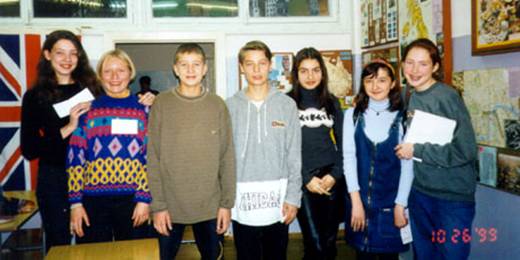
Grade Level: 8-10
Class Culture: Humanities
Music Groups: FSOL, Fatboy Slim, RHCP, Jamiroquae, Methods of Mayhem
Authors: Alexandra Marinina, Sidney Sheldon
TV Programs: The X-Files, Dawson's Creek, The Field of Wonders
Food: Blini, pelmeni, manty
School Subjects: English, Russian, French, German
Sports: Chicago Bulls; tennis, aerobics.
Computer/video games: Heroes 3
Weekend activity: Disco, cinema, theatre
Describe a popular fad: Rapper, Breaker, Yuppies
School Information: College 130, Uchenych 10, Novosibirsk 90
Number of students: 25 in class, 1100 at school
Size of school: big building
School emblem, colors: White & green; leaf
Type and number of computers: 25 Pentium 2
School history: the school was opened in 1959; this building appeared in 1970 in a new-born town
School Program: We are studying two or three languages; we have twenty different subjects in 10th grade. We study for ten years.
Events: March 8 - public holiday; March 24- April 2 - Spring break
Community: Academy Town
City: Novosibirsk, 1 , South-West of Siberia, Russia
Visitors: It's very clean, very green, exotic
Land Formation: The Great Siberian Plain; the Ob River
School 130, Novosibirsk, Russia
Школа 130, Новосибирск, Россия
My favourite character
Jane Austen "Pride and Prejudice"
I love this book. I think that all the characters are unique and interesting in their style, but I would say that my favourite character is Fitzwilliam Darcy, or, as in the book, just Mr. Darcy. I first saw the movie. I liked it very much, the cast was wonderful. I really liked the actor who played Mr. Darcy, Colin Firth. I think that the film had a very strong influence on me, and when I read the book afterwards, I always imagined Mr. Darcy to look just like in the movie, and that made the story even more romantic and interesting for me. I guess I should say a few words about the novel. It is about a family, the Bennets, who have a daughter, Elizabeth, the main heroine. She and her family meet Mr. Darcy and his friend Mr. Bingley at a ball. Afterwards all sorts of plots follow, but the main idea is this: Elizabeth and Mr. Darcy are in love with each other, but Elizabeth is blinded by prejudice, and Mr. Darcy by pride. In the end they finally marry, after going through all sorts of hardships. How romantic! I think that what I like best in Darcy is that he doesn't talk too much. He shows some things in his behaviour, or suddenly and completely unexpectedely says something really wise or remarkable. One of my favourite frases of his is of Elizabeth: "It is many months now that I have considered her one of the handsomest women of my aquaintance", or his confession of love: "In vain I struggle. You must allow me to tell you how ardently I admire and love you". Wonderful. Mr. Darcy is very noble and smart. He is very different from other people, maybe that's why he doesn't talk too much among them or is thought selfish and dissagreable. It is also very touching to read about how he treats his younger sister, Georgiana. She says of him that he is the best brother in the world. I agree with her. So I think that Mr. Darcy is really all that their could be good in a man like him. I wish that their were more such people in our world now.
Evgenia Koptyug, grade 8
My favorite author is Griboedov. I'm impressed by his comedy "Sorrow from the mind" and the main character Chackiy.. He laughs at the society. He is so clever and even genius that he could disgrace everyone. The society in this comedy is the mirror of natural people around him. Chackiy loved Sofia, but she betrayed him. Sofia lives by her heart, not by the brain. And so Chackiy couldn't impress her, because she didn't understand his beauty. Sofia thought that he was against all of the people, but the main character opposed Chackiy is Molchalin was is clever too, but he understand Chackiy's domination and tries to defend himself not to be confused. When Chackiy came, he believed Sofia loved him, but she didn't. Filled with anger Chackiy got away. This book ends up by the Chackiy monologue... This story is read from 19th century to nowadays...
Ilia Semyonov, grade 8
My favourite literature character is Beowulf. It's a manuscript. There are many legends and interesting stories about him. In some books he is described as strong as thirty men. The motherland of Beowulf is Scandinavia. Only the manuscript remains today. Many people think that Beowulf is a legend but for me it is true.
Evgeny Dovydenko, grade 8
My favourite writer is Alexander Sergeevich Pushkin. I like his book "Evgeny Onegin" very much. My favourite character is the main character of this book-Tatiana Larina. She is a daughter of one of the Russian landowner. Her father died and she's leaving with her mother and sister olga in their house. She is very romantic and she usually has her head in the clouds. Tatiana dreams about "beautiful and forever" love. She loves Evgeny very much and she is ready to do everything for him. But unfortunately he doesn't love her and their happiness is impossible. Some years pass and Evgeny met Tatiana at a ball in Moscow. she was very nice and pretty. And suddenly he understands that he loves Tatiana. But she is already married and they can't be together. I was astonished by her fortitude, honesty and sincerity. I understand, what true love means. What I also like in her is her devotion to her moral principles, I think that it's really great to be such a kind woman.
Irina Lebedeva, grade 8
My favorite character is Lisa from Alexander Pushkin's story "The Reasant Lady." The chief hero is Lisa in this story. Lisa is a beautiful lady with brown eyes. She is a lettle spoilt by her father because she grows without a mother. But she has a good education and good manners because her father has enough money and he can afford a theacher. Also Lisa has a servant, who always help her in a difficult situation and gives her an advice. I think Lisa is a gay, clever and careful lady. Sometimes she likes to do absurd things. She wants to get acquinted with Alex but she can not do this because her father quarrelled with Alex's father. And she dresses up as peasant-woman and goes to meet with Alex in the forest. I think it is a brave step to meet with a man whom you don't know. She does this and then Lisa sends letters to Alex with hope to see him again and to be togather. Alex and alisa overcome all abstacles for love. I am happy that this love story ends very well thanks to Lisa's character.
Elena Chesnokova, grade 8
School 130, Novosibirsk, Russia
Школа 130, Новосибирск, Россия
Our Town
Our city of Novosibirsk was founded in 1896, it is built on the two banks of the River Ob, which is the largest Russian Asiatic river. The Ob, as all the other rivers in Siberia, freezes in November or even October and becomes solid ice till April or even May. It is large, and there are lots of fish in it. It is also polluted in places, and in summer, people cannot swim in it or use the water for drinking because of harmful substances found in it. Maybe thanks to our very long winter, and partly due to the decrease of industries and to the dramatic fall in production in general, the River Ob became much cleaner than it was some years ago.
Akademgorodok, our Academic Research Community, was founded as part of Novosibirsk city, yet it is about 30km away from the center. When Akademgorodok was built, an artificial large lake, or a water reservoir, was also built near it. It is called the Ob Sea. For many years it was very nice and clean, and it remained the most popular resting place for the town inhabitants. Even in winter, people go fishing, they make a hole in the ice and remain there for many hours waiting for some fish who is not asleep under the many meters of ice to bite! There are several plants and factories around the Ob Sea. Some of them, like the Paper and Cellulose Factory in a nearby city, used to pour waste into the water. Our Sea became dirty, and every summer, we watched green algae turn it into soup, so that we couldn't swim. There is a hydro-electric station here too, and it also plays a role in what is happening.
Now the waters are much cleaner everywhere, the fish returned, and there are even crawfish which noone had seen for a long time. If you come here in July, you'd be surprised at how many sunbathers are on the beach, how warm and clean it is.
There are plenty of lakes in Novosibirsk region too. However, please remember that Siberia is a large country: Baikal Lake is more than 1,000 km away! Our region is situated on the Great Siberian Plain, and the greatest treasure, perhaps, is its forest. Or forests, woods, the taiga (not tundra!). When our town was built, the architects and builders counted every tree and cut down as little as possible. For example, our school, which has the area of 1,500 square meters, was built on a clearing in the forest, and not a single tree was cut down. The original forest trees are all around the school, and all the inhabitants, like squirrels, birds, live here. When it's very cold in winter, -30 or even -40C, they come into the school to get warm and to be fed. All around the area one can see the famous Siberian "Ribbon Forests" which are still preserved in all their beauty. Imagine driving along a road and seeing tall beautiful pine-trees and the white Siberian birches right here in the city, not somewhere far away. At times, it looks like paradise. Thanks to the trees and waters, the air is fresh and clean. There is a pest: once the snow melts, poisonous tick appears. One has to be careful and not walk on the grass. If a person is bitten, they must go to the emeregency room at once and be inoculated within 72 hours. Otherwise, they might get severely sick or even die. However, fortunately for us, the areas where the tick is active are well-known, and if you take the necessary precautions, you'll never get bitten. Many people like this place, and visit it again and again.
School 130, Novosibirsk, Russia
Students, 8th Grade, 10th Grade, Humanities Groups
Школа № 000, Новосибирск, Россия
Spare Time
Свободное время
Our school schedules are very tense, both for the teachers and the students. At least four days a week, students have 8 lessons a day, and in Russian schools, there is no lunch break, just short breaks between the lessons. So when you come into our school, you'll see students running along with a bun or roll in their hands. This small meal is their major meal during the day, which starts at 8:30AM and continues till about 4PM. Many students commute, so they have their breakfast at 7AM and dinner at 5PM, very little food in between. 8th graders study six days a week, 10th graders 5 days a week, but their days are longer. When they have school, students have neither time nor energy left for anything, and they have to do lots of homework every night.
However, our questionnaires show that students love swimming in summer and skiing in winter, all of us can ski. Many people go in for tennis, music lessons. Lots of people love dancing, and all of us living in Akademgorodok love walking, it's a nice place to walk in. Amazingly, many students manage to write compositions and stories, draw pictures, perform at school events. Most of us are quite cheerful is spite of the hard work and living conditions.
Robert-Bosch School, Germany
Школа Роберт-Бош, Германия
Literary portrait Gunther Grass
Gunther Grass was born on 16.october 1927 in Danzig. There he visited grammar school until he was drawn for the army. In 1945 Gunther Grass was wounded and he was took for a prisoner. In May 1945 he was released and worked as an agricultural worker, worker in a potash hill and as jazz musician. From 1951 till 1952 Grass completed a sculpture study at the art-academy of Dusseldorf. In the years 1951 and 1952 he traveled trough Italy and France.
1954 Gunther Grass married Anna Schulz. 1957 he joined the "group 47", whose prize he received for the "Blechtrommel". Between 1961 and 1972 Gunther Grass participated actively in the election campaign of the SPD.
From 1983 til 1856 he was the president of the art-academy in Berlin. Until 1987 he stayed in Kalkutta. Now he lives in Behlendorf near Melln.
Gunther Grass received numerous literature-prizes: The Georg-Buchner-Prize(1965), The Carl-von-Ossietzky-Medaille(1965), the Fontane-Prize(1968), the Italian Premio-Letterario Veareggio(1978), The Literaturpreis der Bayrischen Akademie der Schenen Kunste(1994) and his biggest success was the Nobel Prize for Literature(1999).
Gunther Grass created one of the most significant works in German post war literature. His style is marked by dramatic-realistic detail descriptions and grotesque-imagination plots.
In his most time criticle works he uses ironicle phrases. He presents his political conviction not only in his works, but also in public.
Robert-Bosche School, Germany
, Германия
Peaceful co-existence of nationalities in Germany
Through its central location in Europe, Germany was influenced by other nations early. A lot of wars were commanded in the Middle Age in Europe. Because of this many peoples moved through the German area. So there had always remained few soldiers and refugees behind. Even later artists from all over the world moved to the cities with an high cultural standard. But just after World War II Germany's production site gets interesting. Through the occupation Germany's by the USA, Great Britain, France and the Soviet Union were friendships made and some soldiers settled down with their families. In the 50's grew the economy of Germany and a lot of jobs arose. There were so many jobs for the own population because many men died in the last wars. That's why the government recruits workers from other countries. Mainly they came from Italy, Spain and Turkey. Originally they wanted to stay just for few time to earn money for a better life in their native country. But time goes by and they feeled well and got their families over or they founded one. Problems like prejudices and misunderstandings made the living together more difficult. The children of those families haven't it more easier today. For example children of turkish families live between two cultures, on the one hand the traditionel parents and on the other hand the german friends who influenced them with their modern way of life. But these children are integrated in German society and doesn't have such big problems like the persons seeking asylum.
These are partly political victims of persecution who will always get asylum but there are also economical refugees who believe to live a better life in Germany. Exact these economical refugees aren't welcome because a lot of Germans believe their life isn't the best too and so they don't help with the integration of those people. Just a few part wants to expel them from Germany. These Germans refer often to fascism. We call them "Nazis". They try to hunt foreigners, to trash them or to burn down their houses. The most Germans despise and hate Nazis and so they are just a fringe group. Additional you have to distinguish in Germany between people who are living in the country or who are living in cities. In the cities you find more people hating foreigners than in the country. The foreigners are making groups in cities to protect their identity and to speak their own language. But these meetings handicapps the integration partly because now the Germans feel despise.
The last important 'wave of foreigners' started in Russia. After the breakdown of the communism a lot of Russians with german origin wanted to move back to their old native country Germany. Meanwhile the different groups of foreigners fight against each other. This sounds very negativ, but we made the experience that most people are nice people no matter which nationality or origin and that it is easy to come along with them and that it is easy to make friendships.
This international co-existence offers more opportunities for everyone. The educational chances of such a society are better because every culture influences the community. Where would our generation be without Pizza or ice-cream?
Robert-Bosche School, Germany
Роберт-Бош Школа, Германия
Water - a treasure
The daily water for our city Hildesheim comes from the Harz. The Harz is a landscape with mountains and in former times it was boundary between east and west part of Germany. It is used for economical hobnails, e. g. for the woodeconomical. Then it was operated for mining and today itґs famous for tourism.
1700mm water per year falls down, ca. 400mm evaporate and 300mm was trickle away and store as groundwater.
The rest of the water (1000mm) run down in the valley can be a danger for some villages. Particulary in the winter month, cause by the snowthaw, the rivers get much bigger. Sometimes a whole village must resettle, because it's to dangerouse in case of highwater.
There would be set up dams to protect the villages. In the dams, the people collect the very clean water.
In the plant of the dams, the water would be process to drinking water.
Robert-Bosch School, Germany
Школа Роберт-Бош, Германия
World-War II
World War II and the time of national-socialism is the most awful period in German history. Adolf Hitler used the dissatisfaction and the poverty during the Weimarer Republik to become 'Reichskanzler' of Germany. He promissed a better future for all Germans. Most Germans trusted Hitler. So, in 1933 he was elected Reichskanzler of Germany.
Today all people who lived during this time would say that they didnґt know what Hitler really wanted. But I think that they only wanted a better living, and that was one point in Hitlers program. But an other interest was to create a northern-race; and people who were not good enough, in Hitler`s eyes, got killed in concentration camps. Jews, handicapped people and many others belonged to these people.
Some Germans tried to give these people an hiding-place. But if the Gestapo (Geheime Staats Polizei) found that out, these Germans went into concentration-camps, too. This fact brought most Germans to follow Hitler, without any complaints.
In 1939 the second World War began with Hitlers order to attack Poland. During this time many million civilians got killed. The beating of the German Army in Stalingrad was an important step to bring Germany to capitulate. But Hitler send even children to fight to the front to put of the capitulation. As Hitler realized that the War was losed, he killed himself.
In 1945, Germany capitulated and the war was over.
The systematic genocide of the Jews and other minorities was the most awful and brutal time in Germany. It is important to remember the time, to guarantee that this kind of crime and dictatorship canґt be repeated.
If find it shameful that parties like the REP (Republikaner) can take part in German politics although they have a similar ideology like the party of Adolf Hitler. But fortunately only small groups vote for parties like the REP. But I think that groups like neo-fascists must be forbidden.
Robert-Bosch-Gesamtschule Hildesheim, Germany
Школа Роберт-Бош, Германия
Innerste - flora of a river near Hildesheim
The Innerste runs directly through Hildesheim and decades ago it was an often flooded river with many kinds of fish. Its source is in the Harz Mountains (low mountain range) and eventually it flows into a river called Leine and in the end it flows into the North Sea. One reason to straighten the Innerste was to protect the town and its surroundings from floods. Through the mines in the Harz Mountains the sediment is polluted with heavy metals. These heavy metals are partly deposited during the flood periods into the soil. A lot of fields and pastures were polluted. So a lot of people had to die before they realized the connection between the mines and the pollution. Today the grounds are still polluted and it is not allowed to use them for food production.
Near the Innerste there are many kinds of biospheres. For example the wet meadow. It offers biosphere for many different plants which are limited to a minimum of space. Mainly in the springtime the meadows need to be flooded regularly and through the straightenings in the last decades a lot of meadows were destroyed because the floods weren't secured. But the flood
delivers a plentiful nutrient offer and through this a natural way of manure.
The same problem is with the forests directly around the river. Through many human interventions into the ecology of the river are only a few remained. But just these forests count to those with a multitude of varieties in the Central European landscape. There are two different kinds of frorests. The first one gets only flooded through the floods in the autumn - and springtime and typical trees are oaks, elms, ashs, poplars and cherry trees. The other kind is lower, always wet and has to be flooded more regularly. Typical are willows and alders.
We examined a forest in the outskirts of Hildesheim for the problematic nature and discovered, that these forests aren't only dependent of the floods but also from the ground-water level, which had very extrem variations in its level in the last years. The sinking of the ground-water level is one reason why forests are drying up because their roots are to short to reach the water.
This is from River Valley High School (USA)
Школа Ривер Вэлли Хай, США
Department of Energy
In 1942 US Army Corps of Engineers established the Manhattan Engineer District to manage the DOE. In 1946 the Atomic Energy Act settled a debate which took over Atomic Energy commission. Atomic Energy Commission established a government controlling of the field of atomic researchers and development. In mid 1920's, the Atomic Energy had the authority to regulate the new industry. The energy crisis of 1970 demonstrated the need for unified energy organization and planning. The Department of Energy Organization Act brought the department to a single agency. On October 1,1977, the Department of Energy was activated. The Department undertook responsibility for long-term, high-risk research and development of energy technology, federal power marketing, energy conservation, nuclear weapons program, energy regulatory program, and a central energy and at a collection and analysis programs.
DOE looks at radiation on Thursday, October 29, 1999. DOE wants MED and SOP meeting to answer questions about possible radiation contamination on the SOP. SOP's property contains laboratory facility built in 1942 by Monsanto Corporation. DOE omitted that Mound Laboratory in Miamisburg was not operational. DOE is trying to get US Army Corps of Engineers to investigate and possible cleanup the site. Secretary Hazel O'Leary came to office January 22,1993, brought the Department of Energy (DOE) extensive private-sector experiences. In February, Secretary O'Leary established 15 teams called the Priorities Team. The team included members from the department, addressing management, process, and technical policy issues, Secretary O'Leary announced DOE geared to achieve the administration energy, environmental, and economic objectives on March 4, 1993. The Secretary said, "Our goal is to carry out pieces of the Promise President Clinton brought with him into office: to reinvent government to make it responsible, accountable, and cost-effective and put the public's interest first." Secretary O'Leary headed a class of 60 department exclusive program at a July 8-10 training session. This was suppose to help with the process of building DOE management and leadership team.
Responsibilities for the group are promoting the department strategic direction; committing regard resources to the process of quality improvement, customers satisfactions, and work force empowerment; overseeing the activities of Quality Council by evaluating, recommending, approving, and implementing proposals; supporting the development of department wide performance measure; modeling the departments core values in all aspects of work; and coordinating implementation of NPR (National Performance Review) and DOE team activities. 27 employees are selected from all levels and organizations in the department.
DOE has enthusiasm among its customers plus a need to demonstrate to them that the current administration and the department are to committed to reinvention. DOE has done a good job accomplishing their direction for the future. The Federal, State, and Local Partnership Lab anticipates that the external trends of this partnership will lead to better understanding between DOE and stockholders about the behavior National Clean Industry initiative which is led by Cabinet Cluster of Energy, Environment, and National Resources Administration investments in advanced technology by: strengthening America's industrial competitiveness and creating jobs, creating a business environment where technical innovation can flourish; ensuring coordinate management of technology all across government; forging closer partnership among industry, federal, and state government workers, and universities; and reeducating focus of national effects toward technologies.
Kraslava Gymnasium, Latvia.
Гимназия Краслава, Латвия
The Literary Camp in Latvia
23 years ago in the summer time there was the first literary camp for creative students of Latvia. Since then the camp takes place in different parts of the country every year, but its goal is always the same: to get all young poets and writers of Latvia to one place. That is why the camp is called "Vocation".
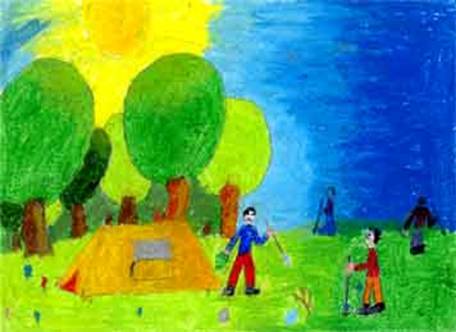
It all starts in January with the announcement in each school. It invites all the youngsters who enjoy writing to send their stories, poems and plays and every year lots of postings are delivered to the organizers of the project who usually are writers themselves. They read everything they have got and then choose about 30 authors from about 500 participants. These 30 young people receive the invitation to "Vocation" where they will be able to find friends and the people with the same interests. I also sent some of my works once and it gave me the opportunity to go to the camp too.
The camp usually lasts for a week. Last summer it took place in Saulkrasti, a beautiful town near the Baltic Sea. We lived there in tents and ate pasta every day, but it did not matter much. During the week some writers visited the camp and read what we had written and then commented on it. I have to say that there I met the best people I have ever known and among them one of my favourite poets Janis Ramba. It was so exciting!
After the camp ended, the organizers worked on publishing a collection of our works and not long ago the book appeared and everyone can buy it in any bookshop.
You see that creative people here do have things to the way, every year the number of young writers increases and it means that the literature in Latvia has future.
Kraslava Gymnasium, Latvia.
Гимназия Краслава, Латвия
Rivers and lakes - our treasure
In Latvia there are many lakes and rivers. The region where we live, Latgale is called the Land of Blue Lakes because in Latgale there are more lakes and rivers than in any other of three Latvian regions, Kurzeme, Vidzeme and Zemgale. In total there are 5000 lakes that occupy 110 thousand sq. km of the territory of Latvia. Many lakes and rivers distinguish with their peculiarities. These are the most famous lakes in Latvia:
Dridzis is the deepest lake in all three Baltic states (65,1 m).
Lake Lubans is the biggest lake in Latvia (87 sq. km).
Lake Usma is situated in the oldest natural reserve, Moricsalas reserve founded in 1912.
The banks of lake Kanieris have medical muds.
Lakes Babites, Limbazhu and Papes are the cleanest lakes with lots of fish.
In Lakes Ropazhu, Bullu and Ilzinas there are floating islands.
Near lakes Engure and Babite more birds than near any other lake live.
The bottom of lake Pitela is covered with peat layer.
In Latvia there are 4 big rivers: the Daugava, the Gauja, the Lielupe and the Venta.
The length of the Daugava is 1020 km, but only 357 km are in Latvia.
There are three power stations on it in Plavinas, Kegums and Riga.
The Gauja is the longest Latvian river (452km).
The river Lielupe has most tributaries (more than 250), the biggest are Musa (165km) and Memele (191km).
On the river Venta there is the biggest waterfall in Latvia, Ventas Rumba (2m high).
Rivers and lakes are the main beauty of Latvia.
Water pollution
Water pollution increases together with the technical and industrial development of the country. Rivers first of all are polluted by drain water that contains wastes. Water pollution increases due to the wastes thrown and poured into rivers and lakes or thrown and left near them. Some people used to wash cars in rivers and lakes. Fortunately, there is no navigation on our rivers and lakes and it protects them from oil products. To improve the situation the authorities should forbid polluting water with wastes and washing cars in or near rivers and lakes. They should also better clean drain water building new water cleaning stations and using modern technologies.
Kraslava Gymnasium, Latvia.
Гимназия Краслава, Латвия
Literary characters in Latvian fairy-tales
Latvian people have very many fairy-tales and in many of them you can meet the same characters. The most typical fairy-tale heroes are three brothers, two of them clever and the third one silly. His name is usually Fool, but he proves to be much cleverer than his brothers. He frequently gains a victory over the dragon with nine heads, marries the king's daughter and inherits half of the country. Clever brothers stay with empty hands.
The second popular folklore character is a herdsboy who usually meets with the devil. Sometimes the characters of fairy-tales are orphans who suffer from their stepmother's despise. Of course, all fair-tales end well and orphans forgive their stepmothers.
In fairy-tales about animals typical Latvian animals - foxes, hares, wolves and bears act. Foxes are very cunning and fool even the cleverest animals. Hares are mostly fat and wolves' best friends. Bears are clumsy, but clever. Wolves trust all animals and it`s easy to fool them.
Latvian fairy-tales are rich in interesting characters and full of wonders and as in every country, they are loved by small children.
