

Партнерка на США и Канаду по недвижимости, выплаты в крипто
- 30% recurring commission
- Выплаты в USDT
- Вывод каждую неделю
- Комиссия до 5 лет за каждого referral
HOME READING UNIT 4
· Before you read
ü What do you know about genetic engineering?
ü Do you think it is safe to eat genetically modified food?
ü Would you like to clone something or someone?
ü Have you read any books – scientific or fiction – about cloning?
ü Are there any films where the issue of human cloning comes up?
ü Is cloning a matter of technology, ethics or politics?
· Match these words with their synonyms and antonyms.
Words 1. endanger 2. extract 3. unique 4. extinction 5. replica 6. particular 7. identical 8. create 9. latest 10. brilliant 11. improve 12. move ahead | Synonyms A. copy B. special C. take out D. threaten E. death F. exclusive G. recent H. make better I. progress J. same K. intelligent L. make | Antonyms a. survival b. original c. protect d. insert e. general f. common g. fall behind h. destroy i. different j. stupid k. make worse l. old |
Cloning
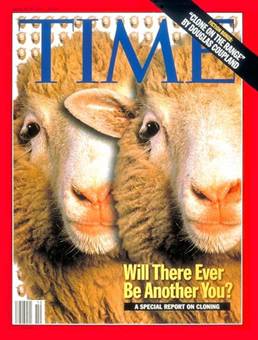 It used to be only in science fiction that the existence of a race of identical creatures could be imagined: a group of people with exactly the same hair colour, the same features and the same height. However, now this dream – or nightmare – could actually become reality. In theory, the process of creating replicas of any living being seems quite simple. First, a body cell, which contains the specific genes of a living organism, splits in two. The resulting new cells, each containing the same genes, then grow into two new, identical organisms. This process is known as cloning, and it can be applied to humans, animals, insects and plants.
Early experiments with cloning took place using the tadpoles of frogs. In 1968, Dr J. B. Gurdon of Oxford University, England, took an unfertilized frog’s egg from a frog – let us call it frog number 1 – and destroyed its nucleus. This meant that he had removed all the genetic information which related to this frog. He then inserted a new nucleus extracted from a cell from another frog – frog number two. The tadpole which developed from the egg produced by frog number 1 was identical to frog number 2, not to frog number 1! It was not until 1996, however, in Scotland, that a group of British researchers led by Ian Wilmut achieved the successful cloning of an adult animal. The result was Dolly, who has taken her place in the history books as the first lamb to be cloned from DNA of an adult sheep.
Following the birth of Dolly, both scientists and ordinary people have begun to think about the possibilities of cloning. The latest technology now means that we can remove body cells from the best of our race, the brilliant scientist, the musical genius, the child prodigy, and ensure that the same genes are reproduced in as many babies as we wish. However, cloning does not mean copying. The process actually takes its name from the Greek word clon which means a twig. A twig has the same genetic information as the tree it comes from, but the two look very different. In the same way, a clone shares the same genes as its donor, but its behaviour and characteristics will be different: personality will always be unique.
Science has provided us with knowledge which seems to have unlimited possibilities. We can not only make designer human beings, but we can also use cloning to improve health. For example, scientists predict that in the future, pigs with organs that could be used in human transplants could be cloned. Cloning could also enable us to learn more about the embryo and how organisms develop. Cloning could put an end to the risk of extinction of the endangered species on our planet; if animals can be cloned, they will never die out.
However, the process is very controversial. Some people have asked whether a cloned individual would really be a human; would it have a soul? Would there be relationships and responsibilities between donors and clones? What would be the position of the children of donors in relation to clones? These people are concerned that cloning, or genetic engineering, would interfere with the laws of religion or nature. Others are concerned that it might lead to attempts to alter the features of a particular race and result in a new kind of ethnic cleansing. The fact is that the new opportunities offered by science have always meant that we are faced with new ethical questions. These questions need to be discussed and evaluated before we move ahead.
· After you read
I. Choose the best title for each paragraph. There is one title, which you do not need to use.
CLONING OF LIVING BEINGS BENEFITS OF CLONING COPYING AND CLONING MORE DISADVANTAGES
ETHICAL PROBLEMS POSSIBLE FUTURE
II. Answer the following questions.
1. When did the first attempts to create a clone take place? What happened?
2. Who’s Dolly? Why is she famous?
3. In what ways is cloning different from copying?
4. Give examples of how cloning could be beneficial to humans.
5. What are the disadvantages of cloning from an ethical point of view?
III. Think of at least one more question to the text your partners should answer.
IV. Find words in the text that mean the following:
1) exactly the same
2) a typical quality of something
3) the distance from the top to the bottom of something
4) an exact copy of an object
5) to have something inside, to include something
6) to divide into two or more parts
7) the smallest basic unit of a plant or an animal
8) to take something away from somewhere
9) to put something inside something else
10) to remove or take out something
11) to succeed in finishing something, to reach an aim after a lot of work
12) to grow, to change into a more advanced form
13) the newest, the most modern
14) a very talented child
15) very special, unusual, the only one of its kind
16) to give someone something that they need
17) to make something better
18) to make someone able to do something
19) to say that something will happen in the future
20) a group of living organisms, a kind or a sort
21) to change something
V. Find these words in the text:
существование, кошмар, головастик, неоплодотворенный, ядро, ДНК, гарантировать (обеспечивать, удостовериться), веточка, поведение, вымирание, находящиеся на грани вымирания виды, спорный (противоречивый), ответственность (обязанности), обеспокоенный (озабоченный, встревоженный), привести к, вмешиваться в (сталкиваться с), конкретный (отдельный, особый), возможности, предлагать, попытка, столкнуться лицом к лицу, оценить
VI. Translate the sentences into Russian.
1. It used to be only in science fiction that the existence of a race of identical creatures could be imagined.
2. In theory, the process of creating replicas of any living being seems quite simple.
3. It was not until 1996 in Scotland, that a group of British researchers led by Ian Wilmut achieved the successful cloning of an adult animal.
4. Science has provided us with knowledge which seems to have unlimited possibilities.
5. Some people are concerned that genetic engineering would interfere with the laws of religion or nature. Others are concerned that it might lead to attempts to alter the features of a particular race and result in a new kind of ethnic cleansing.
6. The fact is that the new opportunities offered by science have always meant that we are faced with new ethical questions.
VII. Translate the sentences into English. Use the words from the text:
1) У последней модели телефона есть несколько интересных особенностей.
2) Не ходи туда, если боишься высоты.
3) Я потерял файл, содержащий важные документы.
4) Учитель разбил (разделил) класс на (into) три группы.
5) Ядро каждой клетки содержит основную наследственную (hereditary) информацию.
6) Я бы хотел вставить несколько предложений в этот абзац. (paragraph)
7) Врач извлек кусочки стекла из глаза мальчика.
8) Он усердно работал и достиг своей цели.
9) Родителям следует развивать способности ребенка.
10) Учитель хотел поговорить с родителями Тома о его поведении.
11) Полиция не предоставила никакой информации по этому делу. (case)
12) Лучший способ улучшить разговорный английский — поехать в Великобританию.
13) Интернет позволяет (дает возможность) нам общаться с людьми по всему миру.
14) Ученые предсказывают вымирание некоторых видов животных в ближайшем будущем.
15) Его аргументы слишком противоречивы.
16) Он забыл о своих обязанностях.
17) Меня беспокоит его здоровье.
18) Это их проблемы, я не собираюсь вмешиваться.
19) Эта выставка (exhibition) предоставляет уникальную возможность увидеть ранние картины знаменитого художника.
20) Это исследование позволит нам оценить влияние глобального потепления на различные виды животных.
VIII. Watch the video http://www. /watch? v=rPzSXPTt_Fk (2 minutes). You may need these words:
a wooly mammoth – мамонт, покрытый шерстью, conceivably – предположительно, возможно, to resurrect – воскресить
Answer the questions:
1) When did wooly mammoths live? Why did they die out?
2) How can a mammoth be cloned? What made this discovery possible?
3) What is the practical application of this discovery?
4) When will cloning a mammoth be possible? How much will it cost?
5) Do you think it's a good idea? Can it cause any problems?
IX. Discussion
Should human cloning be banned? Present arguments for and against, discuss in groups.
