


Партнерка на США и Канаду по недвижимости, выплаты в крипто
- 30% recurring commission
- Выплаты в USDT
- Вывод каждую неделю
- Комиссия до 5 лет за каждого referral
ZOYA PROSHINA
THEORY OF TRANSLATION
(ENGLISH AND RUSSIAN)
3d edition, revised
Vladivostok
Far Eastern University Press
2008
ББК 81.2-923
П 78
Рецензенты:
, канд. филол. наук, профессор;
Элизабет Стэнсиу (языковой редактор), магистр гум. наук, волонтер Корпуса мира
П 78 ТЕОРИЯ ПЕРЕВОДА (с английского языка на русский и с русского языка на английский): Уч. на англ. яз. – Владивосток: Изд-во Дальневост. ун-та, 2е изд., перераб.), 2е изд., испр. и перераб.), 1е изд.)
ISBN -2
Учебник по теории перевода предназначен для студентов переводческих отделений. Созданный на основе типовой программы по переводу, он раскрывает такие разделы, как общая и частная теория перевода; последняя основывается на сопоставлении английского и русского языков.
Может быть рекомендован студентам, преподавателям, переводчикам-практикам и всем тем, кто интересуется вопросами изучения иностранных языков и перевода.
П ББК 81.2-923
180(03)-99
(С) Издательство
Дальневосточного
университета ISBN
CONTENTS
ПРЕДИСЛОВИЕ 6
PART I. GENERAL ISSUES OF TRANSLATION 7
CHAPTER 1. What Is Translation? 7
§ 1. TRANSLATION STUDIES. 7
§ 2. SEMIOTIC APPROACH.. 8
§ MUNICATIVE APPROACH.. 9
§ 4. DIALECTICS OF TRANSLATION.. 11
§ 5. TRANSLATION INVARIANT. 12
§ 6. UNIT OF TRANSLATION.. 13
Chapter 2. TYPES OF TRANSLATION 14
§ 1. CLASSIFICATION CRITERIA.. 14
§ 2. MACHINE TRANSLATION.. 15
§ 3. TRANSLATION AND INTERPRETING.. 17
§ 4. FUNCTIONAL CLASSIFICATION.. 21
Chapter 3. EVALUATIVE CLASSIFICATION OF TRANSLATION 21
§ 1. ADEQUATE AND EQUIVALENT TRANSLATION.. 21
§ 2. LITERAL TRANSLATION.. 23
§ 3. FREE TRANSLATION.. 25
§ 4. THE CONCEPT OF ‘UNTRANSLATABILITY’ 26
CHAPTER 4. Translation Equivalence 28
§ 1. TYPES OF EQUIVALENCE.. 28
§ 2. PRAGMATIC LEVEL. 29
§ 3. SITUATIONAL LEVEL. 30
§ 4. SEMANTIC PARAPHRASE.. 30
§ 5. TRANSFORMATIONAL EQUIVALENCE.. 31
§ 6. LEXICAL AND GRAMMATICAL EQUIVALENCE.. 32
§ 7. THE LEVELS OF EQUIVALENCE HIERARCHY. 32
CHAPTER 5. Ways of Achieving Equivalence 33
§ 1. TYPES OF TRANSLATION TECHNIQUES. 33
§ 2. TRANSLATION TRANSCRIPTION.. 34
§ 3. TRANSLITERATION.. 36
§ 4. CАLQUE TRANSLATION.. 39
§ 5. GRAMMAR TRANSFORMATIONS. 40
§ 6. LEXICAL TRANSFORMATIONS. 41
§ PLEX TRANSFORMATIONS. 44
CHAPTER 6. Translation Models 46
§ 1. TRANSLATION PROCESS. 46
§ 2. SITUATIONAL MODEL OF TRANSLATION.. 47
§ 3. TRANSFORMATIONAL MODEL OF TRANSLATION.. 49
§ 4. SEMANTIC MODEL OF TRANSLATION.. 50
§ 5. PSYCHOLINGUISTIC MODEL OF TRANSLATION.. 51
PART III. GRAMMAR PROBLEMS OF TRANSLATION 52
Chapter 1. FORMAL DIFFERENCES BETWEEN SOURCE TEXT AND TARGET TEXT 53
Chapter 2. TRANSLATING FINITE VERB FORMS 54
§1. TRANSLATING TENSE AND ASPECT FORMS. 55
§2. TRANSLATING PASSIVE VOICE FORMS. 57
§3. TRANSLATING THE SUBJUNCTIVE MOOD FORMS. 60
Chapter 3. TRANSLATING NON-FINITE VERB FORMS 62
§1. TRANSLATING THE INFINITIVE.. 62
§2. TRANSLATING THE GERUND.. 65
§3. TRANSLATING THE PARTICIPLE.. 66
§4. TRANSLATING ABSOLUTE CONSTRUCTIONS. 69
Chapter 4. TRANSLATING CAUSATIVE CONSTRUCTIONS 73
§1. TYPES OF CAUSATIVE CONSTRUCTIONS. 73
§2. CONSTRUCTIONS WITH CAUSAL VERBS. 73
§3. CONSTRUCTIONS WITH THE VERBS TO HAVE, TO GET. 74
§4. CAUSATIVE CONSTRUCTIONS WITH NON-CAUSAL VERBS. 76
Chapter 5. TRANSLATING PRONOUNS 77
§1. TRANSLATING PERSONAL PRONOUNS. 77
§2. TRANSLATING POSSESSIVE PRONOUNS. 80
§3. TRANSLATING RELATIVE PRONOUNS. 81
§4. TRANSLATING THE PRONOUN ONE.. 82
§5. TRANSLATING THE PRONOUNS КАЖДЫЙ / ВСЕ.. 83
§6. TRANSLATING PARTITIVE PRONOUNS SOME / ANY. 84
§7. TRANSLATING DEMONSTRATIVE PRONOUNS. 85
Chapter 6. TRANSLATING THE ARTICLE 87
§1. TRANSLATING THE INDEFINITE ARTICLE.. 87
§2. TRANSLATING THE DEFINITE ARTICLE.. 89
§3. TRANSLATING THE ZERO ARTICLE.. 90
Chapter 7. TRANSLATING ATTRIBUTIVE CLUSTERS 92
§1. FEATURES OF THE ATTRIBUTIVE PHRASE.. 92
§2. TRANSLATING THE ATTRIBUTIVE CLUSTER. 93
Chapter 8. SYNTACTIC CHANGES IN TRANSLATION 96
§MUNICATIVE STRUCTURE OF THE ENGLISH AND RUSSIAN SENTENCE.. 96
§2. WORD ORDER CHANGE DUE TO THE FUNCTIONAL SENTENCE PERSPECTIVE.. 98
§3. SENTENCE PARTITIONING AND INTEGRATION.. 99
Chapter 9. DIFFERENCE IN ENGLISH AND RUSSIAN PUNCTUATION 101
§1. PRINCIPLES OF PUNCTUATION IN ENGLISH AND RUSSIAN.. 101
§2. DIFFERENCES IN COMMA USAGE.. 102
§3. USING THE DASH.. 105
§4. USING QUOTATION MARKS. 105
§5. USING THE COLON AND SEMICOLON.. 106
§6. USING THE ELLIPSES. 107
PART IV. SEMANTIC PROBLEMS OF TRANSLATION 109
Chapter 1. WORD CHOICE IN TRANSLATION 109
§1. TYPES OF TRANSLATION EQUIVALENTS. 109
§2. INTERACTION OF WORD SEMANTIC STRUCTURES. 110
§3. WORD CONNOTATION IN TRANSLATION.. 111
§4. INTRALINGUISTIC MEANING.. 113
§5. CONTEXUALLY-BOUND WORDS. 114
Chapter 2. TRANSLATING REALIA 116
§1. CULTURE-BOUND AND EQUIVALENT-LACKING WORDS. 116
§2. TYPES OF CULTURE-BOUND WORDS. 117
§3. WAYS OF TRANSLATING CULTURE-BOUND WORDS. 118
§4. TRANSLATING PEOPLE’S NAMES. 120
§5. TRANSLATING GEOGRAPHICAL TERMS. 123
§6. TRANSLATING PUBLISHED EDITIONS. 124
§7. TRANSLATING ERGONYMS. 125
Chapter 3. TRANSLATING TERMS 125
§1. TRANSLATION FACTORS. 125
§2. TRANSLATION TECHNIQUE.. 128
§3. TERMS IN FICTION AND MAGAZINES. 130
Chapter 4. TRANSLATOR’S FALSE FRIENDS 132
Chapter 5. PHRASEOLOGICAL AND METAPHORICAL TRANSLATION 135
§1. METAPHOR AND THE PHRASEOLOGICAL UNIT. 135
§2. INTERLINGUAL METAPHORIC TRANSFORMATIONS. 136
§3. WAYS OF TRANSLATING IDIOMS. 137
§4. CHALLENGES IN TRANSLATING IDIOMS. 139
Chapter 6. METONYMICAL TRANSLATION 141
§1. DEFINITIONS. 141
§2. LEXICAL METONYMIC TRANSFORMATION.. 143
§3. PREDICATE TRANSLATION.. 143
§4. SYNTACTIC METONYMIC TRANSFORMATIONS. 145
Chapter 7. ANTONYMIC TRANSLATION 147
§1. DEFINITION.. 147
§2. CONVERSIVE TRANSFORMATION.. 147
§3. SHIFTING NEGATIVE MODALITY. 148
§4. REASONS FOR ANTONYMIC TRANSLATION.. 149
Chapter 8. DIFFERENCES IN RUSSIAN AND ENGLISH WORD COMBINABILITY 150
§1. REASONS FOR DIFFERENCES IN WORD COMBINABILITY. 150
§2. TRANSLATION OF ADVERBIAL VERBS. 152
§3. TRANSLATING CONDENSED SYNONYMS. 154
Chapter 9. TRANSLATING NEW COINAGES: DIFFERENCES IN RUSSIAN AND ENGLISH WORD BUILDING 155
§POUNDS. 155
§2. CONVERSION.. 157
§3. AFFIXATION.. 159
§4. ABBREVIATION.. 161
PART V. PRAGMATIC PROBLEMS OF TRANSLATION 165
Chapter 1. TRANSLATION PRAGMATICS 165
§1. CONCEPT OF PRAGMATICS. 165
§2. TEXT PRAGMATICS. 166
§3. AUTHOR’S COMMUNICATIVE INTENTION.. 168
§MUNICATIVE EFFECT UPON THE RECEPTOR.. 172
§5. TRANSLATOR’S IMPACT. 175
Chapter 2. SPEECH FUNCTIONS AND TRANSLATION 176
§1. LANGUAGE AND SPEECH FUNCTIONS. 176
§2. INTERPERSONAL FUNCTION AND MODALITY IN TRANSLATION. 177
§3. EXPRESSIVE FUNCTION IN TRANSLATION.. 183
§4. PHATIC FUNCTION IN TRANSLATION.. 187
§5. CONATIVE FUNCTION IN TRANSLATION.. 191
Chapter 3. FUNCTIONAL STYLES AND TRANSLATION 194
§1. FUNCTIONAL STYLE, REGISTER: DEFINITION.. 194
§2. TRANSLATING SCIENTIFIC AND TECHNICAL STYLE.. 195
§3. TRANSLATING BUREAUCRATIC STYLE.. 199
§4. TRANSLATING JOURNALISTIC (PUBLICISTIC) STYLE.. 203
Chapter 4. RENDERING STYLISTIC DEVICES IN TRANSLATION 208
§1. TRANSLATION OF METAPHORS AND SIMILES. 208
§2. TRANSLATION OF EPITHETS. 211
§3. TRANSLATION OF PERIPHRASE.. 212
§4. TRANSLATION OF PUNS. 214
§5. TRANSLATION OF ALLUSIONS AND QUOTATIONS. 217
Chapter 5. TRANSLATION NORMS AND QUALITY CONTROL OF A TRANSLATION 217
§1. NORMS OF TRANSLATION.. 218
§2. QUALITY CONTROL OF THE TRANSLATION. 222
Chapter 6. TRANSLATION ETIQUETTE 226
§1. PROFESSIONAL ETHICS, ETIQUETTE, AND PROTOCOL. 226
§2. CODE OF PROFESSIONAL CONDUCT. 227
§3. PROTOCOL CEREMONIES. 229
APPENDIX
Russian-English Transliteration Chart 232
APPENDIX
Russian-English-Chinese Transliteration Chart 233
ПРЕДИСЛОВИЕ
В настоящее время теоретические вопросы перевода привлекают внимание не только профессиональных переводчиков, лингвистов, но и всех тех, кто по роду своей деятельности вынужден общаться на английском языке с зарубежными коллегами и партнерами. Литература по сопоставлению русского и английского языков не вполне отвечает потребностям общества, во-первых, в связи с малочисленностью ее тиражирования; во-вторых, в связи с тем, что, как правило, в ней делается упор либо на чисто теоретические моменты перевода, либо на какие-то, достаточно ограниченные, аспекты переводческой деятельности и, в-третьих, в ней совсем не отражена специфика перевода с английского и русского языков как языков-посредников в странах Азиатско-Тихоокеанского региона. В данном учебнике сделана попытка отразить последние два момента.
Учебник построен в соответствии с программой по курсу «Теория перевода» и состоит из пяти частей. Часть I соответствует курсу «Введение в общую теорию перевода» и дает знакомство с общими понятиями и основной терминологией переводоведения. Часть II представляет краткий экскурс в историю перевода. Часть III раскрывает грамматические проблемы перевода с английского языка на русский и с русского на английский. В части IV излагаются семантические проблемы перевода с указанных языков, и часть V знакомит читателя с основными проблемами прагматики перевода, особенностями употребления английского и русского языков.
Данный учебник построен на материале лекций, читаемых автором студентам переводческого отделения ДВГУ, поэтому в нем в определенной мере компилируются взгляды известных теоретиков перевода, что неизбежно при составлении такого жанра как учебник.
PART I. GENERAL ISSUES OF TRANSLATION
CHAPTER 1. What Is Translation?
§ 1. TRANSLATION STUDIES
The second half of the 20th century has seen the in-depth study of translation, which is sometimes called Theory of Translation, Science of Translation, Translation Linguistics, or even Translatology.
It has been claimed abroad that translation studies began in 1972 with Holmes’s paper presented at the Third International Congress of Applied Linguistics, “The Name and Nature of Translation Studies”.1 However, unfortunately, European and American scholars seemed to have been unaware of the achievements of the Russian school of translation studies. Works by V. Komissarov, A. Shveitser, A. Fedorov and many others confirmed the status of translation studies as a discipline of its own even in the 1950s.2
The main concern of translation theory is to determine appropriate translation methods for the widest possible range of texts3 and to give insight into the translation process, into the relations between thought and language, culture and speech.
There are several aspects of this branch of linguistics:
· General theory of translation, whose object is general notions typical of translation from any language.
· Specific (or partial, in terms of Holmes) theory of translation that deals with the regularities of translation characteristic of particular languages - for example, translation from English into Russian and vice versa.
· Special (partial) theory of translation that pays attention to texts of various registers and genres.
There are two terms corresponding to the Russian word “перевод”: translation and interpretation. Those who discriminate between the terms refer the term ‘translation’ to the written text, and the term ‘interpretation’ to oral speech. However, the terms are polysemantic: to interpret might mean “to render or discuss the meaning of the text” – an outstanding British translation theorist P. Newmark, for example, states that “when a part of a text is important to the writer’s intention, but insufficiently determined semantically, the translator has to interpret”.4 The term to translate is often referred to any (written or oral) manner of expression in another language.
We should also differentiate the terms translating and rendering. When we translate, we express in another language not only what is conveyed in the source text but also how it is done. In rendering, we only convey the ideas (the what) of the source text.
Several approaches are used for defining translation.
§ 2. SEMIOTIC APPROACH
Language system is the part of semiotics dealing with sign systems. Therefore, semiotic theories may be applied to language functioning. According to the semiotic approach, translation is language code switching. When translating, we switch from one language to another one.
American linguist Roman Jakobson in his article “On Linguistic Aspects of Translation”5 spoke of three possibilities of code switching:
1) Intralinguistic translation, or rewording, i. e. interpreting verbal signs through other signs of the same language. This can be done on diachronic level: Chaucer’s text is translated into modern English. When done on synchronic level, this kind of code switching is called a paraphrase. We often deal with paraphrasing when trying to explain or define things. For example, to explain the meaning of the phrase I am not much of a cook, we can paraphrase it by I do not like to cook, or I do not cook well. In the theory of translation, this type of code switching is called a transformation. Intralinguistic transfer can also be illustrated by stylistic differentiation, as is done in the following Russian text switching from the expressive publicistic register to a very formal style of the police report: Катя уже в полной горячке обрушилась на инспектора («обвинила работников милиции в равнодушии и жестокости»). И, боясь не выдержать и расплакаться, вскочила и убежала. («Разъяснительную работу провести не удалось ввиду крайней недисциплинированности девочки»).6
2) Interlanguage translation, i. e. substituting verbal signs of one language by verbal signs of another language, or switching from one language code to another one. This type of code switching is translation proper, the object of Translation Studies.
3) Intersemiotic translation, i. e. substituting signs of one semiotic system by signs of a different semiotic system. In its broad meaning, the term implies transmutation and can be illustrated by decoding some ideas and themes expressed, for example, in a poem through the “language” of music or dance.
Other linguists adhere to the semiotic approach to translation. J. Catford, for example, defines translation as “the replacement of textual material in one language (SL) by equivalent textual material in another language (TL).”7
§ MUNICATIVE APPROACH
We communicate to transfer information from one person to another. Translation helps people communicate if they speak different languages.
Thus, translation is a two-facet phenomenon: on the one hand, it is the process of transferring information; on the other hand, it is the result of this the result is meant a new text created in translating.
The communicative situation consists of several elements:
 |
 |
 |
 |
 |
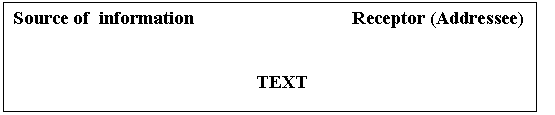

A speaker or writer (an author) makes a meaningful utterance called the text and addresses it to the listener, reader, or receptor, who understands the purport of the text and reacts to it.


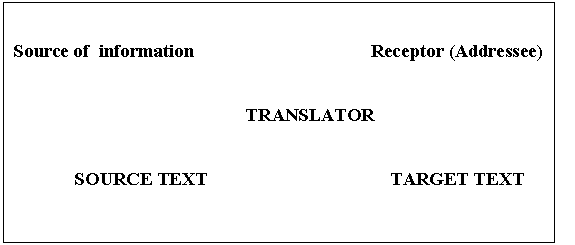 The translation situation doubles the elements of communication.8 The receptor of the original text in turn becomes a translator who makes a translated text, or target text intended for the receptor speaking another language:

 The source text is the text to be translated. The target text is the end-product, the translated text.
For the translation to be adequate and effective, the target text should be equivalent to the source text. Indeed, when reading tragedies by Shakespeare in Russian, the receptor is but seldom aware that the words s/he sees in the text were not written by Shakespeare but by some other person, a translator. The form of the target text is new but the purport and the content are very close to the original. Paradoxically, the better a translator's work, the less his/her work is observed. The translated text is attributed to the author speaking another language and this text is used everywhere as if it were the original.
Thus translation unifies two different language speech acts in one communicative situation. It can be defined as a special type of communication intended to convey information between the participants speaking two different languages. As E. Nida and C. Taber put it, “translating consists of reproducing in the receptor language the closest natural equivalent of the source-language meaning and secondly in terms of style.”9
§ 4. DIALECTICS OF TRANSLATION
1. Inseparability of form and meaning.10
A translator is to convey not only the ideas and themes of the source text (meaning, sense); s/he should also pay attention to the adequate form to express these ideas. S/he should not become carried away with a free (loose) form of translation, nor force the target language by following the source text word for word. A translator always bears in mind a stardard language of the target text, for, as W. Benjamin put it figuratively, «while content and language form a certain unity in the original, like a fruit and its skin, the language of the translation envelops its content like a royal robe with ample folds.» 11
2. Social functions.
Translation does not exist outside of society. It appeared in society when communities began to trade and exchange ideas. At the same time, translation helps the world community develop. Nations could hardly have achieved the technological success as it is in the 20th century if there had been no translations in electronics, physics, chemistry and other branches of science and technology.
According to the Encyclopedia Britannica12, in the 20th century most of the world’s people speak one of about 75 primary languages. A small minority speak one of 450 secondary languages, and more than 4,400 other languages are in use. Without translation and translators the world would not be able to progress.
4.Translation and culture are inseparable.
Translation could not have developed without culture. Literature, science, and philosophy influence translators’ conceptualizations. On the other hand, culture could not have developed without translation, since translations enrich nations with the cultural values of other nations.
3. Reflection and creativity in translation.
Translation reflects the source text but it does not copy it. To translate adequately, a translator must do his or her best to find a proper means of expression. A translator bears in mind that the receptor has a cultural background other than that of a receptor of the original text; therefore, s/he has to be very resourceful in producing the same impact upon the receptor as that of the source text. Special problems arise in translating dialects, foreign speech, puns, poetry, etc. And a translator is in constant search for new tools to solve translation problems.
4. Translation is an art and a science.
Translation is dominated by objective, scientific, and linguistic description and explanation. At the same time it is a subjective choice of means preserving stylistic equivalence of the source text.
§ 5. TRANSLATION INVARIANT
Many linguistic terms have been borrowed from mathematics. Translation invariant is one of translation invariant we mean what is in common between the two expressions, a source one and a target one, after our manipulations and transformations of variable phrases.
By translation invariant we should understand the semantic equivalence of the source and the target texts.13
Some linguists, however, consider the notion to be broader than this definition. They suppose that it is the real situation described by the text that brings together the source and the target texts.14 If the situation is understood differently, it leads to misunderstanding, which can happen in a monolanguage situation as well, and is often the basis for all sorts of comical jokes. For example, the situation in the shop:
Покупатель: Я хочу примерить платье в витрине.
Продавец: Пожалуйста, но у нас есть примерочная.
Customer: I’d like to try on the dress in the shop window.
Salesgirl: You are welcome. But we have a fitting room.
Different situations verbalized here are caused by different pragmatic emphasis. The customer presses upon trying on a featured dress whereas the salesgirl implies the impropriety of using a shop window.
If the translator of this joke had paraphrased the first sentence in a different way (I’d like to try on the dress that is in the shop window), the joke would have been lost, though the meanings of its sentences would have been equally transferred. Therefore, the invariant of translation is based not only on semantics (meaning), but also on pragmatics (communicative intention).
§ 6. UNIT OF TRANSLATION
Singling out and defining a unit of translation is a problem widely discussed in Translation Studies.
According to R. Bell, a unit of translation is the smallest segment of a source language text which can be translated, as a whole, in isolation from other segments (as small as possible and as large as is necessary).15 Should we consider a word as a translation unit? Though there exists the notion of a word-for-word translation, the word can hardly be taken for a translation unit. First of all, this is because word borders are not always clear, especially in English. Sometimes a compound word is written in one element, sometimes it is hyphenated, or the two stems are written separately as a phrase: e. g., moonlight, fire-light, candle light. On the other hand, in oral speech it is difficult to single out separate words because they tend to fuse with each other into inseparable complexes: [‘wud3э 'ko:lim?] – according to the stress, there should be two words, while in written speech we can see four words: Would you call him?
Furthermore, it is impossible to consider a phrase (word combination) as a translation unit, because its bounderies are also vague.
Thus, it is not a language unit that should be considered in translation, but a discourse (speech) unit. A translation unit is a group of words united in speech by their meaning, rhythm and melody, i. e. it is a syntagm, or rhythmic and notional segment of speech.
This definition of the unit of translation is process-oriented. If considered from a product-oriented point of view, it can be defined as the target-text unit that can be mapped onto a source-text unit.16
Chapter 2. TYPES OF TRANSLATION
§ 1. CLASSIFICATION CRITERIA
There are some criteria for classifying translation:
1) The first one is based on who does the translation. These days translation may be done by a human translator or by computer.
2) Form of speech: according to this criterion, translation as a written form, sight translation (or translation-at-sight, on-sight translation) as the oral translation of written text, and interpreting as oral translation of oral discourse are differentiated. This criterion also involves subtitling, that is visual translation involving the superimposition of written text onto the screen, and dubbing, or the replacement of the original speech by a voice track which attempts to follow as closely as possible the timing, phrasing and lip movements of the original dialogue.
3) Source text perception: a translator can see or hear the text.
4) Time lapse between the source text perception and translation: consecutive and simultaneous interpreting.
5) Number of languages in translation situation: one-way or two-way translation.
6) Direction of translation: direct translation, that is, translation into the mother-tongue, and inverse translation, or translation into a foreign language.
7) Methods of interpreting: note-taking interpretation, phrase-by-phrase interpretation
8) Functional style and genre of the text: literary works and informative texts.
§ 2. MACHINE TRANSLATION
The first idea of machine translation is known to have been expressed in 1933 by the Soviet engineer Petr Smirnov-Troyansky but it is not he but Warren Weaver who is credited as the founding father of Machine Translation (MT) research.17 The first demonstration of an MT system took place in 1954 in Georgetown University, U. S.A., where the experiment of making a computer translate words from Russian into English was conducted.
Machine translation is based on analysis and synthesis operations and has required many years of hard work and frustrations. Sometimes the end-product of the machine translation was so ridiculous (like Out of sight, out of mind. – Слепой идиот), that in the 1960s there happened a machine translation ‘recession’. However, with third-generation computer systems emerging in the 1970s, interest in machine translation was revived. Word-processors appeared and today’s translators cannot imagine their lives without them.
Today, machine translation is often called computer-aided translation (CAT). CAT systems are divided into two groups: machine-aided human translation (MAHT) and human-aided machine translation (HAMT). The difference between the two lies in the roles of computer and human translator.
In MAHT, a translator makes the translation, then uses the computer as a tool for typing, checking spelling, grammar, style; for printing the target text, for looking up words in electronic dictionaries and data bases, for getting references on CD-ROMs and other sources, for consulting about contexts, for discussing problems in the web, for seaching a job, etc.
In HAMT, the translation is automated, done by a computer but requiring the assistance of a human editor. There are two phases of human help: pre-editing and post-editing. In pre-editing, an operator (or a customer) prepares the text for input. A special computer translation program transfers the text from one language to another. Then a translator does the post-editing, mostly by correcting the word usage.
Machine translation has a number of advantages and disadvantages. The advantage is, first and foremost, its fast speed, which saves time, so important these days. The computer is tireless; it can work day and night. Now that there are lap-tops, a computer is a very flexible and convenient tool: it can accompany a translator puters are also of great help to disabled people, especially computers working with a human voice.
On the other hand, computers are restricted to the materials. They can translate only clichéd texts. They cannot translate unpredictable texts, like fiction, for example. Usually they provide ‘raw translation’. Another disadvantage is that they are still rather expensive. They require constant upgrading, which is usually not puter viruses are a serious danger to work. And computers are not absolutely safe for human health, either.
§ 3. TRANSLATION AND INTERPRETING
Difference in written translation and interpreting has been fixed by two international professional associations: F. I.T. (Fédération Internationale des Traducteurs) or the International Federation of Translators, the association of written translators; and A. I.I. C. (Association Internationale des Interprètes de Conferénce), or the International Association of Conference Interpreters, dealing with oral translation.
As is seen from the name of the professional association, interpreters are often called conference interpreters, though their functions can be much broader. Conference interpreting is known to have started after World War I, at the Conference on the Preliminaries of Peace in 1919. Until then all international meetings had been held in French, the language of 19th century diplomacy.
The first conference interpreters did consecutive interpreting, i. e. they delivered their translation after listening to the speaker so that there was some time between the source language text and the translation. The interpreters worked in teams of two, each into his mother tongue. At the League of Nations, interpreters went to the rostrum to deliver their translation as soon as the speaker had finished. Occasionally speeches lasted well over an hour, so the interpreters, considering it bad taste to interrupt a speaker, developed a technique of consecutive interpreting with note-taking.
Two Geneva conference interpreters, J.-F. Rozan and J. Herbert, after having reviewed their own as well as their colleagues’ writing pads, came to the conclusion that although each interpreter had his or her own manner of writing, there was something common to all the notes reviewed. This brought to life recommendations to would-be interpreters on how to take notes in order to memorize the message and not to interrupt the speaker.18
Unlike shorthand, an interpreter’s system of note-taking or speedwriting is not a word-for-word recording of speech. It is based on the conceptual representation of the message utterance by utterance and helps to single out the main idea of the speaker. The main principles of note-taking are as follows:
· only key-words and the so called ‘precision’ words (i. e. words conveying unique information, e. g., proper names, statistics, etc.) are put down;
· words are contracted (vowels are omitted, the so-called Arabic approach);
· special symbols are used;
· the syntactic structure has a vertical progression:
Subject group
Predicate
Object
Object (homogeneous parts of the sentence are written one under the other).19
The ‘sentence-by-sentence’ interpreting often found in liaison and community interpretingб is not regarded now as ‘true consecutive’.20 Liaison interpreting takes place in spontaneous conversational settings,21 while community interpreting is typical of the public service sphere.22
These days consecutive interpreting is used mostly in bilateral contacts, to serve only two languages.
Interpreting may take place in two directions when the interpreter has to work for both language participants. This is a two-way, or bidirectional, translation (interpretation) and it requires a special skill of switching the languages to speak to, suppose, a Russian participant in Russian and to an English participant in English and not vice versa. A one-way interpreting means translation from one language only and is usually employed for summit meetings.
There is a sub-variety of the consecutive interpreting, known as postponed consecutive interpreting. This is a translation which is not performed in the presence of the participants, but which is dictated from the interpreter’s notes into a dictating machine or typed, in case the participants have understood the speaker but want to think over the discourse to take appropriate decisions on it.
Consecutive interpreters are also called linear interpreters, for their translation is in line with the source text unlike simultaneous translation that overlaps the original speech.
Simultaneous interpreting, i. e. interpreting almost immediately as the speaker produces the text (the interpreter can lag behind the speaker not more than 2 or 3 seconds), came into life much later, at the Nuremberg trials () and Tokyo trials () of war criminals, though some attempts had been made in the late 1920s and the early 1930s. In the USSR, simultaneous interpreting was first introduced at the 6th Congress of the Communist International in 1928, with the interpreters sitting in the front row of the conference hall trying to catch speakers’ words coming from the rostrum, and talking into heavy microphones hanging on strings from their necks.23 Isolated booths for interpreters appeared five years later, in 1933.

|
Из за большого объема этот материал размещен на нескольких страницах:
1 2 3 4 5 6 7 8 9 10 11 12 13 14 15 16 17 |
