

Партнерка на США и Канаду по недвижимости, выплаты в крипто
- 30% recurring commission
- Выплаты в USDT
- Вывод каждую неделю
- Комиссия до 5 лет за каждого referral
Зачетное задание.
Информация о белке АТФ зависимая ДНК геликаза-recQ.
Итак, данный белок относится к классу ферментов Гидролазы семейству ДНК-геликазы, подсемейству RECQ.
Белок участвует в одном из факторов рекомбинации – recF, причём ген экспрессии находится под регуляцией системы СОС-репарации. Если говорить о взаимодействии с другими субъединицами, то можно отметить взаимодействие белка с селенометионином, катионом цинка, ионом марганца II, водой. Формулы данных лигандов и количество молекул, взаимодействующих с белком указаны в след таблице:
ID | Название | Формула | Число копий | Комментарии |
MSE | SELENOMETHIONINE | C5 H11 N O2 SE | 15 | Cеленометионин |
ZN | ZINC ION | ZN 2+ | 1 | Катион цинка |
MN | MANGANESE (II) ION | MN 2+ | 1 | Катион марганца |
HOH | AQVA | H2 O | 708 | Вода |
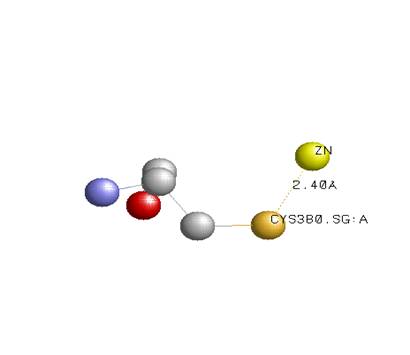
Взаимодействие лиганда цинка с белком RECQ_Ecoli наглядно показано на изображении:
Что касается особенностей последовательности: молекула белка (ATФ-зависимая ДНК – хеликаза) содержит одну цепь (цепь А), состоящую из 609 аминокислотных остатков. Мутация участка от 47 до 54 нуклеотидов не позволит связаться кофактору ATP (Potential). Последовательность в фаста-формате представлена в следующей таблице:
>RECQ_ECOLI ATP-dependent DNA helicase MAQAEVLNLESGAKQVLQETFGYQQFRPGQEEIIDTVLSGRDCLV VMPTGGGKSLCYQIPALLLNGLTVVVSPLISLMKDQVDQLQANGVAAACLNSTQTREQQ LEVMTGCRTGQIRLLYIAPERLMLDNFLEHLAHWNPVLLAVDEAHCISQWGHDFRPEYA ALGQLRQRFPTLPFMALTATADDTTRQDIVRLLGLNDPLIQISSFDRPNIRYMLMEKFK PLDQLMRYVQEQRGKSGIIYCNSRAKVEDTAARLQSKGISAAAYHAGLENNVRADVQEK FQRDDLQIVVATVAFGMGINKPNVRFVVHFDIPRNIESYYQETGRAGRDGLPAEAMLFY DPADMAWLRRCLEEKPQGQLQDIERHKLNAMGAFAEAQTCRRLVLLNYFGEGRQEPCGN CDICLDPPKQYDGSTDAQIALSTIGRVNQRFGMGYVVEVIRGANNQRIRDYGHDKLKVY GMGRDKSHEHWVSVIRQLIHLGLVTQNIAQHSALQLTEAARPVLRGESSLQLAVPRIVA LKPKAMQKSFGGNYDRKLFAKLRKLRKSIADESNVPPYVVFNDATLIEMAEQMPITASE MLSVNGVGMRKLERFGKPFMALIRAHVDGDDEE |
Остовная модель цепи:
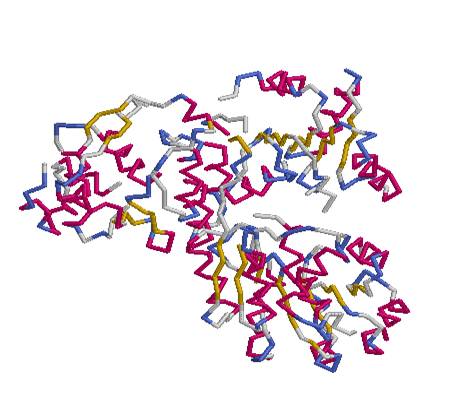
Белок относится к типу «альфа-бета», включает 27 альфа-спиралей, 19 бета-складок и 52 бета-поворота. Окраска белка по структуре:
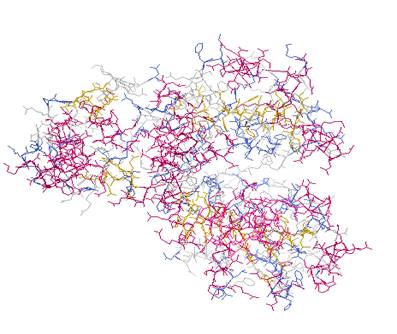
(Альфа-спираль окрашена в малиновый цвет, бета-спираль - в желтый)
RECQ_Ecoli был обнаружен у бактерии Escherichia coli, относящейся к семейству Интеробактерии. Представляет собой структуру каталитического ядра recQ.
Идентификаторы записи в PDB для данного белка следующие: 1OYW, 1OYY, 1WUD; в UniProt: RECQ_ECOLI. Ссылки на статьи про белок (на основании данных UniProt):
http://www. uniprot. org/citations/3 аннотация:
Irino N., Nakayama K., Nakayama H.
A 2,695 bp chromosomal segment of Escherichia coli K12 containing the recQ gene was sequenced. Analysis of the sequence revealed an open reading frame thought to represent recQ, with a clockwise direction of transcription relative to the standard genetic map of E. coli K12 and having a coding capacity for a protein of Mr 68,350. The -10 region of the presumptive recQ promoter overlapped the putative terminator for the upstream gene pldA, and was immediately followed by a 15 bp stretch of DNA bearing a strong resemblance to the reported sequences of LexA repressor binding sites. This latter finding suggested the possibility of SOS regulation of recQ gene expression, which was substantiated by experiments with recQ-lacZ fusions.
http://www. uniprot. org/citations/1 аннотация:
Daniels D. L., Plunkett G. III, Burland V. D., Blattner F. R.
The DNA sequence of 91.4 kilobases of the Escherichia coli K-12 genome, spanning the region between rrnC at 84.5 minutes and rrnA at 86.5 minutes on the genetic map (85 to 87 percent on the physical map), is described. Analysis of this sequence identified 82 potential coding regions (open reading frames) covering 84 percent of the sequenced interval. The arrangement of these open reading frames, together with the consensus promoter sequences and terminator-like sequences found by computer searches, made it possible to assign them to proposed transcriptional units. More than half the open reading frames correlated with known genes or functions suggested by similarity to other sequences. Those remaining encode still unidentified proteins. The sequenced region also contains several RNA genes and two types of repeated sequence elements were found. Intergenic regions include three "gray holes," 0.6 to 0.8 kilobases, with no recognizable functions.
http://www. uniprot. org/citations/9 аннотация:
Blattner F. R., Plunkett G. III, Bloch C. A., Perna N. T., Burland V., Riley M., Collado-Vides J., Glasner J. D., Rode C. K., Mayhew G. F., Gregor J., Davis N. W., Kirkpatrick H. A., Goeden M. A., Rose D. J., Mau B., Shao Y.
The 4,639,221-base pair sequence of Escherichia coli K-12 is presented. Of 4288 protein-coding genes annotated, 38 percent have no attributed parison with five other sequenced microbes reveals ubiquitous as well as narrowly distributed gene families; many families of similar genes within E. coli are also evident. The largest family of paralogous proteins contains 80 ABC transporters. The genome as a whole is strikingly organized with respect to the local direction of replication; guanines, oligonucleotides possibly related to replication and recombination, and most genes are so oriented. The genome also contains insertion sequence (IS) elements, phage remnants, and many other patches of unusual composition indicating genome plasticity through horizontal transfer.
http://www. uniprot. org/citations/, аннотация:
Riley M., Abe T., Arnaud M. B., Berlyn M. K.B., Blattner F. R., Chaudhuri R. R., Glasner J. D., Horiuchi T., Keseler I. M., Kosuge T., Mori H., Perna N. T., Plunkett G. III, Rudd K. E., Serres M. H., Thomas G. H., Thomson N. R., Wishart D., Wanner B. L.
The goal of this group project has been to coordinate and bring up-to-date information on all genes of Escherichia coli K-12. Annotation of the genome of an organism entails identification of genes, the boundaries of genes in terms of precise start and end sites, and description of the gene products. Known and predicted functions were assigned to each gene product on the basis of experimental evidence or sequence analysis. Since both kinds of evidence are constantly expanding, no annotation is complete at any moment in time. This is a snapshot analysis based on the most recent genome sequences of two E. coli K-12 bacteria. An accurate and up-to-date description of E. coli K-12 genes is of particular importance to the scientific community because experimentally determined properties of its gene products provide fundamental information for annotation of innumerable genes of other organisms. Availability of the complete genome sequence of two K-12 strains allows comparison of their genotypes and mutant status of alleles.
http://www. uniprot. org/citations/, аннотация:
Hayashi K., Morooka N., Yamamoto Y., Fujita K., Isono K., Choi S., Ohtsubo E., Baba T., Wanner B. L., Mori H., Horiuchi T.
With the goal of solving the whole-cell problem with Escherichia coli K-12 as a model cell, highly accurate genomes were determined for two closely related K-12 strains, MG1655 and pletion of the W3110 genome and comparison with the MG1655 genome revealed differences at 267 sites, including 251 sites with short, mostly single-nucleotide, insertions or deletions (indels) or base substitutions (totaling 358 nucleotides), in addition to 13 sites with an insertion sequence element or defective prophage in only one strain and two sites for the W3110 inversion. Direct DNA sequencing of PCR products for the 251 regions with short indel and base disparities revealed that only eight sites are true differences. The other 243 discrepancies were due to errors in the original MG1655 sequence, including 79 frameshifts, one amino-acid residue deletion, five amino-acid residue insertions, 73 missense, and 17 silent changes within coding regions. Errors in the original MG1655 sequence (<1 per 13,000 bases) were mostly within portions sequenced with out-dated technology based on radioactive chemistry.
http://www. uniprot. org/citations/2 аннотация:
Escherichia coli RecQ protein is a DNA helicase. UniProtKB (1) rdf/xml
Umezu K., Nakayama K., Nakayama H.
The Escherichia coli recQ gene, a member of the RecF recombination gene family, was set in an overexpression plasmid, and its product was purified to near-homogeneity. The purified RecQ protein exhibited a DNA-dependent ATPase and a helicase activity. Without DNA, no ATPase activity was detected. The capacity as ATPase cofactor varied with the type of DNA in the following order: circular single strand greater than linear single strand much greater than circular or linear duplex. As a helicase, RecQ protein displaced an annealed 71-base or 143-base single-stranded fragment from circular or linear phage M13 DNA, and the direction of unwinding seemed to be 3'----5' with respect to the DNA single strand to which the enzyme supposedly bound. Furthermore, the protein could unwind 143-base-pair blunt-ended duplex DNA at a higher enzyme concentration. It is concluded that RecQ protein is a previously unreported helicase, which might possibly serve to generate single-stranded tails for a strand transfer reaction in the process of recombination.
