

Партнерка на США и Канаду по недвижимости, выплаты в крипто
- 30% recurring commission
- Выплаты в USDT
- Вывод каждую неделю
- Комиссия до 5 лет за каждого referral
Published in: “Crisis and sustainable business in Central and Eastern Europe” Haniel-Seminar Discussion Paper edited by Prof. Dr. Knut Richter, Alexander Klebe. European University Viadrina Frankfurt (Oder) Department of Business Administration and Economics Discussion Paper No. 282 November 2009 ISSN 1
Sergei F. Sutyrin[1]
Internationalization of Russian Economy: threats and opportunities in time of crisis[2]
1. Introduction
2. Some basic definitions
3. Blessings and curses of internationalization
4. Crises in modern Russian economic history: is internationalization of any help?
5. Conclusion
Abstract
Current economic crisis similarly to its predecessors challenges viability of various economic actors. Some of them have higher chances to survive and even to expand while others are doomed to fail. Are the firms and national economies deeply involved in various international economic transactions better equipped to stand the time of troubles in comparison with their more domestically-oriented counterparts? Present paper attempts to answer this question with respect to Russian case.
Key words: Internationalization, Russian economy, economic crisis
1. Introduction
Although it might sound almost trivial nevertheless contemporary Russian economy dramatically differs from the Soviet one. Novelty of the situation in many cases results from expansion in scope and scale of inward and outward international economic co-operation. Various firms have had different level of involvement in foreign trade, international investment, or industrial cooperation. In each specific case abovementioned difference not only has been generated by certain reasons but also has had for participating companies as well as for the national economy in general its own cost and benefits. The balance between these two might influence the overall performance substantially and ultimately predefine strategic business decisions regarding speed and magnitude of internationalization.
For at least one third of its less than two decades-long modern history Russian economic development has been accompanied by severe difficulties and malfunctions of various sorts including current economic crisis. It goes without saying that problems of early 1990s had different nature in comparison with default of August 1998 or today recession. At the same time, taking under consideration controversial effects international economic transactions might have on companies and economies involved one is really tempted to ask whether it is good or bad for them to be “international” and even “global” in time of crisis?
2. Some basic definitions
During last several decades many companies in different regions of our planet gradually became deeper and deeper involved in two closely linked and partly overlapping processes, namely internationalization and globalization. Both of these notions are widely used nowadays in all kinds of publications and discussions. Nevertheless, with regard to their actual meanings views differ substantially indeed. Under the circumstances it looks sensible enough to introduce more or less precise definitions the present paper will rely upon.
Let’s start with internationalization. Being perceived from microeconomic point of view in a proper sense of a word it assumes gradual process of relatively large-scale expansion of standard reproduction cycle beyond national borders of respective firm. Two additional comments/clarifications appear to be relevant. Firstly, “relatively large-scale expansion” means that in terms of influence on overall results of company’s performance significant share of respective stage has to be moved beyond national borders. Secondly, “expansion of standard reproduction cycle” means that operations carried out abroad should not be perceived by the company as something extraordinary. In other words, they become a part of routine performance.
As late as the second half of 1980s internationalization process gained new very important feature. In contrast to the previous period, geographical diversity of foreign operations increased substantially. Under the circumstances new international domain for each individual respective company tended to include all major economic regions of the globe. That was how globalization came on stage.
From this perspective internationalization and globalization have common features as well as significant peculiarities. In both cases large-scale expansion of routine operational cycle seems to be crucial indeed. Here available data clearly illustrate an achieved level. In particular United Nations Conference on Trade and Development (UNCTAD) traditionally applies two indicators to measure the magnitude of international involvement. These are Transnationality index (TNI) and Internationalization Index (II). The former is calculated as a composite of three ratios, namely foreign assets/total assets; foreign sales/total sales; foreign employment /total employment. The latter is a ratio of transnational companies’ (TNC’s) foreign affiliates/total number of affiliates. In 2005 for top hundred TNCs of the globe TNI equaled to 59.9 (varying between the industries from 50.6 in transport and storage to 73.3 in food and beverages). II equaled to 69.5 (varying between the industries from 53.1 in utilities to 81.9 in pharmaceuticals) (World Investment Report 2007. p.26).
On the other hand, the difference between the company operating in line with internationalization pattern (international company) and the company operating in line with globalization pattern (global company) is also extremely important. A French firm with its subsidiaries in UK, Germany, Spain, Finland and Greece, is without any doubts international. Nevertheless it is by no means global one. In order to achieve this higher level of maturity it should expand towards North and South Americas and Asia, Eastern Europe and Africa.
Already at the internationalization stage operational domain of the companies ceased to correspond with jurisdiction of their origin national state. Globalization increased the gap by far. Under the circumstances national state experiences serious limitations while trying to govern performance of its economic agents. In their turn, international and global companies facing large diversity of regulatory regimes between the countries around the globe act correspondingly. They try their best to utilize opportunities provided by growth in scale and scope of international transaction supported by liberalization of foreign trade and FDI. In addition to achieving other goals TNCs can relocate their activities geographically to minimize the burden of state governance by avoiding and evading it[3].
Within the framework of globalization the leading manufacturers in the main developed countries significantly changed their approach with respect to marketing and management strategies. Typical international company of 70s or even 80s tried to adjust its product towards national/regional peculiarities of each separate target-market it operated on. This attitude originated from the idea that each country/region was something special, if not unique. Global companies tend to operate quite in a different way. With a reasonable level of approximation one might argue that they are ultimately driven by «one size fits all» perception. Accordingly there is no need to pay any serious attention to national or even regional peculiarities. On the contrary, potential consumers of the particular product all around the globe should be «educated» and persuade to be equally interested in it.
In order to secure an adequate understanding of internationalization/globalization one should take under consideration the fact that the main driving forces behind the process under review as well as its major performing agents are precisely large firms - transnational corporations nowadays more and more behaving according to «global pattern» described above. At the same time one should probably bear in mind that even from the point of view of normative theory (say nothing about positive approach) each individual global company could hardly be blamed for the way it operates. To a very substantial extent these firms might be perceived as a kind of victims. They are actually forced to do what they do by severe and pitiless logic of international competitive cooperation (or as some people prefer to name it – cooperative competition). One of the leading Nordic experts in the field Professor Rejo Luostarinen from Helsinki School of Economics and Business Administration used to describe the challenge faced by Finnish companies in a following way:
* with respect to the period of 70-80s - internationalize or die;
* with respect to the period of 90s and at least first decade of a new millennium - globalize or die.
Nevertheless, in spite of all new developments of the last twenty years contemporary world does not constitute a single economic space with close to zero barriers to international trade, capital and labor mobility. Neither general business environment in different countries managed to converge towards any more or less universal pattern. In other words, the process of globalization is very far from being completed. According to one of the latest UNCTAD reports this is evidenced by the fact that in the larger OECD economies – and even in some of the smaller ones – most firms still produce the largest proportion of their output within national boundaries. Less than a dozen of the biggest TNCs in the Fortune 500 are truly “global” in the sense of having 20 per cent or more of their sales in each of the three large geographical trade blocs – North America, Western Europe and East Asia. Within these blocs, most firms produce most of their output within national boundaries, and, when they do trade or move abroad, most find a disproportionately large number of their markets and locations close to home (Trade and Development Report, 2007 p. XIII).
In general this is twice as true with respect to Russian companies. Due to relatively short history of their direct involvement[4] in international economic transactions they in most cases did not so far achieve the level of maturity typical for many foreign global firms. Under the circumstances this paper rather treats Russian companies as international and the process they are currently involved in as internationalization.
3. Blessings and curses of internationalization
It is a well-known fact that overwhelming majority of events and processes that in their aggregate constitute contemporary economic development might influence business entities and national economies in general in ambiguous way. Typically these processes are perceived both as potential threats and existing opportunities. The approach is defiantly valid with respect to internationalization. Even in terms of its initial and core hypostasis – namely foreign trade internationalization generate diverse effects.
On the one hand, at least starting from Adam Smith and David Ricardo economists have investigated what is known as “gains from trade”. Respective concept basically claims that if a country trades it (assuming certain price ratio) will be better off in comparison with autarky pattern. Initial focus on specialization as the main (if not the only) factor generating additional wealth has been gradually complemented by several other “gains” – from economies of scale, product variety, increased competition, productivity, etc. (For a comprehensive review of trade theory evolution see: World Trade Report 2008). All in all, nowadays one has a whole bunch of good reasons to believe that foreign trade can seriously contribute to economic growth and prosperity.
On the other hand, risks associated with deep involvement in foreign trade might be in many cases much higher than those related to domestically-oriented transactions. This is due to the fact that at least during last couple of decades volatility of foreign trade flows has substantially exceeded fluctuations of such macroeconomic indicators as GDP or industrial production. Both national and global statistical data illustrate the trend vividly enough. In particular, according to recent calculations of the WTO Secretariat “…world trade responds strongly to variations in global economic activity… Income elasticity – how much trade responds to change in income – has been between 1.5 and 2 over the last decade” (World Trade Report 2008. p.2).
When the economy is on the rise above-mentioned dynamics logically enough tends to provide extra opportunities and to create additional incentives for the companies to expand their export and import operations. At the same time, for the periods of disturbances pendulum swings to an opposite direction. Already in case of mere deceleration of economic growth foreign trade can experience serious problems. It actually happened at the very beginning of a current millennium. Contraction of world GDP growth rate from 4.1% in 2000 down to 1.5% in 2001 was accompanied by respective contraction of world merchandise export growth from 10.7% down to -0.5%. (World Trade Report 2008. p.3).
As for the time of real recession the situation appears to be even worse and threatening. Current economic crisis provides a convincing proof of that. It is not by chance that just after first evidences of global economic contraction world leaders at September 2008 G-20 summit clearly expressed both their common concerns on possible reduction of international trade flows and interest in avoiding of a new wave of protectionism. Since then similar declarations have been constantly made by many prominent politicians all around the globe. In spite of that actual trade policy measures introduced by US, EU, Russian Federation and other countries in contrast to aforementioned pro-liberalization appeals added new tariff and non-tariff barriers to already existing ones. These steps did their bit to suppress international trade, which started to contract pretty fast by itself largely regardless of any respective efforts of national regulators. Figure 1 depicts this dramatic contraction.
Figure 1 Collapse in world trade: sudden, severe, synchronised (change in monthly trade
flows between October and December 2008, or latest data). ComTrade data.
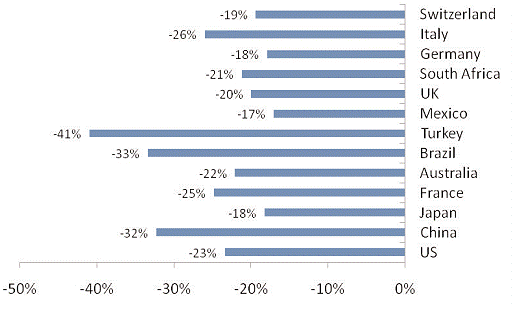
Source: The collapse of global trade, murky protectionism, and the crisis: Recommendations for the G20 A VoxEU. org publication Edited by Richard Baldwin and Simon Evenett. Centre for Economic Policy Research 2009. p.1.
In a next paragraph the author will try to discuss advantages and disadvantages of RF internationalized against background of 1990s-2000s economic disturbances.
4. Crises in modern Russian economic history: is internationalization of any help?
For at least one third of its less than two decades-long modern history Russian economic development has been accompanied by severe difficulties and malfunctions of various sorts including current economic crisis. Crisis in general might be defined as a reaction of the particular system on imbalances (violation of some key proportions) between its elements when these imbalances exceed certain affordable limits. Reaction under review in most cases tends to be a) relatively fast and b) pretty painful. The crisis could result either in a restoration of previously violated balance (some key proportions) and hence renewal of what might be called a “regular” operation of the system, or in a collapse of the system.
This general definition basically fits our specific case, namely national economies. In Russian case from the very start of post-Soviet transformation in 1992 the country experienced dramatic contraction of major macroeconomic indicators. Table 1 provides some relevant information.
Table 1 Development in selected Russian economic indicators
(%% of annual changes)
1992 ‘93 ‘94 ‘95 ‘96 ‘97 ‘98
GDP -19
Industrial
production -1-2
Fixed
investments -4-112.0
Source: www. *****, author’s calculations
Even prior to the collapse of the USSR certain limited measures had been introduced in order to liberalize foreign economic relations in general, foreign trade in particular[5]. Nevertheless, comprehensive overall liberalization came on stage later, as a part of Eltsyn-Gaidar general economic reform.
Initially the idea of free economic interaction with outside world was a very attractive and even magnetic one for many people in Russia. In terms of institutional framework this positive public attitude might be regarded as a set of informal institutions supporting internationalization of Russian companies. This resulted from several main reasons.
First of all, a pure logic of a so-called "forbidden fruit". For many years enterprises as well as, at least to some extent, consumers were rejected from any effective access to the foreign markets. But the more they were rejected, the more they wished to get that access.
Secondly, underestimation of problems and difficulties associated with direct involvement into modern international economic activities. Large part of the country’s managers anticipated both foreign trade and other forms of international co-operation as an easy and pleasant job. It mainly resulted from the Soviet historical background. The managers used to operate within the system when almost any foreign business trip was treated as some kind of encouragement (both moral and material) given to them by some senior state or party officials. In addition to basic travel expenses these managers usually got some extra currency sufficient to do a modest shopping and to bring home some goods which were out of the supply in Russian shops. Since their responsibilities during the trips were minimal, quite often the latter appeared to be hardly more than a mere tourism.
Thirdly, one should also consider overestimation of possible gains from foreign economic activities. That false impression was to a large extent cultivated by many representatives of a mass media. In general the idea was more or less the following: "For many years some evil forces didn't allow Russian producers to trade freely. At last now they can do it. Everybody is happy, western consumers are eager to pay the highest prices for Russian goods, western producers are willing to sell to Russia cheaply high quality commodities." In general, the understanding of the facts that foreign markets were very competitive ones (especially for outsiders), that foreign business transactions could inflict substantial losses, and alike took a relatively long period of time. Some economists, politicians, and high-ranking civil servants surprisingly enough expressed the extreme form of the described above attitude. In fact they claimed that since Russia rejected the communist system and accepted the role of a prodigal son in its relations with Western developed countries, the latter simply had to provide Russia with free financial and material support. More than that, they had to do it on a more or less permanent basis.
Fourthly, traditional Russian attitude towards foreign countries as a whole, foreign products in particular. As a result, ordinary Soviet citizens of 1970s and 1980s, in contrast to the inhabitants of Western countries, used to care very much indeed about the whole sphere of “international”, which, at least subjectively, was of a much greater interest for them than the domestic issues. At the same time, they had some kind of an inferiority complex with regard to the goods made abroad. Any campaign, similar to those conducted in many Western countries under the slogans of “Buy domestic (British, Finnish, Spanish, etc.)”, had absolutely no chances even to be launched (say nothing to succeed) in the Soviet Union during the last couple of decades of its history.
Regardless of the public attitude foreign trade and other forms international cooperation played a significant role in specific pattern of Russian economic development. First and foremost, already in very early stage of transformation geographical composition of country’s foreign trade experienced radical shift towards an obvious dominance of Western countries. In contrast to last years of the Soviet period when share of inter-republican trade (trade between Russian Federation and Georgia, Armenia and Ukraine, etc.) in total USSR foreign trade[6] had equalled to about 70%, trade between the members of Commonwealth of Independent States (intra-CIS trade) accounted in for less than a quarter of Russian foreign trade turnover.
In terms of its economic impact disintegration of the USSR as a single economic space undeniably generated enormous problems for almost all the countries involved, contributing greatly to the extent of the economic crisis experienced during most of the 1990s by member countries of the CIS. For example, according to some estimates, up to 60% of the industrial output decline in Russia and other former Soviet republics can be attributed to the collapse of Soviet Union (Bykov A. “Rossiya – SNG – mirivoi rynok” Economica I Zhizn’. 1995, No5). The reason for this is clear: the structure and composition of the former Soviet economy. One of its key features was an extremely high level of specialization and monopolization. Under these circumstances and with a state monopoly on foreign economic relations, each republic inevitably participated actively in inter-republican trade.
Large state enterprises - monopolies in terms of their market share - were the key element of the Soviet economy. Whereas international standards define a monopoly as a firm, which controls more than 30% of the market, there were several markets in the USSR with only one producer for the whole country (e. g. domestic air conditioners were produced by the only plant in Baku). Official Soviet statistics used to divide the entire range of industrial products into 344 so-called enlarged groups (i. e. markets). In 1989 there were 109 groups with only one producer controlling more than 90% of the entire market and 209 groups in which one producer had a market share exceeding 50%. Tables 2 and 3 illustrate the situation clearly enough. The disintegration of the USSR has also seriously damaged the pre-existing system of cooperation, thus contributing greatly to the economic crisis.
Table 2 Production of selected products by individual Russian enterprises in 1993
(% of total output)
Enterprise PO "Kolomenski zavod" PO "Novocherkasski electrovozostroitel'ni zavod" Tverskoe PO vagonostroenija Zavod "Bezhetsksel'mash" Trolleibusni zavod im, Urizkogo PO "Leningradski metallicheski zavod" PO "Rostsel'mash" AO "Tulamashzavod" Tikhorezki mjasokombinat | Type of product Diesel locomotives Electric locomotives Railway passenger carriages Flax combine Trolley buses Steam turbines Combine harvesters Motor scooters Meat goggles for children | % of total Russian output 100 100 86 100 100 80 81 100 100 |
Table 3 Concentration of Russian industrial production in 1993
Branch of industry | Share of total Russian output (%) | ||
3 enterprises | 6 enterprises | 10 enterprises | |
Electrical engineering / Electricity generation Fuel industry Ferrous metallurgy Non-ferrous metallurgy Chemical industry Mechanical engineering Timber, wood-processing and paper industry Construction industry Light industry Food processing | 11.7 12.3 26.4 26.2 8.9 12.6 5.4 4.1 4.0 3.9 | 18.5 22.7 40.2 39.7 13.4 16.3 9.4 6.2 7.0 6.0 | 25.6 34.1 52.0 48.7 19.0 19.8 13.5 8.4 10.1 8.4 |
Source: Vorozheikin V. N., Rybakov F. F. Demonopolizatsiya economici kak element rynochnyh otnoshenii. SPb. Gidrometioizdat. 1994, p.28,37.
As for economic interaction with Western countries at least with respect to foreign trade one has to consider different types of influence on national economy. First of all, instantaneous opening of Russian market to foreign goods helped to increase supply and overcome dramatic shortage of many basic products. At the same time, expansion of foreign trade operations clearly revealed inability of many Russian enterprises and even the whole branches of industry to compete successfully with the foreign firms. A very substantial part of the companies, which suddenly got direct access to foreign markets, had no experience in the field. As a result they paid more and got less. Anonymous foreign trade expert was asked at that time whether it was true that 4 from each 5 Russian enterprises doing business with foreign partners were cheated. He answered that actual ratio was 5 from 5. According to some estimates, as a result of the foreign trade liberalization Russia only in 1992 lost as much as $20‑40 bn.
Nevertheless, in spite of this type of losses Russian foreign trade in clear contrast to all other macroeconomic indicators experienced during impressive growth. Table 4 provides vivid illustration of above-mentioned.
Table 4 Development of Russian GDP and foreign trade
(%% of annual changes)
1992 ‘93 ‘94 ‘95 ‘96 ‘97
GDP -1
Exports …… 29 -3.1
Imports …… 18 5.7
Source: www. *****, author’s calculations
This trend looks strange in light of standard economic approach. Indeed, basic theory suggests that foreign trade should in general increase as a result of growth of GDP and vice versa. Under the circumstances elasticity of a foreign trade with respect to national output is positive. So, one is really tempted to ask how it happened that in Russia elasticity of foreign trade with respect to national output was NEGATIVE for such a long period of time?[7]
In order to answer the question it seems reasonable to look a bit more specifically at two components of Russian foreign trade – import and export – separately. In case of the former standard theory assumes that import transactions result from the internal demand which is directly linked to national GDP. But Russian import behaved differently.
According to the author of a present paper perception it was due to several factors. Their significance differs from year to year. But for the period as a whole all of them were relevant. These factors included:
n “Economy of shortages” legacy, which especially during the first years of transition manifested itself in two major ways. First one was commodity hunger, when after the period of severe lack of basic foodstuff and consumer goods consumers were eager to buy almost everything. The second one was kind of a shock generated by Western marketing methods (advertising, nice looking wrapping, etc.) almost entirely unfamiliar to the bulk of Russian population.
n Inflationary pressure, which also was especially high during initial stage of transitional period. Here consumer behaved quite rationally - they bought as soon as they could and hence generated additional demand. Imported goods matched the latter to a very large extent.
n Declining living standards typical for the substantial part of Russian population mostly in line with standard economic theory resulted in growth of their MPC (marginal propensity to consumption). Initially (during the pre-transition period) these people had been deeply involved in savings in order to accumulate enough to buy a flat, a car or some other consumer durables. When just a theoretical possibility to do that disappeared, they started to consume more food, clothes and other products, which constituted a large share of Russian import.
n Crowding out of domestic products by foreign ones was at that time probably one of the most important dimensions of a kind of discussed above «inferiority complex» with regard to foreign unfortunately typical for many Russian citizens. Both old and young have a strong perception that almost any product made abroad was paribus ceteris of better quality than domestic one. As soon as due to the liberalization of foreign trade supply of the former grew tremendously, consumers switched to foreign goods.
n Internal prices almost equalled external ones as long as the process of transition went on. During the last couple of years under review that was just another additional incentive for import in contrast to the situation of early 90s, when domestic products in general had been really much cheaper then foreign ones.
n Relative stabilization of national currency within the framework of so called «sliding currency corridor» applied from July 1996 also helped to keep the demand for imported goods high.
In case of export its main «driving force» originates from the outside demand for the products of domestic manufacturers. Economic performance of the countries where Russian export was mainly destined during the period under review per se in general gave no ground for its substantial increment. More than that, under the conditions of economic recession (even of substantially less magnitude in comparison with the crisis hitting Russia at that time) international competitiveness of domestic companies normally suffers and thus suppresses export.
Nevertheless, as already was mentioned, Russian export in has grown fast enough. Here, as in case of import, several factors were relevant changing their significance from year to year. According to author’s opinion these factors were:
n Substantial gap between internal and external prices. After the abolishment of a foreign trade state monopoly and the system of centralized planning Russian companies in general became free to choose their customers between domestic and foreign ones. In spite of severe inflation during first several years of transition the prices paid by the latter were still higher than prices paid by the former. Under the circumstances export in many cases really was «the first-best solution» for those Russian companies which could handle it.
n Very low starting point for export during the period under review obviously should be taken under consideration. Indeed, unless one makes certain adjustment with regard to the fact that export of 1992 equalled to only 59.6% of export in 1990 and the level of the latter wasn’t entirely regained even in 1996, the whole picture is incomplete and in a sense misleading.
n Undervalued rouble (according to many experts that was the case mainly in ) totally in line with the assumptions of traditional theory helped to secure international competitiveness of Russian goods. Hence, it was just another incentive for the companies of the country to sell their products abroad.
n Strategy of risk minimization. For RF companies the bigger was the scale of their activities in the West, the lower was the risk. Minimization of risks for the CIS exporters was based mostly on stability of payments from Western partners and stability of tariffs and other international “rules of the game” compared to the Russian ones.
n «Forced export» phenomenon. According to the standard perception the firm would normally try to enter foreign markets as long as it expands, i. e. after and on the basis of more or less successful operations within the domain of internal market. In contrast to that, many Russian enterprises during the period under review sold their products abroad literally in order to survive. The customers at home had no money to finance their input. So, they either did not pay at all, or provided their output in kind to meet their obligations versus suppliers. Under the circumstances severe lack of the current assets was a matter of life and death for the substantial part of Russian companies. Foreign customers, who paid for the products they bought, from that crucial, albeit in a sense short-term, perspective appeared to be the clients of top priority never mind if the prices they offer hardly covered expenses or even inflicted losses for manufacturers.
In order to illustrate this very interesting (at least from the point of view of this paper subject-matter) phenomenon one can consider situation in the Russian pulp and paper industry. Since October 1995 international pulp and paper prices have been going down (with one exception of paper for newspapers). Earlier the Russian government had launched a strong currency regulation policy that reduced the dollar income of exporters. The combination of two factors - the fall of prices in the market and the new currency policy of the government - resulted in the situation when the Russian pulp and paper exporters` profits in fact were reduced to nil.
Logically thinking this situation should push the Russian pulp and paper producers to stop export. But it did not happen in reality, since without export manufacturers of the product would not get any money at all. Costs of pulp and paper producers were going up because of the growth of prices on fuel, electricity, etc. At certain moment it was also almost impossible for the producers to get loans either for investment purposes or even in order to cover operative expenses. Under the circumstances the only way to get at least some money for the industry was to export.
We could see similar situation in the ferrous metallurgy. Up to the late 1980s the USSR had been one of the major both consumers and producers of ferrous metals. In the middle of the 1990s industrial consumers of the product in Russia couldn’t afford to pay the prices domestic producers demanded. These prices resulted from high costs of energy, extremely high rail way tariffs and taxes. Lack of money forced the former Soviet ferrous metal producers to export a large share of their product. Export prices in this case were almost the same as cost of production. Nevertheless, western consumers could pay immediately, unlike those who represented Russia and other CIS member states. They needed much longer time for payment or had no money at all.
In general these developments resulted in a threatening trend of certain kind of isolation in case of outward-oriented industries/companies. Table 5 illustrates the situation.
Table 5. Export share in total production of selected goods in Russian economy
(in %%)
1992 | 1993 | 1994 | 1995 | 1996 | |
Crude oil | 35.4 | 34.7 | 40.2 | 39.7 | 42.9 |
Natural gas | 30.2 | 27.6 | 30.4 | 32.3 | 34.2 |
Mineral fertilisers | 69.3 | 72.0 | 75.2 | 77.5 | 78.4 |
Pulp | 40.8 | 66.4 | 79.1 | 78.5 | 88.5 |
Source: “Economica i zhizn’” 1997 No 13.
With constantly growing share of production being directed to foreign customers these companies/industries also largely tended to spend their revenues abroad. As a result they generated relatively small additional domestic demand, thus partly depressing less internationalized part of national economy and challenging its structural integrity. This Russian version of a famous Dutch disease dramatically overlapped with centrifugal processes of regional disintegration.
After a short period of what could be perceived (at least statistically for 1997) as stabilization Russian economy experienced yet another impressive disturbance – namely August 1998 crisis with unilateral suspension of payments to domestic and foreign creditors and almost 4-fold devaluation of the rouble for about two months. In terms of statistics Russian GDP contracted almost five per cent in 1998. It had not contracted so abruptly since 1994.
The magnitude of the crisis was to a very large extent facilitated by what might be called as external forces (substantial decline in world prices on oil, pressure of IMF, financial crises in South-East Asia, etc.). At the same time, the crisis itself influenced immensely the whole sphere of Russian international economic operations and hence directly influenced positions and interests of Russia’s main foreign trade partners, foreign investors and other similar businesses. In particular, the government both in terms of declarations and undertaken practical steps became more orientated towards protection of domestic manufacturers as well as fiscal considerations associated with custom duties.
On the other hand, due to dramatic devaluation of RUR foreign companies lost substantial part of their competitiveness vis-â-vis Russian businesses. According to the survey conducted by “The Boston Consulting Group” (“Ostajutsja v Rossii” Expert №P.42-43.) November 1998 sales of Western subsidiaries in Russia were in average equal to 50% of pre-crisis level and forecasts of 2000 USD nominated demand were expected to reach as little as 80% of 1997 one maximum. As a result many MNCs were forced to adjust their competitive strategy to fit “new reality”. Among these adjustments were:
* shift of the product mix (either in favour of exclusive and very expensive or in favour of really chip products, demand for medium segment has gone);
* attempts to weaken “price peg” to USD (discount exchange rates, reduction of prices on some foreign cars, etc.)
* comprehensive minimization of expenses[8].
In their turn Russian companies also faced crisis challenges. They tried to react accordingly. In particular, “Clothes Factories of St. Petersburg” (FOSP) - the best Russian light industry company of 1998 - as a result of the crisis, was forced to facilitate its long-prepared switch from foreign suppliers to domestic ones to cover up to 80% of the total input. (Nevskoe Vremja. January30, 1999)
Financial and economic disturbances of August 1998 had substantial negative impact on Russian foreign trade. In some specific cases reduction was really dramatic. One of the two largest custom-houses in North-West region of Russia of that period - “Baltic custom-house” reported that during September-October 1998 total volume of imports which went through St. Petersburg sea port contracted 6-fold (!) in comparison with pre-August period, total amount of cargo custom declarations contracted 2.7 times and total volume of custom duties - 2-fold in rouble terms (5-fold in USD terms). According to another largest custom-house of the region - “St. Petersburg custom house”, during the second half of 1998 import of certain commodity groups (meat and meat products, oil processing products transport equipment) was entirely blocked. (Nevskoe Vremja. February 2, 1999)
At the national level reduction was less severe. In line with previously discussed it is worth mentioning that negative elasticity of foreign trade with respect to national output typical for turned into positive. So, in the whole 1% contraction of GDP and 5.2% contraction of industrial production were accompanied by 15.1% drop in merchandise export and 18.7% drop in import[9]. GDP, industrial production and export started to grow already in 1999, while import – only in 2000. These developments clearly indicated that it took Russian companies some time to adjust their performance in order to exploit opportunity window of import substitution. As a result merchandise trade surplus in 1999 almost equaled to import and in 2000 exceeded it by more than 30% - respectively $36.1 bn against $39.5 bn and $60.1 bn against $44.9 bn. (www. *****).
Ten years after notorious August 1998 Russian economy once again was hit, this time by global economic crisis, which with enormous speed spread from country to country precisely due to the fact that they in the process of internationalization/globalization were closely linked to each other. While discussing ongoing processes notions of “financial crisis”, “economic crisis”, “crisis of capitalism” are frequently used. Being quite close to each over and largely overlapping these notions are not identical. They have their own focuses. The first one deals with a relatively independent sub-system of national economy constituted by various types of financial middlemen operating with a whole bunch of financial instruments. Many crises of the past started in financial sector, and the current one continues this trend. The second notion in principle has two possible meanings. It relates either to the whole national economic system (including financial sub-system) or to what is known as “a real sector”, i. e. industrial production, agriculture, construction (in contrast to financial sub-system). In terms of current events both meanings assume expansion of the crisis beyond financial sub-system, which makes overall situation more problematic and painful. At last the third notion deals with a social-economic type of society existing nowadays in most countries on the globe. Here in contrast with two previous notions describing what happens, the emphasis is on why it happens and whether similar crises could be avoided in the future.
From this point of view capitalism could be defined as a type of society with market mechanism being the main tool coordinating business activities within its framework. One can hardly imagine capitalism without thousands and thousands of various independent economic actors striving separately for their own benefits. Meanwhile, coordinating capacities of market mechanism have always been limited. Under the circumstances gradual accumulation of imbalances and disproportions appears to be inevitable ultimately generating crises. In general, even taking under consideration relatively large level of regulatory activities typical for example to many developed countries in Western Europe and Eastern Asia, capitalism has no real alternative to the crisis as a tool to restore abovementioned key imbalances and disproportions.
Imperatives of globalization tended to add another dimension to the problem. The author already mentioned that globalization forced companies to expand the whole spectrum of their operations (starting from R&D and production, ending with bringing products to ultimate consumers) far beyond national borders towards all major economic regions of the world. The process resulted in creation of huge chains and networks operating under private control and spreading over and between the continents. Growing complexity of the system requires higher precision in regulation, which is still largely based on the same market principles. More than that, due to globalization local and partial disproportions via abovementioned chains and networks often expand internationally finally hitting almost each and every country on the planet. Current crisis provides clear evidence of that.
Within the framework of numerous discussions on various aspects of current economic disturbances an idea of “new capitalism” as a strategic tool for global modernization is frequently advertized. Two points look significant here. Firstly, the term “capitalism” per se due to different reasons is far from being neutral. Negative attitude to it is typical for a substantial part of population all around the globe. It is not by chance that in contrast to its alternative – term “socialism”, which in a recent history was incorporated in official names of several countries (Union of Soviet Socialist Republics, Socialist Federative Republic of Yugoslavia, etc.), “capitalism” didn’t get the same status. Neither United Capitalist States of America, nor Federative Capitalist Republic of Germany have existed, exist and have any real chances to emerge. Even Friedrich Hayek, who had well deserved “high priest of the free market” reputation once claimed: “The word capitalism was invented by enemies of the market system and conveys the erroneous impression that the system is in the interests only of capitalists” (Now! 1981 No75, P.27). Secondly, adjective “new” also doesn’t look either promising or appropriate. Indeed, history of capitalism has been accompanied by economic crises of various scope and magnitude for almost two hundred years (the first one has happened in 1825). Since the first half of XIX century capitalism has experienced several transformations/renovations. None of them have changed ultimate nature of the system. They also failed to free it from crises. To summarize: if we want something really new the core of the system should be changed and cease to be “capitalism”. If we prefer to have “capitalism” it will preserve its core, then novelty would be quite limited.
In a specific case of Russia current crisis at its initial stage was not perceived (both by RF authorities and many foreign experts) as a serious threat for Russian economy. This might be explained by several factors, namely relatively underdeveloped RF real estate/mortgages market and high oil prices, which allowed to accumulate large financial reserves. Later on official attitude presented by both Vladimir Putin and Dmitri Medvedev as well as by top ranking civil servants changed. They started to admit that crisis has already hit national economy and would bring substantial damage, especially if state intervention is inadequate and poorly managed. Nevertheless, state officials are relatively optimistic. In particular they claim that crisis might “help” to move economy towards “innovation-based pattern” and launch new phase of RF economic development. In contrast to that, critics argue that authorities underreport the scale of recession and are not able to react adequately largely ignoring in their stabilization measures interests of ordinary people in favour of business leaders and bureaucracy.
As for the impact crisis had for international economic operations, several markets contracted severely indeed. Sharp reduction in sales of foreign cars (both brought from abroad and assembled in Russia) provides may be the most vivid example. At the same time, in some other cases current developments continue (albeit often facilitating) longer trends. In particular, for the third year in a row share of households’ monetary income spent on purchase of foreign currency
tended to grow and for the whole 2008 equaled to 7.9%. On the other hand in October, November, December, when RUR went through the period of devaluation, it was 12.8%, 12.1% and 14.9% respectively (www. *****).
At the national level Russian foreign trade turnover in October-December 2008 equaled to 77.4% of the same period of 2007 (export – 71.1%, import – 86.6%). Meanwhile, being roughly of the same magnitude with at least half of the countries depicted in Figure 1, these data per se might make a wrong impression. The point is that they are strongly influenced by a very sharp decline in world oil prices. In particular, actual export price of Russian oil equaled in December 2008 to 53.5% of December 2007 level, while in comparison with peak price of July 2008 it was only 36.7%. As for the volume of Russian oil export, for the whole 2008 it contracted by 6% against the level of 2007 and started to grow in December 2008 in comparison both with previous month and December 2007. On the top of that one should take under consideration that just crude oil accounted for 24.3% of total RF merchandise export in December 2008 and for 34.4% - in whole 2008 (www. *****).
Does this, if only partly, imply that those Russian companies deeply involved in export operations are better equipped to resist current crisis comparing to their mostly domestically oriented counterparts? So far we haven’t got enough information to give any definite verdict. Nevertheless, comparison of recent developments experienced by various industrial sectors might provide some clue. Relevant data are presented in Table 6.
Table 6. Monthly changes in Russian industrial production (%% in comparison with the previous month)
Month | Total industrial output | Extraction of mineral resources | Processing industry |
September 2008 | 101.4 | 98.3 | 102.0 |
October 2008 | 102.8 | 99.7 | 100.4 |
November 2008 | 89.2 | 94.2 | 84.7 |
December 2008 | 103.8 | 102.3 | 101.6 |
January 2009 | 80.1 | 97.0 | 67.3 |
Source: www. *****
Available statistics suggests that at least during last three months smaller domestic orientation of output typical for RF mineral resources extraction helped to support industrial performance. Export operations were in the most cases not sufficient to secure positive economic growth. At the same time without them contraction would be more substantial, if not really dramatic. For example, largely due to the impressive expansion in export of mineral fertilizers in 2% growth in case of nitric fertilizers and 2.6-fold (!) growth in case of potash ones) contraction of output in comparison with 2007 was relatively minor – 6% only (www. *****).
5. Conclusion
The author by no means pretends to provide comprehensive analysis of the impact, which difference in internationalization levels typical to certain Russian companies might have on their sustainability during the periods of economic disturbances. More profound approach would require expansion of discussion beyond merchandise trade towards trade in services, FDI, labour mobility and other forms of international economic collaboration. It also seems sensible to deal separately with the effects of inward and outward internationalization. It goes without saying that all these tasks far exceed limited volume of the present paper.
Nevertheless, already at a current stage of investigation one might conclude the following:
- Two out of three crisis periods in modern Russian economic history (August 1998 and current economic crises) clearly demonstrate the same higher volatility of national foreign trade with respect to fluctuations of GDP as global trade in general;
- Period of provides a rare example of negative elasticity of foreign trade (both export and import sides) with respect to GDP;
- Abovementioned dynamics of foreign trade suggests that for the companies involved in particular as well as for the national economy in general this hypostasis of internationalization both provides substantial extra opportunities (“forced export” phenomenon as a vivid illustration) and is associated with serious additional risks;
- In a sense internationalization might be perceived as an expensive tool, which every economic agent nowadays has to buy almost regardless of its wishes and preferences. To those who know how to use this tool it brings higher productivity, competitiveness and other gains. Those who lack necessary skills have extra expenses with no rewards.
Bibliography:
Bykov A. “Rossiya – SNG – mirivoi rynok” Economica I Zhizn’. 1995, No5.
Mysteries and Puzzles of Modern Russian Economy. Sergei F. Sutyrin. Turku School of Economics and Business Administration. Business and Research Development Centre. Series B Research Reports. B 13/1999.
“Ostajutsja v Rossii” Expert №P.42-43.
Rosstat. www. *****
The collapse of global trade, murky protectionism, and the crisis: Recommendations for the G20 A VoxEU. org publication Edited by Richard Baldwin and Simon Evenett. Centre for Economic Policy Research 2009.
UNCTAD. Trade and Development Report, 2007
UNCTAD. World Investment Report 2007
Vorozheikin V. N., Rybakov F. F. Demonopolizatsiya economici kak element rynochnyh otnoshenii. SPb. Gidrometioizdat. 1994
WTO. World Trade Report 2008
[1] Sergei F. Sutyrin - Professor, World Economy Department Head, St. Petersburg State University, International Banking Institute (St. Petersburg, Russian Federation). 191123 Chaikovskogo st. 62, St. Petersburg, Russia. E-mail: *****@***com
[2] Initial version of the paper was published as Serge F. Sutyrin Internationalization of Russian Economy: threats and opportunities in time of crisis. Electronic Publications of Pan-European Institute 4/2009 www. tse. fi/pei.
[3] Hence, the countries with high level of taxation, strict regulation in terms of social and environmental standards, etc. might experience substantial resources outflow. In order to prevent these developments (situation in a way similar to that described by downward slope of Laffer curve) national state often has no real alternative to deregulation. Other countries would retaliate by even more radical deregulation. Ultimately that might bring all of them into a vicious circle of “race to the bottom” with gradually diminishing governing power.
[4] It goes without saying that certain amount of Soviet plants and factories operating under the system of centralized planning both produced some products designated to foreign customers and used for manufacturing some foreign input. At the same time, in a strict sense of the word they didn’t interact directly with their foreign counterparts. Several government agencies-middlemen were ultimately in charge of economic and financial aspects of the transactions.
[5] Within the framework of the “classical” Soviet-type economy these operations had been partly totally outlawed, the rest had been the subject of a strict state control.
[6] Striclty speaking trade between Soviet Republics didn’t totally fit the definition of ”foreign trade”. Nevertheless, for the sake of comparison this definition might be accepted with certain reservations.
[7] For more detailed discussion of the phenomenon see: Mysteries and Puzzles of Modern Russian Economy. Sergei F. Sutyrin. Turku School of Economics and Business Administration. Business and Research Development Centre. Series B Research Reports. B 13/1999. Part 3.
[8] One specific point seemed to be relevant here - the higher the “rouble share” in total costs the easier for the company to handle the problem. This could provide additional incentives for growth of inward FDI. Meanwhile in a short run it largely didn’t happen.
[9] These data also support abovementioned point of high relative volatility of the foreign trade.
