

Партнерка на США и Канаду по недвижимости, выплаты в крипто
- 30% recurring commission
- Выплаты в USDT
- Вывод каждую неделю
- Комиссия до 5 лет за каждого referral
Name and surname:
Omarova Batish,
Abdieva Roza
Country: Kazahstan
Work place: Kazakh National University
e-mail: *****@***ru
address: Almaty city, 41 house, 25 flat
The title of the article:
THE GENERAL STRUCTURE OF THE EDUCATION SYSTEM IN KAZAKHSTAN.
Abstract
In this article the writer tries to open up this theme with explaining the education system, then slips up to gives some statistics about the quality of graduates, system of training and professional development of teachers of Kazakhstan, the outcomes of it. Also this article tries to answer topical questions about the unified educational system of Kazakhstan. As a lecturer of a University, the author gives some examples of professional student teaching and developing and fostering well-educated students and analysing, solving problems of adolescents.
Key words: high school problems analysing, professional development, training, qualifications
The general structure of the education system in Kazakhstan.
The main objectives of the education system in the Republic of Kazakhstan are:
- The formation of scientific and general cultural training of students;
- Social adaptation of students for life in the community;
- Civic education and love of country;
- Addressing the needs of society for qualified workers and specialists, retraining and professional development.
In the Constitution of the Republic of Kazakhstan (Article 30) is written:
"Citizens are guaranteed free secondary education in public schools. Secondary education is compulsory. Citizen has the right to receive, on a competitive basis higher education in the state of higher education. Paying and receiving education in private educational establishments are prescribed by the law. State establishes educational standards in education. affairs of any educational institutions must comply with these standards".
Structure of state education in Kazakhstan which is supported by the new project of the republic
Pre-school education
Family, kindergartens, crèches
Pre-school preparation
Family, kindergartens, kindergartens with special programmes, comprehensive schools
Pre-school education
Primary school
Primary classes from 1-4, comprehensive schools, grammar schools
Comprehensive school
Common Professional
State schools, comprehensive schools, grammar schools,classes
Professional lyceums, professional schools,
Professional colleges 3-4 years
Universities
Bachelor’s degree
Basic high school
Special high school
Universities, academies, high schools – 4-5 years
Scientific – pedagogical high school
Master’s degree -1-2 years
Doctorate – Phd
Postgraduate education
Schooling.
Secondary education is guaranteed and is mandatory for all citizens. In addition, the priorities of secondary education are computerization and updating of educational content.
Before the system of secondary education are to:
- Enrollment of all school-age children
- Implementation of the state compulsory standards of secondary education;
- Improving the quality of education in schools by improving the content and teaching methods, the introduction of objective criteria and guidelines for assessing students' knowledge and work of teachers;
- Provision of measures to protect the health of students and teachers.
General secondary education is acquired in stages by learning educational programs in three stages:
1) Primary (grades 1-4),
2) Secondary (grades 5-9) and
3) Senior (10-11or 12classes).
These levels may function together in the same general education institution, or separately, in primary or secondary school principal.
The republic has8, 290schools, with an enrollment of3117.7thousand children, including 8191comprehensive schools with3097 thousand students.
Along with the day long schools have 31evening secondary schools.
A network of educational institutions of a new type(gymnasiums and lyceums), of which there are320, including high schools-178schools - 142.
Given the needs of the population of ethnic studies in schools is available in 7 languages.Of the total number of schools -3474aretrainingin Kazakh,2514 - in Russian,2107 - Kazakh and Russian, 78 schools - in Uzbek, 13 - Uighur, 3 - Tajik,1 school - in Ukrainian and 1 school - in German. In areas where minority nationalities are organized studying of 14native languages.
Vocational education.
Primary and secondary vocational education is acquired in vocational schools, high schools and colleges and are combined with general secondary education.
The main tasks of vocational education:
- Development and implementation of state educational standards of professional education, updated view of the situation on the labor market and structural changes in the economy;
- Creating conditions for increasing the availability of vocational education;
- Support of the private sector of vocational education;
- The organization and development of social partnership in vocational education;
- Expansion of international cooperation on training and retraining of personnel in institutions of vocational education.
Initial vocational education includes training, retraining and advanced training of workers, professionals and the unemployed, and the unemployed.
The country has 306 vocational schools and high schools with 88,348 students. Skilled workers is more than 300 specialties.
Professional training colleges are colleges which have switched to training in the new state standards of vocational education and curriculum. Colleges introduced a new mechanism for the formation of the student body and training with full cost recovery on a contract basis, taking into account the needs of the region in the workforce. Opening of new specialties made only in the presence of the customer and a regional employment office.
Secondary vocational education is provided by 285 colleges, including the 173 - and 112 state - non-state ownership. The number of students is 155,893 people.
Higher education.
Higher vocational education is acquired by citizens with secondary education. In Kazakhstan, the following types of higher education institutions:
university, academy, institute and similar (conservatory, high school, university college).
In the structure of higher education, there are three levels:
I. Higher basic education that includes a broad humanitarian and fundamental natural science training in specialty profile with an academic degree "Bachelor";
II. Higher professional education qualification "specialist with higher education" (graduate);
III. Higher scientific-pedagogical higher education is aimed at graduates in the subsequent use of research and teaching (in high school) work. Person who has successfully passed final certification, the qualification of "specialist with higher education" and the academic degree "Master of Science";
Universities have the right to determine the appropriate structure of multistage training. The university can function as all levels of higher education, as well as separately.
The system of higher education in the Republicincludes164institutions of higher education, including 47 public, 117 private.
Training for education is higher and specialized secondary educational institutions, the head of which is the Kazakh State University named after Abai.
Foreign students are conducted in47 higher education institutions of Kazakhstan. They train3,598students from 43countries around the world, including students from the CIS and Baltic states. Conditions for admission of foreign students are democratic
Postgraduate education.
Postgraduate vocational education is for specialists with higher professional education or academic degree of "Master." The main forms of postgraduate education are postgraduate and doctoral universities, research organizations. Training of scientific and scientific-pedagogical personnel may be out of post-graduate in the form researches, transfer to senior researchers and providing sabbaticals.
Postgraduate open on 215 specialties and doctorate - to 29 specialties.
Training and retraining of personnel conducted educational organizations, organizations, research and training centers, the public employment service. They can be carried out by the state budget, and on a contract basis. Refreshing training is conducted at the National Institute of Advanced Training, retraining of scientific, methodological and managerial personnel of the education system - in the regional and municipal institutions of Teachers [1].
Statistics on the education system of Kazakhstan
Coverage rates for all levels of education
(In percentage of total population of the corresponding age group this level) (1
1989 | 1990 | 1991 | 1992 | 1993 | 1994 | 1995 | 1996 | 1997 | 1998 | 1999 | |
Education: | |||||||||||
Enrollment ratiopreschool institutions(netrates, the percentage of the population aged3-6 years) | 53,1 | 53,7 | 53,1 | 47,0 | 42,0 | 31,6 | 25,5 | - | 12,3 | 12,4 | 10,5 |
The enrollment ratein basic education(gross rates, percentage ofrelevant population) | 94,8 | 94,6 | 93,9 | 94,1 | 93,8 | 94,2 | 94,4 | 94,7 | 94,2 | 94,3 | 94,2 |
Enrollment ratio(the second stage) (gross rates, percentageof the population aged15-18 years) | 75,8 | 74,2 | 70,4 | 66,3 | 62,4 | 58,5 | 57,0 | 57,3 | 57,4 | - | - |
Enrollment ratiohigher education (gross rates, percentage of population aged 19-24) | 18,1 | 18,7 | 18,5 | 17,7 | 16,9 | 16,9 | 16,6 | 16,2 | 18,7 | 20,4 | 23,3 |
CIS: Coverage of higher education in Central Asia
(gross rates, percentage of population aged19 - 24years).
(gg.)
Republics | 1989 | 1990 | 1991 | 1992 | 1993 | 1994 | 1995 | 1996 | 1997 | 1998 | 1999 |
Kazakhstan | 18,1 | 18,7 | 18,5 | 17,7 | 16,9 | 16,9 | 16,6 | 16,2 | 18,7 | 20,4 | 23,3 |
Kyrgyzstan | 13,2 | 12,9 | 12,5 | 11,5 | 10,7 | 11,2 | 12,9 | 15,3 | 19,0 | 24,8 | 29,8 |
Tajikistan | 11,5 | 11,9 | 11,3 | 11,6 | 11,2 | 11,9 | 11,8 | 12,1 | 11,9 | 11,3 | 11,5 |
Тurkmenistan | 10,2 | 9,9 | 9,5 | 8,6 | 8,1 | 7,8 | 6,4 | 5,7 | 5,0 | 4,4 | 3,9 |
Uzbekistan | 15,0 | 15,2 | 14,8 | 13,4 | 11,3 | 9,4 | 7,6 | 6,6 | 6,1 | 6,0 | 6,2 |
Number of students in general education schools in the Republic of Kazakhstan in school year(thousand).
Total Students (people) | Number of students in state schools | Including the Office of the Ministry of Education | Including the Office of RSE Kazakhstan "TemirJoly" | Including the Office Agency for Tourism and Sport | Including the Office of Ministry of Health-care | Non state. organizations |
3115,3 | 3095,6 | 3073 | 17,8 | 1,7 | 1,4 | 19,7 г. Аlmaty |
Institutions of higher education to industry groups.
According to the Statistical Abstract of the Agency of the Republic of Kazakhstan on Statistics,2001 (Graduates)
Beginning of a new studying year | All | inclindustry and construction | Incl Transport and Commu nications | Incl agriculture | Incle econimics, | Incl edu cation | Incl Sport and PE | Incl art and cinema tography |
In thousands : | ||||||||
1996/ 97* | 49.0 | 8.6 | 0.9 | 3.6 | 3.7 | 27.5 | 4.2 | 0.5 |
1997/ 98* | 50.8 | 6.9 | 0.8 | 3.4 | 5.5 | 30.3 | 3.4 | 0.5 |
1998/ 99* | 51.8 | 8.4 | 0.8 | 2.5 | 4.9 | 31.0 | 3.7 | 0.5 |
1999/ 00* | 55.4 | 9.0 | 0.9 | 2.7 | 6.0 | 33.2 | 3.0 | 0.6 |
In %: | ||||||||
1996/ 97* | 100 | 17.6 | 1.8 | 7.5 | 7.6 | 56.1 | 8.5 | 0.9 |
1997/ 98* | 100 | 13.6 | 1.6 | 6.8 | 10.7 | 59.5 | 6.7 | 1.1 |
1998/ 99* | 100 | 16.2 | 1.5 | 4.8 | 9.5 | 59.8 | 7.1 | 1.0 |
1999/00* | 100 | 16.2 | 1.6 | 4.9 | 10.8 | 59.9 | 5.4 | 1.1 |
* Including non-governmental, not allocated to industry groups. [2]
Analysis of the current state of education
Total score
According to the legislation a national model of education based on the principles of continuity of educational programs, including4 levels of education:
1) pre-school education and training;
2) secondary(general secondary, primary and secondary vocational) education;
3)higher professional education;
4)Post-graduate professional education.
Educational programs are implemented in preschools, schools, comprehensive schools, vocational schools, colleges and universities.
The number of educational institutions increased steadily until 1990.However, starting in1991, a network of educational organizations began to decline. This especially affected kindergartens. [3]
A slight decrease in the network during this period occurred in institutions of general secondary, primary and secondary education, on the contrary there was an increase in the number of higher education institutions,. This increase was due to growth in the number of private universities. In primary and secondary vocational education growth in the number of private schools and colleges did not allow a collapse the network.
In the republic due to the closure of most of their pre-school contingent decreased by 1.0 million children There were only 70,000 out of 400,%). This had an impact on the quality of the children for school. From first grade school year coming to school without school preparation, only 20.4% showed an appropriate level of development of the program of the first quarter, while among first graders passed preschool education, a high level of development of the program (91.3% ).
During this period occurred despite a slight decrease in the network, reducing reaching adolescents and youth vocational training, primary and secondary levels.
In Kazakhstan, before the XX century 58 students had only one computer, 48% of schools were in need of repair, there were no more than 3700 teachers, 28% of teachers had completed higher education.
The Project's "Concept of Education of Kazakhstan up to 2015" has now begun, it offers new approaches in the field of higher and postgraduate education, the transition to a multi-level training of highly qualified specialists - Bachelor - Master - Doctor Ph. D. Higher education is through the undergraduate program that allows professionals to prepare a new model adapted to the rapidly changing conditions of production and the market. In the post-graduate education will include training of masters on the basis of universities and research institutes on special flexible programs for scientific and industrial fields. The second stage involves postgraduate and doctoral programs Ph. D which combines the optimum balance between teaching and research. Training of specialists of the new formation will be based on the model, the corresponding Bologna Declaration on the European Higher Education area and the International Standard Classification of Education. Reform of the system of scientific and scientific-pedagogical personnel involves parallel circulation degrees candidates, doctors and doctors of philosophy (PhD). After the adoption of the new concept of the universities can take over the function to award doctorates.
Another innovation in higher education is the shift to credit learning. Now students can choose not only the university, specialty, and about 50% of the subjects of the curriculum and teachers.
Implementation of the concept, if develops, say scientists and university presidents, in the short term will require a fundamental processing standards of education at all levels, a new generation of scientific and pedagogical staff, management and implementation of the system of quality control, further democratization of the entire education system. [8]
According to the First Deputy Minister of Education and Science Gennady Gamarnik, "Today, a new national doctrine of education, taking into account the modern world trends and achievements. One of the objectives of the concept is to restore to a new level of priority the dignity of the old Soviet system: the high level of basic training, the ability to train staff on a variety of areas of science and production, adequate training and methodological support to all levels of education and a unique system of organization of the educational process. All this will synthesize the domestic education system and a new national model of education, based on the international innovation introductions"[9].
Analysis of the problems of higher education
Since 2001, Classifier training and qualifications of higher education was introduced, a redesigned towards integration of specialties and specialties containing 274 references in 43 groups. Classifier in the future will be brought to the International Standard Classification of Education, UNESCO recommended signatories to the Lisbon Convention. In high schools, with appropriate licenses may be sold educational programs of general secondary, primary and secondary vocational education. Citizens with higher professional education, can receive a fee second higher professional education in a shorter period. The country has about 300 civilian universities and branches, of which 36 are public, 14 joint-stock companies, 3 international, 114 private and 119 branches with the total enrollment of about 570,000 students. This demonstrates the creation of the education market. The Concept of the system of higher education, establishing priorities for its development in the short, medium and long term.
Since 1999, the transition to a new model of university student population became on the basis of state order. Government order is implemented by providing educational grants and government student loans. The essence of the new model is that all applicants pass entrance exams by comprehensive testing and participate in the competition for their chosen profession in the whole country. State educational grants and loans given to specific people who were, after a bidding process. Prospective student - winner of the grant or loan, chooses high school, in which the training in their chosen specialty. Changed and mechanism of training specialists with higher education - budget funds allocated to specific individuals, not to the university.
To conduct a comprehensive test was created by a single independent schools body - the National Testing Center (now the National Center of State Education Standards and Testing). In 2000, the transition to the second stage of a new model of student contingent, which was extended to all forms of education in public and private universities that have passed state certification.
System of training and professional development of teachers of Kazakhstan
Within 5 years, about 120,000 teachers will be trained in the new programs of professional development at the Centre for teaching skills and its subsidiaries, JSC "National Center of Excellence" Orleu "and its affiliates.
According to a press release from the Center of pedagogical skills AOS "Nazarbayev Intellectual Schools", in accordance with the Government of the Republic of Kazakhstan on November 9, 2012 teachers of educational institutions, implementing training programs of primary, elementary and secondary education, passed the training curriculum AOS "Nazarbayev Intellectual Schools" and be certified by the appropriate level of the program, from September 1, 2012 is set to supplement their wages for: third (base) qualification level - 30%, and the second (main) qualification level - 70%, the first ( Advanced) qualification level - 100%.
According to Deputy Director of the Centre of pedagogical skills Bakhty Balgimbaev: "We can say that such approaches to the organization of training for the first time in Kazakhstan applied. Yes, there were all sorts of courses, and the two-week, maybe even more. But the main thing is that the format of these courses is quite different. This all takes place in interactive. That is, the teacher does not talk about how to work interactively, and with it the coach organizes the learning process in the form in which it has to work with the students.
In accordance with the instructions of the Head of State NA Nazarbayev in 2011, the Government of Kazakhstan approved conceptual approaches for the development of the system of training and professional development of teachers of the country.
Specially created centers of teaching skills AOS "Nazarbayev Intellectual Schools" entrusted with the International Examination Board Cambridge University to develop a multi-level program of professional development courses Kazakh teachers with the best international teaching experience.
During the I International scientific-practical conference "Professional Development of Teachers: Tradition and Change" 5-6 December 2011 in conjunction with British experts outlined the main directions of the Kazakh-British project to improve the skills of teachers of Kazakhstan.
Center teaching skills together with experts from the Department of Education, University of Cambridge has developed and implemented in accordance with the third (baseline), the second (main) and the first (advanced) qualification levels refresher course following training materials: software training courses teachers of the Republic of Kazakhstan; pre-course job, jobs, for a period of practice at school, a teacher's guide, a guide for trainers, handouts (weekly). "
As part of the Tier Programme in 2012,the Center published a number of pedagogical skills and information materials produced films: "The Changing World - we change" on the Centre teaching skills and a film presentation of the Centre.
Center teaching skills together with experts from the Department of Education, University of Cambridge from January to December 2012is preparing trainers third (base), second (middle) and the first (advanced) levels. Trained coaches Kazakhstan in April2012began the first training of teachers of the country.
Since 2013, the country had planned a full-scale professional development of teachers.
Qualifications of teachers - priorities of the state.
One of the factors that determine the quality of education is the training of teachers.
I found a small piece of the decree on the state program of education in Kazakhstan, which proposed a new national vision: by 2020, Kazakhstan - educated country, smart economy and a highly skilled workforce. The development of education should be the platform on which to build the future of the economic, political, social and cultural prosperity.
The main problem of low skills among teachers is prestige of the teaching profession, the low wages and poor scientific resource base in many educational institutions for the issuance of educators.
Today, the development of education is a priority, but in spite of this efficiency drops raising a component in the Republic lost the system of labor training and vocational guidance, insufficient number of circles of artistic and musical creativity, sports clubs in schools and after-school organizations.
Negative factors in secondary education are outdated methodology and principles for selection of educational content. Information overload leads to lower learning motivation and poor health of students. Education is focused on obtaining formal results, not on personality development.
Thus, the problems make it necessary to upgrade the system of secondary education in line with the current requirements of Kazakh society and the conditions of integration into the world educational space.
Today is active work is being done to improve the situation, centers of pedagogical skills that allow for program courses for our teachers are being opened. This will substantially improve the position of the best.
Already, trains specialists who will begin training for teachers of secondary schools in the Republic of Kazakhstan. The basic course will include the passage of 3-month program baseline. The format of the training involves classroom instruction in small groups, and, and distance learning is not excluded.
In 2012, in a pilot mode will be set up several independent centers that demonstrate proficiency on industry associations. It is important at this stage to prevent any possibility of corruption,
The number and quality of graduates
In collecting data for social video on the quality of higher education in the Republic of Kazakhstan, has found interesting statistics from the Statistics Agency of Kazakhstan.
Figure 1 shows a graph of graduates over the past12 years
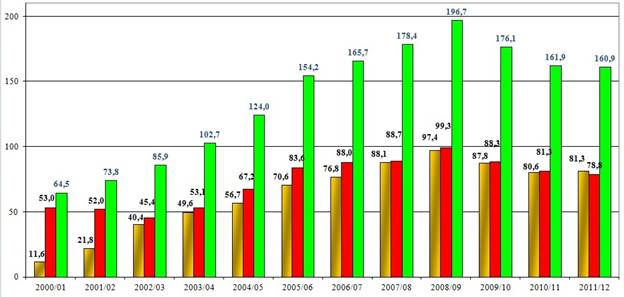
 graduations from non-state Universities, thousand people
 graduations from state Universities, thousand people
 – graduations from high schools, thousand people
Figure 1 - Number of institutions of higher education
We see that increasing number of graduates of private higher education institutions to 11.6 thousand (in ) to 81.3 million people (in the academic year.) The number of graduates has increased seven times. In the academic year, the number of graduates of private universities has exceeded the number of students from state schools - for the first time during the study period.
Issue of public universities has also increased from 53 thousand (in ) to 78.8 million people (in the academic year) or just half.
Thus, the total number of graduates from high schools increased from 64.5 thousand (in ) to 160.9 thousand people (in the academic year) or 2.5 times the expense of private universities. During 12 years of production of the higher educational institutions of Kazakhstan amounted to 1 644.8 thousand people!
The graph shows that for the academic year, a decrease in the total number of graduates. This can be explained by the fact that four years ago was the so-called financial crisis. At the same time accounts for the rising cost of higher education. That is, enrollment in private universities four years ago, it was less because of graduates in the past year was less.
It's the same with public universities - in the financial crisis - the cost of education reduced - number of accepted students has also decreased.
All in all, summing up all these, we can easily find from this that effective teaching and professional teaching is necessary everywhere. In Kazakhstan new European system is set, up-to-date teaching resources have come out, and in order to bring it all to actions, we all should do something about it. We, as teachers, should keep productive, bring in new methodic, and do our best to bring up clever, creative students.
Used literature:
1.According to the materials of the Education of the Soros Foundation-Kazakhstan,
2.According to the materials of the Education of the Soros Foundation-Kazakhstan and Ministry of Education of Kazakhstan
3.According to the materials of the State Programme "Education." Approved by the Decree of the President of the Republic of Kazakhstan from September 30, 2000№ 000.
4.Source - http://www. *****/news/1/3036publication date23/02/2004.
5.KhidirbekuhliD. Problemsof Post-Soviet liberal education in Kazakhstan.
6.OsikYI, Nadir A.,OsikLG, Networking and problems of higher education/ /Proceedings of the International Scientific Conference "Science and Education" - a leading factorStrategy"Kazakhstan-2030", dedicated to the 10thanniversary of Independence Kazakhstan, Karaganda, 2001, Issue 1.
7.Express-K, not to stay in the side, №on 14 February2004.
8. Translated from http://charko. *****/tekst/an7/3.html
9)http://www. *****/news/sistemy_podgotovki_i_povyshenija_kvalifikacii_pedagogicheskikh_kadrov_respubliki_kazakhstan/1006
10) http:///community/records/last/
11)http://www. *****/news/innovacii_v_sisteme_tekhnicheskogo_i_professionalnogo_obrazovanija/997
12)http://www. *****/news/sistemy_podgotovki_i_povyshenija_kvalifikacii_pedagogicheskikh_kadrov_respubliki_kazakhstan/1006
