


Партнерка на США и Канаду по недвижимости, выплаты в крипто
- 30% recurring commission
- Выплаты в USDT
- Вывод каждую неделю
- Комиссия до 5 лет за каждого referral
2. Money is a medium … exchange because the seller will accept it … exchange … good or service.
3. … the past governments used paper money … the form of gold or silver certificates to issue representative money.
4. The value of money is set …a government fiat or order. Money has value because the government has ordered that it should be acceptable … payment … dept.
5. When there is rapid and unpredictable inflation, money’s ability to act … a store of value decreases.
2. Linking: match the first half of each sentence with the most appropriate second half.
1. Money should perform the role as general purchasing power and | a) it must be universally acceptable. |
2. Paper currency has been increasingly | b) using as a means or medium in buying and selling activities. |
3. Over the history, for example, gold silver, precious stones, olive oil, salt, rice | c) commodity money. |
4. A crucial role of the government in maintaining the value of fiat money is controlling its supply, in other words, | d) have been valued enough for their scarcity. |
5. Money is not normally demanded for itself but for | e) i. e. activities which include the transfer of goods or services from one person or organization to another |
6. Metallic money or coins is called | f) to act as a common measure of values of all goods and services. |
7. Money is today popularly used in performing almost all economic transactions | g) issued and circulated in the present century |
8. The second important function that money performs is | h) maintaining its scarcity |
4. Translate: give the English equivalents for the following word combinations.
Tоварные деньги (деньги, представленные каким-л. товаром и имеющие реальную внутреннюю стоимость), бумажные деньги, полностью обеспеченные золотом или серебром; бумажные деньги (не обеспеченные золотом); бартер, средство обращения; мера стоимости; масштаб цен; средство сбережения.
5. Translate the following sentences into English.
1. До появления денег люди пользовались бартером, обменивая товар на товар.
2. Решить проблемы прошлого были призваны товарные деньги, которые являлись своего рода валютой, основанной на ценности основного товара.
3. Бумажные деньги были введены ввиду того, что золото становилось дефицитом, и экономические системы не могли обеспечить им рынки в необходимом количестве.
4. В свое время колонисты, к примеру, использовали шкурки бобров и сушеное зерно для проведения сделок. Выбор этих предметов был обусловлен рядом причин, важнейшими из которых являлись портативность, долговечность и легкость в хранении.
5. В случае необходимости, правительство может выпускать в обращение больше валюты до тех пор, пока люди доверяют ему.
6. Чрезмерный выпуск может привести к обесцениванию как самих денег, так и товаров и услуг, имеющих больше предложения, чем спроса.
7. Выпуск денег необходимо сохранять в рамках потребностей национальной экономики.
IV. Reading
A. Reading for the Main Idea
Read the text to understand the main idea of it and try the following tasks.
1. Choose the statement that best summarises the main idea of the text.
1. At different times and places people accepted cattle, corn, gold, seashells, stones, and whale teeth as payment for goods and services.
2. Money with its economic properties is defined in terms of four functions: a medium of exchange, measure of values, a standard of value and a store of value.
3. There are three main types of money: commodity money, representative money and fiat money.
B. Reading for Details
Read the text again to understand details and try the following tasks.
1. Understanding Expressions: give the best explanation for each of these phrases used in the text.
Flexible pricing of goods; to experience significant inflation; to put money aside; purchasing power; barter; acceptability of money; to outstrip demand; to fulfill the functions of legal tender; to be backed by something tangible.
2. Answer the following questions.
1. What types of money are discussed in the text? How do they differ?
2. Explain how money serves, acts, circulates and works.
3. What economic properties of money do you know?
3. According to the text, mark these statements T (true) or F (false).
1. Money has always served as a medium of exchange.
2. Being easy and efficient, barter makes any economic transaction convenient.
3. Money determines the economic worth in the exchange process.
4. Money serves as a standard of value, something that holds its value over time.
5. Money allows for the precise and flexible pricing of goods and services.
4. Give the best definition for the following economic terms.
Money, commodity money, fiat money, representative money, surplus, a unit of account, a medium of exchange, a measure of values, a standard of value, a store of value.
5. Explain the difference between the terms in each of these pairs.
1) To hoard money – to circulate money; 2) to store money – to hoard money; 3) barter – financial transaction; 4) to outstrip the demand – to satisfy the demand; 5) to put money aside – to spend money; 6) inflation – deflation.
6. Say how you understand the sentence “Money is what money does”.
7. Give profound answers to the following questions.
1. Is each of the following items as easy to use as money? Diamonds? Salt? Whale teeth? Why/ Why not?
2. Why are economic transactions easier with money than with barter?
3. Why is it important for money to be divisible?
4. How are the economic properties of money related to its functions?
5. What is fiat money? Why is fiat money said to have no tangible backing?
6. Must money be scarce? Why/ Why not?
8. Practise reading §5 of the text. Translate it into Russian. Give a short summary of it.
C. How the text is organized
1. What do these words refer to in the text?
1) that (§1); 2) it (§1); 3) its (§2); 4) They (§3); 5) It (§5); 6) it (§5).
2. Find the paragraphs of the text dealing with the following concepts.
1) means through which goods and services can be exchanged; 2) money that acts as a unit of account; 3) the economic worth in the exchange process; 4) money that holds its value over time; 5) money that derives its value from the type of material from which it is made; 6) paper money backed by something tangible; 7) value that can be used as money according to the government decree.
3. Based on the text, fill in these gaps related to money:
I FUNCTIONS: ...; II PROPERTIES: ...; III TYPES: ... .
V. Speaking
A. Giving your opinion
Explain how you understand the following sayings.
1. Money talks.
2. The love of money is the root of all evil.
B: Discussion
Work in pairs or groups. Discuss your views on the following issues.
1. The way the Belarusian currency serves each of the three properties of money.
2. If you were in business, what type of economic transactions would you prefer? With money or with barter? Why?
C. Role play
Prepare for a role play. Read the situation and the roles, and follow the procedure.
The situation
“The EURO as a common currency”
On January1, 2002 a new currency – the euro – was put into full use in 12 European countries, each a member of the European Union (EU). Today, there are 27 countries in the European Union. Each country that adopted the euro gave up its national currency. Great Britain, Norway, Denmark and Sweden refused to give up their currencies, though they adopted the euro. Finland is the only country in Scandinavia where the euro is characterized as fiat money.
The roles:
Representatives: Students choose a country they would represent (Austria, Denmark, Belgium, the Netherlands, France, Finland, the U. K, Iceland, Spain, Norway, Italy, Greece, and Germany) to participate in the summit: “The EURO expansion”. Students choose one of the following issues and get ready to make a report on one of the following topics. The issues of this summit are:
Ø Economic and political integration of European countries
Ø The euro as a common currency
Ø Easy and cheap trade among the nations
Ø Meeting specific economic standards
Ø Control of the supply of Euros
Moderator: The moderator gives the floor to the representatives, asks questions, and evaluates the summit.
The Procedure:
1. Make a careful study of the situation.
2. Appoint the moderator and representatives.
3. Hold the summit “The EURO expansion”.
4. The moderator evaluates the participants’ performance.
VI. Writing
Write an essay on the following topic.
Write a letter to the editor of a local newspaper opposing the plan of some chief executives of the local administration that your region should issue its own money. Give valid reasons supporting your point of view.
Unit 10 Inflation
I. Anticipating the Issue
Discuss your answers to the following questions.
1. What is inflation? How does inflation affect people’s income and wealth?
2. Why should inflation cause concern of the government?
II. Background Reading
Read the following text. Focus on the meaning of the boldfaced words. Determine whether what you anticipated coincides with the information of the text.
Inflation
1. Economists measure inflation through a price index, which measures changes in the price level over time. Inflation occurs when the general level of prices of goods and services increases, while deflation occurs when the price level decreases. The most popular measure is the consumer price index (CPI). In order to compile a CPI, first select a market basket that represents commonly purchased goods and services. Then, find the average price of each item and select a base year from which to compare all other years. Finally, convert the currency cost of the market basket into an index value by dividing the cost of every market basket by the base-year market basket cost.
2. To measure inflation, divide the change in the CPI by the beginning value of the CPI. Today many developed countries have creeping inflation —low inflation in the range of 1 to 3 percent. Sometimes inflation can soar, causing hyperinflation in the range of 500 percent or more a year. A period of slow economic growth and inflation is called stagflation.
3. Economists also use the producer price index (PPI) – to measure prices domestic producers receive – and the implicit GDP price deflator –to measure price changes in the GDP.
4. Almost every period of inflation is caused by either one or a combination of the following: a demand-pull inflation, cost-push inflation, wage-price spiral, and/or excessive money growth. According to the demand-pull inflation theory, prices rise because all sectors of the economy try to buy more goods and services than the economy can produce. Excessive demand creates shortages that pull up prices. The cost-push inflation theory claims that rising input costs, especially energy and organised labour, drive up the prices of products. This leads manufacturers to recover increased costs by raising prices. The wage-price spiral, on the other hand, explains that rising prices do not result from a particular group or event but is instead a self-maintaining spiral of wages and prices that is difficult to stop. The spiral may begin when higher prices make workers demand higher wages, which leads to producers trying to recover that cost with higher prices. Excessive monetary growth—when the money supply grows faster than real GDP – is the most popular explanation for inflation. A demand-pull effect that drives up prices occurs when people spend the additional money created by the Federal Reserve System. Advocates of this explanation believe that a growing money supply maintains inflation.
5. High inflation can reduce purchasing power, distort spending, encourage speculation, and affect the distribution of income. Inflation reduces consumers’ purchasing power because the currency buys less as prices rise. In this way, the dollar loses value over time. The reduced purchasing power of the dollar is especially hard for people with fixed incomes, such as retirees.
6. When prices rise, distorted spending patterns emerge because people use their money differently. For example, when there has been a rise in interest rates in the past, spending on durable goods has fallen dramatically. Inflation also encourages speculation. People may try to take advantage of rising prices by investing in ventures with higher risks. However, such investments can lose money, and the average consumer usually can’t absorb heavy losses. Finally, inflation can distort the distribution of income. During periods of long inflation, a creditor, a person or institution who lends money, is generally hurt more, because the debtor, a person who borrows and therefore owes money, pays the earlier loan back with currencies that buy less.
III. Vocabulary Reinforcement
A. Vocabulary
Match the words with their definitions.
occur, v | put together out of existing material or data |
compile, v | implied though not directly expressed |
creeping, adj | beyond normal limits |
soar, v | a person who pleads for an idea |
implicit, adj | come into being or existence |
deflator, n | moving slowly |
excessive, adj | be sufficient to meet the charge or cost of something |
advocate, n | a statistical factor designed to remove the effect of inflation |
distort, v | rise rapidly |
emerge, v | cause the failure or ruin of |
absorb, v | happen, or be the case in the course of events or by chance |
B. Word Families
Complete the chart.
Verb | Adjective | Noun |
emergence | ||
excessive | ||
creeping | ||
recover | ||
absorb | ||
compile | ||
advocate | ||
occurrence | ||
soar | ||
distortion | ||
deflator |
C. Word Groups
1. Match the words having similar meanings.
creeping | drive up |
pull up | slow |
soar | happen |
occur | begin |
emerge | decrease |
reduce | rise |
2. Match the words having opposite meanings.
stop | fall |
creeping | deflation |
grow (prices/inflation) | borrow |
creditor | emerge |
lend | debtor |
inflation | high |
D. Word Fields
1. Which of the words and phrases below are associated with the measures of inflation?
Price index, consumer price index, interest rate, wage-price spiral, market basket, a debtor, durable goods, base year, price deflator, input costs.
2. Find the words and phrases in the text associated with high inflation.
E. Word Usage
plete: use an appropriate preposition where necessary.
for, up, to, from, through, by, with (2), in (3), of (2) |
1. Inflation is measured … two indexes. One index measures how pricing is affecting consumers, or buyers. The other index measures how pricing is affecting producers, or suppliers and vendors.
2. Inflation concerns are likely to continue to drive … commodity prices.
3. For people … a low fixed income life can be hard as there are many expenses and not enough money to pay … them all.
4. According … the latest statistics a rise … interest rates has discouraged a mortgage refinancing boom.
5. People who invest... start-up companies … big risks hope to get high returns … a period... time.
6. The Philippines is in a good position to take advantage … rising metal prices encouraged … huge demand … China.
plete: use appropriate information from the text to finish the following sentences.
1. As a rule, inflation is a common phenomenon and is happening when …
2. Economists offer the following causes of inflation: … .
3. When discussing a country’s high inflation, we at once think of … .
4. The reduced purchasing power of money can lead to … .
5. If economists want to measure inflation, they … .
6. During periods of long inflation … .
3. Translate: give the English equivalents for the following word combinations.
Инфляция, стагфляция, гиперинфляция, цены растут, инфляция спроса, инфляция издержек, бурный рост, потребительская корзина, исходный (базисный) год, дефлятор цен, индекс потребительской корзины, индекс цен на потребительские товары, товары долговременного пользования.
4. Translate the following sentences into English.
1. Стагфляцией называют ситуацию, когда инфляция сопровождается падением производства (стагнацией).
2. Наиболее распространенным методом измерения инфляции является индекс потребительских цен, который рассчитывается по отношению к базовому году.
3. Инфляция издержек есть один из видов инфляции, проявляющийся в росте цен на ресурсы, факторы производства, вследствие чего растут издержки производства, а также цены на выпускаемую продукцию.
4. Гиперинфляция есть исключительно высокая инфляция, когда цены растут настолько быстро, что деньги в значительной степени теряют свою функцию средства обращения. В условиях гиперинфляции субъекты теряют доверие к национальной валюте, стараются как можно скорее избавиться от обесценивающейся наличности и сбережений.
5. Инфляция спроса характеризуется следующей фразой: «Слишком много денег охотится за слишком малым количеством товаров».
IV. Reading
A. Reading for the Main Idea
Read the text to understand the main idea of it and answer the following questions.
1. What types of inflation are mentioned in the text? How do they differ?
2. What is the difference between “inflation” and “deflation”?
B. Reading for Details
Read the text again to understand details and try the following tasks.
1. Understanding Expressions: give the best explanation for each of these phrases used in the text.
To measure inflation; to maintain inflation; consumers’ purchasing power; a market basket; a base year; a price index; a rise in interest rate; to lose value (about money); fixed incomes; durable goods.
2. According to the text, mark these statements T (true) or F (false).
1. Inflation occurs when the general level of prices of goods and services increases.
2. Sometimes inflation can soar, causing hyperinflation.
3. The cost-push inflation theory claims that prices rise because all sectors of the economy try to buy more goods and services than the economy can produce.
4. Excessive monetary growth happens when real GDP grows faster than the money supply.
5. Inflation reduces consumers’ purchasing power because the currency buys less as prices rise.
6. The reduced purchasing power of the currency is especially hard for people with fixed incomes.
7. Inflation discourages speculation.
8. People may try to take advantage of rising prices by investing in ventures with higher risks.
3. Illustrate the consequences of high inflation using the information from the text.
4. Give the best definition for the following economic terms.
Inflation, hyperinflation, stagflation, deflation, cost-push inflation, demand-pull inflation, wage-price spiral.
5. Choose the variant that best explains the idea of the sentence below.
In this way, the dollar loses value over time.
a) The dollar declines when it loses value in relationship to foreign currencies.
b) A weak dollar influences whether Americans can afford a trip overseas and how much they spend in a foreign country.
c) The U. S. dollar has decreased in value against the world's major foreign currencies, more than 22% since early 2002.
6. Explain the relationship between the terms in each of these pairs.
1) Consumer price index – producer price index; 2) demand-pull inflation – cost-push inflation; 3) hyperinflation – deflation; 4) to reduce consumers’ purchasing power – to increase consumers’ purchasing power.
7. Comment on the sentence “Inflation also encourages speculation”.
8. Give profound answers to the following questions:
1. Why does inflation occur? What does inflation affect? How?
2. How is a CPI compiled?
3. Why might a person who is working cope with inflation better than a retired person?
4. How are cost-push inflation and demand-pull inflation alike and how are they different?
5. What does the wage-price spiral explain?
6. How can inflation distort the distribution of income?
7. Who do you think loses from inflation? Who wins from it?
8. Why is stagflation considered to be the result of cost-push inflation but not demand-pull inflation?
C. How the text is organised
1. What do these words refer to in the text?
1) which (§1); 2) that (§4); 3) this (§4); 4) that (§4); 5) that (§6).
2. Find the paragraphs of the text dealing with.
1) the demand-pull and cost-push inflation theories; 2) the concept of a market basket; 3) the concept of CPI; 4) the period of long inflation; 5) consequences of high inflation; 6) the way economists measure inflation; 7) inflation mechanism in economy; 8) basic causes of inflation.
V. Speaking |
A. Giving your opinion
Express your opinion on the following statements.
1. Too much money chases too few goods.
2. If everyone expects inflation to occur, it will.
B. Discussion
Work in pairs or groups. Discuss your views on the following issues.
1. Who would be the first to experience inflation, producers or customers?
2. Suppose you live in a country that is experiencing a period of hyperinflation. Imagine a scene at a town market where you are making purchases to meet your basic needs.
3. If you were a business owner, what decisions might you make on the news of a steady rise in inflation?
C. Project Work
Use the diagram below to reveal causes and effects of inflation. Present your information to the group. Be ready to answer your fellow students’ questions.
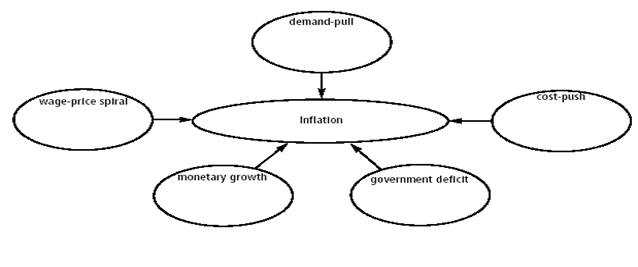
D. Case Study
Read the text and do the tasks given below.
The Effects of Inflation in the 1970s
Background Periods of high inflation can lead to the destruction of a country’s economy. In the 1970s, for example, the United States experienced the biggest and most sustained period of inflation in the country’s 1979, inflation had risen into the “double digits,” that is, to 10 percent per year or higher. The prices of consumer goods – everything from food and gas to cars and houses – rose dramatically. Those on fixed incomes were particularly hard-hit, because as prices rose their limited budgets bought less.
What’s the issue? How did inflation affect people and businesses in the 1970s? Study the sources given below to discover what it was like to live with a high rate of inflation.
How inflation affected the U. S. economy
For the years 1967 through 1978, the U. S. inflation rate averaged 6.1 per cent a year, compared with an average of 2 per cent for the years 1952 through 1967. Even during the 1973–74 recession, unlike most previous recessions, the inflation rate continued at a relatively high rate. In the late 1970s inflation speeded up again, reaching unprecedented levels. Inflation would not be so bad, in the opinion of some economists, if it were accompanied by substantial increases in output and employment. But economic growth in the United States slowed during the high inflation 1970s, bringing on a condition that economists describe as “stagflation.” Another measure of economic health – productivity, or output per worker – also slowed dramatically in [those] years throughout the industrialised world,
and in the United States and Great Britain for a time failed to increase at all. For the United States, a country long accustomed to ever-increasing material wealth, the fall-off in economic growth and the constantly eroding value of the dollar were traumatic developments. If the trends continued, the average American could no longer anticipate a constantly rising standard of living.
Consumers grew impatient with the government’s inability to control
inflation.
Here we are, spending more and getting less, but the [government] economists are optimistic. What makes them so happy? The rate of inflation may have dropped 1 per cent. Just suppose the rate of inflation had gone down from 5 per cent to 4 per cent. To me this is another increase of four cents, and a further shrinkage of my dollar.
Obviously this type of economics is good for someone. It certainly isn’t good for me, or my friends, or my relatives. Everyone is complaining, but the experts are satisfied.
I have a family of meat eaters. Long ago I discovered a marvelous cut of meat called skirt steak. It used to cost 89 cents a pound. It has inched its way up and has recently taken a leap to $1.59 and overtaken sirloin steak. Chopped meat is now where my skirt steak used to be. Even the lowly onion is no longer cheap. A weekly trip to the supermarket, which in 1969 cost $50, now costs $70.
Thinking Economically
1. Explain how the effects of inflation might be offset by increases in output and employment.
2. Why might a small decrease in a large rate of inflation satisfy government economists but upset consumers?
VI. Writing
Write an essay on the following topic.
According to opinion polls, most Americans think inflation is a more serious problem than unemployment. Write a paragraph stating your view on which is more serious. Use convincing reasons and examples.

|
Из за большого объема этот материал размещен на нескольких страницах:
1 2 3 4 5 6 7 8 9 10 |
