

Партнерка на США и Канаду по недвижимости, выплаты в крипто
- 30% recurring commission
- Выплаты в USDT
- Вывод каждую неделю
- Комиссия до 5 лет за каждого referral
IS THE UNIVERSE REALLY LOCKED UP IN THE GRAVITATIONAL CAVITY?
Gordeev A. V.
NRC “Kurchatov Institute”, Moscow, Russia, *****@
According to the contemporary concept, the initial stage of the Big Bang was accompanied by the particle energy up to  GeV [1]. By the account of the Planck dimension
  the rise of the charges particles with the mass
  may be possible what corresponds to the energy
  GeV. The annihilation of such particles can result in the generation of a strong electromagnetic field that essentially affects the relativistic motion of the particles by the magnetic field
  Gs. In this case, the particles transfer the energy
  to the electromagnetic field at the size
  [2]. When one considers, that the energy-momentum tensor in the Einstein equations
  consists of the electromagnetic field for the most part, and makes use of the Maxwell equations, the expression for
  and
and  can be obtained
 ,
, 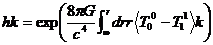 ,
,  (1)
(1)
in the four-dimension interval
 . (2)
. (2)
There exists the energy conservation law by the account of the gravitational mass defect [3]
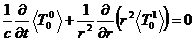 . (3)
. (3)
For the above-mentioned electromagnetic fields, the functions and change its signs:  already for a rather small size, quite analogous to black holes [4].
In the Big Bang model by the instantaneous energy generation at the size  the most of the energy is placed for
  , where
  therefore
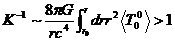 ,
,  ,
,  . (4)
. (4)
This means that the Universe expansion is impossible because the electromagnetic energy turns out to be less than the electromagnetic energy at the final stage of the expansion by the account of the gravitational mass defect according to (3).
One can show that the alternative scenario of the permanent energy rise via successive micro-explosions is possible from the size  , when in view of
 and the metric (2) is retained. For this size, the micro-explosion power is equal to
  erg/s. As a result, the total incoming energy is equal to
  erg for the lifetime of the Universe
  s, which is in agreement with the Universe energy
  erg, where
  is the proton mass.
References
[1]. Lyubimov A., Kish D. Introduction in the Experimental Particle Physics. M.:Fizmatlit, 2001.
[2]. Berestetskii V. B., Lifshitz E. M., Pitaevskii L. P. Quantum Electrodynamics. Pergamon, Oxford,1982.
[3]. Gordeev A. V.// 39th International Zvenigorod Conference on Plasma Physics and Controlled Fusion, Zvenigorod, 6-10 February, 2012. Book of Abstracts, p.191.
[4]. Landau L. D., Lifshitz E. M. The Classical Theory of Fields. Pergamon, Oxford, 1975.
