


Партнерка на США и Канаду по недвижимости, выплаты в крипто
- 30% recurring commission
- Выплаты в USDT
- Вывод каждую неделю
- Комиссия до 5 лет за каждого referral
Урок английского языка по теме: “Crime”
10 аб класс
Учебник “Rising Star”, автор Л. Продромоу, цикл 14
Учитель
Тема: Crime
Время: 2 урока – 80 минут.
Цель урока:
- формирование лексических навыков,
- развитие навыков аудирования,
- развитие навыков изучающего чтения.
Образовательный компонент цели урока:
- развитие навыков критического мышления,
- Расширение лингвистического и общего кругозора.
Развивающий компонент цели урока:
- развитие умений анализировать, выделять главное, систематизировать.
Воспитательный компонент цели урока:
- создание условий для воспитания потребности в практическом использовании английского языка в различных сферах деятельности.
Тип урока:
Комбинированный, урок развития умений изучающего чтения и развития навыков монологической речи.
Используемые технологии:
Технология развития критического мышления (таксономия Д. Блума)
Методическое обеспечение урока:
1. Материал учебника “Rising Star” by Luke Prodromou
2. “Ideas and Issues” by Ken Wilson
3. “Achieve IELTS 2” by L. Harrison, S. Hutchinson
4. http://encarta. /
Оснащённость урока:
- раздаточный материал;
- магнитофон.
Lesson Plan
Lesson 1.
1. Greeting. Introducing the topic of the lesson. Vocabulary revision. (4 min.)
At the previous lesson we studied the words connected with the topic ‘Crime’.
Let’s revise the vocabulary by completing the logical chain. What happens when someone commits a crime? Put the following activities in the correct order. The first one has been done for you. (Appendix 1)
The convict is released on parole
1. The criminal commits a crime
The criminal goes to court
The criminal goes to prison
The criminal is released on bail
The judge passes sentence
The jury finds the suspect guilty
The jury listens to the evidence
The jury reaches a verdict
The police arrest the suspect
The police charge the criminal
The police investigate
The trial starts
2. Pre-listening. At the previous lessons we spoke about A. Christie and her novels. Today let’s speak about one of the most famous fictional detective Sherlock Holmes. Discuss and make a list of facts about him. (7 min.)
Read the synopsis of the story.
Sherlock Holmes investigates a murder which appears to be an ‘open and shut case’, (a case in which it is quite clear who is guilty). A man called McCarthy was seen arguing with his son in a forest. The son emerged from the forest covered in blood, and his father shortly afterwards was found dead. The son was arrested and accused of the murder. Holmes was not convinced by the circumstantial evidence, and eventually proved that someone else was guilty of the crime.
The extract we are going to listen to describes how the murder took place. Use the following words to predict the information you are going to hear.
Serving man gamekeeper witness to depose tragedy thickly wooded lodge-keeper quarrel stain blows butt-end
3. prehension. Discussion.
Listen and say whether you were right. Now listen to the text again and answer the questions and do the tasks. (Appendix 2,min.)
1. How many people are referred to in the account of the crime?
2. What do you know about them? Summarize the text.
3. What made father and son have a violent quarrel?
pare the clues the police use to find a criminal in the time of Sherlock Holmes and now.
5. Sherlock Holmes visited the scene of the crime in The Boscombe Valley Mystery. He gave this portrait of the real murderer:
(He) is a tall man, left-handed, limps with his right leg, wears thick-soled shooting boots and a grey cloak/smokes Indian cigars, uses a cigar-holder, and carries a blunt penknife in his pocket. There are several other indications, but these may be enough to aid us in our search.
Young Mr McCarthy had given him information about the grey cloak, but how did Holmes arrive at the rest of his portrait of the murderer? Discuss the possible clues that he found at the scene of the crime.
6. Do you think the police had enough evidence to arrest the young man? Why?
4. Role-play. Work in groups of five or six and produce a mini-drama involving Sherlock Holmes. (15 min.)
Think of a crime (a murder or a robbery) that Sherlock Holmes could solve. Work out the details of the crime: who was killed/what was stolen/who discovered the crime/what kind of questions Sherlock Holmes could ask. There should be three or four people at the scene of the crime and one (or more) of them should be guilty.
Lesson 2.
5. Pre-reading.
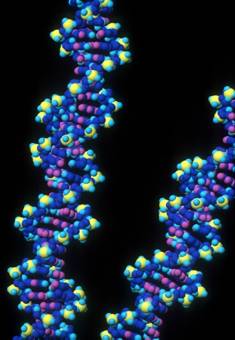
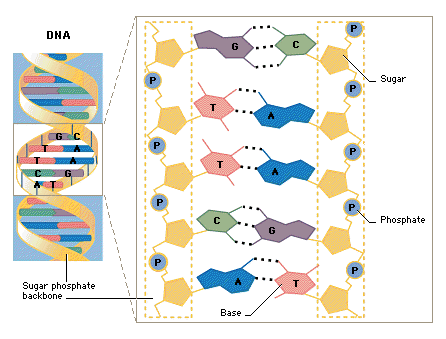
Look at these pictures. (Appendix 4) How are they connected with solving a crime? Match the pictures and the titles. (3 min.)
6. Reading. (Appendix 5) Now read the text and check your predictions. (6 min.)
Read the text again. Do the statements reflect the claims of the writer? (Appendixmin.)
YES if the statement reflects the claims of the writer.
NO if the statement contradicts the claims of the writer.
NOT GIVEN if it is impossible to say what the writer thinks about it.
1. The differences in DNA between people are small.
2. DNA profiles look like the codes on products in shops.
3. DNA fragments move through the gel because they have a positive charge.
4. By treating DNA fragments with radioactivity we can see them by using X-rays.
5. Information about our health can be found in genes containing features of the face.
Now complete the summary. Use no more than three words. (4 min.)
DNA profiling has completely changed the ( 1 )________ of forensic analysis and has become an important way of ( 2 ) ________ crime. DNA profiling ( 3 )_____ in 1980s when Dr Jeffreys was looking for ( 4 )________ between human genes.
By separating DNA and processing it, he found a way of ( 5 )________ individual DNA samples. In Britain ( 6 )________ have collected genetic material from people for a National DNA database. Discoveries in medical science are being used to ( 7 )________ crimes, but Sir Alec questions the ( 8 )________ to have this information.
Мatch the words and their definitions. (4 min.)
1. DNA a) a single thin piece of thread, wire, hair, etc.
2. forensic b) electric force
3. genome c) an acid that carries genetic information in a cell
4. barcode d) the smaller part of a living thing that can exist
5. cell e) a shape consisting of two parallel spirals
6. helix f) material forming animal or plant cells
7. strand g) the total of all the genes that are found in one type
of a living thing
8. electric charge h) connected with the methods used for finding out who is guilty
9. tissue i) a group of thin and thick lines from which a computer
reads information about a product
7. Discussion. Work groups. Discuss the questions аnd share your ideas with the group. (10 min.)
1. Do you think government should have records of our DNA? Why or why not?
2. Do you think it is fair for the police to take samples from people before the person has gone to trial? Why or why not?
3. Would you like to have your DNA profile taken? Why?
4. Do you know if DNA profiling is used to solve crime in our country?
5. Can you give more details about any case?
8. Setting homework. Before setting the homework, the teacher asks pupils the following questions. (5 min.)
1. Is crime a big problem in our country?
2. Do you worry about the crime?
3. Do you think crime is getting better or worse?
Write the essay. Some people think that criminals should be locked away from society, but other people think that education is better than imprisonment. What are your opinions on this? Write 180-240 words about this topic. Give reasons for your answer and include any relevant examples from your knowledge or experience.
Appendix 1
What happens when someone commits a crime? Put the following activities in the correct order. The first one has been done for you.
The convict is released on parole
4. The criminal commits a crime
The criminal goes to court
The criminal goes to prison
The criminal is released on bail
The judge passes sentence
The jury finds the suspect guilty
The jury listens to the evidence
The jury reaches a verdict
The police arrest the suspect
The police charge the criminal
The police investigate
The trial starts
Appendix 2
The Adventures of Sherlock Holmes
The Boscombe Valley Mystery
Sherlock Holmes investigates a murder which appears to be an ‘open and shut case’, (a case in which it is quite clear who is guilty). A man called McCarthy was seen arguing with his son in a forest. The son emerged from the forest covered in blood, and his father shortly afterwards was found dead. The son was arrested and accused of the murder. Holmes was not convinced by the circumstantial evidence, and eventually proved that someone else was guilty of the crime.
HOLMES: On June 3rd-that is, on Monday last - McCarthy left his house at Hatherley about three in the afternoon, and walked down to the Boscombe Pool, which is a small lake formed by the spreading out of the stream which runs down The Boscombe Valley. He had been out with his serving - man in the morning at Ross, and he had told the man that he must hurry, as he had an appointment of importance to keep at three. From that appointment he never came back alive.
From Hatheley Farm-house to the Boscombe Pool is a quarter of a mile, and two people saw him as he passed over this ground. One was an old woman, whose name is not mentioned, and the other was William Crowder, a gamekeeper in the employ of Mr Turner.) Both these witnesses depose that Mr McCarthy was walking alone. The gamekeeper adds that within a few minutes of his seeing McCarthy pass he had seen his son, Mr James McCarthy, going the same way with a gun under his arm. To the best of his belief, the father was in sight all the time, and the sun was following him. He thought no more of the matter until he heard in the evening that the tragedy had occurred.
The two McCarthys were after the time when William Crowder, the gamekeeper, lost sight of them. The Boscombe Pool is a thickly wooded round, with just a fringe of grass and of reeds around the edge.
A girl of fourteen, Patience Morgan, who is the daughter of the lodge-keeper of the Boscombe Valley Estate, was in one of the woods picking flowers. She states that while she was there, she saw, at the border of the wood and close by the lake, Mr McCarthy and his son and they appeared to be having a violent quarrel. She heard Mr McCarthy the elder raise up his hand as if to strike his father. She was so frightened by their violence that she ran away, and told her mother when she reached home that she had left the two McCarthys quarelling near Boscombe Pool, and that she was afraid they were going to fight. She had hardly said the words when young McCarthy came running up to the lodge to say that he had found his father dead in the wood, and to ask for the help of the lodge-keeper. He was much excited, without either his gun or his hat, and his right hand and sleeve were observed to be stained with fresh blood. On following him they found the dead body of his father stretched out upon the grass beside the pool.
The head had been beaten in by repeated blows of some heavy and blunt weapon. The injuries were such as might well have been inflicted by the butt-end of the son’s gun, which was found lying on the grass within a few paces of the body. Under these circumstances, the young man was instantly arrested…
Appendix 3
Read the synopsis of the story.
Sherlock Holmes investigates a murder which appears to be an ‘open and shut case’, (a case in which it is quite clear who is guilty). A man called McCarthy was seen arguing with his son in a forest. The son emerged from the forest covered in blood, and his father shortly afterwards was found dead. The son was arrested and accused of the murder. Holmes was not convinced by the circumstantial evidence, and eventually proved that someone else was guilty of the crime.
The extract we are going to listen to describes how the murder took place. Use the following words to predict the information you are going to hear.
Serving man gamekeeper witness to depose tragedy thickly wooded lodge-keeper quarrel stain blows butt-end
prehension. Discussion.
Now listen to the text and answer the questions and do the tasks.
1. How many people are referred to in the account of the crime?
2. What do you know about them? Summarize the text.
3. What made father and son have a violent quarrel?
pare the clues the police use to find a criminal in the time of Sherlock Holmes and now.
5. Sherlock Holmes visited the scene of the crime in The Boscombe Valley Mystery. He gave this portrait of the real murderer:
(He) is a tall man, left-handed, limps with his right leg, wears thick-soled shooting boots and a grey cloak/smokes Indian cigars, uses a cigar-holder, and carries a blunt penknife in his pocket. There are several other indications, but these may be enough to aid us in our search.
Young Mr McCarthy had given him information about the grey cloak, but how did Holmes arrive at the rest of his portrait of the murderer? Discuss the possible clues that he found at the scene of the crime.
6. Do you think the police had enough evidence to arrest the young man? Why?
Appendix 4
Look at these pictures. Match the headings with the pictures.
a) DNA molecule
b) DNA strands
c) DNA barcode
How are they connected with solving a crime?
1
2 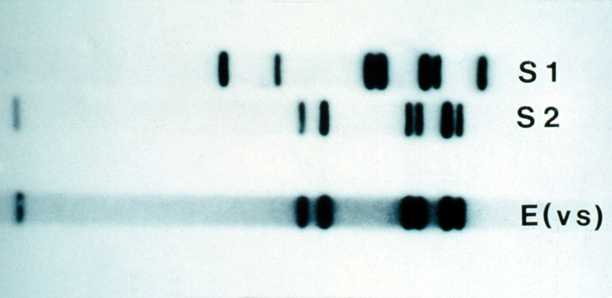
3
Appendix 5
DNA profiling: the greatest advance in forensic science since fingerprinting
The analysis of genetic material, to create DNA profiles, has revolutionized forensic science. Since its first application, DNA profiling has taken paternity disputes and forensics by storm. In 2001, American labs alone performed more than 300,000 paternity tests, and many countries have collected large DNA databases. Two decades after its discovery, forensic DNA analysis has become an important crime-fighting tool.
The origins of DNA profiling go back to the early 1980s, when Sir Alec Jeffreys identified places in human DNA that differ from one individual to the next. Since over 99% of the human genome is common to everyone, such variation between people is minimal. Indeed, the differences are in the number of DNA sequences at different locations of the genome. The number of DNA sequences at different genome locations is highly variable between individuals, but are identical within individuals. In each individual 50% of their genes are related to their parents as each parent contributes 50 % of their genetic material to their children. These DNA sequences are non-coding, that is, they do not contribute to the genetic blueprint that makes us what we are and so are not responsible for distinguishing our appearance or determining the number of DNA repeats at each genome location for eleven different locations, scientists can establish a DNA profile for an individual, which is almost unique. When this information is presented visually by bars of different thickness for the eleven different locations, it resembles a barcode, which is why DNA profiles have been compared to supermarket barcodes. The DNA codes of two people can than be compared side by side.
In order to obtain a DNA profile DNA samples need to be collected. When these samples arrive at the laboratory, the DNA has to be chemically extracted from blood (it is present in white blood cells) or another source such as single hair roots. The DNA is heated to 94*C at which temperature the DNA double helix becomes a single strand. It is then cooled to 50*C to allow an enzyme (DNA polymerases) to attach itself to the single DNA strand and copy it. At 60*C, double helixes are formed and the cycle begins again. The process allows a DNA profile to be determined in less than eight hours. As the number of DNA repeats alters the size of the copied DNA, they are separated on the basis of size as they move through a gel under the influence of applied electric charge (DNA has a slight negative charge). After profiling, the DNA strands look like supermarket barcodes.
In the mid-1990s, as DNA profiling became more powerful, automated and easier to conduct, Britain started to compile a national DNA database. For years, the police have taken genetic tissue from people charged with offences whether or not they are found guilty of the crime with all resulting DNA profiles held immediately. Since 1995, the national DNA Database has collected 23 million profiles, representing 5% of the adult population (and 9% of all men). This is more than any other country in the world: in America, by contrast, the FBI’s database holds profiles for less than 1% of the adults.
While it is difficult to criticize innovations that have uses in fighting crime, each technologies need special public attention, as their abuse could lead to discriminatory practices and invasions of privacy on a massive scale. New advances in biometrical sciences are being looked at for possible use in criminal investigations. However, Sir Alec Jeffreys strongly opposes crossing the boundaries between forensic and medical analysis. ‘If you were to look at genes involved in facial features, you can bet your bottom dollar that you’d also access information about serious congenital defects,’ he says. ‘Police have absolutely no right to that information. I believe forensics and medicine should forever remain separate.’ However, the existence of laws that allow the police to collect such genetic information in Britain, the Netherlands and Japan suggests that lawmakers think differently.
Appendix 6
Read the text again. Do the statements reflect the claims of the writer?
YES if the statement reflects the claims of the writer.
NO if the statement contradicts the claims of the writer.
NOT GIVEN if it is impossible to say what the writer thinks about it.
1. The differences in DNA between people are small.
2. DNA profiles look like the codes on products in shops.
5. DNA fragments move through the gel because they have a positive charge.
6. By treating DNA fragments with radioactivity we can see them by using X-rays.
7. Information about our health can be found in genes containing features of the face.
Now complete the summary. Use no more than three words.
DNA profiling has completely changed the ( 1 )________ of forensic analysis and has become an important way of ( 2 ) ________ crime. DNA profiling ( 3 )_____ in 1980s when Dr Jeffreys was looking for ( 4 )________ between human separating DNA and processing it, he found a way of ( 5 )________ individual DNA samples. In Britain ( 6 )________ have collected genetic material from people for a National DNA database. Discoveries in medical science are being used to ( 7 )________ crimes, but Sir Alec questions the ( 8 )________ to have this information.
5. Discussion. Work in pairs. Discuss the questions.
1. Do you think government should have records of our DNA? Why or why not?
2. Do you think it is fair for the police to take samples from people before the person has gone to trial? Why or why not?
3. Do you know if DNA profiling is used to solve crime in our country? Can you give more details about any case?
Мatch the words and their definitions.
1. DNA a) a single thin piece of thread, wire, hair, etc.
2. forensic b) electric force
3. genome c) an acid that carries genetic information in a cell
4. barcode d) the smaller part of a living thing that can exist
5. cell e) a shape consisting of two parallel spirals
6. helix f) material forming animal or plant cells
7. strand g) the total of all the genes that are found in one type
of a living thing
8. electric charge h) connected with the methods used for finding out who is guilty
9. tissue i) a group of thin and thick lines from which a computer
reads information about a product
Appendix 7
KEYS
1 The criminal commits a crime 2 The police investigate 3 The police arrest 4 The police charge 5 The criminal is released on bail 6 The criminal goes to court 7 The trial starts 8 The jury listens to the evidence 9 The jury reaches a verdict 10 The jury finds the suspect guilty 11 The judge passes sentence 12 The convict is released on parole
8The jury
T/F-1C 2D 3B 4A 5E 6F
1 Y
2 Y
3 N
4 NG
5 Y
Summary
1 science 5 comparing
2 fighting 6 police
3 originated 7 investigate
4 differences 8 right
Matching
1 C
2 H
3 G
4 I
5 D
6 E
7 A
8 B
9 F
Appendix 8
Bloom’s Taxonomy
Benjamin Bloom’s theory of developing higher levels of thought processes is applied for work with different sources of information. It reflects the progression of thinking and responding from the literal level to the evaluative. Not all levels need to be developed for every selection.
Six Levels of Bloom’s Taxonomy
KNOWLEDGE – the recall of specific information
COMPREHENSION – understanding of what was read
APPLICATION – converting of abstract content to concrete situations
ANALYSIS – comparison and contrast of the content to personal experience
SYNTHESIS – organization of thoughts, ideas, and information from the context
EVALUATION - judgment and evaluation of characters, actions, outcome, etc., for personal reflection and understanding.
Самоанализ урока английского языка по теме: “Crime”
Учебник “Rising Star”, автор Л. Продромоу, цикл 14
Учитель
Дата проведения: 28.03.2009
Класс: группа 10 аб
Описание используемой технологии развития критического мышления.
Критическое мышление представляет собой такой тип мышления, который помогает человеку определить собственные приоритеты в личной, профессиональной и общественной жизни, предполагает принятие собственной ответственности за сделанный выбор.
Человек с развитым критическим мышлением – это человек, умеющий анализировать информацию, делать самостоятельные выводы, прогнозировать последствия своих решений и нести за них ответственность. С педагогической точки зрения критическое мышление можно рассматривать как активный, творческий процесс познания.
Согласно Дэвиду Клустеру, определение «критическое мышление» состоит из 5 пунктов:
1. самостоятельность;
2. опора на информацию;
3. постановка вопросов и уяснение проблемы;
4. убедительная аргументация;
5. социальное мышление.
При подготовке к уроку использовались приёмы работы с информацией, основанные на таксономии Д. Блума (узнавание и вызов полученной информации, ее интерпретация, оценка, применение, логическое обобщение, целостное восприятие причинно-следственных связей, выделение «частного» в контексте «общего»). Понимание, согласно Блуму, проходит через некоторые стадии, этапы, имеет разные уровни (см. Приложение 8), связанные с усилиями нашей мысли. Первоначальное схватывание постепенно переходит в глубокое понимание. Глубокое понимание теснейшим образом связано с мыслительными навыками высшего порядка: анализом, синтезом, оценкой (4,5,6 ступени иерархии Блума). Так, анализ углубляет понимание, а синтез и оценка демонстрируют, что понимание имело место.
Данная технология предоставляет учителю систему эффективных стратегий и приемов, которые позволяют создать атмосферу сотрудничества, совместного поиска способов решения проблем.
Группа учащихся, в которой проводился урок, характеризуется высоким уровнем мотивации, хорошими учебными возможностями (несколько учащихся занимаются на 5 уровне), поэтому при подготовке к уроку использовался материал уровней Intermediate и Advanced.
Тема урока «Crime».
Первый урок.
1.Урок начинается с формулировки темы урока и актуализации знаний, полученных на предыдущем уроке. Учащиеся восстанавливают логическую цепочку, состоящую из 13 ступеней, отражающих ход судебного процесса. Таким образом осуществляется повторение изученной лексики и введение в тему урока. Организация работы на данном этапе формирует познавательный интерес, закрепляется лексика.
2. Подготовка к аудированию. Учащиеся будут слушать отрывок из произведения о Ш. Холмсе. На этом этапе предлагалось при помощи ключевых слов предсказать содержание текста.
3. Учащиеся слушали текст 2 раза, 1-й раз проверяя свою догадку, 2-й раз отвечали на вопросы, направленные на развитие различных мыслительных навыков ( основаны на таксономии Блума).
4. Первый урок заканчивается созданием собственного продукта – ролевая игра с участием Ш. Холмса.
Второй урок.
5. Предтекстовые упражнения. Данные упражнения направлены на развитие навыков прогнозирования содержания текста. (Приложение 4). При выполнении этого задания осуществляется связь с предметами биология, химия.
6. Усвоение новых знаний. Работа с текстом, лексикой. Учащиеся читают текст о том, как анализ ДНК помогает раскрыть преступления и учатся извлекать информацию из текста в том объёме, который необходим для решения конкретной речевой задачи.
7. На данном этапе используются задания, основанные на таксономии Блума (узнавание и вызов полученной информации, ее интерпретация, оценка, применение, логическое обобщение, целостное восприятие причинно-следственных связей, выделение «частного» в контексте «общего»).
8. Заключительный этап урока. Постановка домашнего задания.
Для достижения целей урока использовались разные виды деятельности: монологическая, диалогическая, аудирование, чтение, ролевая игра.
На занятии использовались различные формы организации познавательной деятельности учащихся: учитель-класс, ученик-ученик, ученик 1, ученик 2, ученик 3, работа в группах и т. д.
Оба урока построены на основе базовой модели развития критического мышления, включающей три стадии: «Вызов – осмысление – рефлексия». Такое построение учебного процесса помогает учащимся самим определить цели обучения, осуществить активный поиск новой информации, проанализировать ее и соотнести с собственными знаниями. На стадии вызова происходит процесс актуализации имеющихся знаний и представлений о предмете изучения. Организация работы на данной стадии позволяет сформировать познавательный интерес, определить цели рассмотрения той или иной темы. На стадии осмысления (реализации смысла) учащийся работает с новой информацией, систематизирует ее, учится формулировать вопросы по мере соотнесения старой и новой информации. Стадия рефлексии (размышления) позволяет учащимся закрепить новые знания и перестроить свое первичное представление об изучаемом материале. Таким образом, происходит целостное осмысление и «присвоение» нового знания, формирование собственного отношения к изучаемому материалу.
В ходе работы по данной технологии ученики овладели различными приемами работы с информацией, делали выводы, формулировали свою точку зрения, отстаивали ее логическими доводами, ясно выражали свои мысли, внимательно относились к аргументам оппонента и т. д.
Выбранные методы работы соответствовали целям урока, его содержанию и обеспечили хорошее усвоение материала урока.
В целом урок достиг цели. С предложенным объёмом заданий учащиеся успешно справились. Временные рамки урока были выдержаны.
Домашнее задание соответствовало теме урока.
