

Партнерка на США и Канаду по недвижимости, выплаты в крипто
- 30% recurring commission
- Выплаты в USDT
- Вывод каждую неделю
- Комиссия до 5 лет за каждого referral
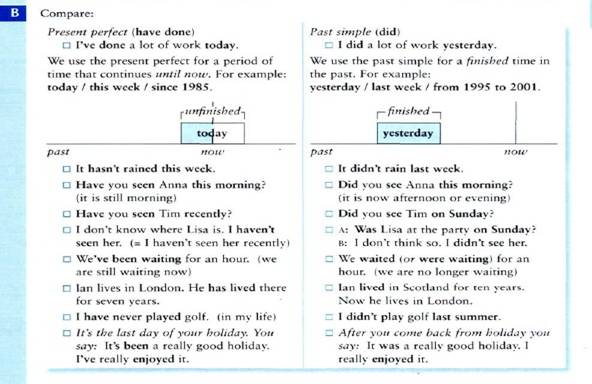
Past Simple и Present Perfect в сравнении
Образование The Past Indefinite (Simple) |
Утвердительная форма | Вопросительная форма | Отрицательная форма | ||||
... + II | Did ... + I ? | ... did not + I | ||||
I played. Я играл. | Did I play? Я играл? | I did not (=didn't) play. Я не играл. | ||||
He She It We You They | played | Did | he she it we you they | play? | He She It We You They | did not play =(didn't play) |
The Present Perfect |
Утвердительная форма | Вопросительная форма | Отрицательная форма | ||||
... + have/has + III | Have/has ... + III? | ... have/has not + III | ||||
I have (=I've) played. Я сыграл. ( уже или ранее ) | Have I played? Я сыграл? | I have not (=I haven't) played. Я не сыграл. | ||||
He She It | has played =(...'s played) | Has | he she it | played? | He She It | has not played =(hasn't played) |
We You They | have played =(...'ve played) | Have | we you they | played? | We You They | have not played =(haven't played) |
Signal Words
Simple Past | Present Perfect Simple |
|
|
Для того чтобы различать когда нужно употребить Present Perfect, а когда Past Simple, нужно знать некоторые положения:
1. Результат действия в Present Perfect влияет на настоящее и непосредственно связан с ним, а результат действия Past Simple относится только к пршлому.
I have lost my wallet. Я потерял свой бумажник (значит, сейчас его у меня нет - результат в настоящем).
He graduated from the university in 1985. Он окончил университет в 1985 году (факт прошлого, не имеющий значения в данный момент).
2. При употреблении Past Simple указывается время совершения действия. Если действие в предложении связано с определённым временем, даже если его результат влияет на настоящее, всегда используется Past Simple.
I lost my wallet yesterday. Вчера я потерял свой бумажник.
He came one minute ago. Он пришел минуту назад.
I heard strange sounds several second ago. Несколько секунд назад я услышал странные звуки.
3. Если вопросительное предложение начинается со слова when (когда), то употребляется Past Simple, так как подобный вопрос уже привязывает действие к прошлому.
When did you have your hair cut? Когда ты подстригся?
4. Выражения, которые обычно употребляются в Past Simple, несмотря на то, что они относятся к настоящему:
I didn't understand. Я не понял.
I didn't get it. До меня "не дошло"./Я не понял.
I didn't catch it. Я "не ухватил".

Ссылки на видео
http:///wall_3621?z=video_%2F2b21024e59865a9276
http:///video_
Тесты для самопроверки
Exercise 1. Put the verbs into the correct tense (simple past or present perfect simple).
Mother: I want to prepare dinner. (you / wash) the dishes yet? Daughter: I (wash) the dishes yesterday, but I (have / not) the time yet to do it today. Mother: (you / do / already) your homework? Daughter: No, I (come / just) home from school. Mother: You (come) home from school two hours ago! Daughter: Well, but my friend Lucy (call) when I (arrive) and I (finish / just) the phone call. Mother: (you / see / not) Lucy at school in the morning? Daughter: Yes, but we (have / not) time to talk then.Exercise 2. Put the verbs into the correct tense (simple past or present perfect simple).
A: (you / try / ever) haggis?
B: Oh, yes!
A: How often (you / eat) haggis yet?
B: Two times exactly.
A: When (you / eat / first) haggis?
B: That (be) in 2005. We (have) a Scottish festival in our town and they also (sell) traditional Scottish food. So I (buy) haggis.
A: (you / like) it?
B: It (be / not) too bad. And I (know / not) anything about haggis then.
A: When (you / find out) ?
B: When I (be) in Scotland in 2007. I (go) to a restaurant and (order) haggis. Afterwards, the waiter (tell) me about haggis: it's the heart, liver and lungs of a sheep, boiled in the animal's stomach. Well, I (eat / never) haggis again since then.
Exercise 3. Read the text and put the verbs into the correct tense (simple past or present perfect simple).
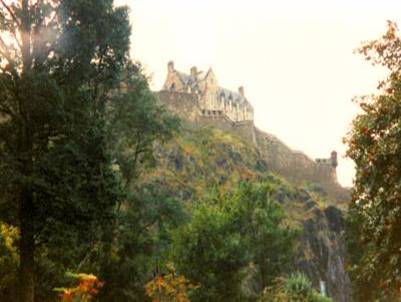
Edinburgh is the capital of Scotland. It has a beautiful old city centre and a castle that lies on a hill above the city. In the castle you can see the statues of two Scottish heroes: Robert Bruce and William Wallace (known from the film Braveheart). Several famous people were born in Edinburgh, for example Alexander Graham Bell (who invented the telephone), Tony Blair (Prime Minister) and Arthur Conan Doyle (who wrote the Sherlock Holmes stories). By the way, J. K. Rowling wrote her first Harry Potter book in an Edinburgh coffee-shop. |
|
Тесты для самопроверки (ответы).doc
Задания для самоконтроля
Test 1. Put the verbs into the correct tense (simple past or present perfect simple).
Since computers were first introduced to the public in the early 1980's, technology (change) a great deal. The first computers (be) simple machines designed for basic tasks. They (have, not) much memory and they (be, not) very powerful. Early computers were often quite expensive and customers often (pay) thousands of dollars for machines which actually (do) very little. Most computers (be) separate, individual machines used mostly as expensive typewriters or for playing games.
Times (change) . Computers (become) powerful machines with very practical applications. Programmers (create) a large selection of useful programs which do everything from teaching foreign languages to bookkeeping. We are still playing video games, but today's games (become) faster, more exciting interactive adventures. Many computer users (get, also) on the Internet and (begin) communicating with other computer users around the world. We (start) to create international communities online. In short, the simple, individual machines of the past (evolve) into an international World Wide Web of knowledge.
Test II
A difficult week
I ………………….. (not / have) a very good week this week. On Monday I …………… (lose) my purse. It only ……………. (have) about £3 in it, but I …………. (be) upset, because I …………….. (love) that purse. It ……………. (be) like an old friend. It’s the first time I ……………….. (ever / lose) a purse.
On Tuesday, I …………… (miss) the bus and …………. (be) late for work. That’s something I ……………… (not / do) since last winter, when there ……….. (be) lots of snow. Of course, when I ……………. (walk) in late, my boss ………… (give) me a good telling off. What about you, ……………………. (you / ever / be) late for work?
Which brings me to today: for a start, I ………………. (have) a headache all day, and I still have – it ………………… (not / go) away. I’m leaving the office in a few minutes, and I can tell you, I ………………… (have) problems from the moment I …………….. (arrive). At 9.05 my word processor …………… (refuse) to work. I …………….. (call) one of the technicians, and she ………………. (manage) to sort it out – but that …………… (take) half the morning. They …………………. (promise) me a new one, but it …………….. (not arrive) yet. At lunch, I ………….. (eat) something that ……………….. (not agree) with my stomach, and I …………….. (have) stomach ache all afternoon – it’s still not finished.
So now it’s 5.25 on Wednesday evening and I’m feeling rather nervous – I ……………….. (have) enough trouble already this week, and I don’t need any more! I …………….. (not / leave) the office yet – I hope nothing else happens in the last five minutes!
TEST III
1) Он уже посмотрел этот фильм.
2) Он посмотрел этот фильм на прошлой неделе.
3) Она купила красивое платье 2 дня назад.
4) Она только что купила новые туфли.
5) Майк здесь? - Нет, он вышел. Когда он вышел? - Он вышел 10 минут назад.
6) Где Том? - Он уехал в Америку. Как долго он в Америке? - Он в Америке 2 недели.
Задания для самоконтроля(ответы).doc
