


Партнерка на США и Канаду по недвижимости, выплаты в крипто
- 30% recurring commission
- Выплаты в USDT
- Вывод каждую неделю
- Комиссия до 5 лет за каждого referral
АВТОНОМНОЕ ОБЩЕОБРАЗОВАТЕЛЬНОЕ УЧРЕЖДЕНИЕ
МУНИЦИПАЛЬНОГО ОБРАЗОВАНИЯ
ГОРОДА ДОЛГОПРУДНОГО
ЛИЦЕЙ №11 «ФИЗТЕХ»
XII научно-практическая конференция
Старт в инновации
Streets hooligans.
Автор работы: Гаврилова Диана, 10 класс
Научный руководитель:
2013 г.
(1 pages) 1. Title page
(2 pages) 2. Contents:
1. Introduction (3 pages)
2. The main part. (4-8 pages)
1. The behavior of fans during the matches. (4-9 pages)
a) Football chants (4 page)
b) Fans’ perfomances (4 page)
c) Pitch invasions (4 page)
d) Self-expression fans (5 page)
e) Derby mathes (6-9 pages)
2. Practical part (10 page)
3. Conclusion (11 page)
4. Literature (12 page)
The aim of this paper is to investigate football not only as a sport, but the phenomena surrounding the game, such as football chants, disasters during the matches, hooliganism and violence, pitch invasions, as well as positive aspects, such as fair play campaign, etc.
However, there have been a number of accidents and disasters in the history of football. Some of these, such as the Hillsborough and Ibox disasters, were due to problems with crowd control. The Heysel Stadium disaster was a combination of hooliganism and poor crowd control. The Bradford City stadium fire was due to poor fire safety in the stadium. Lessons learned from these disasters have led to safer football stadia.
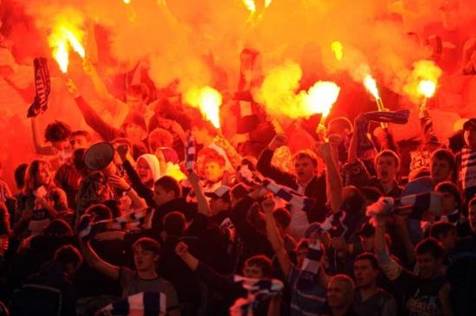
What do the fans do? We can say that they have very much work.
The first thing I will tell you is about the chants. It is the fans songs. Football songs are generated by fans at matches to encourage their team, insult the opposition, or just make a noise. Some clubs have their own anthems which the crowds sing. Some songs are shared between clubs. While some chants are used to mock opposition players, such as "Who Ate All the Pies?," Others are more aggressive and of a personal nature against a player on the pitch. Some chanting can be more than insulting, and may even be racist or sectarian in nature. FIFA and UEFA have both sanctioned "Say no to racism" campaigns to combat offensive chants and songs. Although FIFA and UEFA do not directly punish fans who partake in such discrimination, they do expect the domestic leagues and local stadiums to act upon the policies and control what fans say.
Perfomances – the most pretty show, of those that satisfied fans. Beautiful word «performance» football ultras represent his grandiose view that they are prepared to implement during matches. In the performance used in almost anything that can provide a visual effect - as authorized by law for use in the stands, and the forbidden. But, in any case, it all looks beautiful
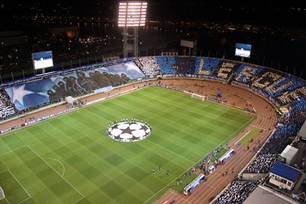
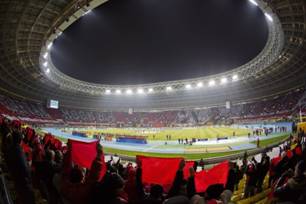
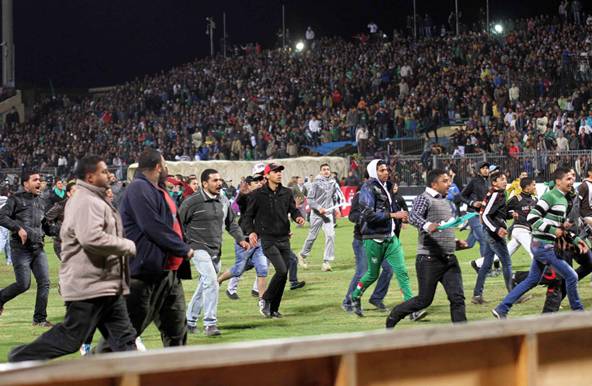
Pitch invasions. Pitch invasions happen when supporters move from the stands onto the football pitch, some times to deliberately disrupt a match. This is distinguished from times when, due to safety reasons, fans are let onto the pitch.
Examples of pitch invasions include the 1923 "White Horse" FA Cup final between Bolton and West Ham United at Wembley. Due to the overwhelming numbers in the stadium the police had to bring order back to the stadium. Another example is the 1977 British Home Championship match between England and Scotland, again at Wembley. After Scotland won 2–1, the "Tartan Army" invaded the pitch and managed to break down the goalposts, as well as cutting up the turf to take.
Solo invasions are more common although few in number. In some cases these are streakers who try to invade the pitch while nude. Supporters tend to view this as harmless fun. One such pitch invasion was at Euro 2004, in the final game between Portugal and Greece, when Jimmy Jump ran onto the pitch to disrupt the game. Another well known invasion was carried out by Karl Power, who sneaked into Manchester Uniteds team photograph before their Champions League game with Bayern Munich; his other stunts have involved the England national rugby union team and the British Grand Prix.
Fans' attribute is not less important "self-expression fans." At first it may seem that this is the most harmless fan of pranks, but this involves a lot of interesting stories. The history of Russian fans attribute started in 1972, in the stands, filled with supporters of the Moscow "Spartak", a man will appear in a simple red and white scarf. Believe it - no, but it was the first sign of a fan culture in the Soviet Union.
Over time, the scarf of your favorite club has come to mean for the fans much more than an unusual item of clothing. Today the most cruel insult to fans of another club is to take their scarf with the logo of the club and burn it. For us, it looks like aboriginal habits, but in fact it happens very often.
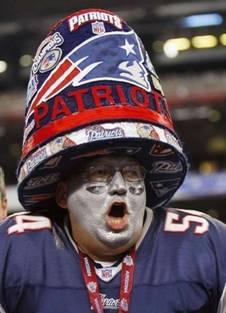
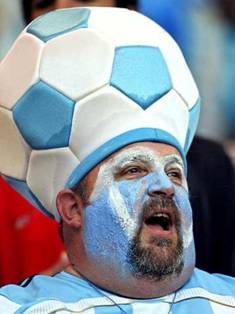
I would like to tell apart on this type of games as a derby. Derby matches, which are matches between two neighbouring rival clubs, are often fiercely competitive. Sometimes there are underlying political or sectarian tensions. The term often applies to matches between two teams from the same city or region, but it is sometimes used to refer to matches between big clubs from the same country. Derbies are usually treated as the most important matches by the fans, players and clubs, regardless of position in the league table, et cetera. The film Green Street embodies the spirit of derbies when one of the characters refers to the West Ham United versus Millwall Football Club rivalry as that of Israel against Palestine. Of course this film does focus on the mostly past era of hooliganism, however its depiction of matchday passion shows just how important derby day is to fans. When it comes to derbies, the culture of football thrives and shines in all its colours. How Soccer Explains the World is a perfect source into how derbies emerged and what they mean to the community.
Most often, all the mass brawl and wrecking public spaces occur in the derby day, because these matches passions run to the limit.
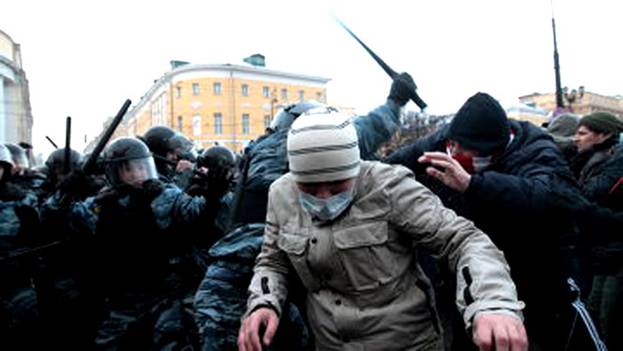
Football hooliganism refers to what is widely considered unruly and destructive behaviour by overzealous football fans. Actions such as brawling, vandalism and intimidation are enacted by association football club fans participating in football hooliganism.[1] The behaviour is often based upon rivalry between different teams and conflict may take place before or after football matches. Participants often select locations away from stadia to avoid arrest by the police, but conflict can also erupt spontaneously inside the stadium or in the surrounding streets.
Football hooliganism can range from shouts and small-scale fistfights to huge riots where firms attack each other with deadly weapons (including, but not limited to, sports bats, glass bottles, rocks, knives, machetes and pistols). In some cases, stadium brawls have caused fans to flee in panic and injuries have been caused when fences or walls have collapsed from the pressure of the exiting crowd. In the most extreme cases, hooligans, police, and bystanders have been killed, and riot police have intervened with tear gas, armoured vehicles and water cannons.
A football firm (also known as a hooligan firm) is a gang formed for the specific purpose of antagonising and physically attacking supporters of other clubs. Some firms exist to promote fringe political causes, both on the far Left and Right, and, in some cases, the promotion of political ideals through violence is of greater importance than the football club itself.
The first instance of football violence is unknown, but the phenomenon can be traced back to the 14th century England. In 1314, Edward II banned football (at that time, a violent, unruly activity involving rival villages kicking a pig's bladder across the local heath) because he believed the disorder surrounding matches might lead to social unrest, or even treason. According to a University of Liverpool academic paper, conflict at an 1846 match in Derby, England, required a reading of the "riot act" and two groups of dragoons to effectively respond to the disorderly crowd. This same paper also identified "pitch invasions" as a common occurrence during the 1880s in English football.
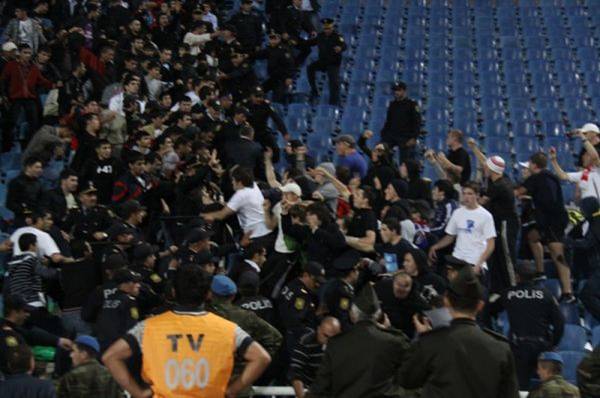
The first recorded instances of football hooliganism in the modern game allegedly occurred during the 1880s in England, a period when gangs of supporters would intimidate neighbourhoods, in addition to attacking referees, opposing supporters and players. In 1885, after Preston North End beat Aston Villa 5-0 in a friendly match, both teams were pelted with stones, attacked with sticks, punched, kicked and spat at. One Preston player was beaten so severely that he lost consciousness and press reports at the time described the fans as "howling roughs". The following year, Preston fans fought Queen's Park fans in a railway station—the first alleged instance of football hooliganism outside of a match. In 1905, a number of Preston fans were tried for hooliganism, including a "drunk and disorderly" 70 year-old woman, following their match against Blackburn Rovers.
Although instances of football crowd violence and disorder have been a feature of association football throughout its history, (e. g. Millwall's ground was reportedly closed in 1920, 1934 and 1950 after crowd disturbances), the phenomenon only started to gain the media's attention in the late-1950s due to the re-emergence of violence in Latin American football. In the 1955-56 English football season, Liverpool and Everton fans were involved in a number of incidents and, by the 1960s, an average of 25 hooligan incidents were being reported each year in England. The label "football hooliganism" first began to appear in the English media in the mid-1960s, leading to increases media interest in, and reporting of, acts of disorder. It has been argued that this in turn created a 'moral panic' out of proportion with the scale of the actual problem.
In the 1970s and early 1980s, the "casual" subculture transformed the British football hooligan scene. Instead of wearing skinhead-style, working class clothes, which readily identified hooligans to the police, firm members began wearing designer clothes and expensive "offhand" sportswear (clothing worn without careful attention to practical considerations).
The level of passion with which football teams are supported has from time to time caused problems, and clashes between fans can result in violence. Some violence occurs by people aiming to cause trouble, a phenomenon known as hooliganism. Other fans group together in hooligan firms, which are organised gangs that seek fights with other firms supporting rival clubs. Both are sometimes known as the "English Disease," after the disorder caused by English fans travelling abroad to support either their club or national team in the 1970s and 1980s. Europe is trying to emulate England and thus hooliganism among fans went beyond their homeland. However organised violence surrounding football has been prevalent throughout other countries, most notably by ultras in Italy, torcidas organizadas in Brazil and barra brava in Argentina and other Latin American countries.
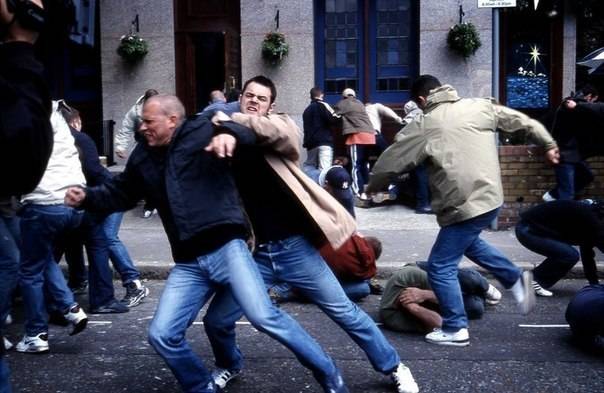
Violence by fans has ranged from small fights between fans to tragedies such as the Heysel Stadium disaster and also the Football War. There have been incidents of fans being murdered, such as the killings of Christopher Loftus and Kevin Speight, two Leeds United supporters, in Istanbul in 2000 on the eve of the UEFA Cup Semi-Final first leg. In recent years this aspect of the game seems to have passed its peak in England though it has by no means disappeared completely. Specialist police units and information-sharing between regional and international police forces has made it much harder for the hooligans to organise and participate in disorder. CCTV inside and outside stadiums and also at other anticipated "flash points" such as city centres and railway stations now makes it more likely that people involved in disorder can be identified later even if they are not arrested at the scene. However there are still disruptions surrounding football matches.
Violence by fans has also affected players, but this is rare. For example, a message to Christian Vieri, apparently by an Inter Milan fan, threatened to burn down his restaurant, criticising his attitude towards the team. There is also the notorious incident where the Colombian international player Andrés Escobar was murdered shortly after returning home from the 1994 World Cup. This was reputedly for scoring the own goal which eliminated Colombia from the competition.
I want to talk about some interesting positive and negative sides of the incidents involving the fans.
The most tragic story of Russian football took place on 20 October 1982. At Luzhniki Stadium was there match between Spartak and Haarlem. Toward the end of the match, not expecting more goals, most of the (by then quite frozen) fans began to leave their seats in the stands and headed for the exits. Most fans from platform "C" moved to the stairs № 1, which was close to the subway. Just 20 seconds before the final whistle, Sergei Shvetsov scored a second goal against Haarlem. At about the same time on Ladder number one of platform "C" in the space under the stadium tribune there began, stampede which led to the death of 66 fans.
And the next incident happened to me personally. This summer I was at the match Spartak-CSKA. This is the most irreconcilable derby in Russian football. I like to visit this derby, because that day means to the brim stadium for 82,000 seats. Thousands of fans, each confident of victory his team’s. The week before the derby fans start to think about the composition of the teams, and they have dreams about this *****ssian football fans are waiting for it a year before. The atmosphere at the stadium is impossible to discribe. You start to feel it at the subway stations before near the stadium, when you walk surrounded by thousands of fans. After the game, I saw a picture that brought a fly in the ointment. I was walking towards the train and saw the fans in front of me trying to get into their car OMON. This was so brutal, that got very frightened. But riot police arrived in time, thank God for help, and the instigators were arrested.
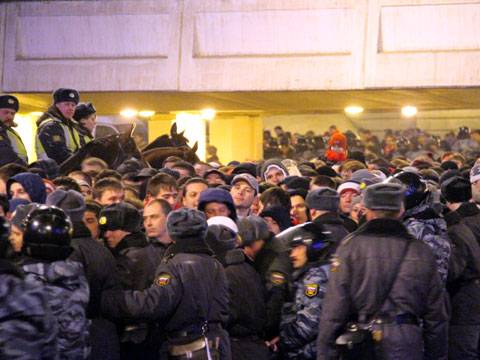
Despite numerous disaster-related activities fans, fan movement is fascinating in its own way. In my opinion, the fans behave quite differently in different situations. The proof of this is recent match Russia-Portugal. The audience were very disciplined and friendly. I did not observe any aggressive actions on the part of the fans.
So everyone has their own opinion on the fans, but certainly the fan movement has the right to exist.
Literature:
1. http://en. wikipedia. org/wiki/Association_football_culture
2. http://en. wikipedia. org/wiki/Football_hooliganism
3. http://www. football-hooligans. org/
