

Партнерка на США и Канаду по недвижимости, выплаты в крипто
- 30% recurring commission
- Выплаты в USDT
- Вывод каждую неделю
- Комиссия до 5 лет за каждого referral
ДОСТОПРИМЕЧАТЕЛЬНОСТИ ВЕЛИКОБРИТАНИИ
Аннотация
Данное учебное пособие предназначено, в первую очередь, для учеников старших классов средней школы, и может быть использовано как источник дополнительных материалов страноведческого характера к любому из ныне существующих учебников английского языка. Пособие с успехом может стать основой курса «Страноведение» в старших классах школ с гуманитарной ориентацией.
Возможно использование пособия в других учебных заведениях: на гуманитарных факультетах различных вузов, в системе дополнительного образования, на различных языковых курсах.
Учебное пособие знакомит учащихся с наиболее знаменитыми достопримечательностями Великобритании. Тексты пособия написаны легким, увлекательным языком, максимально приближенным к живому, разговорному английскому.
Предисловие. Кому адресовано это пособие
Это учебное пособие может сослужить хорошую службу ученикам старших классов средних школ, или студентам младших курсов гуманитарных ВУЗов. Главная цель пособия: рассказать о самых знаменитых достопримечательностях Соединенного Королевства: самыми посещаемыми городами и музеями страны, самыми популярными культурными фестивалями, их истории, экономическом и культурном значении. Пособие может использоваться как в класса, так и для самостоятельной работы.
Пособие содержит тексты, большая часть которых представляет собой рассказ гида, сопровождающего группу российских туристов в поездке по Британии, и упражнения, позволяющие развивать различные навыки работы с текстом.
Тексты пособия могут использоваться как дополнение к любому курсу «Страноведение» или как материал для чтения в классах, где изучаются различные аспекты истории, культуры Великобритании.
Foreword. Who the book is for
This book can be used by advanced students of English in the upper grades of secondary schools or on the more basic courses in colleges and universities. This book aims to offer students a broad introduction to the most famous and interesting sights of the United Kingdom: the most visited cities and museums, the most famous art festivals, their history and significance to the country’s economy and culture. It can be successfully used both in the classroom and as a self-study aid.
Each unit contains a text, usually in the form of a dialogue between Russian tourists and their English tour guide, and exercises that will help develop language skills such as comprehension and text analysis.
The book provides good reading material for any British Studies program or for use in advanced English languages classes where the UK is the topic under consideration.
Introduction:
First of all, let me introduce the main characters of the book: my friends Vladimir and Valentina. They got married three years ago it has become a good tradition to celebrate their wedding anniversary by spending a week or so abroad every year. This year is not an exemption. So, they went to the travel agency where the following dialogue happened:
Travel agent: Can I help you?
Valentina: Oh, yes. You know, last year we went to Greece and spent two weeks at the sea resort. It was really great. But this year we are looking for something different, you see, something exciting.
Vladimir: I would say, something we could remember for many years to come.
Travel agent: Well, I think there is something for you. How about a 2 week holiday in Britain? You will travel by coach around the country and see the most interesting places in England, Scotland, Wales. Castles, palaces, ancient monuments, medieval towns and modern cities.
Vladimir: It sounds great.
Travel agent: And not very expensive. The price includes everything: accommodation, catering, excursions and admission fee to all museums and historical buildings.
Valentina: Yes, we will take it.
At London Airport they are joined by some other Russian tourists who are going on this tour: Anna and Denis. The tourists are welcomed by Richard Dawson – their tour guide.
Richard: It is my profound pleasure to invite to this wonderful journey around the United Kingdom. This tour was designed to give you the freedom to explore both the history and the culture of Britain.
Anna: Excuse me, I have a question which I have always wanted to answer. You say the UK and Britain, is there any difference?
Richard: Well, actually, no. The official name of my country is The United Kingdom of Great Britain and Northern Ireland but it is such a fuss to pronounce it that we usually say just UK. Britain and Great Britain are geographical names. As you know UK consists of several parts: England, Wales, Scotland and Northern Ireland. The word England should never be used to describe Britain, because England is only one part of the country. It is always correct to call people from England, Scotland, or Wales British, although people from England are properly called the English, people from Scotland are the Scots, and people from Wales are the Welsh.
Denis: So, if I address anyone “English” in, say, Scotland…
Richard: You will offend this person. Please, be careful with what you are saying.
Valentina: How very interesting!
Richard: The United Kingdom is a small nation: 244,110 sq km, it is about the size of Byelorussia or twice the size of New York State. The climate, in general, is mild and often wet. We have about 300 rainy or cloudy days per year.
Anna: Now I understand all these sayings about “the English weather”.
Valentina: The British weather…
Richard: Despite its size, Britain is a highly developed nation with stable economy, prosperous and peaceful. The British enjoy one of the highest standards of living in the world. Britain’s rich cultural heritage and traditions are the main reasons why it has millions of visitors each year. The attractions include theaters, museums, art galleries, and historical buildings that are all around the country and numerous annual arts festivals.
Tourism is very important to our economy. Britain is one of the world’s most visited countries. We have about 25 million visitors a year.
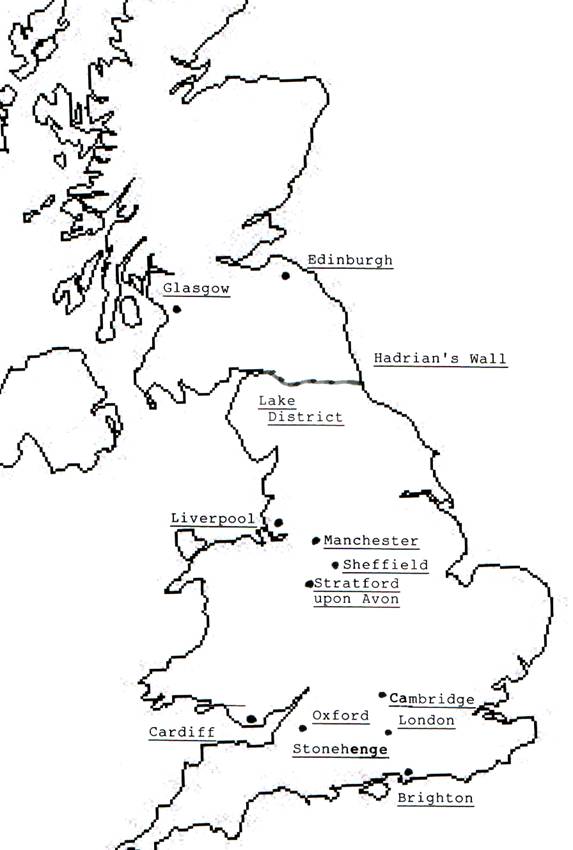
Now, take a look at the map. It shows the places and cities we are going to see.
Take a look at the map that Richard has shown to the tourists.
1. St. Paul’s Cathedral
Richard: Before we leave London, there are some very important landmarks of the British capital that we simply must see. First is St. Paul’s Cathedral. It is a magnificent, unique building, one of the greatest churches in the world.
Vladimir: How old is it?
Richard: In fact, there has been a Cathedral on this site since 604 AD but it was destroyed and rebuilt several at least three times and the Cathedral you can see today dates from in the 17th century. Every day about 40 000 people come to St. Paul: some attend the services, some are tourists from all parts of our planet.
Anna: Why was it destroyed several times?
Richard: Mostly it was seriously damaged by the fire. When in 1666 the Cathedral was burnt down as a result of the Great Fire of London, the plans were made to build the new Cathedral at once. The construction finished only in 1710. Many famous artists took part in the decorating of St. Paul: the beautiful frescoes and glittering mosaics that the visitors adore today are the perfect works of art. Many contemporary artists continue to enrich the Cathedral.
Denis: It is true that St. Paul is the main church of London?
Richard: Yes, a lot of important events were celebrated at the Cathedral: the Golden Jubilees of Queen Victoria and Queen Elizabeth II, famous priests of the past and present preached here. The Cathedral is also the burial place of many important and influential political and marital figures. They are commemorated with beautiful monuments. Although the Cathedral is full of treasures it is not a museum. St. Paul is a living place of worship. The services take place daily, so we will be allowed to enter the Cathedral only when the sermon is over. And do not forget to turn off your camera and a mobile phone. Tourists are not allowed to use them when at the Cathedral.
Wellington Memorial honours one of the greatest military figures in history |
Anna: The Cathedral is enormous, I think we need several hours to look around. What are the most interesting things we should see here?
Richard: The Nave – the central part of the Cathedral where there is the altar and the imposing memorial to Wellington, it is the largest memorial in the Cathedral, it commemorates a famous British officer.
Denis: Yes, I see, Wellington is depicted riding his horse on the top of the monument.
Valentina: This monument is so big! If is just fantastic!
Richard: Several architect worked on it for more than 20 years.
Anna: On the walls there are paintings depicting the scenes from the life of Jesus Christ as far as I can understand.
Richard: Yes, you are right. If we go down the Nave we can view the statues of famous priests of the past, some of these statues are very old, and mosaics that show the symbols of the Christianity.
The staircase takes us up to the Dome – this part of the Cathedral is also often referred to as “The Galleries”. Perhaps you have heard about the Whispering Gallery – it is 259 steps up – where a word said on one side can be heard 32 metres away on the other.
Vladimir: I guess if this place is called “The Galleries” there is more than one gallery.
Richard: There is not only one gallery in the Dome. 378 steps up is the Stone Gallery and if you climb 530 steps you will get to the Golden Gallery which offers panoramic view across London.
OK, now it is time to go to a gift shop and a café. The tourists love to buy the books, cards, souvenirs reflecting the beauty of the Cathedral. At the café we can have a snack - buy a sandwich or a cup of tea. It is a good idea to have a short rest here before we go on to the Crypt.
Anna: Where?
Richard: The Crypt - the basement of the Cathedral. Many important persons and national heroes are commemorated here: you will see the monuments to the army officers Nelson and Wellington, Lawrence of Arabia, the prime minister of the UK Winston Churchill and Florence Nightingale – the woman who founded the first nursing school in England. There is also the memorial to William Turner, one of the greatest painters of the 19th century.
Denis: If I am not mistakes, Christopher Wren, the architect who designed the Cathedral, is also buried here.
Richard: Yes, we will stop at his grave. It is very simple, there is no monument but the plate on the gravestone says: “If you look for a monument, just look around”.
Denis: Yes, the whole Cathedral is a true memorial to this talented architect.
Vocabulary
Landmark знак, символ
Service (здесь) богослужение
Nave неф (центральная часть церкви)
Glittering блестящий
Golden Jubilee золотой юбилей (50 лет правления Монарха). В истории Великобритании эта дата отмечалась только два раза: в 1887 отмечалось 50летие коронации королевы Виктории, а в 2002 свой Золотой Юбилей отпраздновала Елизавета II.
Dome купол
Crypt крипта (склеп)
Comment
The famous people mentioned in the text:
William Turner – Уильям Тернер () a famous English painter, renowned for his dramatic treatment of natural light.
Christopher Wren – Кристофер Рен () a famous English architect. Apart from St. Paul’s Cathedral he designed the Royal Observatory in Greenwich, and Chelsea Royal Hospital (London).
Florence Nightingale – Флоренс Найтингейл () a British nurse and hospital reformer who became internationally known as the founder of modern nursing. The nursing was considered low-grade unskilled labor, thanks to her efforts it became a respected profession.
Winston Churchill – Уинстон Черчиль () a famous British politician and prime minister of the United Kingdom (, ), widely regarded as the greatest British leader of the 20th century.
Admiral Horatio Nelson –Адмирал Горацио Нельсон (1758 –1805) a British admiral famous for his participation in the Napoleonic Wars, most notably in the Battle of Trafalgar, where he lost his life. He became the greatest naval hero in the history of the United Kingdom. He is honoured with Nelson's Column, which stands in Trafalgar Square.
Duke of Wellington – Герцог Веллингтон (1769 –1852) a British soldier and statesman, widely considered one of the leading military and political figures of the 19th century.
Lawrence of Arabia – Лоренс Аравийский () a British adventurer, soldier, and spy. In 1914 Lawrence was sent to Saudi Arabia where he worked among the Arabs in revolt against Ottoman rule and became their military adviser.
Ex. 1 Choose the best answer
St. Paul’s Cathedral is the place of many celebrations because:
i. it is the largest church in the UK
ii. it is the official church of the Monarch
iii. the Cathedral is the main Church of London
iv. it is just a tradition to celebrate all important events here
Ex. 2 Answer these questions briefly
How many times has the Cathedral been rebuilt? Who designed the Cathedral? How many galleries does the Cathedral have?Ex. 3 Answer these questions using the information from the text:
Why do people like to go the Whisper Gallery? What can you see on the wall of the Nave? Why is there no monument to Christopher Wren?Ex. 4 Make a short presentation of St. Paul’s Cathedral to your friends. Tell them about its history. Your report should contain the answers to the following questions:
When was the first Cathedral on this spot built? When was the present Cathedral completed? Is St. Paul’s Cathedral important to the British?Gather the information from the text about the famous people who are commemorated at the Cathedral and complete these sentences:
At least three famous military figures are buried at St. Paul’s. They are: ….
One of the most famous politicians in the history of Britain is commemorated here: …
This woman was just a nurse but today you can see her grave at St. Paul’s and her portrait is on the reverse side of the British banknotes: …
He was a famous painter in his lifetime and decorated the Cathedral with his paintings …
Ex. 5 Make true sentences:
| All monuments and memorials are … To go to the galleries you should … Near the Nave there is … If you want to have a souvenir that will remind you about your visit to the Cathedral … | a. go to the gift shop that is at the end of the Nave b. a small café where you can rest a little c. ascend to the Dome d. in the Crypt, below the Cathedral |
Ex. 6 Translate these sentences into English
Собор Св. Павла – один из символов Лондона. Здание огромно и внутри очень много интересного. Перед тем как войти, выключите свои телефоны! В центральной части собора мы увидели красивейшие фрески и статуи видных деятелей церкви прошлого. Затем мы поднялись наверх, в купол собора. Там находятся знаменитые галереи. Среди них самая известная «галерея шепота». После мы провели немного времени в магазине сувениров. Я купил книгу о истории собора..
2. Buckingham Palace
Richard: Now we are moving down the Mall, at the end of this street there is Buckingham Palace – the official London residence of the British Monarch. The palace has 600 rooms and stands on a 20 hectare patch of land.
Vladimir: How did it get its name?
Richard: The palace was built by the Duke of Buckingham in 1705, hence, the name of the building. Originally it was not intended to become the Royal residence. For centuries the Monarch lived first in Westminster Palace and then in St. James Palace where he moved after the Palace of Westminster was damaged by fire. In 1762 George III bought the Palace from the Duke and presented it to his wife. This way the Palace became the property of the Royal Family but only in the second half of the 19th century, when Queen Victoria was on the throne, Buckingham Palace was turned into the residence of the Monarch. The Queen moved to Buckingham Palace for practical reason: she decided that St. James Palace was too small for her family – she had eight children. Since then practically all British kings and queens have lived and worked in Buckingham Palace.
The Monarchs of the reigning dynasty - the Windsors - continue to use the Palace as their working place.
Denis: But the Monarchs no longer live here, do they?
Richard: No, they do not. The real home of the Sovereign is Windsor Castle, which lies on the outskirts of London.
Today Buckingham Palace is a very busy place. Several hundred people work here, helping the Monarch run the country. Hundreds of people daily come to the Palace to see the Sovereign on various matters, lots of important meetings, receptions and ceremonies take place here.
In 1994 the Queen Elizabeth II opened the Palace to the public. You can visit Buckingham Palace in August and September when the Monarch traditionally goes on holiday. During these two months the Palace receives about 8000 visitors a day.
Anna: We are lucky to be here in August. We will be able to go on the tour of the the way, what is this monument in front of the Palace Gates?
Richard: The Victoria Memorial, a statue of Queen Victoria. Now let’s enter the building.
First we see the State Rooms: they are furnished with the greatest treasures from the Royal Collection - paintings by Rembrandt, Rubens, Vermeer; sculpture by Canova and Chantrey; exquisite examples of porcelain; the finest English and French furniture in the world.
Although Buckingham Palace is furnished and decorated with priceless works of art in the world today, it is not an art gallery.
The State Rooms are used regularly by the Monarch and members of the Royal Family for various official ceremonies.
Vladimir: And this is the Throne Room. I must say it is rather difficult to imagine a king or a queen sitting nowadays on the throne like in a movie.
Richard: In the Throne Room the Monarch receives all important visitors like the Heads of the foreign states. Actually this room is not used very often.
Now we are at Ballroom that is 36 m long and 18m wide and 13 m high. It is the largest room in Buckingham Palace. It was opened in 1856 with a ball to celebrate the end of the Crimean War.
When a foreign president comes to the UK on the official visit there is always the State Dinner in his/her honour held in this room.
From the Ballroom we can go to the West Gallery decorated with amazing frescoes and paintings. The Gallery overlooks the gardens that surround the Palace.
We must see the State Dining Room too. Many distinguished people have dined in this room including lots of presidents and prime ministers. A lot of banquets are held here throughout the year.
Valentina: It was very interesting! This Palace is fantastic!
Richard: Our tour is not over yet. There is something to see outside Buckingham Palace: the Changing of the Guard. This magnificent ceremony takes place in front of the palace every day from April to September.
Vocabulary
Porcelain фарфор
State Rooms Парадные Комнаты
Throne Room Тронный Зал
Ballroom Танцевальный Зал
State Dining Room Парадная Столовая
Comment
Crimean War – Крымская Война () a military conflict between Russia and a coalition of Great Britain, France, and the Ottoman Empire (now Turkey); it was a turning point in the political history of Europe..
Ex. 1 Choose the best answer:
How did the Palace of Buckingham become the residence of the Monarch?
i. The King ordered to built it
ii. The King bought it from the Duke of Buckingham
iii. The Duke of Buckingham presented the Palace to the King
iv. Queen Victoria bought the Palace from the Dukes of Buckingham.
Ex. 2 Answer these questions briefly
What is the largest room in the Palace? How many rooms are there in the Palace? When can you visit the Palace?Ex. 3 Answer these questions using the information from the text
Why is there the memorial to the Queen Victoria in front of the Palace? Was the Palace open to the public in the early 20th century? What ceremony takes place in front of the Palace daily?Ex. 4 Match the names of the State Rooms and the purposes they serve
| The Throne Room The Ballroom The State Dining Room | the banquets on various occasions the State Dinner when a Head of another country comes to Britain the official welcome of the Head of a foreign country to the UK |
Ex. 5 Express your opinion: is Buckingham Palace worth visiting? Why?
3.The Houses of Parliament (The Palace of Westminster)
Richard: The Palace of Westminster is nearly 1000 years old although it was reconstructed, enlarged and redesigned many times and today’s palace dates mostly from the 19th century. For a long period of time the Palace of Westminster was the home of the Monarch. It was in 1512 that a great fire seriously damaged the Palace and the king Henry VIII decided to leave it and move to another palace.
Anna: Yes, you have just told us about it…the king moved to…oh, I have forgotten…
Richard: St. James Palace and then to Buckingham, but now we are talking about Westminster. Since the 16th century the palace has served as the home of the British Parliament.
Vladimir: So, this is where the House of Commons and the House of Lords work.
Richard: Yes, two chambers of the British Parliament are here, all laws are passed and all important political and social questions are discussed in this building. This is where the Monarch of the UK reads his/her special speech to the Government and the nation once a year.
Valentina: Is the Palace open to the public?
Richard: Yes, we can enter it and see some very interesting historic rooms and halls. Now, when we are inside the building, look at the ceiling of the main hall. You see the three colours of Parliament – gold that symbolizes the Monarchy, red – the symbol of the House of Lords and green – the symbol of the House of Commons. The building is divided in three parts according to these colours.. On our tour we will first pass through the royal part of the palace, the part of the House of Lords and the House of Commons.
First, the Robing Hall. In this room the Monarch receives the Imperial State Crown which is placed on his/her head just before he/she walks though the corridor to the House of Lords to read his annual address.
Denis: This Crown is usually kept in the Tower.
Richard: Yes, it is used only once a year. The Monarch wears it during the opening Parliament.
This rooms lead us to the Royal Gallery where there are Royal portraits. These are kings and queens from the ancient times till nowadays. And these two large paintings show the scenes from the battles which were fought against the French in the 19th century - the Battle of Trafalgar and the Battle of Waterloo.
Now we are going to the House of Lords.
Denis: This part of the palace does not seem very old.
Richard: It is not very old because in the Second World War the palace was bombed and this part of it was rebuilt in the 1950s.
The Lords sit on the red benches and the Lord Chancellor who is the head of the House sit at the end of the hall on the big red divan.
Vladimir: It is often called “the woolsack”, is not it?
Richard: Yes, many years ago, he really sat on the woolsack, it was used as the symbol of the prosperity of England but today it is just a divan. And here is the House of Commons.
Anna: The prevailing colour here is green.
Richard: As you see the members of the Parliament sit on the green benches.
Valentina: And the Lord Chancellor sits on the green divan, does not he?
Richard: No, he does not. There is no the Lord Chancellor. The head of the House is the Speaker and he sits on the green chair.
Well, our tour is ending here.
Anna: And what about Big Ben? This famous clock is also a part of the Palace.
Richard: Yes, but Big Ben is actually the name of
the bell, not the clock or the tower. This clock strikes every 15 minutes and it is the most famous public clock in the world.
Vocabulary
House of Commons Палата Общин (нижняя палата Британского Парламента)
House of Lords Палата Лордов (верхняя палата Британского Парламента)
The Imperial State Crown Государственная Императорская Корона, хранится в Тауэрском музее, используется только один раз в год: Монарх носит корону во время торжественного прохода по Вестминстерскому Дворцу, прежде чем зачитать традиционное послание к правительству. Как правило, это происходит во время открытия очередной сессии Парламента
Lord Chancellor Лорд Канцлер
Woolsack мешок с шерстью
Comment
The Battle of Waterloo – Битва при Ватерлоо (June 18, 1815) – Napoleon’s last battle when he fought against the allied forces of Britain (under the Duke of Wellington) and Prussia.
The Battle of Trafalgar – Трафальгарская Битва (21 October 1805) a very important event in the war of Britain against Spain. It was one of the most significant naval battles in history. A Royal Navy fleet of 27 ships under Admiral Nelson destroyed an allied French and Spanish fleet of 33 ships near Cape Trafalgar. The French and Spanish lost 22 ships; the British none.
Ex. 1 Choose the best answer:
Why did the king vacate the Palace?
i. Parliament needed a place and threw the king out
ii. The King did not like the Palace
iii. The King never lived in this Palace, it was built specially for Parliament
iv. The Palace was damaged by fire
Ex. 2 Answer these questions briefly:
How many times a year does the Monarch read a special speech to the nation? How many parts does the Palace consist of? “Big Ben” is not the name of the clock, is it?Ex. 3 Answer these questions using the information from the text:
What can you see in the main hall of the Palace? Is the Royal Crown kept at the Palace? Which two famous battles are commemorated in the paintings you can see at the Royal Apartments of Westminster? Why did the House of Lords have to be reconstructed in the 1950s?Ex. 4 Tell your groupmates what you have learned about the Palace of Westminster. Answer these questions:
Ex. 5 Make up a dialogue about the Palace of Westminster. Base it on the text you have read. Ask and answer the questions about the history of the Palace, the sights you can see there.
Ex. 6 Translate these sentences into Russian
Вестминстерский Дворец – место, где заседает Британский Парламент. Экскурсия по Дворцу была очень интересной. Во-первых, мы посетили Королевскую Галерею, где увидели портреты всех британских монархов. Дворец разделен на три части: Королевские Комнаты, Палата Лордов и Палата Общин. У каждой части дворца есть свой традиционный цвет. Например, традиционный цвет Палаты Лордов – красный. Члены палаты сидят на красных скамьях, а глава палаты – Лорд Канцлер – сидит на красном диване.
StonehengeRichard: The first destination on our list is Salisbury Plane in south – western England. We are going to see Stonehenge.
Valentina: My God, is it all there is to see!!
Richard: You are not the only one who says these words. Many people feel the same when they arrive here. Really, on the one hand Stonehenge is nothing more than a circle of large stones that dramatically dominate rather bleak landscape.
But on the other hand, it is a prehistoric monument that dates from the late Stone Age. It is the largest, the most famous and important megalithic monument in Europe.
Denis: What was it built for?
Richard: We do not know its precise purpose, there are hundreds of theories, thousands of myths about its origins and possible ways in which it could be used. Some say (and some do not agree with them) that Stonehenge was a tribal gathering place. The other widely known theory suggests that it was a religious centre and it was connected with astronomical observations.
Anna: I think it was a very difficult task to erect these huge stones here.
Richard: Stonehenge is made up of large sandstone blocks (each is 4 m high) that form a circle 33 m in diameter.
Vladimir: You said it is prehistoric.
Richard: Stonehenge was built around 2200 BC. The scientists believe that all 82 sandstones were transported from Wales.
Denis: What? But Wales is very far from here. Why did these people move these large stones from Wales to this plain? How did they do it? Why?
Richard: It is a good question. Very little is known about this people but we can assume that it had good trade connections and settled in this region about 1600 BC. The archaeologists found numerous burials around the monument. The graves were very rich and contained many precious objects.
When the Romans occupied Britain, they took little interest in Stonehenge but tore down some stones. The chronicles say that two stones fell in January 1797, and another stone fell in 1900. In 1958 these stones were raised to give the monument the appearance that it had during the Roman occupation of Britain.
Valentina: Why was Stonehenge built?
Richard: I wish I knew. May be people used it to predict the summer and winter solstices, the equinoxes and eclipses of the sun and moon.
Denis: So, Stonehenge is a prehistoric calendar.
Richard: Perhaps it was the gathering place for religious ceremonies connected with the sun and moon. We can say no more. The science stops here but fantasy begins to take off. Some say that the stones possess magical power and can cure any disease, and some believe that this structure was erected by the beings from the space.
Today tourists from all over the world wander among these giant stones, take pictures of them and try to imagine that Stonehenge had been here long before the pyramids in Egypt were built.
Vocabulary
Bleak унылый
Sandstone песчаник
BC (англ. Before Christ) до нашей эры
Solstice день солнцестояние
Equinox день равноденствие
Eclipse затмение
Ex. 1 Choose the best answer:
What is the precise purpose of Stonehenge?
i. It was a prehistoric calendar
ii. It was a burial place
iii. We do not know
iv. It was used as an observatory
Ex. 2 Answer these questions briefly
Where does Stonehenge stand? How old is it? How many stones does Stonehenge consist of? In what form is the stones arranged?Ex. 3 Answer these questions using the information from the text
Were the people who built Stonehenge rich? What astronomical events might Stonehenge be connected with? What are the most popular theories about the origins and purposes of Stonehenge? Why is Stonehenge so famous and important?Ex. 4 Put these events in the chronological order
Ex. 5 If you could go to England, would you like to see Stonehenge? Why (not)?
Handrian’s WallVladimir: Another ancient monument. This time it is not prehistoric and, well, at least I know something about it. In 55 BC the Roman Emperor Julius Caesar undertook his first attempt to invade Britain. Of course at that time there was not any country on the British Isles, they were inhabited by many Celtic tribes, some had common language and culture.
Richard: Yes, Caesar found Britain to be “a nice land with forests and marshes, filled with a great number of men and cattle" as his historians wrote. He defeated some local tribes on the southern coast of Britain and thus began the Roman occupation of Britain.
Other Roman Emperors continued to drive off the natives from their territory and establish settlements and fortresses. In 79 AD the present day England and Wales were under control, but the far North remained a serious problem. Many times the Romans tried to invade the present day Scotland but they failed. The peoples who inhabited Scotland were fiercely resistant and independent.
Denis: And the Romans decided to build this wall to mark the end of their territory and protect it from the Scots, I guess.
Richard: Yes…
Denis: But why is it called Hadrian’s Wall?
Vladimir: Hadrian was a Roman Emperor. He decided to build this wall.
Richard: That is 117 AD the Roman Empire had already ceased to expand and the biggest problem was to control its borders. In 122 AD Hadrian visited Britain and ordered to build a wall to (as he said) “separate Romans from Barbarians".
Vladimir: I read that the wall was built by slaves.
Richard: It is not true. The historians say that constructing the wall was a way to keep Roman legionaries busy. There was not very much to do in Britain those days, and the Roman soldiers needed exercise to keep fit and spend their free time in some way.
Anna: You mean they built the wall just to have some fun.
Richard: Well, to some extent, yes… It took the soldiers six years to build the wall. The wall stretched for 117 km across the country. It was 3 m thick and about 4 m high. Many fortresses were built at regular intervals along the wall to patrol the territory. Hadrian's Wall was attacked by the hostile people from the North three times: in 180, 297, and 367 AD and was finally abandoned in about 400 AD. Some parts of the wall still stand today and we see them as the greatest monuments to the power of the Roman Empire.
There are also the remains of the Roman forts and houses that we can see. They can help you take a look at what life was like in Britain 2000 years ago.
The city of Carlisle was one the Roman’s strongholds. Today we can see a well preserved Roman fort there that is almost 2 000 years old and is a museum now.
Vocabulary
Celtic кельтский
Marsh болото
AD (латин. Anno Domini) наша эра
Barbarians варвары
Slave раб
To keep fit поддерживать форму
Ex. 1 Choose the best answer
Why was the wall built?
i. To protect the Scots from the Romans
ii. To protect the Romans from the Scots
iii. To mark the border of the Roman Empire

|
Из за большого объема этот материал размещен на нескольких страницах:
1 2 3 4 |
