

Партнерка на США и Канаду по недвижимости, выплаты в крипто
- 30% recurring commission
- Выплаты в USDT
- Вывод каждую неделю
- Комиссия до 5 лет за каждого referral
, *****@***ru, 4-53
МОУ Средняя школа 21
10 кл, 6-й год обучения, В1
Учащиеся: возраст 16-17 лет, интересы: спорт, общение с ровесниками, точные науки, уровень владения Pre-Intermediate
Тема урока: Messages
Основной УМК: Spotlight 10 кл, 2010 г. Unit 2e Short messages
Текст и аббревиатуры взяты с: http://www. teachingenglish. org. uk/lesson-plans/texting
Цель урока: Научить составлять краткое письменное сообщение неформального характера
Задачи:
- Познакомить с особенностями структуры письменного сообщения
- Изучить основные правила построения аббревиатур в англ. языке
- Развитие навыков чтения с полным пониманием текста
- Развитие навыков письменной речи
- Расширение кругозора
Материалы для Урока:
Учебник, раздаточный материал, компьютер, проектор
Время | Этапы урока | Формы взаимодействия учащихся | Материалы, ТСО |
5 мин | Lead in | discussion (general questioning) | |
3 min | Task 1 | in pairs | notes |
5 min | Eliciting the topic and the goals of the lesson | discussion (general questioning) | |
15 min | Task 2 | in groups | screen, answer sheets |
3 min | Task 3 | one by one | SB |
4 min | Task 4 | in pairs | exercise-books |
20 min | Task 5 | discussion (general questioning),individually | Papers with texts |
3 min | Task 6 | in groups, general questioning | Papers with texts, papers with the task |
10 min | Task 7 | general questioning, in groups | Papers with a note |
2 min | Conclusion | ||
20 min | Task 8 | individually | SB, exercise-books |
Introduction
Communication is the main activity for teens. Variety of gadgets and programs used for this aim is huge but the most popular are mobiles and different messengers. Besides, pupils are very active social nets users that gives them opportunity to use the language in the situation of real communication. In this lesson they learn some rules of modern English writing and the difference between private and official messages.
(Pupils are divided into 2 groups)
Lead in: Discussion (general questioning for eliciting the topic and the goals of the lesson)
Guys, you are very active and communicative!
How do you keep in touch with you friends and relatives? What helps you? (messengers/ i-net/ mobile/ social nets/ skype)
What do you use your mobile and e-mail for? (sending messages/ texting)
Are your messages long or short? How long is your average written message? Why?
When do you leave or send messages? What for? (to send information, to remind, to say thank you, to say sorry / apologise)
(On the blackboard: How? their variants When? their variants Size: their variants )
Task 1
Guys, You all were sent a note! Answer my question from the note, please.
On each desk there is a note: HT! GR8 T C U! RUOK 2day? (Hello there! Great to see you! Are you OK today?)
In pairs they try to guess.
What do you think are we going to talk about today? (short messages)
Topic appears only after their answers. It might be in the form of: sending messages / leaving messages / written messages (the final variant is discussed with the pupils)
In what form can short messages exist? (a postcard, a note, text, short e-mail)
What can you learn today? (how to write short messages)
What do you think you will be able to do at the end of our class? You can also use your answers which are written on the blackboard (Eliciting the answers and putting them down as goals for the lesson:
– to learn how to write text messages;
– to learn how to read text messages;
Task 2
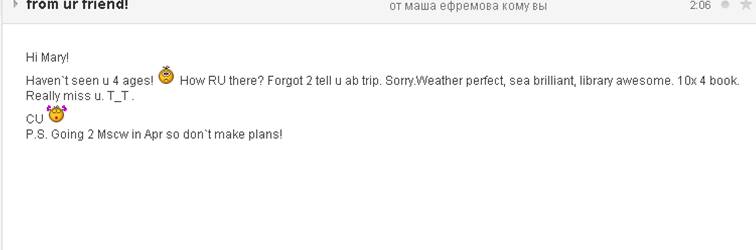
Yesterday I got a mail which is a good pattern of a writing message for us. Look at its screenshot.
Read this message and tell me:
What are the purposes of this message? Prove.
Are there any special features in its style? I`ve noticed at least 7.
What about you? Discuss in groups. And fill your answer sheets. You have 5 min.
You can use the answers you gave in the begining:
- Inform
- Remind
- Thank
- Apologise
Checking answers.
Can you answer how many people take part in writing communication? (at least 2)
Who are they? (sender and addressee)
Does the content of a message depend on the
They read variant by variant (they are put on the blackboard in suitable variants):
- no personal pronouns, articles, auxiliaries
- using of contractions
- imperatives
- informal linkers
- abbreviations
- emoticons
(absence of pronouns, articles, emoticons, etc.)
How can we name all these features? What do they help us to do? (help to write, rules of writing)
Put above the list Rules of writing:
Have we already achieved any of our goals today? (to learn how to write text messages)
But we know only the rule! What are we going to next? (Do exercises)
Task 3
SB ex.3 p.36
Pupils asked one by one
Task 4
By the way do you remember there were not only contractions in the e-mail but also some abbreviations! Let`s try to guess their meaning.
On the blackboard: 4 ages, going 2 visit, tell u ab, 10x 4 book, CU
(for ages, going to visit, tell you about, thanks for book, see you)
Task 5
Do you use the same abbreviations in Russian? Do you use them while texting to your friends? Do your parents use such symbols? What do they think about literacy in texting?
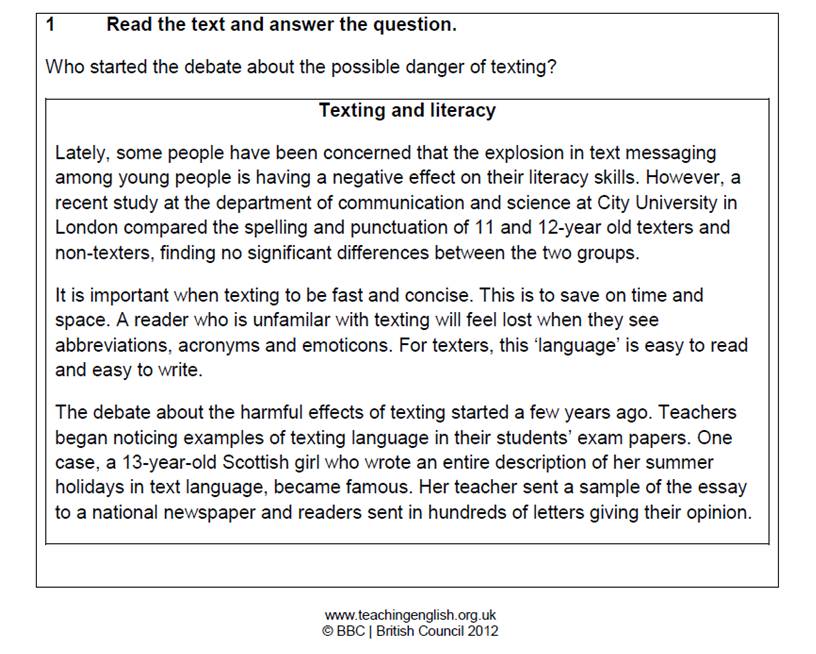
Let`s find out specialists` opinion. Take the text you have on your desks.
You are to scan the text and then to answer my question
Who started the debate about the possible danger of texting?
Task 6
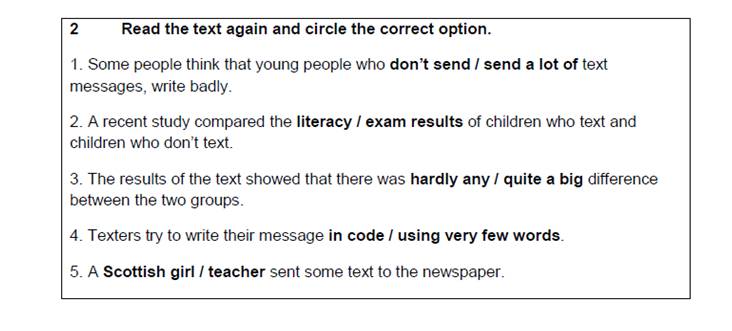
Now read this text once again and choose the correct variant. Discuss this task in groups.
Checking in the oral way.
What`s the gist of this article?
What are we to remember while communicating in writing?
(Does addressee influence on our style of writing? In what way?)
Task 7
Now it`s high time for you to use your knowledge in practice.
Both groups have a note. One`s from your mum, another – from sister. You are to leave a reply (25-35 words).
But before you start let`s remember some rules and the structure of the message:
(image with e-mail is opened again)
- opening/closing remarks (variants)
- no personal pronouns, articles, auxiliaries
- contractions, abbreviations, emoticons
- imperatives
- informal linkers
Start your work. You have 7 min.
Let`s check. Give your note to another group and let`s discuss highs and lows of your works.
Guys, let`s make a conclusion of our lesson.
What goals did we set?
Did we achieve them?
What can be the task for total achievement of our goal? (Elicit the right answer)
Task 8
Ex 9 p 38
You work individually. Take one of the situations you like more and write your answer.
Appendix
Note (Task 1)
HT! GR8 T C U! RUOK 2day?
Letter (Task 2)
Answer sheet (Task 2)
Purposes of sending the message:
- _________________________________
- _________________________________
- _________________________________
- _________________________________
- _________________________________
Features of the message:
- _________________________________
- _________________________________
- _________________________________
- _________________________________
- _________________________________
- _________________________________
- _________________________________
 Text (Task 5)
Task 7
(1 group)
Luke
Gone out to get football boots. Size 8?
Call me if wrong size! What time are you back tonight?
Don`t forget – Dad`s b`daydinner at 7!
Love Mum xxx
_________________________________________________
_________________________________________________
_________________________________________________
_________________________________________________
_________________________________________________
_________________________________________________
_________________________________________________
(2 group)
Emma
Going shopping with Jane after school. Want to come? Will wait at bus stop till 4.
Katie
P. S. Could go to cinema or have dinner after
_________________________________________________
_________________________________________________
_________________________________________________
_________________________________________________
_________________________________________________
_________________________________________________
_________________________________________________
