

Партнерка на США и Канаду по недвижимости, выплаты в крипто
- 30% recurring commission
- Выплаты в USDT
- Вывод каждую неделю
- Комиссия до 5 лет за каждого referral
New Economic School, Masters in Finance
financial markets and instruments
Supplementary materials for class 3
Крупным планом: Срочно на рынок!
Обороты торговли производными втрое перекрыли классический рынок РТС
Андрей Панов Ведомости 05.04.2006, №59 (1586)
На российском фондовом рынке стремительно развивается новый сектор — торговля фьючерсами и опционами. Меньше чем за год объем торгов производными инструментами на бирже РТС вырос почти в 10 раз, значительно обогнав обороты на классическом рынке. Все больше компаний создает специализированные подразделения по торговле деривативами или задумывается о выходе на новый для себя рынок.
У срочного рынка в России непростая судьба: “черные вторники”, “четверги” и девальвация рубля в 1998 г. разорили большинство биржевых площадок, на которых активно торговали производными инструментами. И даже ММВБ пришлось в августе 1998 г. принудительно закрывать позиции по валютным фьючерсам задним числом, к большому недовольству многих участников. Возрождение срочного рынка акций началось в сентябре 2001 г., когда РТС открыла секцию FORTS и начала торги по фьючерсам на акции “Газпрома”, “Лукойла”, “Сургутнефтегаза” и РАО ЕЭС. К маю 2003 г. среднемесячные обороты на FORTS достигли 20 млрд руб. и держались около этого уровня следующие два года. Но в прошлом августе на рынке произошел прорыв: биржа запустила торги фьючерсами на индекс РТС, и обороты моментально выросли до 76 млрд руб. А уже в марте этого года они превысили 195 млрд (почти трехкратный объем торгов на классическом рынке). Средний объем открытых позиций вырос за год в четыре раза — с 11 млрд руб. до 45 млрд руб.
РТС пока остается единственной площадкой, на которой можно купить фьючерсы или опционы на акции, но уже во второй половине этого года аналогичную FORTS секцию планирует запустить ММВБ. В развитии торговли производными заинтересованы не только биржи. Замруководителя ФСФР Владислав Стрельцов неоднократно заявлял, что служба видит в срочном рынке цивилизованную альтернативу для маржинальной торговли. До недавнего времени торговля с плечом большим, чем 1 к 1, официально была запрещена. Сейчас позволена торговля 1 к 3, хотя в действительности многие инвесткомпании позволяют своим клиентам работать с плечом 1 к 7, а то и к 10. А гарантийное обеспечение по фьючерсу на акции составляет 20-15%, что эквивалентно плечу 1 к 4-6, причем клиенту не нужно платить проценты за одолженные активы.
Постепенно к новым возможностям стали присматриваться и “классические” российские инвесткомпании. Если в первом полугодии 2005 г. десятку лидеров по активности в секции FORTS оккупировали интернет-брокеры и редкие банки — “Зенит” и Металлинвестбанк, то по итогам февраля 2006 г. на третьем месте оказалась “Тройка Диалог”.
Арбитраж, хеджирование и работа на перспективу
“Во всем мире объемы торгов деривативами превышают обороты по основным активам, — говорит управляющий директор "Тройки Диалог" Жак Дер Мегредичян. — Понятно, что в России со временем будет так же и мы хотим заранее иметь серьезные позиции на этом рынке”. Впрочем, для “Тройки” работа на срочном рынке — это не только работа на перспективу. “Операции с производными инструментами открывают дополнительные возможности заработать, — утверждает Дер Мегредичян. — Ситуация, когда возможен арбитраж, возникает постоянно. Например, до недавнего времени котировки фьючерса на индекс РТС были на 2-3% ниже, чем сам индекс, — можно было купить фьючерс, продать акции дюжины компаний, стоимость которых коррелирует с индексом более чем на 90%, и с большой вероятностью получить прибыль”. С лета прошлого года фьючерс на акции “Газпрома” стоит существенно больше самой акции, отмечает гендиректор агентства Derevative Expert Илья Ефимчук: “Покупка акций газовой монополии с одновременной продажей фьючерса сейчас приносит 12% годовых в рублях, а некоторое время назад приносила и все 20%”. “Не хочу рассказывать о наших операциях, — скрытничает топ-менеджер одного из крупных операторов срочного рынка. — Чем дольше окружающие не понимают всех возможностей, тем больше денег мы заработаем”.
Ведущий специалист “Брокеркредитсервиса” Павел Сороковой выделяет среди клиентов две группы инвесторов. Для первых FORTS — это привлекательная альтернатива маржинальной торговле. “Они имеют бесплатное плечо, да комиссии по сделкам ниже, чем на споте”, — поясняет Сороковой. Но, по его оценке, все больше крупных институциональных инвесторов используют срочный рынок именно для арбитража. “Доля этих операций увеличивается, и именно за счет них идет такой бурный рост рынка в последнее время”, — полагает специалист.
Операции с фьючерсами на индекс помимо арбитража дают “Тройке Диалог” возможность хеджировать опционы, которые она продает клиентам на внебиржевом рынке. Хеджирует такие операции и “Ренессанс Капитал”, признается директор управления структурных продуктов “Ренессанса” Роман Сарычев, который называет свою компанию одним из лидеров по объему открытых позиций на опционах в FORTS. По словам Дер Мегредичяна, срочный рынок нужен компании еще и потому, что дневные обороты “Тройки Диалог” по акциям на порядок превосходят собственную позицию. “Из-за этого необходимость в краткосрочном хеджировании резко возрастает, — утверждает менеджер. — Не могу сказать, что мы постоянно используем фьючерс на индекс для хеджирования. Но это происходит регулярно и гораздо чаще, чем полгода назад”.
Большие деньги завтра
Дер Мегредичян не сомневается, что возможности, которые срочный рынок дает управляющим и спекулянтам, подтолкнут развитие торговли деривативами. Но пока круг торговцев деривативами довольно узок, признает он, и во многом это связано с очень быстрым развитием фондового рынка. “Инвестиционные дома не успевают за этим ростом и в первую очередь концентрируются на тех направлениях, где можно много заработать уже сегодня, — полагает Дер Мегредичян. — А тут большие деньги будут завтра. Сейчас — только нормальные”.
Тем не менее инвестиционные компании активно создают специализированные подразделения для работы на срочном рынке. “Мы активизировались на рынке фьючерсов после появления контракта на индекс, — говорит Сарычев. — Это очень удачный проект биржи, и я думаю, что интерес к индексным деривативам будет очень сильно расти”. А вот торговля фьючерсами на акции пока не интересна “Ренессансу”, поскольку у компании нет необходимости в маржинальной торговле или репо, а цена на эти фьючерсы “слишком просто” зависит от базового актива
. “Пока у нас практически нет собственной позиции на FORTS, но в ближайшее время мы собираемся стать маркет-мейкерами по всем торгуемым опционам”, — рассказывает директор департамента производных “Атона” Евгений Бузун. Подразделение по торговле срочными контрактами
создается и в “Уралсибе”.
“Я бы с удовольствием строил стратегии на сужении спрэдов корпоративных облигаций и ОФЗ, — признается трейдер одного из крупнейших частных банков. — Но, к сожалению, пока рынок фьючерсов на облигации не слишком ликвидный”. Тем не менее он “напрямую рассматривает” возможность покупки фьючерсов, чтобы проверить, насколько эффективным может быть такая игра.
Без аналитиков
Клиентам инвестиционных компаний ежедневно приходят отчеты аналитиков, в которых они рекомендуют купить или продать какую-либо акцию. Упоминание фьючерсов или опционов в этих отчетах и исследованиях — крайняя редкость. “Стоимость фьючерсов привязана к спот-рынку, поэтому отдельной аналитики по фьючерсам, например, "Лукойла" не нужно. А фьючерс на индекс появился недавно”, — поясняет Ефимчук.
“Пока нашим клиентам это не интересно. Не помню, чтобы кто-либо из них спрашивал меня о фьючерсах”, — признается аналитик “Уралсиба” по стратегии Владимир Савов. Зато стратегический аналитик “Ренессанс Капитала” Ованес Оганесян уделяет внимание срочному рынку. “На срочном рынке очень сильно выросли объемы”, — поясняет аналитик. Тем не менее много аналитики по деривативам не будет, полагает Дер Мегредичян: “Она всегда будет менее глубокой и скорее описательной — ведь тут важна скорее ликвидность и спрэд к основному активу. Хотя мы постепенно будем вставлять ее в свои обычные отчеты”. Оганесян добавляет, что аналитика по срочному делу — это скорее удел тех, кто продает клиентам сложные продукты и предлагает стратегии игры на срочном рынке. А Ефимчук считает, что аналитика появится, когда рынок опционов станет ликвидным, поскольку ценообразование опционов и стратегии торговли устроены гораздо сложнее, чем для фьючерсов.
Но отсутствие аналитики — не единственная проблема этого рынка. Например, налогообложение фьючерса на индекс не прописано четко, ведь по законодательству индекс — это не ценная бумага
. “Здравый смысл подсказывает, что никакой разницы между фьючерсами на индекс и на акции "Газпрома" нет, но проблемы у частных лиц могут возникать, — полагает топ-менеджер "Тройки". — А ведь для "интернетчиков" гораздо логичнее спекулировать на индексе с финансовым плечом 1 к 10, чем на акциях РАО ЕЭС, поведение которых во многом зависит от ситуации в конкретном секторе”.
Forecast for weather derivatives
This hot market shows no signs of cooling off
By Lori Pizzani
Barely a decade old, the weather derivatives market has grown by leaps and bounds, fueled by an increased awareness of global warming, cyclical climate changes, the devastation of harsh weather evidenced by 2005’s infamous Atlantic hurricane season, and the realization that while weather is an omnipresent force that cannot be altered, the everyday risk it poses can be managed. Industry estimates are that up to 30 percent of the U. S. economy is affected in one way or another by weather.
In addition, a greater number of participants on both sides of weather risk management agreements are stepping up, including a growing number of hedge fund managers willing to assume the risk that businesses, farmers, insurers and reinsurance firms are hoping to shift to others.
 Trading Mother Nature
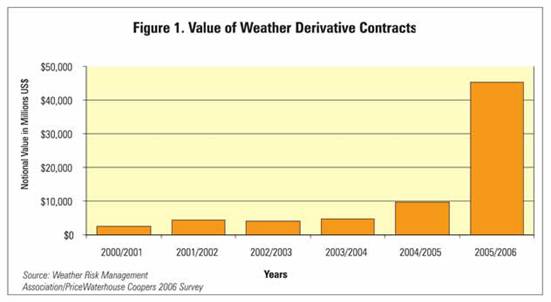
From its meager beginnings with the trading of the first privately negotiated weather derivative by energy companies in the Fall of 1997, the total weather derivatives market has grown more than ten-fold over the past two years to more than $45 billion notional in size from $4 billion, according to a survey jointly released this past June by the Weather Risk Management Association and accounting firm PriceWaterhouse Coopers. The WRMA is an industry trade group made up of member companies that participate in the weather derivatives market.
The broader weather derivatives market includes both privately negotiated contracts (typically constructed as swap agreements) that are traded in the Over The Counter (OTC) market as well as index-linked derivatives created and traded via the Chicago Mercantile Exchange.
Although the industry’s roots are in the OTC market and much of the volume has been centered there since deregulation of the energy market allowed for the innovation of weather derivatives, the pendulum appears to have shifted. A growing number of products are now being traded on the CME while the volume of trading in the OTC markets has fallen by 50 percent.
The recent WRMA/PriceWaterhouse Coopers’ survey tracking market activity between April 2005 and March 2006 noted that the value of trades on the CME increased by a factor of eight, while the number of CME trades quadrupled from one year earlier. Over one million weather derivatives traded via the CME from the summer of 2005 through the 2005/2006 winter, versus 223,000 trades over the same period one year earlier.
According to a CME spokesman, as of late June 2006 the average daily volume of weather derivatives traded is now 3,212. CME-traded contracts account for about $41 billion of that total $45 billion in notional value. That is up a sunny 64 percent from the $25 billion in trades one year earlier, according to the survey.
In contrast OTC trades, as reported by the 17 companies that participated in the survey, amounted to 2,180 versus a warmer 4,057 in the 2004/2005 survey, although it is unclear why the volume of privately negotiated contacts declined.
Mercury Rising and Jack Frost
Weather derivatives that center on Heating Degree Days (HDD) are by far the most popular type of weather derivative. HDDs involve calculating the number of degrees that a day’s average temperature, as measured from midnight to midnight, is lower than a 65-degrees Fahrenheit baseline (which translated to 18 degrees Celsius.) Similarly, weather derivatives that encompass Cooling Degree Days take into account the number of degrees that a day’s average temperature is greater than 65 degrees F.
Such temperature-dependent weather derivatives can protect energy companies, retailers and other weather-dependent businesses to hedge the risk associated with a decrease in earnings, crop losses or increases in costs due to unexpected temperature changes.
But weather derivatives don’t just run hot and cold. Weather derivatives have vastly expanded into growing degree days for farmers, as well as snowfall hedges, precipitation (rain/drought) hedges, wind hedges, humidity hedges and other types of derivatives to help manage the short-term or long-term risk of weather volatility.
However, unlike traditional insurance products and catastrophe bonds that can be purchased from insurers to hedge against unlikely and unusual events such as hurricanes, tornadoes, tsunamis, floods and other low-probability cataclysmic events, weather derivatives provide a hedge against the risks associated with high-probability events such as colder/hotter, rainier or dryer than usual summers and colder/warmer or snowier than expected winters. Many of these meteorological conditions can be brought on by cyclical weather patterns such as El Nino/La Nina or climatic trends such as global warming which, many predict, will increase weather volatility.
Weather derivatives are also unlike catastrophic insurance in that to collect money, businesses don’t have to prove a loss and wait for insurance money. Rather, if a certain measurable event occurs, such as 30 days of cold temperatures, the contract is immediately paid on.
Forecasting New Weather Risk Management Tools
The CME was the first commodities exchange to jump into the weather fray. In the summer of 1999 it launched the first exchange-traded weather derivative and has been adding to its risk management toolbox ever since.
It now offers a plethora of monthly and seasonal futures and options on futures products including ones based upon 29 cities (18 in the U. S., nine in Europe and two in Japan). Salt Lake City, Utah, Baltimore, Maryland, and Detroit, Michigan, as well as four European cities were added in 2005. It also launched a new frost days futures product nearly one year ago. In February 2006 the CME launched snowfall futures and options for Boston and New York. And the forecast is for the CME to add to its pool of weather derivatives.
“The CME is adding cities and variables that they didn’t have before,” said Jeff Hamlin, director of weather risk solutions at Risk Management Solutions, a weather risk management product and service provider in Newark, California.
“We are looking at (adding) evacuation risk, hurricane risk and precipitation risk (products),” confirmed Felix Carabello, director of alternative investments at the CME. According to Carabello, the CME sees an opportunity to address problems in the current weather derivatives market, as well as address the needs of market participants who are looking for bigger opportunities. “The CME is committed to making markets work better, not just create indexes to do something novel, but rather to address issues,” he noted.
And hybrid products that combine weather derivatives or are paired with future contracts on other commodities make sense and are being considered by some, said John Lovi, managing partner of the New York law firm of Steptoe Johnson, LLP. For example, a weather derivative for frost days can be combined with a futures contract on orange juice where a few frosty nights can wipe out an entire crop, he said. Similarly a weather derivative focusing onstream flow (the volume of gallons of water flowing in a stream used by hydroelectric power plants) pairs nicely with a rainfall weather derivative, he added.
Driving Winds, Driving Rains, Driving Demand
What’s driving the demand for weather derivatives?
Experts agree that beyond farming and agricultural firms, other seasonal and weather-dependent businesses (ski lodges, construction companies, ice cream manufacturers, amusement park owners, etc.) and even municipalities are beginning to warm to the concept of hedging weather risk. In addition, insurance and reinsurance firms are finding weather derivatives an attractive way to transfer risk and lighten their insurance liabilities.
|
|
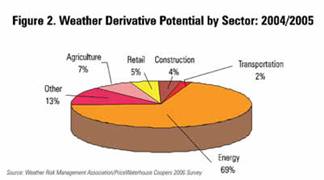
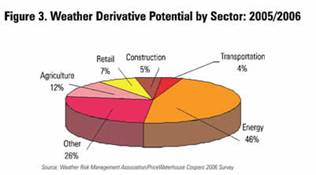
Moreover, a niche but growing number of hedge fund managers are grabbing weather derivatives for their risk premiums or to hedge some of their own energy company investments. A few enterprising souls have started hedge funds that only trade weather derivatives.
“People are always complaining about the weather. Weather derivatives are just one way people can start doing something about it,” said Dr. Timothy J. Richards, the Power Professor of Agribusiness at the Morrison School of Agribusiness of the Arizona State University in Mesa, Arizona. The FDA spends $17 billion a year to offer crop insurance to growers, but certain micro-crops such as rutabagas or kiwi don’t qualify, making these growers ripe for considering weather derivatives, he said.
“Many agricultural companies are establishing long-term production contracts and it would make sense to embed weather derivatives into these as a way to manage the risk of yields,” he said. That’s not only for crops but dairy farms and others as well. For agricultural needs, the CME’s products will never work, he noted.
Dr. Richards is conducting research related to weather derivatives and is coauthor of an academic paper on how to price weather derivatives. Pricing derivatives is seen by many as one of the obstacles to further growth of the industry.
Folks in the construction industry, asphalt and concrete manufacturers and beyond are beginning to realize significant benefits, said Brian O’Hearne, managing director, environment and commodities markets at insurance firm Swiss Re, and president of the WRMA. “The beauty is that weather impacts so many industries,” he noted. He also notes that “pricing continues to get better and better.”
The deregulation of the energy sector increased the desire among energy companies to ensure against unused capacity or buying resources at higher prices, said Peter Stockman, head of the capital markets team at PA Consulting Group, a consulting firm in New York. “A cooling or heating hedge is much more efficient in hedging risks,” he said.
In addition, insurance companies facing risk concentration on their balance sheets will often sell off portions of a large insurance deal via weather derivatives, Stockman added.
“With greater transparency on how weather impacts balance sheets it will become a less acceptable argument for a company to say: we didn’t do well because of bad weather,” said Carabello of the CME.
Hedge Funds: Let it Snow, Let it Snow, Let it Snow
“More recently hedge funds have come to use weather derivatives to hedge other derivatives,” confirmed Willa Cohen Bruckner, attorney with the New York law firm of Alston & Bird. Most hedge fund managers aren’t loading up on weather derivatives, but hedges funds make up the bulk of investors. They are also appealing because they are not correlated to traditional equity or bond markets, she added.
“Hedge fund managers are always searching for oversized returns and, like Star Trek, boldly go where no man has gone before,” quipped C. Evan Stewart, partner with the New York Law firm of Zuckerman Spaeder.
But not every hedge fund is clamoring for weather derivatives. Some hedge funds as well as banks have waded into the eye of the storm only to find they cannot make a profit, said Lovi of Steptoe & Johnson. In addition, it can be a hard sell to the end users. “Nobody is packing their bags and their PowerPoint presentation and hitting the Mom and Pop shops,” he chided. Growth of this market will depend on marketers, he added.
