


Партнерка на США и Канаду по недвижимости, выплаты в крипто
- 30% recurring commission
- Выплаты в USDT
- Вывод каждую неделю
- Комиссия до 5 лет за каждого referral
In OE there were twelve preterite-present verbs. Most of them did not indicate actions, but expressed a kind of attitude to an action denoted by another verb, an Infinitive of which followed the preterie-present, eventually preterite-present verbs developed into modal verbs.
Anomalous verbs had irregular forms. The verb willan had a past tense form wolde. Some verbs combined the features of strong and weak verbs. OE dōn had a week Past tense form with a vowel interchange and a Participle in –n like strong verbsn: dōn – dyde – зedōn. Būan-būde-зebūn.
Suppletive verbs. Two verbs were suppletive. OE зān whose Past tense was built from a different root: зān – eōde – зeзān and wesan, bēon. The verb bēon is an ancient IE suppletive verb. N nmany languages its paradigm is made up oif several roots (R. Быть, есть). In Oe the Present tense forms were the modifications of the roots *wes- and *bhu-.The Past tense was built from the root *wesan on the pattern of the strong verbs of the Class 5.
Conjugation of OE bēon, NE be
OE | NE | ||
Infinitive | wesan | bēon | be |
Pres. Indicative | |||
1st p. sg | eom/am | bēo/biom | am |
2nd p. sg | eart | bist/bis | - |
3rd p. sg | is | biþ | is |
Pl | sint/sindon | bēoþ | are |
earon/aron | |||
Pres. Subjunctive | |||
Sg | sīe, sý | bēo | be |
Pl | sīen, sýn | bēon | |
Imperative | |||
Sg | wes | bēo | be |
Pl | wesaþ | bēoþ | |
Part.1 | wesende | bēonde | being |
Past Indicative | |||
1st p. sg | wæs | was | |
2nd p. sg | wǽre | ||
3rd p. sg | wæs | was | |
PI | wǽron | were | |
Past Subjunctive | - | ||
Sg | wǽre | were | |
Pl | wǽren | ||
Part. II | - | been |
Syntax
Ways of expressing syntactical relations: agreement, government, joining.
The sentence. The simple sentence. The main parts, the secondary parts. Word order. Multiple pound and complex sentences. Connectives.
Lecture 6
Old English Vocabulary
Plan
1. Etymological survey of the OE vocabulary.
2. Foreign element in the Old English vocabulary.
3. Word formation in OE.
Literature
1. Rastorgueva T. A. A History of English. M.,1983; M.,2005. - p.131-.147
2. Ilyish B. History of the English language. Л. 1972. – p 56-63.
3. Reznik R. V., Sorokina T. S., Reznik I. V. A History of the English Language. M., 2001. – p. 173-178,190-202.
4. Аракин английского языка. М., 1985. – c.92-101.
5. История английского языка. М., 2003. – Т.1, 108-1
6. , , Беляева английского языка. СПб., 1998. с. 15-18.
7. Смирницкий язык. М., 1998. – с. 155-206.
Etymological survey of the Old English Vocabulary.
Native mon Indo-European words, common Germanic words, specifically English words.
Foreign element in the Old English vocabulary. Borrowings from Celtic. Latin loan-words.
Lecture 7
MIDDLE AND NEW ENGLISH PERIODS
Historical Background from the 11th to 15th century,
16th-19th c.
Plan
1. Economic and social conditions in the 11th – 12th c.
2. The Scandinavian invasions.
3. The Norman conquest.
4. Early and Late Middle English dialects.
5. Development of the natinal literary english language (16th-19th c.)
6. Spelling changes and the rules of reading.
Literature
1. Rastorgueva T. A. A History of English. M.,1983; M.,2005. - p.
2. Ilyish B. History of the English language. Л. 1972. – p 134-160.
3. Reznik R. V., Sorokina T. S., Reznik I. V. A History of the English Language. M., 2001. – p. 48-77.
4. Аракин английского языка. М., 1985. – c. 103-110, 177-186.
5. , , Беляева английского языка. СПб., 1998. с. 19-22, 28-31, 35-39.
6. Смирницкий по истории английского языка (средний и новый период). М., 1998. – 14-51, 140-153.
Economic and social conditions. Period of established feudalism. Natural economy. Tools, local feuds, travel restrictions.
Effect of the Scandinavian invasions. “Danelaw”. Political annexation of England by Denmark under Canute. The impact of the Scandinavian element on the linguistic situation. The increased regional differences.
The Norman conquest. The battle of Hastings (1066). Effect of the Norman conquest on the linguistic situation. The origin of the Normans. Norman domination in Britain. The decline of the written form of English. Official recognition of English. Early Middle English dialects. Southern (Kentish and South-Western), Central (West Midland ahd East Midland) and Northern. Extension of the English territory.
Early Middle English written records. Peterborough Chronicles.
Late Middle English. Reestablishment of English as the language of state and literature. Dialects in Late Middle English. London dialect. The inhabitants of London throughout its history. The Age of Chaucer.
Development of the national literary language in the 16th – 19th centuries. Economic and political unification. Development of the capitalist mode of production. The end of the Hundred Year’s War. The War of Roses. Establishment of the absolute monarchy of Tudors. Conditions for linguistic unity. Consolidation of the English nation, formation of the national language. Progress of culture. Introduction of printing. W. Caxton and his spelling.

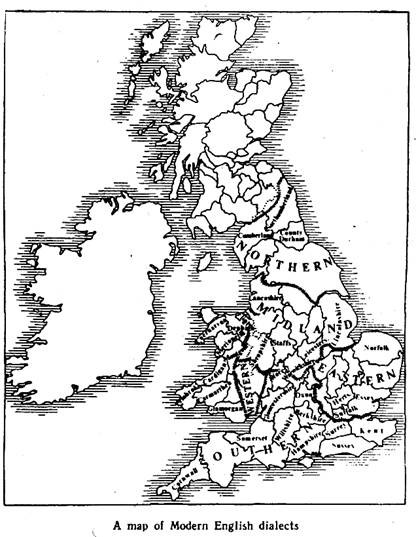
Expansion of English over the British Isles. Flourishing of literature in Early New English (Literary Renaissance). The age of Shakespeare. Establishment of the Written Standard. Normalising tendencies. Growing of the Spoken Standard. Varieties of English in Britain. Geographical Expansion of English outside the British Isles.
Spelling changes in Middle *****les of reading.
Peculiarities of Middle English Spelling
Letters indicating vowels | Letters indicating consonants |
Single letters | |
a [a] | с [s] or [k] |
y, as well as i [i] | f [f] |
о [o] or [u] | g [d3] or [g] j [d3] k [к] s [s] or [z] v (often spelt as u) [v] y [j] |
Digraphs | |
ее [e:J or [a:] | ch, tch [ts] |
ie [e:] | dg [d3] |
oo [o:] or [ر:] | gh [xl or [x'] |
ou [u:] or [ou] | qu [kw] |
ow [u:] or [ou] | th [ð] or [θ] sh, sch, ssh [s] wh [hw] |
Whan that Aprille with his shoures soote
[xwan 'θat ap'rille 'wiθ his ' su:rəs 'so:tə]
the droghte of March hath perced. to the roote,
[θə 'druxt of 'marts haθ 'persəd 'to: θə 'rоtə
And bathed every veyne in swich licour,
[and 'ba:ðəd 'evri 'vein in 'swits li'ku:rl
|Of which verhi engendred is the flour;
[of 'xwits ver'tju: en'd3endred 'is θə 'flu:r ]
(When April with his sweet showers
The draught of March has pierced to the root,
And bathed every vein in such liquor,
Of Which (whose) virtue (power) engendered is the flower...)
Lecture 8
PhoneticChanges in Middle and Early New English
4 hours
Plan
1. Word accentuation in ME and ENE.
2. Changes in u stressed vowels.
3. Quantaive and qualitative changes in stressed vowels.
4. Evolution of consonants.
Literature
1. Rastorgueva T. A. A History of English. M.,1983; M.,2005. - p.188-218
2. Ilyish B. History of the English language. Л. 1972. – p 160-174, 254-273, 299-303.
3. Reznik R. V., Sorokina T. S., Reznik I. V. A History of the English Language. M., 2001. – p. 126-145.
4. Аракин английского языка. М., 1985. – c. 110-123, 187-207 .
5. История английского языка. М., 2003. – Т.1, с. 202-259, 262-276, 285-322.
6. , , Беляева английского языка. СПб., 1998. с. 69-97.
7. Смирницкий по истории английского языка (средний и новый период). М., 1998. – 52-94, 154-181.
Word stress. New accentual patterns. Stress in loan-words: recessive and rhythmic tendencies. Phonological function of stress: distinguishing a verb from a noun.
Changes in unstressed vowels. The tendency towards phonetic reduction. Loss of unstressed vowels. The appearance of new unstressed vowels.
Main trends in the changes of stressed vowels. Quantitative vowel changes in Early Middle English. Phonetic conditions of lengthening and shortening. Restrictions to the rules. Qualitative vowel changes.
Quantitative Vowel Changes in Late Old English and Early Middle English
Phonetic conditions | Change illustrated | Examples | ||
OE | ME | NE | ||
Before homorganic consonant sequences: | Vowels become long | cild | child [tsi:ld] | child |
sonorant plus plosive | findan | finden [fi:ndən] | .find | |
(Id, nd, mb) | climban | climben ['кli:mbən] | climb | |
cold | cold ['ko:ldJ | cold | ||
feld | field [fe:ld] | field | ||
fundon | founden ['fu:ndən] | found (Past of find) | ||
gold | gold [go:ld] | gold | ||
Before other | Vowels be- | fiftfs | fifty ['fifti] | fifty |
consonant | come short | fedde | fedde ['feddə] | fed |
sequences | mette | mette ['mettə] | met | |
wisdom | wisdom ['wizdəm] | wisdom | ||
In open syllables | Vowels be- | mete | mete ['me:tə] | meat |
come long and more open | stelan | stelen ['ste:lən] | steal | |
macian | maken ['ma:kən] | make | ||
talu | tale [tа:1ə] | tale | ||
nosu | nose ['no:zə] | nose | ||
stolen | stolen ['sto:lən] | stolen | ||
yfel | yvel, evel [i:vəl] [e:vəl] | evil | ||
duru | doore ['do:rə] | door |
Development of OE [y] and [y:] in ME dialects

|
Из за большого объема этот материал размещен на нескольких страницах:
1 2 3 4 5 6 7 8 9 10 11 12 13 14 |
