


Партнерка на США и Канаду по недвижимости, выплаты в крипто
- 30% recurring commission
- Выплаты в USDT
- Вывод каждую неделю
- Комиссия до 5 лет за каждого referral
Cultural Growth
Australians are world famous for their love of sport, but they are also enthusiastic supporters of the arts and the communications industries.
Australian cultural achievements are becoming well known internationally through the awards gained by films and literature, and the reputation of touring Australian groups.
Government support has been an important factor in developing the arts.
The Australian Chamber Orchestra, established 20 years ago, become a permanent orchestra five years ago and now tours overseas several times a year.
Government-supported television and radio channels play an important part in artistic and cultural development, with the Australian Broadcasting Corporation (ABC) receiving $515.1 million from the Federal Government in 1994-95 and the Special Broadcasting Service (SBS) $75.7 million.
Aboriginal Arts
Aboriginal art was little known and appreciated until recent years.
Indigenous dance and music have been introduced to national and international audiences through Federal Government support.
Aboriginal and non-Aboriginal musicians and combines traditional and modern Aboriginal musical styles, has also proved popular in Australia and overseas. Aboriginal and Torres Strait Islander writes like Sally Morgan and Jack Davis, and the late Kevin Gilbert and Oodgeroo Nunuccal, are well known throughout Australia.
The Federal Government has decided that it will establish a gallery of Aboriginal Australia in Canberra to provide a national perspective on indigenous cultures.
Aboriginal Music
For many thousands years, music has played a very significant part in the life of Australia Aborigines. Song and dance are vital in many rituals and ceremonies, and are often used to dramatize and illustrate a story. The actions of birds and animals are imitated. Children enjoy imitating and learning the dances of their ciders. The word ‘corroboree’ is well known and is often used as the name for an Aboriginal ritual dance.
Аутентичные языковые материалы по теме "Природа Австралии"
I. Reading
Read the text and try to guess: where has this text come from?
A leaflet about a guided tour? A book about one of the greatest cities in Australia? A geography book?
Nature at our Doorstep
Sydney is Australia’s largest city, with over four million residents. It covers more than1500 square kilometers – one of the largest city areas in the world. From the famous beaches to the distant Blue Mountains, Sydney’s suburbs spread out in a network of houses, roads, shopping centers and office blocks. But if you look at a satellite photo of this booming metropolis, the dominant colour is green.
National parks have much to do with this. From any high point in the city you’ll see them – large areas of protected bushland, enveloping and giving life to Sydney. Even in the metropolitan area, national parks can be found in many places – beside the rivers, among the houses, around the harbour. The largest wilderness area in New South Wales – in Wollemi National Park – begins barely 70 kilometres from the CBD.
Sydney’s environmental wealth is no accident. It’s the legacy of more than a century of conservation efforts by concerned citizens, conservation groups and the state government. Since the creation of Royal National Park – the world’s second national park – in 1879, Sydney’s parks and reserves have been growing in number. They are now part of a large network of some 500 protected areas across New South Wales, working towards the conservation of the state’s amazing natural diversity.
Managed by the New South Wales National Parks and Wildlife Service, Sydney’s national parks exist for a variety of reasons. They give Sydneysiders a chance to relax and enjoy themselves in the great outdoors. They provide habitat for the countless animals and plant species that are native to the region. And they protect Sydney’s cultural heritage – Aboriginal sites, colonial relics, and monuments of the often troubled history that Aboriginal and non – Aboriginal people share.
If you’re in Sydney for the Olympics and Paralympics, you won’t be getting into the spirit of these Games without a visit to a national park. Of course there are many other parks to experience throughout NSW. They include the World Heritage-listed rainforests of the north coast, the red desert landscapes of the far west, and the fragile alpine herbfields of the Snowy Mountains. If you are interested in traveling beyond Sydney to discover more of the state’s huge variety of landscapes, we can help you plan a more extensive trip. Welcome to the sandstone, water and bushland that lie at the heart of this Olympic city!
According to the text which of the following is true?
1. the dominant color of the booming metropolis is
a. green
b. yellow
c. brown
d. black
2. from any high point in the city you can see
a. a network of houses, roads, shopping centers and office blocks
b. large areas of protected bushland
c. countless industrial sites
d. historic defence installations
3. there is a large network of
a. 200 protected areas
b. 100 protected areas
c. 500 protected areas
4. from any high point in the city you’ll see
a. distant Blue Mountains
b. large areas of protected bushland
c. the Sydney Harbour
5. NSW Parks include
a. the World Heritage-listed rainforests of the north coast
b. the red desert landscapes of the far west
c. the fragile alpine herbfields of the Snowy Mountains
Give the reasons for
1. existence of conservation groups and their efforts to protect Sydney’s environmental wealth
2. existence of Sydney’s national parks
According to the text which two of the following statements are wrong? Find them.
Sydney’s environmental wealth is an accident. The area of Sydney is one of the largest city areas in the world. Sydney’s parks give Sydneysiders a chance to relax and enjoy themselves. Since the creation of RNP the number of Sydney’s parks and reserves has remained the same. There is a large network of parks in NSW.Choose the information which was unknown to you.
II. Vocabulary drill
1. Match the words and expressions from the text with their definitions:
The population of a city or a town To occupy a territory Situated at some distance from a place A number of objects situated in a certain way and connected with each other Nature reserves protected by the government An area where the natural habitat is preserved A rich variety of plant and animal species Groups of volunteers who aim at preserving the environment A resident of Sydney Rare things inherited from the times when Australia was a British colony To feel the atmosphere | to get into the spirit relics residents a network protected bushland to cover wilderness area environmental wealth natural diversity distant a Sydneysider conservation groups |
III. LISTENING
You will hear a conversation between a tourist and a tourist office person. Why have many tourists from around the world always been eager to visit Sydney National Park? Say whether the statements below are true or false.
T-tourist O. P.-office person
O. P.- Good morning. Welcome to Sydney Harbour National Park. You can enjoy spectacular views of the Harbour Bridge and Opera House from prominent headlands.
T: - Yes, I’d like to visit Harbour National Park and to see native plants and animals for a start.
O. P. - Great choice. Sydney Harbour National Park is a natural haven in the heart of a busy city. It protects precious remnants of the bushland that once covered the harbour foreshores.
T.- That sounds nice. I hope the wildlife is rich there.
O. P.- Sure. Long-nosed bandicoots, native water rats and even little penguins all live elsewhere in the park.
T.- I hope to see important cultural heritage.
O. P.- Yes, you will. Around 70 Aboriginal sites have been found in the park, from rock paintings to axe-grinding grooves. Some are many thousands of years old.
T.- I’ve heard the life of local Aboriginal people was tragic.
O. P- Yes it was. During the construction of Sydney, almost all local Aboriginal people were either forced out of the area, or killed by European diseases and guns. Besides, you can also explore many historic defense installations. I’m sure you’ll be amazed at what you find.
1. Sydney Harbour National Park is a natural haven in the heart of a busy city.
2. Long-nosed bandicoots, water rats and little penguins can be found in the South America as well.
3. You can find nearly 70 Aboriginal sites in the park.
4. There still remain a lot of local people living in Sydney.
5. You can explore many historic defense installations here.
IV. USE OF ENGLISH
Read the texts. Use the words given in capitals at the end of each line to form a word that fits in the space in the same line.
GREEN AND GOLDEN BELL FROG 1. As its name suggests, the --- green and golden bell frog’s upper body is a jumble of vivid greens and almost --- golds. However its croak could be described as “ bell-like” - --- have likened it to the sound of a motorbike --- gears. This once widespread frog is now limited to a series of isolated --- population including one near the Sydney Olympic site in Homebush. LITTLE PENGUIN 2. --- of all penguins, the little or fairy penguin grows to 45 cm tall. The only known colony of these ---- seabirds in mainland NSW is in a --- cove of Sydney Harbour near Manly. WATER RAT 3.The television --- “Water Rats” may be set in Sydney Harbour but for years these handsome 30-cm native rodents were hard to find. The ---- of water quality in the harbour has --- to increases in the numbers of aquatic insects, fish and mollusks the rats feed on. In 1999 a ---population of water rats was ---- on Goat Island in Sydney Harbour National Park, providing a valued --- to be harbour’s biodiversity. EASTERN GREY KANGAROO 4. When European --- first saw eastern grey kangaroos around Sydney many thought the joeys --- carried by their mothers had been born in the pouch. The real story is a little --- complicated. As with all marsupials, joeys are born --- and tiny. They must drag themselves through their mother’s fur and into her pouch, where they attach themselves to a teat and continue to grow. YELLOW-BELLIED GLIDER 5 --- possums “ fly” from one tree to another on a sheet of skin which stretches between their forepaws and ankles, --- their long furry tails as rudders. The yellow-bellied glider best ---of the family can travel over 1000 metres in one leap. SUPERB LYREBIRD 6. In the theatre of the forest floor, few can match the --- of the male superb lyrebird. Like all lyrebirds, he is able to mimic almost any sound --- other birds and animals, whistles and car alarms. However he also --- a spectacular visual display, with a lyre - ---- tail which he fans over his head to attract females. SHORT-BEAKED ECHIDNA 7. Together with the platypus, echidnas are the --- only living monotremes, or egg – laying ---. The short-beaked echidna lives all over NSW, wherever termites – their main food source – can be ---. Their long, … snout is an amasingly sensitive organ, used to search for food and detect danger. FRILL-NECKED LIZARD 8. Mascot of the Sydney Paralympics, the frill – --- lizard capable of scaring off even large --- with its fanned – out display. However the show is all bluff – like all other Australian lizards, this reptile is --- harmless. | endanger small serie settle be glide talent world neck |
Fill in the table
name of the bird, animal | |
habitat | |
appearance | |
characteristic features |
V. WRITING
This is an extract from a letter you have received from your pen friend :
…We’re doing a project at school about different Sydney Parks, Australia’s natural diversity, its birds and animals. Could you write me a short report about Australian wildlife to include in the project?
Write as soon as you can.
I wish you luck in your exams.
John.
VII. SAMPLE LETTER
Australia’s plants and animals are special. Most of them occur nowhere else and our networks of protected areas are crucial for their long-term survival. Some protected areas can cope fairly easily with different types of human activities. However, the environments of others are more fragile, and their plant and animal populations can take a long time to recover even from the smallest amount of human interference.
National parks are relatively large areas protected for their unspoiled landscapes and their native plants and animals. They are set aside for public education and recreation, and usually offer visitor facilities. Situated near large population centers, they offer open space and recreational and cultural opportunities for urban residents. Marine parks are unique and outstanding marine areas, set aside to conserve aquatic plants and animals. Historic sites can include buildings, objects, monuments or landscapes. They have national cultural importance, and are generally open to visitors.
Use of English: endangered, metallic, listeners, changing, coastal, smallest, flightless, secluded, series, improvement, lead, healthy, discovered, contribution, settlers, being, more, undeveloped, gliding, using, flyer, talents, including, boasts, shaped, world’s, mammals, found, hairless, necked, predators, largely.
Задания по теме «Австралия»
1. Now let’s start our competition. You task is to put the missing letters. Thank You.
| Key: |
2. Read the sentence and say if it is try ore false.
1) Canberra is the home of Australia’s government. (T)
2) Sydney is the capital of Australia. (F)
3) Sydney is the largest and the oldest city in Australia. (T)
4) Canberra is a “cyclist’s paradise”. (T)
5) Sydney Opera House is one of the greatest examples of 20th century. (T)
plete the sentences:
Australia was discovered in ______ by ________. The discoverer of Australia claimed it for ___________. The first settlers were ________________. People rushed to Australia because _________. Australia’s is located in __________ hemisphere. The hottest month in Australia is ________. About 70 per cent of the population live in the __________. ________ is the capital of Australia. The Olympic Games were held in Sydney in ___________. If in London it’s 8 a. m., in Sydney it is _______. People in Australia speak ________. Australia became independent in _____.Key:
1770, James Cook the king of England convicts gold was discovered there the southern January 10 largest cities Canberra 2p. m. English 1931.4. What is wrong in the sentences?
Key:
Australia is situated south of Asia, between the Pacific and the Indian Oceans. Canberra is the capital of Australia, but it isn’t the biggest city. Aborigines now comprise only 1,5 per cent of the population.5. Write the names of the territories on the map:
Western Australia
Northen Territory
South Australia
Queensland
New South Wales
6. Translate the sentences into English – first read the Russian variant, then – the translation.
Большая часть населения – англичане по происхождению. The population is mainly English in background. Английский – основной язык, на котором говорят австралийцы, но один из пяти австралийцев также говорит на итальянском, греческом, арабском, китайском или испанском. English is the main language spoken, but one in five Australians speak also Italian, Greek, Arabic, Lebanese, Chinese or Spanish. Средиземноморский климат, галереи, музеи, архитектура и парки привлекают туристов в Сидней. Mediterranean climate, galleries, museums, architecture and parks attract tourist to Sydney.7. Answer the questions:
What is the official name of the country? (The Commonwealth of Australia.) When was the Commonwealth of Australia formed? (In 1901.) What kind of state is Australia? (Constitutional Monarchy.) What is the capital of Australia? (Canberra.) Who is the Head of State? (Queen Elizabeth 2 of Great Britain.) Who is the Head of State? (Prime Minister.) How many states and territories are there in Australia? (6 and 2.) What is the population of Australia? (More than 18 million people.) Which is the official language in Australia? (English.) What colour is the flag of Australia? (It is blue, red and white.) Which are the national colours? (Green and gold.) What animals can be seen on Australia’s coat-of-arms? (The Kangaroo and emu.) Which is the hottest month in Australia? (January.) What are the main ports in Australia? ( Sydney, Melbourne, Adelaide, Brisbane and Perth.) How long does kangaroo live? (10 – 15 years.) Can emu fly? (No, it can’t.) What are Australian’s best-known animals? (The Kangaroo, Koala, the dingo.) When is spring in Australia? (From September to November.) What is the main occupation in Australia? (Agriculture.) What does Koala eat? (Leaves of eucalyptus.)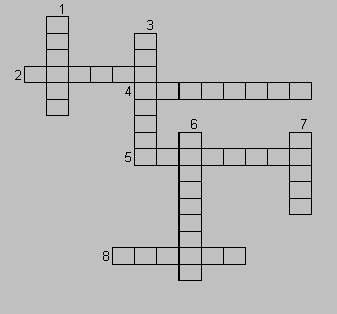
8. Do the crossword puzzle.
Across:
2. Tropical climate. Population 70 000. Capital of Nothern Territory.
4. Tropical climate makes this city a year-round vacation place.
5. An industrial city. Population about 1 million.
8. Australia’s oldest and largest city.
Down:
1. Capital of Australian island-state of Tasmania. Cold winters.
3. Capital of Australia. Hosted 1956.
6. 2nd largest city of Australia. Hosted 1956 Olympics.
7. It has one of the best climates in Australia. Capital of Western Australia.
Key:
Hobart.
Darwin.
Canberra.
Brisbane.
Adelaide.
Melbourne.
Perth.
Sydney.
9. The last task. Choose the right answer.
1. What is the capital of Australia?
a) Sydney;
b) Melbourne;
c) Canberra.
2. When did Europeans settle in Australia?
a) 1488;
b) 1788;
c) 1492;
d) 1901.
3. Which is/ are a popular Australian animal(s)?
a) Koala;
b) Kangaroo;
c) Emu;
d) All of the above.
4. Which two animals can you see on the Australian coat of arms?
a) Kangaroo and Dingo;
b) Koala and Parrot;
c) Kangaroo and Emu.
5. Which city is Australia’s oldest and largest?
a) Sydney;
b) Melbourne;
c) Canberra.
6. Who are the Australian natives?
a) Eskimos;
b) Aborigines;
c) Indians.
7. Who discovered Australia?
a) Christopher Columbus;
b) Captain Cook;
c) Lewis and Clark.
8. Australia is not a (an)
a) Country;
b) Island;
c) City;
d) Continent.
9. Approximately how many nationalities live in Australia?
a) 200;
b) 20;
c) 75;
d) 5.
10. What is the official language in Australia?
a) French;
b) German;
c) English.
11. In which season do Australians celebrate Christmas?
a) Spring;
b) Summer;
c) Autumn;
d) Winter.
Первые племена и народы на территории Британии. Тексты с заданиями на английском языке
UNIT 1 THE DAWN OF BRITISH HISTORY
Words to remember:
1) the dawn | 4) social development |
2) stone tools | 5) ancient Greek historian Herodotus |
3) already in existence | 6) tin |
At the dawn of their history the peoples of this planet lived in primitive societies. These primitive peoples wherever they lived, began their long path of progress with stone tools, but they did not reach the same level of civilisation at the same time in different countries.
The ancient civilisations of Greece and Rome were already in existence when the people living in Britain were only at the first stage of social development.
The Greeks were the first to mention the British Isles in their books. The ancient Greek historian Herodotus, who is called the father of history, wrote that in the 5th century BC the Phoenicians used to come to the British Isles for tin, which is used for making bronze. The Greek called the British Isles the Tin Isles.
The very first stages of the existence of people on the British Isles are frequently described as prehistoric and referred to as unwritten history of Britain.
The geographical position of the land was both a blessing and a problem: on the one hand the insular position protected the country from invasions; and on the other – the lowland facing the continent always invited invasions.
Tasks:
Indicate the correct variant:
1. At the dawn of their history the peoples of this planet lived in ………….
А. well-organised groups
B. big towns
C. primitive societies
2. The primitive peoples began their long path of progress with ……………… tools
А. bronze
B. stone
C. metal
3. The level of civilisation ………… the same at the same time in different countries.
was
B. was not
4. Which of these statements is correct?
A. The ancient civilisation of Rome was already in existence when the people living in Britain were at the last stage of social development.
B. The ancient civilisation of Britain was already in existence when the people living in Greece and Rome were only at the first stage of social development.
C. The ancient civilisations of Greece and Rome were already in existence when the people living in Britain were only at the first stage of social development.
5. Write the statements correctly:
1. The Greeks were | a. the Tin Isles |
2. The ancient Greek historian Herodotus | b. used to come to the British Isles |
3. in the 5th century BC the Phoenicians | c. is called the father of history |
4. tin | d. is used for making bronze |
5. The Greek called the British Isles | e. the first to mention the British Isles in their books |
UNIT 2 IBERIANS
Words to remember:
1) first inhabitants | 5) to till soil |
2) descendants | 6) to cultivate crops |
3) to breed or tame animals | 7) the art of grinding and polishing stone |
4) herds of cattle | 8) make smooth objects of stone with sharp edges and points |
Not much is known about the first inhabitants of Britain. About three thousand years BC many parts of Europe, including the British Isles were inhabited by a people who are known as the Iberians. Their descendants are still found in the North of Spain on the Iberian Peninsula. Some historians believe that they moved over from the Continent to Britain at the end of the Ice Age, when climate changes caused changes in the hunting situation on the Continent, so the Iberians had to look for new places to hunt.
We do not know much about these early people because they lived in Britain long before a word of their history was written, but we can learn something from their skeletons, their weapons and the remains of their dwellings which have been found. The Iberians used stone weapons and tools. The art of grinding and polishing stone was known to them and they could make smooth objects of stone with sharp edges and points.
From 6 to the 3d century BC the Celts spread across Europe from the East to the West The Iberians were unable to fight back the attacks of the Celts, who were better armed with metal weapons, so most of the Iberians were slain in the conflict; some of them were driven westwards into the mountains of what is now Wales.
Tasks:
Indicate the correct variant:
1. the Iberians inhabited many parts of Europe, including the British Isles, about ………… years BC.
А. 5000
B. 3500
C. 3000
2. Their descendants are still found ……………
A. in the South of Spain on the Iberian Island.
B. in the North of Spain on the Iberian Peninsula
C. in the North of Italy on the Iberian Peninsula.
3. They moved over from the Continent to Britain…………..
A. at the end of the Ice Age
B. at the beginning of our era
C. after the Great Flood
4. The Iberians had to look for new places to hunt when…………
A. new hunting laws were adopted
B. new lands were discovered to the north-west of Spain
C. climate changes caused changes in the hunting situation on the Continent
5. The Iberians …………….
A. hunted or gathered their food
B. did not breed animals, or tame them
C. did not till soil.
6. The Iberians used ………….. weapons and tools.
A. metal and stone B. stone and bronze C. stone
7. They knew the art of
A. grinding and polishing stone
B. making bronze tools
C. building huge structures
UNIT 3 CELTS
Words to remember:
1) invade | 5) war-chariots |
2) to be armed with | 6) detachments of warriors |
3) weapons: spears, swords, daggers, axes | 7) to be slain |
4) to charge fiercely in battle |
During the period from 6 to the 3d century BC the Celts spread across Europe from the East to the West. Several Celtic tribes invaded Britain. Among them were such tribes as the Picts, the Scots, the Britons. The Iberians were unable to fight back the attacks of the Celts, who were better armed with metal weapons: spears, swords, daggers, and axes. Some of the Celtic tribes were quite large and fighting was common among them. Julius Caesar wrote that they were tall and blue-eyed. The Celts wore long flowing moustaches but no beards. They charged fiercely in the battle, and they also used war-chariots on the battle-field. The chariots were drawn by two or four horses, and were large enough to hold several warriors in each. Standing in their chariots they rushed along the enemy’s lines waving their spears and uttering loud cries. So most of the Iberians were slain in the conflict; some of them were driven westwards into the mountains of what is now Wales, others probably mixed with the Celts.
Tasks:
Indicate the correct variant:
1. the Celts spread across Europe from the East to the West ………………century BC
А. in the 6th
B. after the 3rd
C. from the 6th to the 3rd
2. Among the tribes, which invaded Britain were …………….
А. the Britons & the Scots
B. the Britons & the Picts
C. the Picts, the Scots, & the Britons.
3. Is the story correct?
The Britons penetrated into the mountains of the North; some of them crossed over to Ireland and settled there. The Picts settled in the North in such big numbers that the name of Scotland was given to that country. Powerful Celtic tribes, the Scots, held most of the country, and all the southern half of the island was named Britain after them.
4. The Iberians were unable to fight back the attacks of the Celts because ………….
A. they were peaceful farmers who had no weapons and were not used to fighting.
B. the Celts were better armed with metal weapons: spears, swords, daggers, and axes.
C. on the battlefield the Celts also used war-chariots drawn by two or four horses, and large enough to hold several warriors in each.
5. The military leaders of the largest tribes were sometimes called ……….. and stood at the head of detachments of warriors.
А. kings
B. chiefs
C. knights
UNIT 4 THE WAY OF LIFE OF THE CELTS
Words to remember:
1) an iron plough | 4) private property |
2) to build dwellings | 5) a period of transition from primitive to class society |
3) to make clothing | 6) to predominate |
The Celts lived in villages, were acquainted with the use of copper, tin and iron, they kept large herds of cattle, cultivated crops, especially corn. They used light ploughs as well as horses and grew their crops in small, square fields. The Celtic tribe called the Britons was more civilised than the others, their clothing was made of wool, woven in many colours while the other Celts wore skins. The improved tools brought about important changes in the living conditions of primitive man. The Iberians gathered or hunted their food, but the Celts began to tame and breed animals, to till the soil. Iron ploughs could cut the soil deeper, and so they could cultivate also the rich heavy soil in the valleys. They grew more and more corn, they began to build dwellings and to make clothing.
They were ruled by chiefs whom all the tribesman obeyed. The chiefs were military leaders and some of them were very powerful. The military leaders of the largest tribes were sometimes called kings, they stood at the head of detachments of warriors. In primitive society there was no private property, therefore there were no classes, no state system, that is no armed forces, no prisons, no courts, no government bodies. In the last centuries B. C. and in the first centuries A. D. the Celts were in a period of transition from primitive to class society. The elders, military leaders and their warriors made up the tribal nobility.
The Celts worshiped nature. They believed that the sky, the sun, the moon & the earth was ruled by beings like themselves, only much more powerful.
Tasks
Indicate the correct variant:
1. Chose the correct statement:
A. The Celts lived in villages and small towns, were acquainted with the use of wood, glass and iron, they kept large herds of pigs, and cultivated crops, especially potatoes.
B. The Celts lived in villages, but they didn’t know the use of copper, tin and iron, though they kept large herds of cattle, and cultivated crops, especially wheat.
C. The Celts lived in villages, were acquainted with the use of copper, tin and iron, they kept large herds of cattle, and cultivated crops, especially corn.
2. The Celtic tribe called ………… was more civilised than the others, their clothing was made of wool, woven in many colours while the other Celts wore skins.

|
Из за большого объема этот материал размещен на нескольких страницах:
1 2 3 4 |
