


Партнерка на США и Канаду по недвижимости, выплаты в крипто
- 30% recurring commission
- Выплаты в USDT
- Вывод каждую неделю
- Комиссия до 5 лет за каждого referral
1. Серия занятий: «Экскурсия по реке Москве»
Занятие 1-2: Small talk
ХОД ЗАНЯТИЯ
Сообщение темы занятияa) Сообщение темы урока
b) Выбор темы урока: «Small Talk». For successful communication with native speakers of English people must be able to make “small talks”. Let's think over the meaning of the notion and subjects which are regarded as appropriate and safe in English – speaking countries and in Russia.
Самостоятельная работа со справочной литературой.Teacher: I wonder if you could tell me what “small talk” is?
Pupil 1: The Longman dictionary of English Language and Culture explains that “small talk” is light conversation on important or non-serious subjects and gives the following example to illustrate it: “people making small talk at a cocktail party”.
Pupil 2: Oxford Advanced Dictionary of Current English by Hornby defines small talk as “conversation about everyday and unimportant social matters”.
3. Работа с таблицей
Teacher: Could you tell me whether choosing the right topic is vital for communication?
Pupil 3: I think so. The safe topics for conversation vary from country to country.
Teacher: Let's compare the “conversation areas” in Russian and English languages. I suggest you filling the table and then we compare your results with those given in the magazine.
Topics for conversation | popular with Russians | considered 'safe' in the English-speaking world |
Travel | ||
Weather | ||
Politics | ||
Interests. hobbies | ||
Literature and art | ||
Jobs, education | ||
Money, income. salary | ||
Origins | ||
Age | ||
Health | ||
Religion | ||
Race relations | ||
Pets | ||
Topical events (plane crashes. earthquakes, museum, robberies — not politics) |
And now let's have a look at the table in the article from magazine “Hello”[20]:
Topics for conversation | Popular with the Russians | Considered 'safe' in the English-speaking world |
Travel | +++ | +++ |
Weather | – | + |
Politics | + + + | – – – |
Interests, hobbies | + | + |
Literature and art | ++ | + |
Jobs, education | + | + |
Money, income. salary | + | – – – |
Origins | + | + |
Age | – | – |
Health | + + | – |
Religion | – | – |
Race relations | + | – |
Pets | + + | ++ |
Topical events (plane crashes. earthquakes, museum, robberies — not politics) | + | – |
Учащиеся обсуждают результаты анкеты, ссылаясь на статью из журнала «Hello».
Pupil 4: The safest topics recommended for small talk in England are as follows: travelling, weather, jobs (not salary or other money matters), origins (that is where you come from, the country or city), hobbies and pets makе headlines in newspapers and magazines but not politics.
Pupil 2: As for the unsafe topics, Americans say that it is dangerous to talk about two things: religion and politics.
Pupil 6: The list of unsafe topics in GB. Also includes the royal Family, race relations, income, health and Northern Ireland.
Pupil 7: In Russia many of these unsafe topics are the most popular subjects discussed by educated people when they get together on various occasions. And it is only natural that they transfer their conversation habits into communication in English.
Teacher: Students of English must not only be aware of the cultural differences in topics for small talk but also try to acquire certain skills in it. Got any idea what they are?
Pupil 8: The 3 “A”s are very important in a typical conversation in English:
“ANSWER → ADD → ASK”.
It means that when you are asked a question you should answer it, add something, and in you turn ask a question – to keep the conversation going. Instead of turning art conversation into a monologue you are to show interest in the matters of your partner's life.
Pupil 9: When answering the question, do not give a “yes” or “no” answer, develop your idea in some way.
Pupil 10 Try not to sound categorical: use phrases like: I think, I guess, in my opinion, I believe.
Pupil 11: When disagreeing use phrases like: I don't think so; I see what you mean, but... That's right but...
Pupil 12: English people try to avoid a direct question. Many of these will end with a question tag (in this case tags are pronounced with a falling intonation) It's a fine day, isn't it.
Pupil 13: If you want to introduce one of the less safe subjects, it is best to be indirect. Start with “would you mind if I asked you...”, “forgive me for asking, but could you tell me...”, “it's important to know... ”, Is it significant to know...”, “Do you agree that...”
4.Актуализация лексических и грамматических знаний
a) Повторение грамматического материала: Indirect questions
Учащиеся по таблице «Grammar for revision» выводят правило постановки длинного типа вопросов. Be ready to use as many indirect questions as you can.
b) Напомнить учащимся образование и значение слов to interview, interviewee, interviewer: interviewee – a person who is interviewed; interviewer – a person who interviews.
Начало разговора | Вежливое обращение |
Awful day, isn't it? | Would you mind telling me what …? |
Lovely weather for ducks | I'm terribly sorry to have bothered you but |
Did you have good weather? | I wonder if you would mind telling me... |
A beautiful day, isn't it? | If it is not too much trouble, could you...? |
Isn't the weather awful? | I'd like to know what …? |
What a dreadful day! | I was wondering what....? |
It's pouring outside – raining cats and dogs | Do you happen to know...? |
Terrible weather | I have no idea what...? |
Реплики во время разговора | |
It's very kind of you | Indeed? I can hardly believe my ears! |
It was a real pleasure meeting you | Exactly! By all means! |
Do you see what I mean? | What an interesting remark! |
Sorry, I don't follow what you said about... | I like your idea! |
Pardon? | That's exactly what I mean! |
it's important to know | That's all what I've to say. |
Is it significant to know.. |
V: I think it's your first visit to Moscow, isn't it? Do you know anything about the city?
P1: We've read a lot. Moscow is the capital of Russia, its political, cultural and historical centre. It's an old city. It was found in 1147 by Jury Dolgoruky. The first monument in Moscow was erected in 1818 in the centre of Red Square. It was the monument to Minin and Pozharsky – the leaders of the patriotic movement in the 17-th century. We know that Red Square is the heart of Moscow and it means that it is a nice square.
V: – Oh, you've read a lot. Let's visit the Tretyakov Gallery – a treasure house of Russian art.
M: – We'll try to take you to the Bolshoi Theatre, one of the most famous opera and ballet houses all over the world.
V: – Let's start from the Moscow University. It's one of the highest buildings in Moscow. It is interesting to know that it was founded in 1755 by the greatest scientist Lomonosov.
M: – The largest clock in all of Russia is on the main building of Moscow University. The clock face is 9 meters in diameter.
V: – We'll go there by metro. I think it is the most beautiful and comfortable one. It has got 190 stations. It began working in 1935, and it had only 13 stations at that time.
6. Анкетирование
Would you like to check yourselves how well you know your own city and how deep your scope about London is?
What country do you think is older: Great Britain or Russia? Are the capitals of Russia and Great Britain of the same size? Which city is larger? What do you know about the population of the two countries? How old are the capitals of Great Britain and Russia? Which city is older: Moscow or London? Can you name the nickname of the Thames river? Where do you think the river is longer: in Moscow or in London? How many inhabitants does London have? And Moscow? If the Kremlin is the centre of Moscow what is the centre of London? Who built the first stone Kremlin (the name of the ruler)? What are the main 5 sights of Moscow and 5 sights of London in your opinion? What ruler started building the Tower? Where does the British Queen live? When was the Great fire of London and why? Where is the oldest metro: in London or in Moscow? In which century did the British learn about our county's existence? What did Russian Tzar start trading with England? Where was the British embassy situated in Moscow first? And where is it now? Is it true that Moscow and London have some similar sights? Can you prove it? Which sights in Moscow are connected with the English? Do the Russian rulers have any relatives among the British ones?Занятие 5-6: Актуализация грамматических и лексических знаний; совершенствование произносительных навыков.
The 1. theatres/ cinemas (The Bolshoi Theatre) 2. museums 3. picture galleries 4. monuments / memorials 5. hotels 6. restaurants 7. oceans/ seas (the Black Sea,) 8. rivers/ gulfs (the Thames/ the Volga (The river Volga)) 1. straits, channels/ falls (The Suez Canal, The Victoria Fall,) | No article 1. streets / roads (Trafalgar Square, Oxford Street.) 2. parks (Gorky Park) 3. squares / avenues 4. subway stations 5. companies 6. university (Moscow University) 7. churches / cathedrals (St Paul's Cathedral) 8. islands / peninsula 9. continents / countries / states (England) 10. cities / towns / villages (Moscow, London.) 11. bays / lakes 12. bridges (London Bridge) | Exceptions The University of London The Millennium Bridge |
* Обратите внимание: на картах названия, как правило, даются без артикля!
Упражнение. Распределите географические название по колонкам
Города ... | Реки/ Каналы ... | Мосты ... | Площади/ улицы ... |
Парки ... | Церкви/ Соборы ... | Памятники ... | Театры ... |
Музеи ... | Станции метро | Монастыри | Университеты |
Изучив карту центра Лондона, нужно заполнить предложения именами собственными, обращая внимание на использование артиклей.
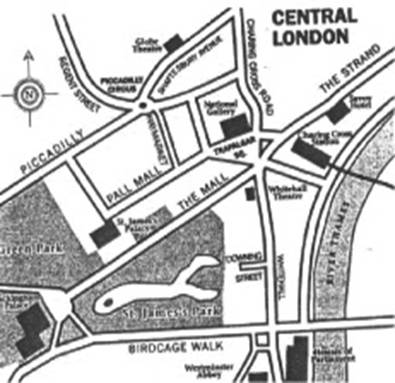 |
1. ___________________ is in Trafalgar Square.
2. ___________________ are next to the River Thames.
3. St. James’s Park lies between _____________ and __________.
4. ___________________ is situated in the Strand.
5. Buckingham Palace and Trafalgar Square are connected by ________.
6. St. James’s Palace lies at the end of ________.
7. ____________, ____________, _____________ and ____________ are streets which radiate from Piccadilly Circus.
8. The Prime Minister’s residence is in ___________________.
9. ___________________ is between the Thames and the Strand.
10. ___________________ run north from Trafalgar Square.
Key: 1. The National Gallery; 2. The Houses of Parliament; 3. The Mall, Birdcage Walk; 4. The Savoy Hotel; 5. The Mall; 6. Pall Mall; 7. Piccadilly, Regent Street, Shaftesbury Avenue, Haymarket; 8. Downing Street; 9. Charing Cross Station; 10. Charing Cross Road
Занятие 4: Фонетическая отработка географических названий и объектов
Moscow The Russian Federation The Kremlin The Bolshoi Theatre Gorky Park The Red Square St. Basil`s Cathedral the Cathedral of Christ the Saviour. Kievskaya station Kievsky Bridge. Nikitskaya street Armoury Moscow State University The Novodevichy Convent The Crimean Bridge The statue to Tsar Peter the Great Red October Candy Factory Old England yard Saviour Tower | London The United Kingdom The Tower The Globe the British Airways London Eye Tower Bridge London Bridge The Millennium Bridge Westminster Bridge London University – The University of London. St. Paul`s Cathedral Cleopatra’s Needle Tate Gallery Somerset House Ship Belfast Beefeater |
Занятие 3: Введение и отработка лексики по теме «Путешествие».
To do sightseeing | Осматривать достопримечательности |
Let's do Moscow | Давайте осмотрим Москву |
To stand for smth | Обозначать что-либо |
A masterpiece | Шедевр |
An impression | Впечатление |
Central Park | Центральный парк |
A ferry | Паром |
A flier | Рекламный проспект |
To give smb a treat | Побаловать кого-либо |
Moscow suburban estate-museums | Подмосковные музеи и усадьбы |
Picturesque | живописный |
Ancient | Древний |
Antique | Античный |
Castle | Замок |
Exhibition | Выставка |
Folk art | Народное творчество |
Fountain | Фонтан |
Monastery / convent | Монастырь |
Monument | Памятник |
Painting | Живопись |
Ruins | Развалины |
Statue | Статуя |
Street map | Карта города |
Armory | Оружейная палата |
l Asking and explaining the way l Could you tell me where...is? l Excuse me, how do I get to...? l Turn left (right)... l On the left (right) side... l It's opposite the... l It's between the... and the... l It's on the corner... l go up (down) the street... l Go straight on... l Go past... l Keep going until you see... | l It's very kind of you l It was a real pleasure meeting you l Indeed? I can hardly believe my ears! l Exactly! By all means! l What an interesting remark! l I like your idea! l Do you see what I mean? l Sorry, I don't follow what you said about...(I didn't see what you mean) l That's exactly what I mean! l Pardon? l That's all what I've to say. |
What tours do you have round Moscow? | Какие имеются маршруты по Москве? |
We are interested in historical places of the city | Нас интересуют исторические места города |
Whom is this monument to? | Кому поставлен этот памятник? |
I like the architecture of this building | Мне нравится архитектура этого здания |
We should like to take a trip down (up) this canal / Moscow River / Moscow suburbs | Нам бы хотелось совершить поездку по каналу |
What are your general impressions of Moscow? | Каково ваше общее впечатление о Москве? |
I must say that Moscow is a well-kept city. | Должен сказать, что Москва содержится в образцовом состоянии |
What is the programme of the excursion? | Какова программа этой экскурсии? |
I recommend going to | Я бы посоветовал вам сходить в... |
There's a wonderful view over the whole city | Оттуда открывается чудесный вид на город |
It's become a bit too touristy | Это стало слишком туристическим местом |
Do you have an English-speaking guide? | Есть ли экскурсовод, говорящий по английски? |
When was it built? | Когда это было построено? |
Is it free to go in? | Вход свободный? |
Can you show me where is it on the map? | Вы можете мне это показать на карте? |
I'd like some information on... | Я бы хотел получить сведения об... |
Expressing your impression I really enjoy it It's fantastic I didn't like that much it was a bit boring I'm not really a fan of modern art | |
It's very touristy | Рассчитано больше на туристов |
It's expensive for what it is | Это того не стоит |
Ложные друзья переводчика (англ.)
alley – переулок (не аллея) |
virtual – фактический (а не виртуальный) |
speculation – размышление, предположение, догадка (а не только спекуляция |
number – число, количество (а не только номер) |
monitor – староста класса (а не только монитор) |
magazine – журнал (а не магазин) |
list – список (а не лист) |
intelligence – ум, интеллект; разведка (а не интеллигенция) |
fabric – ткань (а не фабрика) |
artist – художник (а не только артист) |
arc – дуга (а не арка) |
camera – фотоаппарат (а не тюремная камера) |
brilliant – блестящий (редко бриллиант) |
Занятие 7-11. Знакомство с культурологическими источниками по теме
Letter from Ivan the Terrible to Elizabeth I
Милосердия ради милости бога нашего (...) мы, великий государь, царь и великий князь Иван Васильевич всеа Русии (...) королевне Елизавети Аглинской, Францовской, Хиперской и иных. Что преже сего не в которое время братъ твой Едвартъ король некоторых людей своих на имя Рыцерта послал нъкоторыхъ для потреб по всему миру местом, и писал ко всемъ королем и царем и княземъ и властодержцомъ и местоблюстителем. А къ намъ ни одного слова на имя не было. И те брата твоего люди, Рыцертъ с товарищи, не ведаемъ которымъ обычаемъ, волею или неволею, пристали к пристанищу к морскому в нашемъ града Двины. И мы и туто какъ подобаетъ государемъ христьянскимъ милостивно учинили ихъ в чести, принели, и въ своихъ в государских в нарядных столехъ ихъ своимъ жалованьемъ упокоили (...) брату к твоему отпустили. А в те поры ваши аглинские гости почали многие лукавства делати над нашими гостьми и товары свои почали дорого продавати, что чего не стоит. А ты пребываеш въ своемъ девическомъ чину, как есть пошлая девица. А что которой будет хотя и в нашемъ деле был, да нам изменил, и тому было верити не пригож. А Московское государьство покаместо без аглинских товаров не скудно было. Писана в нашем государстве града Москвы лета от созданья миру 7079-го октября в 24. | In the name of the mercy of our God, [...] We, Great Ruler, Tsar and Grand Prince Ivan Vasilevich of all Russia [....] to Queen Elizabeth of England, France, Ireland and Others. [1] Sometime ago your brother Edward, the King, sent some of his people with Richard to find things needed throughout the World.[2] And he wrote to all the Kings and Tsars and Princes and Lieutenants and Plenipotentiaries, but he never wrote to Us by name. And by some unknown accident those people sent by your brother, Richard and his comrades, of their own wish or unwillingly, landed in our port in our city on the Dvina. And We, as is appropriate for Christian Rulers, showed them honour and received them behind our kingly banqueting tables and showed them our goodness and peace[...] and let them go [back] to your brother. English merchants started to make much trouble for our merchants and they started to sell their goods expensively at prices which they were not worth. We had hoped that you were ruler in your Kingdom and that you yourself ruled, But it appears that other people rule for you. They are not just people, they are trading peasants and they do not care about our Ruler's heads and our honours and the advantages of our lands, instead seeking just their own trade advantages. The Moscow State has not suffered so far without English goods. And you should send us the letter which you sent us on trade matters. And even if you don't send us this letter, we will not order that anything should be done about it. This was written in our city of Moscow of our state in the year 7079[3] from the Creation, on 24th October. |
Занятие 12: Выбор и отработка музыкального сопровождения экскурсии
Песня “Подмосковные вечера” на английском языке.
Not a whisper’s heard, not a rustling sound, Placid streams I see and they seem to be Tell, me, darling, why your sweet glance is shy, Faint horizon’s light in this fading night, | Не слышны в саду даже шорохи. Все здесь замерло до утра. Если б знали вы, как мне дороги Подмосковные вечера. Речка движется и не движется, Вся из лунного серебра. Песня слышится и не слышится В эти тихие вечера. Что ж, ты, милая, смотришь искоса, Низко голову наклоня? Трудно высказать и не высказать Все, что на сердце у меня. А рассвет уже все заметнее. Так, пожалуйста, будь добра, Не забудь и ты эти летние Подмосковные вечера. |
Занятие 13: Along the Moscow River on a Motor Launch
Plan
Old England yard
the Kremlin (Armoury)
Red Square and St Basil's Cathedral
the Cathedral of Christ the Saviour.
Red October Candy Factory
The statue to Tsar Peter the Great
Gorky Park
The Crimean Bridge
The Pushkin Bridge
The Novodevichy Convent
Moscow State University
Luzhniki
Hello! I am your guide. I'll show you around Moscow today. Going along the Moscow River you will see interesting places of the capital, famous buildings, and the bridges you pass under, and learn some interesting facts about the history of Moscow.
Lies Moscow with its stones of white,
Its ancient domes and spires streaming
With golden crosses, ember-bright,
Ah, friends, I too have been delighted
When all at once far-off I've sighted
That splendid view of distant domes,
Of churches, belfries, stately homes!
How oft... for long and separated!
When wayward face has made me stray -
I've dreamt of Moscow! How that sound is freighted
With meaning for our Russian hearts!
How many echoes it imparts!
Alexander Pushkin
Моsсоw's origins have long been shrouded in the mystery of time, but there are many stories linked with it. One legend has it that Moscow was founded by the Suzdal Prince Yury Dolgoruky, who was the son of the Kievan Prince Vladimir Monomakh. The date of Moscow's founding is generally accepted as 4 April 1147, when Yury Dolgoruky received his brother, Prince Svyatoslav Olgovich of Novgorod Seversky. This is the first record of Moscow in Russian chronicles.
Now we are witnesses to Moscow's renaissance. It is becoming an impressive, modern capital city in the Еurореаn sense while preserving its unique national character and its unforgettable historical appearance.
Moscow stands on the bank of the Moskva River. The territory of Moscow is about 1000 square kilometres. On the map it looks like an ellipse. About 10 million people live in the city. Moscow is famous for its historical and architectural monuments built by outstanding architects and sculptors: Kazakov, Bazhenov, Bove, Mikhailov, Martos, Opekushin and others.
Moscow is a scientific and cultural centre with lots of institutes, universities, libraries, museums, technical schools, colleges and secondary schools. The city boasts a varied cultural life.
The best starting point for the tour is The Chambers of the Old English Court. It is an invaluable monument of the medieval store architecture of the XV–XVII centuries. It can be rightfully named a treasure of Russian national culture.
The history of this building is connected with the birth and rise of Russian-English relations, the English Moscovia Company’s work, the name of the boyar I. A. Miloslavsky, the metropolitan Fillaret from Nizhny Novgorod, Peter the Great. The Chambers in Varvarka street were granted to the famous “Moscovia Company” by Tsar Ivan IV. During the past century, this building suffered the great change and fully lost its first sight. The Chambers of the Old English Court were considered as irrevocably lost. The sight of “The Stone Chamber” was reconstructed at the time of the end XV to XVII centuries, when the Old English Court was the centre of the extensive English factory in Russia was used as “The English Ambassadorial Court” and the same time. The Chambers were never intended for living or for using them as a palace. They fully answered to the purpose of being the centre of the trade residence. The main storey of the building includes the Official Hall with an entrance and a wide staircase. Vast halls of the lower storey were used as cellars and storerooms. Goods were kept on the upper storeys. The Official Hall was the main hall of the English residence in Moscow. It was the place for signing contracts, business receptions and for storing treasury. The Official Hall’s interior was decorated with Russian tiled stove with the English fireplace built in it, and with furniture in the English style of the XVI century.
The visit to “The Chambers of The Old English Court” gives you a chance to feel the spirit of medieval Moscow.
We continue our tour along the the way, do you know how long it is?
The River Moskva within the city is nearly 80 km in length.
On your right-hand side, you can enjoy the beautiful sight of the Kremlin, with its golden domes? The word Kremlin means a fortress. The first Kremlin walls ware built by Yuri Dolgoruky in 1156. At the end of the 15th century, under Ivan the III, the red brick wall that we can now see was built by Italian architects ().
Do you know how many towers the walls get? The wall has got 20 towers and 3 of them are the entrances. The Kremlin wall is 1.5 miles long, up to 55 feet high and up to 15 feet thick. Behind the wall the first building to the left is the Armoury. It is one of the oldest and richest museums in Russia. It contains treasures of applied art, produced by the Russian and the foreign craftsmen beginning from the 12th to the 20th centuries. The pride of the museum is the collection of hand-crafted eggs of the world famous Fabergé jewellery firm.
If the Kremlin is a symbol of Russia, then the Spasskaya (Savior) Tower is the symbol of the Kremlin. It was built in 1491 and got its name from icon of the Saviour (Spas), that was above the tower gate. The star-topped tower is 71 metres high. The Spasskaya Tower served as the main gates. In old days it was forbidden to drive or walk through the gates wearing a hat on one's head. Even the tsars had to remove their hats. The Saviour's Tower is notable for its clock, which melodious chimes are well-known to all those who listen to the Moscow radio. This chime mechanism occupied three floors. The weight of the clock mechanism is about 25 tons. The clock has four faces, 6.12 metres in diameter. The length of the hour and the minute hands is 2.97 meters and 3.28 meters. The clock sends a melodic chime over Red Square every quarter of an hour. The sound comes from the clock's numerous bells. Foreign visitors call this clock 'a wonder of the world'
The tallest of the Kremlin Towers is the Trinity Tower – 80m -- which is connected with the Kutafia tower by a bridge. Next to a yellow-white building is the Great Kremlin Palace. It was built in the middle of the XX century. The architecture of many halls of the Palace, the decoration of their ceilings and composite parquets are of great value. Now it is used for receptions of foreign heads of the state. A passage connects the Palace with the Armory. The Bell tower of Ivan the Great has twenty-two large bells and over thirty small ones in the bell tower.
The Church with the gilded cupola in the centre and 4 grey cupolas is the Archangel Michael Cathedral, which was constructed in . It was a state necropolis and all Russian tzars, beginning from Ivan Kalita (the Moneybag) to Peter II were buried there.
Red Square
Red Square is the main square of Moscow. It witnessed many events of Russian history. Laid in the 15th century it is the heart of Moscow.
In the 17th century people gave it a new name – Krasnaya, which meant «beautiful». Under this name it is known all over the world. In the 18th and 19th centuries Red Square lost its political importance with the shift of the capital to St. Petersburg. It was used only as a market at the weekends before Easter. After the October Revolution of 1917 military parades were grandly held twice a year on Red Square. Nowadays, it is a place for public gatherings, musical concerts and a military parade once a year on Victory Day.
The Pokrovsky Cathedral is better known as St. Basil's Cathedral. (Try to guess how many churches are there in Moscow?) The name comes from side chapel where, as the legend tells, Vasily the Blessed was buried. It has 9 chapels.
Now you should go inside the Kremlin.
"What is to be compared with this Kremlin, which, surrounded by castellated walls and adorned by the golden domes of the cathedrals, sits on a high hill like a royal crown on the head of an awesome monarch?" M. Lermontov
Straight ahead you can enjoy the beautiful sight of the Cathedral of Christ the Saviour.
Can you say how many Cathedral are there in Moscow? (14)
Only a short time ago, it would have been difficult to imagine that on the site where steam from the Moscow open air baths had once swirled heavenwards, a five-domed giant would again rise up as the hope and aspiration of Russia. There were many opponents to the project, but now the majestic golden cupola of the Cathedral of Christ the Saviour towers could be seen above Moscow again. The cathedral was originally built by the decree of Alexander I in thanksgiving to God for saving Russia in the Patriotic War of 1812 and in commemoration of the Russian army's victory over Napoleon. It was built in Moscow for it was the city which had become the grave of Napoleon's ambition. Alexander I personally reviewed all the competing designs for the cathedral. This Cathedral is the largest church in Russia. It can accommodate about 15,000 believers. The cathedral had been built for 44 years. (In 1883). However, 48 years later, on December 5,1931 it was ruined, by the Stalin's orders. In 1958 an open swimming-pool "Moskva" was built in its place. The reconstruction of the Cathedral started at the beginning of 1995. In 2000 the new structure was consecrated by his Holiness Alexy II, the Patriarch of Moscow and all Russia.
You can see a large red-brick building of the Red October Candy Factory which was founded in the 19th century on the other bank of the river.
Now we have come to the split of drainage canal and the Moskva River. The monument to the founder of Russian Navy is located. The statue to Tsar Peter the Great stands on the base made in the form of a ship. The monument is 93 metres high and is made of bronze.
The Crimean Bridge is situated near Gorky Park, a favourite place for Muscovites on their days off. The park was opened in 1928.
The Novodevichy Convent (Do you know how many convents are there in Moscow? (12)
It was founded by Vasily III in 1524.
Novodevichy was the Moscow's richest convent and many wives and widows of tsars and boyars and their daughters and sisters entered the convent. Among them were nieces of Ivan the Terrible, his daughter in-law, the daughter of Boris Godunov, Ksenia, the widow of Tsar Vasily Shiusky, Peter's first wife, Yevdokia Lopukhina, and others.
The Convent witnessed numerous historic events. For example, Boris Godunov was elected Russian tsar there. It became a prison for Princess Sophia. In front of us, near a pond you can see a round corner Naprudny Tower where Princess Sophia was kept.
There is the New Maiden Cemetery (Novodevichy Cemetery) behind the south wall of the convent. Outstanding Russian people were buried there, Gogol, Chekhov, Mayakovsky, Tolstoy, Nikulin, Shalyapin, Raisa Gorbacheva, Nikita Khrushchev.
The Vorobyevy Hills are the most picturesque and highest elevation on the right bank of the Moskva River. They are 80 meters above the river and 250 meters above the sea level. It is a green area, with the environment which is better than in the rest of the city.
Moscow is decorated with some skyscrapers,
including Moscow State University where
young people from different parts of our
country and abroad study. You can see the main 36-stored building of Moscow State University on the Vorobyevy Hills. The University was founded by M. Lomonosov in 1755 on St. Tatyana's Day. Now it is the most popular university in Russia.
The large sport arena was built in 1956. This area was called Luzhniki from the word "luzha", because of the constant river floods, the lands had not been used before.
Fire of Moscow (1812)
After the Battle of Borodino, on 13 September 1812, the chief commander of the Russian Army Michael Kutuzov, against the will of most of his generals, issued an order to retreat from Moscow. Nobody expected such a turn of events, least of all the citizens of Moscow, who, on the one hand, were not morally ready to accept the power of Napoleon, but, on the other hand, had not undertaken any measures to evacuate the wounded and sick, or any tangible property. The Muscovites simply stood up and left the city.
The morning of 14 September 1812 was beautiful, there was “the extraordinary autumn weather that always comes as a surprise, when the sun hangs low and gives more heat than in spring, when everything shines so brightly in the rare clear atmosphere that the eyes smart, when the lungs are strengthened and refreshed by inhaling the aromatic autumn air...” (Leo Tolstoy War and Peace)
The 1812 Fire of Moscow broke out on September 14, 1812 on the day when Russian troops and most residents abandoned the city and Napoleon's vanguard troops entered the city following the Battle of Borodino. The fire raged until September 18, destroying an estimated three-quarters of Moscow contents.
Causes. Before leaving Moscow, Count Rastopchin gave orders to have the Kremlin and major public buildings (including churches and monasteries) either be blown up or set on fire. It is believed that Moscow governor Fyodor Rostopchin had made preparations for anything that might have been of any use to the French army — food stores, granaries, warehouses and cloth stores — to be torched once the city was evacuated by the Russians.
Tolstoy, in War and Peace, suggests that the fire was not deliberately set: the natural result of placing a wooden city in the hands of strangers in wintertime is that they will make small fires to stay warm, cook their foods, and that some of those fires will get out of control.
Timeline of events
September 13 – the Russian military council at Fili agreed to abandon Moscow without fighting.
September 15 – Massive fire in Kitai-gorod. Napoleon arrived at Kremlin.
September 17-18 – the Fire destroyed most of the city and settled down; Napoleon returned to the Kremlin, expecting plea for peace from tsar Alexander I of Russia.
October 18-19 – the French army left Moscow.
Extent of the disaster
u6,496 of 9,151 private houses ( 6,584 wooden and 2,567 brick buildings)
u8,251 retail shops and warehouses (including most of Kitai-gorod and Zamoskvorechye business districts)
u122 of 329 churches (counting total losses only)
2,000 wounded Russian soldiers perished in the fire. Moscow State University, was completely destroyed; many pieces of art were lost forever. The population of Moscow in 1811 is estimated at 270,000; after the war, when residents returned to the city, it decreased to 215,000; by 1840, it had increased to 349,000 (Filippov). Maps compiled by Russian authorities after the war show that the majority of Moscow territory had succumbed to the fire. Notable exceptions are Moscow Kremlin, northern segment of Bely Gorod from Tverskaya Street to Pokrovka Street, Patriarchy Ponds in the west, as well as the suburban settlements.
Our excursion is coming to an end. We hope you have learnt quite a lot about our city. We are sure that before leaving Moscow, everybody would like to buy some souvenirs.
[1]
[2]
[3]
