

Партнерка на США и Канаду по недвижимости, выплаты в крипто
- 30% recurring commission
- Выплаты в USDT
- Вывод каждую неделю
- Комиссия до 5 лет за каждого referral
ОПИСАНИЕ ПРОЦЕССА ТЕПЛОПРОВОДНОСТИ В ОДНОСВЯЗНОЙ ФРАКТАЛЬНОЙ СИСТЕМЕ С ПОМОЩЬЮ МЕТОДА РАСШИРЕНИЯ ФАЗОВОГО ПРОСТРАНСТВА С ИСПОЛЬЗОВАНИЕМ МАСШТАБНОЙ ПЕРЕМЕННОЙ
О. Н. Хатунцева
“Энергия”, МФТИ, г. Королев
Методы, применяемые в работах, относящихся к описанию процессов, «протекающих» во фрактальных (с дробной размерностью) пространствах, в основном связаны с заменой производных по времени и производных по пространственным переменным на производные в дробной степени, соответствующие производным Римана-Лиувилля.
Главными недостатками такой процедуры видятся, во-первых, невозможность учета влияния масштаба структурного элемента фрактала на скорость протекания процесса, хотя в задачах подобного рода такая зависимость явно прослеживается; во-вторых, отсутствие четкой обоснованности перехода к дифференцированию с дробными производными.
Поясним сказанное на примере уравнения теплопроводности (диффузии). При описании евклидовых (с целым числом измерений) пространств увеличение числа пространственных переменных в этом уравнении не влечет принципиального изменения вида самого уравнения и его решений. А именно, производная по времени всегда остается дифференциалом первой степени вне зависимости от числа пространственных переменных; «пространственная» часть уравнения представляет собой сумму производных второй степени по соответствующим пространственным переменным. В результате при переходе от задачи в одномерной пространственной постановки к двух - и трехмерной, решения уравнения теплопроводности (диффузии) не приобретают принципиальных различий.
Совсем иное дело - переход к дробным степеням  и
и  производных:
  ,
,  . В этом случае решение для
  ,
,  характеризуется волновыми свойствами. Проверка решений таких уравнений, в основном, сводится к переходу к пределу
  и
и  . Алгоритм поиска степеней производных и , как правило, не приводится, хотя всегда говорится, что их значения должны быть связаны с размерностью фрактального пространства.
В данной работе задача исследования процесса теплопроводности (диффузии) в односвязном фрактальном пространстве решается с помощью метода расширения фазового пространства – введения дополнительной переменной, характеризующей масштаб рассмотрения фрактальной структуры. С учетом этого изменяется полная производная по времени и коэффициент теплопроводности.
Найдена аналитическая зависимость температуры от времени, пространственных координат и масштаба рассмотрения фрактальной структуры для случая распространения тепла от локализованного источника в бесконечное пространство, обладающее односвязной фрактальной структурой, “вложенной” в непроводящее (плохо проводящее) тепло трехмерное пространство.
The description of heat conduction in single connected fractal system by the method of the enhancement of the phase space via the scale variable
O. N. Khatuntseva
RSC “Energia”, MIPT, Korolev
The methods applied in works related with processes “occurring” in the fractal (fractional dimension) spaces usually are connected with the replacement of time derivatives and derivatives along space variables by the fractional order derivatives corresponding Riemann-Loiuville derivatives. The main drawbacks of this routine are, first, the impossibility to account the impact of the scale of the fractal element to the rate of the processes (although, this dependence is visible), second, the absence of rigor foundation of the transfer to the fractional order differentiation.
Let’s illustrate this statement on the example of heat transfer (diffusion) equation. Increasing of the number of spatial variables does not cause the principal change of equation itself and its solutions when Euclidian (with integer number of dimensions) space is described. Namely, the time derivative always is the first order differential independently on the number of spatial variables, the “spatial” part of the equation is the sum of the second order derivatives along corresponding space variables. The solutions of heat transfer (diffusion) equations do not obtain principal differences at the transfer from the single dimensional statement towards two or three dimensional ones.
The transition to the fractional orders and of derivatives demonstrate quite another behavior:
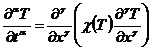 , .
, .
In this case the solution for  ,
,  is specified by wave properties. The validation of such equations’ solutions is restricted by the transit to limit
  and . The algorithm for the search of and usually is not provided, although their values are stated to be connected with the fractal space dimension. ,
In present work, the problem of studying the heat transfer (diffusion) process in simply connected fractal space is resolved via the method of phase space enhancement by introducing an additional variable specifying the scale of the fractal space consideration. The total time derivative and conductivity coefficients are changed with this account.
The analytic dependence of temperature on the time, space coordinates and the scale of fractal structure consideration is found for the heat transfer from local heat source in the infinite space of simply connected fractal structure “enclosed” to three dimension space with no (or weak) heat conduction.
