

Партнерка на США и Канаду по недвижимости, выплаты в крипто
- 30% recurring commission
- Выплаты в USDT
- Вывод каждую неделю
- Комиссия до 5 лет за каждого referral
New Economic School, 2005/6
financial risk management
Lecture notes
Plan of the course
· Classification of risks and strategic risk management
· Derivatives and financial engineering
· Market risk
· Liquidity risk
· Credit risk
· Operational risk
Lecture 1. Introduction
Plan
· Definition of risk
· Main types of risks
· Examples of financial failures
· Specifics of financial risk management
· Empirical evidence on RM practices
What is risk?
· Chinese hyeroglif “risk”
o Danger or opportunity
o This is the essence of financial risk-management!
· Uncertainty vs risk
o Subjective / objective probabilities
o Speculative / pure
How to measure risk?
· Probability / magnitude / exposure
o Systematic vs residual risk
· Maximal vs average losses
· Absolute vs relative risk
How to classify risks?
· Nature / political / transportation / …
· Commercial
o Property / production / trade / …
o Financial
v Investment: lost opportunity (e. g. due to no hedging), direct losses, lower return
v Purchasing power of money: inflation, currency, liquidity
Main types of financial risks
· Market risk
o Interest rate / currency / equity / commodity
· Credit risk
o Sovereign / corporate / personal
· Liquidity risk
o Market / funding
· Operational risk
o System & control / management failure / human error
· Event risk
Examples of financial failures

Lessons for risk management
· Integrated approach to different types of risks
· Portfolio view
· Accounting for derivatives
· Market microstructure
· Role of regulators and self-regulating organizations
Methods for dealing with uncertainty by Knight
· Consolidation
· Specialization
· Control of the future
· Increased power of prediction
Financial risk management
· Avoid?
o But you cannot earn money without taking on risks
· Reserves: esp. banks
· Diversification
o But: only nonsystematic risk
· Hedging
o Usually, using derivatives
· Insurance: for exogenous low-probability events
o Otherwise bad incentives
· Evaluation based on risk-adjusted performance
· Strategic RM: enterprise-wide policy towards risks
o Identification / Measurement / Management / Monitoring
Should the companies hedge? NO
· The MM irrelevance argument
o The firm’s value is determined by its asset side
· The CAPM argument
o Why hedge unsystematic (e. g., FX) risk?
o Any decrease in % will be accompanied by decrease in E[CF]!
· Transactions with derivatives have negative expected value for a company
o After fixed costs
Should the companies hedge? YES
· Both MM and CAPM require perfect markets
o Bankruptcy costs are important
· The CAPM requires diversification
o Real assets are not very liquid and divisible
· Shareholder wealth maximization
o Market frictions: financial distress costs / taxes / external financing costs
· Managerial incentives
o Improving executive compensation and performance evaluation
· Improving decision making
Empirical evidence on RM practices
· Financial firms:
o The size of derivative positions is much greater than assets (often more than 10 times)
· Non-financial firms:
o Main goal: stabilize CFs
o Firms with high probability of distress do not engage in more RM
o Firms with enhanced inv opportunities and lower liquidity are more likely to use derivatives
Methods for dealing with uncertainty by Knight
· Consolidation
· Specialization
· Control of the future
· Increased power of prediction
Financial risk management
· Avoid?
o But you cannot earn money without taking on risks
· Reserves: esp. banks
· Diversification
o But: only nonsystematic risk
· Hedging
o Usually, using derivatives
· Insurance: for exogenous low-probability events
o Otherwise bad incentives
· Evaluation based on risk-adjusted performance
· Strategic risk management: enterprise-wide policy towards risks
o Identification / Measurement / Management / Monitoring
Current trends in risk management
· Deregulation of financial markets
· Increasing banking supervision and regulation
· Technological advances
· Results: risk aggregation, increasing systemic and operating risks
Lecture 2. Financial engineering
Plan
· Specifics of risks of different instruments
o Investment strategies / pricing / systematic risks
· Stocks / bonds / derivatives
o Forwards / futures / options / swaps
General approach to financial risk modeling
· Use of returns
o Stationary (in contrast to prices)
· Risk mapping: projecting our positions to (a small set of) risk factors
o We might not have enough observations for some positions
v E. g., new market or instrument
o Too large dimensionality of the covariance matrix
v For n assets: n variances and n(n-1)/2 correlations
o Excessive computations during simulations
Specifics of risks for different assets
· Discounted cash flow approach: P0 = Σt CFt/(1+r)t
· Stocks: P0 = (P1+Div1)/(1+r) = Σt=1:∞ Divt/(1+r)t
o Interest rates / Exchange rates
o Prices on goods and resources
o Corporate governance / Political risk
· Bonds: P0 = Σt=1:T C/(1+rt)t + F/(1+rT)T
o Interest rates for different maturities
o Default risk
· Derivatives
o Price of the underlying asset
v Shape of the payoff function
v Volatility
o Interest rates
Index models: Ri, t = αi + ΣkβkiIkt + εi, t,
where E(εi, t)=0, cov(Ik, εi)=0, and E(εiεj)=0 for i≠j
· Risk management: ΔRi ≈ ΣkβkiΔIk
· Separation of total risk on systematic and idiosyncratic: var(Ri) = βi2σ2M + σ2(ε)i
o Systematic risk depends on factor exposures (betas): βi2σ2M
o Idiosyncratic risk can be reduced by diversification
· Covariance matrix: cov(Ri, Rj) = βiβjσ2M
o Correlations computed directly from the historical data are bad predictors
Stocks
Single-index model with market factor: Ri, t = αi + βiRMt + εi, t
(Market model, if we don’t make an assumption E(εiεj)=0 for i≠j)
where β=cov(Ri, RM)/var(RM): (market) beta, sensitivity to the market risk
Multi-index models:
· Industry indices
· Macroeconomic factors
o 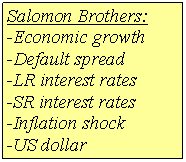 Oil price, inflation, exchange rates, interest rates, GDP/ consumption growth rates
· Investment styles
o Small-cap / large-cap
o Value / growth (low/high P/E)
o Momentum / reversal
· Statistical factors
o Principal components
Investment strategies
· Speculative: choosing higher beta
o Increases expected return and risk
o Used by more aggressive mutual funds
· Hedging (systematic risk): β = 0
o Market-neutral strategy: return does not depend on the market movement
o Often used by hedge funds
· Arbitrage: riskless profit (“free lunch”)
o Buy undervalued asset and sell overvalued asset with the same risk characteristics
o Pure arbitrage is very rare: there always some risks
Bonds
Single-index model with interest rate: Ri, t = ai + Di Δyt + ei, t
where yt: interest rate in period t,
D: duration, exposure to interest risk
Macauley duration: D = -[∂P/P]/[∂y/y] = -Σt=1:T t Ct / (P yt)
For the bond with the price: P0 = Σt=1:T Ct / yt
· Wtd-average maturity of bond payments, D ≤ T
· Elasticity of the bond’s price to its YTM (yield to maturity)
· For small changes in %: ΔP/P ≈ - D Δy/y = - D* Δy
o D* = D/y: modified duration
Convexity: C = -Σt=1:T t(t+1)Ct / (P ytt)
· For small changes in %: ΔP/P ≈ - D Δy/y + ½ C (Δy/y)2
Asset-liability management: used by pension funds, insurance companies
· Gap analysis: gapt = At-Lt
o Positive gap implies higher interest income in case of rising %
· Perfect hedging: zero gaps (cash flow matching)
o Can be unachievable or too expensive
· Immunization: D(assets) = D(liabilities)
o Active strategy, since both duration and the term structure of interest rates evolve over time
o Need precise measure of duration (and convexity)
o Does not protect from large changes in %
Derivatives
Derivatives:
· Unbundled contingent claims
o Forwards / Futures / Swaps / Options
· Embedded options:
o Convertible / redeemable bonds
· Role of derivatives: efficient risk sharing
o Speculation: give high leverage
o Hedging: reduce undesirable risks
· Notional size: around $140 trln
o Twice as large as equity and bond markets combined
· The total market value (based on positive side): less than $3 trln
Forward / futures
· Obligation to buy or sell the underlying asset in period T at fixed settlement price K
· Zero value at the moment of signing the contract (t=0)
· Payoff at T, long position: ST-F
Forward
· Specific terms
· Spot settlement
· Low liquidity
o Must be offset by the counter deal
· Credit risk
Futures
· Standardized exchange-traded contract
o Amount, quality, delivery date, place, and conditions of the settlement
· Credit risk taken by the exchange
o The exchange clearing-house is a counter-party
o Collateral: the initial / maintenance margin
o Marking to market daily
v Long position: receive A(Ft-Ft-1) into account
· High liquidity, popular among speculators
o Can be offset by taking an opposite position
o Usually, cash settlement
No-arbitrage forward price F (assuming perfect markets):
· For assets with known dividend yield q: F = Se(r-q)T
o Value of the long position: (F-K)e-rT = Se-qT - K-rT
Systematic risks
· Delta (first derivative wrt the price of the underlying): δ=e-qT
· Gamma (second derivative wrt the price of the underlying): zero!
Specifics of futures
· If r=const, futures price = forward price
· If r is stochastic and corr(r, S)>0, futures price > forward price
o The margin proceeds will be re-invested at higher rate
· Liquidity risk due to margin requirements
· Basis risk: the basis = spot price – futures price
o Ideal hedge: the basis=0 at the delivery date
o Usually, the basis > 0 at the settlement date
v Maturity / quality / location risks
Example: Metallgesellschaft
· Sold a huge volume of 5-10 year oil forwards in 1990-93, hedging with short-term futures
· When the oil price fell, the margin requirements exceeded $1 bln. The Board of Directors decided to fix the futures’ losses and close forward positions. The final losses were around $1.3 bln.
· Lessons:
o The rollover basis risk was ignored by those managers who designed the strategy
o The senior management did not understand this strategy and therefore made clearly inefficient decision to close long forward positions that were profitable after decline in oil prices.
Investment strategies
· Speculative
o Naked: buying or selling futures
o Spread: calendar / cross
· Hedging
o E. g., short hedge: we need to sell the underlying asset, hedge with short futures
· Hedge ratio: hedged position / total position
o Hedging stock exposure with stock index futures: βS
o Hedging interest rate risk with duration: immunization
Options:
· European call (put): right to buy (sell) the underlying asset at the exercise date T at the strike/exercise price K
· American call (put): can be exercised at any time before T
· Right, no obligation (for the buyer) => asymmetric payoff function
o Call: cT = max(ST-K, 0)
o Put: pT = max(K-ST, 0)
· Synthetic forward: long call, short put
· European call-put parity: c0 + Ke-rT = p0 + S0
o Covered put = call + cash
Speculative strategies
· Naked / covered option
· Spread: options of one type
o Bear / bull: long and short call (put)
o Butterfly: long with K1 and K3, two short with K2= ½ (K1+K3)
o Calendar: short with T and long with T+t with the same strike
· Combination: options of different type
o Straddle: call and put
o Strip: call and two puts
o Strap: two calls and put
o Strangle: with different strikes
Black-Scholes model
· Call: ct = Ste-qT N(d1) – Xe-rT N(d2)
· Put: p = Xe-rT N(-d2) – Se-qT N(-d1)
o d1 = [ln(S/X) + T(r-q+σ2/2)] / [σ√T], d2 = d1 – σ√T
o q is cont. dividend yield
o N(.) is a std normal distribution function
· Given price, σ is implied volatility
o Good forecast of future volatility of the underlying
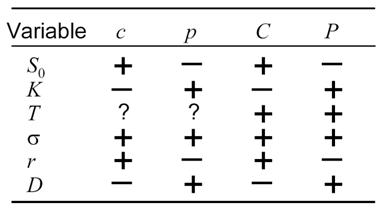
Systematic risks: the greeks
· Delta (wrt price of the underlying asset)
o Call: δ =e-qT N(d1)
o Put: δ=-e-qT N(-d1)
· Rho (wrt risk-free rate)
o Call: ρ=XTe-rT N(d2)
o Put: ρ=-XTe-rT N(-d2)
· Vega (wrt volatility)
· Theta (wrt time)
Hedging strategies
· Delta-neutral
· Gamma-neutral
· Delta-rho-neutral
Swaps
· Interest rate swap: exchange of fixed-rate and floating-rate interest payments for a fixed par value
o Sensitive to interest rate risk
o Pricing swap: via decomposition of PV(fixed coupons) and PV(forward rate coupons)
v The market price of the floating-rate bond equals par after each coupon payment!
· Currency swap: exchange of interest payments in different currencies
o Sensitive to interest rate and currency risks
Lecture 3. Measuring volatility
Historical volatility: MA
· Moving Average with equal weights
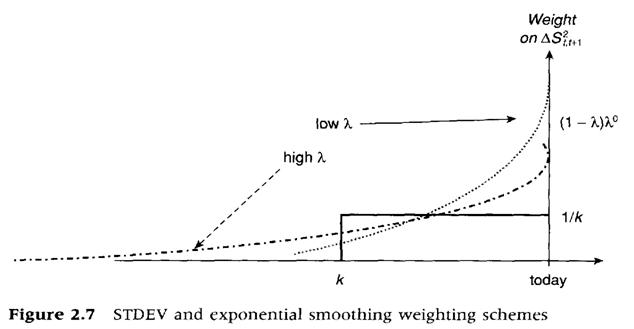
EWMA (used by RiskMetrics)
σ2t = λσ2t-1 + (1-λ)r2t-1 = (1-λ) Σk>0 λt-1r2t-k
· Exponentially Weighted Moving Average quickly absorbs shocks
· λ is chosen to minimize Root of Mean Squared Error
RMSE = √ (1/T)∑t=1:T (σ2t-r2t)2
· λ = 0.94 for developed markets

GARCH(1,1)
σ2t = a + b σ2t-1 + cε2t-1
· Parameter restrictions: a>0, b+c<1
o Guarantee that variation is non-negative and that unconditional expectation exists:
E[σ2] = a/(1-b-c)
· More general model than EWMA, can be modified
o More lags
o Leverage effect: stronger reaction to negative shocks
· More parameters leads to larger estimation error
o Used less frequently in RM than EWMA
Implied
· Based on options’ market prices and (Black-Sholes) model
o Forward-looking!
Realized
· Based on intraday data
o E. g., prices over hourly intervals
o Only for liquid assets
Lectures 4-7. Market risk: VaR and beyond
Identification of market risk
· Primary: directional risks from taking a net long/short position in a given asset class
o Interest rate / currency / equity / commodity
· Secondary: other
o Volatility / spread / dividend
o Many trading books are managed with the objective of reducing primary risks…
v at the expense of an increase in secondary risks
· General (systematic) vs specific risks
o The latter may be important because of lack of diversification or implementation of a specific investment strategy
· Non-linear (option-like) instruments
o Need to model full probability distribution of the underlying markets factor(s)
o Sensitive to long-term market volatilities and correlations
Assessment of market risk: selection of factors and choice of models
· Statistical models: factor return distributions
o Describing uncertainty about the future values of market factors
o E. g., geometric Brownian motion, GARCH
· Pricing models: factor exposures
o Relating the prices and sensitivities of instruments to underlying market factors
o E. g., Black-Scholes
· Risk aggregation models: risk measures
o Evaluating the risk of losses in the future portfolio’s value
o E. g., standard deviation, VaR
Traditional measures of market risk
·  Position
o Size and direction
· Volatility
o Time aggregation: √T rule
o Cross aggregation: diversification effect
· Exposure
o Stocks: beta
o FI: duration, convexity
o Derivatives: delta, gamma, vega, ...
Issues
· Aggregation and comparability of risks
o Can’t sum up deltas or vegas
o Market vs credit vs operational risk
· Measuring losses
· Controlling risk: position limits
o Until 1990s, mostly restrictions on size of net positions, including delta equivalent exposures
History of Market Risk Management
· In late 1970s and 1980s,
o Major financial institutions started work on internal models to measure and aggregate risks across the institution.
o As firms became more complex, it was becoming more difficult but also more important to get a view of firm-wide risks
o Firms lacked the methodology to aggregate risks from sub-firm level
· Early 1990s
o Group of 30 report. Derivatives: Practices and Principles. Their work helped shape the emerging field of financial risk management
o Oct 1994 JP Morgan published RiskMetrics and made the data and methodology freely available on the internet. Riskmetrics was developed over the previous 8 months, based on their own internal model.
·
o Value at Risk (VaR) becomes a standard financial market risk measurement tool worldwide
Value-at-Risk (VaR)
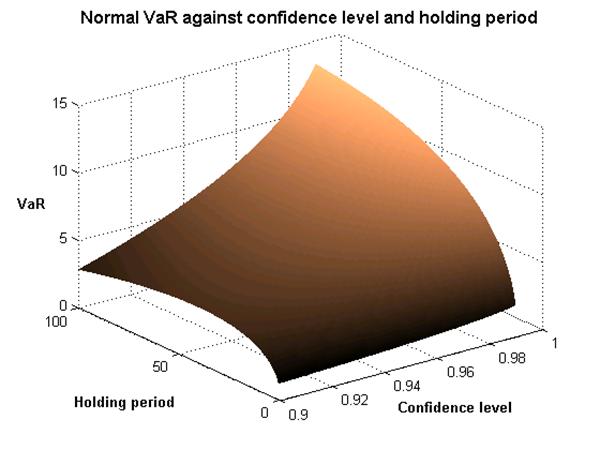
· Maximum loss due to market fluctuations over a certain time period with a given probability 1-α:
Prob(Loss<VaR)=1-α
· Key parameters:
o Confidence level: 99% (Basel) or 95% (RiskMetrics)
v  The higher the confidence level, the lower the precision
o Holding period: 10d (Basel) or 1d (RiskMetrics)
v Time necessary to close or hedge the position
v Investment horizon
· Estimation period
· Statistical model

VaR measurement: general framework
· Marking-to-market position
· Portfolio sensitivity to risk factors
o Linear vs non-linear
· Distribution of the risk factors
o Normal vs other
· Parameter assumptions
o Confidence level and horizon
· Data
o Estimation period and frequency
Main methods of computing VaR
· Delta-normal
o Analytic, variance-covariance
· Historical simulation
o Bootstrap
· Monte Carlo
o Simulations
· Stress Testing and Scenario Analysis are complementary tools to VaR
o Focus on potential extreme market moves
Local estimation approaches
Standard delta-normal method
· Assuming that ptf returns are normally distributed: VaR = V(1-exp(k1-ασt+μ)) ≈ k1-αVσt
o Quantile: 1%) и 2%)
o Daily data: assume that expected return = 0
· Holding period up to 10 days
o T-day Var = daily Var * √T
o Assuming zero auto-correlation
· Applications:
o Single asset
o Large, well-diversified ptf of many iid positions (e. g., consumer credits)
o ‘Quick and dirty’ way to compute VaR of the business unit, based on historical P&L
Delta-normal method: risk mapping
· Decomposition of the ptf to multiple risk factors: V = ΣiWiFi
VaR = k1-αV√WTΣW
o V is decomposed based on Taylor series
o W: vector of ptf weights or sensitivities of ptf return to factor returns
o Σ: covariance matrix of risk factors
v Can be decomposed to SD and correlations: covi, j = corri, j σi σj
v Correlations are more stable in time, use larger estimation period
v SD is more time-varying, computed by EWMA or GARCH
· Decomposition of the ptf to standardized positions Xi
VaR = k1-α√XTΣX
o Standardized positions: sensitive only to the given factor, with same delta as the ptf
v Example: for a US investor, ptf of dollar bonds on $2 mln has std positions for interest rate risk on $2 mln and for FX risk on $2 mln
o Two-stage approach by RiskMetrics: VaR = √ PVaRT Ω PVaR
v Estimate risks of each std position: PVaR
v Aggregate using pre-estimated correlation matrix of std positions Ω

Dealing with deviations from normal distribution:
· Fat tails / skewness
o Adjusted quantiles based on Student’s t distribution or mixture of normal distributions
· Nonlinear relationships: dV = Δ dS + ½ Γ dS2 +Λ dσ + Θ dt + ...
o Options: deltas are unstable and asymmetric
o Delta-gamma-vega approximation: VaR = |Δ| k1-ασS – ½ Γ (k1-ασS)2 + |Λ| |dσ|
Critique
· Quick computations
· Decomposes risks
· Strong assumptions about return distributions
· Cannot handle complicated derivatives
· The computations rise geometrically with # factors
· Can’t aggregate volatility over time with √T for large T
Full estimation approaches
Historical simulation method: nonparametric, full estimation approach
· Take historical time series of risk factors or assets
o Usually, at least one year
o Longer period increases the precision unless the process properties change over time
· Simulate the change in value of a given ptf using historical factor realizations
o Actual price functions (e. g., Black-Scholes)
o Approximate ptf payoff function (based on ptf sensitivities)
· Repeat simulations, plot the empirical distribution of P&L
Modifications:
· Different probabilities for historical observations
o EWMA: geometrically decreasing probabilities λt for lag t (0<λ<1)
v More distant events have smaller probability
o Higher weight for observations from the same month
v For seasonal commodities, such as natural gas
· Hull-White, standardized returns: use Ri, tsi/σi, t in the simulations
o σi, t: historical volatility of factor i
o si: current volatility forecast for factor i
· Intra-day returns (e. g., hourly intervals)
o Can analyze assets with short history (e. g., after IPO)
Critique
· Easy and simple
· No model risk
o No need to assume normal distribution, forecast volatility
· Correlations are embedded
· Path-dependent, assumes stationarity
· Requires long history
o Otherwise miss rare shocks
· Does not give structural knowledge
Monte Carlo (simulation) method
· Model (multivariate) factor distributions
o Stocks: Geometric Brownian Motion / with jumps
o Interest rates: Vasicek / CIR / multifactor models
· Generate scenarios and compute the realized P&L
o Using factor innovations from the model
· Plot the empirical distribution of P&L
Critique
· Most powerful and flexible
o (Cross-)factor dependencies
o Most complicated instruments (path-dependent options)
· Intellectual and technological skills required
· Lengthy computations
· Model risk
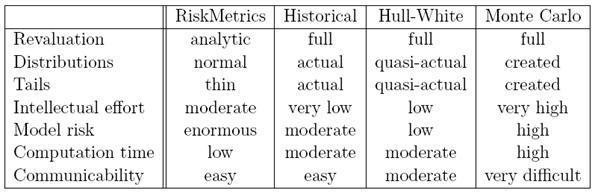
West (2004), Comparative summary of the methods
Different types of VaR
· VaR delta: partial derivative wrt factor or position
· VaR beta: % measuring the contribution of a given factor or position to the overall ptf risk
· Incremental VaR: change in VaR due to a change in the position
o Precise measurement requires re-estimation
· Marginal (component) VaR: Delta*Position
o Additive: ptf VaR is a sum of marginal VaRs
· Relative VaR: VaR of the ptf’s deviation from the benchmark
o Measures excessive risk
Backtesting VaR
· Verification of how precisely VaR is measured
o Compare % cases when the losses exceed VaR with the predicted frequency
· Historical approach: based on the actual recorded P&L
o More traditional, required by Basel
o Helps to identify the model’s weaknesses, mistakes in the data, and intra-day trading
o Often, actual P&L produces lower than expected frequency of VaR violations due to day trading that allows positions to be closed quickly when the markets become volatile
v Thus, reducing actual losses compared holding a static portfolio for 24 hours
· Hypothetical approach: based on hypothetical P&L computed using current ptf weights (factor exposures) and historical data on assets (risk factors)
o Concentrates on the current risk profile
o Eliminates the impact of intra-day trading
o But: may give biased results if the same model is used both for estimating P&L and for VaR
· Small sample problem
o Need long history for high confidence level (99%) to ensure statistical accuracy of VaR
· Basel: 1 year of daily data
# exceptions | Zone | Scaling factor for reserves |
0-4 | Green | 3 |
5 | Yellow | 3.4 |
6 | Yellow | 3.5 |
7 | Yellow | 3.65 |
8 | Yellow | 3.75 |
9 | Yellow | 3.85 |
10+ | Red | 4 (model withdrawn) |
Berkowitz and O’Brien, JF 2002
· Examine the practice of VaR measurement in 6 large US banks
o Compare VaR based on internal model with that based on reduced-form model for P&L
· Data, 01/1998 – 03/2000
o Consolidated end-of-day P&L, internal daily 99% VaR
o The returns are normalized by SD to hide the identities of the banks
· Т1: for 5 from 6 banks VaR is exceeded in 3 or less cases from 570
· Т1, F1: when VaR is exceed, the losses are high, over 2 SD for 3 banks (prob. 0.1% for t5)
· Т2, F2: most cases of exceeding VaR during the 3 months of the Russian default in 8-10/1998
o Banks make conservative estimates of VaR: the exceptions are rare, but large and clustered in time
·  Т3: the correlation between banks’ daily P&L is quite low (0.2), the correlation between banks’ daily VaR is unstable
· Т4: evaluating the accuracy of VaR estimates
o Unconditional coverage test: reject H0 for one bank (but low power)
o Independence (for i. i.d. distribution of violations): reject H0 for 2 banks
o Conditional coverage test (sum of the previous two): reject H0 for 2 banks
· Compare with the reduced-form models: ARMA(1,1) & GARCH(1,1), out-of-sample starting after 165 days
o Does not account for change in positions and risks, cannot be used for sensitivity or scenario analysis
o Embeds systematic mistakes in P&L
o Т5, F4: VaR is lower, the average # exceptions close to 1%, the magnitude of losses is lower, similar test results
· Conclusions:
o Banks’ estimates of VaR are too conservative, do not adequately reflect risks in certain periods; are not better than those based on a simpler forecasting models (ARMA-GARCH)
o Makes sense to use both models
v Traditional: forward-looking, decomposes individual risks
v Times series: flexible and parsimonious, advantage in forecasting, provides check for the main model
VaR implementation
· Measurement
o Local vs full estimation
o Portfolio effects
· Applications
· Verification: back testing
· Sensitivity: stress testing
· Limitations
VaR applications
· Portfolio management
o Min VaR with given expected return
· Position limits
o Trading vs investment
o Hierarchical structure
· Capital adequacy requirements
o  Basel: reserves = 3*VaR99%
o The multiplier goes up if VaR is underestimated
· Risk-adjusted performance evaluation
o RAROC = Risk-Adjusted Return / Economic Capital
o Similar measures in corporate finance: EaR (Earnings at Risk), CFaR (Cash Flow at Risk)
Stress testing
· Analysis of ptf value under rare, but possible scenario
o Shows the magnitude of losses which exceed VaR
o Helps to identify the weaknesses
· Factor push: assume that one of the key model parameters changes a lot
o E. g., increase in volatility / correlations / exchange rate / oil price
o For complicated derivatives need to check how the ptf value changes under different values of the parameter
o But: correlations are ignored
· Historical scenarios
o August 1998: Russian gvt default, ruble devaluation, credit spreads rising, developed countries’ bonds rates falling, gradual liquidity crisis
o Shock for a certain asset class: Black Monday for the US stock market in 1987, war in Iraq and oil price, etc.
o Shock for a certain region: Asian crisis in 1997 (for emerging markets), USD weakening
o 9/11 terror attack, Enron reporting scandal, Yukos case, etc.
o Advantage: keep correlation between different factors
· Hypothetical scenarios
o Rising correlations: e. g., model each asset’s return Ri as wtd sum of Ri & market return RM
o Russia: bank crisis, inflation, WTO entry, …
o It is important to ensure that there no internal inconsistencies in the perturbed model (e. g., arbitrage opportunities)
o Advantage: very flexible
· Hybrid method
o Change the covariance matrix & other parameters
o Estimate the conditional distribution of ptf value and compute ‘stress’ VaR
· Extreme-value theory
o Estimate the parameters of distribution of maximum losses
o Block maxima: e. g., annual highest losses
o Peak-over-threshold: 1% days with the lowest return
o But: needs large and representative data base
Examples of scenarios
· Stock market falling (e. g., US in 1987)
o Developed stock markets falling by 20%, emerging ones by 30%; volatility rising by 25%
o Flight to quality leads to strengthening of the dollar (by 10% relative to EM)
o Interest rates in DM falling, EM % go up by 0.5% (1%) for long (short) maturities
o Commodity prices falling due to fear of recession: oil price goes down by 5%
· Tightening of the Fed’s monetary policy (to tighten up inflation, as in 1984)
o Overnight rates rising by 1%, longer-maturity rates by 0.5%
o Interest rates in other countries rising less
o Relative strengthening of the dollar (investors put more in dollar-denominated instruments)
o Credit spreads rising
o Stock markets falling by 3-5%, volatility rising
Stress testing practice
· Morgan Stanley: blue book
· JP Morgan Chase: VID (vulnerability identification)
o Re-estimation at least once a month, discussed by the top managers
o Several macroeconomic crisis scenarios
o Complementary scenarios for different market segments
o Conservative assumption: positions remain the same during the crisis
v To be ready to the abrupt fall in liquidity
· Objective: be prepared to any possible financial crisis
o Even though we don’t know its probability of occurring
RiskMetrics: JP Morgan & Reuters (since 1994)
· Market risk measurement methodologies
o Delta-normal / historical / Monte Carlo
o Stress testing: VID (vulnerability identification)
· Data on volatilities and correlations
o Cash flow mapping to stock indices, currencies, and FI baskets
· Software
Example: Orange County, $1.7 bln losses in 1994 due to rising %
· Leveraged purchases of interest rate derivatives financed with reverse repos
o Betting on the slope of the yield curve
· Jorion: at the end of 1994, one-year 5% VaR was about $1 bln
o Are the downside risks worth the upside?
o Bad incentives for managers: either modest, above-market return or financial disaster
· Miller and Ross: Orange County was not insolvent, with net assets of $6 bln, including $600 mln in cash (for $20 bln in total assets)
o The bankruptcy could have easily been prevented!
Quiz
· Total vs selective risk management
o Value vs cash flow at risk
· VaR vs expected return and upside potential
· How to manipulate VaR?
· What is the relation between Basel and RiskMetrics VaR?
· Is it bad if the actual losses exceed VaR?
Beyond VaR
VaR assumptions
· Portfolio sensitivity
o Risk factor coverage
o (Non-)linearity
· Distributions
o Stable and exploitable relationships
o Fat tails and skewness
· Arbitrary parameters
VaR drawbacks
· Implicit assumptions
o No intraday trading
o Risks are described by exposures to several risk factors
o Usually, second cross-derivatives are neglected
· The actual losses are unknown
· The measurement error may be large, esp. for a high confidence level
· Model risk
· Manipulation: incentive to choose
o Strategies neutral to given risk factors
o Portfolios with very unlikely extreme losses
· Not subadditive
Properties of a coherent risk measure ρ
· Monotonicity: ρ(X1) ≥ ρ(X2) for X1 ≤ X2
o Higher return implies lower risk
· Translation invariance: ρ(X+const) = ρ(X)-const
o Adding cash lowers risk by the same amount
· Homogeneity: ρ(λX) = λρ(X) for λ ≥ 0
o Increasing the ptf’s size leads to proportional increase in risk
· Subadditivity: ρ(X1+X2) ≤ ρ(X1) + ρ(X2)
o Ptf risk does not exceed the sum of its components’ risks
Alternative market risk measures
· Full distribution
· Higher moments
o Variance, kurtosis, etc.
· Partial moments
o Semi-variance: risks in the falling market
v Downside CAPM: beta measured on the basis of low returns only
o Expected shortfall (coherent!)
· Cash flow risk
Lecture 8. Liquidity risk
Market liquidity: the ability to open or close large positions without a strong effect on price
Dimensions of market liquidity
· Tightness: price deviation
o Observed / Realized / Effective spread
v Driven by inventory and adverse selection costs
· Depth: potential supply and demand
o Trading volume
o Turnover rate (to volatility)
o % non-traded days
o Amihud (2002): daily ratio of absolute return to trading volume
v Daily price response associated with $1 of trading
· Resiliency: time necessary for price to recover
· Immediacy: the execution time
Market microstructure estimates of illiquidity
The Glosten-Harris model: Δpt = λqt + ψ[Dt-Dt-1] + εt
· Trade-by-trade data
· D: order sign
o Buyer (seller) initiated if the price is above (below) mid-quote: +1 (-1)
· q: signed trade quantity
o Positive for buyer-initiated trades
· ψ: fixed cost component
· λ: inverse market depth parameter
The Hasbrouck-Foster-Viswanathan model: Δpt = α + λqUt + ψ[Dt-Dt-1] + εt
· qU: the unexpected signed trading volume
o Based on the model for q with five lags of q and five lags of Δp
o Measures the informativeness of trades
· Cost components, in % of the price
o Proportional: λ * avg trade size / avg closing price
o Fixed: ψ / avg closing price
Liquidity and asset pricing
· Lower transaction costs lead to lower equity premium for risk
· Brennan (JFE, 1996):
o Portfolios with higher estimated costs have higher expected return
v Unexplained by Fama-French model
o Higher spread implies lower returns!
v Spread is a bad measure of illiquidity
· Amihud (2002):
o Expected illiquidity implies higher expected return
o Unexpected decrease in liquidity decreases the current prices
Determinants of the liquidity
· Asset characteristics
o Substitution (leading to concentration) vs complementarity effects
·  Market microstructure
o Transaction costs
o Info transparency
o Trading system
v Auction vs dealership markets: price-volume trade-off
· Behavioral factor
o  Dominating market participants
o Heterogeneity
v Buy/sell, risk attitude, investment horizon
Specifics of the Russian stock market
· Liquidity is concentrated in blue chips
· Liquidity moved from RTS to MICEX
· Flight to liquidity (or quality) during the crises
o E. g., August 1998, August 2003, April 2004
Modeling market liquidity risk
· The actual price may differ from the current market price
· The effective spread depends on the transaction size and timing
o Harder to measure for the OTC market
o Increases during the crisis
· Monte Carlo analysis: VaR adjustment, accounting for
o Direction and size of positions
v No more positive homogeneity of degree 1
v Ideally, should know elasticity of price wrt volume
o Correlation between market dynamics and liquidity
v Asymmetry between bullish and bearish markets
· Stress testing, accounting for
o Margin requirements
v Esp. if you hold a large portfolio with one broker
o Risk limits
v Low limits will soon require further sales to stop losses
o The likelihood of systemic crisis
o Typical scenario: a dealer stops to provide quotes
Funding liquidity (insolvency) risk
· Inability to fulfill the obligations because of the shortage of liquid funds
· Determinants:
o Current cash reserves
o Ability to borrow or generate CFs
· Sources:
o Systemic
v E. g., Russian gvt default in August 17, 1998
o Individual
v Change of a company’s (implicit) credit rating
o Technical
v Unbalanced forward payment structure
v Uncertainty about future CFs
Example: LTCM
· Investment strategy
o Betting on convergence of spreads
v E. g., long position on the off-the-run Treasury bonds, short position in the on-the-run (recently issued and more liquid) Treasuries
v In general, long (short) position in riskier (less risky) instruments
o High leverage, no diversification
o Brought net returns over 40% in 1995 and 1996
o But: sensitive to market-wide liquidity
· At the end of 1997:
o After returning $2.7 bln to their investors
o Balance sheet assets of $125 bln
o Off balance sheet notional amounts round $1 trln
v Mostly nettable (swaps)
o Positions with nominal value of $1.25 trln
· Addressing funding liquidity risk:
o Own capital of $4.8 bln
v 30 times leverage for BS sheet assets only!
o Credit line of $900 mln
o Investors commit capital for at least 2 years
· The crisis and its resolution
o August 1998: Russian default triggered “flight to safety”, all risk premiums rose
v LTCM lost $550 mln in August 21 only
o By the end of September, capital declined to $400 mln
v LTCM was forced to liquidate positions to meet margin calls
o September 1998: 90% of the LTCM ptf was purchased by a consortium of 14 banks for $3.625 bln
v That prevented the danger that the default of LTCM would trigger many cross-defaults
o July 1999: redemption of the fund
· The issues raised
o Risk management at LTCM
v Role of stress testing
o Risk management at LTCM counterparties
v Interaction with a highly leveraged institution
o Supervision
o Moral hazard
Lectures 9-13. Credit risk
Credit risk: losses due to the counterparty’s failure to honour his obligations
Credit event
· Default: an obligation is not honored
· Payment default: an obligor does not make a payment when it is due
o Repudiation: refusal to accept claim as valid
o Moratorium: declaration to stop all payments for some period of time
v Usually, by sovereigns
o Credit default: payment default on borrowed money (loans and bonds)
· Insolvency: inability to pay (even temporary)
· Bankruptcy: the start of a formal legal procedure to ensure fair treatment of all creditors
Specifics of CR:
· Asymmetry: possibility of big losses
o “the most you can lose is everything”
· Rare occurrence
· Longer horizon
· Non-tradability of most loans
o Hard to measure correlations
· Limits at the transaction level
· Interaction with market risk
· Esp important for banks
· Larger reserves
o Basel: 4*VaR
Examples
· Savings&loans crisis in the US in 1980s
o The restructuring cost the gvt $30 bln
· Defaults on Latin American countries’ debt in 1980s
o Restructuring in Brady bonds
· Defaults on corporate bonds
o Esp. junk bonds at the end of 1990s
· Accumulation of bad quality loans in Japanese banks
· Russia
o No default on corporate bonds so far
o Yukos on the brink of bankruptcy
Measuring credit risk
· Basic components:
o Probability of default (PD)
o Recovery rate (RR) / loss given default (LGD), RR + LGD = 1
o Credit exposure (CE) / Exposure at default (EAD), CE = EAD
· 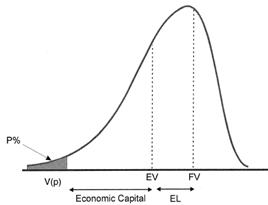 Credit loss: CLi = Di*LGDi*EADi
o Di: default indicator
· The credit loss distribution: CL = Σi[Di*LGDi*EADi]
o Highly skewed: limited upside, high downside
o Correlation risk: assuming independence will underestimate risks
o Concentration risk: sensitivity to the largest loans
· Credit VaR = WCLα – E[CL]
o Difference between expected losses and certain quantile of losses
o Expected losses covered by ptf’s earnings
o Unexpected losses covered by capital reserves
Modeling credit risk
· Internal approach: usually used by banks, focus on PD
o Classical solvency analysis
o  Market environment
o Quality of the company’s management
o Credit history
o Credit product characteristics
· External approach: using market data on stocks / bonds
MV(CR)= f(loss distribution, risk premium)
o Need to measure both PD and RR
o Requires liquid secondary market
Recovery rate
· Highly variable, neglected by research for a long time
o Fragmented and unreliable data
· Market value recovery:
o MV per unit of legal claim amount, short time (1/3m) after the default
· Settlement value recovery:
o Value of the default settlement per unit of legal claim amount, discounted back to the default date and after subtracting legal and administrative costs
· Legal environment factors
o Collateral or guarantees
o Priority class: collateralized, senior, junior, etc.
o The bankruptcy legislation
v Large cross-country differences: e. g., US and France more obligor-friendly than UK
v US bankruptcy procedures: ch. 11 (aim to restructure the obligor) vs ch. 7 (aim to liquidate the obligor and pay off debt)
· Other empirically observed factors
o Industry
o The obligor’s rating prior to default
o Business cycle & average rating in the industry
· Altman: US,
o On average, about 40% with SD of 20-30%
· Modelling RR: beta distribution with density f(x) = c xa (1-x)b
o For mean μ and variance σ2: a=μ2(1-μ)/σ2, b=μ(1-μ)2/σ2
Credit exposure: the amount we would lose in case of default with zero recovery
· Only the positive economic value counts: current CEt=max(Vt, 0)
o  Vt: credit portfolio’s value
· Current vs potential
o Expected (ECE) vs Worst (WSE), for a given confidence level
· Loans and bonds: direct, fixed exposures
o Usually, at par
· Commitments (e. g., line of credit): large potential exposure
o Usually, fraction of par
· OTC derivatives: variable exposures
o Usually, at current value with adjustment for market risk
v E. g., 90% quantile of the distribution
o Interest rate swap:
v Diffusion effect: increasing risk over time
v Amortization effect: decreasing duration
Traditional approaches to CR measurement
Credit ratings
· Independent agencies: S&P, Moody’s, Fitch
· Integral estimate of the company’s solvency based on PD (and RR)
o S&P: “general creditworthiness… based on relevant risk factors”
o Moody’s: “future ability… of an issuer to make timely payments of principal and interest on a specific fixed-income security”
· The rating procedure
o Comprehensive analysis, from micro - to macro-level
v Quantitative: based on financial reports
v Qualitative: evaluation of the management (business perspectives, risk attitude, etc.)
v Legal
o The rating committee decides by voting
o The rating is reconsidered at least once a year
· Long-term company rating
o Investment rating: from BBB (S&P), Baa (M’s)
v Meant for conservative investors
o Speculative rating
o Smaller gradations: 1/2/3, +/-, Outlook, Watch
· “Through-the-cycle” approach: CR at the worst point in cycle over contract’s maturity
o Does not depend on the current market environment
o In contrast to the “point-in-time” approach: CR depending on the current macro environment
· Short-term company rating
· Rating of specific instruments
Applications:
· Credit policy and limits
· Pricing the credit
· Monitoring and credit control
· Securitization
Survival analysis: actuarial approach to estimating PD
· Sample period from 20 years
o Need to accumulate default statistics (esp. for first-class issuers)
o Need to account for different stages of the business cycles
· For each rating: average PD
o Equal weights: PD = # defaults / # companies (with a given rating)
v Another approach: weights proportional to the issue’s volume
· Type of the bonds
o Bonds traded in the US market vs bonds of US companies
o Straight bonds vs convertible/redeemable bonds
o Newly issued bonds vs seasoned bonds
· Horizon
o Lower # observations for longer horizon
Measures of PD
· Marginal mortality rate (MMR) in year t
o Estimated PD in year t after the issuance
· Survival rate (SR)
o In year 1: SR1 = 1-MMR1
o During T years: SRT = (1-MMR1)*…* (1-MMRT)
· MR in year t given survival during t-1 years: MRt = SRt-1*MMRt
· Cumulative MR during T years: CMRT = Σt=1:TMRt = 1-SRT
· Average MR during T years: AMRT = 1-(1-CMRT)1/T
Estimation results
· Cumulative PD goes down with rating
· The highest MMR is for 4-5 years since the bond’s issuance
Critique of credit ratings
· Ratings react with a lag to the change in the company’s solvency
· Bias in ratings: too conservative
· Large measurement error
o Companies with the same (different) rating may have different (same) rating
o Ratings of different agencies often do not coincide
· Monte Carlo analysis by KMV
o Generate 50,000 times a 25 year sample of N companies with a given PD
v The parameters match those in Moody’s data base
o The estimated PD is very noisy, higher than the actual one for most issuers
o The differences between the estimated and actual PD rise with correlation between defaults
Credit ratings vs credit spreads
· Credit spread of a given bond often differs from the avg in the group with the same credit rating
· Credit spread depends on CR and other factors:
o Liquidity risk
o Maturity
o Macroeconomic factors
o Market volatility
· Ratings react with a lag to the change in credit spread
o Though the difference usually disappears with time: change in the firm’s solvency is reflected in rating within half a year, or spread returns to the initial value
Internal rating systems: evaluation of the borrower’s solvency
· Criterions
o Probability of default
o Recovery rate
· Horizon
o Usually, 1 year
· Scale
o According to S&P/Moody’s or its own
· Factors
o E. g., 5C: Character, Capital, Capacity, Collateral, Cycle
Analysis of financial reports
· Current / quick liquidity, leverage, profitability, turnover ratios
· Backward-looking: using historical data
o Extrapolation of the past into the future gives imprecise forecast
v Esp. under high uncertainy
· In Russia: little trust to fin reports
o RAS is clearly inferior to IAS
o Often reports are corrupted
v To misguide tax authorities, minority shareholders, banks, etc.
Role of expert’s opinion
· Visit to the company
· Personal contact with opt managers
· Human factor
Credit scoring models: predicting the default based on the borrower’s data
· Altman’s Z-score (1968): linear function of 5 variables
o X1: Working Capital to Assets
o X2: Retained Earnings to Assets
o X3: EBIT to Assets
o X4: Market Value of Equity to Book Value of Liabilities
o X5: Sales to Assets
· The sample: 66 companies, half of which defaulted
Z = 1.2X1 + 1.4X2 + 3.3X3 + 0.6X4+ 0.999X5
· Interpretation:
o Z > 3: default is unlikely
o 2.7 < Z ≤ 3: closer to the “dangerous zone”
o  1.8 < Z ≤ 2.7: likely default
o Z ≤ 1.8: very high PD
· How to evaluate the model?
o Type-1 error: default by the borrower who received a loan
o Type-2 error: predicting default for the good borrower
o Results: more than 90% firms were correctly classified
Constructing a scoring model
· Financial variables:
o Profitability, income volatility
o Leverage and interest coverage
o Liquidity
o Capitalization
o Management quality
· Methodology
o The binary choice logit / probit model
o Discriminant analysis
· Examples:
o ZETA-model (1977): for big companies ($100 mln in assets)
v 7 variables instead of 5
o EMS (emerging markets score): for emerging countries
v Using the model calibrated by the US firms
v Adjusted for the risk of currency’s devaluation, industry specifics, competitive advantage, presence of a guarantee, etc.
Critiqiue: pros and cons
· Simplicity
· Solves the problem of subjectivity of experts’ grades
· Usually assumes simple linear dependence
· Limited theory to explain the degree of each variable’s impact
o Danger of overfitting in-sample
· Need a good data-base
o Usually, a biased sample excluding borrowers that were denied credit
· Same old problems with financial report data
How to estimate losses of a credit portfolio?
Requirements to an ideal CR model
· Instrument characteristics
o Seniority
o Collateral / guarantee
· Company characteristics
o Financial leverage
o Balance liquidity
o Type of the business: cyclical, growing
o Size
· Impact of macro factors
o Recession
o Decline in the stock or commodity market
o Market liquidity crisis
· Portfolio effects
o Interaction between different credit instruments
o Sensitivity to common risk factors
Basel requirements
· The internal CR models should capture
o Concentration / spread / downgrade / default risk
· Capital charge = 4*VaR(99%, 10d)
· Interaction between MR and CR
o Spread risk includes both interest rate risk (MR) and default premium (CR)
o Credit events are often anticipated and reflected in spread
o Default is a special case of downgrade
· Ideally: integrated approach to MR and CR measurement
Classification of CR models
· Aggregation
o Bottom up: start from individual positions
o Top down: model aggregate credit portfolio
· Type of CR
o Default-mode (loss-based): an exposure is held till maturity, when it is repaid or defaults
o Mark-to-market (NPV-based): track changes in the current market value of the instrument
· Method of estimating PD:
o Conditional: depending on the current stage of the business cycle
o Unconditional
· Modeling default
o Structural: (endogenous) decision by the firm
o Reduced-form: (exogenous) stochastic process
Proprietary models of credit risk
Benchmark CR models
· CreditMetrics, 1997
o JP Morgan Chase
· KMV Portfolio Manager, 1998
o Kealhofer, McQuown, Vasicek
· CreditRisk+, 1997
o Credit Suisse
· Credit Portfolio View, 1997
o McKinsey
CreditMetrics / Credit VaR I: CR driven by change in credit rating
· CR is modeled as change in credit rating during a period equal to VaR horizon
o Each rating is characterized by a certain PD
v Assuming that all companies with same rating have same risk of default
o Use migration probabilities (of moving from one to another rating)
o Use data from one of the ratings agencies or internal ratings
· Compute a probability distribution of the future value of the instrument, using
o Forward rates for each rating
v Thus, account for duration and spread effects
o Recovery rate in case of default
v Depending on seniority
· Estimate VaR as a difference between a given quantile and expected value
· Bottom up approach:
o First estimate VaR for each instrument
o Then aggregate to ptf VaR accounting for correlations


Migration of credit ratings
· Transition matrix, usually for 1 year
o Probability that a company with rating X next year receives rating Y
· How to estimate T-year transition matrix?
o Directly
v But: increasing T means fewer observations and larger measurement error
o Cross-multiplying annual transition matrices T times
v But: ignoring auto-correlation effects
Example:
· Bond with BBB rating, senior, unsecured, maturing in 5 years, 6% coupon rate
· Ratings: S&P
o 7 groups: from AAA (first-class borrowers) to CCC (default)
· Horizon: 1 year
o Could be from 1 to 10 years
· Annual forward curve for each rating
o Allows us to compute the value of any bond in 1 year from now
Price of the bond in 1 year, if it keeps BBB rating


Forward distribution of the bond’s price
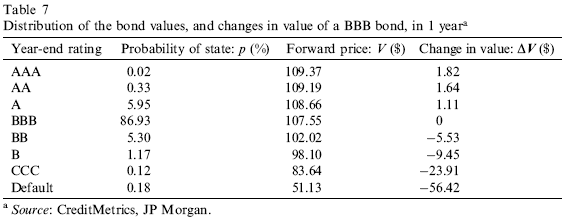

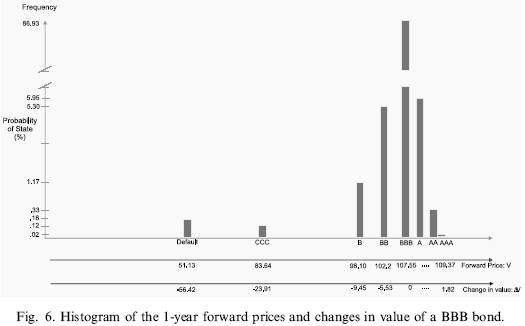

0.01 quantile of ΔV distribution: -23.91=VaR99%
CreditMetrics for a portfolio: diversification effect
· Assume that return on assets is distributed as stock return (GBM)
· Determine thresholds for the return distribution corresponding to the actual migration probabilities
· Derive the correlation matrix
o Based on multifactor model with user-defined country and industry weights
· Monte Carlo analysis
o Generate joint rating migration scenarios for bonds within the portfolio
o Estimate the empirical distribution of ptf value and compute VaR
Critique
· Ignore MR
o Derivatives require stochastic interest rates
o Esp. important to assume stochastic interest rates for derivatives
· Assume homogeneity with the same rating class
· Discrete migration matrix based on avg historical frequencies
o Transition probabilities are usually underestimated
· Simplified estimation procedure for correlations
Theoretical approaches to CR measurement
· Structural approach: estimate risk-neutral PD
o Use risky debt prices
o Use equity prices and Merton (1974) option model
· Reduced-form approach: use actuarial estimates of PD
o Apply on the portfolio level
Credit spread analysis (based on bond’s market price)
· For a one-period zero-coupon bond: r-rf ≈PD*LGD
o LGD: relative to face value
· Components:
o Credit risk premium
v Usually rising with maturity
o Liquidity risk premium
· Determinants:
o Macro factors
v Market volatility / liquidity
o Bond characteristics
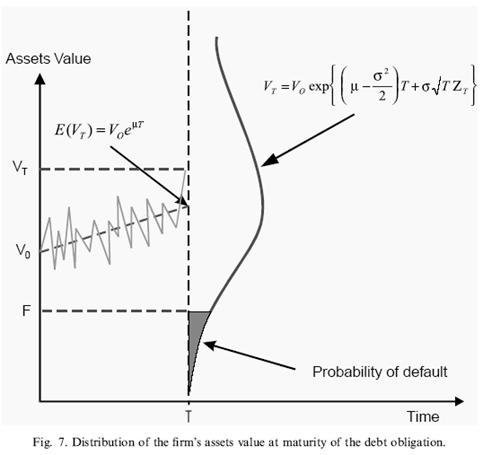
Merton model: stock as a call option on the value of the company V


· Assume that V follows a log-normal distribution:
o Zt~N(0,1): std Brownian motion
o σV: volatility (SD) of the relative growth in V (dV/Vt)
o μ: average growth rate, E[Vt]=V0eμt
· The company’s capital structure includes
o Equity, with value E
o Debt (zero-coupon), with face value F and maturity T
· Default occurs at maturity if VT<F
o Stockholders receive at T: max(VT-F,0)
o Creditors receive at T: min(VT, F)
· Stockholders: call option on the value of the company V
o Exercise date: T
o Price of the underlying asset: V
o Volatility: σV
· Creditors: bond and short put
o Or basic asset (the company) and short call
Derivation of the parameters:
· V and σV are unobservable, derived from two equations:
o The value of equity by Black-Scholes: E=V*N(d1)-Fe-rTN(d2)
v r: risk-free rate
v d1=[ln(V/F) + T(r+σ2/2)] / [σV√T], d2=d1-σV√T
o The equation for stock volatility: σEE = N(d1) σVV
· Risk-neutral probability of default: PD = 1-N(d2) = N(-d2)
· Recovery rate (as % of the assets): RR = [1-N(d1)] / [1-N(d2)]
o The current market value of debt: V-E=e-rT[(1-PD)+PD*RR]*F
Implicit assumptions:
· Stockholders’ behavior – as given
o Though they are interested in raising risk
· Lognormal distribution
o Underestimate PD at short horizon
· Bankruptcy when V below the face value of debt
o Default may be different from bankruptcy

KMV: main idea
· Estimate PD using the modified Merton model
· Move from empirical PD to risk-neutral PD
· Derive analytically the future value of the company’s obligations and VaR
KMV Credit Monitor (1993): EDF model
· Estimate the market value and volatility of the firm’s assets using modified Merton model
o For public companies: estimate V and σV based on equity prices
v Assume more complicated capital structure: equity, short-term debt, long-term debt, and convertible preferred shares
o For private companies: estimate V and σV based on financial accounting measures
v V is between the operational value (proportional to EBIT) and book value
v σV is an empirical function of sales, assets, industry, etc.
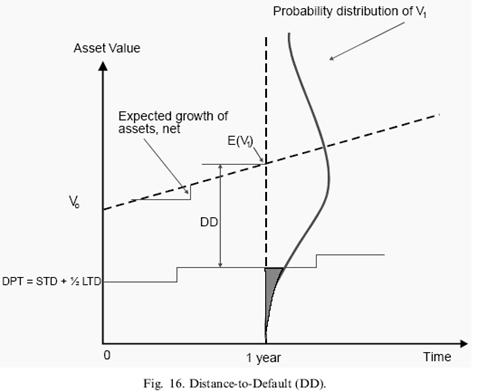
· Compute distance to default (measure of default risk in T years)
o Empirically estimated default point: DP = short-term liabilities + ½ long-term liabilities
o Distance to default: DD = ln[E(V)-DP]/σV (in %, in σ)


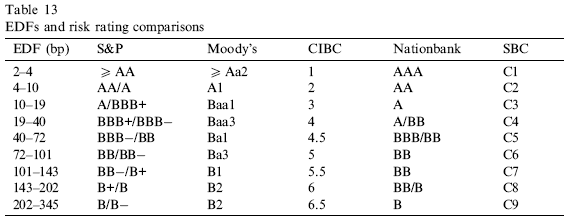
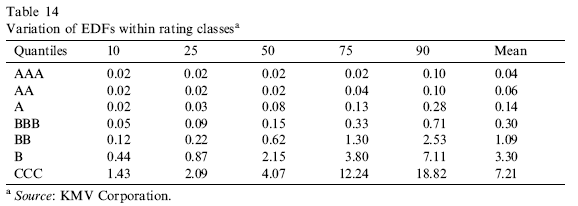
· Mapping DD to actual PD using historical data, for a given time horizon
o Expected Default Frequency: EDF = # defaulted companies / # companies, for given DD
o Can compute implied rating

Critique
· Company-specific
· Continuous, not biased by periods of high or low defaults
· The correlation between defaults based on stock price correlations
· Testing: EDF rises sharply 1-2 years before the default
o Agencies’ ratings are slow to react
· Best applied to publicly traded firms
o Can’t estimate country risk
· Ignore more complicated features of the debt
o Seniority, collateral, etc.


KMV Portfolio Manager: CR driven by change in MV(assets)
· Estimate actual EDF: KMV Credit Monitor
· Derive risk-neutral EDF
o Cumulative risk-neutral EDF at horizon T: QT = N[N-1(EDFT)+Sharpe√T)]
o Substitute Sharpei=ρi*SharpeM*Tθ
v In theory, θ=½
o Calibrate the market Sharpe ratio and θ with observed corporate spreads over LIBOR
v For maturity t: r-rf=(-1/t)ln(1-Q*LGD)
· Estimate stock return correlation matrix using a 3-level multifactor model
o Individual
o Country and industry
o Global and regional
· Portfolio’s losses: L=VT(NoDefault)-VT(equilibrium)
o Analytical derivation of VaR
o The limiting loss distribution: normal inverse (highly skewed and leptokurtic)
Critique
· Theoretically sound approach
o Using risk-neutral probabilities
· EDF is a good measure of default risk
· Need market prices of equity
o Assuming liquid market
o Can’t estimate country risk
· Hard to account for different types of debt
· Behaviour of equityholders – as given
o Though the have incentives and are able to increase risk
· Assuming lognormal distribution
CreditRisk+: actuarial approach to estimate PD
·  Time horizon: usually, 1y
· Assume
o For each loan, PD is small and independent across periods
o No assumption about the causes of the default
· PD for a ptf: Poisson distribution, P(n defaults) = μnexp(-n)/n!
o Avg # defaults: μ=ΣiPDi
o St. dev.: √μ
· Assume stochastical mean PD: μ is gamma-distributed
o Otherwise, volatility of PD is underestimated
· Exposure = Forward value * LGD
o Differing exposure amounts may result in a loss distribution far from Poisson
· The loan ptf is divided into exposure bands
o Each band j has same exposure νj (in rounded units)
o For each band, expected loss: εj=νjμjs
· Deriving analytical distribution of ptf losses:
o Probability generating function for each band
o Probability generating function for the entire ptf
o Loss distribution of the entire ptf
v Depends on two sets of parameters: εj and νj
· Extensions:
o Hold-to-maturity horizon
v Decompose the exposure profile over time
o Multiple years
v Take into account that default happens only once
o Sector analysis: dealing with concentration risk
v Assign sector-specific parameters to given obligors
o Scenario analysis
· Critique
o Easy implementation
v Focus on default
v Few inputs
o Analytical form of the results
o Ignore MR and migration risk
o Reduced-form
o Not applicable to non-linear instruments
Credit Portfolio View: top down approach using macro factors
· Assume PD(grade) = logistic f(macroeconomic index)
o The index = linear f(macro and industry factors)
o Each factor follows AR(2)
v %, FX, industry growth
· Estimate conditional rating migration matrix
o Adjust the unconditional migration matrix by the ratio of conditional and unconditional simulated PD
o Recession: more mass to downgrade migrations and PD
· Monte Carlo analysis
o Simulate the joint cond distribution of default and migration probabilities
· Critique
o Link macro factors to default and migration probabilities
o Need reliable historical data on PD
o Best applied to speculative grade obligors
o Ad hoc procedure of estimating the migration matrix
Other models
· CreditGrades: RiskMetrics, Goldman Sachs, JP Morgan, Deutche Bank
o Stochastic default barrier: lognormally distributed, with possible discrete jumps
v Increases estimated PD
o PD is a closed form function of 6 parameters:
v Mean and std of RR
v Initial and current stock price
v Implied stock volatility: calibrated from actual CDS spreads
o CreditGrade = model implied 5y credit spread
· Algorithmics Mark-to-Future (MtF): scenario-based approach
o Links CR, MR, and LR
o Generates cumulative PD conditional on scenario
Credit risk management
Impact of CR on derivatives
· Derivatives on (credit) risky bonds
o Long put gains in value
· Vulnerable derivatives: subject to CR by the writer
o The value diminishes by the credit spread: V’=V*Prisky(T)/PRF(T)
Traditional methods of CR management: credit exposure vs default modifiers
· Modeling CE
o BIS approach: CE = MV(deal) + potential CE
v Usually, potential CE as 0-15% of par
o Direct estimation of the potential CE distribution:
v Stress-case / trees / Monte Carlo
· Collateral arrangements: become popular for (longer-dated) swaps
o Derivatives: usually, initial margin=0, variation margin only in case of MtM moves over the exposure limit
o Longer period between remarkings
o Post securities as collateral
· Remarking / recouponing (to bring the value back to 0)
o Usually quarterly
· Netting: reduce potential CE to net position
o Better assessed by scenario and simulation analysis
o But: risk of “cherry-picking”
· Credit guarantees
o Esp valuable if the guarantee is from an independent company
o Usually provided by parent companies
· Credit triggers
o Rating downgrade clause: right to terminate all transactions if the counterparty’s rating falls below the trigger level
· Mutual termination option
o Time put: right to terminate on one or more dates using a pre-agreed formula to value the transaction at these times
o Termination brings CE to 0
· Modeling recovery rate
o Derivatives: usually, rank equally with senior unsecured debt
Implementation issues
· Legal considerations
o Collateral: maybe problems with enforceability in case of bankruptcy
· Economic considerations
o Resources required to implement recouponing and collateral arrangements
CR management instruments
· Limits
o Maturity / collateral / currency / regional / industry
· Target levels
o Return to CR
· Diversification
· Reserves
· Credit derivatives
Credit derivatives
Evolution of derivatives: 3 waves
· Second and third generation of price and event derivatives
o Hybrid / contingent / path-dependent risks
· Strategic management
o Ptf risk, balance sheet growth, overall business performance
· New underlying risks
o Catastrophe / electricity / inflation / credit
Why credit derivatives?
· Separate CR mgt from the underlying asset
o Confidentiality
o Customized terms
o Objective and visible market pricing
· Short-selling CR becomes possible
o Arbitrage and efficient markets
· Off-balance-sheet operations
o Banks can avoid selling loans
§ Tax considerations / underpricing / client
o Hedge funds can invest in CR, with leverage
§ Avoid transfer of property rights and administrative costs
· Completing the market
o Risk managers hedge CR
o Issuers minimize liquidity costs
o Investors find interesting instruments
· Rapid growth since end of 1990s, currently over $2 trln
· Types of insured CR:
o Credit event, value of the underlying asset, recovery rate, maturity
· Classified by:
o Type of the underlying asset
o Trigger event
o Payoff function
Credit default swap:
· Regular premium payments in exchange for a one-time premium in case of the credit event
o Materiality clause: credit event is not triggered by a technical default
o Both credit event and payments can be linked to a group of obligations
· Settlement
o Fixed payment
o Cash settlement: difference between the strike (par) and current market price
o Physical settlement in return of the par amount
· Basket default swap
o The underlying asset: loan portfolio
· First-to-default (basket) swap
· Dynamic credit swap
o Changing principal
· Practical role
o Enhance liquidity
o Hedging / investment opportunity
Total return swap:
· Fixed or floating payments in exchange for the current income from the underlying asset
o Regular exchange of payments
o Insures both MR and CR
Credit options:
·  Call or put on the price of FRN, bond, loan, or asset swap package
o (Multi-)European / American
o Can knock out upon credit event
· Practical role
o Yield enhancement
o Credit spread protection
o Hedging future borrowing costs
· Downgrade options
Other credit derivatives
· Hybrid
o Require a material movement in %, equity prices, …
· Credit spread forwards / options
· Credit-linked note: coupon payments conditional on the credit event
o Usually via SPV (special purpose vehicle), trust company
Risks of credit derivatives
· Correlation: simultaneous default of the underlying asset and protection seller
· Basis
· Legal
o 1999, 2003: ISDA adopted standard terms and documentation
· Liquidity: usually traded OTC
· Protection:
o Bilateral netting
o Option for premature abortion of the contract in the case of the counterparty’s financial distress
Lecture 14. Operational risk
Operational risk:
· Definition 1: financial risks besides MR and CR
o But: includes business risks
o Did the credit default result from the ‘normal’ credit risk or mistake of the loan officer?
· Definition 2: risks originating at financial transactions
o But: excludes risks due to internal conflicts, model risk, …
· Definition 3: risks due to deficiencies or mistakes from
o Information systems and technologies
o Internal procedures
o Personnel
o External events
Classification of OR
· Operational failure (internal) risk
o People: incompetency / fraud
o Process: model / transaction / operating control risk
o Technology: info systems, software, data bases
· Operational strategic (external) risk
o Environmental factors
o Change in political and regulatory regime
· Usually, business risk is excluded
o Choice of strategy
o Loss of reputation
o Legal
Examples of OR failures
· Barings and Nick Leeson (the “rogue trader”): more than $1 bln losses in 1995
o Strategy: cash-futures arbitrage, Singapore-Osaka arbitrage
o Booked losing trades to Account
o End of 1992: hidden losses of 2 mln pounds
o End of 1994: hidden losses of 208 mln pounds
o 1994: unauthorized positions in options
o January 1995: earthquake in Kobe, massive margin calls
· Daiwa bank and Iguchi Toshihide
o Since 1979, VP in NY, average profit of $4mln
o 1984: loss of $50,000-200,000,
o 1996: losses accumulated to $1.1 bln, confessed
o The bank hid this from Fed, was fined $340 mln and had to close its US operations
· Sumitomo corporation and Hamanaka Yasuo, $2.6 bln total losses
o Since 1975, in copper section, at heyday nicknamed “Mr. 5%”, “The Hammer”
o From 1984: unauthorized speculative futures trading together with the head of the copper trading team, trying to boost profitability
o 1987: cumulative losses $58mln, Hamanaka became head of the copper section, received $150 mln from Merrill Lynch
o 1990: began borrowing money against Sumitomo’s trading stocks to fund his trading positions, started fictitious option trades to create an impression of success
o 1991: asked a broker to issue a backdated invoice for fictitious trades, worth $350 mln
§ The exchange notified Sumitomo, which replied it was needed for tax reasons
o 1993: borrowed $100 mln from ING using forged signatures of senior managers
o 1994: raised $150 mln from Morgan, then $350 mln from a 7-bank consortium
o 1995: investigations by US and UK regulators into unusual fluctuations in copper prices
o March 1996: Sumitomo discovered that a statement from a foreign bank did not match its records
o Hamanaka was jailed for 8 years, Sumitomo paid a fine of $150 mln in the US and $8 mln in the UK, Merrill Lynch paid a fine of $15 mln in the US and $10 mln in the UK,
o Sumitomo filed suits against Morgan and other banks in assisting the illegal trades
Specifics of OR
· Company-specific
· Hard to quantify
· Inverse relation between E(loss) and Prob(occurrence)
o HFLS: high frequency, low severity
§ VaR techniques
o LFHS: low frequency, high severity
§ Extreme value theory
· Intentional (fraud) vs unintentional (mistakes)
· Interaction with MR and CR
Quantification of OR: top down vs bottom up approaches
· Indicators
o Key performance indicators
§ E. g., # wrong operations
o Key control indicators:
§ E. g., # prevented mistakes
o Key risk indicators
§ Forecast OR based on performance and control indicators
· Analysis of P&L volatility unexplained by MR and CR
· Causal models
o Measure losses using conditional probabilities
· Distribution of P&L
Management of OR
· Internal control system
o General policy by top management
o Assessment of risks
o Control procedures
§ Internal: no conflicts of interests, double checking, approving access
§ External: confirmation, audit
o Current monitoring
· Financial transactions system
o Front-office: “the face of the company”
o Back-office: execution of the deals, accounting
o Middle-office: input data, prepare papers, evaluate risks
· Information system:
o Data bases, software
o Security, aggregation, interaction
New Basel agreement: reserves for OR
· Basic indicator approach (BIA): ORC = αGI
o GI: gross income, 3y avg
o α: reservation coefficient, 15%
· The standardized approach (TSA): ORC = Σi βi GIi
o 8 std directions: corporate finance, trading operations, payments (all 18%), retail (12%) and commercial banking (15%), intermediation (15%), asset management, brokerage (12%)
o Alternative standardized approach: loans and advances instead of GI
· Advanced measurement approaches (AMA)
o Internal measurement approach (IMA): ORC = Σi γi ELi
§ Expected losses instead of GI based on PD, LGD, and correlations
§ Can be adjusted for risk profile index (RPI)
o Loss distribution approach (LDA): ORC = Σi OVaRi
o Scorecard approach
o Up to 20% of OR exposure can be insured
Special risks
· Model risk
o Wrong model
o Missing risk factor
o Inputs
v Low liquidity
· Legal risk
o Standardization
v 1992: ISDA Master agreement
· Accounting risk
o Marking-to-market
v Low liquidity
o Hedging vs speculative
o Swaps
o Taxation
Integrated risk-management
Recent developments
· Increase in volatility after 1973
· Globalization
· Deregulation
· Huge growth of the (exotic) derivatives market
· Higher volume of the off-balance (derivatives) operations
· Securitization
· Technological progress
o Electronic trading systems
o Program trading
· Conclusions:
o Aggregation of risks
v Importance of the enterprise-wide RM
v Need unified framework
o Higher systemic risks
o Higher operational risks
RAROC (Bankers Trust, end of 70s)
· Most popular risk-adjusted performance measure
o Other: RORAC, RARORAC
· RAROC = [Earnings – E(Loss)] / RC
o Earnings: profit net of all taxes and expenses
o Expected losses:
v CR: f(PD, CE, RR)
v MR: based on VaR models
o Risk capital: reserves covering losses with given prob for given horizon
v Can be adjusted with stress testing
· Horizon: usually annual
o Trade-off between MR and CR
· Identification of risks
o Usually: MR, CR, and OR
o Additional: business, event, balance risks
· Aggregation
o Standard: RC = MRC + CRC + ORC
o Monte Carlo
Applications of RAROC
· Enterprise level:
o Evaluate efficiency of work (backward-looking)
o Optimal capital distribution (forward-looking)
o Information for the outside world (shareholders, regulators, rating agencies)
o Managerial compensation
· Critique
o Common bottom-up approach
o Based on total risk (contrary to CAPM)
o Inapplicable to risk-free instruments (unless impose positive reserves)
Regulation of banks
· The standardized framework vs internal models
o Internal models should satisfy certain criteria and be approved by CB
· Basel Capital Accord (BIS I, 1988)
o Differentiate the CR exposures
· The 1995 amendment
o Incorporate MR
· The new Basel Capital Accord (BIS II, 2003)
o Integrate MR, CR, and OR
