


Партнерка на США и Канаду по недвижимости, выплаты в крипто
- 30% recurring commission
- Выплаты в USDT
- Вывод каждую неделю
- Комиссия до 5 лет за каждого referral
ЗАНЯТИЕ ЭЛЕКТИВНОГО КУРСА ПО АНГЛИЙСКОМУ ЯЗЫКУ В 9 КЛАССЕ.
Тема: Английская интонация.
Цель занятия: совершенствовать умение учащихся правильно произносить английские предложения, соблюдая интонационный рисунок.
Задачи:
Совершенствовать умение правильно артикулировать английские звуки и соединять их в словах, словосочетаниях и предложениях. Познакомить учащихся с интонационным рисунком разных предложений в английском языке, практиковать учащихся в их правильном произнесении. Развивать учебно-познавательный интерес учащихся к изучению английского языка. Совершенствовать навыки самоконтроля учащихся, обучать рефлексии собственной учебной деятельности.Оборудование: ноутбук (2шт.), медиапроектор, экран, наушники (2шт.), колонки, СД «Мистер Хиггинс», аудиомагнитофон, аудиокассета, классная доска.
Размещение участников и оборудования в кабинете:


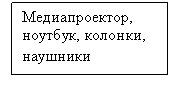
Group №1 | Group №2 | Group №3 |

Ход занятия.
Организационный момент. Сообщение целей и задач занятия.Good morning, my dear pupils! Today we have the fifth lesson of our elective course. We’ll repeat the English sounds, practice the pronunciation of the vowels and consonants. You will do on-line quiz and check up your knowledge. Besides that we’ll study the new theme from the English phonetics, but you should guess the name of the theme during the lesson.
Every pupil in our group has the learning diary. It will help us to analyze our work, our knowledge and our achievements during the lesson. You should complete this diary with the smiles and your comments about the tasks during the lesson. You have 4 types of smiles: excellent, good, fair, poor. The list of phrases can help you to do the comments. In the third column of the table you should write down the short information from the part of the lesson. You can use words, schemes and drawings. Right now you should complete the first and the second lines of your diary.
Отработка звуков английского языка. Повторение и отработка гласных и согласных звуков английского языка.The first group will work with the vowels, the second group with the consonants and the third group will work with the proverbs. Every pupil in a group should come to the computer, put the ear-phones on and practice the English sounds. You will do it one by one. At the same time the other pupils in a group will work with a paper task. The pupils of the first and the second groups should match the words with the sound and than write down the symbols for underlined letters. The pupils of the third group should write down the transcription in words. You have 6 minutes to do the task than we will check up your answers.
Group №1
Match the words with the correct sounds.
| dark |
[ı] | dog |
[e] | sport |
[æ] | tin |
[a:] | black |
[ʌ] | moon |
[ɔ] | leave |
[ɔ:] | cut |
[u] | look |
[u:] | red |
 [і:]
[і:]Keys:
| dark |
| dog |
| sport |
| tin |
[a:] | black |
| moon |
[ɔ] | leave |
[ɔ:] | cut |
| look |
[u:] | red |

 [і:]
[і:]
 [ ı]
[ ı]
 [e]
[e] [æ]
[æ]
 [ʌ]
[ʌ] [u]
[u]get | [e] |
seen | […] |
can | […] |
disk | […] |
foot | […] |
car | […] |
Keys:
seen | [і:] |
can | [æ] |
disk | [ı] |
foot | [u] |
car | [a:] |
Group № 2
1. Match the words with the correct sounds.
| Join |
[ʃ] | Long |
[ʒ] | Three |
[tʃ] | Push |
[dʒ] | These |
[θ] | Treasure |
[η] | Chair |
[ks] | Photo |
[j] | Yellow |
[f] | Xerox |
 [ð]
[ð]Keys:
| Join |
| Long |
| Three |
| Push |
[dʒ] | These |
[θ] | Treasure |
[η] | Chair |
| Photo |
| Yellow |
[f] | Xerox |

 [ð]
[ð]
 [ ʃ]
[ ʃ]
 [ ʒ]
[ ʒ] [ tʃ]
[ tʃ]
 [ks]
[ks] [j]
[j]2. Write down the symbols for the underlined letters.
Five | [f] |
she | […] |
you | […] |
orange | […] |
six | […] |
teacher | […] |
Keys:
she | [ʃ] |
you | [j] |
orange | [dʒ] |
six | [ks] |
teacher | [tʃ] |
Group № 3
Write the transcription in words.
[cæn aı help ju:]
[ə tʃі:zbə:gə ænd ən ɔrındʒ dʒu:s plі:z]
Keys:
Can I help you?
A cheeseburger and an orange juice, please.
Look at the screen and check up your answers, complete your learning diary with the smiles and comments.
Работа с он-лайн викториной.Now we will work with the quiz. Take the tasks of the quiz, there are 10 of them. Listen to the speaker and do the task in your papers. Nadya will do the quiz on the computer and she will help us to check up the answers.
(приложение)
Сomplete your learning diary with the smiles and comments.
4. Знакомство учащихся с английской интонацией.
1. Определение темы занятия.
We know a lot about English sounds and words. What can be new for us? Let’s listen to the dialogue and try to identify the new theme of our lesson.

 – Hello.
– Hello. May I speak to Alice, please?
– Just a minute.
Alice, it’s for you.
– Hello.
– Hi, Alice. This is Fred.
Would you like to go to the cinema today?
– Thanks. I’d love to. I haven’t been to the cinema for a long time.
– Good. I’ll pick you up at 7.30.
– Fine, I’ll be ready.
What helps you to understand what sentence is a question and what sentence is narrative?
Compare two sentences.
This is the pen. – Is this a question or a statement? (statement) Is this a pen? - Is this a question or a statement? (a question)(intonation)
And so you can write down the new theme of our lesson: Intonation.
2. Знакомство учащихся с интонационным рисунком различных английских предложений.
Different sentences in English sentences have different intonation. There are two important intonation patterns.
 The intonation rises at the end of the sentence.
 The intonation falls at the end of the sentence.

 Intonation
|
 |
Rising Falling
(восходящая) (нисходящая)
A statement.The intonation goes down at the end of the statement.

I’ve got an English penfreind.
«Yes/No» questions.
In “Yes/No” questions the intonation often goes up at the end of the sentence.

Can you see that girl?
(elementary ex.2 p.99 - Yes/No questions/statements)
Listen. Is this a question or a statement?(the sounds then sentences)
Has your cousin arrived?
Did you go to the disco yesterday?
I’ve bought some new trousers.
Is Jackie from New York?
I’m from Australia.
I went to England last summer.
Have you ever seen a UFO?
Wh – questions.In wh-questions the intonation goes down at the end of the sentence.

What’s she like?
(starter ex.2 p.106 – Wh-questions)
Listen and repeat.
What’s she like?
What’s her name?
What colour are your eyes?
What’s your job?
How old are you?
Alternative questions.In “Yes/No” questions the intonation normally rises at the end of the sentence.

Do you want to go by car?
However, when the question contains two or more choices the intonation rises and then falls at the end of the sentence.

Do you want to go by car or by train?
(pre-intermediate ex.2.p.108 – Yes/No questions/ Alternative questions)
Look at these questions. Does the intonation rise or fall at the end?
Listen and check your answers.
 Do you want orange juice or apple juice?
 Have you got one bag or two?
 Are we going to New York?
 Are you going to France or Italy?
 Shall we go in June or July?
 Is the programme on tonight?
 Does the film start at 8 or 8.30?
Listen and repeat.
E. List intonation.
In a list, the intonation goes up on each item and then down on the final item.
 | |
 | |
It’s on at two, five-thirty, and eight o’clock.
(starter ex.2 p.108)
Listen and repeat.
It’s on at two, five-thirty, and eight o’clock.
We have holidays in April, July, August, and September.
I play football, tennis, and baseball.
I need some shoes, some jeans, a shirt, and a jacket.
They pushed me, hit me, and kicked me.
I’d like a hamburger, French fries, and a cola.
For my birthday I got a bike, some books and a video.
F. Imperative.
In imperative sentences the intonation falls at the end.

Go to school!
G. Request.
In requests the intonation goes up at the end of the sentence.

May I go to school?
(диск, предложение/совет)
Listen and repeat.
Martha, may I ask you for a dance?
Compare the intonation in Russian and English sentences we could say that it differs in requests and can be different in English questions.
Russian |
|
English |

Now complete your learning diary with smiles and comments.
3. Закрепление новой темы.
A. You can often tell what people are talking about from the general pattern of the sounds.
Listen. You will hear some dialogues, but you will hear the sounds not the words what is the dialogue? Choose from these:
a news presentation a reporter reporting from the scene an advert a sports commentary a programme for childrenNow listen to the real dialogues. Check your ideas.
1. Yes. Eight out of ten people preferred New Washo. So try New Washo yourself. It’s new. It’s the best. It’s New Washo. /C/
2. And here’s Gibson now with the ball. He passes to Dandini. Now it’s Gonzalez. He shoots. Yes! What a goal! /D/
3. The Prime Minister is in Brussels today for a meeting of the European Union. Before he left London our reporter spoke to him about the meeting. /A/
4. Oh, isn’t Barney a silly bear? What do you think he’s going to do now, children? Yes. He’s going to buy some stamps. /E/
5. I’m standing in front of the parliament building. As you can see it has been almost completely destroyed by the fire. /B/
B. Now let’s work with the disk in groups. Listen and repeat the phrases from the dialogues one by one.
Now complete your learning diary with smiles and comments.
Заключительный этап урока.And so let’s make a conclusion of our lesson.
- What is the intonation in English sentences? (rising/falling) What is the intonation in Yes/No-questions? (rising) What is the intonation in statements? (falling) What is the list intonation? (rising and falling at the end of the sentence) What is the intonation in alternative questions? (rising, falling at the end) In what sentences the intonation is different in Russian and English language? (requests) I want to know if you like the lesson or not. Show me you smiles.
Thanks for your work today. I’m satisfied with it. Stand up. The lesson is over. Good bye.
