

Партнерка на США и Канаду по недвижимости, выплаты в крипто
- 30% recurring commission
- Выплаты в USDT
- Вывод каждую неделю
- Комиссия до 5 лет за каждого referral
FOOD SECURITY IN RUSSIA
Olentsova J. A.
Krasnoyarsk state agrarian university, Krasnoyarsk, Russia
The problem of food security in Russia is very important. The government has taken a major decision in the interests of domestic producers - reducing imports in general and strengthening domestic agriculture.
The food security of Russia was formalized in January 2010 when president Medvedev signed the “Food Security Doctrine”, which aims to see the country reach 85% self-sufficiency in meat and poultry by 2020. Business Monitor International (London, Great Britain) forecast self-sufficiency in poultry is reached in *****ssia is using the tools to achieve such goals include slashes in import quotas. This year, US pork quotas were cut 43% from 100,000 to 57,000 tones. Specialists expect demand will suffer as prices rise and forecast a decline in pork consumption for 2010. And Putin (2010) says: “We have taken a major decision in the interests of domestic producers — in 2011, we’ll cut poultry imports to Russia practically in half. This was not an easy decision but we’ve taken it with a view of reducing imports in general and strengthening domestic agriculture. Less favorable weather means grain harvests for 2009/2010 expected to fall across the board following bumper 2008/2009 season, wheat to fall 4.0% year-on-year to 61.1mn tones, corn to plummet 33% to 4.44mn tones, barley to drop 26% to 17.1mn tones. Milk consumption forecast for 2010 revised upwards with improving Russian economy, which we now expect to grow 4.0% over the year. A slight year-on-year gain in milk consumption is expected, with the figure remaining around 12.1mn tones.”
Balance of trade in goods expected to rise from US $ 303.3 bln. in 2009 to a forecast US $ 364.0 bln. in *****ssia is aiming at the expansion of wheat exports to Asia. With quality perception a challenge, Business Monitor International believes that it is likely to focus initially on more price sensitive South East Asian markets such as Indonesia, Vietnam and *****ssia plans to ship 1mn tones of wheat to the region in 2010. The laws requiring milk made with milk powder to be called “milk drink” are causing trouble for milk processors. Market leader Wimm Bill Dann saw its profits drop to one-third of 2008 levels in 2009. The US-Russian trade dispute over poultry exports may soon be at an end. US producers are expected to stop using the chlorine washes which caused the ban, with exports expected to resume thereafter. Yet, while US producers remain outlawed, their Russian counterparts should continue to benefit. The length of time it takes for exports to resume poses a risk to our production forecasts.
Food independence is the ability of agrarian sector of the country to provide manufacturing, storage, processing and delivery to the population foodstuffs principal views, in quantity and the assortment necessary for an active healthy life. Food safety is not provided if manufacture of a foodstuff makes less than 75-80%, according to physiological norms. It is offered to use support of manufacturers and foodstuffs consumers in Russia.
Growth of manufacture of agricultural production in Russia was accompanied by growth of import of the foodstuffs. The import volume has reached 35.2 bln. dollars, and the negative balance of export and import has made 25.8 bln. dollars (see Figure 1). Import growth goes much faster than export growth.
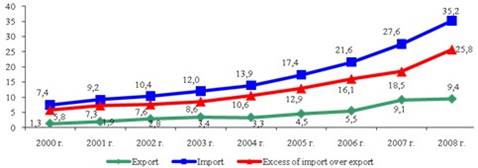
Figure 1. Export and import of agricultural production
Volumes of import of meat fresh and frozen, dairy products (see Table 1) have considerably increased. The basic increase in value of import has occurred at the expense of increase of average contract prices practically on all articles of food. In 13 times contract prices of meat fresh and frozen, and also fowl have increased. Table 1 Import of Principal Views of Articles of Food and Agricultural Raw Materials to the Russian Federation, Thousand Tone.
Kinds of the agricultural production and the foodstuffs | 2006 | 2007 | 2008 | 2008 year in % 2007 |
Articles of food and agricultural raw materials (except textile). bln. dollars of the USA | 21,6 | 27,6 | 35,2 | 127,3 |
Meat fresh and frozen (meatless birds) | 1,41 | 1,48 | 1,72 | 114,9 |
Fowl fresh and frozen | 1,282 | 1,29 | 1,2 | 94,5 |
Fish fresh and frozen | 686,1 | 870,2 | 881,1 | 101,2 |
Milk and cream condensed | 145,3 | 130,6 | 160,2 | 122,6 |
Oil creamy and other dairy fats | 165,0 | 123,5 | 140,0 | 113,5 |
Oil sunflower | 100,0 | 131,9 | 111,9 | 84,8 |
Sugar-raw | 2,62 | 3,41 | 2,41 | 70,9 |
Sugar-white | 349,7 | 296,1 | 165,1 | 55,8 |
Citron fruits | 1,18 | 1,26 | 1,28 | 102,2 |
Table 1.
That is high import dependence of the country by separate kinds of agricultural production and the foodstuffs remains. At the expense of import 36% of commodity resources today are formed. Sharply, there is a problem of dependence on import in the market of cattle-breeding production. The share of import in commodity resources of meat is estimated in 41%, milk in 27%. Import of pork from the beginning of 2009 has grown on 29 % and dried milk almost in 2 times.
Growth of internal manufacture of meat not to the full covered increase of consumer demand of the population was reflected in increase in volumes of its import (see Figure 2).
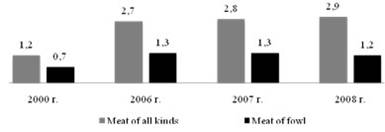
Figure 2. Meat import
It is necessary to solve simultaneously some the interconnected and capital-intensive problems: technological modernization of agriculture and the food-processing industry, sphere of industrial service of agrarian and industrial complex; formations of personnel potential of the branch, capable to master an innovation; Work on manufacture restoration on the thrown agricultural grounds; Creation a modern social infrastructure of rural territories (habitation, roads, etc.).
The guarantee of safety of foodstuff is connected with overcoming of following negative factors: Substantial growth of threshold value of criteria of a saturation of home market by import production, for example, meat; Low level of payment ability of the population for a foodstuff; Not stability of system of the financial credit; Insufficient level of development of an infrastructure of home market; Moral and physical ageing of a material condition agroindustrial and a fishery complex; Insufficient level of an innovation and investment actions; Reduction of national genetic resources; Probable expansion of production of biological fuel from agricultural production and raw materials; Shortage of competent staff.
The Ministry of Agriculture and the foodstuffs of Russia have developed the doctrine of food safety. In the doctrine, the conventional recommendations of FAO about a share of import and stocks of food resources are considered.
Doctrine's main objective is self-maintenance of the country with qualitative agricultural production, raw materials and the foodstuffs at level not less than 80-90% from requirement. At the summit, the concrete contribution of Russia to strengthening of global food safety at the expense of stable growth of manufacture of grain and the accruing volume of its export has been noted. For today Russia is included into a three of the largest world suppliers of wheat. The next 10-15 years in Russia, it is planned to finish manufacture of grain to 120-125 million tons a year that will allow providing stable export at level of 30-40 million tons.
Within the limits of the doctrine of food safety reduction of import of meat to 18% by 2012, which is almost twice in comparison with 2008 is predicted. Internal manufacture of meat should grow on 25% or on one and a half million tons, milk, to 33 million tons; import on milk will be reduced by 2012 to 16.6%. As a result of realization of a series of measures on agriculture development, by 2012 in separate directions the stage import replacement (fowl, pork, grain, a potato, vegetable oil) and saturation of home market by domestic production is finished. In the world, the country and in region management of agriculture with a view of advancement to food safety should be coordinated necessarily with food independence.
References
1. Basakov M. I., The National report on a course and results of realization in 2008 of a government program of development of agriculture and regulation of the markets of agricultural production, raw materials and the foodstuffs on .Moscow. 2009
2. Scherer F., Ross D., Performance at panel session on agrarian questions at the Petersburg international economic forum, 6/18St. Petersburg. 2010
3. Chekalin V. S., About the total declaration of the world summit on food safety, Rome. 2010
4. www. *****/news/6752
