


Партнерка на США и Канаду по недвижимости, выплаты в крипто
- 30% recurring commission
- Выплаты в USDT
- Вывод каждую неделю
- Комиссия до 5 лет за каждого referral
Министерство образования и науки Российской Федерации
Федеральное агентство по образованию
Государственное образовательное учреждение высшего профессионального образования
«Тобольский государственный педагогический институт имени »
терминология нефтегазовой отрасли
Учебные материалы для студентов
направления подготовки «лингвистика» (заочная форма обучения)
для организации самостоятельной работы
составитель:
к. ф.н., доцент
Тобольск – 2009
Texts for individual work.
1. Study the text, translate and explain the words which are underlined. Make a glossary of oil and gas terms
Tough RFID Tag Strikes Oil
By Claire Swedberg
May 23, 2008—Merrick Systems is providing an embedded RFID tag for oil drilling that it says is more rugged than other RFID tags, both in its ability to withstand high and low temperatures, as well as its adherence to the drill pipes as they are exposed to rotation, pressure, heat, abrasion and various chemicals in oil wells. Thus far the tag is being used by Trailblazer Drilling Corp., a division of Savannah Energy Services, and is being piloted by other unnamed companies.
Although many oil companies, oil-drilling operators and drilling-equipment providers are using RFID tags to track the multiple pipes that are joined together in long vertical strings for drilling wells, many RFID tags simply fail to perform after exposure to heat generated in the drilling process, get knocked loose or are unreadable through heavy coatings of mud. The Merrick tags, part of the Merrick Systems hardware and software solution for tracking equipment on the oil field, are about the size and shape of a U. S. quarter and embedded into the drill pipe and tubing in locations where they are less likely to be damaged. The tags that Merrick sells are encased in Victrex Peek polymers to withstand extremely high temperatures.
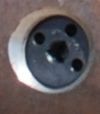
Merrick RFID tags are embedded in circular pockets machined into drill pipes.
"Peek polymer is more robust—it can stand up to chemicals and heat. That's the advantage for the oil industry," says Melanie Gast, Victrex regional business manager for oil and gas. Most plastics are not chemical resistant and cannot sustain high temperatures, such as the conditions found in oil wells.
Merrick Systems is primarily an industrial information technology software provider, says Merrick president and CEO Kemal Farid. In 2005 the company saw the benefit of using RFID technology as the company entered the drilling market, and designed a software system for drill equipment and developed its own RFID tag with a 125 kHz passive chip compliant with ISO 18000-2 standard. The 125 kHz frequency provides a short read range, says Ian Binmore, Merrick's director of drilling products, with less interference from the highly metallic environment and better able to read through chemicals that are used in the drilling process. Those chemicals include drilling fluids, acidizing treatments and polymer fluids designed to break up rock, and cements for drill hole walls, to name a few. In 2007 Merrick began offering the full RFID system, which includes HP IPAQ handheld computers with RFID readers provided by Ecom Instruments and other industrial suppliers.
Without RFID, oil drill companies have several problems. They can't know exactly where a drill has been before, how it was used or how old it is. Sections of pipe used for making a drill assembly are stored on racks in the derrick during drilling operations or stacked on racks in pipe yards. Often to find the right piece for the drill string they are building, roughnecks need to climb around and on racks of pipe (often in windy conditions) measuring pipe with tape measures. They then write down the specifications on a piece of paper and manually enter the data into a computer later. In some cases they may use stencils to spray-paint identifying numbers on drill pipe, but that is only partially helpful. If the mark is facing the wrong way on the rack, or if it has been covered by mud or worn away, it doesn't serve any purpose.
The equipment owners embed the Merrick tags into circular pockets machined into sides of the pipes by the owners themselves or by third-party installers, explains Binmore. These embedded RFID tags, used in conjunction with Merrick software, allows oil-field owners, drilling companies, and drilling equipment leasing companies to track equipment locations and know how it has been used by keeping an electronic record of where each piece of equipment has been and the temperature, chemicals, pressure and depth it has been exposed to, and for how long. This kind of tracking helps equipment users avoid accidents, such as a catastrophic drill string failure or breakage underground, or injuries to drilling employees.
"The drilling operation is very expensive," says Kemal Farid, Merrick president and CEO, and a string of drill pipes can cost $1 million or more. Oil wells are like cork screws, he says, with turns and twists that can damage or weaken a pipe. Temperatures within the holes can vary from 400 degrees Fahrenheit to -320 degrees when liquid nitrogen is used as an inert substance added to create a buffer inside the well. The pressure can be more than 20,000 pounds per square inch (psi). If one piece of a drill breaks, the entire string must be removed, costing many hours of delay.
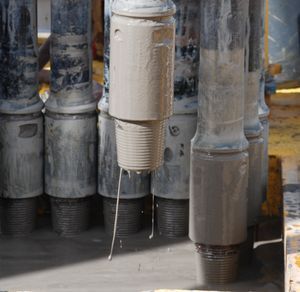 With the Merrick system, drillers use a computer to design the drill string they will need. The string consists of various sizes of pipes and joints that connect those pipes, all of which are tagged. Oil drillers also use pipe for special purposes such as recording the hole angle or geological information. Merrick software enables drillers to locate the specific ID numbers on the pieces they will be using. They then use a handheld reader to identify the necessary pipes and joints by capturing their tag ID numbers. Each pipe has three RFID tags encoded with the same ID number specific to that piece of equipment. The data related to those pipes, such as where and how they have been used, is stored on a local server and can then be backed up to a server that can be hosted by Merrick or the drilling company or leaser.
The tags are designed to withstand exposure to heat and other physical forces generated by the drilling process and be readable through heavy coatings of mud.
After its tag is read, a pipe section or joint is connected with other pieces in a string that is then drilled into the ground. As the drill equipment operates, the drilling rig's sensor system tracks the torque, axial tension, and downhole pressure and temperature. That data is then stored in the server using Merrick software to link it with the specific pieces of equipment panies such as Trailblazer can then access that data before reusing a pipe to know what kinds of conditions it has been exposed to in the past.
By the end of the year, Farid says, Merrick will be installing fixed readers below the drilling floor—the platform of the drilling rig where drilling operations are conducted—allowing the RFID tags to be read as the pipe sections are lowered. Farid also says there has been interest from the drilling industry in adding RFID tags to torque wrenches in order to track the amount of torque on bolts used to hold drilling equipment in place. Accidents can occur on oil rigs and at drilling operations when one or a series of bolts breaks because of errors in torque.
Currently the Merrick RFID system, says Binmore, "is hands-down the most rugged RFID tag available for drilling operations." The tag has been tested up to 22,000 psi and can operate under exposure to 360 degrees Fahrenheit indefinitely, rather than more typical tags that can survive such heat for only short periods of time. Binmore explains Merrick accomplished that heat and pressure resistance through the design of the casing and configuration of the tag, but says that exactly how the company achieved this is proprietary information.
2. Listen to the abstract 1 about oil and gas industry; write a reflexive essay about the problem touched upon there.
3. Study the text, translate and explain the words which are underlined. Make a glossary of oil and gas terms
New Oil and Gas Technology
by khalifa saber on Saturday, 25 October 2008
Improved technology is one factor that might make future oil and gas production better than the bleak future that most of us are foreseeing today. It might even reduce costs, so that more oil and gas can be produced at the lower prices we are seeing today.
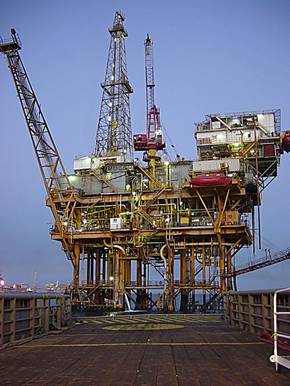 One area ripe for improvement is the poor success rate in drilling new oil wells–generally 25% or less. One newer technology trying to improve success rates is Deep Electromagnetic Imaging.
Whatever your criterion, deep electromagnetic (EM) imaging, which uses EM energy to find hydrocarbons without drilling wells, has clearly become a major industry in its own right. Its much older sister industry, seismic surveying, has been the cornerstone for exploration decisions since modern-day oil exploration began. However, seismic techniques have limited ability to successfully predict the location of hydrocarbons when used in isolation, which is one reason why offshore exploration drilling hit rates are less than one in four.
The traditional exploration workflow relies on indirect evidence to locate hydrocarbons, and seismic methods are mainly sensitive to rock structures and not to the fluids within them. In contrast, EM methods are very sensitive to reservoir fluids and can indicate hydrocarbons directly. Naturally, the first popular use of EM imaging in the oil industry was to test, before drilling, whether the potential reservoir structures (prospects) identified from seismic data actually contained oil. This significantly reduced exploration drilling risks and avoided many costly dry wells.
More recently, new applications of EM imaging have extended its use to act like a divining rod to search for direct evidence of hydrocarbons before performing extensive seismic surveys or bidding for new acreage in licensing rounds. This is particularly valuable in frontier regions because it enables costly exploration resources to be targeted on the most promising areas, and it accelerates the delivery of higher-grade prospects and, ultimately, more discoveries. Applications beyond exploration are also being pursued. Scientists and engineers are developing methods and technology to use EM imaging for field appraisal, advancing field development plans and even reservoir monitoring on mature assets to help optimise production and recovery.
Fewer than 10 years have passed since the idea behind the technology was conceived, and it is only five years since the first commercial survey was performed, and yet the usually conservative exploration community has embraced EM imaging. During the latter half of 2007, interest in EM technology has intensified and has culminated in a frenzy of merger and acquisition activities, as smaller EM companies and the big-three seismic players have scrambled to catch up with the market leader and pioneer of the technique, Electromagnetic Geoservices (EMGS).
The Oil Drum reader, Andrey Berg, has recently patented an imaging system which works better at greater depths, which he calls the Binary Seismo-Electromagnetic (BSE) method. This is a link to a write-up about that method.
Through Tubing Rotary Drilling
TTRD is a technique where new/stranded pockets of oil are accessed by drilling through an existing well bore. The main benefit of this technique is that the functionality of existing wells remains undisturbed hence dramatically reducing the associated well construction costs in some cases by as much as 50 percent. In many cases, this technique is the only economical way of accessing these stranded reserves.
A number of special tools have been developed to make this process work. The process has only been deployed in Norway to date.
Regarding improvements in technology in Canada’s oil sands, O&G reports that gasification of byproducts is now providing significant benefits:
In recent years, advancements in gasification make it possible to use process byproducts to replace costly natural gas. “Gasification will be used because natural gas is so valuable,” Heusinkveld said. “The gasification process takes coker and hydrocracker residue produced from upgrading and converts it into a syngas that has a variety of potential uses. Syngas can be used as a boiler fuel in place of natural gas to raise the steam required for in-situ production; it can be used to fuel large gas turbine generators to make the operations self-sufficient in power; it can be used to produce the hydrogen needed for the hydrotreating and hydrocracking of the bitumen (replacing the natural gas fueled steam methane reforming process); and it can be used as a feedstock for various fertilizer and primary petrochemical production processes.
Residue gasification will dramatically reduce operating costs in these projects. The coke is a waste product, and none of the operating companies has a license to store it indefinitely. Something has to be done with it. So the gasification process solves two problems. It addresses the issue of disposing of the coke, and it alleviates the need for additional natural gas which is becoming increasingly more expensive.”
An additional advantage of the gasification process is that it produces a great deal of excess heat, which can be used to produce steam. This provides upgraders with an accessible supply of cheap steam to run steam turbines as equipment drivers or to produce electric power.
Innovations in pigging pipelines (for cleaning the pipelines):
Being asked to clean pipe work whilst still in operation, i. e. online, completely floors many traditional pigging contractors yet this requirement is becoming more and more common and rightly so. With the immense raft of technology currently available why should operators have to shut down the plant or even take individual portions of a plant offline in order to get their pipelines cleaned? Yes there are CIP, cleaning in place, systems primarily used for pharmaceutical and food industries, but for online cleaning of larger, more industrial pipeline applications pigging contractors and of course pipeline operators need to know where to turn.
Tube Tech International were asked by a global oil giant in Asia if we could “pig” the blockages inside their furnace tubes which had formed along 2 x 100mm diameter 100m long serpentine, coiled furnace tubes. The client had told us that other pigging contractors had conceded that pigging was not the way to go and could only recommend high pressure jetting companies, who in turn suggested the only solution was to shut down and cut off all the bends. We didn’t think so.
As one of four high pressure jetting contractors approached we believed it was possible not only to unblock both lines without cutting off bends and re-welding but to up the stakes by “unblocking and pigging” the unit whilst online and operating at 430 degrees centigrade! In order to prove our theory we fabricated the scale size furnace in our yard and demonstrated the new procedure to the client and successfully unblocked the furnace, blocked with concrete as a simulation, at 430 deg C much to the astonishment of the client. Actual site conditions were slightly less at 150 degrees due to other critical site requirements but the point was still proven thanks to innovation and exhaustive trials.
Something else I ran across in Drumbeat that sounds interesting involves producing electricity from the hot water co-produced in an operating oil field:
Geothermal Energy Improves U. S. Oil Recovery
Ormat Technologies, Inc. announces the successful co-production of geothermal power at a producing oil well. This project marks the first of its kind by providing onsite fuel free power that will increase the productivity and possibly extend the longevity of existing U. S. oil fields. . .
The oil fields in the United States could provide an additional 5,000 MW of electricity for the United States through this technology, according to United States Senator Mike Enzi (R - Wyoming).
4. Watch the video about oil and gas industry; write a reflexive essay about the problem touched upon there.
A task for to get a credit.
Translate one of the texts suggested below and make up a glossary of terms, watch the video devoted to the steps of oil production and make a scheme of this process
New LWD technology mitigates risk from elevated borehole temperatures Drilling under pressure Exploration technology Asia-Pacific growth increasing seismic demand Growth in Schlumberger’s Operation Support Centers Drilling through salt Real-time seismic-while-drilling Gas Lift Proving Effective In Gas Wells Technology extends gas lift reach Optimizing Petronius productionA brief glossary of gas and oil terms
A
ABANDONED WELL - A well no longer in use; a dry hole that, in most states, must be properly plugged.
ACIDIZING A WELL- A technique for increasing the flow of oil from a well. Hydrochloric acid is pumped into the well under high pressure to reopen and enlarge the pores in the oil-bearing limestone formations.
ACID TREATMENT - A refining process in which unfinished petroleum products such as gasoline, kerosene, diesel fuels, and lubricating stocks are treated with sulfuric acid to improve color, odor, and other properties.
ACOUSTIC LOG - A generic term for a well log that displays any of several measurements of acoustic waves in rocks exposed in a borehole, e. g., compressional-wave transmit time over an interval (sonic log) or relative amplitude (cement bond log).
AMINE - Organic base used in refining operations to absorb acidic gases (H2S, COS, CO2) occurring in process streams. Two common amines are monoethanolamine (MEA) and diethanolamine (DEA).
AMINE UNIT - A natural gas treatment unit for removing contaminants (H2S, COS, CO2) by the use of amines. Amine units are often skid-mounted so they can be moved to the site of new gas production. Gas containing H2S and other impurities must be cleaned up before it is acceptable to gas transmission pipelines.
APPRAISAL DRILLING - Wells drilled in the vicinity of a discovery or wildcat well in order to evaluate the extent and the importance of the find.
AREA OF INTEREST - The area immediately surrounding a successful well in which the investors (in the good well) have an implied right to participate in any future wells drilled by the same operator.
ARTIFICIAL LIFT - Pumping an oil well with a rod, tubing, or bottom-hole centrifugal pump may be termed artificially lifting crude oil to the surface or doing so by mechanical means.
ASSIGNMENT - In oil and gas usage, assignment is a transfer of a property or an interest in an oil or gas property; most commonly, the transfer of an oil or gas lease. The assignor does the transferring and the assignee receives the interest of property.
ASSOCIATED GAS - Gas that occurs with oil, either as free gas or in solution. Gas occurring alone in a reservoir is unassociated gas.
ATTIC OIL - An unscientific, but descriptive term for the oil above the borehole in horizontal wells; oil in the top few feet of a productive interval which will gravitate or be pressured into the horizontal drain hole.
AUSTRALIAN OFFSET - A humorous reference to a well drilled miles away from proven production.
B
BACK-IN-PROVISION - A term used to describe a provision in a farmout agreement whereby the person granting the farmout (the farmor) has the option to exchange a retained override for a share of the working interest.
BASKET PRICE - The blanket or average price of crude oil on the world market. For example, the basket price of $18.00/bbl. could mean average price of average gravity. Lower-gravity crude with high-transit cost would bring less than $18.00, and conversely, higher gravity crude with low sulfur and close to market would be a premium - a basket of crude oils of differing gravities, sulfur content, sweet and sour.
BATTERY - Two or more tanks connected together to receive oil production on a lease; tank battery.
BEHIND THE PIPE - Refers to oil and gas reservoirs penetrated or passed through by wells, but never tapped or produced. Behind the pipe usually refers to tight formations of low permeability that, although recognized, were passed through because they were uneconomical to produce at the time. Today, however, with the growing scarcity of oil and high prices, many of these passed-through formations are getting a second look by producers.
B. H.T. - Bottom-hole temperature. In deep wells, 15,000 feet and deeper, bottom-hole temperatures are above the boiling point of water, ranging up to 400 degrees Fahrenheit. At these depths and temperatures, water-base drilling muds can not be used, only oil-based.
BIOGENESIS - Formed by the presence or the actions of living organisms, for example, coral reefs and atolls. Biogenesis is also the theory that all life is derived from previously living organisms.
BIT, ROTARY - The tool attached to the lower end of the drillpipe; a heavy steel head equipped with various types of cutting or grinding teeth. Some are fixed; some turn on bearings. A hole in the bottom of the drill permits the flow of drilling mud being pumped down through the drillpipe to wash the cuttings to the surface and also cool and lubricate the bit.
BIT, SPUDDING - A bit used to start the borehole; a bit that is some variation of the fishtail or drag bit, one used in soft, unconsolidated, near-surface material.
BLINDPOOL - Money put into a drilling fund that is held by the fund managers until likely prospects for drilling are found or come along. The rationale for the blind fund is that with ready money, the fund managers can act quickly when good opportunities for investment arise. Blind fund money usually is kept in an interest-bearing account while waiting for a hot prospect.
BLOWING A WELL - Opening a well to let it blow for a short period to free the well tubing or casing of accumulations of water, sand, or other deposits.
BLOWOUT - Out-of-control gas and/or oil pressure erupting from a well being drilled; a dangerous, uncontrolled eruption of gas and oil from a well; a wild well.
BLOWOUT PREVENTER - A stack or an assembly of heavy-duty valves attached to the top of the casing to control well pressure; a “Christmas tree”.
BONUS - Usually, the bonus is the money paid by the lessee for the execution of an oil and gas lease by the landowner. Another form is called an oil or royalty bonus. This may be in the form of an overriding royalty reserved to the landowner in addition to the usual one-eighth royalty.
BOREHOLE - The hole in the earth made by the drill; the uncased drill hole from the surface to the bottom of the well.
B. P.M. - Barrels per minute. The pumping rate of small rotary pumps.
BRIDGE PLUG - An expandable plug used in a well’s casing to isolate producing zones or to plug back to produce from a shallower formation; also to isolate a section of the borehole to be filled with cement when a well is plugged.
BUTANE - A hydrocarbon fraction; at ordinary atmospheric conditions, butane is a gas but it is easily liquefied; one of the most useful L. P.-gases; widely used household fuel.
BUTANE SPLITTER - A type of fractionator vessel at a gas reformer plant that produces commercial propane as well as normal and isobutanes. Splitters are fired with natural gas to provide heat for the distillation.
C
CARRIED WORKING INTEREST - A fractional interest in an oil and gas property conveyed or assigned to another party by the operator or owner of the working interest. In its simplest form, a carried working interest is exempt from all costs of development and operation of the property. However, the carried interest may specify “to casing point”, “to setting of tanks”, or “through well completion”. If the arrangement specifies through well completion, then the carried interest may assume the equivalent fractional interest of operating costs upon completion of the well. There are many different types of carried interests, the details varying considerably from arrangement to arrangement. One authority has observed, “The numerous forms this interest is given from time to time make it apparent the term ‘carried interest’ does not define any specific form of agreement but serves only as a guide in preparing and interpreting instruments”.
CASING POINT - A term that designates a time when a decision must be made whether casing is to be run and set or the well abandoned and plugged. In a joint operating agreement, casing point refers to the time when a well has been drilled to objective depth, tests made, and the operator notifies the drilling parties of his recommendation with respect to setting casing and a production string and completing the well. On a marginal well, the decision to set pipe is often difficult. To case a well often costs as much as the drilling. On a very good well there is no hesitation; the operators are glad to run casing and complete the well.
CEMENT, TO - (1) To fix the casing firmly in the hole with cement, which is pumped through the drillpipe to the bottom of the casing and up into the annular space between the casing and the walls of the well bore. After the cement sets (hardens), it is drilled out of the casing. The casing is then perforated to allow oil and gas to enter the well. (2) Sedimentary. Mineral material, usually precipitated chemically, that fills the spaces between individual grains of a consolidated (hard) sedimentary rock; the binding material that holds the grains together. The most common binders are silica, carbonates, and certain iron oxides. Other cements are clay minerals, barite, gypsum, anhydrite, and pyrite.
CHRISTMAS TREE - (1) An assembly of valves mounted on the casinghead through which a well is produced. The Christmas tree also contains valves for testing the well and for shutting it in if necessary. (2) A subsea production system similar to a conventional land tree except it is assembled complete for remote installation on the seafloor with or without diver assistance. The marine tree is installed from the drilling platform; it is lowered into position on guide cables anchored to foundation legs implanted in the ocean floor. The tree is then latched mechanically or hydraulically to the casinghead by remote control.
COMPLETION - To finish a well so that it is ready to produce oil or gas. After reaching total depth (T. D.), casing is run and cemented; casing is perforated opposite the producing zone, tubing is run, and control and flow valves are installed at the wellhead. Well completions vary according to the kind of well, depth, and the formation from which the well is to produce.
COMPLETION FUNDS - Completion funds are formed to invest in well completions, to finance the completing and equipping of a potentially productive well. After a well is drilled into a productive formation, there remain the costs of setting pipe, (casing the well); perforating, testing, acidizing, or fracturing the formation; and running production tubing and installing pumping equipment, separators, stock tanks, etc. The operator who drills the well may not have the financial resources to complete the well, so he may sell part or all of his interests to a completion pletion funds are not as risky an investment as drilling funds, but are less certain than income funds and royalty funds.
CORE SAMPLE - A solid column of rock, usually from 2 - 4 inches in diameter, taken from the bottom of a well bore as a sample of an underground formation. Cores are also taken in geological studies of an area to determine the oil and gas prospects.
CRUDE OIL - Oil as it comes from the well; unrefined petroleum.
D
DEPOSIT - An accumulation of oil or gas capable of being produced commercially.
DERRICK - A wooden or steel structure built over a wellsite to provide support for drilling equipment and a tall mast for raising and lowering drillpipe and casing; a drilling rig.
DEVELOPMENT WELLS - Wells drilled in an area already proved to be productive.
DISCOVERY WELL - An exploratory well that encounters a new and previously untapped petroleum deposit; a successful wildcat well. A discovery well may also open a new horizon in an established field.
DOWNHOLE - A term to describe tools, equipment, and instruments used in the well bore; also conditions or techniques applying to the well bore.
DRILLING PERMIT - In states that regulate well spacing, a drilling permit is the authorization to drill at a specified location; a well permit.
DRY GAS - A natural gas from the well free of liquid hydrocarbons; gas that has been treated to remove all liquids; pipeline gas.
E
EFFECTIVE POROSITY - The percent of the total volume of rock that consists of connecting pores or interstices. The part of a rock that is capable of holding a fluid (oil, water, or gas) is the effective porosity.
ELECTRIC LOG -An electrical survey made on uncased holes. A special tool is lowered into the hole which ejects an electrical current into the rock and records its resistance to the current. The data from the survey is used by the geologist to determine the nature of the rock and its contents.
EXPLORATION - A general term referring to all efforts made in the search for new deposits of oil and gas.
F
FLOWING WELL - A well capable of producing oil or gas by its own energy without the aid of a mechanical pump. Normally a pump is put on the well after the pressure reduction inhibits the rate of production. FRACING - The process of pumping fluids into a productive formation at high rates of injection to hydraulically break the rock. The "fractures" which are created in the rock act as flow channels for the oil and gas to the well.
FIELD BUTANES - A raw mix of natural gas liquids; the product of gas processing plants in the field. Raw mix streams are sent to fractionating plants where the various components - butane, propane, hexane, and others - are separated. Some refineries are capable of using field butanes at 10 to 15 percent of charge stock.
FIELD POTENTIAL - The producing capacity of a field during a 24-hour period.
FLARE - (1) To burn unwanted gas through a pipe or stack (Under conservation laws, the flaring of natural gas is illegal.) (2) The flame from a flare; the pipe or the stack itself.
FOSSIL ENERGY - Energy derived from crude oil, natural gas, or coal.
G
GAS - “Any fluid, combustible or noncombustible, which is produced in a natural state from the earth and which maintains a gaseous or rarified state at ordinary temperature and pressure conditions”. Code of Federal Regulations, Title 30, Mineral Resources, Chap. II, Geological Survey, 221.2
GAS CAP - The portion of an oil-producing reservoir occupied by free gas; in a free state above an oil zone.
GAS WELL - A well that produces natural gas which is not associated with crude oil. GEOLOGY - The science of the history of the Earth and its life as recorded in rocks.
H
HYDROCARBONS - Organic chemical compounds of hydrogen and carbon atoms. There are a vast number of these compounds, and they form the basis of all petroleum products. They may exist as gases, liquids, or solids. An example of each is methane, hexane, and asphalt.
I
IDC - (Intangible Drilling Costs) All cost incurred in drilling a well other than equipment or leasehold. These expenses are 100% tax deductible even if the well is productive.
IP - (Initial Production) Production from a well is generally broken down into three categories: a. Flush or Initial b. Settled c. Stripper. It is important to realize that a well cannot maintain the flow rates it made during the first stages of its life.
J
No definitions.
K
No definitions.
L
LIGHT ENDS - The more volatile products of petroleum refining, e. g., butane, propane, and gasoline.
M
No definitions.
N
NON-COMMERCIAL - A well that is not capable of producing enough oil to pay for the drilling.
NRI - (Net Revenue Interest) That percent of the production revenue allocated to the working interest after first deducting proceeds allocated to royalty and overriding interest.
O
OFFSET WELL - (1) A well drilled on the next location to the original well. The distance form the first well to the offset well depends upon spacing regulations and whether the original well produces oil or gas. (2) A well drilled on one tract of land to prevent the drainage of oil or gas to an adjoining tract where a well is being drilled or is already producing.
OIL - A liquid hydrocarbon. (see "Crude Oil")
OIL BEHIND THE PIPE - Refers to oil and gas sands or formations knowingly passed through, never produced. Such formations usually were of low permeability (tight formations) that, say 20 years ago, were uneconomical to produce when oil was around $5 or less a barrel. Other times formations would be purposely ignored because the operator was going deeper for bigger game, so the less-spectacular, plain-Jane sands were cased off. When the price of crude oil reached $30 per barrel, the bypassed formations looked pretty good and were opened up and produced.
OIL-CUT MUD - Drilling mud with which crude oil has been unintentionally mixed. This may occur when drilling into or through an oil-bearing formation whose pressure is sufficient to overcome the pressure or weight of the column of mud in the hole. Oil also may become mixed with the drilling mud when a drillstem test is taken.
OIL GRAVITY - The most widely used indicator of a crude oil's worth to the producer is its API gravity. Normally, the price which a producer receives for his oil depends on its gravity, the less dense oils (higher API gravity) being the most valuable. This price schedule is based on the premise that the lighter oil contains higher percentages of the more valuable products such as gasoline. API Gravity (degrees) = (141.5/sp. gr.
OIL IN PLACE - Crude oil estimated to exist in a field or a reservoir; oil in the formation not yet produced
OIL & GAS LEASES - A contract between an oil operator and a landowner which gives the operator the right to drill for oil and gas on his property for a consideration. It is simply a "ticket to hunt".
ON THE PUMP - An expression that means a well is incapable of flowing and that the oil is being pumped to the surface by a "pumping unit".
OPEN HOLE - An uncased well bore; the section of the well bore below the casing; a well in which there is no protective string of pipe.
OPEN-HOLE LOGGING - Logging operations in an uncased well bore. The well is logged below the relatively shallow surface pipe.
OPERATING EXPENSE - The expenses incurred through the operation of producing properties.
ORGANIZATION OF PETROLEUM EXPORTING COUNTRIES (OPEC) - Oil producing and exporting countries in the Middle East, Africa, and South America that have organized for the purpose of negotiating with oil companies on matters of oil production, prices, and future concession rights. OPEC was created in 1960.
P
PACKER - An expanding plug used in a well to seal off certain secti0ons of the tubing or casing when cementing and acidizing or when a production formation is to be isolated. Packers are run on the tubing or the casing and when in position can be expanded mechanically or hydraulically against the pipe wall or the wall of the well bore.
PARAFFIN - A white, odorless, tasteless, chemically inert, waxy substance derived from distilling petroleum; a crystalline, flammable substance composed of saturated hydrocarbons.
PAYOUT - When the costs of drilling, producing and operating have been recouped from the sale of products on a well.
PERFORATING GUN - A special tool used downhole for shooting holes in the well’s casing opposite the producing formation. The gun, a steel tube of various lengths, has steel projectiles placed at intervals over its outer circumference, perpendicular to the gun’s long axis. When lowered into the well’s casing on a wireline opposite the formation to be produced, the gun is fired electrically, shooting numerous holes in the casing that permit the oil or gas to flow into the casing.
PERMEABILITY - A measure of the resistance of rock to the movement of fluids. Rocks may have holes or void spaces in them (porosity), but if these holes do not connect, the permeability can be drastically reduced.
PINCHOUT - The disappearance or “wedging out” of a porous, permeable formation between two layers of impervious rock. The gradual, vertical “thinning” of a formation, over a horizontal or near-horizontal distance, until it disappears.
PIPELINE GAS - Gas under sufficient pressure to enter the high-pressure gas lines of a purchaser; gas sufficiently dry so that liquid hydrocarbons - natural gasoline, butane, and other gas liquids usually present in natural gas - will not condense or drop out in the transmission lines.
PLUG - To fill a well’s borehole with cement or other impervious material to prevent the flow of water, gas or oil from one strata to another when a well is abandoned; to screw a metal plug into a pipeline to shut off drainage or to divert the stream of oil to a connecting line to stop the flow of oil or gas.
PLUGGING A WELL - To fill up the borehole of an abandoned well with mud and cement to prevent the flow of water or oil from one strata to another or to the surface. In the industry’s early years, wells were often improperly plugged or left open. Modern practice requires that an abandoned well be properly and securely plugged.
POROSITY - A measure of the relative volume of void space in rock to the total rock volume. These spaces or pores are where oil and gas accumulate; therefore, a formation containing a high percentage of porosity can contain more hydrocarbons.
PROVEN RESERVES - Oil and gas which has not been produced but has been located and is recoverable.
PUMP, CASING - A sucker-rod pump designed to pump oil up through the casing instead of the more common method of pumping through tubing. A casing pump is run into the well on the sucker rods; a packer on the top or bottom of the pump barrel provides packoff or seal between the pump and the wall of the casing at any desired depth. Oil is discharged from the pump into the casing and out the wellhead.
PUMP, ROD - A class of downhole pumps in which the barrel, plunger, and standing valve are assembled and lowered into the well through the tubing. When lowered to its pumping position, the pump is locked to the tubing to permit relative motion between plunger and barrel. The locking device is a holddown and consists either of cups or a mechanical, metal-to-metal seal.
PUMPING UNIT - A pump connected to a source of power; an oil-well pumping jack; a pipeline pump and engine.
PUMPER - An employee of an operator who is responsible for gauging the oil and gas sold off the leases he has been assigned and who is also responsible for maintaining and reporting the daily production.
Q
No definitions.
R
REAL ESTATE INVESTMENT TRUSTS (REITs) - A trust or association that invests in a variety of real estate. REITs are managed by one or more trustees, like a mutual fund, and trade like a stock. No federal income tax needs to be paid by the trust if 75% of the income is real-estate related and 95% of the income is distributed to investors. Individual investors can be taxed.
REEF RESERVOIR - A type of reservoir trap composed of rocks, usually limestone, made up of the skeletal remains of marine animals. Reef reservoirs are often characterized by high initial production that falls off rapidly, requiring pressure maintenance techniques to sustain production.
RESERVOIR - A porous, permeable sedimentary rock formation containing quantities of oil and/or gas enclosed or surrounded by layers of less-permeable or impervious rock; a structural trap; a stratigraphic trap.
REWORK OPERATIONS - Any major operation performed on a well after its completion in an attempt to restore or improve its ability to produce.
ROTARY TONGS - The massive, counter-weighted tongs used on the drill floor to screw joints of drillpipe, tubing or casing; the generic term for the heavy wrenches used by the rough necks on the rig floor.
ROYALTY, LANDOWNER’S - A share of gross production of oil and gas, free of all costs of production. Occasionally, the term is used to describe an interest in production created by the landowner outside the lease and distinguished from the conventional lessor’s royalty. In this case the landowner’s royalty, outside of the lease, may have any specified duration. In general usage, landowner’s and lessor’s royalty are synonymous.
S
SALT WATER DISPOSAL WELL - Many wells produce salt water while producing oil. The disposal of this water is a problem to an operator because of pollution. The best solution to the problem is to pump the waste back into a formation that is deep enough not to pollute shallow water sands. Many stripper wells which are no longer commercial are converted for this purpose.
SATURATION - (1) The extent to which the pore space in a formation contains hydrocarbons or connate water. (2) The extent to which gas is dissolved in the liquid hydrocarbons in a formation.
SCOUT TICKETS - A written report of wells drilling in the area. The reports contain all pertinent information - all that can be found out by the enterprising oil scout; operator, location, lease, drilling contractor, depth of well, formations encountered, results of drillstem tests, logs, etc. On tight holes the scout is reduced to surreptitious means to get information. Talks to water hauler, to well-service people who may be talkative or landowner’s brother-in-law. The bird-dogging scout estimates the drillpipe set-backs for approximate depth; he notes the acid trucks or the shooting (perforating) crew; and through his binoculars, he judges the expressions on the operator’s face: happy or disgruntled.
SECONDARY RECOVERY - A broad term encompassing any method of extracting oil from a reservoir after a well or field has exhausted its primary production.
SEDIMENTARY ROCKS - Rock is generally classified in one of three categories: a. Sedimentary; b. Igneous; c. Metamorphic.
SEPARATOR GAS - Natural gas separated out of the oil by a separator at the well.
SET CASING - To cement casing in the hole. The cement is pumped downhole to the bottom of the well and is forced up a certain distance into the annular space between casing and the rock wall of the drill hole. It is then allowed to harden, thus sealing off upper formations that may contain water. The small amount of cement in the casing is drilled out in preparation for perforating to permit the oil to enter the casing. The decision to set casing (or pipe) is an indication that the operator believes he has a commercial well.
SETTLED PRODUCTION - The second phase of production in the producing life of a well. (see IP).
SHALE - A very fine-grained sedimentary rock formed by the consolidation and compression of clay, silt, or mud. It has a finely laminated or layered structure. Shale breaks easily into thin parallel layers; a thinly laminated siltstone, mudstone, or claystone. Shale is soft, but sufficiently hard packed (indurated), so as not to disintegrate upon becoming wet. However, some shales absorb water and swell considerable, causing problems in well drilling. Most shales are compacted, and consequently, do not contain commercial quantities of oil and gas.
SHOT HOLE - A small-diameter hole, usually drilled with a portable, truck-mounted drill, for “planting” explosive charges in seismic operations.
SHUT IN - To close the valves at the wellhead so that the well stops flowing or producing; also describes a well on which the valves have been closed.
SOUR GAS - Natural gas containing chemical impurities, a notable hydrogen sulfide (H2S) or other sulfur compounds that make it extremely harmful to breathe even small amounts; a gas with disagreeable odor resembling that of rotten eggs.
SQUEEZING A WELL - A technique to seal off with cement a section of the well bore where a leak or incursion of water or gas occurs; forcing to the bottom of the casing and up the annular space between the casing and the wall of the borehole to seal off a formation or plug a leak in the casing; a squeeze job.
STRATIGRAPHIC TEST - A test well drilled to obtain information on the thickness, lithology, porosity, and permeability of the rock layers drilled through or to locate a key bed. Such wells are often drilled to evaluate a potentially productive pay zone.
STRIPPER WELL - The final state in the life of a producing well.
STRUCTURAL TRAP - A fold or break (or both) in the earth's crust which creates an impervious trap for oil and gas. Oil will migrate underground through rock until it is "trapped".
SUCKER ROD - Steel rods that are screwed together to form a “string” that connects the pump inside a well’s tubing downhole to the pumping jack on the surface; pumping rods.
SURFACE PIPE - Pipe which is set with cement through the shallow water sands to avoid polluting the water and keep the sand from caving in while drilling a well.
SWAB - A tool which is lowered down the pipe on a wire line. The "swab" is then pulled out of the hole. As it travels up the pipe, rubber elements expand so that the fluid in the pipe is trapped above the swab and pushed to the surface. This operation is necessary when the formation pressure is not high enough to blow the fluids in the pipe to the surface.
SWEET CRUDE - Crude oil containing very little sulfur and having a good odor.
SWEET GAS - Natural gas free of significant amounts of hydrogen sulfide (H2S) when produced.
3-D SEISMIC PROGRAM - Seismic surveys shot from surfaces to map underground stratigraphy; to profile the underlying strata in search of up-dips, down dips, faults, and other promising anomalies.
T
TANK BATTERY - A group of tanks at a well site used to store oil prior to sale to a pipeline company.
TESTING - When each new well is competed, a series of tests are run on the well. The various tests are used to estimate the daily deliverability, payout, and reserves.
TIGHT HOLE - A drilling well about which all information - depth, formations encountered, drilling rate, logs - is kept secret by the operator.
TOTAL DEPTH (T. D.) - The depth of a well when drilling is completed. Total depth of a well is the vertical distance from the rig floor to the bottom of the hole. A 10,000-foot well may take 11,300 feet of casing to complete the well because the well bore has drifted several degrees from vertical, adding 1,300 feet to the depth of the hole, not the depth of the well.
TRAP - A type of geological structure that retards the free migration of oil and concentrates the oil in a limited space. A mass of porous, permeable rock that is sealed on top and down both flanks by nonporous, impermeable rock, thus forming a trap.
TUBING - Small diameter pipe which is installed in the casing. Oil is produced through tubing because it increases the viscosity of fluid and a well's flow capabilities.
TURNKEY CONTRACT - A contract in which an operator or drilling contractor agrees to furnish all labor and materials necessary to drill a well to a certain depth or stage of completion for a specified sum of money. The operator or contractor assumes all of the responsibility and risks involved in completing the operation.
U
UNASSOCIATED GAS - Natural gas occurring alone, not in solution or as free gas with oil or condensate.
V
VISCOSITY - The resistance of fluid to flow. A high viscosity fluid will not flow as easily as a low viscosity fluid (Mud will not move as easily as water).
W
WATER CONNING - The encroachment of water in a well bore in a water-drive reservoir owing to an excessive rate of production. The water below the oil moves upward to the well bore through channels, fissures, and permeable streaks, leaving the oil sidetracked and bypassed.
WATER FLOODING - A secondary recovery method for the production of oil from a formation. Oil will float on water. When water is injected into some formations, the oil will float or be washed to the surface, thereby, increasing the amount of production from a well or field. Some formations will not react to this type of stimulation.
WELL COMPLETION - The work of preparing a newly drilled well for production. This is a costly procedure and includes setting and cementing the casing, perforating the casing, running production tubing, hanging the control valves (nippling up the production tree, i. e., Christmas tree), connecting the flow lines, and erecting the flow tanks or lease tanks.
WELL COST, AVERAGE - In 1983, the average cost to drill, case, and complete a well was $410,000. Included in this average were many deep, multimillion dollar wells - the 15,000 to 25,000-foot gas wells - any many thousands of shallower wells costing $250,000 or even less.
WELL LOGGING - Gathering and recording information about the surface formation, the nature and extent of the various downhole rock layers. Also included are records kept by the driller, the record of cuttings, core analysis drillstem tests, and electric, acoustic, and radioactivity logs. Any pertinent information about a well, written and saved, is a log - from sailing ship days.
WHIPSTOCK - A tool used at the bottom of the borehole to change the direction of the drilling bit. The whipstock is, essentially, a wedge that crowds the bit to the side of the hole, causing it to drill at an angle to the vertical.
WHITE OIL - A colloquial term for condensate, gas condensate, casinghead gasoline; liquid hydrocarbons produced with natural gas.
WILDCAT - A well that is drained one or more miles from a proven well.
WORKING INTEREST - A working interest in an oil or gas property is one that is burdened with the cost of development and operation of the property, such as the responsibility to share expenses of drilling completing or operating an oil and gas property, according to working or operating mineral interest in any tract or parcel of land. Rights to overriding royalties, production payments, and the like do not constitute working interests because they are not burdened with the responsibility to share expenses of drilling, completing, or operating oil and gas property. Likewise, contract rights to extract or share in oil and gas, or in the profits from extraction, without liability to share in the costs of production do not constitute working interests.
WORKING INTEREST, FULL-TERM - A working interest that lasts as long as the well or the lease is productive; as long as oil and gas are produced in quantities that make the well economic to operate.
WORKOVER - Operations on a producing well to restore or increase production. Tubing is pulled and the casing at the bottom of the well is pumped or washed free of sand that may have accumulated.
WRITE-OFFS - That portion of an oil investment which is deductible for tax purposes. All intangibles are deductible.
