


Партнерка на США и Канаду по недвижимости, выплаты в крипто
- 30% recurring commission
- Выплаты в USDT
- Вывод каждую неделю
- Комиссия до 5 лет за каждого referral
Национальный банк Республики Беларусь
УО «Полесский государственный университет»
Ю. В. КОРЖЕНЕВИЧ
SPOKEN ENGLISH
Part I
английский ДЛЯ РАЗВИТИЯ НАВЫКОВ УСТНОЙ РЕЧИ
Часть I
Учебный практикум для студентов специальностей ”Биология (по направлениям)“, ”Садово-парковый дизайн“, ”Промышленное рыбоводство“ дневной и заочной формы обучения.
Пинск
ПолесГУ
2012
УДК 076.5
ББК 81.2Англ
К66
Р е ц е н з е н т ы:
кандидат педагогических наук, доцент ;
кандидат филологических наук,
У т в е р ж д е н о
научно-методическим советом ПолесГУ
Корженевич, Ю. В.
К66 Spoken english: практикум для студентов специальностей ”Биология (по направлениям)“, ”Садово-парковый дизайн“, ”Промышленное рыбоводство“ дневной и заочной формы обучения.
/ . – Пинск: ПолесГУ, 2012. – с.58
ISBN -071-8
Пособие направлено на развитие навыков устной речи по темам ”About You“, ”My Family“, ”English as a World Language“, ”My University Life“, ”Places around My Town“, ”Each Man Is a Creator of a Temple Called Human Body“ and ”At the Doctor’s“.
УДК 076.5
ББК 81.2Англ
ISBN -071-8 © Полесский государственный
университет, 2012


ВВЕДЕНИЕ
Данный практикум предназначен для студентов специальностей ”Биология (по направлениям)“, ”Садово-парковый дизайн“, ”Промышленное рыбоводство“ дневной и заочной форм обучения и состоит из семи разделов. Каждый раздел включает в себя лексический и текстовый материал по определенной тематике, подобранной в соответствии с типовой программой по английскому языку для неязыковых специальностей высших учебных заведений. Для активизации и усвоения изученного материала представлены разнообразные лексические и речевые упражнения, а также творческие задания, направленные на развитие навыков устной речи. Во второй части практикума собраны диалоги по заданным темам.
Цель данного практикума - помочь обучающимся совершенствовать навыки чтения и устной речи, а также расширить словарный запас по заданным темам.
Part I
Unit 1
ABOUT YOU
Appearance and Character
Topical Vocabulary
appearance
attractive
beautiful
handsome
ugly
plain
height
tall
short
medium height
weight and build
thin
medium-build
fat
hair
straight
curly
wavy
long
short
medium-length
eyes
face
chin
nose
lips
forehead
body
head
ears
mouth
character
kind
honest
reliable
humorous
hard-working
lazy
sociable
aggressive
modest
intelligent
внешность
привлекательный
красивый
красивый (о мужчине)
уродливый
обыкновенный, простой
рост
высокий
низкий
среднего роста
вес и телосложение
худой
среднего телосложения
полный
волосы
прямые
кучерявые
волнистые
длинные
короткие
средней длины
глаза
лицо
подбородок
нос
губы
лоб
тело
голова
уши
рот
характер
добрый
честный
надежный
забавный, смешной
трудолюбивый
ленивый
общительный
агрессивный
скромный
умный
Consult the dictionary and translate the following words and word combinations:
Appearance
well-dressed, casually dressed, poorly dressed
neat
dishevelled
good-looking
unattractive
pretty, cute, nice
Weight and Build
quite thin, slim / slender
overweight
muscular, athletic
Chin
protruding, split, double, pointed
Nose
aquiline, hooked, straight, upturned
Lips
thin, plump, thick, heart-shaped
Forehead
wrinkled, narrow, balding, high
Human body
body and soul, flesh and blood, skin and bones
Head
skull, brain, face
temples, eyebrows, eyes, cheeks, nose, mouth, lips, chin
eye, eyelid, eyelashes, eye socket / orbit, eyeball, pupil, iris, retina, lens, optic nerve
bridge of the nose, nostrils, sinuses
jaws, teeth, gums, tongue, tip of the tongue, hard palate, soft palate, uvula
tooth, teeth
ear, earlobe, middle ear, eardrum
Body
body, neck, chest, stomach, back, buttocks, arms, hands, legs, feet
skeleton, bone, bone marrow, spine, collarbone, breastbone, rib, pelvis
joint, tendon, ligament, muscle
neck, Adam's apple, nape of the neck, throat, pharynx, larynx, vocal cords
torso, trunk, chest, breast, nipple, diaphragm, abdomen, navel
Limbs
upper limbs, arm, shoulder, armpit, elbow, forearm, wrist, hand
hand, palm, fingers, thumb, index finger, middle finger, ring finger, little finger, fingernail
lower limbs, leg, hip, thigh, knee, kneecap, calf, shin, ankle, foot
foot, feet, sole, heel, toes, big toe, little toe, toenail
Age
young, old, middle-aged, in her thirties, about forty
Character
strong, weak
terrible, bad-tempered
dependable, dishonest
reasonable / sensible
unreasonable, argumentative
mature, immature
sensitive, insensitive
attentive, alert
perceptive, observant, insightful
thoughtful, considerate
amusing, funny
boring
independent, ambitious, tough
disciplined, organized, careful, accurate, neat
formal, official
informal, relaxed, casual
pushy, self-confident
humble, shy
moody, melancholic
stubborn, obstinate
self-centred, egoistical, haughty
self-conscious
outgoing, friendly
unfriendly, hostile
economical, thrifty, strange, odd, weird, eccentric, crazy
Mind
sharp, keen, bright, quick, agile, wise, clever
broad-minded, narrow-minded
foolish, stupid, dull
Vocabulary Exercises
Exercise 1
Look at the students of your group and say:
1) who has the following type of hair:
a) straight, long, short, curly, wavy
b) fair, dark, blonde, black, brown, grey
2) whose constitution can be characterized as
a) short, tall, of medium height
b) slim, plump, very thin
3) who has: plump cheeks, cheeks with dimples; round face, expressive eyes
Exercise 2
Look at the following words used to describe people’s character. Make two columns of 1) what you think are bad characteristics; 2) what you think are good characteristics.
tolerant
generous
sympathetic
irresponsible
unsociable
cruel
ambitious
intelligent
sly
patient
silly
even-tempered
thrifty
sincere
greedy
shrewd
rude
ill-mannered
Exercise 3
How would you describe a person who:
...likes to talk with other people?
...hates to communicate?
...looks on the bright side of things?
...looks on the black side of things?
...gives his or her last to other people?
...never lends you money?
...has a high opinion of himself or herself?
...easily flies into a rage?
...never loses his or her temper?
...tell the truth to others?
...cheats other people?
...is practical in approach to life?
...is dreamy in approach to life?
...never praises himself or herself?
CHARACTER AND APPEARANCE
Appearances are deceptive. It is common truth; practically everyone has met at least someone whose character and appearance differ radically.
When one sees a tall, broad-shouldered youth, one expects him to be strong-willed and brave. One thinks: A model to follow! How often a good-looking individual turns out to be petty, weak-willed or even cowardly. Then one thinks: A mediocrity!
At the same time everyone knows that a lot of great people were of a poor build: short and fragile. It did not stop them from displaying intelligence and courage. Ingenuity does not depend on one’s complexion or constitution. Plump or fat people create an impression of generous and kind personalities. Strangely enough, but sometimes they may be thrifty or even greedy. One usually thinks: A scrooge!
On the other hand, thin or slim nervous ladies often tend to be lavish. They like to buy and never think twice when they pay. One thinks: I would call her open-handed and mother would call her a spendthrift. Yes, mothers are always stricter in judgments.
Has it ever happened to you to come to an important office and see an important boss? You immediately evaluate his looks: round-faced, small narrow eyes, dimples on the cheeks and an upturned nose. What a kind-hearted person! A simpleton! You tell the boss of your troubles and expect immediate help. But the boss appears to be rude, harsh and willful. You never get your help and think: A stone heart and an iron fist.
When someone sees a delicately built pretty blonde with curly hair, blue eyes, a straight nose and a high forehead, one is inclined to think that the beauty is intelligent and nice. It may be disappointing to think later: What a stupid, capricious, impolite bore!
On the contrary, when one sees a skinny brunette with ugly irregular features — a hooked nose, pointed chin, close-set eyes and thin lips, strange thoughts come into one’s head, because it is the image of evil people — cruel and cunning. It may be a relief some time later to find her a clever, gentle and good-mannered lady and think: What charm! A heart of gold!
Another general misconception lies in the fact that children are always expected to resemble their parents. And parents like it when children take after them. Relatives like to compare moles, the shape of noses, etc. The greatest compliment is: They are as like as two peas. The greatest disappointment is to find nothing in common. We want to deny people their exclusiveness; we don’t want to admit that nature has selected other options from an enormous genetic fund developed over generations. Why do we like our copies? Who knows!
Nature likes to play tricks on us. But don’t you think it is a present on the part of nature? Life becomes not a boring routine, but a brilliant kaleidoscope of characters and appearances which often clash.
Exercise 1
Find in the text the English equivalents of the following words and expressions:
внешность обманчива; модель для подражания; слабого телосложения; проявлять ум и храбрость; зависеть от телосложения; быть щедрым, расточительным; простак; скряга; посредственность; добряк; быть похожим на родителей; быть похожими, как две капли воды.
Exercise 2
Complete the sentences:
1. Appearances are….
2. When one sees a tall, broad-shouldered youth, one expects him to be….
3. Ingenuity does not depend on one’s….
4. Plump or fat people create an impression of….
5. Another general misconception lies in the fact that….
6. Relatives like to compare….
7. The greatest compliment is: ….
8. Nature likes….
Exercise 3
Answer the questions:
1. Do you agree that appearances are deceptive? Tell your classmates about your own experience.
2. Do you think it is worth judging by appearances? Give your reasons.
3. What impression do plump and fat people usually make?
4. What kind of people is usually considered to be cruel and cunning?
5. What is more important for you: people’s character or appearance?
APPLYING FOR A JOB
In different countries different conventions apply to the process of job application and interviews. In most parts of the world, it is common to submit a typed CV (curriculum vitae — British English) or resume (American English). This contains all the unchanging information about you: your education, background and work experience. This usually accompanies a letter of application, which in some countries has to be handwritten not typed. A supplementary information sheet containing information relevant to this particular job may also be required though this is not used in some countries.
Many companies expect all your personal information to be entered on a standard application form. Unfortunately, no two application forms are alike and filling in each one may present unexpected difficulties. Some personnel departments believe that the CV and application letter give a better impression of a candidate.
THE CURRICULUM VITAE
An excellent CV may help you get the job of your dreams and a poor CV may mean a lost opportunity.
Since this is the first piece of information a company will receive about you, it is critically important that your CV be well-written.
It should be presented at the beginning of any interview that you have with a company. Ideally, CV should not be longer than one page.
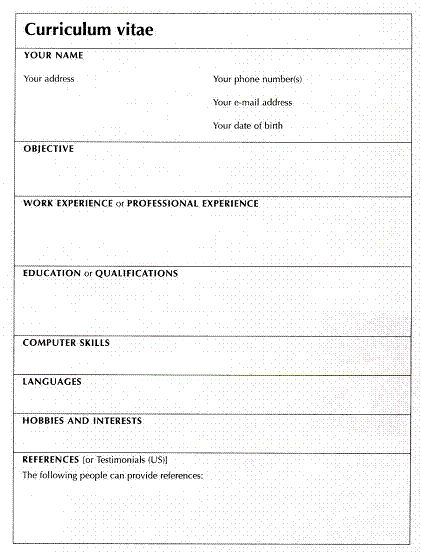
The contents of a CV can be roughly categorized as: 1) PERSONAL INFORMATION (address and telephone number), 2) JOB OBJECTIVE, 3) EDUCATION, 4) EXPERIENCE, 5) SKILLS, 6) EXTRACURRICULAR ACTIVITIES, 7) REFERENCES.
The resume begins with PERSONAL INFORMATION, name, address, telephone number centered at the top page.
After your address, a statement of intent or JOB OBJECTIVE should be written. This objective should be well thought out from the very beginning since it will influence how you will write the rest of the resume. It should not be too general, e. g: ”To obtain a managerial position in a Western company.“
Think about your job search and career goals carefully, write them down in a way that shows you have given this much thought.
For example:”Objective: To obtain a position in telecommunication that will allow me to use my knowledge of engineering and take advantage of my desire to work in sales.“
Notice that your desire to have a well-paid job is not included in this statement. A focus on money in your résumé’s first sentence will not make the best impression anywhere in the world, not just in Russia.
After the statement of intent, describe your EDUCATION.
List the universities, institutes and colleges you have attended in reverse chronological order.
Any studying you have done abroad should be included and courses that you have taken that are relevant.
If you graduated with honors, you should definitely include this. A ”red diploma“ can be called ”graduated with high honors“ in English. Do not include your high school.
Your working EXPERIENCE is the next section. List your experience starting with your most recent place of employment and work backwards.
Spell out the exact dates of employment, your position, and the name of the company you worked for.
Provide information about your responsibilities, emphasizing important activities by listing the most relevant to your objective. Do not use complete sentences! List your responsibilities in short statements that do not include the words ”my“ or ”I“.
Following experience, you should list your special SKILLS.
These include your language skills, computer abilities, and any other talent that relates to your statement of intent.
When describing your language abilities, it is best to be honest about assessing your level, ”Fluent English“, ”native Russian“, ”intermediate German“, and ”beginning French“ are all ways to describe your language abilities.
EXTRACURRICULAR ACTIVITIES should be included in the next section. Student or professional organizations you belong to, travel, sports and hobbies should be listed here.
Do not list ”reading“ or ”writing“ as an activity. It is assumed most people with a higher education do these things regularly.
The last section of your resume is the REFERENCE section. List at least two people, not related to you, who can describe your qualification for the job.
Their names, titles, places of work, and telephone numbers should be included. If you do not have space on your resume for this, write ”Available upon request.” You will then be expected to give this information to a prospective employer if it is requested.
The style and format of a resume are extremely important. Your resume must be typed, preferably on a computer in order to format it most effectively. A neat and well-written resume with no spelling mistakes will give an employer the impression that you are accurate and take care of details.
A resume will not get you a job. An interview with a company will get a job. In order to have the opportunity of interviewing with a company you should send your resume with a cover letter.
Exercise 1
Find in the text the English equivalents of the following words and expressions:
устраиваться на работу; краткая автобиография; дополнительная информация; личные данные; бланк (форма заявления); получить должность; опыт работы; навыки; рекомендации.
Exercise 2
Complete the sentences:
1. In different countries different conventions apply to the process of …
2. CV contains all the unchanging information about you:…
3. An excellent CV may help you …
4. The contents of a CV can be roughly categorized as: …
5. When describing your language abilities, it is best to…
6. In order to have the opportunity of interviewing with a company you should…
Exercise 3
Answer the questions:
1. What information should your CV contain?
2. How long should your CV be?
3. What are the main parts of CV?
Writing
Write a CV.
My Future Profession
Biotechnologists are researchers who use microscopic analysis and laboratory experiments to collect and analyze biological, microbiological, and biochemical data. They examine blood and tissue for signs of disease or viruses, and test the effects of different medicines on bacteria. Biotechnologists have made many discoveries that have led to improved human health. They can also work in forensics laboratories identifying and comparing materials such as blood, body fluids and hair.
The Things They Do:
· Collect samples and conduct biological, microbiological and biochemical tests and laboratory analyses;
· Perform or assist in scientific experiments;
· Set up and maintain laboratory equipment;
· Analyze research information and prepare reports;
Duties may be related to a number of developing specialties in the field of biotechnology, including forensic sciences, genetic engineering and human cell culture.
Working Conditions:
Biotechnologists often work in sterile laboratories within research teams and alongside scientists. A great deal of time is spent working alone, over a microscope and/or working in front of computers. The work requires tremendous attention to detail and intense concentration.
Most Biotechnologists Work In:
· Government agencies;
· Food, chemical and drug manufacturing companies;
· Biotechnology companies;
· Health research facilities and natural resource companies;
· Universities;
· Pharmaceutical companies;
To follow biotechnology as a preferred profession, you must have a sound grounding in science from the early school days. You must have keen interest in various branches of science not just for the sake of study or for obtaining good grades. Rather, you must have a keen perception to understand scientific applications and even keep pace with the latest news from the scientific world.
Important traits for getting into this domain are a high degree of intelligence and a general aptitude for science and scientific applications.
Since biotechnology is redefining the boundaries of science, to become a part of such an innovative field you must posses an inherent attitude of originality and imagination. Other skills that will sail you through a successful and a fulfilling career in this path-breaking area are perseverance, immense patience, analytical proficiency, ability to work for long hours and team spirit.
Biotechnology assimilates in itself a number of disciplines. Further, there is a great demand for biotechnical experts in countless industries and sectors. The following are applications where biotechnological techniques are used extensively:
· Agriculture
· Animal Husbandry
· Environment Conservation
· Genetic Engineering
· Health Care
· Medicine
· Industrial Research and Development
Career opportunities for students in biotechnology abound. Those specializing in different sub-disciplines of this field can easily find jobs in both private and government sector undertakings. If you have acquired a post-graduate degree in biotechnology then you can easily find a suitable position in a number of industries.
Major recruiters include industries engaged in processing and developing agricultural and biological products, bio-processing industries, pharmaceutical and chemical industries. There are ample opportunities in industries producing healthcare products, textile industry, cosmetics and organisations engaged in different types of industrial research and development.
These days a growing number of qualified biotechnical professionals are engaged by different industries for environment protection activities and for the safe disposal of hazardous materials.
Exercise 1
Find in the text the English equivalents of the following words and expressions:
исследователи; собирать и анализировать сведения; собирать образцы; проводить биохимические тесты; проводить научные эксперименты; готовить отчеты; широкие возможности; деятельность по защите окружающей среды.
Exercise 2
Complete the sentences:
1. Biotechnologists are researchers who…
2. Biotechnologists often work in…
3. The work requires…
4. Most biotechnologists work in…
5. To follow biotechnology as a preferred profession, you must…
6. Major recruiters include industries engaged in…
Exercise 3
Answer the questions:
1. Who are biotechnologists?
2. What do they do?
3. What can you tell about working condition of biotechnologists?
4. Where are biotechnological techniques used extensively?
5. What are the career opportunities for students in biotechnology?
Discussion
Do yon agree or not? Comment on the following statements.
1. A good name is better than riches.
2. A little body often harbours a great soul.
3. A word is enough to the wise.
4. All that glitters is not gold.
5. Handsome is as handsome does.
6. He that is full of himself is very empty.
7. You cannot judge a tree by its bark.
Role-play
A Formal Gathering
Setting: A formal gathering in a grand villa on the coast of the Mediterranean Sea.
Situation: The Rich family invites a lot of people to their villa to the engagement of their son and the daughter of the Wealthy family. The guests hardly know each other. They entertain themselves by discussing the appearance and character of the people they see around. The host and the hostess circulate and hear what different people say about each other.
Characters:
Card I—II — Christopher and Christine, the fiancés.
Card III—IV — Mr. and Mrs. Rich, the owners of the villa.
Card V—VI — Mr. and Mrs. Wealthy, Christine’s parents.
Card VII—VIII — Franklin and Frances, newly-weds. Franklin is Christopher’s cousin. He owns a textile factory and is often away from home.
Card IX—X — Patricia and Flotilla — two middle-aged single women. They are Christine’s aunts. They never married because they could not find a good match.
Card XI—XII — Stephen and Stephanie, a married couple. Stephen is a distant relative to the Rich family.
Card XIII—XIV — Clement and Clementine, a married couple. Clement is a distant relative to the Wealthy family.
WRITING
Write an essay on one of the following topics:
1. My self-portrait.
2. What kind of people do you get on with best?
3. Looking through a family album.
Unit 2
Family Life
Family and Relatives
Topical Vocabulary
aunt
brother
cousin
daughter
father
grandchild
granddaughter
grandson
grandfather, grandpapa
grandpa
grandmother, grandmamma
grandma
grandparent (s)
great-grandchild
husband
ex-husband
in-laws
father-in-law
mother-in-law
son-in-law
mother
niece
nephew
parents
sister
son
step-father
step-daughter
step-son
twin
twin-brother
twin-sister
uncle
widow (woman)
widower (man)
wife
ex-wife
тетя; тетка
брат
двоюродный брат, двоюродная сестра
дочь
отец
внук; внучка |
внучка |
внук |
дедушка |
дедушка (ласкательное) |
бабушка |
бабушка (ласкательное) |
дедушка и бабушка |
правнук; правнучка |
муж |
бывший муж |
родители жены/мужа |
свекор, тесть |
свекровь, теща |
зять (муж дочери) |
мать |
племянница |
племянник |
родители |
сестра |
сын |
отчим |
падчерица |
приемный сын |
близнецы |
брат-близнец |
сестра-близнец |
дядя |
вдова |
вдовец |
жена |
бывшая жена |
Consult the dictionary and translate the following words and word combinations:
Family
spouse
child, children
sibling
great-grandfather, great-grandmother; great-grandchild
adopted son, adopted daughter, adopted child
foster family; foster father, foster mother, foster parents; foster son, foster daughter, foster child
Relatives
uncle, aunt; nephew, niece
cousin, first cousin, second cousin
my family, my relatives, my folks, my kin
Relatives by marriage
in-laws; father-in-law, mother-in-law; son-in-law, daughter-in-law
brother-in-law, brothers-in-law, sister-in-law, sisters-in-law
Age groups
child, baby, infant; teenager, adolescent; adult, grownup
young man, young woman; old man, old woman
Marital status and related words
single, married, engaged; separated, divorced; widower, widow
fiance, engagement, engagement ring
bride, bridegroom, wedding, wedding rings, honeymoon
divorce, ex-husband / ex, ex-wife / ex; alimony, child support
girlfriend, boyfriend
lover, paramour, beau, mistress
Other related words
pregnancy, birth
child care, kindergarten, day-care centre, babysitter
illness, sickness, disease
death, funeral, burial, cemetery, grave
Vocabulary Exercises
Exercise 1
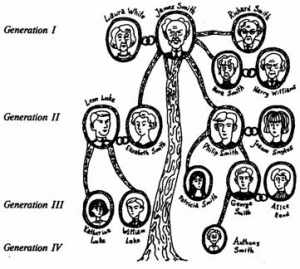
Choose one of the names in the family tree below and say how the person is related to other people. Note that the pictures of marriage partners are connected with wedding rings.
►Pattern: William Luke is Leon Luke’s son, Philip Smith’s nephew and Laura White’s grandson
Exercise 2
Make up your family tree and speak about your family.
Exercise 3
Work in pairs and talk. Imagine that:
a) you are speaking with a distant relative trying to find out what relation you are to one another;
b) you show your family album to your friend and answer all his or her questions.
Family as the key social structure
There are many different views on family life. Some people say they cannot do without the support and love of their families. Many others say it is the source of most of their problems. Yet it is difficult to give the definition of a ”normal“ family.
What exactly is a family? Broadly speaking the family is a group of people related by blood or law, living together and joined by marriage for a common purpose.
Sociologists divide families into two general types: the nuclear family and the extended family. In highly developed industrial countries, especially in their large cities, the nuclear family is regarded as normal. Most people think of it as consisting of two parents and two-children. But even this type is changing; there are a lot of families with one child only, which means that the nuclear family is shrinking year by year.
The variety of family types exiting at present also includes unmarried couples living together, two-person childless families, single-parent homes which are becoming steadily more common.
I believe that everything has beginning in the family. Family is important for every person because it gives you a feeling of having understanding. In happy families parents are honest with their children. At weekends they have breakfast together. They broadly smile and look cheerful. In a friendly family people are gentle, respectful and loving.
At wedding ceremonies couples are sure that they will have and hold each other from this day forward. Marriage is a very responsible mon interests, mutual respect are no less important than love. Children need to know that their parents love them and they also love each other.
I suppose the saying is true that small children create small problems while the big ones bring big problems. The older we grow, the more patient our parents should be with us.
Every generation is different from the previous one. Parent’s judgments on many things are sensible and reasonable, but at the same time I suppose that children have the right to make their own mistakes and to overcome their own hardships.
I want to admit that sociologists think that the family reflects all the processes of modern society and, like any social phenomenon, it keeps changing.
Exercise 1
Find in the text English equivalents of the following words and word combinations:
поддержка; уменьшаться; нуклеарная семья; расширенная семья; неженатые пары; бездетная семья; неполная семья; ответственное решение; общие интересы; свадебная церемония; поколение; преодолевать трудности.
Exercise 2
Complete the sentences:
1. Some people say they can not do without ….
2. The family is a group of people ……
3. Sociologists divide families into two general types: ….
4. The variety of family types existing at present also includes …..
5. Family is important for every person because …
6. At wedding ceremonies couples are sure that ….
7. The older we grow…
8. Sociologists think that the family ….
Exercise 3
Answer the questions:
1. Is it easy to give the definition of a ”normal“ family? Why?
2. What is a family?
3. What are two general types of the family? Can you name any other types of families?
4. Why is family important for every person?
5. Can you describe a happy family?
6. People should think everything over before they get married, shouldn’t they?
7. Is it easy for people of different generations to live together? Why?
8. Will any new types of families appear in the future?
Family: Perspectives
Household and/ or Family?
A household is any single person or group of people who make up the people at a common residence and who share facilities or have a meal a day in that place. They may or may not be a family. They allow a label for when there is no family resident.
It is important to realize that some people live in destitution, without a home, living on the streets and in poverty, moving from shelter to shelter. They often seek an address in order to improve chances of getting work. They may need help from social services and other agencies.
There are four main types of families:
Nuclear family.
This is limited to two generations of a mother, father and child or children. It is what people often imagine a family to be, but it is often not the reality.
Extended family.
This is where generations are added on to the nuclear family. It can be extended horizontally to brothers and sisters or cousins. It can be extended vertically to include a grandparent or more, with three or even four generations.
Lone parent family.
Here there is one parent only and his or her children.
Reconstituted family.
Here we have social parents (raising the children) who may not be the biological parents for all or some of the children. There are a high number of reconstituted families due to separations, divorces and adoptions of children.
What do families do?
Families carry out important roles of providing physical (actual), emotional and economic support.
According to functionalists, the family plays a very important positive role in raising the next generation.
• Families reproduce and raise the next generation. Not only do they carry out this rather obvious point, but they show how to do it. They pass on and display a model of rearing children, through (often) a monogamous sexual relationship and techniques of child rearing. This model is passed on to the next generation and is seen as the way to do child rearing by others in society.
• Families nurture children into the values and norms of society. They transmit the culture of society and how to conform. It is said that family is the essential bedrock of society: if families are in harmony then society will be in harmony. This is called primary socialization because it is a crucial, early and continuing part of socialization for the child.
• Families give emotional and psychological support. They are safe places (when they work properly). One expects comfort, sympathy and support from other family members regarding the stresses of going to school, college and work, and through all the difficulties of ill health and life crises.

|
Из за большого объема этот материал размещен на нескольких страницах:
1 2 3 4 |
