


Партнерка на США и Канаду по недвижимости, выплаты в крипто
- 30% recurring commission
- Выплаты в USDT
- Вывод каждую неделю
- Комиссия до 5 лет за каждого referral
Лицей №8 «Олимпия»
г. Волгоград
Социокультурный компонент в содержании обучения
английскому языку в 10-х классах.
Социокультурный подход к преподаванию иностранного языка предполагает ознакомление учащихся с новой культурой, используя различные источники, а также через язык и его изучение. Обучение страноведческим фоновым знаниям должно быть неотъемлемой частью обучения иностранным языкам ибо, по мнению ученых, оно не менее важно, чем обучение языковым средствам, так как страноведческие знания имеют не только общеобразовательное, но и воспитательное значение. Они имеют также выход в коммуникацию: прежде всего они обеспечивают рецепцию, т. е. адекватное (а не буквальное) понимание обращенной речи.
Таким образом, основной целью уроков по страноведению является развитие у учащихся осознание особенностей иноязычной культуры относительно своей собственной, совершенствование навыков межкультурного общения.
Структура таких уроков следующая:
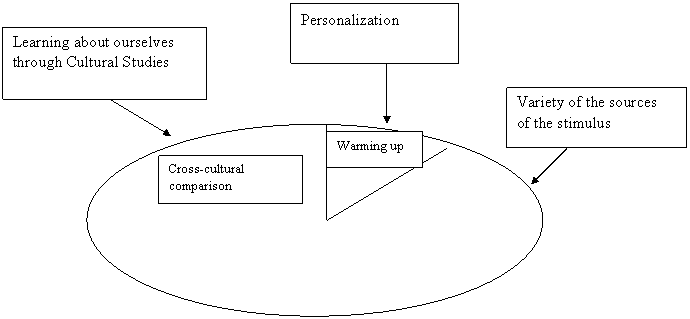
· Речевая зарядка (warming up), назначение которой заинтересовать учащихся и получить их личный отклик на предложенную тему;
· Самостоятельное чтение нетрадиционных текстов о стране изучаемого языка, представленных в виде диаграмм, буклетов, каталогов, карт;
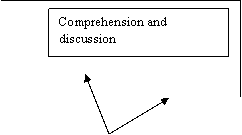
· Проверка понимания и обсуждения полученной информации;
· Кросс-культурное сравнение, использование различных форм его проведения.
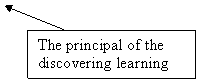
и предлагают следующую схему этапов и принципов обучения на уроках страноведения ( Учебный год 2004, №2 Иностранный язык)
| |
 | |
 | |
|
Воспитание человека культуры, впитавшего в себя богатство культурного наследия прошлого своего народа и народов других стран, способного осуществлять межличностное и межкультурное общение. Исходя из этого, мною выбрана тема урока в логике технологии "Диалога культур".
1.Greeting
Teacher: - How are you? - How are things? - How are you keeping? - How are you getting on? - How are you feeling today? - How are things at school? | Students: - I'm fine, thanks. - Ok, thank you. - Splendid. - The same old way. - Things look pretty good, - Pretty much the same. |
Teacher. I'm glad that everybody is fine and we can start our lesson.
Teacher: The subject of our talk today is FROM RESPECTING CULTURAL TRADITIONS TO UNDERSTANDING YOURSELF. We'll talk about traditions, social behaviour in different countries, compare it with Russian manners. We’ll try to write a factsheet which would be useful for foreign visitors.
Teacher: Have уоu ever been to Thailand? Dо уоu know any information about it? What?
Student 1: I’ve never been to Thailand and I’d like to visit this country because it’s traditions are very unique, I’d like to visit it’s temples.
Student 2: As for me I’ve watched a TV programme about Thailand but I have never been there. I hope to see this wonderful country one day.
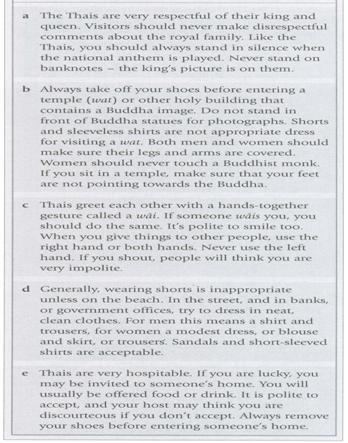
Teacher: Let’s read the factsheet for visitors wanting to know more about the culture of Thailand. Match the headings (1-5) to the paragraphs (а-е).
|
 1 Social attitudes and gestures
 2 Кing and country
 3 Visiting homes
Student 3: It will be interesting to learn about its culture.
|
Thailand
|
Teacher: Does anything surprise уоu about manners and etiquette in Thailand? What?
Student 1: It is interesting to learn about their behaviour in temples and national respect to the royal family.
Student 2: I haven’t heard about hands usage and gesture language of the Thais.
Student 3: So called dress-code seems also interesting.
Teacher: Now let’s have some language practice.
Complete the lists with the correct form of the word from the factsheet. noun adjective opposite respect respectful ___________ politeness polite ___________ appropriateness appropriate ____________ hospitality _________ inhospitable modesty __________ immodest courtesy courteous _____________ acceptability ____________ unacceptable |
Teacher: Work in pairs. Ask and answer these types of questions with information from the factsheet. · 'Is it ОК for women to visit Buddhist temples?' · 'If I meet someone, should I shake hands like we do in Еurоре?' |
Teacher: Now I want you to watch a documentary about the U. S.A. because as Englishmen say "Seeing is Believing". After watching the documentary I'll ask you only one question.
(Video film.).
Teacher: So, students, you've heard from the documentary that the images and myths of America have spread all around the world and become an important part of everyone's life. A point for discussion: Doesn't it seem to you that we are loosing our Russian culture?
Student1: I don't think so. People all over the world eat Big-Mac, drink Coca-Cola, wear jeans, have Swedish table and Japanese "Walkman", watch MTV and use the Internet. Is it so bad? If you don't want to use it, do that. Each person can do his own things and behaves, as he likes. But we must regard that all these things are becoming the way of our *****ssian culture can't be isolated from the world.
Student2: Let's take, for example, soap-operas. Australian soap-opera "Neighbours" is the favourite serial of British young people. Mexican and Brazilian soap-operas are favourite serials of Russian old people. They like them and let it be so. Tastes differ. You may watch another channel and another program.
Student3: People living in varied cultures handle many things differently and I think what a dull world it would be, if it were not true.
Student4:I think it's impossible to have so-called absolute world culture. I think there is only need to learn the traditions and customs of other countries, their way of life. The multifamily of cultures is the base of human civilization. And the more we learn the more we know.
Teacher: And another problem. Do you agree that cultural differences cause world conflicts and where is the way out?
Student1: I suppose we must be tolerant to each other and respect each other. Cultures can't be worse or better, they can be different and we should understand it. The right for culture differences must have the right to exist.
Student2: It seems to me there are no cultural conflicts. We have religious, political, economic conflicts. But no one culture greets violence, genocide and terrorism. So, I think, only political stability and economic progress in all countries will lead to the world without conflicts.
Teacher: Students, you had the task to investigate characteristic phenomena of the American and the Russian life in general. The first group of students will be the Americans and the second one will be the Russians.
Student1: Americans don't enjoy being treated with special respect for age or position, it makes them uncomfortable. They find the terms Mr, Mrs or Miss stiff and formal. Being on first-name terms is taken as a sign of friendless. Americans are more informal than people from many other countries. | Student1: Russians have no terms at all. It isn't adopted in our country when young people address to middle age people only by name. We use a *****ssians are more formal than Americans. |
Teacher: And now let’s work in two groups. What would be useful for visitors to know about social behaviour in Russia? Together write a factsheet and present it to the class.
· Russians have no terms at all. It isn't adopted in our country when young people address to middle age people only by name. We use a *****ssians are more formal than Americans.
· The Russian likes to keep himself to himself. His house has a fence all round to shut him off from his neighbours.
· The Russians used to live in the same house and to be in the same job for 20,30,40 and even more years. They don't like to pull up their roots and change to something new.
· Russian secondary school children have 17 subjects a year. They study six days a week and the duration of their studies is approximately 216 days.
· Russian students must keep to some rules at the lesson such as discipline, holding up a hand before answering. But if they are late for the lesson the teacher allows them to enter the classroom without permission of the school head.
Teacher: I want to finish our lesson with the next idea. All of us are different. We have different history, different cultures, different ways of life. But as Native Americans say "With all things and in all things we are relatives". As we can't return to ignorance, we must go forward to understanding ourselves and the world around us.
