


Партнерка на США и Канаду по недвижимости, выплаты в крипто
- 30% recurring commission
- Выплаты в USDT
- Вывод каждую неделю
- Комиссия до 5 лет за каждого referral
МОУ Детчинская средняя общеобразовательная школа
Урок по английскому языку по теме:

6 класс «Happy *****» К. Кауфман, М. Кауфман.
Учитель II категории:
,
победитель районного конкурса
«Учитель года - 2009»
2008 – 2009 учебный год.
Урок английского языка в 6 классе.
Учитель МОУ Детчинская средняя общеобразовательная школа .
Тема: Выражение глагола «to be» в прошедшем времени.
Цели: 1. Активизировать навыки употребления глагола to be в
простом прошедшем времени
2. Формировать речевые навыки учащихся в ходе использования глагола. “to be” и сопутствующих определений.
3. Воспитывать активность учащихся в решении поисковых задач урока.
4. Развивать языковые способности и устойчивый интерес к изучению иностранного языка.
5. Развивать общеучебные умения; работа с учебником, тетрадями.
Оборудование: раздаточный материал, презентация, картинки.
Ход урока:
I. Организационный момент.
Цель: Организовать учащихся к уроку. Определить цель урока, привлечь учащихся к целеполаганию.
Форма: фронтальная.
T. Good morning boys and girls.
Ps. Good morning teacher.
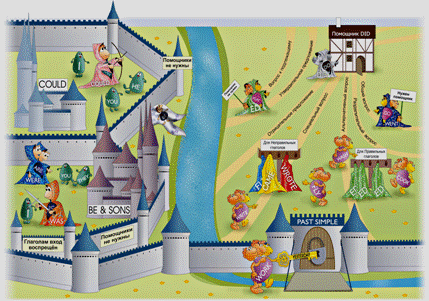
T. Sit down children. I am glad to see you again, I think you remember that my name is Valeria Lvovna; we’ll work at the lesson together and try to get good results. Children, look at the screen. At this lesson we’ll travel to the country DoDidDone. You know there are three counties. Our aim is to get into the county Past city Simple and do every work correctly.
Children, were you in the country DoDidDone?
Were you in the county Past?
Was it interesting there?
Was it big?
Ps. Yes, it was./No, it wasn’t.
T. Can you help me to name the theme of our lesson?
Ps. (ответы детей)
II. Фонетическая зарядка.
Цель: Тренировать произнесение вопросительных предложений с глаголом “to be”
Форма: Фронтальная. (1 мин)
T. Listen to the poem very attentively. Mind the intonation of the speaker. Now look at the screen and read the poem after the speaker. Letэs read the poem without the speaker.
III. Основной этап урока.
Цель: активизировать навыки употребления глагола to be в прошедшем времени.
Форма: индивидуальная.
T. Look at the poem again, answer the question. Are there any words in the poem which will help us to travel over the county Past?
Ps. Yes, they are: were and was.
T. Last lesson you visited the company Be and sons. And you know that be does not work there. Who worked in that company?
Ps. (ответы ребят)
T. Here is the company Be and sons. But I think something is missed here. What is missed here, how do you think.
Ps. I think these are the words it, she, he, they, we, you.
T. Great. А для чего дракошам нужны местоимения, ребята?
Ps. Чтобы строить предложения.
T. А зачем строить предложения?
Ps. Чтобы разговаривать.
T. Или другими словами общаться. Let’s have a short game. I will say a word and you will add the verbs was or were.
he, children, I, they, a pupil, we, Masha, pens, you.
(2 мин)
T. Great children, Oh children, Look Be and sons have a lot of work then they must send a lot of telegrams, but they no time, they ask us to help them. Please do the task and help them.
T. Let’s check up your work. Please … read the sentences. Listen very carefully and be ready, children, to correct the mistakes.
Fill in the gaps. Use was or were.
Last week, I … on the farm. It … so nice! There … a lot of animals there. There … eleven hens, four cows and a wonderful horse. In the morning it … sunny, but a little cold. The forest … wonderful. I … very happy with my new friends.
V. Зарядка (1 мин)
III. Введение новых слов (обстоятельств) соответствующих прошедшему времени.
Цель: предъявить новые слова (опорные) в Past Simple.
Форма: фронтальная, групповая.
T. Hand in your telegrams. But we are not in the county yet. What do we need to open the gates of the county Past? Do we need a password or a key? Work in groups. Turn to each other. Try to find password or a key on this card.
P. The password is yesterday.
T. (показывая ключ) Yes, children it’s the word yesterday, but there are some other words which can help you to open the gates of the Past Simple.
You will work in groups Turn to each other. Take yellow cards, read the sentences and try to find the other passwords of the Past.
Read the sentences and find the passwords of the Past Tense.
1. I was in Rome 3 years ago.
2. We were at the seaside last year.
3. Children were not in the park last week.
4. Sasha was in the zoo two month ago.
5. Their house was built last month.
6. Were you three, six years ago?
(Дети выполняют упражнение в группах, затем представитель каждой группы выходит к доске и выписывает слова) (5 мин)
T. Are you ready? Then let one of each group go to the blackboard and write the answers on the board. Is everything correct? What are the passwords? (What are the general words?)
Ps. (ответы детей)
T. You are right. Let’s read them. (слайд)
VI. Первичное закрепление.
Цель: развивать навыки употребления обстоятельств времени.
Форма: групповая, самостоятельная.
T. Open your books at page 147. We will do ex.1. The task is (). The first variant will fill in the left hand column and the second variant will do the right hand column. Sign your papers. (2 мин)
T. Ребята, а как вы думаете для чего нужны слова пароли?
Ps. (ответы ребят) Чтобы различать Past and Present Simple.
T. Good for you. А для чего мы отправились путешествовать по стране DoDidDone и графству Past.
Ps. (ответы ребят). Если надо, наводящие вопросы. Итог общаться.
T. Good for you. You are quite right. And if we want to communicate with different people, we must know how to ask and answer questions.
You will work in groups again. Some of you will get the envelopes with jigsaw questions and answers. The other will work in the books on page 150. You will use the model from ex. 7 and try to make short dialogues. You must be ready to tell your dialogues by heart.
Puzzle
T. Then children find the envelopes on your desks. There is jigsaw picture. You should put together the parts of the picture. Are you ready? Then turn over the picture upside down. Do you see the sentences? Study the sentences and try to find the negative, interrogative forms of the verb to be in the Past Simple.
Were you at home yesterday? No, I wasn’t.
Were you in the museum? No, I wasn’t.
Were you in the country? No, I wasn’t.
Where were you yesterday? I was in the swimming pool. (3 min)
T. And there is one more task the dragons have for us. They want to test you. After it you’ll become good friends.
VII. Первичный контроль.
Цель: проконтролировать приобретённые навыки в употреблении глагола “to be”.
Форма: индивидуальная.
Test.
I. Fill in was or were.
1. You _______ busy last year.
2. His birthday _______ last month.
3. It ______ cold yesterday.
4. ______ his sisters in the country a year ago.
II. Fill in the words last, ago, yesterday.
1. He was in London __________ week.
2. Misha and Robin were in Russia a year ________.
3. It was Monday ____________.
4. We were not in class four 2 years _______.
III. Circle the correct translation.
1. The stone of Destiny was in Westminster Abbey many years ago.
a. Камень судьбы находится в Вестминстерском Аббатстве, по сей день.
b. Камень судьбы будет находится в Вестминстерском Аббатстве в следующем году.
c. Камень судьбы находился в Вестминстерском Аббатстве много лет назад.
VIII. Домашняя работа.
Цель: закрепить первичные навыки дома.
Форма: индивидуальная.
T. As you have one exercise to do at home then I’ll give you another one. You will do ex. B p 1мин.)
VII. Подведение итогов.
Цель: Оценить свою деятельность.
1. T. Children, let’s revise what we have done at the lesson. What did you like?
What didn’t you like? What was difficult to you?
Ps. (answers.) (1 мин.)
2. T. You have marks in your exercise books.
Stand up children. Thank you for your attention and answers. I hope you’ll get good results in the future. The lesson is over. Good bye.
(1 мин.)
