


Партнерка на США и Канаду по недвижимости, выплаты в крипто
- 30% recurring commission
- Выплаты в USDT
- Вывод каждую неделю
- Комиссия до 5 лет за каждого referral
МЕТОДИЧЕСКИЕ РЕКОМЕНДАЦИИ УРОКА
Творческие проекты на тему: « Welcome to Pyatigorsk», учитель МОУ СОШ № 27 города Пятигорска и « Лермонтовский Пятигорск», учитель той же школы (№ 000), являются прекрасным пособием, помогающим учителю иностранного языка Ставропольского края реализовать требование о включении в программу 10% материала, связанного с региональным компонентом. Кроме того, он может быть использован в рамках тем «Город. Городская жизнь», «Место, где мы живем» и «Знаменитые люди России». Использовать материал можно как готовый урок, а также возможно его фрагментарное использование. Ресурсы могут быть использованы в любом, с 5 по 9, классе, работающих по любому УМК любых авторов.
Цель уроков: создать условия для стимулирования лингвистической активности школьников, расширения их социокультурной компетенции.
Образовательные задачи проекта состоят в совершенствовании умений и навыков практического владения английским языком по всем видам речевой деятельности: аудированию, говорению, чтению и письму. На занятиях идет формирование активного грамматического навыка употребления в речи настоящего совершенного и простого прошедшего времен в форме активного залога.
Развивающие задачи: развитие внимания, памяти, логического мышления, языковой догадки.
Воспитательные задачи: воспитание потребности к творчеству, умения работать в парах, группах; повышение мотивации к изучению предмета иностранный язык.
Следует отметить, что материал проекта может быть представлен как на уроке обучения чтению, так и на уроке обучения аудированию, если убрать текст слайдов. Использование презентации будет целесообразно и в этом случае.
Текст для аудирования.
Some facts about Pyatigorsk
First of all Pyatigorsk is a large town in the North Caucasus. It is situated in Stavropol region. Besides Pyatigorsk is the centre of the Caucasian Mineral Waters.
Pyatigorsk is a spa. It is famous for its mineral springs and mud treatment. You may cure some illnesses here Thousands of people come here every year to restore their health. There are more than 40 mineral quells and 20 sanatoria in Pyatigorsk. They will help you to be healthy.
Pyatigorsk is a historical town. Many outstanding people including Pushkin, Yaroshenko and Shalyapin lived and created here. There are a lot of historical places, monuments and museums in this town. There you can visit our famous Lake ‘Proval’ and read about its history.
It is a well-known fact that Pyatigorsk is a cradle of Lermontov’s poetry. Shattered by Pushkin’s death in 1837, Lermontov wrote a poem “On the Death of the Poet”. For composing “impermissible” verse, the poet was transferred from his Hussar Regiment in St. Petersburg to active service in the Caucasus. This was the poet’s first exile. Some places of interest are closely connected with the memory of a great Russian poet. They are: his cottage, his grotto, the park “Flower Garden “, the place of Lermontov’s duel, Lermontov’s gallery and Lermontov’s monument.
The museum Lermontov’s cottage is situated in Lermontov Street. Actually the museum occupies not only this cottage but some houses nearby. The cottage is rather small. It has only 4 rooms: 2 of them were occupied by M. Lermontov; in 2 others lived his friend. There are some things which really belonged to M. Lermontov. But many of them were collected in the cottage to show the atmosphere of life in the North Caucasus in the 19th century.
Many tourists come to see the museum every year. The guide tells about the life of M. Lermontov in Pyatigorsk and about the museum itself outside the cottage and then visitors have a chance to see the rooms, the furniture, the books and the pictures – everything that are connected with M. Lermontov and which make the cottage so dear to Russian people. Usually the small groups of 10-12 persons go inside. They can see real Lermontov’s desk and his arm chair and, of course, his famous iron bed. He used it during his traveling. The people working in the museum keep all the exhibits with love and care.
Pyatigorsk is a modern town. It is not very old. It was founded 228 years ago. It was founded in 1780. It is situated at the foot of the mount Mashuk. This mount is beautiful in all seasons. It’s one of a kind.
Pyatigorsk is not only a spa; it’s a cultural centre too. They have a lot of educational institutions, many technical and secondary schools, libraries, museums and a theatre of musical comedy.
Some people think that Pyatigorsk is a cozy town. It is a nice place to live and to have a rest in. And it is becoming more beautiful with each coming year. It is very picturesque. It has a lot of interesting places. If you are interested in hiking you may spend your time walking round Mashuk and enjoy beautiful sights.
Контроль понимания услышанного.
I. Make the right choice.
1. Pyatigorsk was founded..... a) 262 years ago ; b) 622 years ago ; c) 228 years ago. 2. It is famous for... a) the mountains ; b) its mineral springs ; c) the animals and birds. 3. Pyatigorsk is..... a) a place of Pushkin’s death ; b) a corner of Nekrasov’s creation ; c) a cradle of Lermontov’s poetry. 4. It is a nice place... a) to sing and dance ; b) to live and to have a rest in ; c) to swim and play. 5. Thousands of people come here every year... a) to restore their health ; b) to take pictures ; c) to meet with friends. | 6. It is situated at the … of the mount Mashuk a) top, b) head, c) foot. 7. There you can visit our famous …‘Proval’ a) square, b) lake, c) place. 8. The poet was transferred from his Hussar Regiment in St. Petersburg to … in the Caucasus. a) war, b) active service, c) rest. 9. Actually the museum occupies not only this cottage but … a) some houses behind it, b) the yard nearby, c) some houses nearby. 10. The visitors can see real Lermontov’s … a) iron bed, b)armchair, c) sofa. |
II. True or false?
III. Answer the questions.
Why is Pyatigorsk a cultural centre of Stavropol region? Why is Pyatigorsk a spa? Why do the small groups of 10-12 persons go inside Lermontov’s museum?Более того, презентации могут быть использованы на занятии, направленном на формирование активного грамматического навыка употребления в речи настоящего совершенного и простого прошедшего времен в форме активного залога.
Если использовать данный творческий проект как региональную информацию для развития навыков устной речи, то работу лучше проводить в течение 2-3 уроков.
На пример, после завершения темы «Город. Городская жизнь» в 6 классе я провожу цикл уроков, посвященных Лермонтову и Пятигорску.
Первый урок - заочное путешествие по Пятигорску. В рамках данного урока используется компьютерная презентация, выполненная в программе Microsoft PowerPoint. Поэтому необходимо наличие в кабинете компьютера и мультипроектора. Данная презентация создает зрелищность и необходимый эмоциональный настрой, выступает как средство зрительной наглядности так необходимой для учащихся – визуалов.
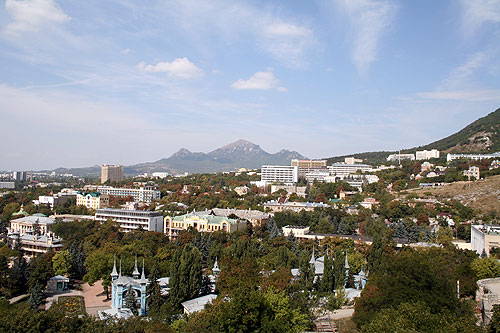
После проведения оргмомента я показывают ученикам слайд № 1 и обращаюсь к ним: “Dear friends, let's try to guess what we’ll do at the lesson. I've found a nice presentation for you. What do you think we shall do?”
Учащиеся высказывают свои предположения. Например:
P1: We’ll speak about Pyatigorsk.
P2: We’ll describe pictures of Pyatigorsk.
P3: We’ll read about Pyatigorsk.
Teacher: Right you are, we’ll make a trip to Pyatigorsk and during this trip we’ll speak about Pyatigorsk, read some information about this beautiful town and then describe some places of interest there. And we are going to speak on this topic today as much as possible. Try to memorize the new words and to learn some facts from the history of this town.
Let’s begin with this picture. Do you know the sight?
P.1: it’s the symbol of Pyatigorsk.
Teacher: I agree with you. But it’s also the symbol of this region.
You can see the eagles in all the town here.
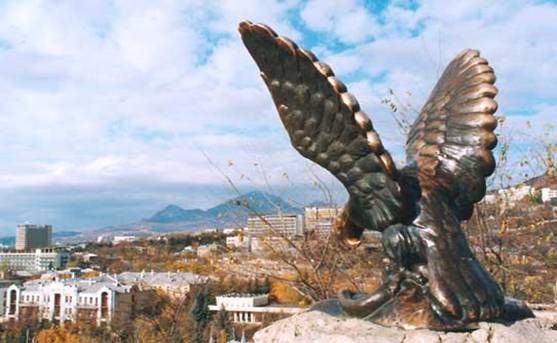
Учащиеся просматривают слайды № 2-8 и читают текст вслух, что способствует лучшему пониманию материала учащимися – аудиалами. Затем учитель проверяет первичное понимание прочитанного и услышанного (слайд № 9).
Teacher: Was it interesting? Did you learn smth. new? Let’s check your memory. Do the test on your papers. Now in pairs change the papers and check each other.
(Ответы: 1.с)
2.b)
3.c)
4.b)
5.a)
Затем учащиеся по очереди читают вопросы теста и отвечают на них.
Teacher: Who has no mistakes? Raise your hands. Excellent!
Who has 1 mistake? Well done!
Who has 2 mistakes? Not bad.
Проводится работа по развитию навыков речи на основе прочитанного и услышанного для чего используется слад № 10.
Teacher: Let’s try to remember what kind of town Pyatigorsk is. You may work in pairs while filling in the chat.
Далее учащиеся обсуждают заполненную схему и приводят аргументы в подтверждение каждого тезиса. (Слайд № 11)
Например:
P.1: Pyatigorsk is a spa because there are many mineral quells and sanatoria there. They help people to be healthy.
P.2 Pyatigorsk is a historical town. There are a lot of historical places, monuments and museums in this town.
P.3 it’s a cultural centre too. There are a lot of educational institutions, many technical and secondary schools, libraries, museums and a theatre of musical comedy.
После такого фронтального повторения всех фактов, организуется работа в группах по 3 человека.
Teacher: Now we’ll work in groups of three. One of you is a guest from the USA who wants to take treatment in Pyatigorsk or in Essentuky. He naturally asks a lot of questions. The others try to convince him to choose Pyatigorsk, so they tell the guest from the USA everything they know.
Use your Social English while speaking.
В роли гостя выступают наиболее подготовленные учащиеся, которые умеют задавать вопросы и смогут направить дискуссию. Фактически учащееся еще раз проговаривают весь материал.
На пример:
P.1:Hallo. Can you help me?
P.2:Yes?
P.1: I want to take treatment in your region. Where should I go?
P.3: To Pyatigorsk, of course.
P.1: Why are you so sure?
P.2: Because it is a good place to rest.
P.3: There are many sanatoria there. They can cure many illnesses.
P.1: Are there any springs there?
P.3: Both mineral quells and mud bath.
P.2: They are very helpful.
P.1: And what about cultural live? Can I visit any museums?
P.2: Certainly. Go to Lermontov’s cottage and to the place of his duel.
P.3: You may go to the musical theatre too.
P.1: How nice. I like theatre very much.
P.2: So Pyatigorsk is the best place for you.
P.1 Thank you. You are so kind.
P.2: We were happy to help you.
В конце урока проводится рефлексия.
Teacher: Dear friends! Our lesson is almost over. What did you think about it?
P.1: It was very great because we used computer.
P.2: It was interesting because we traveled about Pyatigorsk.
P.3: It was cool.
Teacher: What do you feel about your work?
P.1: I guess my work was not very good
.P.2: I think I worked not bad.
P.3: I suppose it was good enough because now I can tell a foreigner about Pyatigorsk
Teacher: Thank you. You were very active, attentive and bright, I enjoyed your work at the lesson today. I put you ''good'' and ''excellent'' marks. Good-bye.
На дом учащиеся получают задание написать письмо другу по переписке из Англии и пригласить его посетить Пятигорск.
Следующий урок начинается с речевой зарядки, основанной на слайде № 11 и карте района Кавказских Минеральных Вод.
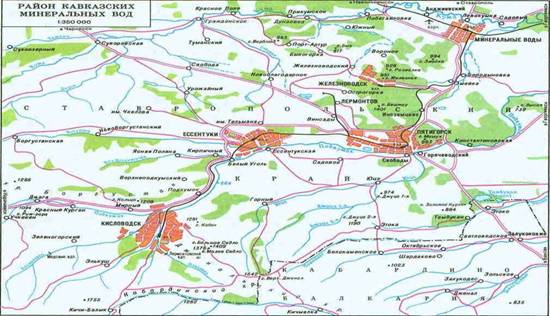
Например:
Teacher: Where is Pyatigorsk situated?
P.1: It is situated in the North Caucasus.
P.2: It is in the south of Russia.
P.3: It is in Stavropol region.
Teacher: What other towns are there in this region?
P.4: There are 5 towns there: Kislovodsk, Essentuky, Zheleznovodsk and Min. Vody.
Teacher: What kind of town is Pyatigorsk?
Затем идет знакомство с достопримечательностями города (Слайды № 12-18).
Закрепление проводится с помощью слайдов № 19-25.
Teacher: Do you remember the sights? What is it?
P.1: I’m sure it’s the duel of Lermontov.
P.2: I’m afraid you are wrong. It is the Lermontov’s duel.
P.3: Both P.1 and P.2 made a mistake. It is the place of Lermontov’s duel.
Для более эффективного запоминания достопримечательностей и их названий я организую парную работу с каждым слайдом, параллельно тренируя школьников в употреблении структур Past Simple и Present Perfect. Упражнения были разработаны на основе упражнений из УМК “English V”, авторы , .
Teacher: Now let’s work in pairs. You are sure to visit Pyatigorsk sometime. Find out if your classmate has seen these places and when he/she did it.
Пары с низким уровнем обучаемости получают напечатанный образец диалога.
P.1: Have you ever been to Pyatigorsk, I wonder?
P.2: Certainly.
P.1: Have you seen /been to the place of Lermontov’s duel?
P.2: Yes, of course.
P.1: When did you see it last?
P.2: I was there last year.
Пары с высоким уровнем обучаемости беседуют по каждому слайду в расширенном варианте.
Варианты дополнительных вопросов:
Who did you go there with?
How many times did you visit Pyatigorsk?
Did you go there by car or by bus?
Did you take pictures there?
What did you like most of all in Pyatigorsk?
Did you like the town?
Would you like to see it once more?
На дом учащиеся получают задание подготовить рассказ о Пятигорске.
Третий урок начинается с фонетической зарядки, основанной на лексики из презентации:
Lermontov’s grotto Lermontov’s monument Lermontov’s cottage Lermontov’s gallery the place of Lermontov’s duel | the park “ Flower Garden” the North Caucasus. the Caucasian Mineral Waters. mineral springs mud treatment. |
Далее используется творческий проект на тему: « Лермонтовский Пятигорск», учитель МОУ СОШ № 27 города Пятигорска (№ 000), знакомящий учащихся с работой их сверстников из Пятигорска над созданием книги:
« Лермонтовский Пятигорск», работа идет во фронтальном режиме.
После того как весь материал прочитан, я организую работу по развитию навыков аудирования на базе слайда № 6.
Teacher: The museum is situated in Lermontov Street. You can see that both the yard and the cottage are rather small. It has only 4 rooms: 2 of them were occupied by
M. Lermontov, in 2 others lived his friend. There are some things which really belonged to
M. Lermontov. But many of them were collected in the cottage to show the atmosphere of life in the North Caucasus in the 19th century.
Many tourists come to see the museum every year because M. Lermontov is a famous and very popular poet in our country. The guide tells about the life of M. Lermontov in Pyatigorsk and about the museum itself outside the cottage and then visitors have a chance to see the rooms, the furniture, the books and the pictures – everything that are connected with M. Lermontov and which make the cottage so dear to Russian people. Usually the small groups of 10-12 persons go inside.
On this slide you can see real Lermontov’s desk and his armchair and, of course, his famous iron bed. He used it during his traveling. And on slide 8 we see a page from Lermontov’s notebook.
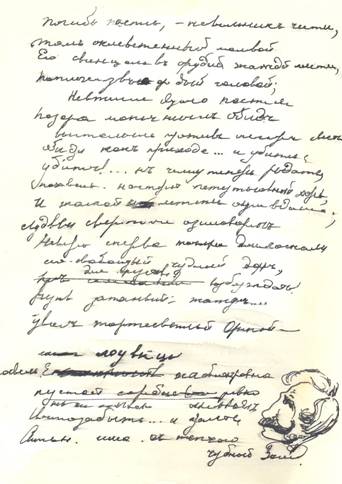
The museum has a long history. It started in 1912 with a small collection. Now it occupies not only the cottage but some houses nearby. The people working in the museum keep all the exhibits with love and care. They do a lot of work there. During the war they tried to save all the documents and exhibits and the cottage itself, because Pyatigorsk was occupied by fascists.
Контроль понимания провожу по вопросам:
Where is the museum? How many rooms are there in the cottage? Why are the groups of tourists very small? Are all the things in the museum real? What really Lermontov’s things can the visitors see? Is the history of the museum long? When did it begin?После этого приступаем к работе над биографией .
Teacher: Let’s try to remember what you know about M. Lermontov. We’ll work in the groups of three. These questions are sure to be helpful for you.
Questions:
1. When was M. Lermontov born?
2. Where was M. Lermontov born?
3. What do you know about his father/ mother/ other relatives?
4. Where did he spend his childhood?
5. Where did he study?
6. When did he begin to write poems?
7. What poems by M. Lermontov do you know?
8. What other works did M. Lermontov write?
9. What did he do in Pyatigorsk?
10. When was his duel?
11. Who was his enemy?
12. When did M. Lermontov die?
13. Where was he buried?
14. Do you like his poems?
Работа над вопросами логически подводит учащихся к домашнему заданию
« Написать сочинение о М. Лермонтове».
