Партнерка на США и Канаду по недвижимости, выплаты в крипто
- 30% recurring commission
- Выплаты в USDT
- Вывод каждую неделю
- Комиссия до 5 лет за каждого referral
Презентации как метод повышения эффективности обучения иностранным языкам
Составлено и подготовлено
Введение
В современных условиях, когда ситуация на рынке труда весьма сложна, требования к молодым специалистам все возрастают, наши выпускники должны обладать конкурентными преимуществами и задача преподавателя – помочь им. В этой связи возникает необходимость включать такие приемы работы, которые приносили бы практическую пользу, повышали уровень знаний и квалификацию студентов, позволяли интенсивно использовать учебное время.
Мы часто считаем, что интенсивные методы преподавания иностранного языка означают увеличение контактных часов, работу студентов под непосредственным наблюдением и руководством преподавателя. Однако, программа, учебный план и психофизические факторы восприятия и усвоения нового материала ставят определенные рамки и ограничения. К тому же, большое количество контактных часов не гарантирует лучшее качество знаний и навыков. В этой связи акцент переносится на самостоятельную работу студентов, их самоподготовку. Однако, как известно, все люди склонны лениться и студенты - не исключение. Следовательно, работа должна быть организована таким образом, чтобы заставить студентов трудиться с полной отдачей. Достигнуть этого можно путем разработки конкретных требований (requirements), создания стимулирующей среды (challenge) и выражения доверия (trust) студентам. Это значит, что мы не просто формулируем четкое задание, но показываем, что мы уверены в способности студентов справиться с этой сложной задачей, что они не брошены с ней один на один и всегда могут рассчитывать на помощь преподавателя. Кроме того, в процессе обучения мы обычно идем от частного к общему, а в реальной жизни чаще возникает обратная задача – проанализировать общую ситуацию, используя многочисленные источники, и сформулировать четкое, узкое, сфокусированное решение.
Презентации
Работа студентов над индивидуальными и групповыми презентациями по изученным темам позволяет решить множество вышеупомянутых задач:
- исключить из процесса обучения монотонность
- сформировать и отработать тематический словарный запас
- изучить основные проблемы, связанные с изучаемой темой
- изучить стилистику материалов, свойственную изучаемой теме
Мало того, крупные компании при проведении собеседований о приеме на работу нередко требуют от кандидатов подготовить групповую презентацию на основе предложенной информации. То есть наш выпускник должен не только проанализировать материал, и структурировано презентовать его, но сделать это в сотрудничестве с незнакомыми конкурентами на должность.
Таким образом, обучая студентов проводить презентации, мы решаем не абстрактные общеобразовательные задачи, а выполняем конкретный заказ работодателей и студентов как заказчиков наших образовательных услуг.
Подготовка и проведение
Работа строится следующим образом. Студенты делятся на группы по 4-5 человек по выбору преподавателя. Тем самым симулируется реальная жизненная ситуация, когда на работе нам приходится иметь дело с теми коллегами, которые назначены на этот участок работы, а не с теми, кого, может быть, предпочли бы мы. В одной команде оказываются студенты с разным уровнем языка, разными характерами. Кто-то имеет качества лидера, другой склонность к анализу, третий – прирожденный оратор.
Команда выбирает интересный с их точки зрения материал, связанный с темой, подход к нему и формулирует соответствующий тезис, т. е. основную идею своей презентации. Тезис выражается одним предложением, содержащим формулировку проблемы и пути решения ее.
В процессе поиска и анализа информации студенты развивают навыки поискового чтения и структурированного письма. Они учатся формулировать тезис и находить его подтверждение, иллюстрации к нему. Составляется подробный план презентации. При этом очень важно обеспечить равное участие всех членов команды, выявить и использовать лучшие качества, умения и навыки каждого для получения лучшего результата для всех. Готовится раздаточный материал. Обычно студенты относятся к презентациям очень творчески, они учатся правильно оценивать свои способности и способности своих товарищей и использовать их на благо общего дела. Презентация должна быть ограничена по времени, о чем студенты знают заранее. Обычно, групповая презентация занимает 12-15 минут, а индивидуальная – 5-7. Эти ограничения учат студентов вычленять главное, отбрасывать маловажное, структурировано организовывать свои мысли.
Индивидуальная презентация является как бы репетицией большого группового проекта. План и тезис презентации разрабатывается каждым студентом отдельно. После индивидуальной презентации все студенты группы дают свои комментарии о том, как, прошла презентация, как был организован материал, насколько убедительно был доказан тезис. Оценивается и то, как выступающий выглядел, как держался, удалось ли ему поддерживать контакт с аудиторией или он суетился, стоял к залу спиной, нервно крутил ручкой или шуршал бумажками.
После групповой презентации преподаватель (или специальная комиссия), а также студенты-участники других команд аргументировано оценивают соответствие теме, доказательность тезиса, равномерность вклада в презентацию всех членов команды, уровень языка, обращают внимание на ошибки. Особо поощряется интерактивность презентации – вовлечение в обсуждение темы слушателей.
Проблема, возникающая в ходе работы над презентациями, связана с тем, что команда получает общий балл и студенты, внесшие больший вклад в подготовку, могут быть не удовлетворены, так как на результат влияет и менее качественная работа их товарищей.
Ниже предлагается подробное описание всех этапов работы, тех аспектов, на которые необходимо обратить внимание при подготовке презентации, а так же форма ее оценки, заполняемая слушателями. Затем читатели могут познакомиться с некоторыми методиками поиска и организации информации, которая далее будет представлена в виде письменного проекта или презентации.
Part 1. Business Presentations & Public Speaking in English
A presentation is a formal talk to one or more people that "presents" ideas or information in a clear, structured way. People are sometimes afraid of speaking in public, but if you follow a few simple rules, giving a presentation is actually very easy. This paper guides you through each stage of giving a presentation in English, from the initial preparation to the conclusion and questions and answers. This paper is itself set out like a mini-presentation. You can follow it logically by starting at the Introduction and then moving on from stage to stage.
Introduction Preparation Equipment Delivery Language The Presentation ReviewIntroduction
All presentations have a common objective. People give presentations because they want to communicate in order to:
- inform train persuade sell
A successful presentation is one of the most effective ways of communicating your message. And because English is so widely used in international business, a working knowledge of the vocabulary and techniques used in an English language presentation is a valuable asset.
We will start by exploring the importance of preparation. After that, we will consider what equipment to use. Then we will look at how to "deliver" a presentation. After delivery, we will examine the language of presentations, before moving on to the presentation itself. Finally, we will conclude with a review of what we have covered.
Preparation
Can you name the 3 most important things when giving any presentation?
Number 1 is. . . Preparation
Number 2 is. . . Preparation!
Number 3 is. . . Preparation!!
With good preparation and planning you will be totally confident and less nervous. And your audience will feel your confidence. Your audience, too, will be confident. They will be confident in you. And this will give you control. Control of your audience and of your presentation. With control, you will be 'in charge' and your audience will listen positively to your message.
Objective
Before you start to prepare a presentation, you should ask yourself: "Why am I making this presentation?" Do you need to inform, to persuade, to train or to sell? Your objective should be clear in your mind. If it is not clear in your mind, it cannot possibly be clear to your audience.
Audience
"Who am I making this presentation to?" Sometimes this will be obvious, but not always. You should try to inform yourself. How many people? Who are they? Business people? Professional people? Political people? Experts or non-experts? Will it be a small, intimate group of 4 colleagues or a large gathering of 400 competitors? How much do they know already and what will they expect from you?
Venue
"Where am I making this presentation?" In a small hotel meeting-room or a large conference hall? What facilities and equipment are available? What are the seating arrangements?
Time and length
"When am I making this presentation and how long will it be?" Will it be 5 minutes or 1 hour? Just before lunch, when your audience will be hungry, or just after lunch, when your audience will be sleepy?
Method
How should I make this presentation?" What approach should you use? Formal or informal? Lots of visual aids or only a few? Will you include some anecdotes and humour for variety?
Content
"What should I say?" Now you must decide exactly what you want to say. First, you should brainstorm your ideas. You will no doubt discover many ideas that you want to include in your presentation. But you must be selective. You should include only information that is relevant to your audience and your objective. You should exclude all other ideas. You also need to create a title for your presentation (if you have not already been given a title). The title will help you to focus on the subject. And you will prepare your visual aids, if you have decided to use them. But remember, in general, less is better than more (a little is better than a lot). You can always give additional information during the questions after the presentation.
You can find additional information on getting ideas and organizing your presentations in the special paragraph in the end of this paper.
Structure
A well organised presentation with a clear structure is easier for the audience to follow. It is therefore more effective. You should organise the points you wish to make in a logical order. Most presentations are organised in three parts, followed by questions:
Beginning | Short introduction |
|
Middle | Body of presentation |
|
End | Short conclusion |
|
Questions and Answers |
Notes
When you give your presentation, you should be - or appear to be - as spontaneous as possible. You should not read your presentation! You should be so familiar with your subject and with the information that you want to deliver that you do not need to read a text. Reading a text is boring! Reading a text will make your audience go to sleep! So if you don't have a text to read, how can you remember to say everything you need to say? With notes. You can create your own system of notes. Some people make notes on small, A6 cards. Some people write down just the title of each section of their talk. Some people write down keywords to remind them. The notes will give you confidence, but because you will have prepared your presentation fully, you may not even need them!
Rehearsal
Rehearsal is a vital part of preparation. You should leave time to practise your presentation two or three times. This will have the following benefits:
- you will become more familiar with what you want to say you will identify weaknesses in your presentation you will be able to practise difficult pronunciations you will be able to check the time that your presentation takes and make any necessary modifications
So prepare, prepare, prepare! Prepare everything: words, visual aids, timing, equipment. Rehearse your presentation several times and time it. Is it the right length? Are you completely familiar with all your illustrations? Are they in the right order? Do you know who the audience is? How many people? How will you answer difficult questions? Do you know the room? Are you confident about the equipment? When you have answered all these questions, you will be a confident, enthusiastic presenter ready to communicate the subject of your presentation to an eager audience.
Equipment
Easily your most important piece of equipment is...YOU! Make sure you're in full working order, and check your personal presentation carefully - if you don't, your audience will! |
|

| The overhead projector (OHP) displays overhead transparencies (OHTs or OHPTs). It has several advantages over the 35mm slide projector:
|
|


|
|
 The whiteboard (more rarely blackboard or greenboard) is a useful device for spontaneous writing - as in brainstorming, for example. For prepared material, the OHP might be more suitable.
 The duster is used for cleaning the whiteboard. It is essential that the duster be clean to start with. You may consider carrying your own duster just in case.
|
 Markers are used for writing on the whiteboard (delible - you can remove the ink) or flipchart (indelible - you cannot remove the ink). They are usually available in blue, red, black and green. Again, it's a good idea to carry a spare set of markers in case you are given some used ones which do not write well.
| The flipchart consists of several leaves of paper that you 'flip' or turn over. Some people prefer the flipchart to the whiteboard, but its use is limited to smaller presentations. |

|

 The Slide projector - which must be used in a darkened room - adds a certain drama. Some slide projectors can be synchronised with audio for audio-visual (AV) presentations. These projectors are typically used for larger presentations. The majority take 35mm slides or transparencies (as seen here), but projectors for 6x6cm slides are also available.
| Transparencies are projected by an overhead projector or a slide projector onto a screen - in this case a folding screen which can be packed up and transported. |

|
|
 The notebook computer is increasingly being used to display graphics during presentations. It is often used in conjunction with an overhead projector, which actually projects the image from the computer screen onto the wall screen.
 Handouts are any documents or samples that you 'hand out' or distribute to your audience. Note that it is not usually a good idea to distribute handouts before your presentation. The audience will read the handouts instead of listening to you.
Delivery
'Delivery' refers to the way in which you actually deliver or perform or give your presentation. Delivery is a vital aspect of all presentations. Delivery is at least as important as content, especially in a multi-cultural context.
Nerves
Most speakers are a little nervous at the beginning of a presentation. So it is normal if you are nervous. The answer is to pay special attention to the beginning of your presentation. First impressions count. This is the time when you establish a rapport with your audience. During this time, try to speak slowly and calmly. You should perhaps learn your introduction by heart. After a few moments, you will relax and gain confidence.
Audience Rapport
You need to build a warm and friendly relationship with your audience. Enthusiasm is contagious. If you are enthusiastic your audience will be enthusiastic too. And be careful to establish eye contact with each member of your audience. Each person should feel that you are speaking directly to him or her. This means that you must look at each person in turn - in as natural a way as possible. This will also give you the opportunity to detect signs of boredom, disinterest or even disagreement, allowing you to modify your presentation as appropriate.
Body Language
What you do not say is at least as important as what you do say. Your body is speaking to your audience even before you open your mouth. Your clothes, your walk, your glasses, your haircut, your expression - it is from these that your audience forms its first impression as you enter the room. Generally speaking, it is better to stand rather than sit when making a presentation. Be aware of and avoid any repetitive and irritating gestures. Be aware, too, that the movement of your body is one of your methods of control. When you move to or from the whiteboard, for example, you can move fast or slowly, raising or reducing the dynamism within the audience. You can stand very still while talking or you can stroll from side to side. What effect do you think these two different approaches would have on an audience?
Cultural Considerations
Because English is so widely used around the world, it is quite possible that many members of your audience will not be native English-speakers. In other words, they will not have an Anglo-Saxon culture. Even within the Anglo-Saxon world, there are many differences in culture. If we hypothetically imagine a German working for an Israeli company making a presentation in English to a Japanese audience in Korea, we can see that there are even more possibilities for cultural misunderstanding. You should try to learn about any particular cultural matters that may affect your audience. This is one reason why preparation for your presentation is so important. Cultural differences can also be seen in body language, which we have just discussed. To a Latin from Southern France or Italy, a presenter who uses his hands and arms when speaking may seem dynamic and friendly. To an Englishman, the same presenter may seem unsure of his words and lacking in self-confidence.
Voice quality
It is, of course, important that your audience be able to hear you clearly throughout your presentation. Remember that if you turn away from your audience, for example towards the whiteboard, you need to speak a little more loudly. In general, you should try to vary your voice. Your voice will then be more interesting for your audience. You can vary your voice in at least three ways:
- speed: you can speak at normal speed, you can speak faster, you can speak more slowly - and you can stop completely! You can pause. This is a very good technique for gaining your audience's attention. intonation: you can change the pitch of your voice. You can speak in a high tone. You can speak in a low tone. volume: you can speak at normal volume, you can speak loudly and you can speak quietly. Lowering your voice and speaking quietly can again attract your audience's interest.
The important point is not to speak in the same, flat, monotonous voice throughout your presentation - this is the voice that hypnotists use to put their patients into trance!
Visual aids
Of all the information that enters our brains, the vast majority of it enters through the eyes. 80% of what your audience learn during your presentation is learned visually (what they see) and only 20% is learned aurally (what they hear). The significance of this is obvious:
- visual aids are an extremely effective means of communication non-native English speakers need not worry so much about spoken English - they can rely more heavily on visual aids
It is well worth spending time in the creation of good visual aids. But it is equally important not to overload your audience's brains. Keep the information on each visual aid to a minimum - and give your audience time to look at and absorb this information. Remember, your audience have never seen these visual aids before. They need time to study and to understand them. Without understanding there is no communication.
Apart from photographs and drawings, some of the most useful visual aids are charts and graphs, like the 3-dimensional ones shown here:

Piecharts are circular in shape (like a pie).
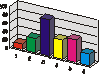
Barcharts can be vertical (as here) or horizontal.
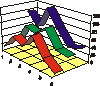
Graphs can rise and fall.
Audience Reaction
Remain calm and polite if you receive difficult or even hostile questions during your presentation. If you receive particularly awkward questions, you might suggest that the questioners ask their questions after your presentation.
Language
Simplicity and Clarity
If you want your audience to understand your message, your language must be simple and clear.
Use short words and short sentences.
Do not use jargon, unless you are certain that your audience understands it.
In general, talk about concrete facts rather than abstract ideas.
Use active verbs instead of passive verbs. Active verbs are much easier to understand. They are much more powerful. Consider these two sentences, which say the same thing:
Toyota sold two million cars last year. Two million cars were sold by Toyota last year.Which is easier to understand? Which is more immediate? Which is more powerful? N°1 is active and N°2 is passive.
Signposting
When you drive on the roads, you know where you are on those roads. Each road has a name or number. Each town has a name. And each house has a number. If you are at house N° 100, you can go back to N° 50 or forward to N° 150. You can look at the signposts for directions. And you can look at your atlas for the structure of the roads in detail. In other words, it is easy to navigate the roads. You cannot get lost. But when you give a presentation, how can your audience know where they are? How can they know the structure of your presentation? How can they know what is coming next? They know because you tell them. Because you put up signposts for them, at the beginning and all along the route. This technique is called 'signposting' (or 'signalling').
During your introduction, you should tell your audience what the structure of your presentation will be. You might say something like this:
"I'll start by describing the current position in Europe. Then I'll move on to some of the achievements we've made in Asia. After that I'll consider the opportunities we see for further expansion in Africa. Lastly, I'll quickly recap before concluding with some recommendations."
A member of the audience can now visualize your presentation like this:
Introduction |
|
Body |
|
Conclusion |
|
He will keep this image in his head during the presentation. He may even write it down. And throughout your presentation, you will put up signposts telling him which point you have reached and where you are going now. When you finish Europe and want to start Asia, you might say:
"That's all I have to say about Europe. Let's turn now to Asia."
When you have finished Africa and want to sum up, you might say:
"Well, we've looked at the three continents Europe, Asia and Africa. I'd like to sum up now."
And when you finish summing up and want to give your recommendations, you might say:
"What does all this mean for us? Well, firstly I recommend..."
The table below lists useful expressions that you can use to signpost the various parts of your presentation.
Signposting | |
Function | Language |
Introducing the subject |
|
Finishing one subject... |
|
...and starting another |
|
Analysing a point and giving recommendations |
|
Giving an example |
|
Dealing with questions |
|
Summarising and concluding |
|
Ordering |
|
The Presentation
Most presentations are divided into 3 main parts (+ questions):
1 | INTRODUCTION | Questions |
2 | BODY | |
3 | CONCLUSION | |
Questions |
As a general rule in communication, repetition is valuable. In presentations, there is a golden rule about repetition:
Say what you are going to say, say it, then say what you have just said.In other words, use the three parts of your presentation to reinforce your message. In the introduction, you tell your audience what your message is going to be. In the body, you tell your audience your real message. In the conclusion, you summarize what your message was.
We will now consider each of these parts in more detail.
Introduction
The introduction is a very important - perhaps the most important - part of your presentation. This is the first impression that your audience have of you. You should concentrate on getting your introduction right. You should use the introduction to:
welcome your audience introduce your subject outline the structure of your presentation give instructions about questionsThe following table shows examples of language for each of these functions. You may need to modify the language as appropriate.
Function | Possible language |
1 Welcoming your audience |
|
2 Introducing your subject |
|
3 Outlining your structure |
|
4 Giving instructions about questions |
|
Body
The body is the 'real' presentation. If the introduction was well prepared and delivered, you will now be 'in control'. You will be relaxed and confident.
The body should be well structured, divided up logically, with plenty of carefully spaced visuals.
Remember these key points while delivering the body of your presentation:
- do not hurry be enthusiastic give time on visuals maintain eye contact modulate your voice look friendly keep to your structure use your notes signpost throughout remain polite when dealing with difficult questions
Conclusion
Use the conclusion to:
Sum up (Give recommendations if appropriate) Thank your audience Invite questionsThe following table shows examples of language for each of these functions. You may need to modify the language as appropriate.
Function | Possible language |
1 Summing up |
|
2 Giving recommendations |
|
3 Thanking your audience |
|
4 Inviting questions |
|
Questions
Questions are a good opportunity for you to interact with your audience. It may be helpful for you to try to predict what questions will be asked so that you can prepare your response in advance. You may wish to accept questions at any time during your presentation, or to keep a time for questions after your presentation. Normally, it's your decision, and you should make it clear during the introduction. Be polite with all questioners, even if they ask difficult questions. They are showing interest in what you have to say and they deserve attention. Sometimes you can reformulate a question. Or answer the question with another question. Or even ask for comment from the rest of the audience.
Review
In this paper, you have learned:
- to allow plenty of time for preparation to ask the all-important question-words, why? who? where? when? how? and what? to structure your presentation into introduction, body, conclusion and questions to write notes based on keywords to rehearse your presentation several times and modify it as necessary to select the right equipment for the job to use equipment effectively to make use of clear, powerful visual aids that do not overload your audience to use clear, simple language, avoiding jargon to use active verbs and concrete facts to explain the structure of your presentation at the beginning so that your listeners know what to expect to link each section of your presentation to signpost your presentation from beginning to end so that your listeners know where they are to say what you are going to say, say it, and say what you have just said to overcome your nerves to establish audience rapport to be aware of your body language to understand cultural differences to control the quality of your voice to maintain interest by varying the speed, volume and pitch of your voice to deal with listeners' questions politely to respond to your audience positively
PRESENTATION OBSERVATION FEEDBACK FORM | |||
surname | first name | group | date |
title/topic | |||
PREPARATION | DELIVERY | ||
Planning: objective · inform · train · persuade · sell audience content structure/organisation rehearsal | Language: simplicity clarity signalling voice quality · articulation · intonation · stress · phrasing | ||
Body language: eye contact pose hands feet | |||
Visual aids: whiteboard other | |||
Audience rapport: enthusiasm awareness questions | |||
POINTS OF VOCABULARY | POINTS OF GRAMMAR | ||
comment | signed | ||