

Партнерка на США и Канаду по недвижимости, выплаты в крипто
- 30% recurring commission
- Выплаты в USDT
- Вывод каждую неделю
- Комиссия до 5 лет за каждого referral
Chemical Physics, 2003, V. 289, N. 2-3, P. 359 – 369
SPECTROSCOPY AND KINETICS OF DITHIOPHOSPHINATE RADICALS COORDINATED WITH DITHIOPHOSPHINATE Ni(II) COMPLEX
D. Yu. Vorobyev, V. F. Plyusnin*, Yu. V. Ivanov and V. P. Grivin
Institute of Chemical Kinetics and Combustion, 630090 Novosibirsk, Russia
S. V. Larionov
Institute of Inorganic Chemistry, 630090 Novosibirsk, Russia
H. Lemmetyinen
Institute of Materials Chemistry, Tampere University of Technology, P. O. Box 589, 33101 Tampere, Finland
Abstract
The laser flash photolysis was used to study the mechanism of photochromic transformations for solutions of phosphinate disulfide ((S2P(i-Bu)2)2 º (S2PR2)2) and Ni(S2P(i-Bu)2)2 (Ni(S2PR2)2) complex in acetonitrile. Under the excitation of an XeCl excimer laser (308 nm), this system manifests transient absorption in the visible and UV ranges which vanishes over a millisecond time domain. The cycle of phototransformations can be repeated without degradation of the optical spectrum of the solution. The process is initiated by photodissociation of a disulfide molecule into two S-radicals (·S2P(i-Bu)2 º ·S2PR2). The radical with a constant of 2.5´109 M-1s-1 enters the coordination sphere of Ni(S2PR2)2 complex to form the radical complex (R2PS2·)Ni(S2PR2)2. When analyzing the kinetics of changes in the optical density of transient absorption, it is assumed that coordination of the second radical with a constant of 1.5´1010 M-1s-1 results in the formation of the secondary or biradical complex (R2PS2·)2Ni(S2PR2)2. The radical complexes dissociate with a radical escaping from the coordination sphere with rate constants equal to 7.5´103 s-1 and 7´102 s-1 for mono - and biradical particles, respectively. As a result, the system regains its initial state due to recombination of ·S2PR2 radicals into initial disulfide.
1. Introduction
The photochromism of many organic and inorganic systems has long been known [1,2]. Photochromic materials are the focus of attention because of the problems of the development of the system of reversible optical recording of information, the accumulation of light energy, etc. Therefore, the discovery of novel photochromic systems and the study of the mechanism of photochemical and dark transformations are of great interest. It is known that many flat coordination compounds reversibly add extraligands. This effect can be used to create new photochromic systems. The appearance of a particle – extraligand should be related to photochemical reactions. In this case, disulfides with the - S-S - bond that has low energy and can dissociate under light quanta in the nearest UV region, are convenient objects of study. Dissociation of disulfides gives nonactive sulfur-centered radicals (S-radicals). Therefore, it is hoped that photochromic systems involving these radicals can undergo a great number of phototransformation cycles.
The flat 1,1'-dithiolate Ni(II) complexes are of interest as traps for S-radicals, because they reversibly coordinate some organic molecules such as pyridine [3-9]. Thus, the S-radicals were assumed to fit reversibly and with a high rate constant in the coordination sphere of a nickel ion. The high rate constant is necessary for successful competition with the reaction of S-radical recombination. Indeed, we have established [10,11] that solutions of thiuramdisulfide (tds) (tds º R2NC(S)S-S(S)CNR2, where R are the alkyl groups) and the flat dithiocarbamate complex of bivalent nickel (Ni(dtc)2) (ligand dtc– º –S2CNR2) exhibit photochromic properties and withstand a great number of transformation cycles. As follows from laser flash photolysis, in the first stage of these transformations, the excited thiuramdisulfide molecule dissociates into two dithiocarbamate radicals (dtc· º ·S2CNR2). These radicals coordinate with Ni(dtc)2 with a rate constant close to the diffusion one to form the radical complex (dtc·)Ni(dtc)2 that dissociates for about 10 ms "releasing" the dtc· radical. Radical recoordination increases the effective lifetime of radical complex by two-three orders of magnitude so that its absorption vanishes over second time domains.
This paper studies the photochromic transformations of phosphinate disulfide (S2P(i-Bu)2)2 and the flat Ni(S2P(i-Bu)2)2 complex. Disulfide was chosen because of the well-known optical spectrum of the ·S2P(i-Bu)2 radical [12]. The type of the chosen complex depends on spectral peculiarities and geometry, i. e., the flat coordination unit consisting of four sulfur atoms with a central ion of divalent nickel.
2. Experimental
The laser flash photolysis of solutions was performed on a setup with an XeCl excimer laser (308 nm, 15 ns, 30 mJ, beam area 10 mm2) described in detail in [13]. The exciting and probing light beams fell onto the cuvette (usual thickness of 1 cm, however, to change the concentrations in wide range we used the cuvettes with a thickness of 0.1 and 0.01 cm) at a small angle (~2o). Studying slow processes within a millisecond time domain, we used special quartz microcuvettes with a volume of 10-20 mm3 (area 10 mm2, thickness 1-2 mm) which allowed us to illuminate the entire cuvette volume with a laser beam and eliminated the influence of convective flow in the cuvette on the kinetics studied. To exclude a substantial influence of probing light in these cases, we used nonactive light sources, i. e., halogen incandescent lamps whose radiation was passed through narrow-band interference filters. In some experiments, we used a similar set-up for laser flash photolysis [14] with perpendicular exciting and probing light beams. The photomultiplier signal was recorded on a digital oscillograph Tektronix 7912AD connected to an IBM computer.
The optical absorption spectra were recorded on spectrophotometers Shimadzu UV-2501 and HP 8453. Solutions were prepared from the spectrally pure solvents. The laser pulse intensity was measured by the value of the optical density of anthracene triplet-triplet absorption in an oxygen-free benzene solution at 431 nm (quantum yield of the triplet state being 0.53 and the absorption coefficient of T-T absorption band being 42000 M-1cm-1 [15]). In the numerical calculations of the kinetics of intermediate optical absorption appearance and decay, the differential equations were solved using a specially developed programme based on the 4th-order Runge-Kutta method. The synthesis of the Ni(S2P(i-Bu)2)2 complex is described in [16]. The synthesis of disulfide (S2P(i-Bu)2)2 was performed according to method presented in [17].
3. Results and Discussion
3.1. Reaction of ·S2PR2 radical coordination with Ni(S2PR2)2 complex. The spectra and kinetic characteristics of the resulting (R2PS2·)Ni(S2PR2)2 radical complex
Figure 1 shows the optical spectrum of (S2PR2)2 disulfide in acetonitrile. The remote UV region exhibits absorption bands with maxima at 210 and 238 nm (e = 10770 and 13250 M-1cm-1, respectively). The shoulder at 290 nm has an absorption coefficient of 3800 M-1cm-1. At the radiation wavelength (308 nm) the absorption coefficient is 1980 M-1cm-1.
The long stationary irradiation of (S2PR2)2 solution in acetonitrile with the pulses of the XeCl laser (308 nm) fails to cause any changes in the optical spectrum. However, using laser flash photolysis one can record intermediate absorption vanishing within a microsecond time domain. Under the radiation of organic disulfides in the UV range, the break of the S-S bond (~100 kJ/mol) is the primary photochemical process resulting in two radicals [18-21]. The laser pulse in (S2PR2)2 solution in acetonitrile is followed by absorption belonging to the ·S2PR2 radical in the form of a band with a maximum at 616 nm and an absorption coefficient of 2580 M-1cm-1 [12]. The radicals vanish upon recombination with the rate constant 2krec = 7.6´109 M-1s-1 [12].
The coordination NiS4 unit for the complexes with sulfur-containing ligands (dithiocarbamates, xanthogenates, dithiophosphates and dithiophosphonates) is flat with a Ni-S distance of about 2.2 A [22-26]. The optical spectrum of Ni(S2P(i-Bu)2)2 complex is characterized by strong absorption bands in the UV range (Fig. 1). For this complex there is the band of charge transfer with a maximum at 334 nm (e = 21080 M-1cm-1), a shoulder at 390 nm (e = 1790 M-1cm-1). In the remote UV region there is a strong absorption band with a maximum at 230 nm (e = 14050 M-1cm-1). In the visible spectrum region the weaker d-d bands are located with maxima at 552 and 730 nm (e = 107 and 84 M-1cm-1, respectively). The assignment of the absorption bands of dithiolate Ni(II) complexes is given in Refs [27-29].
Under stationary irradiation, a solution of Ni(S2PR2)2 complex in acetonitrile fails to display any photochemical activity. No transient absorption was recorded in pulsed experiments. Laser pulse in disulfide-complex solutions is followed by absorption of an intricate kinetic character (Fig. 2). Immediately after laser pulse the absorption band with a maximum at 616 nm belonging to the ·S2PR2 radical is appearing. Thereafter, a change in the optical spectrum of intermediate absorption is observed over three time domains. In the first region, an increase in the optical density in the range 400-500 nm is recorded within 0-10 ms. In the region of the ·S2PR2 radical absorption band (550-650 nm) the optical density decreases over the same time domain. In the second region of a duration of 50-200 ms a further decrease in the optical density is observed almost over the entire spectral range. Intermediate absorption disappears completely in the third region within 1-100 ms.
Figure 3 shows a change in the intermediate absorption spectrum in the first stage of kinetic changes. The radical absorption band with a blurred isosbestic point is observed to transform into a new band with a maximum at 440 nm. The transformation rate increases with increasing concentration of Ni(S2PR2)2 complex. The ability of flat dithiolate Ni(II) complexes to reversibly add extraligands allows the assumption that a new band belongs to the (R2PS2·)Ni(S2PR2)2 radical complex. Thus, transformation occurring in the first stage is of the form
(S2PR2)2 ¾- hn ® ·S2PR2 + ·S2PR2 (1)
·S2PR2 + Ni(S2PR2)2 ¾¾¾® (R2PS2·)Ni(S2PR
·S2PR2 + ·S2PR2 ¾¾¾® (S2PR
Because of two ways of disappearance for the ·S2PR2 radical in the first time range the isosbestic point shifts (Figure 3). The possibility of electron transfer from complex to radical must be excluded. If it were the radical would convert into the –S2PR2 ion rapidly and solution would lose its ability to participate in cyclic photochromic transformations.
Knowing the value of the absorption coefficient of (R2PS2·)Ni(S2PR2)2 absorption band at 440 nm (eRNi440), we can determine the rate constant of S-radical coordination. A competition between radical recombination and coordination prevents us from determining eRNi440 value from the ratio between optical band densities at 616 and 440 nm. Increasing Ni(S2PR2)2 concentration to suppress recombination is limited by an increase in complex absorption and a decrease in the intermediate absorption of both the radical and radical complex.
To determine eRNi440 we use the fact that at short times after the laser pulse, only the reactions of recombination and coordination of the R2PS2· radicals are possible and the recombination contribution decreases with decreasing the initial radical concentration. The ratio between the initial derivatives of a change in optical density for the kinetic curves at 616 and 440 nm is of the form
F(R0) = (dD616/dt)0/(dD440/dt)0 = (eRNi616Z – eR616)/(eRNi440Z - eR440), (4)
where Z = 1/(1+aR0), a = b/C0, b = 2k3/k2, R0 and C0 are the initial concentrations of the radical and Ni(S2PR2)2 complex, eR616, eRNi616, eR440, and eRNi440 are the absorption coefficients of the radical and radical complex at 616 and 440 nm. As the laser pulse intensity and the initial radical concentration R0 decrease, function Z ® 1 and the ratio between the derivatives
F(R0 ® 0) ® (eRNi616 - eR616)/(eRNi440 - eR44
Figure 4a shows the F(R0) dependence on R0 at different concentrations of Ni(S2PR2)2 complex (C0). Derivatives were calculated over the time domain from 0 to 1-2 ms. Function F(R0) is almost linear at small R0 values (0< aR0 <1) which allows to use the linear approximation of experimental points to estimate the parameters. The eR616 = 2580 M-1cm-1 and eR440 = 190 M-1cm-1 values were determined in [12]. The closeness of F(R0) to zero in Fig.4a with R0 ® 0 indicates that eRNi616 » eR616. Thus, the truncation and the initial slope of F(R0) dependence give two equations for three unknowns – eRNi616, eRNi440 and b. The additional equations can be derived by determining the ratio eRNi616/eRNi440. We estimate the value eRNi440 from the ratio eRNi616/eRNi440 which can be extracted from the ratio between the optical densities at 616 and 440 nm at low initial concentrations of the radical (R0 < 2´10-6 M) and at time ~50 ms (t) when radical coordination and recombination are almost over. The analysis in terms of reactions (2), (3) and the expansion into Taylor’s series of the time dependencies of the radical and radical complex concentrations testify this ratio to be
G(C0) = (DD616(t))/(DD440(t)) » (eRNi616/eRNi440)´[1 + (eR616/eRNi616)/k2tC0 + ….]. (6)
Figure 4b shows that the G(C0) depends linearly within good accuracy on the (1/C0) value with truncation (eRNi616/eRNi440) = 0.29 ± 0.01. Thus, the data in Fig.4a and Fig.4b on the absorption coefficient of the (R2PS2·)Ni(S2PR2)2 absorption band at 440 nm give the value eRNi440 = (8900 ± 600) M-1cm-1.
The rate constant of the coordination of ·S2PR2 radical with Ni(S2PR2)2 complex can be determined using the method for estimating of absorption coefficient. The initial derivative of a change in optical density for the kinetic curves at 440 nm is of the form (eRNi440 >> eR440)
(dD440/dt)0 = eRNi440´k2´[C0]´[R0]. (7)
Figure 5 shows the (dD440/dt)0 dependence on the [R0] value at the different concentrations of the Ni(S2PR2)2 complex. A linear dependence is observed to be well satisfied. The slopes provide the value of the coordination rate constant k2 = (2.5 ± 0.2) ´109 M-1s-1.
3.2. Processes of intermediate absorption disappearance
We have considered the processes of (R2PS2·)Ni(S2PR2)2 complex formation. Since a disulfide-complex solution is a photochromic system going back to its initial state after the laser pulse, the simplest way to describe transient absorption disappearance is suggestion of reversibility for radical coordination
(R2PS2·)Ni(S2PR2)2 ¾¾¾® ·S2PR2 + Ni(S2PR
For the tds + Ni(dtc)2 system both the appearance and disappearance of intermediate absorption can be well described in the framework of the reactions similar to reactions (2), (3) and (8) [10]. However, for the (S2PR2)2 + Ni(S2PR2)2 system, these reactions only are not sufficient to describe the kinetic curves of intermediate absorption with three regions differing in the rates over ranges 0-50 ms, 50-200 ms and 1-100 ms (Fig. 2). The existence of the second region (50-200 ms) can be attributed to the formation of a third absorbing transient (third after the ·S2PR2 radical and (R2PS2·)Ni(S2PR2)2 radical complex). The rate of the second region of kinetic curves increases substantially with increasing of the initial concentrations of the radical and radical complex (we changed the laser intensity or the cell thickness from 1 to 0.01 cm with the corresponding increase of the concentrations). Similarly to the first stage (coordination of first radical in reaction (2)), it is assumed that in the second stage the coordination of the second radical occurs

 ·S2PR2 + (R2PS2·)Ni(S2PR2)2 (R2PS2·)2Ni(S2PR
This assumption is in fair agreement with the ability of Ni(II) chelate complexes to add reversibly two heterocyclic molecules. For example, the Ni(Et-xan)2 complex adds two pyridine molecules (py) to form the Ni(Et-xan)2py2 adduct [4]. For the Ni(Et-dtp)2 (Et-dtp º S2P(OEt)2) complex, the dissociation rate constant of the second pyridine molecule is high. So the Ni(Et-dtp)2py complex is formed mainly and the Ni(Et-dtp)2py2 complex arises only at high pyridine concentrations [3,4].
3.3. Kinetic and optical parameters of (R2PS2·)2Ni(S2PR2)2 biradical complex.
A decrease in the optical density in the second stage (50-200 ms) testifies that the secondary radical complex (R2PS2·)2Ni(S2PR2)2 has a lower absorption coefficient at 440 nm than the (R2PS2·)Ni(S2PR2)2 radical complex. Obviously, the formation of this complex starts in the first stage (0-50 ms) following the accumulation of some amount of the primary (R2PS2·)Ni(S2PR2)2 complex with a fairly high free radical concentration. Figure 6 shows the experimental kinetic curve in the range 0-50 ms together with calculations of the kinetics of absorption appearance at 440 nm in terms of reactions (2) and (3). It is seen that for the parameters k2 and eRNi440 found by extrapolating the spectral and kinetic data to zero signals, the calculated curve fitted to the experimental one in the initial region, passes much higher to 50 ms. Thus, with already 50 ms, the formation of the secondary (R2PS2·)2Ni(S2PR2)2 complex noticeably decreases the optical density of intermediate absorption due to its smaller absorption coefficient. Figure 6 shows also calculations involving the reactions of (R2PS2·)2Ni(S2PR2)2 formation. In this case, we can well describe the experimental kinetic curves (the parameters used are listed in captions to Fig. 6 and Tables 1 and 2). Besides, Fig. 6 shows a change in the concentrations of intermediates with time.
Table 1
Absorption coefficients at 440 nm of intermediates for (R2PS2)2 + Ni(S2PR2)2 system in acetonitrile
Ni(S2PR2)2 | R2PS2· | (R2PS2·)Ni(S2PR2)2 | (R2PS2·)2Ni(S2PR2)2 |
90 | 300 ± 20 | 8900 ± 600 | 3600 ± 300 |
Table 2
Reaction rate constants of intermediates for (R2PS2)2 + Ni(S2PR2)2 system in acetonitrile
k2´10-9, M-1s-1 | 2k3´10-9, M-1s-1 | k8´10-3, s-1 | k9´10-10, M-1s-1 | k-9´10-2, s-1 | k10´10-7, M-1s-1 |
2.5 ± 0.2 | 7.6 ± 0.3 | 7.5 ± 1.0 | 1.5 ± 0.4 | 7 ± 2 | 1.0 ± 0.2 |
Forcing the experimental and calculated kinetics of a change in optical density at different wavelengths to fit the kinetic parameters determined for 440 nm, we estimate the absorption coefficients and optical spectra of both radical complexes (Figure 7). Radical complexes display wide absorption bands with maxima in the range 430-450 nm and a stronger absorption in the UV region.
Calculation in the range 0-800 ms shows a fair agreement with the experimental kinetic curves in the second stage (50-200 ms). However, at the end of this time range and at the beginning of the third one a noticeable divergence appears. Note that in the third stage (0.4-50 ms), the kinetics of intermediate absorption disappearance is rather well described by a second-order law. The observed constant (kobs) increases linearly in this case with increasing optical absorption density. Since within this time domain the main absorbing particle is the secondary radical complex (R2PS2·)2Ni(S2PR2)2, it vanishes upon bimolecular reaction. Taking into account the photochromic properties of the system, the following reaction is assumed
(R2PS2·)2Ni(S2PR2)2 + (R2PS2·)2Ni(S2PR2)2 ¾¾¾® 2(R2PS2·)Ni(S2PR2)2 + (R2PS
In reaction (10), the two radicals from the coordination spheres of different complexes recombine by the noncoordinated free sulfur atoms. The resulting disulfide escapes from the coordination spheres of nickel ions. The estimated value of the absorption coefficient of (R2PS2·)2Ni(S2PR2)2 allows us to determine the rate constant k10 = (1.0 ± 0.2)´107 M-1s-1 from the dependence of kobs in the third stage.
Thus, the ultimate kinetics (0-50 ms) of a change in intermediate absorption was calculated (solid lines in Fig.2) using information about 12 parameters (six rate constants, four absorption coefficients and two initial concentrations). The recombination rate constant (2k3) and the absorption coefficient of radical absorption band were determined independently from the flash photolysis of disulfide solution [12]. The initial radical concentration is determined by the optical density at 616 nm just after the laser pulse. The k2 and eRNi440 values were measured by extrapolating kinetic data to zero signals and times. Although five parameters were varied in numerical calculations of kinetics (rate constants k8, k9, k-9, k10 and the absorption coefficient of the biradical complex), they can be determined unambiguously due to the wide time domain of experimental kinetic curves (Fig.2). The kinetic curves contain information on the time of absorption formation in the first kinetic region, the amplitude of this signal, the amplitude and characteristic time of absorption decrease in the second stage and the characteristic time of the third region.
In the previous study [10], no kinetic and spectral manifestations of the formation of a biradical complex have been recorded for the tds + Ni(dtc)2 system. The possible reason is the low rate constant of biradical complex formation. According to calculations, with k9 £ 1´109 M-1s-1 (the other parameters being the same as in Tables 1 and 2) the maximum amount of the biradical complex over the entire time domain will not exceed 2-3% of the monoradical one. A decrease in the k9 value can be related to a strong disturbance of the flat structure of NiS4 coordination node in the (dtc·)Ni(dtc)2 radical complex as compared with the (R2PS2·)Ni(S2PR2)2 one. This will hampers the second radical coordination.
Recording the ESR spectra of (dtc·)Ni(dtc)2 monoradical complexes upon the freezing of irradiated cooled methanol solutions [11] confirms the absence of biradical complex for the tds + Ni(dtc)2 system. Biradical complexes caused by exchange interaction are usually diamagnetic compounds. Thus, for instance, the Ni(II) complexes with two radicals (1,2-hydroxylaminooxime derivatives) in the coordination sphere resulting from oxidative dehydration are diamagnetic [30]. Irradiating the cooled solutions ((S2P(i-Bu)2)2 + Ni(S2P(i-Bu)2)2 in methanol fails to lead to the formation of ESR spectra upon freezing because of the accumulation of the diamagnetic biradical complex (R2PS2·)2Ni(S2PR2)2.
3.4. Thermodynamics of the processes of radical complexes formation
Measurements of absorption kinetics over a wide temperature range (245 – 350 K) and a comparison with calculated kinetic curves allowed us to determine the rate constants of the formation and disappearance of the radical complex (R2PS2·)Ni(S2PR2)2. Figure 8 shows the temperature dependences of the rate constants for these processes. Activation energies are presented in Table 3. The equilibrium constant for the reaction
 R2PS2· + Ni(S2PR2)2 (R2PS2·)Ni(S2PR
obeys the equation
 (12)
(12)
where DG, DH, and DS are the free energy, ethalpy, and enthropy of radical complex formation. On the other hand, we get
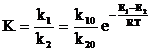 (13)
(13)
where k1 and k2 are the rate constants of the direct and inverse reactions, k10 and k20 are the preexponential factors. As follows from the above relations, a decrease in enthalpy DH during radical coordination (actually, the binding energy Ni–·S2PR2) is equal to the difference in activation energies and according to the data in Table 3, for the (R2PS2·)Ni(S2PR2)2 radical complex, it is about 14.6 kJ´mol-1. For a more stable and longliving (7 ms) dithiocarbamate (dtc·)Ni(dtc)2 radical complex DH = 29.3 kJ´mol-1 [10]. The (RS·)NiL2 radical complexes (RS· is a perfluorothionaphthyl radical and NiL2 are the dithiolate complexes of bivalent nickel) have a lower energy for the Ni–·SR bond (DH=3.7 – 10.2 kJ´mol-1) and a shorter lifetime (7 – 60 ms) [31]. It is worth noting that the energies of Ni–S bonds in dithiolate complexes are about 200 kJ´mol-1 [32], i. e., the radicals are weakly bonded to the nickel ion and the radical complexes dissociate rather rapidly.
Table 3
The thermodynamic parameters of (R2PS2·)Ni(S2PR2)2 and (R2PS2·)2Ni(S2PR2)2 radical complexes in acetonitrile
Radical complex | DEact, kJ´mol-1 | DH, kJ´mol-1 | DS, J´K-1mol-1 | |
Formation | Decay | |||
(R2PS2·)Ni(S2PR2)2 | 5.5 ± 0.7 | 20.1 ± 1.9 | 14.6 ± 2.6 | 58.6 ± 8.4 |
(R2PS2·)2Ni(S2PR2)2 | 17.0 ± 2.1 | 50.7 ± 6.0 | 33.7 ± 8.1 | 14.4 ± 28.2 |
In the processes of formation and decay of the radical complexes, usually k10 > k20 [10, 31], that corresponds to an increase in enthropy upon radical coordination. On the formation of the (R2PS2·)Ni(S2PR2)2 complex, DS = 58.6 J´K-1mol-1. For other above complexes, this value varies from 20 to 100 J´K-1mol-1 [10,31]. One of the reasons for an increase in enthropy can be a decrease in the total rigidity of complex structure due to spin density delocalization from radical to other ligands and the weakening of Ni–S bonds.
Comparing the calculated and experimental kinetics for different temperatures showed the temperature dependence of the rate constants of the formation and dissociation of the (R2PS2·)2Ni(S2PR2) biradical complex (Fig.8). Determining the activation energies of second radical coordination and dissociation (Table 3), we estimate a decrease in enthalpy upon (R2PS2·)2Ni(S2PR2) formation to be 33.7 kJ´mol-1. Thus, the energy of Ni–·S2PR2 bond increases during second radical coordination, that decreases the dissociation rate constant by order of magnitude.
Conclusions
The photochromic processes have been considered for solutions containing phosphinate disulfide ((S2P(i-Bu)2)2 and Ni(S2P(i-Bu)2)2 complex. The laser flash photolysis was used to demonstrate that phototransformations are initiated by photodissociation of disulfide giving rise to the ·S2PR2 radical that coordinates, at a high rate and reversibly, with a flat Ni(S2PR2)2 complex to form the primary radical complex (R2PS2·)Ni(S2PR2)2. The radical lifetime in the coordination sphere of this particle is about 130 ms. However, the observed lifetime of (R2PS2·)Ni(S2PR2)2 can amount to tens of milliseconds due to the repeated coordination of the radical. When there is a certain amount of (R2PS2·)Ni(S2PR2)2 in the solution, the secondary biradical complex (R2PS2·)2Ni(S2PR2)2 forms due to coordination of the second radical with a rate constant six times higher than that of the first radical addition. The individual lifetime of the biradical complex (the splitting out of one of the radicals) is at least one order of magnitude longer than the time of monoradical complex dissociation. The (R2PS2·)2Ni(S2PR2)2 complex has an additional channel of disappearance related to the reaction of disproportionation which results in the initial disulfide and two monoradical paring experimental and calculated kinetics, we determined reaction rate constants, absorption coefficients and the spectra of the optical absorption of radical and biradical complexes.
Acknowledgements
The work was supported by the Russian Foundation for Basic Researches (grants N 7) and the Ministry of Education of Russian Federation ("Universities of Russia", UR.05.01.002).
References
[1] H. Durr, H. Bouas-Laurent (Eds.), Photochromism: Molecules and Systems, Elsevier, Amsterdam, (1990).
[2] V. A. Barachevsky, G. I. Lashkov and V. A. Tzekhomsky, Photochromism and its application. M.: Khimiya, 1977, 279 pp.
[3] D. R. Dakternieks, D. P. Graddon, Aust. J. Chem.
[4] M. Nanjo, T. Yamasaki, J. Inorg. Nucl. Chem.
[5] J. R. Angus, G. M. Woltermann, J. R. Wasson, J. Inorg. Nucl. Chem.
[6] H. E. Francis, G. L. Tincher, W. F. Wagner, J. R. Wasson, G. M. Woltermann, Inorg. Chem.
[7] S. E. Livingstone, A. E. Mihkelson, Inorg. Chem
[8] S. Ooi, Q. Fernando, Inorg. Chem
[9] L. Ang, D. P. Graddon, L. F. Lindoy, S. Prakash, Aust. J. Chem.
[10] Yu. V. Ivanov, V. F. Plyusnin, V. P. Grivin, S. V. Larionov, J. Photochem. Photobiolog. A.: Chem.
[11] Yu. V. Ivanov, V. F. Plyusnin, V. P. Grivin, S. V. Larionov, Chem. Phys. Letters
[12] V. F. Plyusnin, Yu. V. Ivanov, V. P. Grivin, D. Yu. Vorobjev, S. V. Larionov, A. M. Maksimov, V. E.Platonov, N. V. Tkachenko, H. Lemmetyinen, Chem. Phys. Letters
[13] V. P. Grivin, V. F. Plyusnin, I. V. Khmelinski, N. M. Bazhin, M. Mitewa, P. R. Bontchev, J. Photochem. Photobiol. A.: Chem.
[14] H. Lemmetyinen, R. Ovaskanien, K. Nieminen, K. Vaskonen, I. Sychtchikova, J. Chem. Soc. Perkin Trans
[15] R. pton, T. V. Grattan, T. J. Morrow, J. Photochem.
[16] S. V. Larionov, T. E. Okina, L. A. Linskaya and R. F. Levtzova, Koord. Khimiyain Russian).
[17] W. Kuchen, K. Strolenberg, J. Metten, Chem. Ber.
[18] D. D. Carlson, A. R. Knight, Can. J. Chem.
[19] P. M. Rao, J. A. Copeck, A. R. Knight, Can. J. Chem.
[20] K. Sayamol, A. R. Knight, Can. J. Chem.
[21] P. M. Rao, A. R. Knight, Can. J. Chem.
[22] M. Bonamico, G. Dessy, C. Mariani, A. Vaciago, L. Zambonelli, Acta Cryst.
[23] Q. Fernando, C. D. Green, J. Inorg. Nucl. Chem.54.
[24] A. I. Prisyazhnyuk, V. K. Belsky, E. V. Koltchinsky, Koord. Khim.in Russian).
[25] A. I. Prisyazhnyuk, V. K. Belsky, E. V. Koltchinsky, Koord. Khim.in Russian).
[26] Z. Travnicek, R. Pastorek, J. Marek, Collect. Czech. mun.
[27] C. K. Jorgensen, J. Inorg. Nucl. Chem.
[28] S. E. Livingstone, R. A. Mihkelson. Inorg. Chem
[29] J. R. Angus, J. R. Wasson. J. Coord. Chem
[30] S. V. Larionov, V. N. Kiritchenko, A. I. Stetzenko, K. P. Naunova, S. A. Dyatchenko and L. V. Volodarsky, Zhurn. Neorg. Khim.in Russian).
[31] D. Yu. Vorobjev, V. F. Plyusnin, Yu. V. Ivanov, V. P. Grivin, S. V. Larionov, H. Lemmetyinen, J. Photochem. Photobiol. A.: Chem.
[32] K. J. Cavell, J. O. Hill, R. J. Maggee, J. Chem Soc. Dalton Trans., (19
Figure captions
Fig. 1. Optical absorption spectra of the Ni(S2P(i-Bu)2)2 complex (1) and the (S2P(i-Bu)2)2 disulfide (2) in acetonitrile.
Fig.2. Kinetics of change in transient absorption after the laser pulse in different time domains at 440 nm (1) and 616 nm (2). [(S2P(i-Bu)2)2] = 2.4´10-4 M and [Ni(S2P(i-Bu)2)2]´105 = 2.3, 2.4 and 4 M for a, b, с, respectively. Solid lines show calculations of kinetics with parameters listed in Tables 1 and 2. Initial radical concentration was determined by the value of absorption at 616 nm after the laser pulse. Cell thickness 1.0 cm, T = 298 K.
Fig.3. Intermediate optical absorption spectra arising after the laser pulse. [(S2P(i-Bu)2)2] = 2.4´10-4 M, [Ni(S2P(i-Bu)2)2] = 2.8´10-5 M. (1-5) the spectra taken 0, 2, 4, 10 and 40 ms after the pulse.
Fig.4. Determination of absorption coefficients of the (R2PS2)·Ni(S2PR2)2 radical complex absorption band at 440 nm. (a) – the dependence of F(R0) = (dD616/dt)0/(dD440/dt)0 on the initial radical concentration after the laser pulse. [(S2P(i-Bu)2)2] = 2.4´10-4 M, [Ni(S2P(i-Bu)2)2]´105 = 0.5, 1.2, 2.3, 2.8 and 3.9 M for 1-5, respectively. (b) – the dependence of G(C0) = (DD616(t))/(DD440(t)) on the reverse initial concentration of the Ni(S2P(i-Bu)2)2 complex. t – time interval between 40 and 50 ms. Truncation on the ordinate gives the eRNi616/eRNi440 ratio.
Fig.5. Determination of the coordination rate constant (k2) of the (i-Bu)2PS2· radical and Ni(S2P(i-Bu)2)2 complex. The dependence of (dD440/dt)0 of absorption appearance at 440 nm on initial radical concentration after the laser pulse. (1-4) [Ni(S2P(i-Bu)2)2]´105 = 3.9, 2.8, 2.3 and 0.5 M, respectively.
Fig.6. Experimental and calculated (1-5) kinetic curves of a change in optical density at 440 nm. [(S2P(i-Bu)2)2] = 2.4´10-4 M, [Ni(S2P(i-Bu)2)2] = 2.8´10-5 M. (1) calculations of kinetics neglecting the (R2PS2·)2Ni(S2PR2)2 biradical complex formation, (2) taking into account this reaction with parameters listed in Table 1. (3-5) relative concentrations of R2PS2·, (R2PS2)·Ni(S2PR2)2 and ((R2PS2)·)2Ni(S2PR2)2, respectively.
Fig.7. Calculated optical absorption spectra of the (R2PS2)·Ni(S2PR2)2 radical complex (1) and ((R2PS2)·)2Ni(S2PR2)2 biradical complex (2) in acetonitrile (with respect to absorption disappearance of the starting Ni(S2PR2)2 complex).
Fig.8. Temperature dependence of the rate constants of the formation (1, 2) and dissociation (3, 4) of radical (R2PS2)·Ni(S2PR2)2 (1, 3) and biradical (R2PS2)·Ni(S2PR2)2 (2, 4) comlexes.
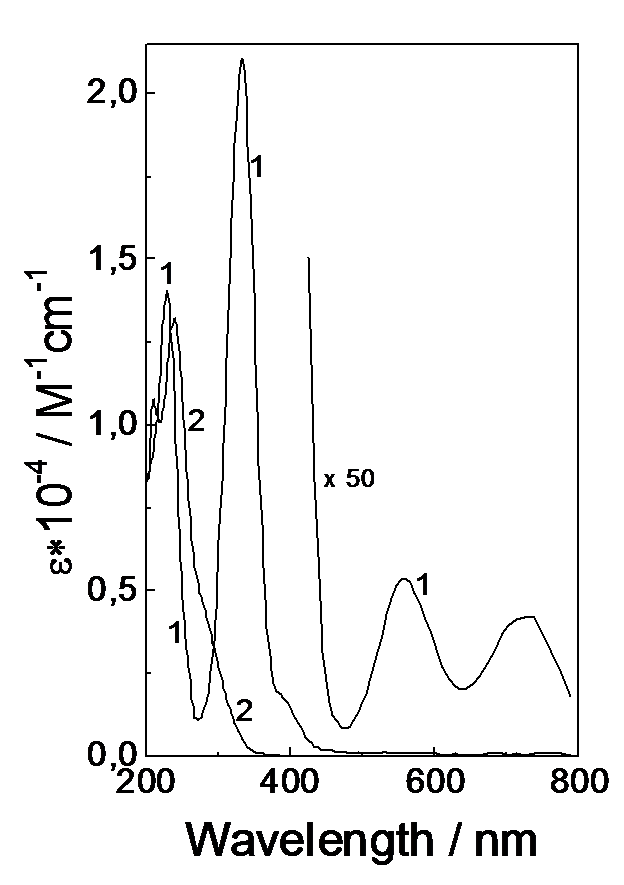 |
Figure1
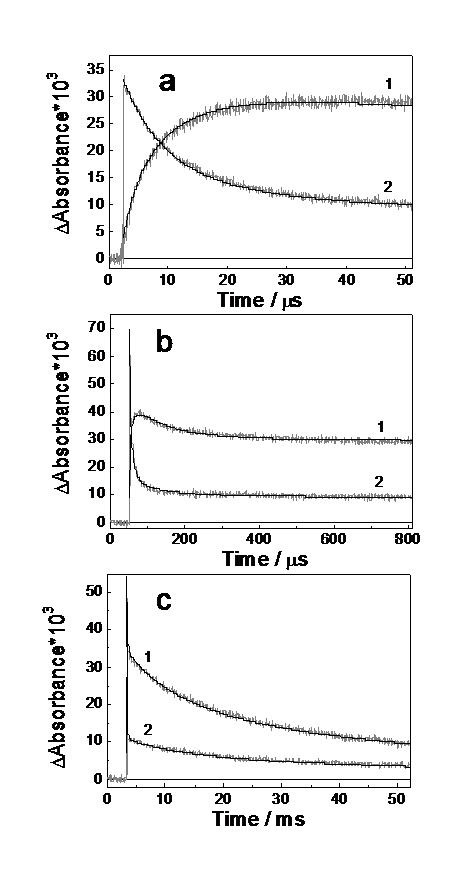 |
Figure 2
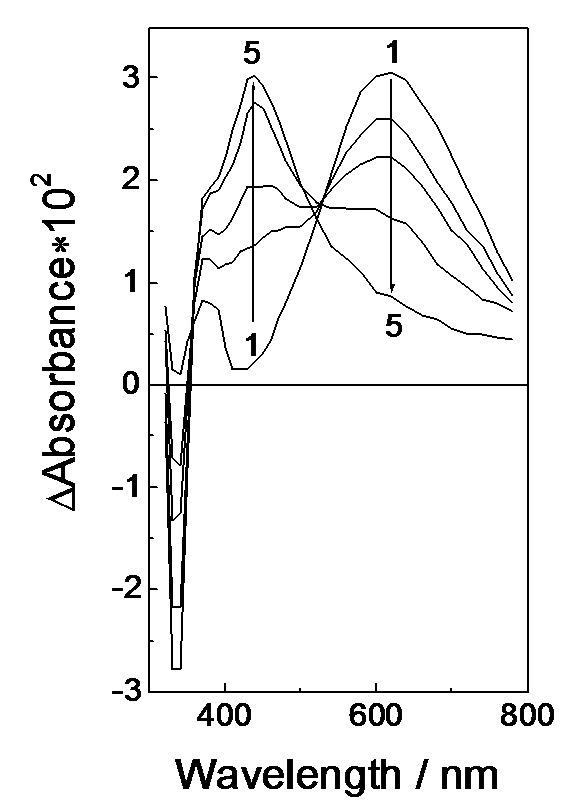 |
Figure 3
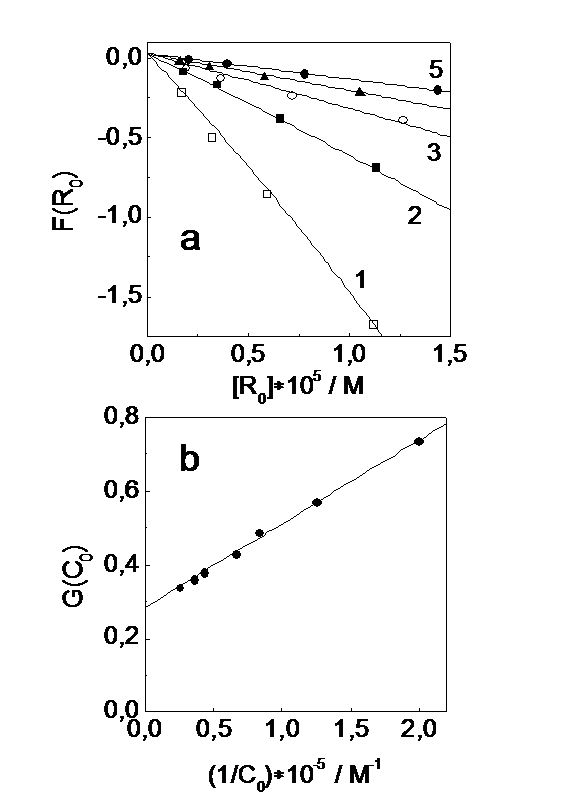 |
Figure 4
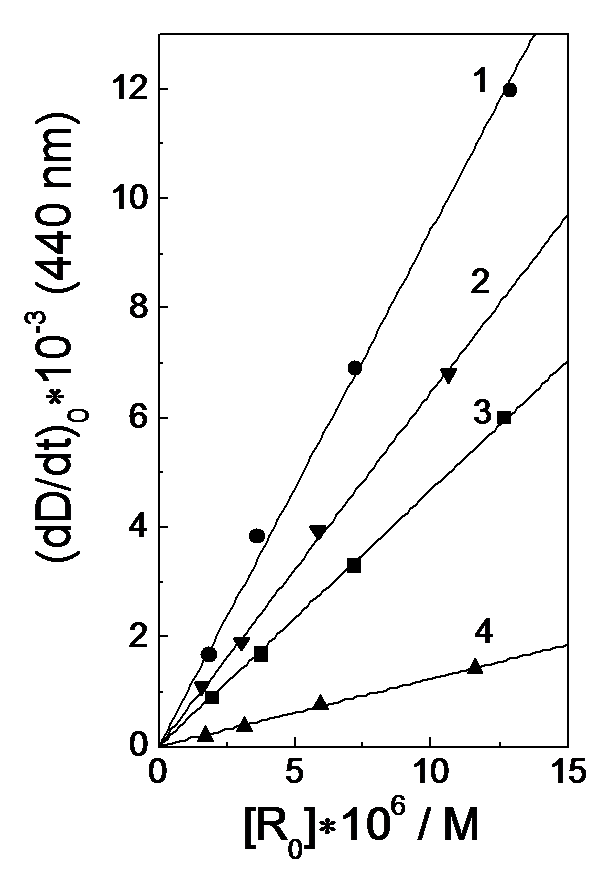 |
Figure 5
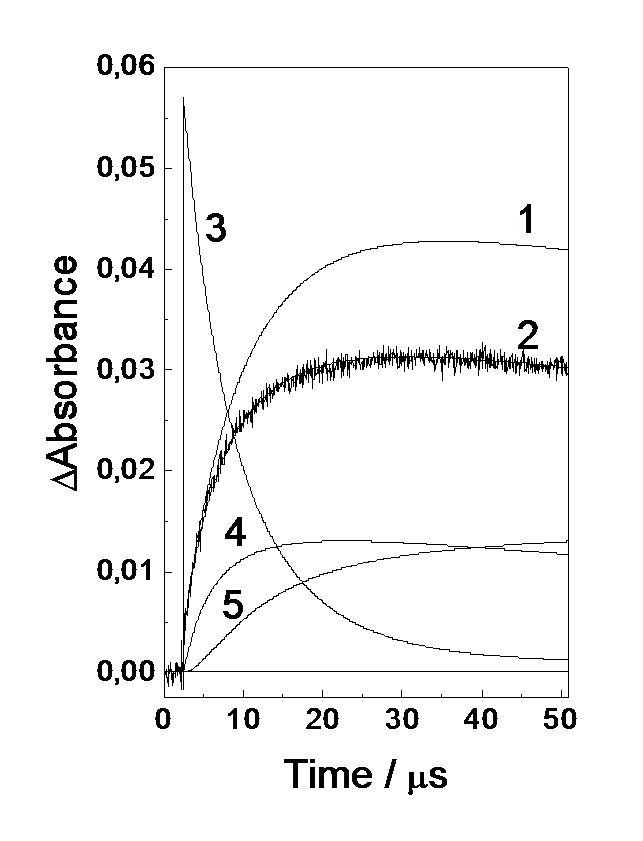 |
Figure 6
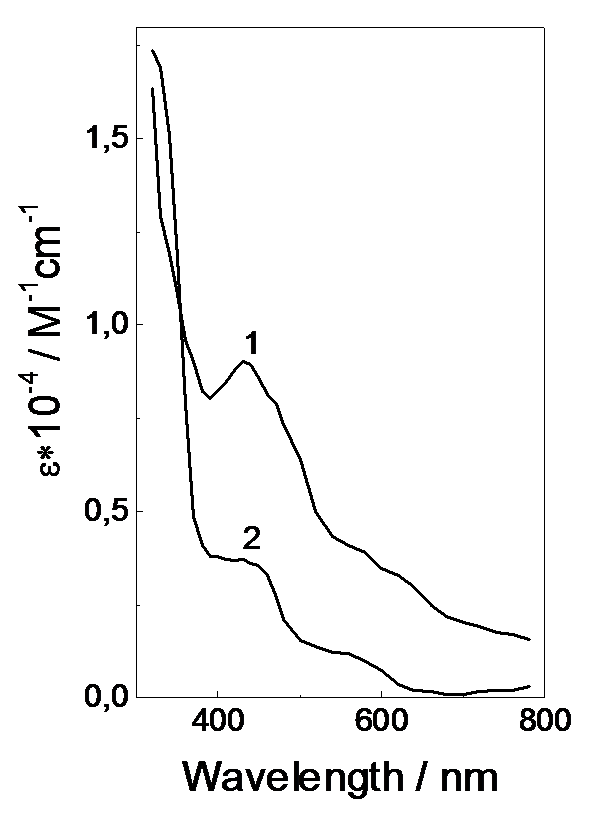 |
Figure 7
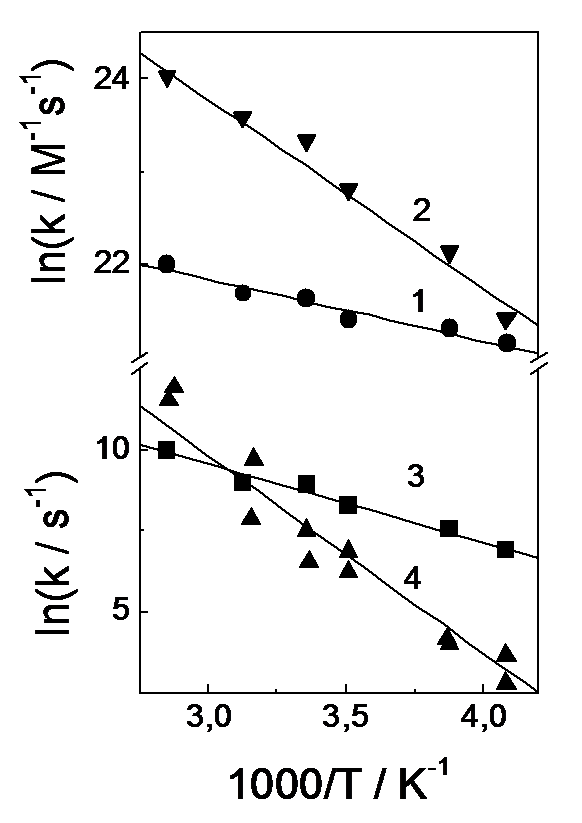 |
Figure 8
