

Партнерка на США и Канаду по недвижимости, выплаты в крипто
- 30% recurring commission
- Выплаты в USDT
- Вывод каждую неделю
- Комиссия до 5 лет за каждого referral
|

International Space Station Research Applications Fact Sheet June 2010
Space Station Experiment “Study of Fast and Slow Neutron Fluxes”
(“BTN-Neytron”)
Status of the Experiment
 The goal of the “BTN-Neytron” experiment is solving both fundamental astrophysical challenges and applied problems of practical cosmonautics, such as:
1. study of spatial non-uniformity and time changeability of Earth`s atmosphere neutron albedo under influence of solar and galactic radiation;
2. study of high-energy neutron fluxes caused by powerful solar flares;
3.study of the neutron radiation background in the vicinity of ISS under various flight conditions;
4. development test of charged and neutral particles registration techniques onboard ISS for subsequent phases of the space experiment “BTN-Neytron” and other future experiments.
The research objects of this space experiment are fluxes of neutrons (in the range from 0,4 eV to 10 МeV) and gamma rays (in the range from 0,3 keV to 15 МeV) on external surface of the Russian Segment of the ISS by use of proportional helium meters and scintillation detectors.
Major Results of the Research
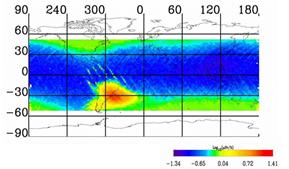 1. Basing on the data received in the course of this experiment for the period from February 26, 2007 up to now, spectra of the neutron flux outside the ISS for energies from the cadmic threshold of about 0.4 eV up to 10 МeV were experimentally assessed. Estimations of dozes accumulation rate outside pressurized ISS modules which depending on geographical position of ISS vary from 0.2 mSv (equator) to 5 mSv (South Atlantic Anomaly - SAA) were made. These data are comparable with the data of the similar experiment BBND and showed good correlation taking into account conditions of both experiments.
2. Neutron fluxes distribution maps were generated. They are referred to various energies at the ISS orbit that testifies that the neutron flux at the station varies considerably depending on its geographic position that is especially obvious during flight above the SAA.
3. Research on degradation of perspective gamma scintillator crystals was made. The research showed applicability of crystals LaBr3:Ce and LaCl3:Ce for utilization in the future space applications because of their low induced activity and low degradation of spectrometric properties.
Further evolution of these research activities
It is planned that up to 2011 the BTN-M1 equipment will continue to be used under conditions of the quiet Sun and at the beginning of the next 24th cycle of solar activity. Neutron flux registration data received during solar flares, solar proton events and during periods of Earth magnetosphere excitation will be of special interest.
The second phase of the experiment will employ BTN-M2 equipment also based on neutron and a gamma spectrometer for the Russian Fobos-Grunt interplanetary probe. This instrument will expand the range of measurable energies up to 15 MeV and improve power resolution of gamma-quantum registration to 3 % that will permit to measure gamma background main lines both from the Earth`s upper atmosphere and from ISS structural elements. Various options of radiation protection against neutrons for future development of radiation shelters for crewmembers of durable lunar and interplanetary missions will also be tested.
Research Manager: Doctor of Science (Physics and Math) I. G.Mitrofanov, IKI-RAS, Moscow.
Publications: V. I Tretyakov; A. S. Kozyrev; M. L. Litvak, et. al., 40th Lunar and Planetary Science Conference, The Woodlands, Texas, USA, March 23-27, 2009, # 1292;
Tretjakov V. I., Mitrofanov I. G., et al. “Space Research”, is accepted for publication on August 28, 2008.
