


Партнерка на США и Канаду по недвижимости, выплаты в крипто
- 30% recurring commission
- Выплаты в USDT
- Вывод каждую неделю
- Комиссия до 5 лет за каждого referral
Anti-foundationalist ontology means that we do not believe that this phenomenon exists independently because all social phenomena are socially constructed and determined by the time or other circumstances influencing our interpretation. We can study only people’s interpretation of the phenomenon and compare this modern interpretation with others in the course of history. The interpretist epistemology matches the anti-foundationalist ontology best. The ontological position affects but not completely determines epistemological position. For example, for the foundationalist ontology it is better to choose positivist or realist epistemology. For the anti-foundationalist ontology it is better to use interpretist epistemology.
II. Epistemology
Epistemology is a Theory of Knowledge (what we can know and how we can know that we know). Epistemology can be positivist, realist and interpretist.
Thus we have the following epistemological approaches:
(1) Positivist epistemology is based on causal relationship, direct observation and development of explanatory or even predictive models. We can establish real world through empirical observation like in natural sciences using methods of natural sciences.
(2) Structuralist epistemology is based on the combination of a positivist approach (direct observation) and structuralist approach (unobservable structure which can produce a crucial effect upon the observable events).
(3) Interpretist epistemology is based on the idea that we cannot establish what the real world is by using our knowledge. We can only establish our own interpretation about the real world. We deal with different interpretations in the course of history and choose the narration which suits us best or seems to be the closest to true knowledge.
III. Ideology
Ideology is a system of political, legal, ethical, aesthetical, religious and philosophical coherent views and ideas that influence the behaviour of people.
IV. Methodology
Methodology is a system of principles and methods.
V. Method
A method is a means of achieving an aim. Methods are used as tools for the investigation of the problem and their choice depends on the field investigated and the researcher’s epistemological approach. There are also different principles of the classification of methods. For example, they can be: traditional and modern methods; qualitative and quantitative methods; quantitative behavioural methods and quantitative postbehavioural methods; methods according to the discipline engaged in the field of investigation (philosophical, economic, juridical, historical and etc); comparative methods of different kind.
VI. Theory
A theory is a system of generalized knowledge, which gives an integral picture of some regularities occurring in the real life. A theory can be analyzed at the following levels: ideological, ontological, epistemological and methodological. The use of a theory must be correlated with the researcher’s own ideological, ontological and epistemological positions.
Example: Marx’s theory.
Foundationalist ontology (the struggle between social classes moves society forward at the specific historical juncture); realist epistemology (there are observable facts and an unobservable structure, for Marx it is an economic structure, i. e. people’s belonging to a social class with certain relations to the means of production); methodology - dialectical materialism and historical determinism; economic, philosophical, historical, sociological, comparative methods; ideology - socialist ideas; theories - Ludwig Feuerbach’s philosophical materialism and Georg Hegel’s dialectics.
The Market of Eldery Collective Accommodation in France.
A Case of Cooperation/Competetiveness Between Public and Private Sectors
Ali SMIDA[9]
Introduction
Protectionism, centralization, and the welfare State have been some of the main features of France for more than two centuries. But, by almost general agreement, this model is no more efficient Many recent crises in public action, the new behaviour of economic actors demanding their autonomy or claiming their local specificity are some illustrations of a need for a change of the role of the State (Bailly, 1998; Delmas, 1991; Smida, 2002; Trosa, 1995).
The internal complexity inside France (in social, economic, political, technological areas) and the external complexity (international environment in all areas) need a new organisation of the State. That is why recently the State has begun to withdraw from the system of goods and services. Private actors have gained more importance in almost all economic sectors (Telemçani, 1993 ).
On the other hand, a new theoretical paradigm (Boix, 1997; Osborne and Gaebler, 1992; Pollitt and Bouckaert, 2000) has played a major role in favour of this change in the distribution of roles between the State and the private sector. France’s non-profit private organisations also play a remarkable role particularly in the health and social system. This dynamic non-profit private sector permits to avoid the public-private dichotomy which has consequences for the productive system of goods and services:
- The public sector could safeguard the public interest, but in the absence of a private sector, it distorts the decision process, it lacks flexibility, initiative and reactivity, and it is harmful for the dynamism of the country’s economy;
- The private sector, with a free hand, seeks only its own interest, bases its activity mainly on financial profit. So, many segments of the population, many social and economic areas, regarded by the private sector as unprofitable, could be forsaken;
- The non-profit private sector could have some flexibility and creativity. It also tries to safeguard the public interest. In fact some non-profit private organisations, such as the French Red Cross, are called “Associations of public interest”.
This article discusses the competitiveness between public, private and non-profit organisations in the French health and social system. It especially examines the case of the elderly homes (EH). This competitiveness appears to be profitable for all categories of the population, even if some segments of the population seem to be more “interesting” for the private commercial organisations.
1. Collective accommodation for the elderly, a new market in expansion
For more than forty years, a real political will in favour of the elderly has taken place in France. This policy has two main consequences: it has improved the living condition of the elderly and it has enhanced medical progress in gerontology (Bichot and Godet 1998; Bonnet, 1995; Borrel 1996; Bourcier de Carbon, 1995; David and Starzec, 1993; Faujas, 1998; Laroque, 1962; Ministère du Travail et des Affaires Sociales, 1997; Rochet, 1995 ; Roger, 1997; Ville, 1989). These two factors contribute to the lengthening of the life expectancy of the elderly, increasing their demographic weight. This numerical importance gives the elderly greater impact to influence political decisions in their favour. So, we have a feedback mechanism making the elderly people live longer and be wealthier. But the process of ageing has consequences: physical and mental dependencies, and isolation of the elderly. These physical, psychological and social difficulties with some financial solvency give birth to a new and dynamic market, that of homes for the elderly.
This market is not homogeneous. The elderly have very unequally distributed financial resources. They also have various needs due to:
· important differences in ages,
· physical and mental health state,
· financial means,
· the degree of integration to the social fabric and
· a strong numerical imbalance in favour of women.
On the other hand, a well-surrounded person, who benefits from a moral and material assistance and who fits into a social environment, does not feel the need to leave his or her home. Thus different accommodation possibilities are given to the elderly.
3. Homes for the elderly, an alternative among other competitive offers
Nowadays, accommodation establishments for the elderly try to propose an offer, which is adapted to their clients.
The expectations and the particular needs of each category of people concerned will have to be taken into account.
The struggle for the market shares will be on two levels:
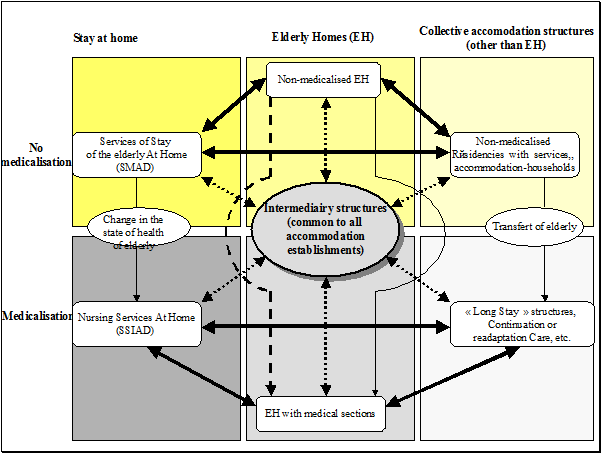
First level: a struggle between three sets of accommodation:
a- the stay at home;
b- the elderly homes;
c- collective accommodations other than homes for the elderly.
Second level: inside the set of homes for the elderly (between different categories of homes for the elderly) (figure 1).
The stay at home is the first preference of the elderly. They have their habits and their past at home, so they reject to leave their usual life environment.
In addition, public authorities have encouraged the elderly to stay at home, particularly through the development and the generalization of assistance services at home. Professionals caring for the elderly at home have also developed strategies to push them to stay at home.
On the other hand, the retirement homes managers develop strategies in order to pull the elderly in the collective accommodations. They use modern management tools that allow them to offer services adapted to each segment of the clients. This offer includes autonomous elderly, sick elderly, and physically or mentally dependent ageing persons.
Dependent elderly in collective accommodations need medicalized services. That is why, the medicalized retirement homes compete with some establishments of care, especially those concerned with long duration care (Long Stay)
However, the retirement homes could attempt to distinguish themselves from the "Long Stay" structures by positioning themselves
· either on a segment concerning a lesser physical dependence, or
· on a segment of psychic dependence ( Alzheimer disease, etc).
Figure petition between the different modes of accomodation for the elderly
 Competition
 Medicalization of EH
 Possible synergies with intermediary structures
3. A specific accommodation offer for each category of elderly
The elderly are a very heterogeneous population (CLEIRPPA, 1997-a, 1997-b, 1997-c; Ministère du Travail et des Affaires Sociales, 1997; Neiss and Rouvera, 1996; SESI, 1996; Simon, 1997). Degrees of solvency, physical or psychic dependence, of social isolation are very variable. In order to attract the elderly with a high level of dependence, retirement homes offer medicalized services. If they are willing to lodge the elderly without solvency, they have to sign agreements with the Region or with the city social services. The elderly with high autonomy need other social activities.
So, the offer has to be adapted to the need and the wish of each category of the elderly. For instance, in the face of the potential demand of the dependent elderly, the market of retirement homes offers some establishments with a variable level of medicalization.
The market can be segmented in reference to the dependence level of the elderly, and to the medicalization level of the retirement homes. So, we can distinguish three categories of medicalized establishments:
· a medicalized category (with at least 20% of beds reserved to the medical section),
· another category slightly medicalized (inferior to 20%) and
· a third category, called ‘not medicalized’, without any medical section.
We also can classify the population in three groups according to the degree of dependence.
The junction of these two factors (dependence and medicalization) shows several axes of possible evolutions for the retirement homes, especially according to their status and their strategies (Table 1).
4. Segmentation of the elderly and competition/cooperation between sectors
The analysis of the market shows that the public sector has the biggest share in two cases:
· Box A (high medicalized establishments, high dependence level of the Elderly). But we notice a potential expansion of commercial profit sector. The competitiveness is also high between these two sectors;
· Box I (no medicalization, no dependence). In this case, some lucrative niches (luxury elderly homes) are occupied by the commercial profit sector.
The commercial profit sector holds a strong place in the Box C (high dependence, no medicalization). It develops specialised establishment in health dependence (Alzheimer disease). Non-profit private sector is developed in the case of low dependence and low medicalization (Box E).
So three situations are possible:
strong competitiveness between sectors (e. g. Box A); no competition between sectors (e. g. Box E); a kind of cooperation where a sector chooses a niche and leaves the rest of the market for the other sectors (e. g. Box C).Table 1. Evolution and potential development of elderly homes ( EH )
Medicalization level of the EH | ||||
High Medicalization | Low Medicalization | No Medicalization | ||
High Dependence | Box A : Rather public (Public EH, “Long Stay”) Potential expansion of medicalization of commercial profit sector. | Box B : Progressive medicalization to adapt the market. | Box C : Often mental dependence. Expansion of commercial private sector with specialisation in mental dependence. | |
Dependence level of the Elderly | Low Dependence | Box D : n. s. (not significant) | Box E : Expansion of non-profit private EH | Box F : EH for patients with low dependence. Progressive medalization or specialisation in mental dependence. |
No Dependence | Box G : n. s. (not significant) | Box H : n. s. (not significant) | Box I : Rather public EH and public accomodation-households. Patients : with social difficulties (Isolation,…). Niche for commercial private sector : luxury EH. |
Conclusion
The public sector continues to play its role of safeguarding public interests. The commercial private sector introduces wide techniques of management experience, and an approach focuses in priority on the competition in a sector with a strong health-social culture and a weak management culture. The non-profit sector plays a significant role in the health and social system in France. This actor enhances competitiveness in some cases and contributes in the cooperation in some others.
These three sectors create competition and competitiveness. This dynamics permits a good quality, reasonable prices and safeguards the interests of the elderly who lack solvency.
Part IX
Critical Review
Analytical tasks:
Read the article. Read the critical review on the article and add your personal opinion (10) and summary (11) according to the plan in Part VI.
Is Culture a Divergence or a Convergence Factor in Economic Growth for Socialist Countries in Economic Transition?[10]
Christian MICHON[11]
It is generally recognised that national energy resources and the rate of development of an open market economy are two essential factors in establishing sustainable economic growth. Merely describing and understanding the significant disparities between countries and continents is not sufficient; it is therefore important to consider a country’s culture as a determinant variable (Hofstede, 2000).[12]
In the context of globalisation, culture can be regarded as a common element that encourages growth, or as a factor that delays growth.[13] Contemporary theories pay little attention to culture’s role in determining economic growth (Guellec & Ralle, 1995; Arrous, 1999).
The examples of development in East and South-East Asian countries effectively illustrate the role of culture in economic growth (Crane, 1978). Based on their experience, we propose a double input-double output theory where cultural factors can be considered as both positive and negative variables.
1. Culture and economy. History
The culture was historically associated to the economic development regarding macro economic or micro economic point of view. For example, the influence of the religion was regarded as a determining explanation of the birth of capitalism.
From a micro economic point of view, both community dimension and a cultural factor were in particular regarded as the source of the Hanseatic development of the Prussian expansionism towards the Dutch and Belgium countries.
In Asia like in other countries, which have Chinese Diaspora, the Chinese community has also developed a network trade, which supplanted the local traditional trade (Vandermeersch, 1986).
Nevertheless, to apprehend the cultural factor, it is necessary to define in a measurable way the variables which determine a specific cultural identity. But that is not enough because it is necessary to determine as well within the relational framework between culture and economy, whether culture or economy plays the main role in economic development and whether culture has direct or indirect relationship with economic development. The search for a model of connection between culture and economy seems a good approach for studying this question.
It makes sense to say that the more there are examples of differentiation in the relation between culture and economic development, the more it will be probable to discover links between these two variables.
Let us recall that culture associated with economy should not be confused with the economy of culture. This one leads to other concerns such as cultural diversity (cultural exception) and the globalisation of the market of culture.
An integrated model of the cultural factor with double input
This model starts from a generally allowed postulate that the economic development supposes basic conditions that are of a political nature, social and economic, and which are necessary at the same time (Furtado, 1970).
We can also observe that some economic developments are only optical illusions when the output revenue is completely confiscated by a political caste and this revenue is based on a single natural resource. If the conditions of growth exist, the cultural values will intervene to support or slow down the economic growth.
It is advisable concerning this proposal to define the cultural approach rather than to take into account an approach based on values listed from a Western point of view (Rokeach Value System for example) (Usunier, 2000).
It seems more appropriate to focus on the relations between globalisation – localization i. e. we propose the principle of a cultural dynamics of co-operation - conflict between the local regulating values and aspirational values.
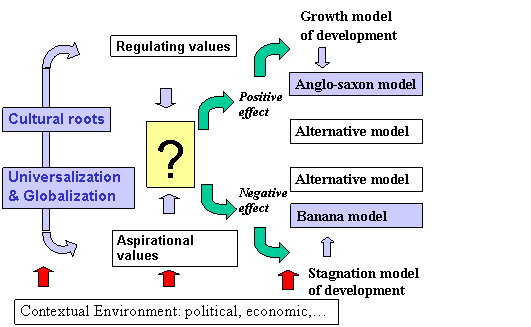

Fig. 1 Model with double input - double output
The regulating variables constitute the first input. They are by nature the variables which control the existing milieu and come from a social framework having deep roots.
The aspirational variables are the second input. They are those which make a society evolve by their specific orientation and their intensity. The aspitational variables are more or less important regarding the perception which one has of the outside world.
They are variables which are very sensitive to the sociocultural currents and trends of country-headlights like the United States of America or Japan for Asian countries. They have a strong inluence on the people’s needs and wants (Prime, 2001).
Is it the pattern of the combination between regulating and aspirational variables which will determine the economic development? The observable facts can bring us to the conclusion that there are two modes of inputs as there are two modes of outputs.
A model with double output
Cultural factors associated with political, social, economic conditions allow the implementation of a positive effect of economic growth or a negative effect leading to the economic stagnation and even recession.
The first output is characterized by a positive spiral of economic growth. The traditional indicators can measure this phenomenon.
It does not explain the relation between economic growth and culture but makes it possible to notice it. The model of Anglo-Saxon development based on the capitalism and the market economy is an example.
The second output is characterized by a negative effect which leads rather to an economic stagnation, and perhaps, even worse to the disintegration of the economy. The model of the “banana” republics of Africa is an example.[14]
2. The role of culture like a source of junction
As in a mathematical model of junction, the positive or negative output can depend on one variable which we may call critical variable. Such a variable reaching a critical threshold of rupture will start an acceleration of the process involved in one direction or the other.
For better understanding we can use the model demonstrating how the culture intervenes in this process and how a combination between regulating and aspirational variables can produce a positive or a negative ouput.
For example, the phenomenon of corruption is often observed in the emerging countries or developing countries and which is more or less condemned by morals of the local government and society.
If the whole of the corruption is a confiscatory process to the advantage of a small group which is a dominant ‘caste’ in the society, for example, then one can observe that the economic development is hindered.
If the whole of the corruption is redistributive, in other words a large part of the population shares the resources of corruption, then the negative economic effect will be limited even if this form of abuse of power does not correspond to the Western values of justice and equality. The same cultural variable can have different effects.
A rich life style and Western comfort are regarded, as something desired, i. e. an aspirational variable.
3. The case of the Asian countries, the example of Vietnam
Vietnam can be characterized as a country whose economic development has been carried out for the last twenty years (Michel M, 1998). While preserving a single party on the political level, this country has been rocking in the market economy for about fifteen years.
By studying the reasons of Vietnam’s growth (Michon & Gruere, 1996), it appears that the combination of old culture - regulating values identical to that of the Chinese world - and effect of globalisation on the aspirational values led to a positive effect.
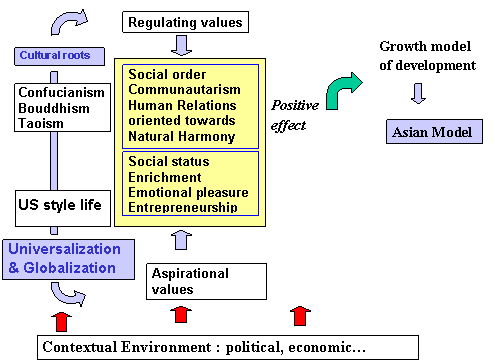

Fig.2: The cultural values model for Asian countries
This success is not fully explained but some research shows how the combination between aspirational values and regulating values has permitted harmonious transformation of the economy regarding the macro, meso or micro economic level.
Such kind of the transition “does” not produce an Anglo-Saxon model of economic growth but rather an alternative model, which one could describe as community model of growth.[15]
References
ARROUS, J. (1999) Les théories de la croissance, ed. du Seuil, Paris.
CRANE, P. S. (1978) Korean Patterns, Kwangjin Publishing Company, Seoul.
FURTADO, C. (1970) Théorie du développement économique, PUF, Paris.
GUELLEC, D. & RALLE, P. (1995) Les nouvelles théories de la croissance, Ed. La découverte, Paris.
HOFSTEDE, G. (2000) Culture’s Consequences, Sage Publications 2nd Ed.
MICHEL, M. (1998) “Succès et incertitudes de la transition vietnamienne”, in Revue Economique, vol. 49 n°1, Jan.
MICHON, C. & GRUERE, J.-P. (1996) “Le Vietnam, apprenti dragon”, in Revue Française du Marketing, Vol. V, Nov.-Dec.
USUNIER, J.-CMarketing Across cultures, Prentice Hall 3rd ed., Europe
PRIME, N. (2001) “Cultures et mondialisation: l’unité dans la diversité”, in Expansion Mangement Review, Sept.
VANDERMEERSCH, L. (1986) Le nouveau monde sinisé, PUF, Paris.
A Critical Review by N. Slanevskaya
on the article “Is Culture a Divergence or a Convergence Factor in Economic Growth for Socialist Countries in Economic Transition?”by Christian Michon
1. Subject:
The article by C. Michon (2006) “Is Culture a Divergence or a Convergence Factor in Economic Growth for Socialist Countries in Economic Transition?” in Global Society: Conflict or Cooperation. Discussion, ed. N. Slanevskaya, St. Petersburg, Nestor: 190-194, highlights the role of a cultural factor in economic growth in a socialist country in economic transition. It can be regarded as an element that encourages growth or as a factor that delays it.
2. Purpose Statement:
The main purpose of the author is to analyse and define in what way the combination of cultural traditions and new values influences the economic growth of socialist countries in economic transition.
3. Major Points:
Christian Michon gives historical examples of the influence of culture on economic development, supplies us with the model of convergence of local and foreign values, which he calls a double input. Such a double cultural input produces a double economic output according to Michon’s model bringing about either a negative or a positive effect which depends on the success of convergence of values. The author illustrates his idea with the example of Vietnam’s socialist economy in transition.
5. The significance of the article.
The author investigates the causes of economic growth and explains the failure of the Anglo-Saxon model in some socialist countries in economic transition. The author offers a new alternative model related to Asian countries which he calls a Community model of economic growth and which is an important contribution to the development of economic theory.
6. Its current relevance.
Under globalization the contacts between different countries and cultures have increased as well as the economic gap. While choosing an economic model for application it is important to understand how cultural diversities are related to economic growth.
7. The effectiveness of the article in making the major points.
Michon’s theoretical insight is based on foundationalist ontology. He believes that cultural factors objectively influence economic growth. He demonstrates it on Vietnam’s economic growth and its particular culture. The failure to admit that cultural factors are important for economic growth leads to economic failure of Western model applied to the socialist countries in transition.
To prove his point of view and investigate the problem Michon uses a realist epistemology. The effect of cultural traditions can’t be observed directly. The interaction of old regulating values in the society and new aspirational values correlated with global economy can be regarded as an unobservable structure. At the same time the author produces the economic model evidently based on economic facts. His argument could have been more persuasive if the author had supplied us with figures and tables showing the economic growth based on the cultural characteristics of the country and if he had used a comparative method for assessing economic achievements in different countries supported with such tables or diagrams.
The author’s adherence to liberal ideology helps him to arrive at the conclusion of the necessity of free choice in application of alternative models in a free market system for Asian countries taking into account cultural diversities.
Methodologically, Michon’s analysis is based on dialectical approach and cultural determinism. The successful interaction of old and new values produces positive effect and leads to economic growth. Cultural determinism correlates well with the author’s foundationalist ontology supported by historical and economic comparative methods. However, dialectical principle explaining interaction between old and new values is not clearly presented. Michon’s investigation could have become more profound if he had illustrated the change of values using sociological polls and questionnaires.
Investigating the phenomenon the author uses the following methods:
- historical comparative method, while speaking about the birth of capitalism, the Prussian expansionism, the network of Chinese diaspora, Vietnam in transition, in the connection with his main thesis of the interaction between culture and economy;
- sociological method, in studying the characteristics of social value systems which exist in different societies;
- economic comparative method, in working out his double input and double output model and an alternative model for Asian economic development.
The choice of methods matches the author’s methodological principle of cultural determinism well and seems to be useful for the investigation of the problem.
This article is based on the theory put forward by Hofstede, who considers cultural factors crucial for the socio-political an economic development.
8. Theoretical implications of the article or theoretical basis of it:
There is no doubt that Michon’s double input and double output model is a great contribution to the field of cultural studies, economics and to the theory suggested by Hofstede. Michon considers economic side of the problem more thoroughly than Hofstede and develops Hofstede’s cultural approach by arguing for an alternative model for Asia countries and by working out a double input and double output model.
9. Policy implications of the article.
There is no necessity of introducing only one economic model, Anglo-Saxon, in all the countries in economic transition. Alternative models can be better for a country with a particular culture.

|
Из за большого объема этот материал размещен на нескольких страницах:
1 2 3 4 5 6 7 8 |
