

Партнерка на США и Канаду по недвижимости, выплаты в крипто
- 30% recurring commission
- Выплаты в USDT
- Вывод каждую неделю
- Комиссия до 5 лет за каждого referral
Preparation of Papers for the Proceedings of the IEEE North West Russia Section
First Author#1, Second Author*2, Third Author#3
#First-Third Department, First-Third University
Address Including Country Name
1first. *****@***edu
3third. *****@***edu
*Second Company
Address Including Country Name
2second. *****@***com
Abstract— This document gives formatting instructions for authors preparing papers for publication in the Proceedings of the IEEE North West Russia Section. The authors must follow the instructions given in the document for the papers to be published. You can use this document as both an instruction set and as a template into which you can type your own text. Define all symbols used in the abstract. Do not cite references in the abstract.
Index Terms—About four key words or phrases in alphabetical order, separated by commas. For a list of suggested keywords, send a blank e-mail to *****@***org or visit http://www. ieee. org/organizations/pubs/ani_prod/keywrd98.txt
I. Introduction
This document is a template for Microsoft Word 2000‑2003. An easy way to comply with the paper formatting requirements is to use this document as a template and simply type your text into it.
II. Page Layout
Your paper must use a page size corresponding to A4 which is 210 mm wide and 297 mm long. The margins must be set as 20 mm. Your paper must be in two column format with a space of 5 mm between columns.
III. Page Style
All paragraphs must be indented. All paragraphs must be justified, i. e. both left-justified and right-justified.
A. Text Font of Entire Document
The entire document should be in Times New Roman or Times font. Recommended font sizes are shown in Table 1. Do not change the font sizes or line spacing to squeeze more text into a limited number of pages. Use italics for emphasis; do not underline.
B. Title and Author Details
All title and author details must be in single-column format and must be centered.
Paper title must be in 24 pt Regular font. Author name(s) must be in 11 pt Regular font. Author affiliation(s) must be in 10 pt Italic. Email address must be in 9 pt Courier Regular font.
The paper title should be written in uppercase and lowercase letters, not all uppercase. Avoid writing long formulas with subscripts in the title; short formulas that identify the elements are fine (e. g., "Nd–Fe–B"). Every word in a title must be capitalized except for short minor words such as “a”, “an”, “and”, “as”, “at”, “by”, “for”, “from”, “if”, “in”, “into”, “on”, “or”, “of”, “the”, “to”, “with”.
TABLE I
Font Sizes for Papers
Font Size | Appearance (in Time New Roman or Times) | ||
Regular | Bold | Italic | |
8 | table caption (in Small Caps), figure caption, reference item | reference item (partial) | |
9 | author email address (in Courier), cell in a table | abstract body | abstract heading (also in Bold) |
10 | level-1 heading (in Small Caps), paragraph | level-2 heading, level-3 heading, author affiliation | |
11 | author name | ||
24 | title |
Full names of authors are preferred in the author field, but are not required. Put a space between authors’ initials. To avoid confusion, the family name must be written as the last part of each author name (e. g. John A. K. Smith).
Each affiliation must include, at the very least, the name of the company. Email address is compulsory for the corresponding author.
C. Section Headings
No more than 3 levels of headings should be used. All headings must be in 10 pt font. Every word in a heading must be capitalized except for short minor words as listed in Section III-B.
1) Level-1 Heading: A level-1 heading must be in Small Caps, centered and numbered using uppercase Roman numerals. For example, see heading “III. Page Style” of this document. The two level-1 headings which must not be numbered are “Acknowledgment” and “References”.
2) Level-2 Heading: A level-2 heading must be in Italic, left-justified and numbered using an uppercase alphabetic letter followed by a period. For example, see heading “C. Section Headings” above.
3) Level-3 Heading: A level-3 heading must be indented, in Italic and numbered with an Arabic numeral followed by a right parenthesis. The level-3 heading must end with a colon. The body of the level-3 section immediately follows the level-3 heading in the same paragraph. For example, this paragraph begins with a level-3 heading.
D. Figures and Tables
Figures and tables must be centered in the column. Large figures and tables may span across both columns. Any table or figure that takes up more than 1 column width must be positioned either at the top or at the bottom of the page.
All graphics and figures must be black-and-white or grayscale. Graphics must not use stipple fill patterns because they may not be reproduced properly. Please use only SOLID FILL colors which contrast well both on screen and on a black-and-white hardcopy, as shown in Fig. 1.
Image quality is very important to how yours graphics will reproduce. Photographs and grayscale figures should be prepared with 300 dpi resolution and saved with no compression, 8 bits per pixel (grayscale). If your graphic looks low in quality, please keep in mind that we cannot improve the quality after submission.
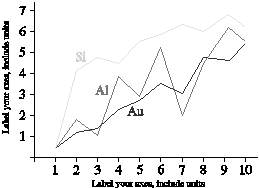
Fig. 1 A sample line graph using colors which contrast well both on screen and on a black-and-white hardcopy
Fig. 2 shows an example of a low-resolution image which would not be acceptable, whereas Fig. 3 shows an example of an image with adequate resolution. Check that the resolution is adequate to reveal the important detail in the figure.
Please check all figures in your paper both on screen and on a black-and-white hardcopy. When you check your paper on a black-and-white hardcopy, please ensure that:
· the colors used in each figure contrast well,
· the image used in each figure is clear,
· all text labels in each figure are legible.
E. Figure Captions
Figures must be numbered using Arabic numerals. Figure captions must be in 8 pt Regular font. Captions of a single line (e. g. Fig. 2) must be centered whereas multi-line captions must be justified (e. g. Fig. 1). Captions with figure numbers must be placed after their associated figures, as shown in Fig. 1.
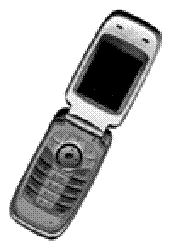
Fig. 2 Example of an unacceptable low-resolution image

Fig. 3 Example of an image with acceptable resolution
Please do not include captions as part of the figures. Do not put captions in “text boxes” linked to the figures. Do not put borders around the outside of your figures.
F. Table Captions
Tables must be numbered using uppercase Roman numerals. Table captions must be centred and in 8 pt Regular font with Small Caps. Every word in a table caption must be capitalized except for short minor words as listed in Section III-B. Captions with table numbers must be placed before their associated tables, as shown in Table 1.
G. Equations
If you are using Word, use either the Microsoft Equation Editor or the MathType add-on (http://www. ) for equations in your paper (Insert | Object | Create New | Microsoft Equation or MathType Equation). “Float over text” should not be selected.
Number equations consecutively with equation numbers in parentheses flush with the right margin, as in (1). First use the equation editor to create the equation. Then select the “Equation” markup style. Press the tab key and write the equation number in parentheses. To make your equations more compact, you may use the solidus ( / ), the exp function, or appropriate exponents. Use parentheses to avoid ambiguities in denominators. Punctuate equations when they are part of a sentence
H. Page Numbers, Headers and Footers
Page numbers, headers and footers must not be used.
I. Links and Bookmarks
All hypertext links and section bookmarks will be removed from papers during the processing of papers for publication. If you need to refer to an Internet email address or URL in your paper, you must type out the address or URL fully in Regular font.
J. References
The heading of the References section must not be numbered. All reference items must be in 8 pt font. Please use Regular and Italic styles to distinguish different fields as shown in the References section. Number the reference items consecutively in square brackets (e. g. [1]).
When referring to a reference item, please simply use the reference number, as in [2]. Do not use “Ref. [3]” or “Reference [3]” except at the beginning of a sentence, e. g. “Reference [3] shows …”. Multiple references are each numbered with separate brackets (e. g. [2], [3], [4]–[6]).
Examples of reference items of different categories shown in the References section include:
· example of a book in [1]
· example of a book in a series in [2]
· example of a journal article in [3]
· example of a conference paper in [4]
· example of a patent in [5]
· example of a website in [6]
· example of a web page in [7]
· example of a databook as a manual in [8]
· example of a datasheet in [9]
· example of a master’s thesis in [10]
· example of a technical report in [11]
· example of a standard in [12]
IV. Conclusions
Although a conclusion may review the main points of the paper, do not replicate the abstract as the conclusion. A conclusion might elaborate on the importance of the work or suggest applications and extensions.
Please submit your manuscript for review electronically via e-mail. Designate one author as the “corresponding author.” This is the author to whom proofs of the paper will be sent.
When you submit your final version via e-mail (after your paper has been accepted), send also, a PDF with complete contact information for all authors. Include full mailing addresses, telephone numbers, fax numbers, and e-mail addresses. This information will be used to provide each author with a complimentary copy of the journal in which the paper appears.
Acknowledgment
The heading of the Acknowledgment section and the References section must not be numbered.
This template is a modification of the original version provided by courtesy of Causal Productions (www. ).
References
[1] S. M. Metev and V. P. Veiko, Laser Assisted Microtechnology, 2nd ed., R. M. Osgood, Jr., Ed. Berlin, Germany: Springer-Verlag, 1998.
[2] J. Breckling, Ed., The Analysis of Directional Time Series: Applications to Wind Speed and Direction, ser. Lecture Notes in Statistics. Berlin, Germany: Springer, 1989, vol. 61.
[3] S. Zhang, C. Zhu, J. K. O. Sin, and P. K. T. Mok, “A novel ultrathin elevated channel low-temperature poly-Si TFT,” IEEE Electron Device Lett., vol. 20, pp. 569–571, Nov. 1999.
[4] M. Wegmuller, J. P. von der Weid, P. Oberson, and N. Gisin, “High resolution fiber distributed measurements with coherent OFDR,” in Proc. ECOC’00, 2000, paper 11.3.4, p. 109.
[5] R. E. Sorace, V. S. Reinhardt, and S. A. Vaughn, “High-speed digital-to-RF converter,” U. S. Patent 5 , Sept. 16, 1997.
[6] (2002) The IEEE website. [Online]. Available: http://www. ieee. org/
[7] M. Shell. (2002) IEEEtran homepage on CTAN. [Online]. Available: http://www. ctan. org/tex-archive/macros/latex/contrib/supported/IEEEtran/
[8] FLEXChip Signal Processor (MC68175/D), Motorola, 1996.
[9] “PDCA12-70 data sheet,” Opto Speed SA, Mezzovico, Switzerland.
[10] A. Karnik, “Performance of TCP congestion control with rate feedback: TCP/ABR and rate adaptive TCP/IP,” M. Eng. thesis, Indian Institute of Science, Bangalore, India, Jan. 1999.
[11] J. Padhye, V. Firoiu, and D. Towsley, “A stochastic model of TCP Reno congestion avoidance and control,” Univ. of Massachusetts, Amherst, MA, CMPSCI Tech. Rep. 99-02, 1999.
[12] Wireless LAN Medium Access Control (MAC) and Physical Layer (PHY) Specification, IEEE Std. 802.11, 1997.
