

Партнерка на США и Канаду по недвижимости, выплаты в крипто
- 30% recurring commission
- Выплаты в USDT
- Вывод каждую неделю
- Комиссия до 5 лет за каждого referral
Andrey S. Ukrainsky, Marina Ja. Orlova-Bienkowskaja
Expansion of Harmonia axyridis Pallas (Coleoptera: Coccinellidae) to European Russia and adjacent regions
A. S. Ukrainsky
State Scientific Research Institute of Restoration,
44/1 Gastello Str., Moscow, Russia
e-mail: *****@***ru
M. Ja. Orlova-Bienkowskaja (Corresponding author)
A. N. Severtsov Institute of Ecology and Evolution, Russian Academy of Sciences,
33 Leninskiy Prospect, Moscow, Russia
e-mail: *****@***ru
Abstract. An invasive alien species, the harlequin ladybird Harmonia axyridis (Pallas, 1773), has quickly expanded its distribution in Eastern Europe. Records of H. axyridis from 31 localities in Lithuania, Latvia, the Ukraine, European Russia, and the Northern Caucasus are summarized and mapped. Within the last few years this species has established in south Latvia, on the Baltic Sea shore (Kaliningrad oblast and Lithuania), in the western and central Ukraine, Crimea, and in the Northern Caucasus. Besides that, individual specimens have been found in 4 more localities in European Russia. The species is recorded from Lipetsk oblast (European Russia), Crimea, and Nikolaev oblast (the Ukraine) for the first time.
Keywords Harlequin ladybird, Pest, Range expansion, European Russia, New records, Harmonia axyridis
Harmonia axyridis (Pallas, 1773) has perhaps become the most infamous of invasive alien insects in the twenty-first century (Roy and Majerus 2010). Native to Asia, since 1916 H. axyridis has been released as a biological control agent of aphids and coccids in various parts of the world (Brown et al. 2011; Belyakova and Polikarpova 2012). In 1988 the species began to establish and propagate in the wild (Chapin and Brou 1991). H. axyridis causes negative ecological and economic consequences: (1) its spread caused the decline of populations of native ladybird species (Roy et al. 2012); (2) it has become a significant pest of fruit production and wine production (Koch and Galvan 2008); (3) it is a nuisance that infests houses and other buildings in large numbers when searching for overwintering sites (Koch and Galvan 2008).
In the last 25 years H. axyridis has established in Europe, North America, South America, and Africa (Brown et al. 2011). In Europe this ladybird was first recorded in the wild in the late 1990s in France and Germany, and since 2002 its range has rapidly expanded (Brown et al. 2008). Between 2006 and 2010 it established in at least 12 countries of Eastern Europe (Brown et al. 2011). According to our data, the European part of the range is continuing to expand eastwards. Here, a review of records of H. axyridis from European Russia, Northern Caucasus, Lithuania, Latvia, and the Ukraine is given (Fig. 1, Table 1).
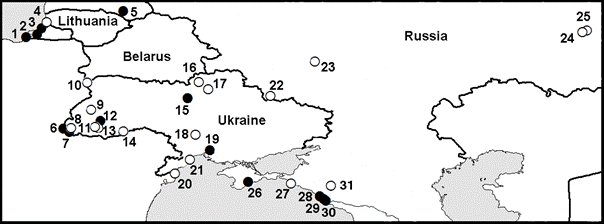
Fig. 1 Distribution of H. axyridis in Latvia, Lithuania, the Ukraine, European Russia, and the Northern Caucasus. Black dots indicate localities where the species has established, white dots – localities, where individual specimens have been found. Numbers of localities correspond to the table below.
Table 1 Localities where H. axyridis was found in the eastern part of its European range.
Number | Locality | Years of records in the wild | Biotopes | Colour forms of adults | Found specimens | References |
1 | Russia, Kaliningrad oblast, Vistula Spit | 2012 | Leaves of shrubs | succinea | Many adults | V. I. Alekseev, personal communication |
2 | Russia, Kaliningrad oblast, Kaliningrad | 2010–2013 | Leaves and stems of Acer pseudoplatanus and Spiraea sp. | succinea, spectabilis | Many adults, larvae and pupae | Zakharov et al. 2011; Alekseev et al. 2012; V. I. Alekseev, personal communication |
3 | Russia, Kaliningrad oblast, Curonian Spit | 2012 | Leaves of shrubs | succinea | Many adults | V. I. Alekseev, personal communication |
4 | Lithuania, Juodkrante | 2011 | Grass in the wood lot | succinea | 1 adult | Nagrockaitė et al. 2011 |
5 | Latvia, Līvāni municipality, Jersika | 2009 | Young shoots of Prunus cerasifera | succinea, spectabilis | Many adults, larvae and pupae | Barševskis 2009 |
6 | Ukraine, Transcarpathian oblast, Chop | 2009 | Unknown | succinea, conspicua, spectabilis | Many adults and larvae | Markó and Pozsgai 2009; Verizhnikova. 2011 |
7 | Ukraine, Transcarpathian oblast, Beregovo | 2009 | Unknown | succinea, conspicua, spectabilis | Many adults larvae and pupae | Markó and Pozsgai 2009; Verizhnikova. 2011 |
8 | Ukraine, Transcarpathian oblast, Mukachevo | 2010 | Unknown | Unknown | Unknown | Nekrasova and Tytar 2012 |
9 | Ukraine, Lvov oblast, Lvov | 2011 | Unknown | Unknown | Unknown | Tytar and Nekrasova 2012 |
10 | Ukraine, Volyn oblast, Shatsk National Natural Park | 2011 | Unknown | Unknown | Unknown | Tytar and Nekrasova 2012 |
11 | Ukraine, Ivano-Frankovsk oblast, Zelionaya | 2010 | Unknown | Unknown | 2 adults | Zamoroka et al. 2011 |
12 | Ukraine, Ivano-Frankovsk oblast, Ivano-Frankovsk | 2009 | Unknown | Unknown | 11 adults | Zamoroka et al. 2011 |
13 | Ukraine, Ivano-Frankovsk oblast, Yarechma | 2010 | Unknown | Unknown | 1 adult | Zamoroka et al. 2011 |
14 | Ukraine, Chernovtsy oblast | 2011 | Unknown | Unknown | Unknown | Nekrasova and Tytar 2012 |
15 | Ukraine, Kiev oblast, Kiev, left bank of the Dnieper River | 2003 | Unknown | spectabilis | Several adults | Verizhnikova and Shylova 2013 |
Ukraine, Kiev oblast, Martusovka | 2007–2012 | Rosa sp., Capsicum annuum, Viburnum opulus | spectabilis, conspicua, succinea | 127 adults were captured in 2007. The population exists up to now | Verizhnikova. 2011; Verizhnikova and Shylova 2013 | |
Ukraine, Kiev oblast, Kiev, different districts of the city | 2009–2012 | Leaves of Swida sanguinea, Acer sp., Tilia cordata, Aesculus hippocastanum, Urtica sp. and Lythrum salicaria. | spectabilis, conspicua, succinea, axyridis | More than 3500 adults, many larvae, and pupae | Nekrasova and Tytar 2009, 2012; Verizhnikova and Shylova 2013 | |
16 | Ukraine, Chernigov oblast, Chernigov | 2011 | Unknown | Unknown | 1 adult | P. N. Sheshurak, personal communication |
17 | Ukraine, Chernigov oblast, Nezhin | 2010 | The specimen was captured on the wall | Unknown | 1 adult | Zamoroka et al. 2011 |
18 | Ukraine, Nikolaev oblast, Kuripchino | 2012 | Unknown | Unknown | 1 adult | P. N. Sheshurak, personal communication |
19 | Ukraine, Nikolaev oblast, Nikolaev | 2011 | The specimens were captured in light trap | Unknown | Several adults | Own data |
20 | Ukraine, Odessa oblast, the Danube Delta, the island Ptichij | 2011 | Unknown | Unknown | Unknown | Tytar and Nekrasova 2012 |
21 | Ukraine, Odessa oblast, Sukhoj Liman | 2011 | Unknown | Unknown | Unknown | Tytar and Nekrasova 2012 |
22 | Russia, Belgorod oblast, Borisovka | 2012 | Unknown | spectabilis | 1 adult | Orlova-Bienkowskaja 2013 |
23 | Russia, Lipetsk oblast, Leski | 2012 | The specimen was captured in light trap | succinea | 1 adult | Own data |
24 | Russia, Bashkir Republic, Iglino district, Urman | 2007 | Unknown | axyridis | 1 adult | Khabibullin et al. 2009 |
25 | Russia, Bashkir Republic, Iglino district near Asha | 1981 | Unknown | axyridis | 1 adult | Khabibullin et al. 2004 |
26 | Ukraine, Crimea, Solnechnogorskoe | 2013 | Leaves of Mimosa pudica | succinea | Many adults | Own data |
27 | Russia, Krasnodar Territory, Bolshoi Utrish | 2011 | Leaves of shrubs | succinea | 1 adult | Ukrainsky 2013 |
28 | Russia, Krasnodar Territory, Lazarevskoe | 2012 | Tilia sp., Hibiscus syriacus, Catalba sp. | succinea | 8 adults, 13 larvae and 26 pupae | Belyakova and Polikarpova 2012 |
29 | Russia, Krasnodar Territory, Loo | 2012 | Artemysia sp., Rosa sp. | succinea | More than 10 adults, several larvae, and 39 pupae | T. A. Mogilevich, personal communication; Belyakova and Polikarpova 2012 |
30 | Russia, Krasnodar Territory, Sochi | 2012, 2013 | Catalba sp., Corylus maxima, Populus tremula, other trees and shrubs | succinea | More than 100 adults and more than 100 larvae and pupae | Belyakova and Polikarpova 2012 and own data |
31 | Russia, Adyghe Republic, Rodnikovyi | 2006 | Crataegus sp. | spectabilis | 1 adult | Ukrainsky and Shapovalov 2010 |
H. axyridis has become established in the Baltic region. First, in August 2009, adults and larvae of this species were observed in great numbers in the south of Latvia (Barševskis 2009). Then, in 2010, many specimens were recorded in the city of Kaliningrad (Russia) (Zakharov et al. 2011), with many more found in different parts of Kaliningrad in August and September 2011 (Alekseev et al. 2012). In summer 2012 H. axyridis was recorded not only in Kaliningrad, but also in Russian parts of Vistula Spit and Curonian Spit. The species was also found in the Lithuanian part of Curonian Spit (Nagrockaitė et al. 2011). Adults of H. axyridis occur in the Baltic region from April to October (V. I. Alekseev, personal communication), so they successfully overwinter there.
From 1964 H. axyridis was released in the western Ukraine (Chernovtsy oblast) as an agent of biological control, but it did not become established (Voronin 1971). In 2003 a few specimens of H. axyridis var. spectabilis were collected in the Ukraine, in the city of Kiev (Verizhnikova and Shylova 2013). At that time other documented parts of the European range were very far from the Ukraine: the species was found only in France, Greece, Germany, Belgium, the Netherlands, and England (Brown et al. 2011). It is likely that the specimens found in the wild in the Ukraine in 2003 were descended from the beetles released in this country.
The oldest known established population in the Ukraine exists in the village of Martusovka, near Kiev. H. axyridis has been recorded there since 2007 (Verizhnikova and Shylova 2013). Recently H. axyridis has become a common species in the center of the country. About 3500 specimens of this species were recorded in 49 localities in the vicinity of Kiev (Tytar and Nekrasova 2012). Spread of H. axyridis in this region has caused the dramatic decline of populations of native ladybird species Coccinella septempunctata Linnaeus, 1758 and Propylea quatuordecimpunctata (Linnaeus, 1758) (Verizhnikova 2011). H. axyridis has established in at least 10 oblasts of the Ukraine (see Table 1). In summer 2011 an established population was found in the vicinity of Nikolaev, where several specimens were captured in light traps (V. V. Strenado, personal communication). Additionally, in July 2013 an established population was found in Crimea, in the vicinity of Alushta, where many specimens were captured on the leaves of Mimosa pudica (E. V. Rybalchenko, personal communication). These are the first records of H. axyridis from Nikolaev oblast and Crimea (the Ukraine).
From the 1930s to 2010 H. axyridis was released in the Caucasus (Belyakova and Polikarpova 2012), but there was no evidence of establishment until recently. In 2006 the first specimen of H. axyridis was found in the Northern Caucasus, namely in Adyghe Republic (Ukrainsky and Shapovalov 2010). In 2011 the species appeared in Krasnodar Territory (Ukrainsky 2013), then in 2012 an established population was found in the vicinity of Sochi (T. A. Mogilevich, personal communication; Belyakova and Polikarpova 2012). According to our own observations, in 2013 H. axyridis not only established in the vicinity of Sochi, but also became the most abundant species of coccinellid there.
Two specimens of H. axyridis were found in Iglino district in Bashkir Republic (14.10.1981 and 14.7.2007), far from both secondary and native areas (Khabibullin et al. 2004, 2009, and personal communication by V. F. Khabibullin). The specimens belong to the colour form H. axyridis var. axyridis, which occurs very rarely in European populations. There is still no evidence of an established population there and probably, individual beetles arrived in this region with produce. Transport of H. axyridis with fruit, vegetables and flowers was documented in various European countries (Brown et al. 2011).
In 2004 one specimen identified as H. axyridis was found near the railway station of Shebekino in Belgorod oblast (Binkovskaya 2004 and personal communication by O. V. Binkovskaya). However, the specimen was lost, so it is impossible to confirm the identification. In August 2012 one female of H. axyridis was found in Borisovka district of Belgorod oblast (Orlova-Bienkowskaja 2013), quite close to the Ukrainian border; and in October 2012 one female was captured in Lipetsk oblast. [H. axyridis var. succinea, with elytral ridge, captured by light trap on the bank of Don river near the village of Leski, Krasnoe district, Lipetsk oblast, 17.10.2012, leg. S. G. Mazurov. This specimen is deposited in the Zoological Museum of Moscow State University.] The latter locality is situated 300 km northeast of the former and is the first record of H. axyridis from Lipetsk oblast (European Russia).
The spread of H. axyridis to Eastern Europe was predicted by an ecological model (Poutsma et al. 2008) and this prognosis is quickly being realized. The established populations appeared in the Baltic region (Lithuania, Latvia, Kaliningrad oblast), the Northern Caucasus, and the Ukraine. Excluding the enclave of Russia in the Baltic region, only individual specimens of H. axyridis have been collected in European Russia. Thus there is still no evidence of established populations in the main part of European Russia. However, the ecological model and recent eastward expansion of the range of this species indicate that H. axyridis will become common in the south of European Russia. There are still no records of H. axyridis from Moldova and Belarus, but it is likely that this invader will soon be found there, since it occurs in all adjacent countries.
Acknowledgments
The specimen of H. axyridis was collected in Lipetsk oblast by S. K. Mazurov and identified by M. N. Tsurikov. Numerous specimens have been collected in Crimea by E. V. Rybalchenko. We are grateful to them for placing this material at our disposal. We are also grateful to V. I. Alekseev, P. N. Sheshurak, and V. V. Strenado for the information about new findings of H. axyridis in Kaliningrad, Chernigov, and Nikolaev oblasts, and to A. Barševskis, O. V. Binkovskaya, V. F. Khabibullin, T. A. Mogilevich, V. Tamutis, V. Yu. Nazarenko, and O. D. Nekrasova, who kindly answered our questions about their records of H. axyridis. We thank P. M.J. Brown (Anglia Ruskin University, UK) for valuable remarks.
References
Alekseev VI, Bukejs A, Balalaikins M (2012) Contributions to the knowledge of beetles (Insecta: Coleoptera) in the Kaliningrad region. 3. Zoology and Ecology 22:99–110
Barševskis A (2009) Multicolored Asian lady beetle (Harmonia axyridis (Pallas, 1773)) (Coleoptera: Coccinellidae) for the first time in the fauna of Latvia. Baltic J Coleopterology 9:135–138
Belyakova NA, Polikarpova YuB (2012) Harmonia axyridis and Cryptolaemus montrouzieri acclimatization at the Black Sea coast of the Caucasus. Plant Prot News 2012(4):43–48 [in Russian]
Binkovskaya OV (2004) The role of forest shelter belts in the protection of Coccinellids as biological pest control agents on agricultural crops. Ecological problems of agricultural production: Proc Int Sci-Practic Conf (Voronezh, 3–4 June 2004). Edit House Voronezh Agr Univ, Voronezh, pp 117–118 [in Russian]
Brown PMJ, Adriaens T, Bathon H, Cuppen J, Goldarazena A, Hägg T, Kenis M, Klausnitzer BEM, Kovář I, Loomans AJM, Majerus MEN, Nedvěd O, Pedersen J, Rabitsch W, Roy HE, Ternois V, Zakharov IA, Roy DB (2008) Harmonia axyridis in Europe: spread and distribution of a non-native coccinellid. BioControl 53:5–21
Brown PMJ, Thomas CE, Lombaert E, Jeffries DL, Estoup A, Lawson Handley L-J (2011) The global spread of Harmonia axyridis (Coleoptera: Coccinellidae): distribution, dispersal and routes of invasion. BioControl 56:623–641
Chapin JB, Brou VA (1991) Harmonia axyridis (Pallas), the third species of the genus to be found in the United States (Coleoptera: Coccinellidae). Proc Entomol Soc Wash 93:630–635
Khabibullin AF, Safina II & Khabibullin VF (2009) On the fauna of Coccinellidae (Coleoptera) of the nothern (industrial) part of Ufa city // Vestnik Mordovia Univ, Ser Biol Sci, 2009(1):74 [in Russian]
Khabibullin VF, Stepanova RK, Khabibullin AF (2004) Ladybird beetles (Coleoptera: Coccinellidae) of Bashkir Republic: educational manual. Editorial-publishing department Bashkir State Univ, Ufa [in Russian]
Koch RL, Galvan TL (2008) Bad side of a good beetle: the North American experience with Harmonia axyridis. BioControl 53:23–35
Markó V, Pozsgai G (2009) Spread of harlequin ladybird (Harmonia axyridis Pallas, 1773) (Coleoptera, Coccinellidae) in Hungary, and the first records from Romania and Ukraine. Növényvédelem 45:481–490 [in Hungarian]
Nagrockaitė R, Tamutė B, Tamutis V (2011) New and rare beetle (Coleoptera) species from Curonian Spit (Lithuania). New and rare for Lithuania insect species 23:34–38
Nekrasova OD, Tytar VM (2009) A record of the Harlequin ladybird Harmonia axyridis (Pallas) (Coleoptera, Coccinellidae) in Kyiv. Vestnik Zoologii 43:538 [in Russian]
Nekrasova OD, Tytar VM (2012) Expansion of the invasive lady beetle Harmonia axyridis (Coleoptera, Coccinellidae) to the Ukraine. Dynamics of biodiversity 2012: Proc I Sci Conf (Lugansk, 19–21 April 2012), Lugansk, pp 99–103 [in Russian]
Orlova-Bienkowskaja MJa (2013) The dangerous invasive harlequin ladybird Harmonia axyridis (Pallas, 1773) (Coleoptera, Coccinellidae) in European *****ssian J Biol Invasions 2013(1):75–82 [in Russian]
Poutsma J, Loomans AJM, Aukema B, Heijerman Th (2008) Predicting the potential geographical distribution of the harlequin ladybird, Harmonia axyridis, using the CLIMEX model. BioControl 53:103–125
Roy HE, Adriaens T, Isaac NJB, Kenis M, Onkelinx T, San Martin G, Brown PMJ, Hautier L, Poland R, Roy DB, Comont R, Eschen R, Frost R, Zindel R, Van Vlaenderen J, Nedvěd O, Ravn HP, Grégoire J-C, de Biseau J-C, Maes D (2012) Invasive alien predator causes rapid declines of native European ladybirds. Diversity and Distributions 18:717–725
Roy HE, Majerus MEN (2010) Coccinellids in a changing world. In: Kindlmann P, Dixon AFG, Michaud JP (ed) Aphid Biodiversity under Environmental Change: Patterns and Processes. Springer, pp 149–170
Tytar VM, Nekrasova OD (2012) Ecological and evolution establishment of an invasive species in terms of Harmonia axyridis (Coleoptera: Coccinellidae). XXVI Lyubistchev reading: Proc Conf (Ulyanovsk, 5–7 April 2012). Ulyanovsk, pp 308–313 [in Russian]
Ukrainsky AS (2013) The multicoloured Asian lady beetle Harmonia axyridis Pall. (Coleoptera, Coccinellidae) in North Caucasus, Russia. Euroasian Entomol J 12:35–38 [in Russian]
Ukrainsky AS, Shapovalov MI (2010) Family Coccinellidae – Ladybird beetles. In: Zamotajlov AS, Nikitsky NB (ed) Coleopterous insects (Insecta, Coleoptera) of Republic of Adygheya (annotated catalogue of species) (Fauna conspecta of Adygheya 1). Adyghei State Univ Publ, Maykop, pp 199–201 [in Russian]
Verizhnikova IV (2011) Invasion by Harmonia axyridis (Coleoptera: Coccinellidae): population growth in Kyiv region. Bull Kharkiv Nat Agr Univ, Ser Phytopath and Entomol, 9:23–26 [in Ukrainian]
Verizhnikova IV, Shylova KA (2013) Consequences of entomophage Harmonia axyridis Pall. (Coleoptera, Coccinellidae) introduction and its predicted area of acclimatization. Urgent Ecol and Env Manag Probl, PFUR, Moscow, 15:65–68 [in Russian]
Voronin KR (1971) On prerequisites of acclimatization of Leis axyridis Pall. (Coleoptera, Coccinellidae). In: Trjapitzin VA (ed) Proc XIII Int Congr Entomol (Moscow, 2–9 August 1968), Nauka, Leningrad, 2:199–200 [in Russian]
Zakharov IA, Goryacheva II, Suvorov A (2011) Mitochondrial DNA polymorphism in invasive and native populations of Harmonia axyridis. Eur J Env Sci 1:15–18
Zamoroka AM, Nazarenko VYu, Sumarokov AM, Sheshurak PN (2011) New finds of Harmonia axyridis (Coleoptera, Coccinellidae) from Ukraine. Vestnik Zoologii 45:286 [in Russian]
