


Партнерка на США и Канаду по недвижимости, выплаты в крипто
- 30% recurring commission
- Выплаты в USDT
- Вывод каждую неделю
- Комиссия до 5 лет за каждого referral
Министерство образования и науки Красноярского края
КГАОУ СПО «Канский педагогический колледж»
Иностранный язык
Методические указания для самостоятельной работы
Специальность 050301 – «Русский язык и литература»
Специальность 050720 – «Физическая культура»
Специальность 050303 – «Иностранный язык»
Специальность 050719 – «Коррекционная
педагогика в начальном образовании»
Специальность 050201 – «Математика»
Специальность 050503 – «Технология»
Канск 2011
Печатается по решению Педагогического совета колледжа
Автор-составитель: , преподаватель КГАОУ СПО «Канский педагогический колледж».
Рецензент: , учитель высшей квалификационной категории, победитель регионального ПНП образования, зав. кафедры иностранных языков МОУ гимназии № 4 г. Канск.
Иностранный язык: методические указания для самостоятельной работы / автор-сост. , рец. ; КГАОУ СПО «Канский педагогический колледж». Канск, 2011. – 44 с
Данное издание предназначено для организации самостоятельной работы студентов неязыковых специальностей по дисциплине «Иностранный язык», с целью закрепления полученных знаний и совершенствования навыков.
Студенты, поступающие на первый курс неязыковых специальностей, имеют разноуровневую подготовку, поэтому структура данного пособия предусматривает два основных раздела: уровень Starter, для лиц, ранее не изучавших английский язык и уровень Elementary, для тех студентов, которые обучались английскому языку, но чьё изучение было сопряжено с какими-либо проблемами. Для студентов, имеющих уровень Pre-intermediate, предусмотрена категория "Дополнительные упражнения" с заданиями повышенного уровня и смешанные задания по уровням Starter и Elementary.
После определения уровня можно выполнить упражнения, выбрав соответствующую категорию. Среди представленных заданий можно встретить как тесты, выполнение которых возможно внутри данного пособия, так и упражнения, которые необходимо записывать. При организации работы рекомендуется начинать с категорий, содержащих проблемные аспекты и завершать смешанными упражнениями, приведенными в категории "Дополнительные упражнения", цель которых обобщить и углубить знания и практические навыки по приведенным выше категориям.
© КГАОУ СПО «Канский педагогический колледж»
Образование настоящего простого времени (ТНЕ PRESENT INDEFINITE TENSE) , утвердительные предложения
Образование
The Present Indefinite Tense - это личная форма инфинитива без частицы to. В третьем лице единственного числа глагол принимает окончание - s или - es, которое читается по тем же правилам, что и окончание множественного числа имен существительных.
Spelling:
- es after – s / - sh / - ch : pass-> pass es finish ->finishes watch -> watches
- y -> - ies : study -> studies try -> tries
Also : do -> does go -> goes
Лицо | Единственное число | Множественное число |
1 | I work | we work |
2 | you work | you work |
3 | he works she works it works | they work |
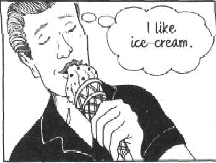
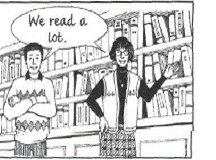
He likes ice-cream. They read a lot
Употребление
1. The Present Indefinite Tense употребляется для выражения действия обычного, постоянного, повторя ющегося, происходящего в настоящее время, не соотнесенного с моментом речи:
- I live in Moscow. — Я живу в Москве.
- My brother studies at the Institute. — Мой брат учится в институте.
- My friend speaks English well. — Мой друг хорошо говорит по-английски.
Обычный, повторяющийся характер действия, выраженного данным временем, часто подчеркивается наречиями: usually, often, seldom, always . В предложении они стоят между подлежащим и смысловым глаголом:
- I always get up at 7.00. — Я всегда встаю в 7 часов.
- We sometimes go sailing at weekends. — Иногда мы совершаем морские прогулки в
выходные.
- Do you often go to the cinema? — Ты часто ходишь в кино?
ВНИМАНИЕ! Глагол to be употребляется перед наречием:
- I am always late for school. — Я всегда опаздываю в школу.
- He ' s never at home when I call. — Его никогда нет дома, когда я звоню.
2. Кроме выражения обычного, постоянно повторяющегося действия The Present Indefinite Tense исполь зуется в ряде других случаев, где эта форма заменяет собой другие видо-временные формы:
— с глаголами understand, want и др. для выражения действий, происходящих в момент речи (вместо The Present Continuous Tense):
- I quite understand what you mean. — Я вполне понимаю, что вы имеете в виду.
— вместо The Present Continuous Tense с глаголами для выражения действий, которые совершаются в момент речи, но называются в общем виде, а не воспринимаются как процесс:
- You leave me no choice. — Вы не оставляете мне выбора.
- I refuse to listen to you. You talk too much. — Я отказываюсь слушать вас. Вы говорите слишком много.
— вместо The Future Indefinite Tense в придаточных предложениях времени (после союзов when, after, before, till / until, as soon as, while), условия (после союзов if, unless, in case ) , уступки (после союзов even if, even though, whatever, whenever , however и др.):
If we don't find him at home we’ll leave him a message. — Если мы не застанем его дома, мы оставим ему записку.
— вместо The Future Indefinite Tense для выражения действий, которые произойдут в недалеком будущем согласно договоренности, программе, плану:
- Your plane leaves in an hour's time. — Твой самолет вылетает через час.
— вместо The Future Indefinite Tense в вопросах, относящихся к ближайшему будущему времени:
What do we do next? — Что мы сделаем дальше?
— иногда вместо The Past Indefinite Tense для описания прошлых событий, чтобы придать описываемому больший драматический эффект:
- I remember the scene very well. Mr. Blake, in a dinner-jacket, arrives at the ground floor
by lift. The lift door opens: Blake gets out, looks at something on the left.... — Я очень
хорошо помню эту сцену. Мистер Блейк, одетый к обеду в пиджак, спустился на
первый этаж на лифте. Дверь лифта открылась: Блейк вышел, посмотрев налево...
The Present Indefinite Tense употребляется в восклицательных предложениях:
How swiftly the years fly! — Как быстро летят годы!
Образование отрицательных предложений и общих вопросов
Вопросительная и отрицательная формы образуются при помощи вспомогательного глагола do в настоящем времени, который в 3-м лице единственного числа имеет форму does и инфинитива смыслового глагола без частицы to.
В вопросительной форме вспомогательный глагол ставится перед подлежащим:
- Do you live in Moscow? - Ты живешь в Москве? - Does he live in Moscow? - Он живет в Москве?
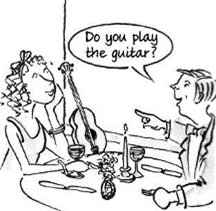
do | I | work? like? do? have? |
does | he she | work? like? do? have? |
Remember: do I/we/you/they does he/she/it... Do they like music? Does he like music?
Short answers
Yes, I/we/you/they do.
he/she/it does.
No, I/we/you/they don't.
he/she/it doesn't.
'Do you play tennis?' 'No, I don't.'
'Do your parents speak English?' 'Yes, they do.'
'Does George work hard?' 'Yes, he does.'
'Does your sister live in London.' 'No, she doesn't.'
В отрицательной форме отрицание not ставится после вспомогательного глагола:
- I do not live in St. Petersburg. - Я не живу в Санкт-Петербурге.
- Не does not live in St. Petersburg. - Он не живет в Санкт-Петербурге.

She doesn't drink coffee. He doesn't like his job.
I drink coffee but I don't drink tea.
Sue drinks tea but she doesn't drink coffee.
You don't work very hard.
We don't watch television very often.
The weather is usually nice. It doesn't rain very often.
Gerry and Linda don't know many people.
Образование специальных вопросов
Вопросительные предложения, в которых вопросительное слово выступает в роли подлежащего или определения к подлежащему, имеют структуру повествовательного предложения.
Вспомогательный глагол do в этом случае не употребляется (а окончание- s в 3-м лице ед. числа принимает уже сам смысловой глагол):
Who helps your mother? - I do | Кто помогает твоей маме? - Я. |
Whose brother goes there? | Чей брат идёт туда? |
Who goes there? | Кто идёт туда? |
Study the word order:
do/does + subject + infinitive
Do | you | work | in the evening? | |
Do | your friends | live | near here? | |
Does | Chris | play | tennis? | |
Where | do | your parents | live? | |
How often | do | you | wash | your hair? |
What | does | this word | mean? | |
How much | does | it | cost | to fly to Rome? |
Questions with always/usually/often:
What | do | you | always | have | breakfast? |
What | does | Chris | often | play | tennis? |
What | do | you | usually | do | at weekends? |
Глагол ‘to have’
Глагол to have – иметь, обладать.
Глагол to have спрягается по общим правилам, сохраняя в Present Indefinite форму have во всех лицах и числах, кроме 3-го лица единственного числа, где он принимает форму has.
В Past Indefinite он принимает форму had. (Из-за большой частоты употребления в формах «haves», «haved» произошло выпадение слога "-ve-", в результате чего образовались формы has, had.
Вопросительные и отрицательные предложения образуются с помощью вспомогательного глагола do/ does или частицы got:
I have a car. / Do you have a car? I have a car. / Have you got a car?
Краткий утвердительный ответ состоит из : Yes, личного местоимения/подлежащего и глагола to have в соответствующем лице:
Have you a blue coat? | У тебя есть синее пальто. |
Yes, I have | Да. |
Отрицания образуются двумя способами: С отрицательным местоимением no, если существительное-дополнение не имеет перед собой определителей (после no никакие артикли не употребляются):
I have no pen. | У меня нет ручки. |
He has no books. | У него нет книг. |
They have no money. | У них нет денег. |
С отрицательной частицей not, если перед существительным имеются его определители (притяжательные или указательные местоимения, неопределенные местоимения much, many и др., количественные слительные и т. д.):
I have not your book | У меня нет твоей книги. |
I haven't many pencils | У меня немного (мало ) карандашей. |
I have not five pens, I have only three. | У меня нет пяти ручек, у меня только три. |
В устной речи употребляются сокращенные формы haven ' t и hasn ' t. Краткий отрицательный ответ состоит из: No, личного местоимения/подлежащего и глагола to have с отрицательной частицей not:
Has he got a red tie? | У него есть красный галстук? |
No, he hasn't ( has not ). | Нет. |
Глагол ‘to be’
Спряжение глагола to be в настоящем неопределенном времени:
Лицо | Единственное число | Множественное число |
1 | I am | We are |
2 | You are | You are |
3 | Не is She is It is | They are |
В прошедшем неопределенном времени глагол to be имеет формы was (для единственного числа) и were (для множественного числа). Формы причастий: been, being, т. е. to be - was, were - been - being.
- He was in St. Petersburg last year. — Он был в Санкт-Петербурге в прошлом году.
- They were in yesterday. — Вчера они были дома.
В вопросительной форме настоящего и прошедшего времени глагол ставится перед подлежащим:
- Was he in St. Petersburg last year? — Он был в Санкт-Петербурге в прошлом году?
- Are you an engineer? — Вы инженер?
Отрицательная форма настоящего и прошедшего времени образуется при помощи отрицания not, которое ставится после глагола: Не is not a student. — Он не студент.
Все другие глагольные времена образуются по общему правилу. В предложении глагол to be может употребляться: — в качестве смыслового глагола со значением "быть", "находиться":
- My friend was in Leningrad during the war. — Мой друг был в Ленинграде во время войны.
— в качестве вспомогательного глагола:
1) для образования группы продолженных времен:
- Не is reading a book now. — Сейчас он читает книгу.
2) для образования всех времен страдательного залога:
- This house was built last year. — Этот дом был построен в прошлом году.
- This house has already been built. — Этот дом уже построен.
— в качестве глагола-связки:
- She is a doctor. — Она врач.
— для выражения долженствования:
- We are to meet at 8. — Мы должны встретиться в 8.
Упражнения
Упражнения уровня Starter
Образование Present simple.
1. Present Simple: he and she. Write the he or she form of the verb.
a) My father really...likes... football/ (like)
b) Patricia............the Internet at work. (use)
c) Our daughter............a lot of television. (watch)
d) Dario............for an internationa1 company. (work)
e) My father............the newspaper at work. (read)
f) Danielle is a teacher: she.......... French. (teach)
g) My friend Bob............in the United States. (live)
h) David is a footballer: he............ or Manchester United., (play)
i) Jackie............three brothers am three sisters. (have)
2. All forms
Underline the correct verb form
a) Michael come/comes from Canada,
b) Mary work/works for a German bank, but she doesn't speak/speaks German at work - she speak/speaks English all the time!
c) 'Does Luis play/plays basketball?'
'No, he doesn't/don't. But he watch / watches it on TV.
d) Jane doesn't/don't eat meat or fish out she eat/eats eggs.
e) Maggie teach/teaches French in a Language school, but she doesn't like/likes her job.
f) Johnny like/likes rock music, but h doesn't/don't like rap music and he hate/hates jazz!
g) 'Do/Does your mother like shopping?' 'Yes, she does/do. She love/loves it!'
3.Complete the text using words from the box
got up get have sleep start finish have go go have

My name's Margaret Beech. I'm a journalist.
I (1).get up early, at quarter to six, and (2)..............to work at about half past six. I (3)..............
breakfast in a cafe near my office, and (4)..............work at half past seven. I don't (5)..............a big lunch, just a sandwich and a coffee. I usually (6)..............work at about six o'clock. I ..home at seven, then I9 8)..............dinner with my husband - he loves cooking! After dinner we usually watch TV, then I (9)..............to bed early, at about ten o'clock, and (..for seven or eight hours.
4. Поставьте данный в скобках глагол в правильную форму.
Подсказка: не забывайте спрягать глаголы по лицам и числам!
Water _______ (to freeze) at 0 degree Celsius. Olay always_______ (to wear) expensive clothes. My job is interesting. I always_______ (to meet) interesting people. We _______ (to like) sandwiches. This pair of shoes is expensive. It _______ (to cost) a lot of money. These shoes are cheap. They_______ (to cost) little money. Misha and Sasha usually_______ (to have) dinner at 4 o'clock. I never_______ (to watch) television. Sometimes my younger brother_______ (to read) in bed.5
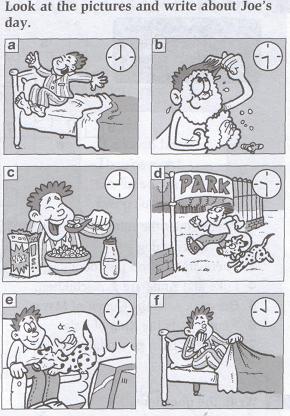
Ex. Joe gets up at eight o'clock. He.........
6. Read about Suzie's day and complete.
Suzie’s Day
8. 30 go to school
9.00 have english
10.30 play volleyball
I. OO have lunch
4. OO qo home.
4.30 play with Tilly
5.00 watch television
Suzie 1 ..goes to school..at hallf past eight every day. She 2...........................at nine o'clock every day. She 3........................... at half past ten. At one o'clock she 4............................At four o'clock she 5……………………………………..She 6...........................in the garden at half past four. At five o'clock she 7............................That's Suzie's day!
7.Complete. Use the correct form of the verbs.
Jack (not wash) doesn’t wash, his face every day and he (not brush) 2......................his hair. He (not eat) 3......................salad and he (not drink) 4......................milk. He eats only hamburgers and hot dogs. Jack is very lazy too. He (not read) 5......................books and he (not do) ...................... his homework. Is he Crazy Jack or Lucky Jack?
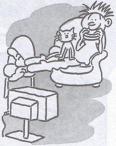
plete. Use do, does, don't or doesn't
Amy 1 ...PP.. you wear jeans?
Ellen Yes, I2..........
Amy 3.........your mum wear jeans?
Ellen Yes, she 4..........My grandma and my grandad wear jeans, too.
Amy 5.........your mum work?
Ellen Yes, she 6..........She's a teacher. Every Saturday I go to the cinema with my grandma and grandad.
Amy And your mum?
Ellen She 7.........like the cinema but she likes pizza. We have pizza every Sunday.
Amy 8.........your grandma and granddad eat pizza?
Ellen No, they 9..........They don't like pizza.
Утвердительные предложения.
plete.
swim do go play (x2) ride
computer games with my grandma.
2 The girls and boys from Micky's class ........in the swimming pool on Fridays.
3 I........to the cinema on Saturdays.
4 I........my homework on Sundays.
5 Every Saturday they........bikes in the
park.
6 We........tennis at school.
10. Match and make sentences.
1 volleyball b
2 football
3 table tennis
4 basketball
5 tennis
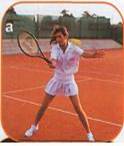
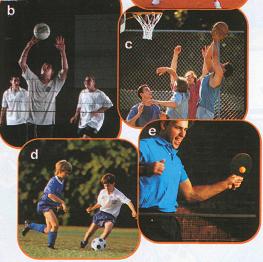
plete. Use the correct form of the verbs.
Every Saturday Suzie (get) 1gets up at eight o'clock and (have) 2........her breakfast. Then
she (wash) 3........Tilly and (brush) 4........her. Then she (go) 5........to the park with Tilly.
Tilly (play) 6........with her ball and (run) 7.........Suzie (go) 8........home with
Tilly at two o'clock. Then Suzie (watch) 9........television and Tilly (listen) 1°........to pop songs.
12. Tell the class about Joe's Saturdays.
Every Saturday Joe gets up at nine o'clock. He...
Saturday
9.00 I get up and have a wash. I brush my hair.
9:30 I have breakfast.
11: 00 I go to the park with Ted. I play with him.
1:30 I go home and have lunch.
2:30 I play computer games.
4:00 I watch television.
6.00 I play tennis with Suzie.
Write about your Saturdays. Every Saturday I get up at.
13. Complete. Use the correct verb form.
Every day I (get up) 1 get up at eight o'clock. I (have) 2.........breakfast and then
I (meet) 3.........Dell Davis. We're singers in a pop group - The Tops. Dell (play) 4.........the guitar too. We (write) 5.........new songs for the group. On Wednesdays and Saturdays I (sing) 6.........
with The Tops at a club. It's cool! My brother (watch) 7.........my concerts. He (like) 8......... The Tops and he's my number one fan!
14. Put the verbs in brackets into the present simple.
1 I....play.... (play) football with my friends on Sundays.
2 Tina.........................(walk) to school every day
3 We...........(go) to bed at 10 o'clock every night,
4 Penguins...........................(live) in the Antarctic
5 Tony.........................(study) Maths at university.
6 Jo and Peter................(visit) their grandparents every week.
7 Sally.............................(speak) Spanish.
8 Mike............................(do) his homework every evening.
9 Susan.......................(wash) her hair every day.
10 Water..........................(boil) at 100° Celsius.
15. Put the verbs in brackets into the present simple.
This restaurant is called "Vienna". Ten people 1) ...work.... (work) here. Julia Thomas is the owner. She 2) (qo) to the restaurant at four o'clock in the afternoon. The waiters 3).........(arrive) at half past four. They4)........(set) the tables and 5)..................(tidy) the kitchen. The chef, Pierre Rousseau, 6)..................... (come) at five o'clock. He 7)................... (prepare) the food for the evening. The restaurant 8) ...................... (open) at six o'clock. Many people 9) (eat) here because the food is very good. The restaurant ........... (close) at one o'clock in the morning, and at half past one Julia, the chef and the waiters11)...................(go) home.
16. Put the adverbs in the correct place, as in the example.
1 I drink a glass of milk in the morning, (always)
I always drink a glass of milk in the morning....
2 Kate goes to bed late at night, (never)
3 My mother watches TV. (rarely)
4 You can see clouds in the sky. (sometimes)
5 Ben eats in a restaurant, (seldom)
6 Joanne doesn't get up early, (usually)
7 They are late for school, (often)
17. Write true sentences about you.
1 beer I like beer. /I don't like beer.
2 swimming_________________
3 pizza_____________________
5 coffee
6 football
7 Italian food
8 wine
9 hamburgers
18. Answer the questions. Write true answers about you.
1 What time do you get up? I get up at
2 What time do you have breakfast?
3 What time do you go to work/school?
4 What time do you have lunch?
5 What time do you get home?
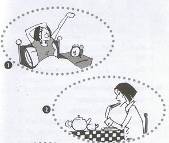
19. Look at the pictures and complete the sentences about Marta's day.
1 Marta gets up at seven thirty.
2 She__________tea and toast for breakfast.
3 She__________home at__________.
4 She __________to work by car.
5 She__________a sandwich for lunch.
6 She_________ home at
7 She sometimes______________out in the evening.
Отрицание и общий вопрос.
Task 20. Write don't in the correct place to make negative sentences.
a) We don't have an expensive car.
b) I study French.
c) I work in the centre of town.
d) I have a brother.
e) We live in Poland.
f) Our сhildren drink tea.
Negative
Task 21. Make these sentences negative
a) My dog likes cats. - My dog doesn't like cats.
b) Paul teaches English.
c) Carla lives with her parents.
d) My father likes rock music.
e) Sam plays tennis.
f) Olga works for a British company.
g) Brian speaks Japanese.
Общие вопросы.
Task 22. Questions
a) Write the questions for these answers.
1 (live/ house/flat)
Do you live in a house or flat?
I live in a flat.
2 (study/ German) ..................................................................?
No, I don't. I study English!
3 (have/ any children) ..................................................................?
Yes, two. Their names are Tom and Anna.
4 (live/ town/city) ..................................................................?
I live in Fermo, it's a town in Italy.
5 (have/ any pets)
...........................................................?
No. 1 don't like animals.
6 (have/ any brothers and sisters)
......................................................... ?
Yes, one brother. His name's Mark.
Tina | Tony | |
Food and drink Do you... eat meat? drink a lot of coffee? | NO, I'm a vegetarian. No. | Yes... I love burgers!! Yes. |
Music Do you... like rock music? like dancing? | No, I hate it! Уеs. | Yes. No. |
Languages Do you... study a foreign language? speak French? | Yes. Yes. | No...I only speak English. No. |
Free time Do you... play a sport? like computer games? | Yes, I play tennis. No. | No. Yes, I love them!! |
b) Write questions and answers about Tina and Tony, as in the example.

|
Из за большого объема этот материал размещен на нескольких страницах:
1 2 3 |
