

Партнерка на США и Канаду по недвижимости, выплаты в крипто
- 30% recurring commission
- Выплаты в USDT
- Вывод каждую неделю
- Комиссия до 5 лет за каждого referral
The Main Principles and Directions of Reforms in the Electrical Power Industry in Russia and Other Countries of the World
Sergei ALEXANDROV
Introduction
This paper systemizes the main premises, principles and contents of the reforms in the electrical power industry in Russia through the prism of earlier reforms in the monopolistic sectors of Western economies. The reformation processes in electrical power industry undertaken recently in different countries can be considered as part of a global tendency towards liberalization in the state sector of the economy. The policy of the state which is the key agent in electrical power industry forms and directs the development of new market forces in the country.
Three directions of state policy can be defined as fundamental for the construction of a restructuring model in the industry of natural monopoly: (1) a greater involvement of the private sector in the management of the industry, (2) the liberalization of economic relations and (3) vertical integration modification.
The state determines the development of electrical power systems by changing the organizational models (structures) of interacting agents. This paper begins with a presentation of the main factors of change in the market of electrical power industry as a former natural monopoly and considers the possibilities for the introduction of differentiated state regulation. The second part of the paper develops the analysis of the three above-mentioned directions of state policy for creating a restructuring model and finally in the conclusion the basic features of the reformation process in electrical power industry are summed up.
1. Evolution of the market form in electrical power industry
1.1. Factors for changing the type of market in electrical power generation industry
Up to the end of the 1970s in economic theory and practice there was a prevailing conception that electrical power industry was a natural monopoly because only in the framework of the whole country it was possible to achieve maximal effect from the scale of production, i. e. minimization of mean and marginal costs of electrical power generation. The whole material complex of the industry historically belonged to the state (or was nationalized after World War II) in the majority of countries.
There are several specific features of electrical power industry going back to the history of its formation and development: it was developed under the control of the state in the large majority of countries. These features are the following:
1. Systemic development, connected with the historic process of the formation of big systems of power and energy industries (Melentyev, Makarov, 1983: 13). The development of these systems is determined mainly by the need of national economies in a certain amount of electrical and thermal energy with the observance of necessary security and reliability requirements, the quality of energy supply, and also ecological security (Glukhov, Barykin, 2003: 28).
2. Activities of big power and energy systems, which perform not only a servicing function but also considerably influence the development and location of productive forces.
3. The priority of reliability of electricity supply to the population and the economy over the economic interests of companies engaged in the industry.
4. High social and economic cost of the functional failure of power systems (Primorsky Krai of Russia[1] at the end of the 1990s up to 2001; California in , North Eastern part of the USA and a part of Canada - August 2003; Italy in September 2003, Moscow region of Russia in May 2005).
5. High capital consumption of the industry and, consequently, the necessity of additional guarantees make the state participate in the projects directly or in other forms in order to attract financial means in the capital market: state’s participation reduces risks of investment in the projects.
6. Strong inertia in the industry’s development which is the consequence of high capital consumption. Academics L. A. Melentyev and A. A. Makarov claim that the factors of inertia and high capital consumption push the horizon of the development of this industry a further 20-30 years (Melentyev, Makarov, 1983: 61).
7. The necessity of creation and support of reserves in the production and transportation of energy resources.
8. Conduction of ecological monitoring and controlling of the industry. The objects of electrical power industry (for example a nuclear power plant) are a source of additional risk for the population and the environment.
9. Exceptional importance of electrical power supply especially in isolated and distant regions of the country.
For all these reasons the preservation of the regulating function of the state is the objective necessity under any extent of liberalization of economic relations in electrical power industry, especially, in the situations of failure of the market (direct tariff formation for the grid companies, control over market abuses, technological and ecological control, strategic investment planning).
The methodology of research of the optimal strategies of management for such complex production systems as electrical power industry is based on the systems approach, implying a complex analysis of input and output characteristics of electrical power industry as a whole by combining the analysis with the consideration of the general development of the economy of the country and world economy.
Here are some facts from the history of Russia: the first practical application of the systems approach in electrical power industry of Russia is considered to be the GOELRO[2] plan of electrification of the whole country which was worked out by a group of outstanding engineers headed by G. Krzhizhanovsky after the October revolution in Russia in 1917. The systems approach was widely used in the years of state planning of the economy of the Soviet Union. Through this a noticeable progress in the balanced development of electrical power industry was achieved and the Unified Energy System was created.
The theoretical basis of new energy policy in the world has become Neoliberalism[3] insisting on the limitation of state interference and regulation in economy, promoting wide scale privatization of state property, and promoting the advantages of privatized infrastructure functioning in competitive conditions and reducing the burden on the state budget, optimizing business processes and realizing new projects comparatively more quickly and effectively (Stober, 2002: 229-231).
So the first catalyst of new attitude to the state energy monopoly became the conviction that the state monopoly was not interested in improving productivity and the quality of services. The systematic liberalization of economic relations in electrical power industry and privatization of power enterprises of different specialization was implemented in in the developed countries (the USA, EU, Australia, etc.) and in a number of developing countries (Argentina, Chile, etc.), and also in post-socialist countries (Poland, Hungary, Ukraine, Kazakhstan, etc.). The reformation programmes of the industry have been developed in China, Japan, South Korea, etc.
Secondly, the successful experiment of deregulation in such industries as gas, telecommunication, civil aviation, railway networks, bank sector in the s in the USA, Great Britain and Japan has also speeded up the reformation of electrical power industry.
Thirdly, the improved international relations in the late 1980s connected with the end of the political confrontation, allowed withdrawal from state management in certain spheres of economy which national security policy required.
Fourthly, the economy of scale which was the main argument in favour of the structure of natural monopoly in this industry has lost its current relevance. The introduction of new technologies (less powerful steam-gas stations of combined heat and power type with a high coefficient of productivity, wind energy and solar energy stations, technologies of photovoltaic panels and thermoelectric devices, etc.) has allowed small and middle-sized electrical power stations to become rather competitive relative to big-sized plants and companies. It has lowered the investment threshold for access into the generation sector and marked the beginning of distributed generation. It can be illustrated by the fact that the unit cost of power capacity ($/MW) of modern gas-steam plants of combined heat and power type of 50-200 MW is comparable in real terms with the unit cost of typical for the 1980s power plants with steam turbines with the capacity of 1,000 MW (Hunt, Shuttleworth, 1998: 4; Chernukhin, Puzin, 1985: 92).
Fifthly, the accumulation of capital and realization of security measures at the power plants allowed power companies to be more independent in financial and maintenance issues.
Sixthly, in a number of countries privatization of electrical power industry has created an additional source of income for the state budget and helped to avoid debts accumulated by unprofitable companies.
Seventhly, the processes of liberalization turned out to be closely connected with the processes of globalization: formation of transnational companies, regional integration (EU, NAFTA, Mercosur) and policies of the World Bank and European Bank for Reconstruction and Development (EBRD) which in many cases lobbied for the restructuring of monopolies and reducing state expenses.
Eighthly, necessity for diversification of portfolio of primary energy resources (especially in the period of oil crises in the 1970s) enhanced interest in the development of power stations of renewable energy resources and other new technologies.
Regarding the starting position of electrical power industry of Russia at the beginning of restructuring in 1999 the following can be stated: the structural frame of electrical power industry of Russia constituted more than 700 power plants with a capacity of 216 GW, centralized system of high-power transmission lines (220 kV and higher) covering the whole territory of the country (except the Far East and Far North), the system of distribution networks (110 kV and lower) and the centres of energy consumption.
The main production funds in electrical power industry of Russia concentrated in:
- the holding company RAO UES[4], where the controlling number of shares (in 2008 it was 52%) belonged to the state (72% of all electric output of the country) until the company ceased to exist in July 2008 as a legal entity due to further reorganization of the power industry;
- State RosEnergoAtom[5], which had 10 Nuclear Power Stations (11% of electrical power of the country);
- a number of smaller independent companies.
The profits of all companies were regulated via tariff established by the Federal Energy Commission (since 2004 by the Federal Tariff Service[6]).
The restructuring of electrical power industry was instigated by certain technological indicators which showed that Russian companies were falling behind the analogous companies in developed countries. It was decided to create incentives to increase the efficiency of power companies and attract more investments to this sector of economy. The need for huge investments estimated by the Head of RAO UES A. Chubais served as an explanation for the privatization reforms in the industry.
The First Deputy Director of the Institute of Problems of Natural Monopolies in Russia B. Nigmatulin states that the increase of power generation according to Rosstat (Fedral Service of State Statistics of Russia[7]) of electrical power industry in Russia constituted 2% and the rise of consumption 2.4% in 2007. He claims that the rate of 4.1% of annual growth for the next years predicted by the Head of RAO UES Anatoly Chubais is not quite correct (the total production was 1.016 trillion kilowattthours in Russia in 2007).
Thus according to Chubais this requires approximately 3.5 GW of new additional capacities. The investment plans of RAO UES and RosEnergoAtom envisage the demand for 8.4 GW of new capacities after 2010 and after 2014-2GW. However Nigmatulin argues that due to the present situation with the work force and industries in Russia such a rise of demand cannot be expected or satisfied (Nigmatulin, 2008).
As a part of reforms in the industry, RAO UES, a state monopoly, was reorganized in two stages. The first stage was connected with WHC-5 and TGC-5 leaving the RAO UES. They have issued additional shares which allowed them to attract strategic investors to participate in their authorized capitals with the government having a blocking shareholding (RAO UES, 2008).
The second stage envisages the return of the state’s control over reorganized industry according to the reorganization plan: high-voltage transmission grids pass to the Federal Grid Company (with the share of the state of 75%), distribution grids transformed into interregional distribution grid companies (11 IDGCs combined under a holding company) with the share of the state of more than 50%, the functions and assets of regional dispatch administrations transferred to the System Operator (100% state-owned).
Generation assets are consolidated into interregional companies of two types; generation companies of the wholesale market (wholesale generation companies - WGCs, which are power plants specializing mainly in electric power generation; six on the basis of thermal plants and one on the basis of hydrogeneration assets - RusHydro) and 14 territorial generation companies (TGCs) which comprise predominately combined heat and power plants producing both heat and electricity (all of them with less than 50% of the Russian Federation-owned share). Many generation companies, sales companies and repair works have already been privatized. The exceptions are nuclear power stations, the Far East Generation Company and isolated AO-Energo companies, which remain under full state control (RAO UES, 2008).
Nowadays, according to the GENI (Global Energy Network Institute) Russia’s electrical power industry includes 440 thermal and hydropower plants and 30 nuclear power plants; a total capacity of 203 GW; thermal power plants (oil-, natural gas-, and coal-fired) account for 68% of Russia’s generation capacity (138 GW), hydropower plants account for 21.5% (44 GW). The Russian electricity fuel mix remains mainly dependent on natural gas (Global Energy Network Institute, 2008).
1.2. Structuring electrical power industry in order to introduce differentiated types of markets
According to the Energy Strategy of Russia it is possible to define the following main principles which determine the target structure of deregulated electrical power industry (Energy Strategy of Russia, 2003: 5[8]):
plete and reliable electricity supply for the population at prices which will encourage people to economize on electricity;
2. The reduction of unit cost on the use of energy resources due to a more rational consumption, introduction of energy saving technologies and equipment and reduction of losses in the production, transmission and distribution processes. In the framework of this reform a special cost-effective business structure is supposed to be created which will minimize the costs (consequently, prices) in each sector of electrical power industry (Gwartney, 2003: 536).
3. It is important to create increased financial stability in the energy sector. Under the restructuring of the industry it is necessary to avoid an excessive fragmentation of business processes. For example, generation companies must be united to a degree which will provide their maximal operational, investing and technological stability and effectiveness without violating the anti-monopoly law.
4. Minimization of technogenic impact on the environment by adopting economic incentives for improvement and implementation of new production technologies, transmission, distribution and consumption.
Figure 1 illustrates the schematic presentation of monopolistic and competing sectors (agents) under restructuring of electrical power industry for the implementation of above-mentioned principles.
It is well known that any branch of industry can generally contain both a market of perfect competition and a market of imperfect competition. The principal difference between them is the degree of control over the prices. In the perfect competition control over prices is impossible because the sellers work in the conditions of absolute elastic demand dependent on the price, which in the electrical power industry is rare.
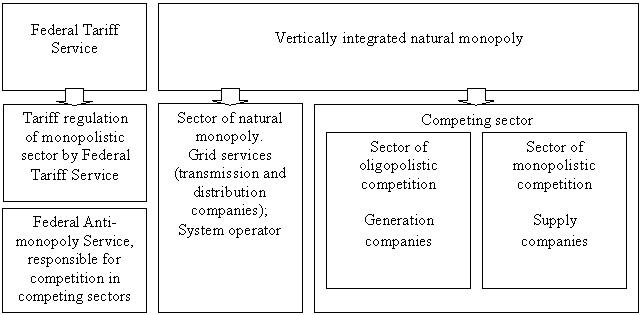 |
Figure 1. The scheme of main subjects under reformation of electrical power industry.
In the upper part there is the industry before reforms;
below – the targeted state; on the left – Federal Tariff Service of Russia[9].
The degree of control in different models of imperfect competition also varies. The monopoly which can be exposed by the domineering position of a producer is characterized by the greatest level of control exercised by the producer (more exactly by a regulating agency) over prices.
Grid services in electrical power industry should be characterized as a natural monopoly of infrastructure due to an economy of scales and other reasons. The population receives unique electric power transmission and distribution services which is economically irrational to double. Therefore, under this lack of choice these services must be physically and price available to the population.
Russia has a unique unified power grid of a huge size and it is used in seven time zones for transmission of energy from one region to another. It has been calculated that if not unified the country would need additional 15 GW capacity.
Organizational and legal forms of natural monopoly in electrical power industry in Russia are the following:
- the unified company for transportation of electrical energy (220 kV and
higher) ‘Federal Grid Company’;
- the Holding of regional distribution companies (below 220 kV);
- the company which is the System Operator, responsible for the adjustment of
the operating schedule of generation and consumption taking into account
the variation of energy demand among regions.
The profits of all companies at present are formed on the basis of tariffs established by the state regulating agency ‘Federal Tariff Service’. The state control over the operation and development of companies is provided by the increase of the state share via authorized capital up to 75%. Till July 2008 the state was an indirect owner of all these companies via the holding company RAO UES having the controlling number of shares (52%).
In the oligopolistic market the supply side is provided by a few big producers, each of them is able to influence the prices of goods and services offered by their competitors. Any decision of an oligopolist about prices and volumes of output will have a direct impact upon the position of the competitors, and he can expect a feedback reaction from them. Thus, the profit of every producer depends not only on the consumers’ response but also on the actions of his competitors. That is why the oligopolistic producer restrains price reductions, and prices, in general, are stable.
The power generation market in the majority of countries is an oligopoly because the demand for electrical power can be satisfied by a few producers or determined by the presence of 2-4 companies whose price policy defines prices for the whole market. So, in Germany it is RWE, E. ON, EnBW, in Sweden - Vattenfall Europe; in Great Britain - RWE Innogy, E. ON. UK (PowerGen), British Energy; in France - EdF and in Italy - Enel.
In 2007 in Russia there were more than 20 generating companies: Territorial Generating Company №№ 1-14 (TGC), Wholesale Generating Company №№ 1-6 (WGC[10]), Wholesale Generating Company ‘RusHydro’ with a capacity of 3 to 20 GW alongside the generating companies of the state concern ‘RosEnergoAtom’[11] (23 GW). Nevertheless, it is worth pointing out that the direct price competition between the main three groups of companies (WGC, TGC, nuclear stations) was restricted by the following:
- thermal combined cycle power stations (included in ТGC) and nuclear power stations have the priority according to the Federal Law on Electrical Power Industry[12];
- the output of hydrostations (included into RusHydro and some TGC) is determined by the residual demand which remains after the use of combined heat and power plants and nuclear power plants and the necessity of preservation of capacity reserve for the peak demand may even lessen their output;
- the thermal stations of WGC and TGC either located in one region or being linked by a network system can enter into the direct price competition when they are concentrating on pure electricity production, though such periods are limited mainly by summer time.
Thus, the conditions of the formation of capacity balance in Russia and also the fact that in a separate region there are not more than 2-3 generating companies (not taking into account the isolated regions of the Extreme North) reveal an oligopolistic type of the market of electrical power generation.
According to the plan of restructuring the electrical power industry, the majority of WGCs and TGCs have been/will be privatized, and wholesale deals will be executed through the commodity exchange by 2011. Many subtleties connected with the free formation of prices in this market and the abilities of the company to make price estimates for the mid-term period and also the questions of regulation by the state are still to be defined.
The third type of market is the market of monopolistic competition (different from a perfect competition) which presupposes a wide use of non-price competition (advertisement, design, service, maintenance, etc). Usually it is connected with the differentiation of products in the monopolistic competition market. It does not, of course, take place in electrical power industry with its highly standardized set of services. However, the sector of supply companies in Russia is the closest to the market of monopolistic competition because it preserves the access barriers: affiliation, licensing of activities, inertia of consumers. Moreover, the majority of regional supply companies are under the trust management of TGCs. It is doubtful that these companies having no strong material basis can preserve their financial stability under the conditions of independence and self-reliance.
It must be emphasized that in respect of Russia’s supply companies the basic principle is the principle of gradual privatization. These companies are interesting for the participants of both local and international markets which can be illustrated by the acquisition of 49.5% of Russian RusEnergoSbyt by the Italian ENEL in 2006. ENEL, which is present in the Russian market as part of the RusEnergoSbyt partnership, and the North-Western thermo-power plant formulated a proposal to take part in privatization of the Russian electrical power sector (Russian News and Information Agency Novosti, 12.03.2007).
On the other hand, Russia may repeat the West European reform scenario when, in the end, the supply companies were acquired by the grid and generation companies restoring, to some degree, the conditions of vertical integration.
The competing factors in the target model of electrical power industry are possible in the market of such imperfect competition as oligopolistic and monopolistic (i. e. generation and supply correspondingly). Grid companies and grid operator, providing unique network service and demonstrating the effect of scale continue functioning in the conditions of operational and price regulation by the state. These are basic requirements for the formation of the industry’s structures implying elements of the liberalization of economic relations.
2. The directions of state policy concerning the restructuring of electrical power industry
State policy measures aimed at restructuring electrical power industry and other natural monopoly industries include three main directions:
1) enlarging the private sector in the management of the industry;
2) liberalizing economic relations in the industry;
3) weakening vertical integration in the industry.
As it can be seen in Figure 2, the farther the model of electrical power industry is from the axes origin, the less there is a direct state interference in the economy and the more competition it implies.
I will further describe in detail each highlighted direction of state policy defining the organizational model (structure) of electrical power industry in transition from planned economy to market economy.
2.1. The direction ‘enlarging the private sector in the management of the industry’
The enlargement of the private sector in the management of the industry includes the complex of three key groups of possible measures conducted by the state or municipality playing the role of industry agents:
(1) change of the degree of public ownership;
(2) public-private partnership (PPP);
(3) transfer of state property into the private sector.
It should be noted, from the very beginning, that the main direction of reformation of electrical power industry in Russia is not privatization but an issue of shares for share-holders and delegation of the management to the private sector preserving a state or municipality property. The proportion of countries using the procedure of privatization and countries practising the transfer of management to private companies is, approximately 2:5 (Varnavsky, 2003: 29-32).
(1) The increase of accountability to the public.
The increase of accountability to the public in Russia should be understood as the change of organizational and/or legal form of unitary state enterprise: issuing shares (corporatization) which obligates the formation of publicly available forms of accountability, annual reports and the system of executive, expert and control bodies, etc. On the other hand, commercialization implies the introduction of a system of indicators of efficiency and the forms of reward to the management.
|
|
|





Figure 2. The directions of state policy concerning the restructuring of electrical power industry[13].
There are three axes of the cube marked as arrows showing the directions of restructuring of electrical power industry. The arrow going up shows the direction named ‘Enlarging the private sector in the management of the industry’. On the left there is the direction ‘Weakening vertical integration in the industry’. On the right there is the direction named ‘Liberalizing economic relations in the industry’. The origin of these three arrows in the middle of Figure 2 denotes the least degree of competition, the greatest degree of state interference and the greatest degree of intensity of vertical integration. Each arrow has markings showing the stages of restructuring. The farthest point on each arrow from the crossing point of axes denotes the most degree of competition, the least degree of state interference and the most degree of disintegration of the vertical chain.
(2) Public-Private Partnership.
The means of the transfer of responsibility for electricity supply from the state/ municipality organs to private companies is a signed contract for giving or receiving services, with reward depending on the results of work.
The other organization may be responsible for the building of the constructions and acquiring resources necessary for the provision of services. The state or municipal body in turn guarantees the provision of economic profit to the contractor, for example, return on capital investment within a certain period of time in exchange for the transfer of the completed construction into the property of the state.
The main advantages of such a contract for the state and municipal bodies are:
- the transfer of responsibility to the specialist who has necessary resources
and knowledge;
- the transfer of the burden of investments costs;
- the transfer of technological, commercial, operational and financial risks;
- the acquisition of the finished object into their property after provision of
economic profit to the private investor.
The totality of relations within such a category of civil-legal agreements is called ‘Public-Private Partnership (PPP)’. In Russia it is a new and legally weak direction which has developed over the last 3-5 years due to the Federal Law on the Basic Regulation of Tariffs for Organization of Public Utility Complex from 30.12.2004[14]; Federal Law on Concession Agreements from 21.07.2005[15] and the legislature initiative of the Federal subjects of the Russian Federation.
The most widely spread type of agreements of PPP is the agreement for trust management, lease and concession.
I want to give an example of trust management in Saint Petersburg: the North-Western combined cycle plant had trust management of the Russian-Italian joint venture Enel ESN Energo Ltd. for three years from 2004. According to the terms of this contract, the managing company finished the construction of the second part of the power station with a capacity of 450 MW. For that purpose the loans of 120 million US dollars via Enel were drawn which remained on the balance sheet of the station after the end of contract validity.
An example of a lease contract is the transfer of all 115 Boiler stations of the Petrograd district of Saint Petersburg to the ‘PeterburgTeploEnergo’ company
(the subsidiary of ‘Gasprom’ company) for 25 years in . The ‘PeterburgTeploEnergo’ plans to modernize them completely for 5 years spending 4 milliard[16] roubles (about 170 million US dollars). The city will repay the leaseholder the payment for a lease and will reimburse all investment within 8 years by raising the tariff for heating energy (the heat supply is centralized in the city). More precisely, during the time necessary for the cost return for the project, 1/8 from the sum spent by the leaseholder for the previous period will be annually included into the tariff.
Concession agreements are the effective model of PPP and they are widely used in international practice. However this model was so new for Russia in 2007 that I could find these agreements only in the preliminary negotiation stage. For example, in Saint Petersburg they were discussing a project of the South-West combined cycle plant with electric capacity of 570 MW. The City Energy Commission in its turn was to establish tariffs on heating energy which would then help to return costs within 9 years and the concessioner would then return it to the city for some reward. The city authorities were going to guarantee the purchase of total output and to finance construction of power, heat and gas network infrastructure.
(3) Privatization.
Another widely used mechanism of implementing market relations is privatization (complete or partial). The existing structure of ownership on the assets in any country before the restructuring of the electrical power industry defines the direction and rate of restructuring (Rappoport, 2003: 30, 37).
Thus, with the prevailing private and municipal property in electrical power industry in the USA and Germany, the state efforts were directed at functional division of enterprises as minimum, and as maximum at the establishment of a free access to the networks. Quite a different picture was observed in electrical power industry of the majority of countries in Western Europe, South America, Russia, Canada, Australia and New Zealand. Here there was a nationalized monopoly system in electrical power industry. It allowed a simpler process of restructuring because it didn’t demand a coordination of the interests of other proprietors.
So, in these circumstances (but not exclusively to them) the reformation of economic units in the industry in these countries was mainly aimed at the division of the industry according to function.
There are many mechanisms for transferring companies into private property:
private offer, public offer, restitution in the form of re-privatization, compensation, bankruptcy, a voucher privatization (experimented in Russia in early 1990s), management options, employee participation programmes, etc.
Russia is realizing the wide scale plan of privatization of generation and supply companies of electrical power industry. The main forms of planned privatization conceived for were the initial public offerings and private sales, which are envisaged as funding for the investment plans of the electrical power companies. According to the industrial development plan in Russia it is estimated that 41 GW more will be introduced before 2011 (which is about 20% of the existing capacity). Measured by attracted money amounts the reform proved to be successful. Among key foreign investors that have acquired control stakes in the companies of power generation sector since 2007 there is Fortum (76% in TGC-10), E. ON (76% in WGC-4), Enel (56% in WGC-5[17]).
2.2. The direction ‘weakening vertical integration in the industry’
Electrical power industry is defined by five technological processes – (1) power generation, (2) power transmission, (3) wholesale, (4) distribution to the end consumers and (5) electricity retail (Figure 3).
According to the character of integration it is possible to distinguish two main models of electrical power industry in the world.
The first model which can be designated as complex (industrial, technological) (Pfaffenberger, 1999: 26-30; Sokolov, 2004: 22-24; Yampolsky, 2003: 10) was realized in Russia, France, Germany, Italy and some other countries.
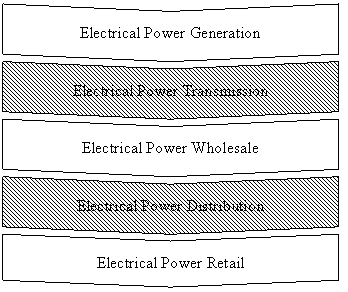

Figure 3. Generation-supply chain in electrical power industry (in the shaded parts there are regulated forms of activities)[18].
In their markets several vertically integrated companies which managed all the elements of generation-supply chain and also the infrastructure of maintenance and repair work (as a rule they are former natural monopolies) had a dominant petiton can be improved by the reduction of the monopolization of the industry via the obligatory partial sales of generating capacities by monopolies or oligopolies and allowing others the access to the networks.
The second model of the organization of the industry is a specialized model. In this case separate parts of the generation-supply chain acquire independence in economic questions and form independent companies with differing structures of ownership. Such structures are typical for modern England, the USA, the Netherlands, Spain, Poland, Ukraine, Kazakhstan and other countries.
Let us come back to Figure 2 which schematizes the directions of restructuring. One of the directions concerns vertical integration in electrical industry (an arrow going to the left in Figure 2). Figure 2 shows gradual changes in the intensity of vertical integration: (1) functional and accounting division of the main elements of generation-supply chain, (2) the separation of operational business units and finally (3) the formation of separate companies with different ownership structures. Thus, these companies eventually turn into independent subjects of the industry with their own interests, rights and responsibilities.
It should be noted that the fragmentation of power companies is a complicated and expensive process, which has positive and negative sides (Figure 4), that is why it demands a balanced approach from the state regulating body. At the beginning of the reformation it is advisable to use alternative methods which mitigate conflicts of interests among different divisions of the company (for example, by using separate systems of accounting). However, not all such agents’ conflicts are dangerous: the provision of unified information flow in the deregulated industry and the effect of scale are still an essential compensation component. For example, the subdivisions of transmission networks include or cooperate closely with the System Operator (a controlling company managing technological work regimes of the components of electrical power industry) and the Sales Operator (controlling the organization of bills for electricity supply). The combination of supply and distribution or supply and generation functions in one company in practice is rather traditional for all models of organization of electrical power industry.
For | Against |
The rise of operational and technological effectiveness as a result of competitive pressure | The decrease of operational and technological effectiveness under the artificial fragmentation of business processes |
Motivation for innovation is stronger | The loss of coordination for mid-term and long-term planning |
The reduction of costs on economic regulation under market price formation and competition | A higher probability of failures in the system, especially with the background of high inertia in power industry |
The avoidance of cross subsidy | The reduction of possibilities in risk management concerning the prices for fuel and electricity |
The reduction of conglomerate discount up to the market value | The reduction of capacity reserves |
The rise of operational flexibility due to a new choice of suppliers and buyers | The dependence of consumers and producers on the ‘conscience’ of supplying intermediary companies |
Figure 4. Positive and negative sides of the destruction of the vertical integration chain in electrical power industry.[19]
Examining the contradictory nature of the destruction of the vertical integration of companies in electrical power industry, directed at the increase of competition in the industry, I want to highlight two key principles of state policy in this direction:
- on the corporative level the vertical integration must be limited only if it
prevents the access of new competing players to the market;
- special attention must be drawn to the preservation of the integrity of
information flows between technological links of industry with the help of the formation of the coordinating body responsible for the mid - and long-term planning in the industry (especially with reference to investment plans, balances of power and capacities in separate regions and energy systems, plans of innovative development, etc).
2.3. The direction ‘liberalizing economic relations in the industry’
Under liberalizing economic relations in the industry I understand increasing openness of the industry to competition including historical monopolies. Deregulation implies the decrease of state regulation in favour of regulative capacities of economic units themselves which can be related to the conception of liberalization.
The necessary part of liberalized industry is the changed (modernized) system of state regulation (the appearance of new laws and controlling bodies for regulating arising market relations (ILO, 1999).
Even in new conditions state policy will be a defining factor for the management of companies while working out their corporative strategies, as the Deloitte researchers demonstrate (the research was carried out for developed countries for the perspective period till 2010) (Deloitte, 2000).
Thus, in order to balance the rights and duties of the producers and consumers and to implement state regulation in the countries of deregulated industry, national organs of control for the market of electrical power are established (for example in the USA – FERC, in Great Britain – OFGEM). An analogous situation will be in the electrical power industry in Russia after the implementation of the programme of liberalization in 2011: even after the state withdrawing from the authorized capital of generation and supply companies, their activities will be regulated by the Federal Tariff Service (tariffs for households) and the Federal Antimonopoly Service (abuses in the market) as shown in Figure 1.
According to the degree of liberalization it is possible to distinguish four main models of organization of electrical power industry: (1) ‘Monopoly’, (2) ‘Purchasing agency’, (3) ‘Competition in the wholesale market’ and (4) ‘Competition in the retail market’.
The first stage of liberalization of economic relations after (1) ‘Monopoly’ can be defined as (2) ‘Purchasing agency’, which is characterized by its intermediary position between competing generation companies for the place in the output balance, and competing supply companies buying according to the regulated tariffs.
The next stage of liberalization is denoted as (3) ‘Competition in the wholesale market’ which gives the right of choice to the wholesale companies.
And the next stage of liberalization is (4) ‘Competition in the retail market’ which includes a free choice of generation companies by a household and a small-sized enterprise. Of course, it is an abstract scheme which is seldom found in a real life.
Additionally, it should be pointed out that in any organizational model of industrial companies of transmission and distribution networks, and also the System Operator, there continue to be monopolistic forms of activities due to the unique infrastructure of services which they provide. Nevertheless, they also feel the impact of competition because in a number of situations it happens that the development of a grid is, in fact, the result of an alternative decision about investment in building a local power station, for example.
A kind of transition from the ‘Purchasing agency” to the partial ‘Competition in the wholesale market’ could be observed after 1997 in Russia.
Since October 2006 in the connection with changes in the Requirements for Wholesale Market the gradual order of wholesale liberalization was established:
- every year the shares of output will be growing at the commodity exchange managed by the Administrator of Trade System (ATS). It was 5% at the beginning of 2007 and will be 100% (minus budget consumers) by 2011. In July 2008 it was 15% and by the end of 2008 the Administrator of Trade System will start selling up to 25% (REC, 2008[20]). Furthermore, all will be sold immediately at the ATS;
- accordingly the share of bilateral contracts between generation and supply companies for regulated tariffs will reduce;
- the supply of electricity to the population according to the fully regulated tariffs will not change till the period of .
As it has been shown in the article, the market of electrical power industry is a designed market: the rules of it are aimed at supporting and developing competition and also at creating a favourable investment climate. The state cannot avoid its obligations just by the transfer of full powers to the market, because market forces (both agents and structures) are formed by its own regulatory policy.
Conclusion
1. The process of reformation in electrical power industry can be considered as the phenomenon of global tendency connected with liberalization of state sectors of economy in general in the world. The main reasons for launching reforms are the following: the increase of political influence of the Neoliberal school since the 1980s; the détente in the international arena; the policy of international organizations and integrated groupings; the necessity of energy diversification (especially after oil shocks); the successful experience of deregulation of other utilities and infrastructures; the technology break-throughs in autonomous energy supply.
2. In the framework of these reforms a special structure is formed which minimizes costs (and consequently, prices) for the production of all sectors of power industry. Services supplied by the grid infrastructure must belong to a regulated natural monopoly, but a competing sector can include generation and supply companies.
3. The reform policy of the state as one of the key agents in the electrical power industry consists of three main directions: the enlargement of the private sector, introduction of market competition and the change of intensity in vertical integration.
4. The enlargement of private sector participation in the management of this branch contains such possibilities as the increase of companies’ accountability to the public; the public-private partnership (PPP); the substitution of state property by private property.
5. According to the degree of liberalization of economic relations in electrical power industry there are four models of industrial organization: a natural monopoly, a purchasing agency, competition in the wholesale market and competition in the retail market. They differ by the degree of competing relations in their production-supply chain.
6. The character of integration determines two main types of model in electrical power industry: complex and specialized. In the first case vertically integrated companies predominate and liberalization is reached by the reduction in monopolization of the market via obligatory sales of some generating capacities by companies, and also by providing all competitors with the right to use the networks. In the second case separate production links - supply chain are formed by independent companies with different property structures.
7. In modern Russia there is a necessity of state regulated reforms in the electrical power sector as a system and it is conditioned by the following main factors: absence of material incentives for raising the effectiveness of output, transmission, distribution and consumption of electricity and heat; the economically and environmentally outdated equipment; the lack of investment infrastructure.
8. After the dissolution of RAO UES as a vertically integrated monopoly, its tasks were assigned to the newly established Ministry of Energy. The expectation is that it will become the centre of decision making in such areas as further liberalization of the generation sector, regulation of network companies (which remain fully state-controlled), the establishment of consumption standards. The issues of the absence of long-term gas supply contracts for generators, low ecological standards, unclear approving procedures for building power stations will be on the agenda in the near future.
9. The ultimate aim of giving people the choice of electricity supplier is set for the period after when nearly 100% wholesale volumes will be marketed at non-regulated prices.
10. Any model (structure) of the organization in electrical power industry is not static; it can and must develop and perfect itself responding to a wide set of external and internal factors.
In this paper I wanted to show that the development of relations between agents brings about structures which are formed and developed, first of all, as a result of the regulating power of the state.
[1] Russia is a federation and consists of 83 federal subjects. Primorsky Krai, a federal subject, is the extreme South Eastern region of Russia bordered by China and North Korea (ed.)
[2] GOELRO is the transliteration of the Russian abbreviation for ‘State Commission for Electrification of Russia’. It was initiated and supervised by the first Soviet leader Vladimir Lenin (see more in Editor’s Notes).
[3] L. von Mises, F. Hayek, M. Friedman, A. Laffer, R. Coase, etc.
[4] UES means Unified Energy System of Russia; on 1 July 2008, RAO ‘UES of Russia’ terminated its operations (the official website of RAO UES: http://www. *****, August 2008) (ed.).
[5] On 19 January 2007 Russian Parliament adopted the law about the formation of AtomEnergoProm - a 100% state owned holding company for all Russian civil nuclear industry, including RosEnergoAtom, the nuclear fuel producer and supplier TVEL, the uranium trader Techsnabexport (Tenex) and nuclear facilities constructor AtomStroyExport (ed.).
[6] Official website of Federal Tariff Service in Russia http://www. *****/eng (ed.).
[7] Official website of Rosstat http://www. *****/ (ed.).
[8] Energy Strategy document of 2003 sets up energy policy of Russia for the period up to 2020.
[9] Made on the basis of Kraft, 2004; RAO UES, 2006.
[10] ‘OGC’ in Russian.
[11] It started functioning in 1992 (ed.).
[12] Federal Law №35.
[13]The chart is based on Evdokimov, 2003: 52-83; Hunt, Shuttleworth, 1996; ILO, 1999; RAO UES, 2006.
[14] Federal law № 000
[15] Federal law № 000
[16] Russian millard is equal to one thousand millions (ed.).
[17] or OGC-4 and OGC-5
[18] Based on the information from the RAO UES’s official website http://www. *****, .
[19] Based on Porter (Porter, 2002: 361-386).
[20] Regional Energy Commission of Tomsk region (Tomskaya oblast).
