

Партнерка на США и Канаду по недвижимости, выплаты в крипто
- 30% recurring commission
- Выплаты в USDT
- Вывод каждую неделю
- Комиссия до 5 лет за каждого referral
Russian Fishery Market. The base tendency in consumers market
Marina Grebennikova
Development Director in the Far East Imh consulting company,
Vladivostok, Russia
Russian seafood market
The basic tendency in the consumers market
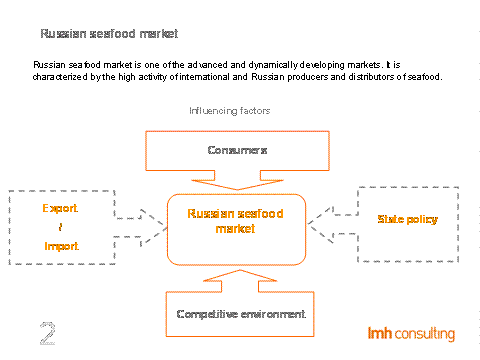
Russian seafood market is one of the advanced and dynamically developing markets. It is characterized by the high activity of international and Russian producers and distributors of seafood.
Primorsky Krai has the largest fishing complex in the system of fish industry of the country.
The share of the region in the all-Russian catch of fish and seafood extraction in 2007 reached about 21%. However, the share in selling finished products in Russian market is considerably less.
Let us examine the basic market factors affecting the market.
One of the most important factors, affecting market development is the state policy.
At the moment the state sets a problem on increasing fish products supplies to the domestic market.
Export/import:
The increase in export of fresh and fresh-frozen fish has been presented for the last 4 years and it is traditionally oriented to the Asian states - Japan, China, Republic of Korea, and also to America – the USA, Panama, Virgin islands (British) and Virgin islands (USA), to the countries of the CIS - the Ukraine.
In respect to export policy the following tendency remains:
- Fish raw material and poor processed production, which are not competitive in the world market, composed the principal portion of commodity export.
- The export of fresh and fresh-frozen fish grows each year (23.7% more than the figures in 2006 in dollar terms) and it is traditionally oriented to the Asian states - Japan, China, Republic of Korea, and to America – the USA, Panama, Virgin islands (British) and Virgin islands (USA), to the countries of the CIS - the Ukraine.
- As a rule, the production of premium quality is exported, and the domestic market gets only that part of the production, which does not meet requirements on quality.
In this case the production is imported, mainly, from the Asian countries: China (87% of total volume of fish and seafood import), Republics of Korea (6%), Vietnam (4%).
- While exporting raw material, a significant quantity of goods is imported.
- Imported goods are often produced from our raw material.
The paradox of this situation consists in the fact that the users prefer imported goods.
Summarizing the general tendency of export-import policy it is important to note that the import grows at a better pace:
The import grew 4.1 times, and the export - 1.6 times to the level of 2004.
The import exceeds export on several commodity positions: “mollusks”, “canned fish and seafood”.
There is following situation in the market from the point view of consumer:
• the consumption of seafood in whole is increasing. The factors, contributing to this fact, are the following:
growth of population income,
the changes in the culinary and cultural preferences of people,
the developing propaganda of “healthy life style”.
• the interest in sea delicacies is growing and the reasons are:
growing number of restaurants, the changes in food preferences and in leisure activities of urban population of the country;
fish delicacies become daily product for consumers with high income level and they are consumed 1-2 times a week;
the consumers with the average and low income level treat fish products as a holiday dish (the consumption is 1 time in 3-4 months).
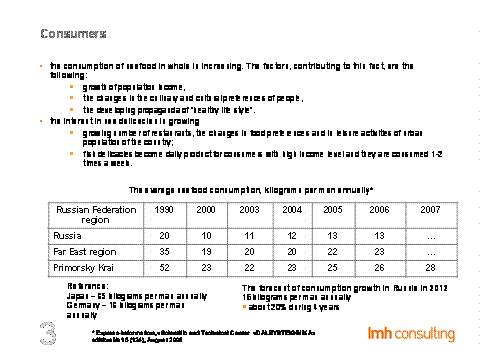
According to the information of scientific and technical center “Dalrybtekhnika” the average seafood consumption in Russia is 13 kilograms per man. In Primorsky Krai this index has reached already 28 kilograms per man by August this year. Growth dynamics has been traced only for the last 4-5 years.
It is important to note that in 1990 fish consumption on the average was 2 times more and this index was 20 kilograms per man in Russia, and 52 kilograms in Primorsky Krai.
As a comparison seafood consumption in Japan is 65 kilograms per man annually.
The consumption in Germany is 16 kilograms per man annually, this index growth has occurred due to the convenience food launching.
The forecast of consumption growth in Russia in 2012:
16 kilograms per man annually, it is about 20% during 4 years
Consumption:
Per-capita volume of fish and fish products consumption by Russians today is two times lower than the volume of the consumption of meat products, besides the consumption of each type of meat separately: bird, pork and beef exceeds.
• The frozen fish prevails in the structure of the retail fish products consumption, its portion is 35% of total fish consumption.
• Shrimps are the most popular product among the sea delicacies. The portion of shrimps in the total volume of sales of sea delicacies reaches 85%, with the fact that demand for this product is still growing.
• The considerable share of Russian fish market belongs to the foreign suppliers, among whom Norway occupies the leading positions.
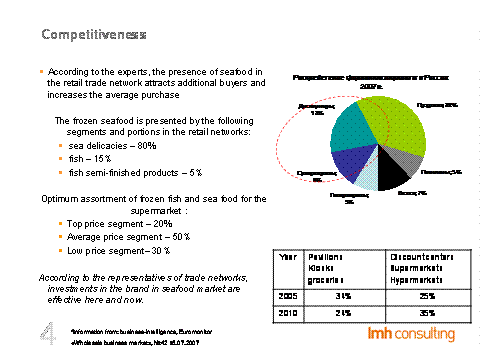
The competitive environment becomes more civilized. First of all, fish products market is moved from markets and places of spontaneous trade to the retail trade: supermarkets, hypermarkets and discount centers.
By 2010 the selling of fish products will be mainly in the retail trade system.
According to the experts, the presence of seafood in the retail trade network attracts additional buyers and increases the average purchase.
• Optimum assortment of frozen fish and sea food for the supermarket is the following:
lower price segment - 30%,
average price segment - 50%,
top price segment - 20%.
• The frozen seafood is presented by the following segments and portions in the retail trade networks:
the sea delicacies, which belong to the top price segment, compose 80%.
fish and fish semi-finished products compose 15% and 5%, respectively.
Thus it appears that categorization of products is unbalanced and determined by the slope towards premium segment.
The packing and goods layout here become the important factors of success. The goods should meet the competition of me-too products, substitutes, and soon the competition will starts within the categories.
According to the representatives of trade networks, investments in the brand in seafood market are effective here and now. Since the competition in the segment of frozen sea food is already high, effective brand and communicative strategy will make it possible to leave the category and will give the most profitable conditions for promoting in the trade networks, and give real chances to win the larger part of the market.
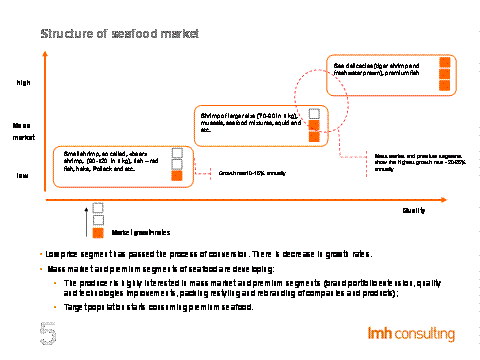
The structure of seafood market divides it into three price segments.
Low segment is presented by small shrimp, frozen fish, surimi. The rates of development of this market segment are low and compose only 10-15% per year. This segment of market has passed the process of the convergence, and considerable dynamics of the market can be seen in the average and premium segments of seafood, and the market on these segments is developing.
This segment is attractive for the producers; therefore there are brand portfolio extension, quality and technologies improvements, packing restyling and rebranding of companies and products in this segment.
The growth rates of these market categories compose 20-25%, and they can reach up to 40% on some positions annually.
• The segment of frozen products is the most promising and dynamically developing segment of the seafood market. According to the preliminary estimations, the volume of this segment composes about 1 billion US dollars, the rate of growth is estimated at from 20 to 40% annually.
• The segment of preserves at the moment is characterized by the low level of competition, but, according to the analysts, it has a good potential for development, just like the frozen products. Today the market of seafood in the brines composes 3 thousand tons annually. The sales gain composes not less than 18% annually.
• The considerable share of Russian fish market belongs to the foreign suppliers, among whom Norway occupies the leading positions.
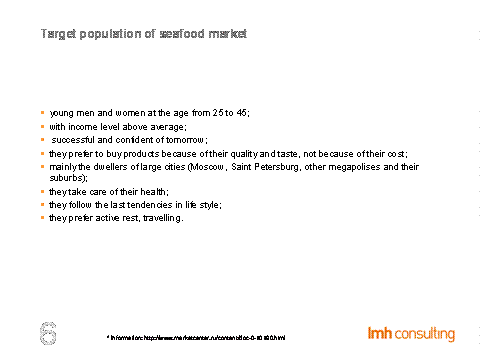
- young men and women at the age from 25 to 45,
- with income level above average,
- successful and confident of tomorrow,
- they prefer to buy products because of their quality and taste, not because of their cost,
- mainly the dwellers of large cities (Moscow, Saint Petersburg, other megapolises and their suburbs),
- they take care of their health,
- they follow the last tendencies in life style.
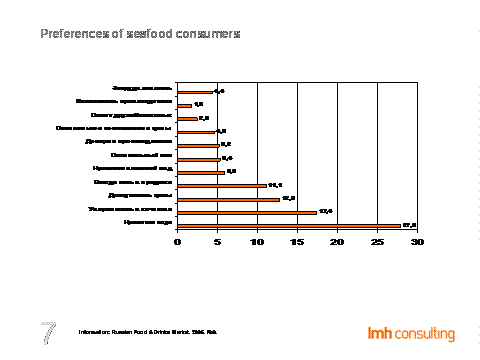
The taste of product plays the leading role among the main factors of the selection of the certain brand of packed fish products, this factor is very important for 27,9% of Russian consumers.
The second factor is assurance of quality (17,4%).
• The price and a constant presence in sale occupy the third place (12,8% and 11,1% respectively).
• Only 1,8% of respondents note the factor of brand and producer reputation.
It is remarkable, that the factor of producer reputation has only insignificant effect, but the leaders of the market already actively work to change this situation.
It is possible to suppose that when Russian consumer picks out the packed fish products he is ruled, mainly, by his own previous experience of purchase and consumption of one or another brand, and, probably, he is not inclined to trust the opinion of close social environment, and the reputation of producer.
The latter fact, probably, is connected with the insufficient information about the producers, who are present at the market.
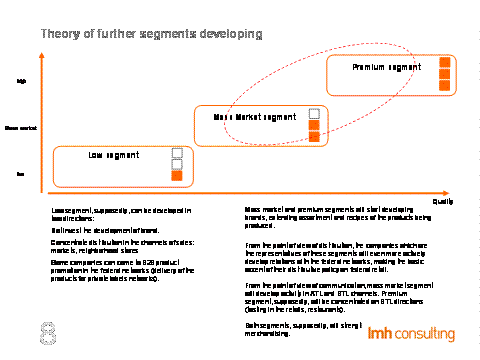
The sales growth will occur first of all because of competiveness increase in these segments, and that in turn will cause the development of communicative activity for the brand, and also reduce prices to the accessible level available for the majority of buyers. There happen to be the latter fact, which provokes a current demand for seafood.
Mass market and premium segments will start developing brands, extending assortment and recipes of the products being produced.
From the point of view of distribution, the companies which are the representatives of these segments will even more actively develop relations with the federal networks, making the basic accent of their distributive policy on federal retail.
From the point of view of communication, mass market segment will develop activity in ATL and BTL channels. Premium segment, supposedly, will be concentrated on BTL directions (tasting in the retails, restaurants).
Both segments, supposedly, will strengthen the policy of merchandising.
Low segment, supposedly, can be developed in two directions: not invest the development of brand, concentrate distribution in the channels of sales: markets, neighborhood stores. Some companies can come to B2B product promotion in the federal networks (delivery of the products for private labels networks).
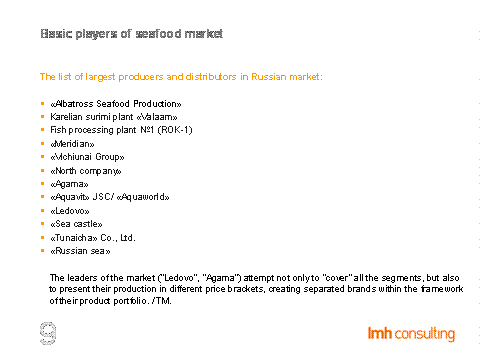
Let us examine the basic players of the market of Russian central part.
“Agama” and “Ledovo” companies should be chosen as the leaders.
The majority of players present their production in several most popular market segments - shrimp, surimi, the frozen semi-finished products, preserves.
In this case the leaders of the market (“Ledovo”, “Agama”) attempt not only to "cover” all the segments, but also to present their production in different price brackets, creating separated brands within the framework of their product portfolio.
The consumer is on the stage of positive perception of the market. The category of loyal consumers at the moment is on the stage of forming.
The mentioned players have already begun to change behavior strategy at the market. They pay less attention to the policy of transferring consumers into the category and pay more attention to the forming strong brands in mass and premium segments.
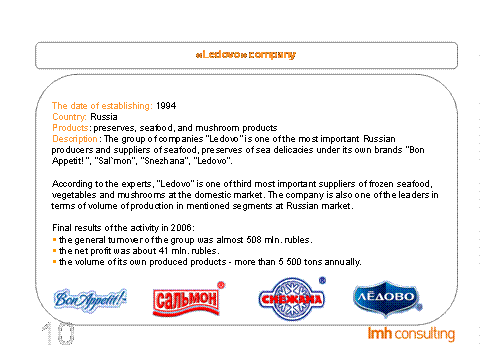
In terms of “Ledovo” company I propose to examine the ways of communication with the consumers.
The group of companies “Ledovo” is one of the most important Russian producers and suppliers of seafood, preserves of sea delicacies under its own brands “Bon Appetit! ”, “Sal`mon”, “Snezhana”, “Ledovo”.
The company has been present in the market since 1994.
Country: Russia
Products: preserves, seafood, and mushroom products.
According to the experts, “Ledovo” is one of third most important suppliers of frozen seafood, vegetables and mushrooms at the domestic market. The company is also one of the leaders in terms of volume of production in mentioned segments at Russian market.
Final results of the activity in 2006:
the general turnover of the group was almost 508 *****bles.
the net profit was about 41 *****bles.
the volume of its own produced products was more than 5 500 tons annually.
The company controls four brands:
Bon Appetit - finished seafood with fillings, sea delicacies with different sauces, salads with laminaria
“Sal`mon” - seafood and sea delicacies for those, who love to pamper themselves with tasty food, but who take care of their health
“Snezhana” - frozen food of the highest quality: vegetable mixes, rice mixes with vegetables and seafood, champignon and fry.
Champignons of “Ledovo” are fresh mushrooms, grown on the agro-complex in Moscow region. They preserve high quality and splendid taste because of freeze.
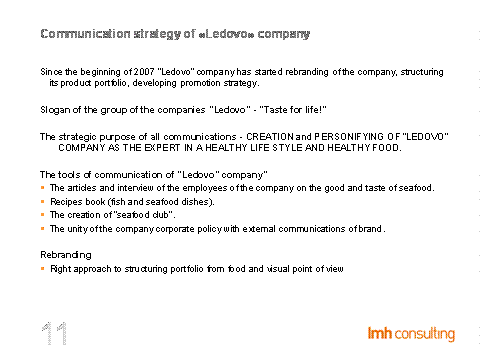
Since the beginning of 2007 “Ledovo” company has started rebranding of the company, structuring its product portfolio, developing promotion strategy.
Slogan of the group of the companies “Ledovo” - “Taste for life!”
The strategic purpose of all communications - CREATION and PERSONIFYING OF “LEDOVO” COMPANY AS THE EXPERT IN A HEALTHY LIFE STYLE AND HEALTHY FOOD.
The tools of communication of “Ledovo” company are the following:
- The articles and interview of the employees of the company on the good and taste of seafood.
- Recipes book (fish and seafood dishes).
- The organization of “seafood club”.
- The unity of the company corporate policy with external communications of brand.
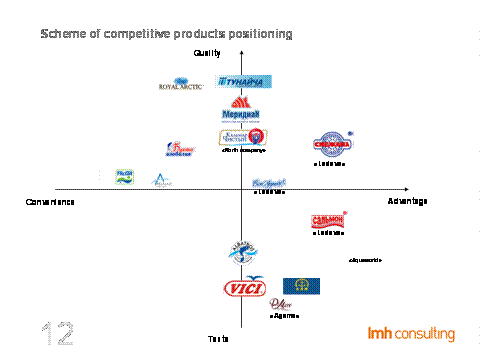
“Albatross Seafood Production” Co., Ltd. - the ocean sea of pleasures on your table
BaltKo (official representative Viciunai in Russia) – If you like surimi – you like Vici
“Aquavit” Joint stock company (brand “Aqua world”) – Pamper yourself with tasty food!
Brand - is the system of values, providing the product, with which it is correlated, with the additional material benefits.
The company, which develops brand, basing on the strategy and following it in view of all communications the section, obtains the following advantages over the competitors:
- Consumers recognition;
- Brand loyalty;
- Brand loyalty due to the separation the general communicative messages;
- Brand recognition.
How is it possible to measure from financial point of view?
- Easier winning and holding the market;
- The leading position in the market and holding its position while changing the dynamics of market growth;
- Stability in the volume of sales;
- Additional profit up to 20-30%;
- Company cost increase.
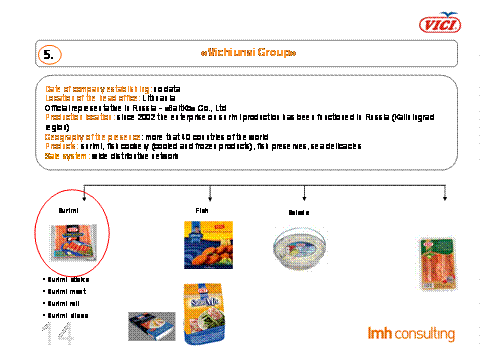
Date of company establishing: no data
Location of the head office: Lithuania
Official representative in Russia - “BaltKo” Co., Ltd.
Production location: since 2002 the enterprise on surimi production has been functioned in Russia (Kaliningrad region)
Geography of the presence: more than 40 countries of the world
Production: surimi, fish cookery (cooled and frozen products), fish preserves, sea delicacies
Sale system: wide distributive network
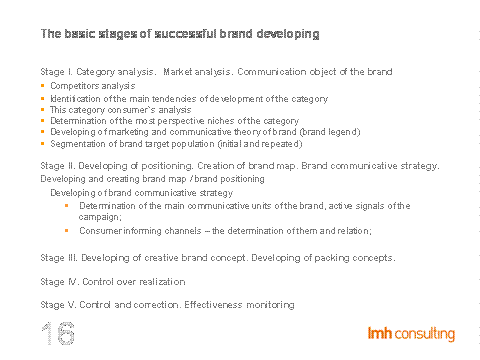
The basic stages of successful brand developing.
According to the experts, the entrance to the market of fish products now is not as expensive as the entrance to others product markets, where there is a great competition and the growth rates are not so high.
For example, sausage market is highly competitive; the entrance to it will cause heavy expenses. The guarantees of success are very low, since it will be more difficult to search for niches in the consciousness of consumers.
The process of entrance to the market with presenting its own brand will guarantee of success, if we mean both the investments in brand with the investments in equipment.
The developing of brand is a continuous and many-sided process.
