

Партнерка на США и Канаду по недвижимости, выплаты в крипто
- 30% recurring commission
- Выплаты в USDT
- Вывод каждую неделю
- Комиссия до 5 лет за каждого referral
By Bjorn Lomborg
Sunday, October 7, 2007;
COPENHAGEN
All eyes are on Greenland's melting glaciers as alarm about global warming spreads. This year, delegations of U. S. and European politicians have made pilgrimages to the fastest-moving glacier at Ilulissat, where they declare that they see climate change unfolding before their eyes.
Curiously, something that's rarely mentioned is that temperatures in Greenland were higher in 1941 than they are today. Or that melt rates around Ilulissat were faster in the early part of the past century, according to a new study. And while the delegations first fly into Kangerlussuaq, about 100 miles to the south, they all change planes to go straight to Ilulissat -- perhaps because the Kangerlussuaq glacier is inconveniently growing.
I point this out not to challenge the reality of global warming or the fact that it's caused in large part by humans, but because the discussion about climate change has turned into a nasty dustup, with one side arguing that we're headed for catastrophe and the other maintaining that it's all a hoax. I say that neither is right. It's wrong to deny the obvious: The Earth is warming, and we're causing it. But that's not the whole story, and predictions of impending disaster just don't stack up.
We have to rediscover the middle ground, where we can have a sensible conversation. We shouldn't ignore climate change or the policies that could attack it. But we should be honest about the shortcomings and costs of those policies, as well as the benefits.
Environmental groups say that the only way to deal with the effects of global warming is to make drastic cuts in carbon emissions -- a project that will cost the world trillions (the Kyoto Protocol alone would cost $180 billion annually). The research I've done over the last decade, beginning with my first book, "The Skeptical Environmentalist," has convinced me that this approach is unsound; it means spending an awful lot to achieve very little. Instead, we should be thinking creatively and pragmatically about how we could combat the much larger challenges facing our planet.
Nobody knows for certain how climate change will play out. But we should deal with the most widely accepted estimates. According to the United Nations' Intergovernmental Panel on Climate Change (IPCC), ocean levels will rise between half a foot and two feet, with the best expectation being about one foot, in this century, mainly because of water expanding as it warms. That's similar to what the world experienced in the past 150 years.
Some individuals and environmental organizations scoff that the IPCC has severely underestimated the melting of glaciers, especially in Greenland. In fact, the IPCC has factored in the likely melt-off from Greenland (contributing a bit over an inch to sea levels in this century) and Antarctica (which, because global warming also generally produces more precipitation, will actually accumulate ice rather than shedding it, making sea levels two inches lower by 2100). At the moment, people are alarmed by a dramatic increase in Greenland's melting. This high level seems transitory, but if sustained it would add three inches, instead of one, to the sea level rise by the end of the century.
A one-foot rise in sea level isn't a catastrophe, though it will pose a problem, particularly for small island nations. But let's remember that very little land was lost when sea levels rose last century. It costs relatively little to protect the land from rising tides: We can drain wetlands, build levees and divert waterways. As nations become richer and land becomes a scarcer commodity, this process makes ever more sense: Like our parents and grandparents, our generation will ensure that the water doesn't claim valuable land.
The IPCC tells us two things: If we focus on economic development and ignore global warming, we're likely to see a 13-inch rise in sea levels by 2100. If we focus instead on environmental concerns and, for instance, adopt the hefty cuts in carbon emissions many environmental groups promote, this could reduce the rise by about five inches. But cutting emissions comes at a cost: Everybody would be poorer in 2100. With less money around to protect land from the sea, cutting carbon emissions would mean that more dry land would be lost, especially in vulnerable regions such as Micronesia, Tuvalu, Vietnam, Bangladesh and the Maldives.
As sea levels rise, so will temperatures. It seems logical to expect more heat waves and therefore more deaths. But though this fact gets much less billing, rising temperatures will also reduce the number of cold spells. This is important because research shows that the cold is a much bigger killer than the heat. According to the first complete peer-reviewed survey of climate change's health effects, global warming will actually save lives. It's estimated that by 2050, global warming will cause almost 400,000 more heat-related deaths each year. But at the same time, 1.8 million fewer people will die from cold.
The Kyoto Protocol, with its drastic emissions cuts, is not a sensible way to stop people from dying in future heat waves. At a much lower cost, urban designers and politicians could lower temperatures more effectively by planting trees, adding water features and reducing the amount of asphalt in at-risk cities. Estimates show that this could reduce the peak temperatures in cities by more than 20 degrees Fahrenheit.
Global warming will claim lives in another way: by increasing the number of people at risk of catching malaria by about 3 percent over this century. According to scientific models, implementing the Kyoto Protocol for the rest of this century would reduce the malaria risk by just 0.2 percent.
On the other hand, we could spend $3 billion annually -- 2 percent of the protocol's cost -- on mosquito nets and medication and cut malaria incidence almost in half within a decade. Malaria death rates are rising in sub-Saharan Africa, but this has nothing to do with climate change and everything to do with poverty: Poor and corrupt governments find it hard to implement and fund the spraying and the provision of mosquito nets that would help eradicate the disease. Yet for every dollar we spend saving one person through policies like the Kyoto Protocol, we could save 36,000 through direct intervention.
Of course, it's not just humans we care about. Environmentalists point out that magnificent creatures such as polar bears will be decimated by global warming as their icy habitat melts. Kyoto would save just one bear a year. Yet every year, hunters kill 300 to 500 polar bears, according to the World Conservation Union. Outlawing this slaughter would be cheap and easy -- and much more effective than a worldwide pact on carbon emissions.
Wherever you look, the inescapable conclusion is the same: Reducing carbon emissions is not the best way to help the world. I don't point this out merely to be contrarian. We do need to fix global warming in the long run. But I'm frustrated at our blinkered focus on policies that won't achieve it.
Eco-Rebels
Thursday, Oct. 04, 2007 By BRYAN WALSH
Maybe it happened the day after Hurricane Katrina or the night Al Gore won an Oscar for An Inconvenient Truth, but the first phase of the global-warming debate has ended. Even Skeptic-in-Chief George W. Bush recently convened a global-warming summit, where Condoleezza Rice told foreign diplomats that "climate change is a real problem--and human beings are contributing to it."
But the climate wars are far from over, and there are still dissidents emerging to challenge the green mainstream. Unlike past skeptics, they accept the basics of global warming but question its severity and challenge the orthodox faith that Kyoto Protocol-style mandatory carbon cuts are the best way to save the planet. Call them the bad boys of environmentalism: gadflies like the Danish economist Bjorn Lomborg, who just came out with the book Cool It, and rebel greens like the political consultants Ted Nordhaus and Michael Shellenberger, who detail their apostasy in Break Through. While their solutions may be flawed, the questions these contrarians raise about climate change are central as we shift into the next and more difficult phase in the debate: what should be done about it.
Lomborg is the right's favorite environmentalist, and it's easy to see why. Though he believes that the world is getting warmer and that humankind is causing it, Lomborg's not too worried. Endangered polar bears? He insists that they're actually thriving. Rising sea levels swamping coastal cities? Lomborg argues that floods won't be biblical and that man-made defenses will be sufficient. The main effect of global warming, he writes, may be that "we just notice people wearing slightly fewer layers of winter clothes on a winter's evening."
The Dane's grasp of climate science seems shaky at best. The polar bear is far from O. K.: the U. S. Geological Survey reported last month that two-thirds of the population will disappear by 2050 because of shrinking sea ice. But his main argument is still worth considering. Lomborg believes that it would be far too costly to reduce global carbon emissions enough to actually cool the climate. Since warming is coming no matter what we do and poor countries will suffer the most from it, we should instead direct scarce resources to helping those nations adapt to climate change. That means improving health-care systems and aiding economic growth so that poor countries are better prepared for calamities ahead, climate-related or not. Lomborg is correct to point out that if we're so worried about the future famines and diseases and refugees of a warmer world, we might want to first do a little more for the hundreds of millions suffering from those catastrophes right now.
Americans Nordhaus and Shellenberger have backgrounds in both politics and environmentalism, and they mercilessly skewer the political mistakes of the green movement. For all the public attention climate change has won, U. S. greens have so far failed to achieve national political action on the issue--and the authors insist that won't change as long as environmentalism remains wedded to what they call the "politics of limits." Mandatory emission cuts alone won't be enough to drive the kind of innovation needed to break the world of its fossil-fuel habit--and China and India will never sign on to caps that could limit economic growth. Instead, Nordhaus and Shellenberger argue for Apollo-program-style government investment in clean-energy research, on the order of $30 billion a year. It's a smart, if not wholly original idea--not least because it would allow greens to frame climate change as an inspiring challenge, not just a pending catastrophe. And that's a contrarian position that just might help win the climate wars.
Europe fights the spread of climate change
By Charles Clover, Environment Editor, and Bruno Waterfield in Brussels
12/01/2007 Telegraph. co. uk
Countries opposed to nuclear power came under pressure to think again as the European Union launched its plans for tackling climate change and improving energy security yesterday. The EU announced its intention of cutting emissions of greenhouse gas by at least 20 per cent from 1990 levels by 2020 in an attempt to prevent "irreversible and possibly catastrophic climate change" as global temperatures soar by up five degrees Celsius this century. Announcing its plans, the European Commission said that unless the EU moved to a low carbon economy, and others followed, the world's temperature was likely to rise by more than two degrees, causing dangerous climate change. For Europe, this would mean higher summer temperatures, with an extra 86,000 summer deaths from heat-related causes a year if temperatures rose three degrees, although there would be a reduction of 36,000 deaths in the winter. A report written for the commission says that the annual migration of 100 million tourists to the Mediterranean would be affected, with holidaymakers attracted instead to the North Sea and the Baltic. It also warns that Europe can expect a decline in the fertility of arable land, a decline in Mediterranean forest, reduced snow at ski resorts and more flooding. The EU plans are also intended to reduce Europe's growing dependency on imported oil and *****ssia disrupted supplies of oil to Belarus earlier this week. The commission called on developed nations around the world to cut emissions of gases blamed for global warming by 30 per cent by 2020, saying the EU would go beyond its unilateral target if others – by which it clearly meant the United States — followed suit. Until now the EU's plan has been for an eight per cent overall cut in emissions by , its commitment under the Kyoto climate change treaty adopted by 15 members before EU enlargement in 2004 which several countries are already struggling to meet. Though the commission said it was "agnostic" on the subject of building nuclear power stations, it nevertheless warned that there should be no reduction in nuclear capacity without the introduction of comparable amounts of low-carbon forms of generation. Andris Piebalgs, the European Energy Commissioner, said: "Nuclear power has no CO2 emissions. It is Europe's biggest source of CO2-free energy." Jose Manuel Barroso, the commission president, insisted that despite "heated opinions" over nuclear power across Europe, the technology's contribution was clear. He pointed to EU statistics showing that 31 per cent of European electricity production is nuclear, compared with 30 per cent from coal and 20 per cent from gas. Mr Barroso is promising countries that revive the nuclear option, such as Britain, that the EU can help overcome the atomic waste and plant decommissioning problems cited by the technology's opponents. The commission and Mr Barroso stepped back, however, from directly stating that EU countries that freeze or ban nuclear power programmes are making Europe dependent on gas imports and fuelling climate change. A moratorium on new nuclear power stations in Germany is one of the key factors in the EU's growing dependency on gas imports. The EU is the world's largest importer of oil and gas, buying 82 per cent of oil and 57 per cent of gas from external countries. "We have an addiction to energy and like any addiction it is worse when we are dependent on others to satisfy our addiction," said Mr Barroso. The commission wants 20 percent of EU power to come from renewable sources, such as wind, by 2020. That compares with an existing target of 12 per cent by 2010 which the bloc is likely to miss. The proposals must be approved by EU governments. |
TIMELY TOPICS
An advanced reading, Grammar and Vocabulary Book
Patrick J. Aquilina
American Language Programm
Columbia University
CHAPTER 1: Immigration
Reading 1: “We, the People”
Prereading Questions
1. What do you know about immigration to the United States? Who came first? Who came later? What major groups of people came? Why did they come?
2. Immigration to the United States in the 19th and 20th centuries has been a period of peaks and valleys or highs and lows. What factors, either in the immigrants' native countries or in the United States, might account for these changes in the number of people who immigrated to the United States?
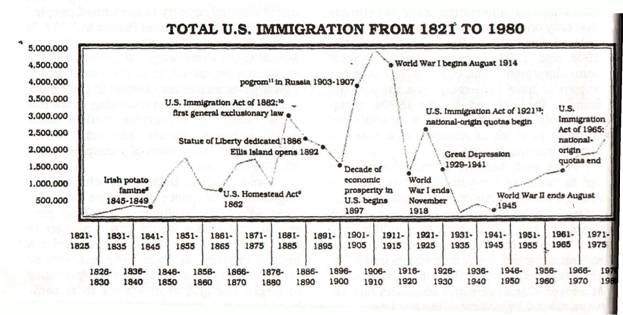
3. Look at the graph of "Total U. S. Immigration from 1821 to 1980" on page 6. Why do you think that any of the events noted on the graph might have affected the rate of immigration?
4. Was there ever a time when a great number of people left your country to come to the United States? If so, when and why did it happen?
Vocabulary Practice p.2
We can often guess the general meaning of a new word when we see it in context. We may not get the exact meaning, but the ideas and the words in the sentence or in the reading give us a clue to the meaning of the word. Look at the italicized words in the sentences below and use the context of the sentence to help you guess the meaning. Then, when you think you have some idea of the meaning, select the definition which best fits the word as it is used in the sentence.
Example: "The bosom of America is open to receive not only the opulent and respectable stranger, but the oppressed and persecuted of all nations." ("Opulent" and "respectable" are contrasted with "oppressed" and "persecuted." "Respectable" is a positive attribute; "oppressed" and "persecuted" have negative meanings. Therefore, we can assume that "opulent" is also positive.
What type of positive-sounding word might go with "respectable"? What kind of people are often considered respectable? "America will accept not only ___ and respectable strangers, but also the oppressed and the persecuted."
a. poor
b. wealthy
c. pleasant
The answer is b. wealthy. Poor can show more of a similarity than a contrast with "the oppressed and persecuted." Although pleasant has a positive meaning, it does not offer a direct contrast and does not make sense within the context of the sentence.
1. A (A.) haven since its very beginnings, America would (B.) absorb an astonishing number of people within its expanding borders.
(A.) a. safe place
b. paradise
с. restricted place
(B.) a. turn away
b. take in
c. restrict
2. Large, sparsely populated lands lay open elsewhere in those years—In Canada and Australia, Argentina and Brazil
a. heavily
b. densely
c. thinly
3. In Europe, political (A.) turmoil and socio-economic (B.) upheavals marked nations entering the industrial age.
(A.) a. peace
b. confusion
c. stability
(В.) a. increases
b. improvements
c. disturbances
4. A basic cause of change was the (A.) unprecedented population explosion that (B.) stemmed front better health conditions.
(A.) a. usual
b. not prepared for
c. never seen before
(B.) a. led to
b. had its origin in
c. harmed
5. 3,574,974 people are known to have left the United States—roughly, a third of the number that entered.
a. harshly
b. approximately
c. exactly
6. Poles and Italians, in particular, were apt to come as temporary visitors, to earn enough money in America to establish themselves comfortably in the homeland.
a. likely
b. unlikely
с. had an aptitude for
7. Sometimes the native-born child of immigrants would ignore the parents' heritage.
a. cultural traditions
b. ancestors
c. heroes
8. The United States has accepted millions of people'over the years, those who (A.) sought a better life, and those who (B.) fled oppression or natural disaster or (C.) pernicious combinations of both.
(A.) a. had
b. tried to find
c. left
(B.) a. found
b. ran away from
c. found a flaw in
(C.) a. fortunate
b. unusual
c. extremely dangerous
9. At times fear has emerged among citizens that these immigrants may (A.) overwhelm the civilization they find, take jobs from those already here, (B.) diminish the wealth of the land, or destroy the ideals on which the nation was founded.
(A.) a. enjoy
b. take over and change
c. overdevelop
(B.) a. steal
b. use well
c. lessen
We, the People p.4
By Leslie Allen
The bosom[1] of America is open to receive not only the opulent and respectable stranger," declares a statement attributed to George Washington, "but the oppressed and persecuted of all nations and religions."
A haven since its very beginnings, America would, in the century and a half after the Founding Fathers[2], absorb an astonishing number of people within its expanding borders. Large, sparsely populated lands lay open elsewhere in those years—in Canada and Australia, Argentina and Brazil. But it was the United States that took in by far the greatest number of newcomers.
In Europe, political turmoil and socio-economic upheavals marked nations entering the industrial age. A basic cause of change was the unprecedented population explosion that stemmed from better health conditions. Aliens continue to enter the U. S. today—many for similar reasons.
The graph below tracks[3] immigration in five-year Intervals between 1820 and 1980. Its totals cannot be exact, because of variations in recordkeeping. Still, official sources show that by 1981 a total of 50 million had come Into the area now encompassed by the U. S.
How many stayed? In technical terms, what is the net[4] total of Immigration? No one is sure. The net total may-well be the most significant figure of all; from it have come new citizens. But if the figures for those entering the U. S. are imperfect, the figures for those leaving are worse—for early decades, almost nonexistent. Experts estimate that only one migrant left for every eight who entered during the 19th century. Between 1908 and 1924, a period that does offer some documentation, 3,574,974 people are known to have left—roughly, a third of the number that the 1880s, cheap steamship fares had made it possible for workers to think of America as a place of short-term employment.
Poles and Italians, in particular, were apt to come as temporary visitors, to earn enough money in America to establish themselves comfortably In the homeland. In the years 1899 to 1924, nearly four million Italians entered the U. S., but more than two million departed. Some individuals undoubtedly traveled back and forth more than once. Moreover, Canadians and Mexicans had always moved freely across the borders.
Thus the sharp peaks and deep troughs on the graph indicate abrupt changes in gross immigration only. One-year Intervals would give a more ragged profile—the all-time high of 1,285,349 in the fiscal year 1907 contributes to the spike for . In two other years of this period the tally topped 1.000,000. (That five-year peak of nearly 5,000,000, if it recorded net immigration, would shrink to about 3.300.000.)
Of events noted on the graph, two—the dedication of the Statue and the opening of Ellis Island[5] —mark a time frame. Others affected immigration to some degree. Sharp lips indicate the falling numbers associated with the world wars, the Great Depression, and the quota laws[6] of the 1920s. (In two brief intervals, 1918-19 and 1932-36, more people left the U. S. than entered it.) The rise in recorded immigration since 1965 is also apparent. It has helped to bring the ratio of the foreign-boom in the current population to about 6 percent.
"Providence has been pleased to give this one connected country to one united people,"
proclaimed the Federalist Papers in 1787, "a people descended from the same ancestors, speaking the same language, professing the same religion, attached to the same principles of government, very similar in their manners and customs." In succeeding years this society based on similarities would become a heterogenous mixture, and yet it would retain its underlying bond of principles, goals, ideas of freedom.
Sometimes the native-born child of immigrants would ignore the parents' heritage. Then sons and daughters of the next generation in America would grow up eager to hear stories of the old country, to revive a holiday custom, to trace their ancestry or revisit a place of origin. "What the son wishes to forget, the grandson wishes to remember." notes one historian. Thus the cultural strands of individual and family are woven into a single fabric that forms the living richness of the nation.
The United States has accepted millions of people over the years, those who sought a better life, and those who fled oppression or natural disaster or pernicious combinations of both. At times fear has emerged among the citizens that these immigrants may overwhelm the civilization they find, take Jobs from those already here, diminish the wealth of the land, destroy the ideals on which the nation is founded.
Yet consistently the newcomers have accepted the discipline of citizenship. And, in one writer's summary, "the Immigrant's grit[7] and courage, and even his anxieties, impart productive energy" to America. Artists, inventors, unskilled workers, musicians, scholars, and artisans—all have made their contribution.
"A willingness of the heart"—in this phrase the perceptive novelist Scott Fitzgerald defined America. Perhaps the willingness is that of those already here to give newcomers a place, to accept their ideas and cultural contributions. Perhaps it is the willingness, too, of those courageous ones who came to stay—who struggled to succeed, to enrich and, finally, to belong to their adopted land. [8][9][10][11][12]
Comprehension and Discussion
A. Circle the correct answer. If the answer is false, tell why.
Ironically, the improvement of health conditions in Europe indirectly lee to many people immigrating to the United States.True False
It was possible for workers to come to the United States to work temporarily in the 1880s because steamship tickets started to become cheaper in that decade.True False
3. It is difficult, if not impossible, to know the exact number of immigrants to the United States because no one knows for sure how many people returned to their countries.
True False
4. In the early part of the 20th century, roughly half of the Italians who entered the United States stayed.
True False
Ellis Island opened in 1892 and caused the rate of immigration to decrease.True False
From the beginning, the United States has been a heterogeneous country.True False
B. Answer the question as completely as possible.
Explain the following sentence from the reading: "What the son wishes to forget, the grandson wishes to remember."
Vocabulary Practice p.8
Match the italicized words in the sentences with the words in the list below. Then rewrite the sentences with the correct form or tense of the new word.
_____ unprecedented | _____heritage | _____haven |
_____pernicious | _____upheaval | _____absorb |
_____sparsely | _____turmoil | _____overwhelm |
_____flee | _____apt to | _____diminish |
_____stem (from) | _____ roughly | _____seek |
_____opulent |
a. For many years, people from all over the world (1.) have run away from political (2.) confusion in their countries and have (3.) tried to find a (4.) safe place in the United States. In the early 19th and 20th centuries, people immigrated to the United States in (5.) never seen or heard before numbers. In 1approximately a million and a quarter immigrants entered the country. Because the population of the United States was (7.) not dense, the country was able to (8.) take in these refugees from famine and social (9.) disturbances.
b. The people who were already here often reacted to this immigration in a negative way. This reaction (10.) had its origin in fears that the (11.) great wealth of this country would be (12.) lessened and that the values and customs would be (13.) completely taken over by these new people with their different customs.
c. When people leave a country because of an (14.) extremely dangerous series of events, and when they find safety in a new land, the children of these newcomers are (15.) likely not to care too much about their cultural (16.) tradition that is passed down to them.
Reading 3: "Newcomers Alter Society, Politics of the Big Apple"
Prereading Questions
What effects do you think immigrants could have on a city in the following areas? Explain these effects as completely as possible and give reasons for them.a. housing/neighborhoods b. politics c. education
New York City has a population of approximately 7.3 million people. What percentage of these would you guess are foreign-born? What other cities in the United States have high percentages of foreign-born residents? What cultural differences could possibly cause problems or misunderstandings between new immigrants and longtime residents?Vocabulary Practice
Match the underlined words in the sentences with the synonyms or definitions in the list below. Use the context of the sentence to help you guess the meaning.
_____ fall behind _____ total involvement
_____ conflict _____ make a sudden attack
_____ hidden motivation _____ humble; unimportant
_____ hold back _____ something that causes anger
_____ force out _____ bring back to life
_____ push gently _____ continuous, meaningless sound
_____ widespread, everywhere
The (a) babble of foreign languages on the streets is so (b) pervasive that the English speaker often feels like the foreigner. Many immigrants take menial jobs and work long hours just to survive. Immigrants have been crucial in revitalizing and stabilizing many neighborhoods. The influence on politics usually lags a generation behind each new wave of arrivals. The school system's response is to combine bilingual education with the immersion approach of English-as-a-Second-Language. In some ways the toughest challenge for New Yorkers already here is cultural and social, (a) Friction as new groups move in, (b) nudging and (c) displacing those already here, is as old a pattern as immigration itself. A shopper born in Haiti insisted that she was (a) assaulted without (b) provocation in January 1990 by the owner. Often there is a strong economic undercurrent to such friction. New immigrant groups pose a challenge for the city's schools and, some say, could hinder the progress of American-born blacks.Newcomers Alter Society, Politics of the Big Apple
By Lucia Mouat
New York City continues to be enriched by new Immigrant groups; the latest waves have bolstered the labor force and housing market. But they pose a challenge for the city's schools and, some say, could hinder the economic progress of American-born blacks.
It’s as if the boundaries of the United Nations had suddenly expanded to include all of New York City. The babble of foreign languages on the streets and in coffee shops is so pervasive that the English-speaker often feels like the foreigner. A full one third of all New Yorkers—up from one fourth 10 years ago – are now foreign-born.
The faces change. Over the last 25 years, UK Caribbean. Latin America, and Asia have largely replaced the nations of Europe as points of origin, but New York City remains the destination of choice for one of every six immigrants to the United States.
Hispanics account for the largest numerical increase. Greater New York now has the second largest Hispanic community in the U. S., after southern California.
New York is one of the few frostbelt[13] cities to actually grow during the 1980s, rising from about 7 million to 7.3million people, according to preliminary 1990 census figures. The new immigrants, arriving at a rate of roughly 90,000 a year, are considered a major factor. Many move into housing and Jobs vacated by earlier immigrants, who have been moving steadily to the suburbs for the last two decades.
Some of the newcomers find the American dream lives up to its promise. Most find making a life here much tougher than they were led to believe by television and word-of-mouth[14] success stories. Many take menial jobs and work long hours just to survive.
In addition to enriching the culture in everything from cuisine[15] to music, the new immigrants have had a powerful and largely positive economic and social impact on the city.
"Immigrants have been critical in revitalizing and stabilizing many New York neighborhoods," says Mitchell Moss, director of New York University's Urban Research Center.
The influence on New York politics usually lags a generation behind each new wave of arrivals. Yet neighborhood ethnicity is playing a major role in the redrawing of City Council districts now under way.
When the Soviets crack down on Armenians or cyclones batter Bangladesh, a sympathetic community of Immigrants in the U. S. now invariably sends up a cry of concern. Congress and U. S. foreign policymakers listen.
The newcomers are a much more diverse group than has come to New York at any other period of our history. . . and it's changing our awareness of the rest of the world." notes Carol Stix, a professor of sociology at Pace University. "Taking a page from the Civil Rights movement, they recognize that they have to speak up and organize to be heard and have their needs met."
New York City schools face one of the strongest challenges posed by the new immigrants. On the enrichment side, teachers are being retrained and given new materials on the theory that every subject at every grade level should note contributions made to It by a variety of cultures; it's termed multicultural education.

|
Из за большого объема этот материал размещен на нескольких страницах:
1 2 3 4 |
