

Партнерка на США и Канаду по недвижимости, выплаты в крипто
- 30% recurring commission
- Выплаты в USDT
- Вывод каждую неделю
- Комиссия до 5 лет за каждого referral
TheFlint-Togliatti Initiative
International Academy University of Michigan-Flint
of Business & Banking School of Management
Certificate of Achievement
|

|

awarded to
Student Name
in recognition of satisfactory completion of
Course Name
______________________________ _____________________________
Dr. Igor V. Bogdanov, President Dr. Fred E. Williams, Dean
International Academy of Business & Banking University of Michigan-Flint, School of Management
______________________________ _____________________________
Dr. Andrei E. Volkov, Rector Dr. Vahid Lotfi, Professor of Mgt Science
International Academy of Business & Banking University of Michigan-Flint, School of Management
|
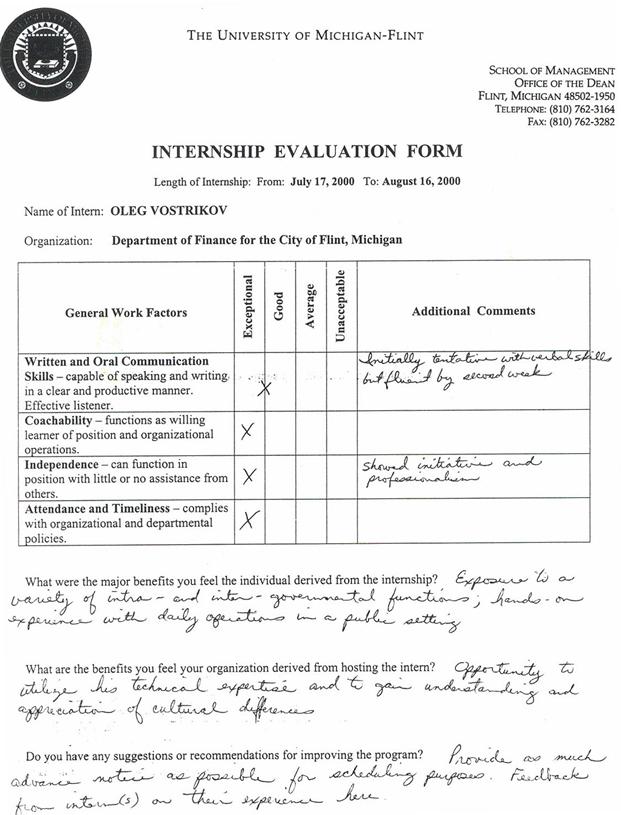
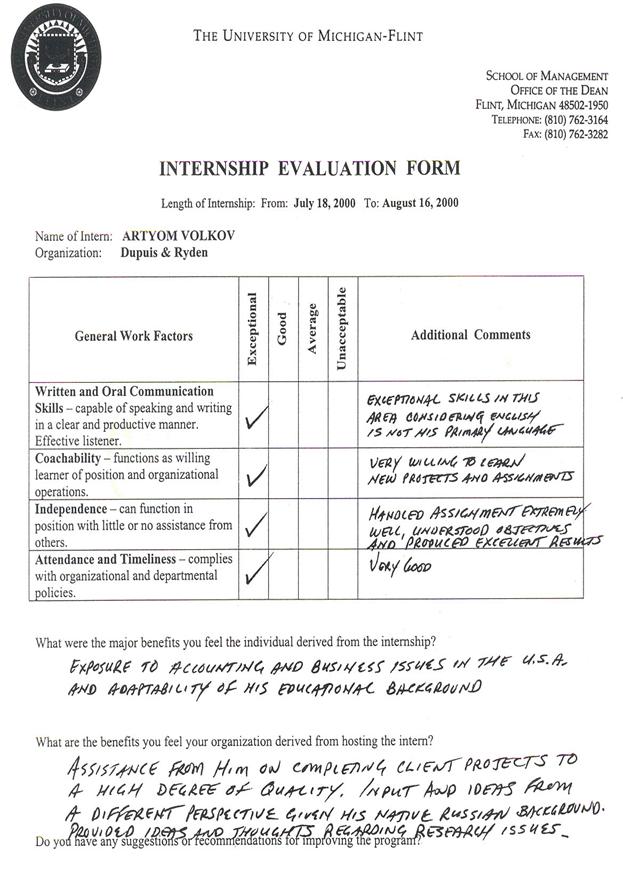
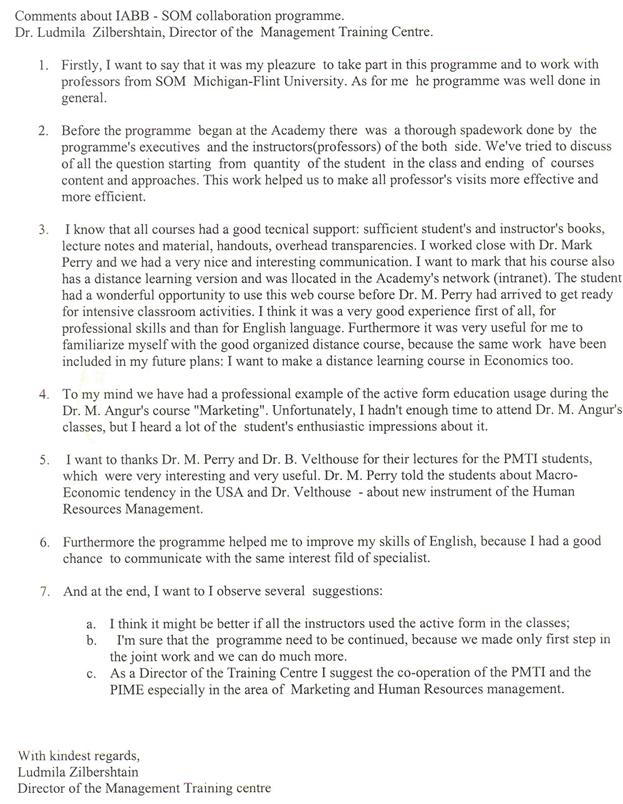
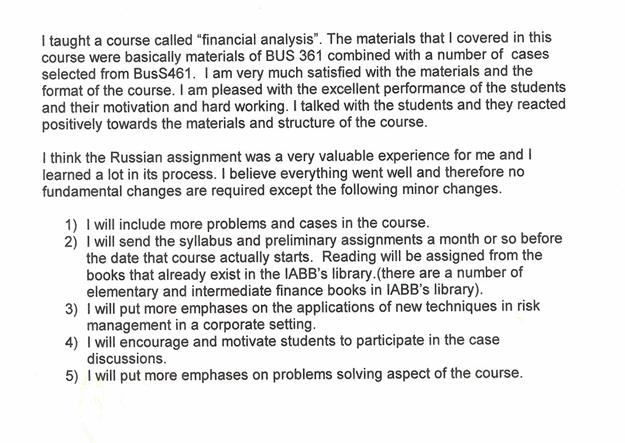
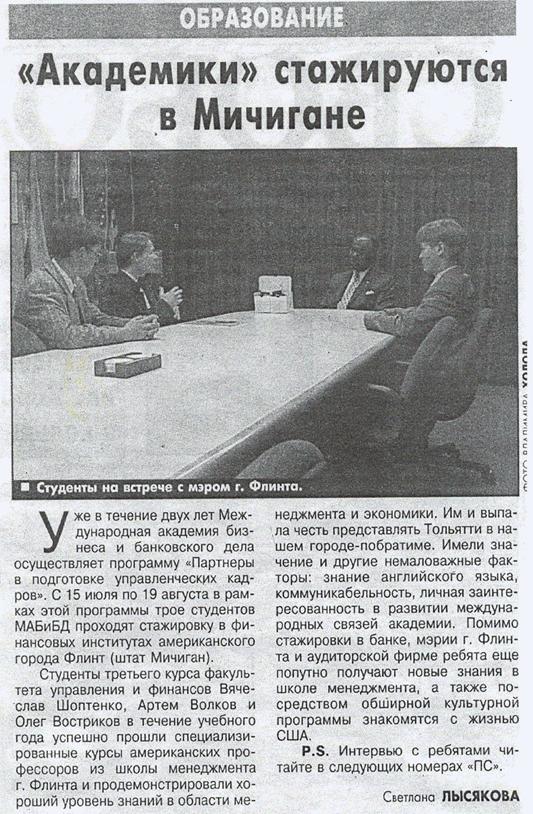
September 11, 2000 Report about Experience gained during Internship and Classes in Flint, MI, USA Artyom Volkov, 3`d year student of Finance & Management Department, IABB, Togliatti, Russia 16.07.2000 ‑18.08.2000 Time of the trip to Flint, MI I can divide into three parts: 1.1. Internship in Dupuis&Ryden 1.2. Three courses in School of Management of University of Michigan Flint: • International Finance ‑ Dr. Seyed Mehdian • Money & Banking ‑ Dr. Mark Perry • Strategic Management ‑ Dr. McGraw 1.3. Culture program 1. 1. The most important part for me was internship. My internship included the following steps: 1. Studying principles of accounting in the USA system. 2. Acquaintance with information system in the US Accounting company. 3. Work in sphere of providing service to the firm's clients. To be more specific, during my internship, I worked on the following reports: • Summary about current situation in automotive and plastic industry. • Summary about food industry. • Cash flow report for one of the client. piling annual audit report for a client. 5. Building computer network in the new office of the firm. In conclusion I want to say that internship in Dupuis&Ryden was very interesting for me, that was great experience! In Russia I already had experience in working at Audit Company, that's why internship in Dupuis&Ryden was specifically informative and important for me. Generally speaking I had a great opportunity to compare in real life two audit systems ‑ used in the USA and the one I worked with in Russia. This could never be accomplished in its fullness if I just read some books. 1.2. Three courses taught by SOM faculty members during Summer Semester were very useful and important. I can positively say that with these courses I understood quite a number of things about international finance and strategic management. I met with Dr. Perry and Dr. Mehdian when they came to IABB, Togliatti to teach me and my classmates (3rd year students of Finance & Management Department) as a part of collaboration program between SOM and IABB. Well, that was my acquaintance with them, and I was really excited to have such an opportunity to take more courses of theirs originally in the US. Besides I took Dr. McGraw class, and it really appealed to me as well. 1.3. Culture program was jut extraordinary. I can't express how thankful I am to Dr. Ted Williams and Dr. Greg Allar and all SOM faculty members who actively participated in providing our leisure time and cultural program: ‑ Dr. Betty Velthouse, Dr. Madhu Angur, Dr. Mark Perry, Dr. Seyed Mehdian, Dr. Vahid Lotfi, Dr. Cathy Miller, Dr. Vijay Gondhalekar, Dr. Jack Smith and others. I think that culture program was perfectly organized and held. My appreciation for the great work done by the American professors. Recommendations I've already mentioned some recommendations above, but I want to add one. It concerns internship and classes: I think that daytime should be devoted only for internship and evening time for study. To my understanding this will let the students to be more efficient at Internship Company. At the end I want to say a big `Thank you' for all people involved in IABB students summer visit to Flint, MI. |
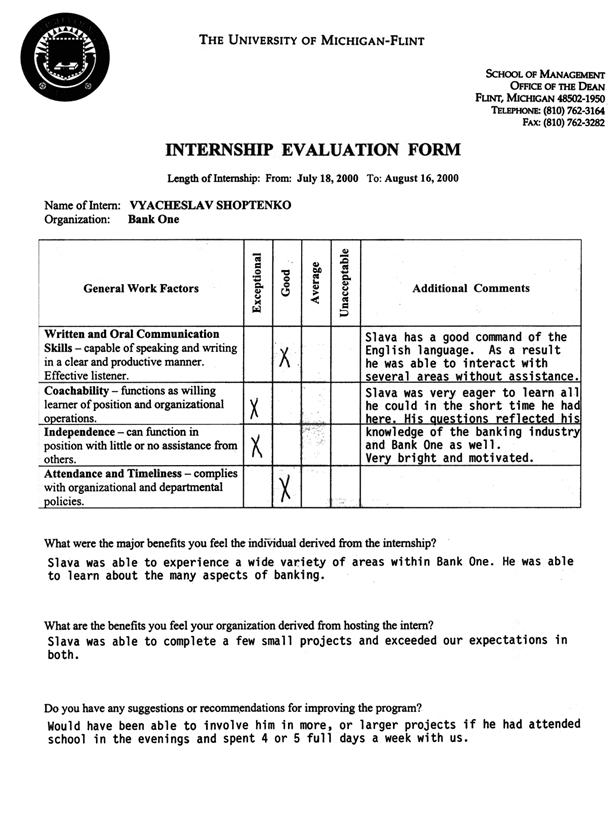
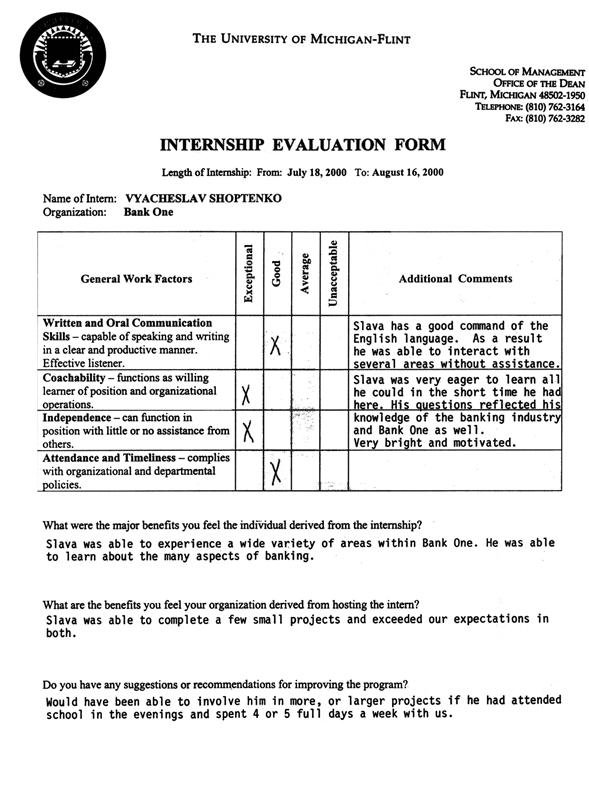
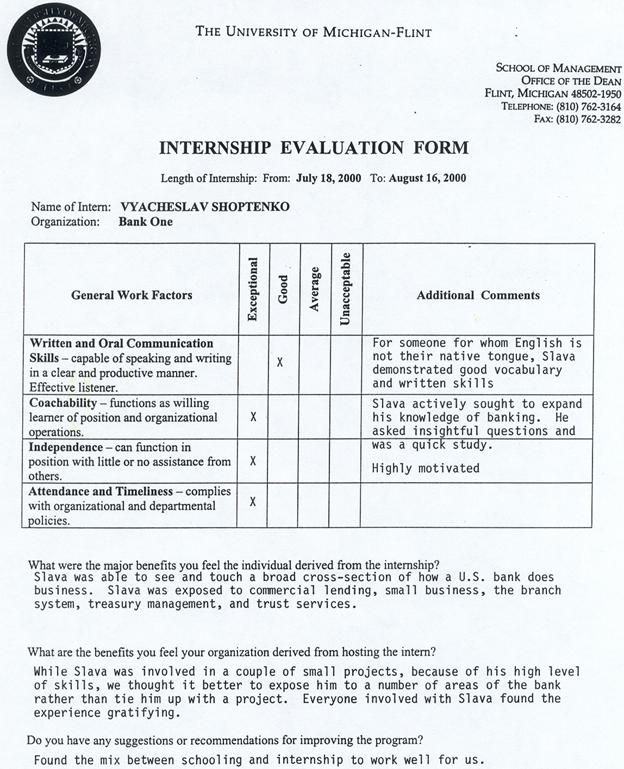
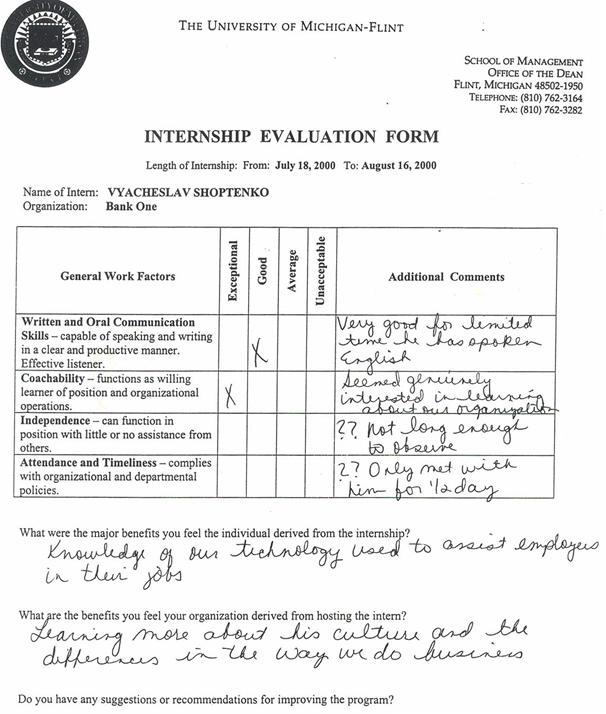
Opinion about the PIME collaboration program implementation and results from one of participating IABB students. Vyacheslav Shoptenko For me participation in the PIME program started from the first class taught by Dr. Mark Perry in IABB in October 1999 and culminated in summer 2000 visit to SOM UMF for classes and internship. I can say, I feel that after participation in this project my level of skills and knowledge made a drastic jump ahead from the point I used to be formerly. Thanks to the organizers' efforts in all program activities I could advance myself in large number of aspects: 1. Skills and knowledge related to my core area of studies with aid of totally 9 courses from Core Business Management Curriculum both adapted to teaching in IABB very intensively and in "original version" during summer semester in UMF. 2. Understanding of Academic area and educational system in United States (due to participation in summer visit, discussions of curriculums of IABB and UMF and their integration opportunities, interaction with UMF faculty). 3. Understanding of U. S. corporate and public style of work by means of internship and number of meetings with different people that represented both public and business sectors. Professional skills achieved by means of this as well. 4. Appearance of circle of people that benefit from our communication and can exchange the knowledge and experience they have. S. Last but not least ‑ I got to know American culture (which is totally different from European and Russian) by means of spending nearly 6 weeks in U. S. and seeing and "feeling" it myself. And I would say this experience is as important as the one described above. It also helped to look on our problems and common things here from the new standpoint and look for solutions with better effectiveness. I already have a lot of opportunities of applying what I have achieved due to this program in the whole number of areas both in IABB and outside it ‑ in projects, educational process, jobs. With the skills and knowledge I got I will be able to benefit the continuation of this collaborative activities (between IABB and UMF and other possible participants) which are very important for further development of American‑Russian cross‑cultural communication and I hope some day I even will be able to benefit the whole our society by means of implementing everything I know now and will learn further. I'm glad that after long process of intensive discussions and negotiation cooperatively IABB and UMF were able to modify slightly the initial agreements and make all activities the most suitable for everyone related or participating. As a summary of this "evaluation", I would grade the achievement of this program as A+ or "excellent". I hope, IABB will be able to continue similar activities in the future, especially taking into account experience and base or background that was elaborated during last two years of PIME activities, because we all understand how useful and beneficial is this for everyone related to this kind of programs. |
Opinion about the PIME collaboration program implementation and results from one of participating IABB students. Oleg Vostrikov My first meeting with PIME‑program occurred at March 1999 when Dr. Ted Williams (Dean of the School of Management at the University of Michigan‑Flint) and Dr. Gregory Allar (Technical Director of PIME) came to the International Academy of Business and Banking, Togliatti and had a meeting with prospective PIME‑attendees. Then at October 1999 the first UM‑Flint professor Dr. Mark J. Perry came to the IABB to teach "Business Economics". And during the year I had 6 UMF courses taught by 8 Professors: Dr. Madhukar Angur ‑ "Marketing Management", Dr. Cathy Miller ‑ "Accounting", Dr. Betty Velthouse and Dr. Jack Smith ‑ "Organizational Behavior & Human Resource Management", Dr. Seyed Mehdian ‑ "Financial Analysis", Dr. Vahid Lotfi and Dr. Ted Williams ‑ "Operations Management" (I took it by on‑line via Internet) I know that the content of the programs was carefully selected by Faculties of both Universities: 6 core business courses that were intended to place a basement for further business studying. All in all, the PIME‑Program was well planned and well executed. 1, as a member of SOM‑IABB collaboration, could mention some possible improvements: I base my suggestions on the conclusions I made analyzing my experience during the internship (Financial Department for the City of Flint): 1. Performance in Mondays in Wednesdays where we had 8 hours of Internship and 2.5 hours of the class shows that this kind of workload is tough but acceptable to the IABB students, which are used to hard work. 2. Tuesdays and Thursdays were not fully utilized, because we had only 2 classes those days totaling the efficient time to 5 hours per Tuesday or Thursday. So the significant resource is in utilizing those 2 days per week more fully. 3. The program of internship was very interesting. But as for me I think IABB students could do more valuable and important work for the organizations. According to the existing practice in the US, the internship takes 5 days per week for the period of 6 week to be functional (to allow students to perform real activities). The proposals: 1. Make the 6 weeks 5‑days per week internship. This will allow students to make some particular job not just observe the organization. 2. Move the classes to the evening. I proposed to increase the length and intensity of the internship that will make all daytime of the weekdays unavailable for studying. Thus the evening (at 7 PM) classes can be the solution. So we can see the following schedule (assuming passing 3 courses 2 classes of 2.5 hours per week for each course): • Monday. 9:00 AM ‑ 6:00 PM‑Internship. 7:00 PM ‑ 9:30 PM‑ 1st Class of the 1st course. • Tuesday. 9:00 AM ‑ 6:00 PM ‑Internship. 7:00 PM ‑ 9:30 PM ‑ 1st Class of the 2nd course. • Wednesday. 9:00 AM‑ 6:00 PM‑Internship. 7:00 PM ‑ 9:30 PM‑ 1st Class of the 3rd course. • Thursday. 9:00 AM‑6:00 PM‑Internship. 7:00 PM‑9:30 PM‑2nd Class of the 1st course. • Friday. 9:00 AM ‑ 3:30 PM ‑ Internship. 4:00 PM ‑ 6:30 PM ‑ 2nd Class of the 2nd course. 7:00 PM ‑ 9:30 PM ‑ 2nd Class of the 3rd course. As you can see the proposed schedule decreases the total length of the Internship by only 3 hours per week (compared to the current schedule that decreased it by 16 hours). |


Syllabi for the following courses:
§ Economics
§ Marketing
§ Accoun ting
§ Finance
§ OB/HRM
§ BUS 371 - Operations Management
BUS371 - OPERATIONS MANAGEMENT
INSTRUCTORS
Professor Vahid Lotfi
Information Technology Services
(8
email: *****@***umich. edu
Professor Fred Williams, Dean
School of Management
(8
email: *****@***umich. edu
COURSE DESCRIPTION
This three credit-hour online course introduces various Operations Management models, to be used by managers in a decision support environment. Session topics include Operations and Productivity, Competitive Advantage, Global Environment, Managing Quality, Forecasting, Capacity Planning, Location and Layout Strategies, Inventory Management, Aggregate Planning, Materials Requirement Planning, and Reliability. The course is designed to provide students ample opportunities to practice model formulation, computer solution, and interpretation of the solution outcomes. As one of the required courses for Bachelor of Business Administration (BBA) degree, this course provides the student with knowledge and skills required to analyze and solve various operations management problems in for-profit as well as non-profit organizations.
EXPECTED OUTCOMES:
By the end of the course, you will be able to:
- Demonstrate an awareness of many critical decisions of Operations Management (OM) Demonstrate familiarity with various issues surrounding productivity, service operations, designing operations, managing operations, and certain quantitative models Demonstrate familiarity with model formulation, computer solution, and interpretation of computer output Correctly identify the appropriate model, state the assumptions, develop formulation, and use a computer software to solve several OM models including
- quality assurance
- time series forecasting
- capacity planning
- location and layout analyses
- inventory management
- aggregate planning
- materials requirement planning Correctly use vocabulary appropriate for discussing the stated OM models Engage in positive and meaningful dialogue with classmates concerning class projects as well as OM Express interest in pursuing further study in OM
COURSE OUTLINE
- Day 1: (5/15/2000) Introduction to the course, and coverage of Chapter 1 - Operations and Productivity. Quiz 1 will be given in the afternoon session. Solve problems 1, 4, and 7. Day 2: (5/16/2000) Covers Chapter 2 - Operations Strategy for Competitive Advantage. Quiz 2 will be given in the afternoon session. Solve problems 2 and 3. Day 3: (5/17/2000) Covers Chapter 3 - Operations in Global Environment. Quiz 3 will be given in the afternoon session. Solve problems 5 and 6. Day 4: (5/18/2000) Covers Chapter 4 - Managing Quality. Quiz 4 will be given in the afternoon session. Solve problems 5, 7, and 9. Day 5: (5/19/2000) Covers Chapter 5 - Forecasting. Quiz 5 will be given in the afternoon session. Solve problems 3, 5, 12, and 39. Day 6: (5/22/2000) Covers Chapter 8 - Location Strategies. Quiz 6 will be given in the afternoon session. Solve problems 2, 4, and 12. Day 7: (5/23/2000) Covers Chapter 9 – Layout Strategies. Quiz 7 will be given in the afternoon session. Solve problems 2, 4, and 10. Day 8: (5/24/2000) Covers Chapter 12 - Inventory Management. Quiz 8 will be given in the afternoon session. Solve problems 3, 7, 16, and 18. Day 9: (5/25/2000) Covers Chapter 13 – Aggregate Planning. Quiz 9 will be given in the afternoon session. Solve problems 3, 11, and 15. Day 10: (5/26/2000) Covers Chapter Materials Requirement Planning. Quiz 10 will be given in the afternoon session. Solve problems 1, 2, and 10.
COURSE EVALUATION:
Your grade will be based on 10 quizzes. Each quiz will cover one chapter and will be given in the afternoon session of the day that the chapter is covered. Therefore, it is critical that you read the chapters ahead of time. The quizzes are weighted equally and the lowest grade will be dropped.
Home works will be assigned but will not be collected. Homework assignments but will be discussed in class.
Discussion Questions
1. Eli Whitney (1800) has been credited for early promotion of "standardization." Why is standardization important? What are the drawbacks?
2. Consider a company specialized in manufacturing and sales of personal computers (e. g., Dell, Compaq, etc.). Choose 3 of the 10 OM decisions and describe specific ways these decisions can be used to gain a competitive advantage for the firm.
3. Read the critical thinking exercise on page 71. Would you contract to produce shoes in China? On what basis would you make your decision?
4. Some critics have claimed that Total Quality Management (and presumably, the entire quality movement) is just another in a long line of management ment.
5. Refer to Critical Thinking Exercise on page 179 and provide your responses to the questions raised in this exercise.
6. Read the Critical Thinking Exercise concerning local and regional bidding wars to attract new business and industrial facilities (pages 311-312). Intense competition to attract new business and industry raises some complex issues identified in the following four thread topics. Please respond to each topic.
7. Read the Critical Thinking Exercise that contrasts office layout in the U. S. and Japan. (page 352). Please respond to each of the two thread topics.
8. Please refer to the Critical Thinking Exercise at the end of Chapter 12 (page 471)and respond to the questions at the end of the exercise.
9. Please refer to the Critical Thinking Exercise at the end of Chapter 13 (page 527)and respond to the questions at the end of the exercise.
10. Read the Critical Thinking Exercise about the compatibility of JIT and MRP. (page 568). Please respond to the question raised in the exercise: What are the techniques, issues, and impacts of adding JIT inventory and purchasing techniques in an organization that has MRP?
International Academy of Business and Banking
Syllabus – Organizational Behavior
Winter, 2000
Instructor: Betty Velthouse, Ph. D.
1
*****@***umich. edu
Course Description:
This course will examine human behavior in organizations. We will discuss differences between individuals – their perceptions, personalities, and motivations. We will address history and trends in management – from scientific management through self-managed teams. We will examine leadership and leadership styles in organizations. We will discuss human behavior in groups – the dynamics of groups and teams. And finally, we will explore the behavior of organizations as entities – their culture, their structures, their environments, their strategies.
Readings and Support Material:
Textbook: Wagner, John A. III and John R. Hollenbeck. 1998. Organizational Behavior, 3rd edition. Prentice Hall: Upper Saddle River, New Jersey.
CD: Velthouse, Betty and Jack E. Smith. 1998. Promoting Teamwork and Cooperation. New York: McGraw-Hill Publishers. (on reserve)
Schedule:
Date Topic Readings
Monday, March 13 – Morning sessions
Lectures: Individual Differences: Chapters 2, 3, 4, 6
Personality
Perception
Diversity
Motivation
Staff Development
Monday, March 13 – Afternoon session
Small team exercise:
develop and present a plan for motivation and
staff development for an individual.
Tuesday, March 14 – Morning sessions
Exam # 1 covering material from day one
Lectures: History and trends in Management Chapters 1, 14, 15,
The history of organizational behavior
Trends in the management of organizations
Tuesday, March 14 – Afternoon session
Small team exercise:
Prepare and present a trip-tick of history and trends
of management in Russia.
Wednesday, March 15 – Morning sessions
Exam # 2 covering material from day two chapters 7, 9, 10, 13
Lectures: Leadership in Organizations
Leadership and leadership style
Power, conflict, and empowerment in organizations
Management vs. leadership
Entrepreneurship
Organization culture
Wednesday, March 15 – Afternoon session
Lecture and small team exercise: chapter 8
the dynamics of groups
Thursday, March 16 – Morning sessions
Exam # 3 covering material from day three
Lectures: Groups and Teams “read” through CD
Teams vs. groups (on reserve)
Team building
Small Team Exercise:
Assessment of a group
Thursday, March 16 – Afternoon session
Lectures: Macro Issues Chapters 11, 12
The macro assignment
Organization’s Life Cycle
Organization’s Environment
Friday, March 17 – Morning sessions
Lectures: Macro Issues continued
Organization’s Technology
Organization’s Structure
Organization’s Strategy
Organization Change
Friday, March 17 – Afternoon
1:00–2:30 Individual Coaching for Macro assignment
2:30-4:00 meet with faculty
discuss and modify syllabus
Summary of Expectations
Individual paper – this paper is to be an individual effort. It should address the topic “How am I motivated?” It should include a discussion of the results of self-assessment administered during the morning sessions of Monday, March 13 and should use one or two of the motivation theories we will have discussed to develop a plan for continued motivation. This paper should be between 2 and 3 pages in length; it is due on Wednesday (March 15) by noon. 50 points
Examinations (3) – these exams are to be individual efforts; they are not cumulative; they will include both multiple choice and short answer questions. 50 points each
Small team exercises (3) – these exercises will involve participation in and a report (or a group presentation) of the group’s findings. 33.3 points each
A Macro assignment – this assignment will be completed in small teams. The assignment involves a written report of an in-depth examination of a living/operating organization. The report must include as assessment and description of the organization’s environment, stage in its life cycle, culture, technology, structure, and strategy. The report must also critique the organization’s overall congruence (do all of the parts fit together?) and suggest where and how the organization should be changed. (For the students who wish to start their own business, the assignment can be modified to allow them to create their ideal organization. This assignment will be due March 31.
100 points
Total points 400 points
Your letter grade will be based on the percentage of total points earned. It will be based on the following standard; grades will not be curved.
97-100 = A+ 94-96 = A 90-93 = A-
87-90 = B+ 84-86 = B 80-83 = B-
77-79 = C+ 74-76 = C 70-73 = C+
67-69 = D+ 64-66 = D 60-63 = D-
Below D = Failure
Identical papers (whether for individual or for groups) will be awarded zero points.
|

BUSINESS ECONOMICS UNIVERSITY OF MICHIGAN‑FLINT Taught at: the International Academy of Business and Banking October 1999 Professor: Dr. Mark J. Perry Office: XXX Telephone: XXX Email: *****@***edu Office Hrs: Before and after class, and by appointment Textbook: Introduction to Economics: The Wealth and Poverty of Nations, by James Gwartney and Richard Stroup Course Objective: To understand the principles and mechanics of how the economy operates at both the macro and microeconomic level. Emphasis will be placed on the economic way of thinking and how economic thinking is used for business decision‑making. Basic concepts in the economic organization of the microeconomy will be reviewed, including price theory, production theory, consumer theory, business structure, resource markets, and the role of government. The emphasis of the class will be on practical applications of microeconomic principles so that students can understand how economic theory can be applied to business decisions. Basic concepts in the economic organization of the macroeconomy will be reviewed, including inflation, unemployment, national income, interest rates, monetary policy, fiscal policy, international trade, money and banking and the role of government. The emphasis of the macro part of the class will be on how monetary and fiscal policy issues affects the economy. Pre‑Test: A pre‑test (40 multiple choice questions) will be given before the class begins. The results of this test will not directly affect your grade, but will be used as an assessment tool to determine students' background in economics. |
Grades: Grades will be based on the following: Take Home Midterm Examination 100 points (50 % ) Four quizzes (first week) 40 points (20 % ) Final Examination, in class 60points (30 TOTAL 200 points Letter grades will be approximately as follows: A 90‑100 % , B 80‑89.9 % , C 7079.9 % , D 60‑69.9 % , F less than 60 % . Pluses and minuses will be given. Exams and Quizzes: A ten point quiz will be given at the beginning of each class during the first week (except Monday) on the material that was covered the previous day. These quizzes will be multiple choice questions, similar to the questions in the Self‑Test sections at the end of the chapters in the text. The midterm examination will consist of 100 multiple choice questions from the test bank and will cover Parts I and II from the textbook (chapters 1‑11). The final examination will cover parts III and IV (chapters 12‑19) from the textbook and handouts given out in class. The final exam will be approximately 60 multiple choice questions. Attendance: Regular attendance is expected. Poor class attendance may be reflected in final grade. Web Page: There is a web page for this course, which contains the lecture notes at spruce. flirit. umich. edu/‑mjperry. Look for "MGT 551 ‑ Business Economics" under "Class Notes" on the home page. Course Schedule: WEEK 1 ‑ During the first week of class, we will do the following: a. cover the material in Chapters 1‑9 (Micro) during lectures which will last about fours per day (during three IABB academic periods). b. watch the "Power of the Market" videotape by Milton Friedman c. have four, ten point quizzes daily from Tuesday‑Friday d. on Friday, I will hand out the take‑home exam on the material from Chapters 1‑9, which will be due in class on Friday, Oct 22. WEEK 2 ‑ During the second week we will do the following: a. cover the material in Chapters 12‑18 (Macro) during lectures which will last about four hours per day (during three IABB academic periods). b. go over the take‑home exam on Friday, Oct. 22, and review for the final examination. The final examination will be administered approximately one week after the end of class, about October 29. |
University of Michigan-Flint
School of Management
Managerial Accounting
Course Syllabus
General Information:
Instructor: Dr. Cathy Miller
Office: TBD
Office Phone: TBD
Email: *****@***umich. edu
Office Hours: TBD
Text: California Car Company, by Adams and Pryor, Copyright 2000 South-Western College Publishing
Readings located on the intranet system
Prerequisites: English; Algebra; Word Processing (e. g. Microsoft Word) and spreadsheet (e. g. Microsoft Excel) skills; Financial Accounting and/or Managerial Accounting course preferred, but not necessary.
Purpose of Course
The emphasis in business today is upon a " new management style", with much greater participation by employees in decision making and in controlling costs and producing goods and services with exceptional quality and service. To accomplish many of the new objectives of management, there has been a greater reliance on cost accounting and information systems. This course places more emphasis on the new way of managing and should help you:
1. begin to "think through" decision making of all types.
2. become aware of the role of managerial accounting in organizations.
3. learn to identify relevant factors in decision making.
4. learn the newest techniques in management, including quality control management, activity based accounting, and just-in-time inventory.
These are just a few of the important ways this course and text can help you understand the role of accounting in management and how management uses accounting.
Grading Standards
Point Assignment Grade Assignment
Preliminary work and exam 100 A = 450 – 500 points
Exam 1 100 B = 400 – 449 points
Exam 2 100 C = 350 – 399 points
Project 200 D = 300 – 349 points
Total 500 F = below 300 points
Plus and minus grade levels will also be assigned
Exams
Each student is expected to take each exam as scheduled. Absences from exams will be excused only with instructor approval before the exam. Exams are written exams and may consist of multiple choice questions, short problems and/or essay questions.
Each student completes his or her own exam. No help from other students or study materials is allowed.
Preliminary work and exam
The preliminary work consists of reading the material provided on the intranet, completing the exercises and problems provided on the intranet, and completing a written exam (covering this prelim material) provided by IABB faculty. Students may work together on the exercises and problems; however, the exam should be completed by each student without the assistance of other students or study materials.
The exercises and problems should be completed by November 19, 1999 and retained until I arrive. Part of your preliminary grade is based on completion of these exercises and problems. This work may be done individually or in groups of 2-3 students. Be sure to identify all of the names of the students who participate in a group.
The exam should be completed by November 23, 1999. The exam should be completed on the intranet and sent to me via email. I will grade the exam and have the results for you when I arrive.
Course lectures and practice – November 29 – December 10
The material covered during this time is outlined in the Course Schedule. The morning hours of class consist of lecture of the assigned material. The afternoon hours of class consist of practice of the assigned material. Practice includes completing exercises and problems and completing the appropriate case assignments in the California Car Company text.
The student is expected to have read the assigned material and attempted to solve the exercises/problems before coming to class. Active participation by students is expected in the solving the exercises, problems, and case assignments. Verbal participation by students is expected in discussions of the material, exercises, problems and case assignments.
Attendance
Attendance during the two-week course lecture and practice session is mandatory.
Project
The project requires application of managerial accounting concepts. The details of the project will be given at the end of the course lecture and practice session. It will involve a written report to be sent to me via email. The project is due no later than December 23, 1999. The project may be completed individually or in groups of 2-3 students. Be sure to identify all of the names of the students who participate in a group.
Successful completion of the course
To receive credit for successful completion of this course, the student must successfully complete all of the following:
* Complete the exercises and problems from the preliminary work.
* Pass the preliminary exam.
Participate in completing exercises, problems and case assignments during the practice class sessions.
* Pass the 2 exams given during the course lecture and practice session.
* Successfully complete the project.
Course Schedule
Date | Managerial Accounting Topic | |
Preliminary work | Nov 19 Nov 23 | Basic managerial terminology, cost classifications, cost behavior, cost volume profit analysis. Prelim Exam |
Lecture and Practice | Nov 29 | Review prior work Variable versus absorption costing, special orders and other decisions |
Nov 30 | Job order and process costing | |
Dec 1 | Standards & Variances | |
Dec 2 | Capital investment | |
Dec 3 | Review/recap traditional cost accounting topics Exam on traditional cost accounting topics | |
Dec 6 | Activity Based Costing | |
Dec 7 | Just-in-Time accounting | |
Dec 8 | Performance measures, Quality | |
Dec 9 | Balanced scorecard | |
Dec 10 | Review/recap recent cost accounting topics Exam on recent cost accounting topics | |
Project | Dec 23 | Managerial accounting project |
THE UNIVERSITY OF MICHIGAN
SCHOOL OF MANAGEMET
INTERNATIONAL ACADEMY OF BUSINESS & BANKING
Winter 2000
Course:: Financial Management: Application and Strategy
Instructor: Dr. Seyed M. Mehdian
E-mail: *****@***umich. edu
Course Objective:
The objective of this course is to apply the techniques and theories of corporate financial management covered in pervious courses to real world cases. Advanced corporate finance topics will also be covered. This is a case study course in that the students are expected to study, analyze and find solutions for the assigned cases and present the results to the instructor and other class members.
Required Materials:
1) Cases in Financial Management, by Joseph M. Sulock and John S. Dunkelberg, second edition, John Wiley & Sons, Inc.
2) Any financial management textbook.
Course Grading:
Final grades are assigned based on the following:
Case analysis and presentation
A final Exam
Mini cases
A project
Class participation and discussion
The Cases:
The finance cases will provide an opportunity for students to apply the tools, techniques and concepts of financial management to real business situations. A major part of the exercise is to analyze the cases and decided how to approach the problems and find solution(s) for them. The cases provide sufficient material for this purpose, but your challenge is to interpret and organize the material in a logical manner, and to sort out the significant from unimportant.
Requirements:
Each student will be responsible for the following:
1. To be a member of a team, which will prepare formal presentation and report on, assigned cases.
2. To participate actively in class discussion.
Team Presentations:
Each member of the team should participate equally in the preparation for and presentation of the class presentation and submitted reports. A single grade will be assigned to each member covering both the presentation and the report. Non-participation will result in 0 score. The presentation is as important as the write-up and finding solutions for the case.
Your team presentation will be a formal presentation to the class as a whole. You should assume the role of a consulting team making a presentation to your client company concerning solutions to the problems that they are facing.
After you have met as a team to review the case materials and to decide on an approach to the case questions, you may want to schedule a meeting with the instructor to discuss aspects of the case and questions that may not be clear.
THE CLASS WILL ASK QUESTIONS DURING THE PRESENTATION AND AT THE END. ALL GORUP MEMEBERS ARE RESPONSIBLE TO ANSWER QUESTIONS ON THE SOLUTIONS, CONCEPTS, ASSUMPTIONS, CALCULATIONS, ETC
Other Information
· This syllabus may be modified as deemed appropriate. All changes will be announced in class.
· Materials to be covered in each session will be announced in class prior to the session in which they are covered.
The University Of Michigan-Flint
School of Management
&
International Academy of Business and Banking
Togliatti, Russia
Marketing Management
Dr. Madhu Angur
Office: TBA
Phone: TBA
Fax: (8
Email: *****@***edu
Office Hours: TBA
Required Materials: Berkowitz, Kerin, Hartley, and Rudelius MARKETING
6th edition, 2000, Irwin/McGraw-Hill Publication
Other readings will be announced in class.
Course Objectives:
1. To help students understand and appreciate the marketing function of the firm from the standpoint of the decision-maker.
2. To provide a conceptual foundation of the marketing variables (e. g., product, promotion, price and place) as related both to the profitability of the firm and to customer satisfaction.
3. To facilitate greater understanding of the marketing management function in the context of the information age, and its role in the firm's strategic planning process.
4. To explicate the economic, legal, social, and international implications of marketing actions.
Grading:
Your course grade is based on five components and will be determined using a weighted average method. The components are:
Exam I 21%
Exam II 21%
Assignments 22%
Class Participation 10%
Final Exam 26%
Examination: Examinations will consist of multiple choice objective questions, short answer and essay questions.
Class Participation:
Students are encouraged to participate in classroom discussions. Points are awarded for relevant and meaningful contributions in class. Class attendance and/or unannounced quizzes will also be used as a proxy for class participation. The final Class Participation component of your grade will be based on three factors -- attendance, class discussion, in-class exercises, and quizzes.
Grades:
Grades are based on the total points earned in the course. Final grades will be assigned approximately as follows:
A+ 97-100% B+ 87-89.9% C+ 77-79.9% D+ 67-69.9%
A 93-96.9% B 83-86.9% C 73-76.9% D 63-66.9%
A - 90-92.9 B - 80-82.9 C - 70-72.9% D - 60-62.9%
E Below 60%
Tentative Course Outline
Unit I
Introduction to Marketing and Course Overview
The Nature of Marketing, Evolution of Marketing, the Marketing Concept.
The Nature of Marketing, Evolution of Marketing, the Marketing Concept—continued. Marketing in the organization, Marketing’s role in society, Linking Marketing and Corporate Strategies.
Unit II
The Strategic Marketing Process and the Strategic Management Process. The Planning Phase, The Market-Product Grid, The Boston Consulting Group, The Marketing Environment. The Marketing Plan
Unit III
Understanding Buyers and Markets, Consumer Behavior
Organizational Markets and Buyer Behavior
Unit IV
Global Marketing and World Trade
Collecting and using Marketing Information, Marketing Research
Unit V
Interactive Marketing and Electronic Commerce
Marketing Segmentation, Target market, Positioning
Unit VI
New Product Development Process
Managing the Product, Product Management and Packaging
Unit VII
Introduction to Marketing Channels
Supply Chain and Logistics Management
Retail Management
Unit VIII
Costing, Value Pricing, Steps in setting prices
Critical issues in Global Pricing strategies
Unit IX
Integrated Marketing Communications, Sales Promotion, and Public Relations
Advertising Measurement and Management
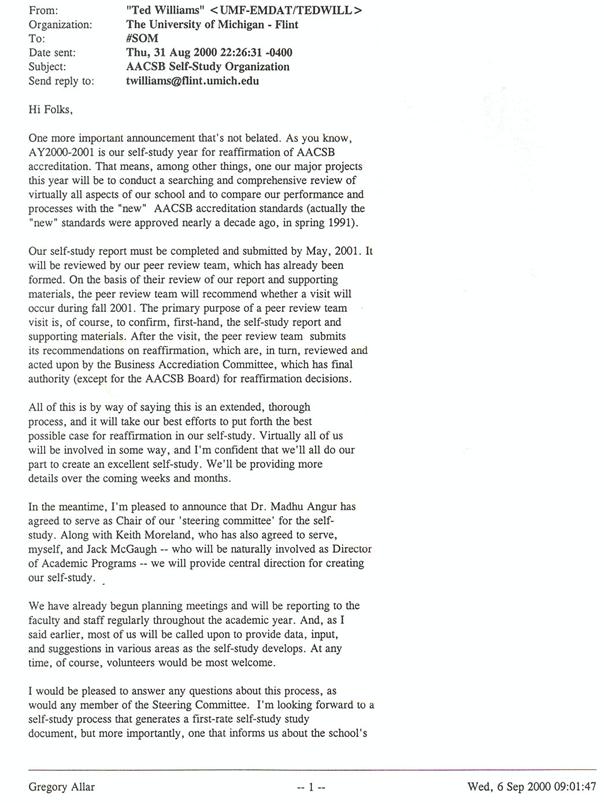
[1] In a September 27, 2000 email Andrei Volkov, Provost for the International Academy of Business and Banking, informed Project Directors for UM-FLINT-SOM that the Board of Directors for the Board of Directors of AACSB-
The International Association for Management Education had approved the IABB’s application for membership.

|
Из за большого объема этот материал размещен на нескольких страницах:
1 2 |
