


Партнерка на США и Канаду по недвижимости, выплаты в крипто
- 30% recurring commission
- Выплаты в USDT
- Вывод каждую неделю
- Комиссия до 5 лет за каждого referral
Федеральное государственное образовательное учреждение
среднего профессионального образования
ПЕРМСКИЙ СТРОИТЕЛЬНЫЙ КОЛЛЕДЖ
МЕТОДИЧЕСКАЯ РАЗРАБОТКА
Дидактическое пособие по английскому языку |
«Презентация проекта» |
для студентов III курса |
специальностей 270301 «Архитектура», |
270103 «Строительство и эксплуатация зданий и сооружений»
СОСТАВИЛ: _____________________________
РЕЦЕНЗЕНТ: ,
Одобрено на заседании предметной комиссии
Иностранных языков |
Протокол №____ от ____ __________
г. Пермь, 2010 г.
Введение
Данная разработка представляет собой дидактическое пособие к изучению лексических тем цикла «Презентация проекта», которое может применяться как в ходе аудиторных занятий, так и при выполнении учащимися домашних заданий. Данное Пособие является содержательным и логическим продолжением существующего пособия «Введение в специальность» для студентов 2 курса и является, таким образом, второй, заключительной, частью дидактического обеспечения эксперимента по специальности 270103 по созданию спецкурса профессионально-ориентированного английского языка.
Пособие разработано с учетом логического плана учебной дисциплины «Архитектура зданий», связывая языковой материал с потребностями развития профессионального мышления техника-строителя, и подготавливая студентов к презентации курсового проекта по архитектуре зданий.
Целесообразно работать с данным пособием в течение всего 3 курса, когда знания архитектуры зданий уже получены студентами. Это не только поспособствует фасилитации учебного процесса, но и позволяет постоянно закреплять базовые профессиональные знания учащихся. Несомненно, преподавателю на первом этапе потребуются консультации преподавателей спецдисциплин.
Поскольку вводно-корректирующий цикл работы с иностранным языком закончен в первом семестре второго курса, данное пособие не предполагает специально работы с грамматикой. Базируясь на уже систематизированных знаниях, данное пособие акцентировано на развитие, в первую очередь, профессионально-ориентированной лексической базы по тематике архитектурной части проектов. Это обусловило видовую подборку упражнений. Тем не менее, работа с данным пособием оставляет возможности и для активизации всех основных правил грамматики. Более того, значительная часть упражнений пособия решает, скорее, языковые задачи – применение устойчивых языковых клише в реальных ситуациях профессиональной деятельности.
Пособие не предлагает вокабуляров по тематике цикла, прежде всего, чтобы обеспечить составление вокабуляров самими студентами, что, в свою очередь, позволяет решать некоторые развивающие задачи. В приложениях находятся словари клише, применяемых при обсуждении проекта.
В ходе изучения цикла «Презентация проекта» предлагаются две контрольные точки: «Описание и оценка архитектурной части проекта» (в конце 5-го семестра), «Обсуждение архитектурной части проекта» (в конце 6-го семестра). Контрольные упражнения даны, соответственно, в разделах Control 1 и Control 2. Контроль первого раздела производится на базе курсовых проектов студентов, выполняемых в ходе 5-го семестра по дисциплине «Архитектура зданий». Варианты заданий для контроля второго раздела, как требующего наибольшей наглядности, содержатся в приложениях Пособия. Выполнение контрольных заданий возможно как в письменном, так и в устном виде – контрольные работы или ролевые игры. Выбор формы контроля зависит от конкретной учебной ситуации в каждой учебной группе.
При подготовке пособия использовались материалы учебника Дж. Камминга «Английский язык для студентов архитектурных и строительных специальностей» британского издательства «Лонгман», что обеспечивает аутентичность представленной лексики.
Рецензия
на методическую разработку по английскому языку
для студентов 3 курса «Презентация проекта»
преподавателя
Дидактическое пособие предназначено для студентов 3 курса специальности 270103. пособие является второй частью спецкурса профессионально-ориентированного английского языка и может с успехом использоваться для аудиторной и самостоятельной работы.
Пособие составлено в соответствии с учебным планом и рабочей программой, ориентировано на требования ГОС СПО.
Материал пособия включает следующие разделы: «Введение», «Повторение», «Геометрические фигуры и формы», «Площади и объемы», «Ориентировка здания», последовательность их выполнения», словари речевых клише, применяемых в ходе презентации проекта в Приложениях 1 и 2, иллюстрации для выполнения зачетных заданий в Приложении 3, варианты контрольной работы по грамматике в Приложении 4 и список литературы.
Задачи презентации, активизации и закрепления языкового материала в пособии решаются в неразрывной связи с проблемой системного подхода к обучению как лексике, так и грамматике, что обеспечивает достаточный уровень языковой подготовленности студентов.
В пособии тщательно подобраны тексты по основным разделам архитектуры зданий. Лексическое наполнение упражнений отражает наиболее важные понятия и явления, имеющие отношение к архитектуре, строительному делу, а также ситуации, типичные для профессионального общения с использованием иностранного языка.
Конечная цель обучения устной речи – научить будущих специалистов высказываться по темам специальности, предусмотренным рабочей программой.
Система упражнений, представленная в пособии, предусматривает обучение умению соотносить средства языка с целью и спецификой обучения, т. е. в области будущей профессиональной деятельности студентов. Представленные упражнения направлены на формирование таких умений и навыков, как подготовка сообщений в соответствии с предложенным планом, подготовка описания факта (процесса, явления), логичность и аргументированность высказывания, выражение своего отношения к факту с использованием разговорных формул (речевых клише).
Формирование специалиста нового типа невозможно без целенаправленной организации самостоятельной работы. Самостоятельная работа является неотъемлемой частью учебного процесса и эффективным средством развития познавательной активности студентов. Для формирования умений и навыков самостоятельной работы автор предлагает различные виды деятельности с текстом, иллюстрацией, чертежом при последующем контроле правильности выполнения задания со стороны преподавателя. Контроль понимания имеет не только контролирующую, но и обучающую функцию.
При подготовке пособия автор использовал материалы учебника Дж. Камминга, большая часть которых творчески переработана и дополнена. Создание пособия решает актуальную задачу предоставления необходимого и достаточного материала для обучения профессионально-ориентированному языку студентов специальности 270103.
Преподаватель английского языка
высшей категории
Рецензия
на методическую разработку по английскому языку для студентов 3 курса
«Презентация проекта»
преподавателя
Представленная работа является логическим продолжением дидактического пособия по английскому языку «Введение в специальность». Это следующая ступенька для студентов, изучающих английский язык, позволяющая продолжить профессионально-ориентированное обучение.
Материал методической разработки представляет разделы рабочей программы по изучению иностранного языка и отражает требования Государственного образовательного стандарта второго поколения (2002 г.):
- студент должен владеть лексическим материалом;
- студент должен иметь навыки работы с текстами профессиональной направленности.
Раздвигая рамки требований программы, автор разработки предлагает развитие навыков речи по профессии, свободное общение студентов на английском языке на профессиональную тематику.
Материал разработки предложен в виде отдельных частей, которые включают в себя профессиональные знания по общепрофессиональным (инженерная графика, строительные материалы) и специальным (архитектура зданий) дисциплинам. Часть упражнений предложена по проектированию генпланов.
Заслуживает внимание построение заданий от простого к сложному. Одни и те же вопросы, задания варьируются. Контрольные вопросы позволяют проверить усвоенный материал и предполагают многовариантность ответов.
От раздела к разделу в методической разработке предлагается взаимоувязка и логическая связь между специальными дисциплинами.
Задания, представленные в разработке, имеют разную структуру:
- упражнения на повторение
- скорость смыслового чтения текста на английском языке
- умения высказать свое отношение к поставленному вопросу, задаче, событию.
Предлагаются варианты клише для ответов. Разработка имеет, кроме текстового материала, таблицы, чертежи, иллюстрации.
Заслуживает внимания предложения автора дать описание зданий города Перми, характерных с точки зрения архитектуры и некоторых конструктивных решений.
Вместе с тем в предложенных упражнениях есть технические и стилистические ошибки, вызванные, видимо, спецификой английского языка, и, тем не менее, они требуют доработки, устранения, т. к. могут привести к путанице основных технических понятий, технических терминов, установленных строительными нормами.
Достоинством работы является возможность подготовки студентов к свободному общению на английском языке в рамках специальности. Проверкой полученных знаний может служить защита проектов на английском языке, выполнение части пояснительной записки на английском языке с переводом на русский язык, подготовка рефератов, интегрированных уроков совместно со специалистами, участие в конференциях и т. д.
Знания, умения и навыки работы по изучению английского языка, предложенные в методической разработке, несомненно, будут способствовать формированию специалиста нового типа.
Преподаватель высшей категории
спецдисциплин специальности
Почетный работник СПО
REVISION
1. Recollect the Russian interpretation for the following terms:
1. Units | 23. Roof | 45. Concrete | 67. Reinforced concrete |
2. Partition | 24. Floor | 46. Foundation | 68. Heat-conductor |
3. Compressive strong | 25. Weather resistance | 47. Joist | 69. Covering |
4. Wall panel | 26. Brick | 48. Beam | 70. Floor panel |
5. Pile | 27. Tensile strong | 49. Security | 71. Tambour |
6. Door plane | 28. Basement | 50. Window plane | 72. Volume |
7. Civil buildings | 29. Porch | 51. Balcony | 73. Loggia |
8. Adaptable to specific activities | 30. To keep out intruders | 52. Multi-apartment building | 74. To control the passage of moisture |
9. Entrance hall | 31. Storey | 53. Room | 75. Corridor |
10. Staircase shaft | 32. Lift shaft | 54. Attic | 76. Loft |
11. Layout | 33. Viewed from | 55. Front | 77. Rear |
12. Side | 34. To provide light | 56. Privacy | 78. Heat-insulator |
13. Sound-conductivity | 35. Canopy | 57. Sound-insulation | 79. Terrace |
14. Opaque | 36. Cupboard | 58. Adjacent | 80. At the bottom |
15. Over | 37. Marble | 59. To comprise | 81. Impermeable |
16. Urban conditions | 38. Combustible | 60. Permanence | 82. Housing |
17. Residential building | 39. Soft | 61. Cellar | 83. Few-storeyed |
18. Multi-storeyed | 40. Public building | 62. Fire-resistant | 84. [be] good for |
19. Design | 41. Heavy | 63. [be ] designed to / for | 85. Design requirement |
20. Industrial buildings | 42. Structure strength | 64. Steel | 86. To house |
21. Glass wool | 43. Rural district | 65. Capital formation | 87. To carry load |
22. Water-supply systems construction | 44. Roads & bridges construction | 66. Ports & dams construction | 88. Buildings construction |
2. Watch an illustration and answer the questions:
a. What type of building is it?
b. What is it designed for?
c. What units does it have?
d. What do they enable?
e. What elements do units consist of?
f. What materials are they made of?
g. What properties do the materials have which act for the design requirements?
h. What are the external and internal volumes of a building?
i. What are their layouts?
j. What volumes does the building not deal with? Why?
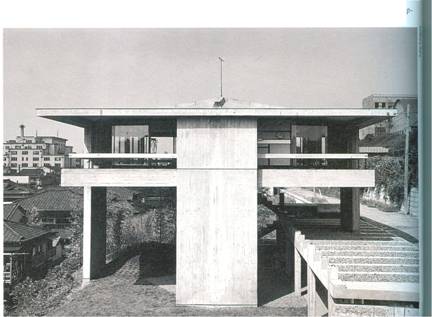
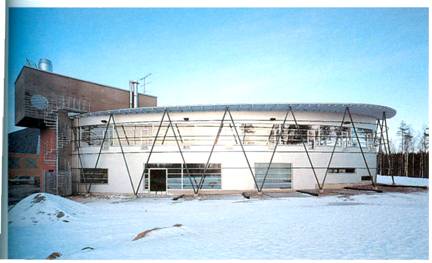
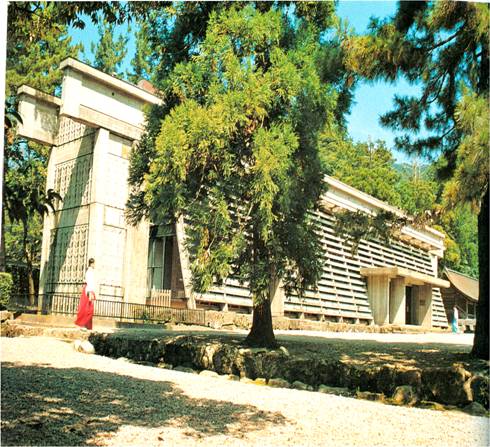
3. Interpret in English:
a. Какое здание вы хотите запроектировать?
b. Было ли здание предназначено для людей?
c. Согласны ли вы на свайный фундамент?
d. Обеспечит ли стеклянная крыша прочность структуры?
e. Является ли пластик, который вы не используете для перегородок, непрочным?
f. Из какого материала вы будете делать наружные стены?
g. Какие конструкции будут служить для пожаробезопасности?
h. Сколько помещений вы расположите на этаже?
i. Как будут располагаться лестничные клетки?
j. Почему вы все еще не включили лоджию во внешний объем?
4. Read in 2 minutes and say employees of what professions could tell the following:
A.
I am proportioning a public building adaptable to many specific activities.
The architect designed a three-storeyed building with two large porches on the front and on the rear and a loggia around all the external walls.
I proportioned the tape foundation, brick walls with large window openings and a flat roof.
The customer did not like the project. He wanted two adjacent corpuses with a covered passage between them.
After calculation the customer chose cheap (дешевый) concrete for walls with few openings for ventilation.
The porches were placed on the sides close to the front.
The customer refused (отказался) from the loggia and the exterior became dull (скучный) – so the architect proposed a double-slope roof.
___________________________________________________________________________________________________________________
To proportion Tape foundation Opening Flat Customer | Рассчитывать конструкции Ленточный фундамент Проем, отверстие Плоский Заказчик | Corpus Passage Calculation Double-slope | Корпус, строение, здание Переход Расчет стоимости Двускатная |
B.
We are constructing a public building for shops.
The engineer proportioned the pile foundation and for moisture control we have made the reinforced-concrete floor for the first storey.
All the walls were made of concrete, and vinyl was used on the external walls to enable attractive finishing. No unit provides natural light as there are no windows; light will be electric.
People will want to have a look at every shop and the architect designed transparent glass partitions to stop visual screening.
The front volumes are divided into three storeys with escalators and lifts shafts in the centre and rooms on either side of them. This layout is not good for fire-resistance, but the customer proposed (предложил) it.
The architect designed the roof made of reinforced glass which acts well to carry snow load and provides sound - and heat-insulation.
The customer wanted heat-ventilators on the entrances but we proposed to construct tambours too, because it will be a public building for movement of many people and tambours will enable to keep warmth for the shops of the first storey.
_____________________________________________________________________________________________________________________________
Engineer Attractive finishing To proportion | Инженер Привлекательная облицовка Рассчитывать конструкции | Architect Escalator Customer | Архитектор Эскалатор Заказчик |
C.
Inside I designed two main volumes: three storeys with lift and staircase shafts and a cellar. The customer changed the project.
Now the engineer is proportioning the units for the storage facilities which occupy (занимают) the rear of the building, and the shop room in the centre of the building, and the three-storeyed volume in the front where all other shops and cafés and office rooms will be placed.
Lift shafts are designed on the left viewed from the front; but escalators shafts are in the centre of the entrance hall.
Close to the right entrance designers will locate a fountain to decorate the interior.
_________________________________________________________
Customer Engineer To proportion Storage facilities Escalator Designer Fountain To decorate | Заказчик Инженер Рассчитывать конструкции Складские помещения Эскалатор Дизайнер интерьера Фонтан Украшать |
5. Read the ex.4 texts thoroughly and make questions for the answers following:
I - Public building - Three-storeyed - Brick - Flat - Adjacent - It’s cheap - For ventilation - On the sides - Double-slope - Because it’s dull | II - For moisture control - Reinforced-concrete - For attractive finishing - Electric - Transparent - On either side - Fire-resistance - Reinforced glass - Tambours - To keep warmth for shops of the first storey | III - Two - The rear of the building - In the centre - Three-storeyed volume - Lift shafts - Close to the right entrance - To decorate the interior |
DISCUSSING VARIANTS
6. Give the Projectors’ opinions to the following points (based on the ex.4 facts). Use the clichés «Discussing Variants. Give an Opinion»
What does the architect (engineer, contractor, workers) think of …
a. porches’ layout?
b. loggia?
c. external walls?
d. fire-resistance?
e. decorating the interior?
f. heat-insulation?
g. glass roof?
h. ventilation?
i. windows?
j. cellar?
7. Analyze the Projectors’ opinions (based on the exs.4&6 facts) from your point of view. Use the clichés «Discussing Variants. Agree / Disagree with an Opinion».
8. Fill in the gaps with the suitable phrases. Use the facts from ex.4 and the clichés «Discussing Variants»:
a. … the contractor. … … dull.
b. … of fire-resistance with this …?
c. … that … … will carry snow load well.
d. … that we need to make the floor of reinforced concrete for …
e. … there will be no windows. What will provide …?
f. … concrete is cheap.
g. … about decorating the …?
h. … we need a cellar. Let us make … in the rear.
i. … constructing … … to keep warm the first-storey’s shops?
j. … the building will be multi-storeyed.
k. … the roof will be flat. I will design it … .
l. … two … volumes?
m. … about ventilation?
n. … will project staircases. … … … … escalators.
o. … stopping visual screening for … ? Make them of ….
9. Interpret in English:
a. Мне кажется, внешний вид здания очень нарядный (smart).
b. Я не думаю, что наше здание будет включать чердак, если подвал такой огромный.
c. Я предлагаю запроектировать четырехскатную крышу.
d. Рабочие не согласны работать с таким хрупким пластиком.
e. Мне не нравится, что крыльцо располагается на боковом фасаде.
f. Инженер полагает, что мы должны украсить фойе для посетителей.
g. Инженер не считает правильным, что вы заменили ленточный фундамент на свайный.
h. Подрядчик настаивает на использовании стекла для всех перегородок.
i. Нам нравится, что для теплоизоляции будут сделаны тамбуры.
j. Мы уверены, что инженер учел (to consider) все меры (norms) противопожарной безопасности, необходимые (necessary) для такого проекта.
10. Group work. Work out a project for a residential (industrial, public) building. Make the necessary drawings sketches; describe the project (use the plan from ex.2).
11. Group work. Analyze the project worked out by your fellow-students. Use the clichés «Discussing Variants. Agree / Disagree with an Opinion».
12. Group work. Analyze your fellow-students’ opinions on your project. Use the clichés «Discussing Variants. Agree / Disagree with an Opinion».
13. The role play. Present your project. Analyze your fellow-students’ projects.
FORMS
| a cube a pyramid a hemisphere a prism a cone a cylinder | сubic pyramidal hemispherical prismatic conic cylindrical |


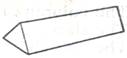
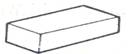


14. Speak on the forms of the objects presented as it is shown in the example:
Example:
| a. The brick is formed like a prism. b. The brick is prismatic in form. |

SHAPES
| a square a triangle a rectangle a circle a semi-circle | square triangular rectangular circular semi-circular |

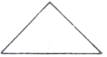



15. Speak on the shapes of the sections for the objects presented in the ex.14 as it is shown in the example:
Example:
| a. The cross-section of a square prism is shaped like a square. b. The longitudinal section of a square prism is rectangular in shape. |
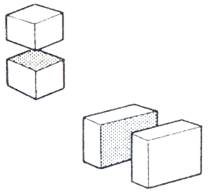
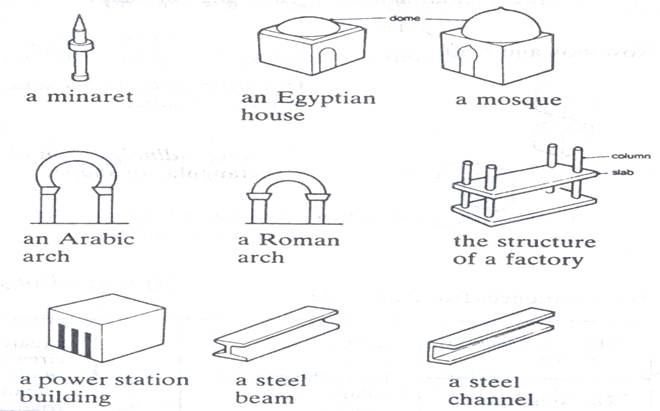
16. Answer the questions:
a. What building is formed like a pencil?
b. What construction element’s cross-section is shaped like “I”?
c. What construction element’s cross-section is shaped like “[“?
d. What arch is horse-shoed in shape?
e. What fruit is a dome formed like?
f. What building has windows shaped like a diamond?
g. What unit is a triangular prism in form?
h. What units and elements are formed like a rectangular prism?
i. What internal volumes are formed like a cylinder?
j. What external volumes are cubic in form?
k. What buildings have circular-shaped windows?
l. What form is a theatre formed like?
_____________________________________________________________
Horse-shoe Diamond | Подкова Бриллиант |
17. Interpret in English:
a. Я не согласен с тем, что здание будет иметь форму куба.
b. С моей точки зрения, швеллер (channel) в форме буквы I более прочный.
c. Что вы думаете о конусообразных крышах?
d. Ему кажется, что продольное сечение будет в форме треугольника!
e. Что он думает о мансардном этаже в форме треугольной призмы?
f. Мы полностью согласны, что окна должны быть круглыми.
g. Я категорически возражаю против нестандартных (unusual) форм для церкви.
h. Возможно, вы правы, и Земля (the Earth) имеет форму шара…
i. Если вы спрашиваете мое мнение, то столб треугольного сечения самый прочный (the strongest).
j. Как вы относитесь к жилым зданиям в форме пирамид?
AREAS & VOLUMES
(Internal Measurements)
18. Read and make up the vocabulary for the topic:
A room has three spatial dimensions: length, height and width. These dimensions are measured in millimetres or metres. The volume of a room equals length times height times width. Volume is measured in cubic metres (m3). The area of a surface in a room is measured in square metres (m2).
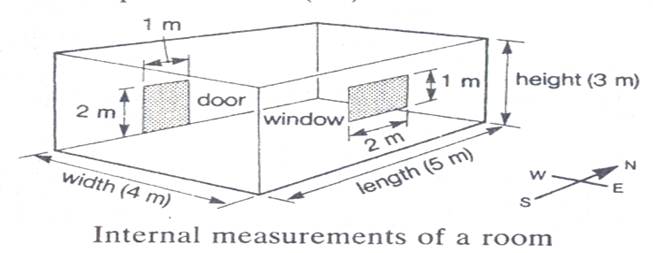
19. Answer the questions by the illustration above:
a. What is the internal area of the north-facing wall?
b. What is the internal area of the east-facing wall?
c. What is the internal area of the west-facing wall?
d. What is the area of the window opening?
e. What is the area of the door opening?
f. What is the area of the cross-section of the room?
g. What is the area of the longitudinal section of the room?
h. What is the volume of the room?
i. What is the volume of the window opening?
j. What is the volume of the door opening if the door is placed in a partition? In a wall?
20. Measure your classroom and speak on the dimensions:
Name of the object | Dimension | Quantity |
classroom window door | width length height ceiling area floor area wall area width height depth window plane area window opening volume width height depth door plane area door opening volume |
21. Mark on the illustration the dimensions discussed by the workers:
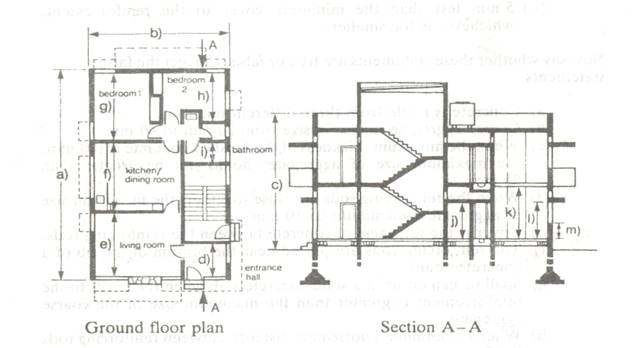
1 ST WORKMAN: Right, we’ve finished measuring the dimensions of the building, let’s check the measurements with the drawings to see if they agree.
2 ST WORKMAN: O. K. You read out the measurements and I’ll check them on the drawings.
1 ST WORKMAN: Are you ready?
2 ST WORKMAN: Yes.
1 ST WORKMAN: O. K. The external length of the building is 12500 mm.
2 ST WORKMAN: That’s right.
1 ST WORKMAN: That’s the external width is 7550 mm.
2 ST WORKMAN: That’s O. K. too. What about the height?
1 ST WORKMAN: Hold on a minute. Ah yes. The height from the ground level to the top of the parapet is 7950 mm.
2 ST WORKMAN: Good. Those measurements agree alright. Let’s check the internal ones now.
1 ST WORKMAN: Right. Oh… Which room first?
2 ST WORKMAN: Let’s start with the entrance hall.
1 ST WORKMAN: O. K. That room is square with a side of 2200 mm.
2 ST WORKMAN: Yes. That’s good. Now the living room.
1 ST WORKMAN: That’s 4800 mm by 3800 mm.
2 ST WORKMAN: Yes. And the kitchen/dinning room?
1 ST WORKMAN: 4500 by 4000 mm.
2 ST WORKMAN: Wait a minute! Are you sure we measured it to be 4500 mm long? It should be 4800 mm because it’s the same length as the living room.
1 ST WORKMAN: Sorry. I can’t read my own writing. You’re right, it’s 4800 mm by 4000 mm.
2 ST WORKMAN: And the first bedroom?
1 ST WORKMAN: 4000 by 3150.
2 ST WORKMAN: And the second bedroom?
1 ST WORKMAN: 3250 by 2250.
2 ST WORKMAN: And the bathroom?
1 ST WORKMAN: 2130 by 1220 mm.
2 ST WORKMAN: So far so good – now some heights. What is the floor-to-ceiling height?
1 ST WORKMAN: Ah. Now. The floor-to-ceiling height for all rooms except the bathroom and toilet is 3000 mm. The ceiling in the bathroom and toilet are 900 mm lower
2 ST WORKMAN: Umm … 900 from 3000 that’s …
1 ST WORKMAN: 2100.
2 ST WORKMAN: That’s right. Good. Carry on.
1 ST WORKMAN: Well. In each room the windowsill height is 900 mm and the window head height is 2100 mm above the floor.
2 ST WORKMAN: That’s great. All the measurements agree thank goodness. Let’s go and have a cup of tea.
1 ST WORKMAN: Wait a minute! You’ve got the wrong drawings there haven’t you?
2 ST WORKMAN: Don’t be silly they’re the right ones …
1 ST WORKMAN: No, they’re not …
22. The ex.21 illustration is made by the scale 1 : 300. Use a ruler and find the dimensions following:
a. the width of the entrance door.
b. the total height of the building.
c. the width of the first floor living-room balcony.
d. the length of the canopy over the kitchen and dining-room window.
e. the depth of the foundation.
23. Sketch the plan for the second storey in the building drawn in the ex.21. Name the rooms’ dimensions.
24. Sketch the front and the rear of the building drawn in the ex.21. Name their details’ dimensions.
BUILDING LOCATION
25. Watch the illustration, study the examples and speak the rest facts on the building location.
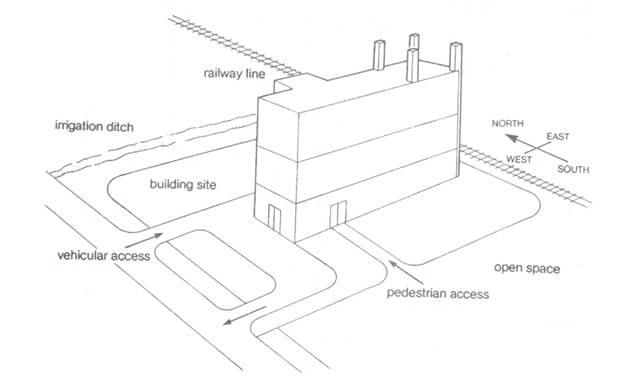
Example 1: The front of the building faces west.
The front of the building is west-facing.
Example 2: The short walls face east and west to minimize the area exposed to the sun.
Example 3: The long axis is orientated east-west.
Example 4: The site is bounded by a road to the west.
A road runs along the western boundary.
Example 5: The site has vehicular access from the road to the west.
26. Fill in the gaps with the suitable phrases. Base on the ex.25 facts:
The building site is approximately … in shape. It is bounded by … to the north, … to the east and … to the west. Vehicular access is from a … which … the western boundary. The long axis of the building is … east-west to minimize …
27. Find out what Perm buildings are described below:
a. This four-storeyed public building is bounded by Komsomolsky Prospect in the north and Lenina Ulitsa in the east. It is cubic in form and the front faces east. The external volume deals with a porch.
b. This two-storeyed public building is located adjacent the Gorky Park. It has a pedestrian access from Komsomolsky Prospect in the south. Its long axis is orientated south-north to maximize the area of walls exposed to the winds as it should be kept cool inside because a lot of people move there.
c. This public building has vehicular and pedestrian accesses from Lenina Ulitsa in the east. The site is bounded by railways from the north, west and south. The internal volumes include two storeys and a cellar. On the front over the main entrance a huge watch is situated.
d. This public building’s front faces west. It has vehicular accesses from the north and south. Its internal volumes include a tambour and entrance hall in the first storey and office rooms in the second one. It is situated on the left of the Rynok Circle viewed from the Revolutsy Ulitsa.
e. The building is cylindrical in form. It has a flat roof, a semi-circular porch and a balcony on the front. There is no vehicular access, and the pedestrian one is from the Uralskaya Ulitsa. The tambour enables to keep warmth the first storey’s buffets. The attractive finishing is made of glass.
28. Interpret in English:
a. Я уверен, что главный фасад выходит на север, дворовый – на юг.
b. Вы считаете, что продольная ось ориентирована с запада на восток?
c. Мне кажется, что короткие стены боковых фасадов выходят на восток и запад, чтобы уменьшить площадь стен, подверженных воздействию ветров.
d. Я полностью согласен, что в учебном (educational) корпусе должно быть тепло; поэтому дворовый фасад выходит на юг, чтобы увеличить площадь стен, подверженных воздействию солнца.
e. Мы поддерживаем вашу точку зрения, что в спортивном корпусе должно быть прохладно, поэтому продольная ось ориентирована с юга на север, чтобы увеличить площадь стен, подверженных воздействию ветра и уменьшить площадь стен, подверженных воздействию солнца.
f. Нам нравится, что одна из центральных улиц города бежит вдоль северной границы участка.
g. Мне казалось, что участок ограничен переулками (side-street) с запада и востока.
h. Как вы относитесь к тому, что пешеходные доступы имеются со всех сторон участка, кроме запада?
i. Я не смогу запроектировать автомобильный доступ только с юго-востока с улицы Пионерской.
j. Я считаю, что расположение участка выгодно и удобно.
29. Give your opinion on the buildings location by the illustrations placed below.


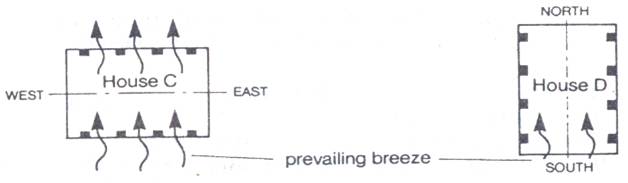
30. Sketch your house location. Work in pairs and find out your fellow-student’s house location. Speak on the facts known.
31. Choose a well-known Perm building and ask your fellow-students on its location facts and their opinions on those points. Start your questions with the words written below:
a. What type …?
b. Where …?
c. How many …?
d. What …?
e. How …?
f. Why …?
g. What cardinal points …?
h. Why …?
i. What …?
j. What do you think of …?
32. Read the Cinema Kristall construction comments. Agree or disagree. Give the right facts:
a. The climate influences the building orientation.
b. The site has both the vehicular and pedestrian accesses.
c. The external volume includes the fire staircase.
d. The frame is made of reinforced concrete.
e. The function of the building influences its location.
f. The building is formed like a cube.
g. There is no lift shaft.
h. The attractive finishing will be made of plastics.
i. The roof will be flat with no space for loft.
j. Window openings were projected circular in shape.
k. Wind and sun will not expose the external walls.
l. Main streets run along the boundaries of the site.
m. The depth of the foundation is as considerable as for a multi-storeyed building.
n. There will be fewer porches than at the Perm College of Constructions.
o. The roof, walls and foundation will be impermeable.
33. Interpret in English:
a. Как вы относитесь к тому, чтобы главный фасад выходил на запад?
b. Если продольная ось ориентирована с севера на юг, площадь стен, подверженных воздействию утреннего солнца, увеличивается.
c. Я согласен, что главный фасад отеля должен выходить на улицу.
d. Мне не нравится, что нет автомобильного доступа к дому.
e. Я считаю, что к дому должны быть только пешеходные доступы.
f. Как вы думаете, река вдоль границы участка устроит (to suit) заказчика?
g. Если вам нужно мое мнение, то я уверен, что изменить ориентацию продольной оси невозможно из-за формы участка.
h. Как вы думаете уменьшить площадь стен, подверженных воздействию ветра?
i. Подрядчик считает, что важно соблюдать (to follow) функциональные требования, а не климатические условия.
j. Я бы хотел, чтобы вы не придавали так много значения (to attach great importance to) погодным условиям в центре города.
CONTROL 1
34. Speak on the building you are projecting. Base on the plan following:
a. The type and function of the building.
b. The main units and materials (the foundation and its type; the walls and finishing; the roof and its form).
c. The external volumes and their placement.
d. The internal volumes and their dimensions.
e. The building’s location.
35. Analyze your fellow-student’s project. Use the clichés “Discussing Variants”.
36. Analyze your fellow-student’s opinions on your project. Use the clichés “Discussing Variants”.
PRACTICE
37. Work out the project for an object to commemorate your city (town) anniversary. Sketch the necessary drawings; describe the object.
38. Analyze your fellow-students’ projects. Use the clichés “Discussing Variants”.
39. Analyze your fellow-students’ opinions on your project. Use the clichés “Discussing Variants”.
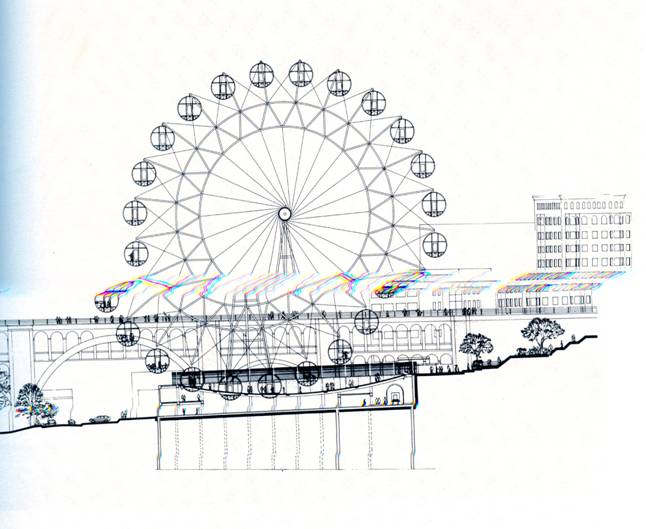

40. Fill in the gaps with the suitable phrases (watch the illustrations). Use the clichés “Discussing Variants”.
To celebrate the bicentennial (двухсотлетие) of the foundation of the city of Cleveland this huge Ferris wheel was projected. It contains a number of restaurant pods (люлька, кабинка) which rotate once every hour-time for a brisk (быстрый) meal.
Architect: - This spectacular image will be a gift for Cleveland and the world.
Client: - …?
Architect: - 280 feet.
Client: - …, a 30-storeyed building height is great. …?
Architect: - High-strength steel tubes 12 inches in diametre.
Client: - …, steel is the strongest modern material, I guess. …?
Architect: - Cylinders 20 feet in diameter, 40 feet long.
Client: - …
Architect: - I wouldn’t agree to you there. One cylinder will place 4 tables, privacy does not need anything else.
Client: - …?
Architect: - From 18 to 28 persons at a time.
Client: - …
Architect: - Yes, that’s exactly my point. There will be a dining-area, a bar, a kitchen, one toilet.
Client: - …?
Architect: - Services and the access will be located on either side of the dining-area.
Client: - …?
Architect: - Glass. Specially designed glass.
Client: - …
Architect: - Yes, that’s how I feel. The wheel is located in an area adjacent to the Detroit Superior Bridge and faces the river and the park. Splendid view!
Client: - … . …?
Architect: - The vehicular one will be from Huron Road. There is a parking. The pedestrian access is along the 55-feet staircase.
Client: - …
Architect: - Is it disturbing you? I’m not so sure about it. This will be a stepped park with lots of recreation places at different levels.
Client: - …
________________________________________________________________________________
Spectacular View Stepped park Recreation Level | Живописный Вид Террасированный парк Отдых Уровень |
41. Analyze the Ferris Wheel Project based on the ex.40 facts). Use the clichés “Discussing Variants”.
42. Read and agree or disagree with the Projector’s opinions. Use the clichés “Discussing Variants”.
This will be a concrete mixing plant in Helsinki.
It will be situated in an area of heavy traffic (дорожное движение).
The site is smaller than a plant requires, and the gravel conveyor will come round the area.
The first storеy floor will have the smallest area so that there is space around the building for tracks (грузовик) to maneuver.
The site is bounded by residential areas and the mixing process will be encapsulated to prevent the environment (окружающая обстановка) from dust.
The metro runs along the western boundary. The contractor paid special attention to attractive finishing. He also made the environment as congenial (благоприятный) to working as possible (north-south orientation of the personnel (штат работников) building, run-screen (жалюзи) on the south window, greenery (зелень) boundaries to provide visual screening, etc).
The units are made of concrete, glass, plastics, wood, steel. “The interaction of the various materials forms the core (суть) of the architectural entity (целостность)” (Kai Wartiaimen, the architect of the project).
WILL IT SUIT THE CLIENT?
43. Mark on the plans the rooms discussed in the client and architect talk:
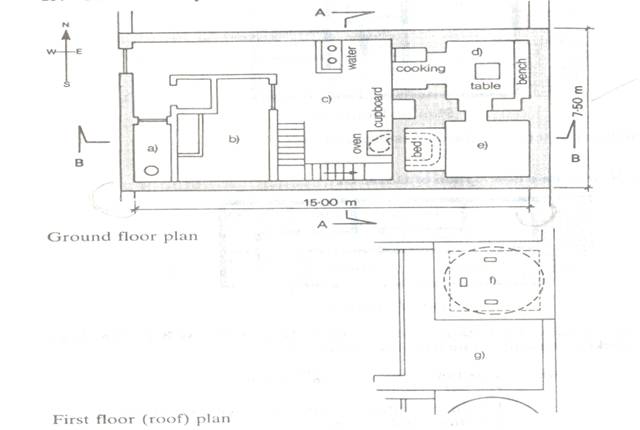
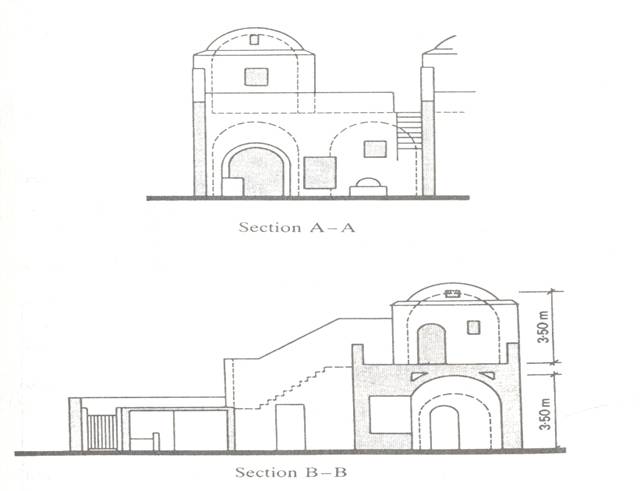
Discussing a Project
Client: - I wonder if you could explain these drawing to me, please.
Architect: - Yes, certainly. Where shall we start?
Client: - What are these spaces on the ground floor used for?
Architect: - As you go through the entrance there is a toilet immediately on the right, here. Adjacent to it the stable is placed with access from the courtyard which is located in the centre of the house.
Client: - I see. The courtyard doesn’t have the roof.
Architect: - Right, it’s an open courtyard.
Client: - And the staircase leads to the first floor, I guess.
Architect: - That’s exactly the point. And the first floor plan shows the open roof terrace and a bedroom.
Client: - As far as I am able to judge, there is a bedroom on the ground floor too.
Architect: - The ground floor bedroom will be used in winter, and the first floor one in summer.
Client: - What is this room placed in front of the winter bedroom?
Architect: - I would say it is on the left as the plan is viewed from the front … That’s the kitchen.
________________________________________________
Stable Access Courtyard | Конюшня Доступ Внутренний двор |
44. Read and say what the client agrees to. Consult ex.43:
Analyzing a Project
The architect said the scale is 1 : 200, so the total height of the house is 8 metres, I like it.
The first storey is higher than the second… that’s all right, I will not spend much time upstairs… though the terrace will be good for air-breathing in the evenings… and for exercises in the morning… and it’s open, great!
The summer bedroom is smaller than the winter one… oh, I can use the terrace like a second bedroom. The winter bedroom is quite big… er… 9 square metres… and cubic in form, fine.
The kitchen is small. When I want to have a party, I will not have space enough. I certainly want a bigger kitchen … as big as the courtyard.
The toilet is far from the residential rooms, I believe. It should be placed nearer, as near as water. And I would not like it to be so narrow as a slit, its width should be 2 metres.
________________________________________________
Scale Upstairs Space Slit | Масштаб Наверху, на втором этаже Пространство Щель |
45. Make up questions to the answers given below. Base on the ex.43-44 facts:
a. 8 metres b. first storey c. for air-breathing d. than the winter bedroom e. 3 metres | f. 9 m2 g. as the courtyard h. from the residential room i. as water j. as a slit | k. 1 : 200 l. 2 metres m. adjacent to the toilet n. roof terrace o. two-flighted |
46. Interpret in English:
a. Мне кажется, алюминий не такой гибкий, как резина.
b. Я не согласен, что алюминий гибкий, я считаю, что он мягкий.
c. Что вы думаете о том, чтобы сделать внутренний объем здания больше?
d. Возможно, деревянные балки так же прочны, как стальные.
e. Как вы относитесь к более глубокому заложению (laying) фундамента?
f. Будут ли внутренние стены толще (thick) наружных?
g. Он согласен, что объем жилых комнат должен быть больше.
h. Мы возражаем против более узких (narrow) лестничных маршей (flight), это не обеспечит срочную эвакуацию (escape) людей при пожаре.
i. Он утверждает, что в жарких регионах площадь оконных проемов зданий меньше, чем в холодных районах.
j. Я уверен, что мрамор – самый дорогой материал.
47. Fill in the gaps with the suitable phrases:
a. The trouble with … is that it is soft and will be dented.
b. … and make them circular.
c. … but your project will suit a rural district.
d. … steel entrance doors will …?
e. … with the external walls. They are as thin as partitions.
f. … about the staircase shaft. It will not be so … as the lift shaft.
g. … with flat roof, because I want a … in the … volume.
h. … two-storeyed. You will economize on land cost.
i. … not to use much concrete for this …
j. I like … as much as …
48. Make up the client’s comments on the points following. Base on the ex.43-44 facts. Use the clichés “Complaining”:
a. The summer bedroom area.
b. The kitchen area.
c. The winter bedroom form.
d. The toilet width.
e. The courtyard.
f. The entrance passage.
g. The window opening depth in a house in the hot region.
h. The stable.
i. The form of the roof.
j. The internal walls thickness.
49. Make up the Projector’s possible answers (based on the ex.43-44, 48 facts)
50. Interpret in English:
a. У меня будут трудности с лестницей, не могли бы вы запроектировать лифт?
b. Лично я предпочел бы одноэтажный дом с мансардным этажом.
c. Я не думал, что теплоизоляция будет беспокоить вас в этом теплом регионе.
d. Жаль, но мы ничего не сможем изменить, перекрытия будут сделаны из дерева.
e. Мне нравятся высокие помещения.
f. Я не хотел оконные проемы ромбовидной формы.
g. Я прослежу за тем, чтобы производитель соблюдал (follow) марку (grade) стали для арматуры (reinforcement).
h. Я не думал, что вам не понравится, что внутренние стены такие же толстые как наружные, это хорошо для противопожарной безопасности.
i. Мы бы предпочли дерево для элементов дома, потому что оно приятнее (agreeable/comfortable).
j. Мы ничего не можем сделать, раствор уже схватился (to harden).
51. Group work.
Analyze the Ferris Wheel Project / The Concrete Mixing Plant Project as if:
a) you are the City Manager;
b) you are the Park Manager / the Metro Manager;
c) you are a local resident;
d) you will be a worker on the object;
e) you are a visitor.
Answer the complaints.
Use the clichés “Complaining”.
CONTROL 2
52. Describe the project.
53. Analyze your fellow-colleague’s project. Use the clichés “Discussing Variants”.
54. Analyze your fellow-colleague’s opinions on your project. Use the clichés “Discussing Variants”.
55. Watch the object projected in your plain on what you do not like. Use the clichés “Complaining”.
56. Answer the client. Use the clichés “Complaining”.
Заключение
Апробирование пособия прошло в первом и втором семестре 2007-08 учебного года. Результаты работы четырех групп третьего курса (С-31, С-32, СВ-31, СЦ-31) доказывают, что в ходе учебных занятий с применением данного пособия формирование профессионально-ориентированных речевых умений происходит в необходимом темпе и с нужной степенью уверенности во владении языковым материалом.
Подготовка итогового монологического высказывания по разделу «Архитектурная часть проекта» выполняется студентами без затруднений, в быстром темпе, грамотно, с применением всех необходимых языковых средств. С такой же уверенностью студенты готовят критику проекта и ответ на критику (защиту проекта). Это подтверждают и оценки, полученные студентами на зачетных занятиях:
Группа | 5 | 4 | 3 | 2 | % успев-ти | % качества | Средний балл |
С-31 | 1 | 3 | 1 | 1 | 82,5 | 66 | 3,66 |
СВ-31 | - | 5 | 3 | - | 100 | 62,5 | 3,63 |
С-32 | 4 | 3 | 3 | - | 100 | 70 | 4,1 |
СЦ-31 | 1 | 6 | 5 | - | 100 | 58,3 | 3,66 |
итого | 6 | 17 | 12 | 1 | 97,2 | 63,9 | 3,78 |
Таким образом, подготовка части пояснительной записки к курсовому проекту по архитектуре зданий на английском языке – задача, выполнимая для любого студента. Можно с уверенностью ожидать, что большая часть студентов способна к устной презентации проектов на английском языке, в т. ч. с ответами на вопросы и критику проектов. Данная работа будет проведена в следующем учебном году, и результаты будут представлены на показательном интегрированном занятии (английский язык и архитектура зданий) в конце декабря 2008 г.
Дальнейшая работа по совершенствованию учебного материала данного пособия предполагает прояснение со специалистами терминов и специфической проектно-строительной лексики в русском варианте.
Список литературы.
Дж. Камминг. Английский для студентов архитектурных и строительных специальностей. АСТ-Астрель – Лонгман, 2004. World Architecture, № 32.Приложение 1
DISCUSSING VARIANTS
Ask For an Opinion | Give an Opinion | Agree With an Opinion | Disagree With an Opinion |
· What do you think of …? · What is your opinion of …? · How do you find …? · How do you feel about …? | · (Speaking) personally, I think that … · My view is … · In my opinion … · From my point of view … · If you ask me … · If you want my opinion, …· As I see it … · As far as I am able to judge … · It would seem to me … · I suppose … · I believe … · I would say … | · I’d go along with you there · Yes, I’d tend to agree with you · I couldn’t agree more · Yes, I entirely agree with you there · Yes, I quite agree with you on that · Yes, that’s exactly my opinion · Yes, that’s just how I see it · Yes, that’s how I feel · I take your point · I’m with <you> there · I’m with <you> on that · I agree to a point · I agree in a way · Perhaps (you are) right | · I’m not really sure I would go along with <you> there · I wouldn’t go along with <you> there · I’m not so sure about that · I’m not so certain about that · I’m not really sure (you are right) · I think that would be a mistake · I couldn’t do that I’m afraid · I wouldn’t agree · I can’t accept that · I don’t think it is a good idea · I don’t agree · I don’t see why I should |
Приложение 2
COMPLAINING
To Complain | To Accept a Complaint | To Delay a Complaint | To Reject a Complaint |
· There seems to be something wrong with … · I’m sorry I’m not at all satisfied with … · I will have a lot of trouble with … · I don’t like … · I’m afraid that … · The trouble with … is that … · Don’t you think that …? · (Personally,) I’d prefer … · I’d rather … · I prefer … · I like … | · I’m sorry about that. + · I will do my best. · I will see to it. · I thought you didn’t mind. · I didn’t realize you felt so strongly about it. · Is it bothering you? · Is it disturbing you? | · We will see what can be done about it. · We will see what we can do about it. | · I’m afraid there is nothing we can do about it actually. · I’m afraid there is not much we can do about it actually. |
