

Партнерка на США и Канаду по недвижимости, выплаты в крипто
- 30% recurring commission
- Выплаты в USDT
- Вывод каждую неделю
- Комиссия до 5 лет за каждого referral
The Russian vsjakij
Georgy Bronnikov
Russian State Humanitarian University
The quantifier vsjakij has drawn considerable attention from semanticists in the Russian tradition. This article proposes an analysis based on the morphological structure of the word, using Carlson’s (1977) theory of kind reference. The result is an account that allows us to give a unified treatment to generic and ``existential’’ uses of vsjakij, which, to my knowledge, has never been done before. There remain a number of problematic cases; those are noted and, where possible, analyzed as well. If the proposed account is correct, vsjakij turns out to be a near-exception to a well-known universal stating that no language has determiners specialized for kind reference (see, for example, Gerstner-Link and Krifka 1995, p. 967, Dayal 2004, p. 394).[1]
1. Contexts of use for vsjakij
We start by listing a number of contexts where vsjakij can be used.
1. Generic universal quantifier: vsjakij can be used in generic sentences like (1), but it is ugrammatical in episodic cotexts like (2). It is also bad with proper nouns (3) (examples from Kronhaus 1984):
(1) Vsjakij čelovek smetren
vsjakijNOM. MASC manNOM mortal
`All men are mortal’
(2) *Vsjakij student prišel na lekciju
vsjakijNOM. MASC studentNOM came to lecture
`Every student came to the lecture’
(3) *Vsjakaja Aksinja živet v Sovetskom
vsjakijNOM. FEM A. lives in Soviet
Sojuze
Union
`Every Aksinja (that is, every woman of that name) lives in the Soviet Union’
2. Meaning close to Russian raznyj, English various:
(4) U nas žili vsjakie koški
at us lived vsjakijNOM. PL cats
`We have had all sorts of cats (in our house)’
3. Some, but not all contexts of “Indirect negation” in the sense of Haspelmath 1997: vsjakij van be used in the scope of implicit negation, but not in the scope of negation in a higher clause, nor in the scope of a downward entailing operator where no negation is present.
(5) Vasja s”el sup bez vsjakoj ložki
V. ate soup without vsjakijGEN. FEM spoon
`Vasya ate the soup without any spoon’
(6) Ja poterjal vsjakoe terpenie
I lost vsjakijACC. NEUT patienceACC
`I lost all my patience’
(7) *Ja ne dumaju čto vsjakij prišel
I not think that vsjakijNOM. MASC came
`I don’t think that anyone came’
(8) *Malo u kogo iz prisutstvujuščix byli
few at who from present were
vsjakie vozraženija
vsjakijNOM. PL objectionsNOM
`Few of those present had any objections’
4. Standard of comparison:
(9) Vasja zabintoval ranu lučše vsjakogo vrača
V. bandaged wound better vsjakijGEN. MASC doctor
`Vasya bandaged the wound better than any doctor’
The list of contexts is not exhaustive, and is intended as an initial data set against which to evaluate our proposal.
2. Previous accounts
Early descriptions of the Russian quantifier system, such as Levin 1973, Paducheva 1974 treat vsjakij as a simple universal quantifier similar to každyj. Levin notes, though, that vsjakij does not apply when the number of quantified objects is bounded. It was Kronhaus (1984) who noted the peculiarity of distribution in (1-3); his explanation is the following (my translation): “Vsjakij combines with a noun phrase associated with some property (intensional reference type). It means that the intensional property implies the predicate property irrespective of the object having that property”. Thus (2) is ungrammatical because here the `predicate property’ does not apply `irrespective of the object’ denoted by the subject NP. The ungrammaticality of (3) is due to proper names lacking intensions. However, Kronhaus deliberately narrows the scope of his investigation to just those contexts that are called ``generic universal’’ in the previous section.
Padučeva (1989) states that vsjakij requires the quantified set to be infinite, non-uniform, and the quantification happens not over individuals, but over properties of those individuals.
Tatevosov 2002 is an investigation of universal quantification across languages. The result is a semantic map extending one constructed for indefinite pronouns in Haspelmath 1997. This map divides uses of a pronoun or quantifier into classes. It is stated that classes of use for any linguistic item occupy a continuous area on the map. Moreover, it is expected that within each class of uses, an item that can be used in one context can also be used in others from the same class. The map for vsjakij is shown on Picture 1 (I extended it to cover the standard of comparison cases; Tatevosov considers them ungrammatical for some reason). Even though such a map does not in itself constitute an analysis[2], it can serve as a valuable tool in determining the distribution of a linguistic item. Note, however, that the second type of contexts (`various’) has no place on this map.
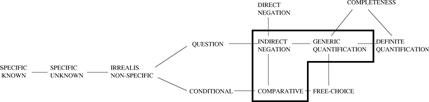
Picture 1. Semantic map according to Haspelmath 1997, Tatevosov 2002.
3. Hints from morphology
It is well known that most Russian pronouns can be organized in a table where rows correspond to ontological classes, and columns to pronoun series. Pronouns are placed in the cells according both to their morphology and semantics. The correspondence is not perfect either way, but sufficient to make rough predictions.
kto | kto-to | kto-nibud’ | kto-libo | vse | ||
čto | čto-to | čto-nibud’ | čto-libo | |||
gde | gde-to | gde-nibud’ | gde-libo | zdes’ | vezde | |
kuda | kuda-to | kuda-nibud’ | kuda-libo | sjuda | tuda | |
kogda | kogda-to | kogda-nibud’ | kogda-libo | togda | vsegda | |
kakoj | kakoj-to | kakoj-nibud’ | kakoj-libo | takoj | vsjakij |
As we see, vsjakij occupies the cell in the table belonging to the pronouns of the same ontological class as kakoj and the series of universal quantifiers. The strategy I will follow is to assume that its meaning is compositional[3] — to try and derive it from the meaning of the row and column in the table where vsjakij resides. The goal of this paper is to investigate how far one can take such a hypothesis; to see where it works and where it breaks. We would expect that in some cases our analysis will give the right predictions, in others it will fail, but the way it fails may also be of interest.
This idea has been studied, in a less formal way, in Paducheva 1989:
In any case, the idea that individual properties of objects are irrelevant constitutes the main component of the meaning of the word vsjakij. Indeed, vsjakij in its non-quantifier uses means `having arbitrary properties' (cf. Ljudi byvajut vsjakie `There are all kinds of people', i. e., not only good, but also bad) … The link between the word vsjakij and the idea of quality is predetermined by its morphology — the qualitative pronominal suffix -ak-, cf. the same suffix in the words dvo-jak-ij `twofold', in-ak-ij `different', t-ak-oj `such', etc. (p. 19).
4. The meaning of kakoj
Before we can state our hypothesis formally, we need to provide some analysis for the wh-word kakoj (`which’, `what kind’, `like what’).
At first sight it seems that, just as kto `who’ is for asking questions about animate entities, čto `what’ is for questions about inanimate entities, expressed, for example, by definite descriptions, gde `where’ is about places expressed by adverbs and PPs, in the same way by using kakoj one asks a question about the properties of the object referred to by its sister NP, expressed by adjectives.[4] An answer to such a question should have the <<e, t>,<e, t>> type. Upon further examination, however, we find, first, that nonsubsective adjectives are not good answers to questions formed with kakoj (10c), and, second, that nouns designating subkinds of the sister NPs do serve as answers to such questions (10d):
(10) — Kakaja u tebja sobaka?
what at you dog
`What kind of dog do you have?’
a. — Bol’šaja.
`A big one’
b. — Staraja
`An old one’
c. — ??Igrušečnaja
`A toy one’
d. — Ovčarka
`A shepherd’
We arrive at the following conclusion: kakoj forms questions about subkinds of the kind expressed by its sister NP.
5. Formalizing the basic hypothesis
In parallel with kakoj, we hypothesize that vsjakij is a universal quantifier over subkinds of the kind denoted by its sister NP. This can be expressed by the following formula:
vsjakij = λQ λP ∀k ((k < nom (Q)) → P(k))
Here nom is a type shift operator converting a predicate into its corresponding kind (of type e) (Partee 1987), and the expression k1 < k2 means that k1 is a subkind of k2.
One extra assumption is needed: when vsjakij forms a DP by itself, its Q argument is filled by the predicate human when vsjakij is in masculine, feminine gender or in plural (11), and by prediicates event or information when it is in singular neuter (12), (13).[5]
(11) Vsjakij obradovalsja etomu izvestiju
vsjakijNOM. MASC was glad thisDAT newsDAT
`Everyone was glad to hear the news’
(12) So mnoj vsjakoe slučalos’
with me vsjakijNOM. NEUT happened
`All kinds of things happened to me’
(13) O Vasje vsjakoe rasskazyvajut
about V. vsjakijACC. NEUT they. tell
`They say all kinds of things about Vasya’
6. Digression: kind-referring NPs
Before we start looking at the behaviour of vsjakij, we need to review briefly kind-referring NPs in general and Russian kind-referring NPs in particular. According to Carlson 1977, these NPs have two groups of uses: generic and “existential”. A limited number of predicates accept kinds as arguments directly, as in
(14) Tigr ohranjaetsja zakonom
tiger is. protected lawINSTR
`The tiger is protected by law’
For most predicates, however, the truth value of the sentence is computed on the basis of truth values of the corresponding predicate applied to the specimens of the kind. In the case of generic use the sentence may be true, for example, when all the “normal” specimens have the requisite property:
(15) Sobaki predany hozjainu
dogs devoted masterDAT
`Dogs are devoted to their master’
In the case of “existential” use, for a sentence containing a kind-referring NP to be true the predicate needs to hold for some “realisation” of the kind — that is, for some object belonging to the kind:[6]
(16) Segodnja u menja po kuxne begali
today at me along kitchen ran
tarakany
cockroaches
`Today there were cockroaches running in my kitchen’
In English kind-referring NPs are of two types: singular NPs with the definite article and bare plurals. In Russian, an article-less language, bare singulars correspond to definite singular NPs in English, and bare plurals correspond to English bare plurals. Singular NPs are mostly used generically, plurals can have both generic and “existential” uses.[7],[8]
7. Checking the hypothesis
7.1. Generic universal quantifier
Vsjakij-NPs in the singular (with count head nouns) are used almost exactly in the same contexts where kind-referring singular NPs are used. This explains the distribution we see in (1-3): (2) is ungrammatical, because singular kind-referring NPs are not used in episodic contexts; (3) because proper names do not have kinds associated with them.
Besides, our working hypothesis correctly predicts that
(17) Vsjakaja sobaka predana svoemu xozjainu
vsjakijNOM. FEM dogNOM devoted itsDAT masterDAT
`Every dog is devoted to its master’
is more likely to allow exceptions than
(18) Každaja sobaka predana svoemu xozjainu
each dog devoted itsDAT masterDAT
`Each dog is devoted to its master’
The translation we get for (17) is the following formula:
∀ k ((k < dog) → NORMALLYx (R(x,k) →devoted-to-master(x)))
Two steps of quantification are involved here: one arises when we derive the meaning of the verb that takes kinds as arguments, and the other is the quanitifier over kinds denoted by vsjakij. The first of these allows exceptions. In (18) there is just one, object-level quantifier, and no exceptions are allowed.
There arises a problem: vsjakij does not combine with predicates that select for kind as their argument:
(19) ??Vsjakij tigr oxranjaetsja zakonom
vsjakijNOM. MASC tiger is. protected lawINSTR
`Any kind of tiger is protected by law’
A possible explanation for this fact is that among the subkinds generated by vsjakij some are equally bad when combined with the predicate (if expressed by singular NPs):
(20) *Staryj tigr oxranjaetsja zakonom
old tiger is. protected lawINSTR
`The old tiger is protected by law’
7.2 “Existential” use
Our analysis predicts the right truth conditions for sentences containing vsjakij-NPs in plural, if one views them as always having “existential” interpretation. For example, (4) is analyzed as follows:
∀k ((k < nom(cat)) →∃x (R(x,k) & lived-with-us(x)))
that is, for every subkind of the kind CAT, at least one representative of that kind lived in our house. Here R(x,k) means that the individual x (or stage, if we follow Carlson's analysis literally) is an instance of kind k. (Cf., however, section 8.)
At the same time generic uses of NPs with vsjakij in plural are impossible:
(21) *Vsjakie ljudi snertny
vsjakijNOM. PL peopleNOM mortal
Grammaticality judgements for bare kind-referring NPs and vsjakij-NPs can be summarized in the following tables:
Bare kind-referring NPs | Vsjakij-NPs | |||||
Singular | Plural | Singular | Plural | |||
Existential | - | + | Existential | - | + | |
Generic | + | + | Generic | + | - |
We see that the tables are mostly similar, however the cell for generic plural remains problematic.
7.3. Indirect negation
For examples like (5), one needs to provide some analysis of bez `without'. Here is our proposal: sentence S bez X has the meaning
S'(e) & participate(X', e)
where e is the event described by the main clause (either a free variable whose value is supplied by the context, or a variable subject to existential closure), and participate(x,e) means that entity x takes part in event e.
It is natural to stipulate that a kind participates in an event iff some realisation of it does. Under these assumptions, we arrive at the following analysis for (5):
∀k ((k < nom(spoon)) → (Vasja-ate-soup(e)
& ∃x (R(x,k) & participate (x,e))))
which corresponds to its intuitively understood truth conditions.
It is also clear why (8) is bad. For this sentence our analysis gives two possible meanings : wide-scope vsjakij
∀ k ((k < nom(objection)) →
FEWx (present (x)) (∃y (R(y,k) & have (x, y))))
(`For each kind of objection, few of those present had such objections’), and narrow-scope vsjakij
FEWx (present (x))(∀k (k < nom(objection)) →
∃y (R(y,k) & have (x, y)))
(`Few of those present had objections of every kind’). While it is possible to get both of them under a highly marked intonation contour, neither of these readings corresponds to the meaning one would expect from an “indirect negation” indefinite pronoun by Haspelmath’s classification (`Few of those present had any objections’). Here a wide-scope universal quantifier is not equivalent to a narrow-scope existential, thus vsjakij does not behave as an indefinite.
Examples like (6) are harder to deal with. In order to avoid presupposition failure (for the verb poterjat’ `lose’), we need to assume that terpenie refers only to those subkinds of patience that the speaker initially had. The particular mechanism providing such an accommodation is unclear.
As for the example (7), the meaning under consideration is unavailable since raising the quantifier would need to cross a tensed clause boundary, violating an island constraint.
As we see, the predictions of our analysis are more informative than those of the semantic maps approach, where all these contexts belong to the same cell of the map.
One problem with the account I present for indirect negation contexts is that, at least in the bez construction, the morphological number of vsjakij-NP corresponds to the number of objects that might participate in the event described. This casts serious doubts on the idea that kind reference is involved.[9]
(22) Vasja s”el sup bez vsjakoj
V. ate soup without vsjakijGEN. FEM
ložki /?vsjakih ložek
spoonGEN vsjakijGEN. PL spoonsGEN
`Vasya ate the soup without any spoon/?any spoons’
(23) Vasja vtaščil rojal’ na sed’moj etaž
V. brought piano to seventh floor
bez?vsjakogo pomoščnika /vsjakih
without vsjakijGEN. MASC assistantGEN /vsjakijGEN. PL
pomoščnikov
assistantsGEN
`Vasya lifted the piano to the seventh floor without any? assistant/assistants’
7.4 Standard of comparison
Analysis of comparatives is a complicated task, and I am unwilling to take sides in the debates on this problem. Therefore I would like to keep the presentation in this section informal. Variants of formal analysis can be found in Schwarzschild and Wilkinson 2002, Heim 2000.
Note, however, that the semantics of comparatives involving vsjakij is consistent with it being a universal quantifier: compare
(24) Vasja spel pesnju lučše každogo iz učenikov
V. sang song better eachGEN of students
`Vasya sang the song better than every student (in his class)’
(25) Vasja svaril sup lučše vsjakogo povara
V. cooked soup better vsjakijGEN. MASC cookGEN
`Vasya cooked the soup better than any cook would’
It should also be noted that when an NP with an object level referent serves as a standard of comparison in an episodic sentence, the resulting sentence presupposes the existence of a real event with the participation of that object. For example,
(26) Vasja narisoval košku bystree Peti
V. drew cat faster P. GEN
`Vasya drew a cat faster than Petya did’
presupposes that Petya has also drawn a cat. But if the standard of comparison is a kind-referring NP, this requirement no longer holds: in (27) no professional artist needs to draw anything in the real world.[10]
(27) Vasja narisoval košku ne xuže
V. drew cat not worse
professional’nogo xudožnika
professionalGEN artistGEN
`Vasya drew a cat no worse than a professional artist’
Considering this, sentences like (9) are analyzed adequately. The event `bandaging the wound by a k-th doctor' here is as hypothetic as in (27), in contrast with (28):
(28) Vasja probežal stometrovku bystree každogo
V. ran 100.meters faster eachGEN
iz sportsmenov
of sportsmen
`Vasya ran 100 meters faster than each of the sportsmen’
Thus we have an additional argument that vsjakij involves reference to kinds.
7.5. Predicate position
One more context where vsjakij is used (not mentioned in the list
at the beginning of this paper) is in the position of the main
predicate of the sentence:
(29) Vasja byvaet vsjakim
V. is. at. times vsjakijINSTR. MASC
≈`Vasya is different in different situations’
To analyze vsjakij in such examples, we assume that the trace left
by quantifier raising is subject to the pred type shift, which
converts it into a predicate. Thus (29) is interpreted in
the following way: for every subkind of human, in some situations
Vasja belongs to that subkind.[11] As a formula:
∀k ((k < nom(human)) → ∃s (pred(k)(s, v)))
7.6. Explaining the distribution of vsjakij on the semantic map
According to Haspelmath (1997), the set of contexts where a pronoun can be used always forms a continuous region on the semantic map in Picture 1. Thus it makes sense to look at the group of contexts adjacent to those occupied by vsjakij on Haspelmath's map, to see whether we can predict the non-occurrence of vsjakij in these contexts.
In the context of protasis of conditionals vsjakij, in order to receive the interpretation of an indefinite pronoun, would need to scope higher than the conditional itself, thus violating an island constraint on extraction:
(30) *Jesli proizojdet vsjakaja neožidannost’,
if will. happen vsjakijNOM. FEM unexpected. event
Vasja prežde vsego obratitsja k Pete
V before all will turn to P.
`If anything unexpected happens, Vasya will first of all turn to Petya’
If the condition is expressed by an adjunct PP, rather than a tensed clause, vsjakij becomes possible:
(31) Pri vsjakoj neožidannosti Vasja prežde vsego
at vsjakijLOC. FEM unexpected. event V. before all
obratitsja k Pete
will turn to P.
`In case of any unexpected event Vasya will first turn to Petya’
In the free choice contexts, as a rule, the choice to be made is not among subkinds, but among particular objects. When one constructs an example with choice among subkinds, vsjakij can be used:
(32) Ty možeš povesti sebja po-vsjakomu
you can behave like. vsjakijDAT
`You can act any way you like’
Note that both for conditionals and free choice uses our predictions are again more precise than Haspelmath’s: his theory is not able to distinguish between uses that correspond to the same cell of the map.
As for questions, it seems impossible to build an example of question where our analysis of vsjakij would predict that it behaves as an indefinite pronoun.
(33) *U tebja jest’ vsjakie voprosy?
at you are vsjakijNOM. PL questions
`Do you have any questions?’
Finally, in direct negation contexts in Russian, the usage of negative concord pronouns with ni- seems to be mandatory. So while there seem to be no semantic reasons for prohibiting vsjakij here, syntactic considerations overrule it. The same also holds for other Russian pronouns, like každyj and the –libo series (cf. Pereltsvaig 2004).
8. “Collective” use
Our analysis so far gives wrong predictions for examples like the following:
(34) Vasja nabil škaf vsjakimi korobkami
V. filled cupboard vsjakijINSTR. PL boxesINSTR
`Vasya filled the cupboard with all sorts of boxes’
What this example means is not that for every kind k of boxes Vasja has filled the cupboard with boxes of that kind. Rather, the senence says, first, that Vasja has filled the cupboard with boxes (which together form a collective object x), and, second, that each subkind of boxes had its representative within x.
Informally it is not hard to justify the existence of such use by analogy with the collective use of the quantifier vse `all, everybody'. Just like vse serves as the endpoint for enumerating individuals that constitute a collective:
(35) V komnate sobralis’ Vasja, Petja, Maša, Sereža… v obščem, vse.
In the room gathered V., P., M., S.… in short, everybody.
vsjakij is the endpoint for enumerating subkinds:
(36) Vasja nabil škaf korobkami: bol’šimi, malen’kimi, kartonnymi, derevjannymi… v obščem, vsjakimi.
Vasja filled the cupboard with boxes: big, small, cardboard, wooden… in general, all sorts of boxes.
As soon as we acknowledge the existence of such “collective” use, a question arises whether we still need the “existential” one separate from it, since the truth conditions are in most cases equivalent. The following example shows that the “existential” use does indeed exist:
(37) Vasja učastvoval vo vsjakih sporah
V. took. part in vsjakijLOC. PL argumentsLOC
`Vasya took part in all sorts of arguments’
This sentence does not describe one event, but a series of events
and different realisations of subkinds of spor `argument' participate in
different events. Thus the “existential” reading allows us to derive us the
following analysis of the sentence:
∀k ((k < argument) → ∃e∃x ((R(x,k) & take-part (v,x)(e))))
which corresponds to the intended reading. When we try to apply the “collective'” meaning to this example, we get the following: there is an compound object x composed of arguments, for every subkind of arguments there is a representative in x, and Vasya took part in x. But to take part in a compound event, it is sufficient to take part in one of its components, so we clearly do not get the intended meaning. Moreover, the statement that Vasya took part in such a compound event is not more informative than the statement that Vasya took part in some argument — presumably this rules out ``collective’’ reading on Gricean grounds.
9. More problematic cases. Historical development
Some more uses of vsjakij are hard to predict from our hypothesis. They are probably best described as a result of historical development.
The most frequent of these (in spoken Russian, this is perhaps the most frequent type of usage of vsjakij in general) are cases where vsjakij means `insignificant’, `not worth describing’. In this use, vsjakij can combine both with common nouns and proper names:
(38) U nas žili vsjakie koški
at us lived vsjakijNOM. PL catsNOM
`Some (insignificant) cats lived in our home’
(39) Ešče vsjakie Vasi budut mne sovetovat’!
also vsjakijNOM. PL VasyaPL will me give. advice
`Vasya wants to give me advice!’ (The speaker does not think Vasya is worth listening to)
This type of usage probably derives from the “existential” and “collective” uses we considered. (In fact, the only surface difference between (38) and (4) is that in the latter vsjakij bears sentence accent, while in the former it is unstressed.) The words raznyj and različnyj, both meaning `various’ or `different', undergo similar development, as does the English expression all sorts of. In (38), (39), vsjakij can be replaced by raznyj with no change in meaning.
Other uses are probably remnants of an older situation, when vsjakij was used more widely than today. Consider the following examples from XVIII century Russian:
(40) I tysjackie, gromoglasno objaviv sobranie vojska, na
lobnom meste zapisyvali imena graždan dlja vsjakoj tysjachi.
`And commanders of thousands, having proclaimed loudly the gathering of the troops, wrote down in the square the names of citizens for every thousand.’ [Karamzin. Marfa Posadnitsa]
(41) My rasstalis' i poehali vsjak v svoju storonu.
`We parted and each went his own way.’ [Radiščev. A journey from St. Petersburg to Moscow]
This kind of development is unexpected. Normally the meaning of a lexical entry becomes less transparent and further removed from its inner form as language evolves.[12] Here the opposite seems to be the case. One possible explanation is to relate this old kind of use to a different meaning of kakoj — `which', which is also present in modern Russian, along with kotoryj. Then we will have two separate meanings for vsjakij in XVIIIth century Russian, parallel to the two meanings for kakoj. In the modern language one of them is mostly lost. However, with some groups of nouns the old usage remains.
One such group is formed by nouns denoting events or situations, namely raz and slučaj. Na vsjakij slučaj `just in case' is an idiom which involves no quantification at all.
The expression vsjakij raz does involve quantification. However the quantification is not over subkinds but simply over events. Moreover, the number of events is allowed to be bounded:
(42) Vasja četyreždy zapeval pesnju, no vsjakij raz
V. four times started song, but vsjakijACC. MASC timeACC
zabyval slova
forgot words
`Vasya started the song four times, but each time he forgot the words’
Vsjakij also behaves in a similar manner when combined with nouns designating time periods. This use is absent from the author's idiolect, but there are dozens of occurrences in modern texts from the corpus (see also Paducheva 1989, p. 17):
(43) Okazyvajetsja, on vsjakij den' za pjat' verst prihodit v pomeščičij dom, čtoby prostyo poobedat'.
`It turns out he walks five versts every day to the squire's house
just to eat dinner.’ [Moris Simaško. The Fifth Rome. Chapters from a book (2000). Oktjabr' N7, 2001]
(44) No kak tol'ko načinalo temnet', ja vsjakuju minutu, kak Zoluška, pogljadyvala na strelku normal'nyh čelovečeskih časov.
`But as soon at it began to get dark, I, like Cinderella, looked every minute at the hand of an ordinary normal watch.’ [Irina
Poljanskaja. Passage of a shadow. 1996]
It seems, however, that in this type of context the number of time periods quantified over cannot be bounded.
10. Conclusions
It is unlikely that a completely uniform account of the meaning of vsjakij is possible. However, our present hypothesis seems to fare reasonably well. It is the first analysis that is able to show the connection between the generic universal and the ``existential’’ readings, and at least partially explains number marking on vsjakij. Indirect negation, standard of comparison and predicative uses are also analyzed adequately. Of the cases that do not fall under our basic analysis, ``collective’’ reasdings, first noted here as a problematic case, are similar to collective readings of ordinary iniversal quantifiers like Russian vse, English all; other problems are probably best described as a result of historic development.
Our analysis is able to predict the distribution of vsjakij with greater accuracy than the description based on semantic maps.
Finally, it is a well known fact that no known language has a determiner specialized for kind reference. If our analysis of vsjakij is correct, it does not serve as a direct counterexample to this universal, but a universal quantifier that has reference to kinds as an essential component of its meaning could still be relevant data for those who investigate the range of possible typological variation.
References
Carlson, Greg N. 1977. A Unified Analysis of the English Bare Plural. Linguistics and Philosophy 1:3 413-458.
Carlson, Greg N. 1989. On the Semantic Composition of English Generic Sentences. In Properties, Types, and Meaning, ed. G. Chierchia, B. H. Partee, and R. Turner, v. II, , 167-192. Dordrecht: Kluwer.
Croft, William. 2002. Radical Construction Grammar: Syntactic Theory in Typological Perspective. Oxford: Oxford University Press.
Dayal, Veneeta. 2004. Number marking and (in)definiteness in kind terms. Linguistics and Philosophy 27: 393-450.
Gerstner-Link, Claudia, and Manfred Krifka 1995. Genericity. In Syntax: An International Handbook of Contemporary Research, eds. J. Jacobs, A. von Stechow, W. Sternefeld, and T. Vennemann, Berlin: de Gruyter.
Haspelmath, Martin. 1997. Indefinite Pronouns. Oxford: Oxford University Press.
Heim, Irene. 2000. Degree operators and scope. In Proceedings of SALT X. Ithaca, NY: CLC Publications.
Kronhaus, M. A. 1984. Tip referencii imennyh grupp s mestoimenijami vse, vsjakij i každyj (Reference type of noun phrases containing pronouns vse, vsjakij and každyj). Semiotika i informatika 23: 107-123.
Levin, Yu. I. 1973. O semantike mestoimenij (On semantics of pronouns). In Problemy grammatičeskogo modelirovanija, ed. A. A. Zaliznjak, Moscow: Nauka.
Padučeva, E. V. 1974. O semantike sintaksisa (On semantics of syntax). Moscow: Nauka.
Padučeva, E. V. 1989. Ideja vseobščnosti v logike i v jestestvennom jazyke' (The idea of universality in logic and in natural language). Voprosy jazykoznania, N2.
Partee, Barbara H. 1987. Noun Phrase Interpretation and Type-Shifting Principles. In Studies in Discourse Representation Theory and the Theory of Generalized Quantifiers, eds. J. Groenendijk, D. de Jongh, and M. Stokhof, GRASS 8, Dordrecht: Foris, 115-143.
Pereltsvaig, Asya 2004. Negative Polarity Items and the ``Bagel Problem’’. In Negation in Slavic, eds. A. Przepiorkowski and S. Brown, Bloomington: Slavica Publishers.
Schwarzschild, Roger, and Karina Wilkinson. 2002. Quantifiers in comparatives: a semantics of degree based on intervals. Natural Language Semantics 10:1-41.
Tatevosov, S. G. 2002. Semantika sostavljajuščih imennoj gruppy: kvantornye slova. (Semantics of noun phrase constituents: quantifier words). Moscow: IMLI RAN.
[1] Many of the examples in this paper are borrowed from the works cited. Examples from real texts have been found in the National Corpus of Russian Language (http://*****). The author would like to thank Nicholas Asher, Maria Brykina, Philip Dudchuk, Nadya Frid, Natalia Kondrashova, Yuriy Lander, Elena Paducheva, Barbara Partee, Elena Rudnitskaya, Tatyana Yanko and the anonymous reviewers for helpful comments. The remaining errors are, of course, my own
[2] Indeed, Tatevosov 2002, along with Croft 2002, claims that no further analysis is possible.
[3] This is not to say that I am ready to provide analyses for the vs'- and -ak- morphemes. The “compositionality” claim should be understood informally
[4] There are at least two distinct meanings of kakoj. For the moment I disregard those uses that correspond to English which (but see section 9).
[5] I use English translations for Russian lexical entries in the formulas I write, hoping that no significant distortion is introduced.
[6] I omit the complications concerning stages.
[7] Carlson 1977 states that the choice between interpretations lies within the predicate — individual level predicates select for generic interpretation of kind-referring NPs, and stage level for “existential” interpretation. However later (Carlson 1989) examples were found showing that other factors can influence the choice, topic-focus structure among them.
[8] This treatment of Russian bare NPs conforms to Cheierchia 1998. In Dayal 2004, indefinite readings for bare singulars in article-less languages are also claimed to stem from kind reference. However, the following examples show that her analysis has problems with scopal and anaphoric behaviour of such NPs, at least for Russian:
(*) (Ne v každom dome byla koška,) a sobaka byla vezde
(Not every house had a cat,) but dog was everywhere
`Not every house had a cat, but there was a dog everywhere (∀$)’
(**) V komnate byla devuškai. Onai govorila s drugoj devuškoj.
`There was a girli in the room. Shei talked to another girl.’
[9] An anonymous reviewer proposes to view these examples as an evidence for polysemy. While I will need to treat vsjakij as poloysemous (see sections 8 and 9), in this case I do not see how to restrict an additional quantifyong-over-individuals sense to just negative contexts, short of stipulation.
[10] A separate explanation is needed as to why negated comparatives are
better in such examples.
[11] I chose byvat', not byt' `be' as the main verb, because otherwise Vasja would need to belong to all the subkinds simultaneously, which would make the sentence Vasja vsjakij self-contradictory or at least requiring a special context.
[12] Examples are everywhere. The English word redneck, say, no longer means a person whose neck is necessarily red..
