

Партнерка на США и Канаду по недвижимости, выплаты в крипто
- 30% recurring commission
- Выплаты в USDT
- Вывод каждую неделю
- Комиссия до 5 лет за каждого referral
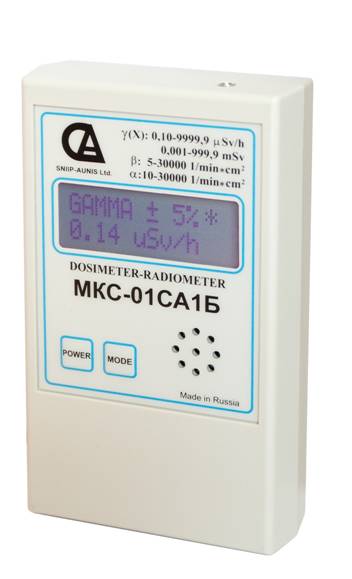
DOMESTIC DOSIMETER-RADIOMETER
МКС-01СА1B
with voice output
Compliance certificate №
Passport
«SNIIP-AUNIS» CO. LTD.
5 Raspletina str., 123060 Moscow
www.aunis.ru
E-mail: info@aunis.ru
tel. +7(4
DOMESTIC DOSIMETER-RADIOMETER МКС-01СА1B with voice output (hereinafter – the instrument) – has developed and produced in accordance with «Provision on metrological status, the manner of development, putting for production and calibration of dosimetric and radiometric instruments for population», «System of development and putting for production ГОСТ 15.001-88», ГОСТ 15.009-91, and design documentation СНЖА.412152.001.
The instrument is provided with the Compliance certificate № dated 10.05.2011 and has been registered in Certification system of Russia.
The instrument was awarded with the following:
- with a gold medal "For uniformity of measurements" at the specialized international exhibition of instrumentation and testing equipment «Metrology 2007» hold on 15-18 of May 2007 in Moscow;
- Diploma and Gold medal on the fifth international specialized exhibition «Laboratory Expo 2007»;
- Certificate of International specialized exhibition «Measure 2008» hold on 15-17of April 2008 in Moscow for the high quality in development and manufacturing.
The instrument does not require to be verified and calibrated when operation.
Results taken by means of this instrument can not be used for official announcement on radiation situation and contamination level
CONTENTS
1 INTRODUCTION …………………………………………….…….. | 4 |
2 SPECIFICATIONS ………………………….. | 4 |
3 GENERAL DESIGN DATA …………... | 5 |
4 OPERATION …………………………………………… | 7 |
4.1 Preparation for operation ………………………………….. | 8 |
4.2 Evaluation of dose rate ………………………………………….. | 8 |
4.3 Evaluation of integral dose ………………………………………. | 9 |
4.4 Beta-particles flux density evaluation from surfaces ………… | 9 |
4.5 Alpha-particles flux density evaluation from surfaces ……… | 10 |
4.6 Setting dose rate signaling thresholds …………….. | 10 |
4.7 Setting dose signaling thresholds ……………….…………. 4.8 Setting beta-particles flux density signaling thresholds ……….. | 11 11 |
5 MAINTENANCE …………………………………………………. | 11 |
6 DELIVERY SET ………………………………………….. | 13 |
7 STORAGE AND TRANSPORTATION REGULATIONS ……… | 13 |
8 TROUBLESHOOTING ………………..…………. | 13 |
9 CURRENT REPAIRS ………………………………………….…... | 14 |
10 WARRANTY OBLIGATIONS …………………….…….. | 14 |
Supplement А A few basic provisions on radiation ….…….. | 15 |
Supplement B Facts from life ………………………………….…... | 17 |
Supplement C Radiation survey of inhabited and public buildings……………………………………….. | 18 |
Supplement D Survey of radioactive radiation sources, items and objects, contaminated with radioactive nuclides. | 19 |
Supplement E Evaluation of radioactive contamination of foodstuff …………………………………………………………... | 19 |
Supplement F Evaluation of radon situation ……………………. | 21 |
1 INTRODUCTION
МКС-01СА1B – a miniature multifunctional domestic dosimeter-radiometer with every second continuous updating of readings result and indication of the current statistic error, as well as with the voice insonation and vocal evaluation of readings results, intended for:
- evaluation of dose ambient equivalent of gamma - (X-rays) radiation (hereinafter –dose rate);
- evaluation of dose ambient equivalent rate of gamma - (X-rays) radiation (hereinafter –dose);
- evaluation of beta-particles flux density from contaminated surfaces;
- evaluation of alpha-particles flux density from contaminated surfaces ;
- survey of ionization radiation sources and on-line evaluation of radiation background;
- evaluation of radon situation and radioactive contamination of foodstuff
The instrument assures on-line survey of contaminated objects or radioactive radiation sources, as well as monitoring of a human-being habitat (radiation safety of working places, habitation, locality; evaluation of radioactive contamination of true objects, foodstuff, materials and samples; evaluation of radon situation in inhabited and working compartments etc).
Speech insonation and on-line voice analysis of radiation situation evaluation results allows to increase essentially the convenience of МКС-01СА1Б application for the population as well as for different services members.
2 SPECIFICATIONS
2.1 Irradiation detector - gas-discharging counter |
2.2 Voice output of dose rate measuring result, interval - once per minute |
2.3 Dose rate measuring range - from 0,1 up to 9999,9 μSv/h |
2.4 Integral dose measuring range – from 0,001 up to 999,9 mSv |
2.5 Measuring range of beta-particles flux density from contaminated surfaces by strontium -90 or cesium -137 - from 5 up to 30000 part/(min *cm2) |
2.6 Measuring range of alpha-particles flux density (by plutonium -239) – from part/(min*cm2) |
2.7 Energy range of photons being registered – from 0,05 up to 3,0 MeV |
2.8 The lower limit of the beta-radiation energy being registered, not more than 0,05 MeV |
2.9 The lower limit of the alpha-radiation energy being registered, not more than 3,0, MeV |
2.10 Measurements error – not less than ±25% |
2.11 Preset by the user thresholds of signaling on the dose rate with a 0,1 μSv/hour step - in the whole measuring range |
2.12 Preset by the user thresholds of signaling on gamma-radiation integral dose, mSv (with a 0,001 mSv step) - in the whole measuring range |
2.13 Preset by the user thresholds of signaling on beta-particles flux density with the step 1 part/(min *cm2) - in the whole measuring range 2.14 Measurement indication and its statistic error - continuously |
2.15 Display readings change interval - 1 s |
2.16 Construction implementation - case is made of plastic |
2.17 Power supply - two elements of АА "DURACELL MN1500" type |
2.18 Continuous operation time period with one set of power supply elements is not less than 400 hour |
2.19 Working temperature range – from minus 20 up to +50 0С |
2.20 Overall dimensions - 112х64х30 mm |
2.21 Mass is not more than 200 g |
3 GENERAL DESIGN DATA
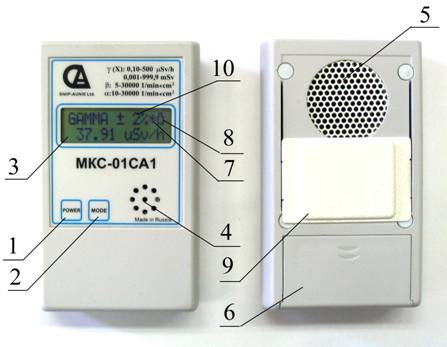
Fig.1. МКС-01СА1B controls
1 – «POWER» power supply on/off button
2 - «MODE» button for highlighting the display and:
- selecting the operation modes. If push briefly (less than 1 s) the modes are changed in a circle: «Dose rate measuring»; «Beta-particles flux density measuring»; «Alpha-particles flux density measuring»; «Integral dose measuring»; «Integral dose reset (nullification)»; «Voice insonation activation (deactivation)». Respectively, the following are displayed: «GAMMA»; «BETA»; «ALPHA»; «DOSE»; «ERASE DOSE»; «SOUND ON(OFF)»;
- setting the signaling thresholds on the dose rate. If push the button «MODE» longer (more than 2 s) when the «GAMMA» is displayed, the instrument switches over to the dose rate thresholds setting mode and «THRESHOLD» and «9999.9 mSv/h» are displayed;
- setting the voice signaling thresholds on the integral dose. If push the button «MODE» longer (more than 2 s) when the «DOSE» is displayed, the instrument switches over to the dose thresholds setting and «THRESHOLD» and «999.999 mSv» are displayed;
- reset (nullification) of the integral dose when the «ERASE DOSE» is displayed (more than 2 s long twice push)
- activation (deactivation) of voice insonation of the dose rate measuring results in «SOUND ON(OFF)» mode (long pushing for more than 2 s): when «SOUND ON» is displayed - voice insonation of the dose rate measuring is performed once per minute; when «SOUND OFF» is displayed – the voice insonation is deactivated.
3 - a two line alphanumeric liquid –crystal display
4 - an audible dynamic speaker
5 - a detector sensitive input window with a shield grid
6 - a cover of the power supply compartment
7 - a gamma - (beta-, alpha-) radiation activity indicator
8 - an indicator of low charge of power supply elements
9 - a removable screen, fixed in extreme positions, corresponding to the selected mode of operation. In the «BETA» and «ALPHA» mode –the detector is opened (the lower position, as shown on figure 1), in «GAMMA» mode –the detector is closed (the upper position)
10 – a digital indicator of the statistic error current value when measuring the dose rate, beta - or alpha - flux density
Radiation activity indicator – flashing symbol «*» (pos.7 on fig1) in the top part of the display. Each single gamma-quantum (of alpha - or beta-particle) being registered by the detector is accompanied with the symbol «*» appeared for the short-time (less than 0,5 s). By repetition rate of this signal the on-line survey can be performed and radioactively contaminated areas can be detected.
Signaling on the dose rate and beta-particles flux density threshold exceeding– interrupted sound signal (0,25 s – signal, 1 s – pause) when exceeding the preset threshold of the dose rate
Signaling on dose threshold exceeding – interrupted sound signal (0,25 s – signal, 3 s – pause) when exceeding the preset dose threshold.
Overload signaling- when exceeding the upper level of the dose rate measuring 9999,9 μSv/h or beta - and alpha-particles flux density 30000 part/(min*cm2 ) – digits, 9999.9 or 30000 respectively are displayed and the continuous sound signal is activated.
Indication of low charge of power supply elements - a symbol in the form of cylindrical power element appeared in the right top corner when the power supply elements have discharged up to 1,6V (pos.8 on fig.1).
Display highlight – activated by the short-term push of «MODE» button. The highlight duration– 10s. When the highlight is activated, each time the operation mode is changed over by the single short-time push of the «MODE» button, at the same time the highlighting is prolonged for 10s more. When the display highlight is deactivated, the operation modes are changed over by the double short-time push of the «MODE» button (the first push activates the highlight only, the operation mode is not changed).
4 OPERATION
As a detector an end-plate gas-discharging counter is applied in the instrument. The counter converts an ionizing gamma - (beta-, alpha - ) radiation flux in electrical signals sequence. These signals are generated by duration and amplitude and then transferred to registration and indication charts.
The instrument every second in cycle continuously evaluates and updates measuring results and indicates the current statistic error (δ) in confidence interval 0,95 on the display (pos.10 on fig.1). As the time goes by in permanent (stationary) field of ionization radiation the instrument readings are continuously averaged and updated. At the same time the error value δ is decreasing from ±99% up to ±1%.
In case of sharp change of radiation activity by more than the twice mean-square deviation of the measuring result (2s), “old” display readings are changed automatically fast (during 1-5s) with «new» and the averaging and updating process of the new measuring result is repeated.
The instrument measuring time depends on the dose rate value (alpha-and beta - particle flux density) being surveyed and on the measurement accuracy required δ.
First cycles readings of survey are useful for the first on-line evaluation of the dose rate (alpha-or beta - particle flux density).
To assure the more accurate results of survey, the information on measured values is taken from the instrument when the statistic error is not more than 10%.
When the same value is measured many times, the instrument is restarted by the button «MODE» by switching the operation modes in cycle up to the initial status.
4.1 Preparation for operation
In order to prepare the instrument for operation, perform the following:
-remove the cover of the power supply section (see fig. 1);
-set the power supply elements taking into account the polarity;
-set the cover of the power supply section at its place.
4.2 Evalution of dose rate
To evaluate the dose rate level in the room perform the following:
- close the input window of the detector by the screen (see fig.1);
- switch the instrument power supply on (press the button «POWER» once and release). Once it is switched on the manufacture’s data «МКС-01СА1» and «tel. (4» will be displayed for 2 s.
- once the instrument has been switched on, it is set previously in the dose rate evaluating mode: («GAMMA» is indicated on the display);
- place the instrument at not less than 1 m distance from the floor (ground) surface and any other nearby objects.
- in 2-3 seconds the first averaged dose rate value of the natural radiation background and the fist statistic error value, ±90% approximately will be displayed;
- to define the dose rate precisely it is essential to fix the display readings in 1-2 minutes approximately, at that the statistic error δ will be decreased and achieved the value close to 10 percentage.
- keep in mind that each rapid displacement of the instrument or rapid change of the radiation activity leads to reset of the accumulated information (nullification) and the process starts again.
Voice insonation is activated when evaluating the dose rate is activated (disactivated) by the user’s request. To activate the voice accompaniment switch over to «SOUND ON(OFF)» by «MODE» button. Activation (deactivation) of voice insonation is performed by long pushing the button «MODE» (for more than 2 s): when «SOUND ON» is displayed - voice insonation of the dose rate measuring is performed once per minute; when «SOUND OFF» is displayed – the voice insonation is deactivated.
ATTENTION! For the user’s convenience the voice insonation of dose rate evaluation results is made in old (not-system) units – microroentgen (milli roentgen) per hour. It shall be kept in mind that:
1μR/hour =0.01μSv/h (1 μSv/h=100 μR/h).
4.3 Evaluation of integral dose
Switch the instrument power supply on (press the button «POWER» once and release). Set the mode «DOSE» by the button «MODE».
In the «DOSE» mode the instrument display indicates the accumulated dose value in the form of four significant digits with a floating point indicating the measuring units «millisievert»: «Х. ХХХ mSv».
The instrument sums up the gamma-radiation integral dose once the instrument is switched on irrespectively of operation modes «GAMMA» or «DOSE» preset by the button «MODE». In operation modes «BETA» or «ALPHA» the integral dose is not accumulated.
The instrument keeps the accumulated dose value after it is switched off (or when the power elements are absent) in the nonvolatile memory for more than 5 year period. At each new cycle of the dose or the dose rate evaluation the instrument sum up the results of the accumulated dose.
To reset (to null) the integral dose, switch over the instrument to the mode «ERASE DOSE» (the integral dose nullification) by pressing the button «MODE» briefly. Keeping the button «MODE» pressed twice (more than 2 s long pressing) resets the accumulated dose and «0.000 mSv» four-digits number will be displayed.
4.4 Beta-particles flux density evaluation from surfaces
To evaluate the beta-particles flux density from the surface being surveyed, perform the following:
- open the input window of the detector, by moving the screen (see fig.1) in the lower position;
- switch the instrument power supply on and set the mode «BETA» by the button «MODE»;
- place the dosimeter detector at (3-5) mm distance directly under the surface to be surveyed. As soon as the statistic error has achieved less than 10%, register the average value of the display Nф+β;
- place the instrument under any certainly clean area of the surface (or place the dosimeter in air at not less than 1 m distance from the floor surface, ground and any surrounding objects);
- as soon as the statistic error has achieved less than 10%, register the average background reading of the display Nф, part/(min·cm2);
- calculate the beta-particles flux density Фβ , part/(min·cm2) by the formula
Фβ = (Nф+β - Nф ), part/(min·cm
4.5 Alpha-particles flux density evaluation from surfaces
To evaluate the alpha-particles flux density from the surface to be surveyed, perform the following:
- open the input window of the detector, by moving the screen in the lower position;
- switch the instrument power supply on and set the mode « ALPHA» by the button «MODE»;
- place the input window of the detector directly under the surface to be surveyed in such a way so the distance between the detector window and the surface to be monitored shall be minimum: not more than (1-2) mm;
- as soon as the statistic error has achieved less than 10%, register the readings of the display Nф+α, part/(min·cm2);
- without changing the instrument position, put a paper sheet between the instrument and the surface to be surveyed. As soon as the statistic error has achieved less than 10%, register the average reading of the display Nф , part/(min·cm2);
- determine the contamination level Фα , part/(min·cm2) by the formula
Фα = Nф+α - Nф , part/(min·cm2) (2)
4.6 Setting dose rate signaling thresholds
If the button «MODE» is kept pressed (for more than 2 s) when «GAMMA» is indicated on the display, the instrument is switched over to the setting mode of the dose rate signaling thresholds:
«THRESHOLD»
«9999.9 mSv/h» are displayed
Set each underlined significant digit of the dose rate threshold by pressing the button «MODE» briefly. Set the next digit – by keeping the button «MODE» pressed (for more than 2 s). At that the cursor (a line under the digit) moves to the next digit. Repeating this procedure you will set the requested threshold of the alarm signaling activation.
Exit the threshold setting mode – by keeping the button «MODE» pressed when the cursor is under the last significant digit
«9999.9 mSv/h»
4.7 Setting dose signaling thresholds
Switch the instrument power supply on. If the button «MODE» is kept pressed (for more than 2 s) when «DOSE» is indicated on the display, the instrument is switched over to the integral dose thresholds setting mode. At that :
«THRESHOLD»
«999.999 mSv» are displayed
Set each underlined from below significant digit of the integral dose threshold by pressing the button «MODE» briefly. Set the next digit – by keeping the button «MODE» pressed (for more than 2 s). Exit the integral dose threshold setting mode – by keeping the button «MODE» pressed when the cursor is under the last (minor) significant digit:
«THRESHOLD»
«999.999 mSv»
4.8 Setting beta-particles flux density signaling thresholds
Switch the instrument power supply on and set the mode «BETA» by the button «MODE». If the button «MODE» is kept pressed (for more than 2 s) when « BETA» is indicated on the display, the instrument is switched over to the setting mode of beta-particles flux density signaling thresholds. At that the text «THRESHOLD» and «99999 min -1cm-2» is activated on the display.
Set each underlined from below significant digit by pressing the button «MODE» briefly. Set the next digit – by keeping the button «MODE» pressed (for more than 2 s). Exit the beta-particles flux density threshold setting mode – by keeping the button «MODE» pressed when the last underlined from below significant digit «9999.9 min -1cm-2 » is indicated on the display.
5 MAINTENANCE
5.1 Operational limitations (precaution measures)
Prior to start working with the instrument study carefully and understand the established safety guidelines. Strictly observe the instrument handling rules.
Precaution measures stated below assure safety and correct application of the instrument in order to prevent a user’s injuring, and also the instrument’s damage.
5.2 Precautions
Keep the instrument in places, inaccessible for small children. Accidental damage of the instrument or power supply elements may cause a child’s serious injury.
Do not try to demount or to modify the instrument. Demounting or modification of the instrument can cause the high voltage electrical shock. Check, modification and repairs shall be performed only by specialists of «SNIIP-AUNIS» Co. pany.
Do not use substances, containing spirit, petrol, solvents and other accelerants for cleaning and maintenance of the instrument. Application of these substances can cause inflammability.
ATTENTION! To prevent the detector power supply occurrence under the high voltage and malfunction of the chart elements it is forbidden to open the sealed section of the instrument.
5.3 Preventing malfunctions
Protect the instrument against impacts, dust and moisture.
In places with the increased dust and/or humidity it is recommended to place the dosimeter in the polyethylene parcel. Remove the dust regularly from the dosimeter by means of a dry, clean flannel or brush.
In case of radioactive substances occur on the instrument’s case, the background readings can be increased.
The instrument’s case contamination can be cleaned by the decontaminating solution. To prepare such a solution, dissolve the neutral washing powder («Lotos» etc.) in the water in proportion of one tea-spoon for liter. The instrument decontamination shall be performed on condition the power supply elements have been removed. Moisten the sponge in the solution, wring it and wipe the instrument case. Than wipe the case with a dry flannel.
Do not touch the detector working surface, being under the protective perforated metal grid, with sharp objects.
5.4 Precaution measures when handling the instrument
Do not try to demount or repair the instrument by yourself.
Do not press the display and do not knock at it, since it can cause cracks and damage.
Do not leave the instrument for a long time under exposure of the direct sun and fluorescent light.
At low temperature the display response time in increasing, when at high temperature the display screen can become dark. At the room temperature thedisplay common properties are recovered.
5.5 Actions under extreme conditions
ATTENTION! IF THE INSTRUMENT REGISTERS THE DOSE RATE OF MORE THAN 1,20 µSV/H, LEAVE THIS AREA IMMEDIATELY AND ADDRESS TO THE STATE SANITARY-EPIDEMIOLOGICAL SERVICE FOR DETAILED RADIATION SURVEY.
6 DELIVERY SET
Domestic Dosimeter-radiometer МКС-01СА1Б - 1pc.
Power supply elements of АА «DURACELL» type MN1pcs.
Passport - 1 pc.
Package - 1 pc.
7 STORAGE AND TRANSPORTATION REGULATIONS
7.1 The instrument shall be stored without the power supply element in the sealed polyethylene parcel at the ambient temperature from +5 up to +40 0С and the air relative humidity up to 80% at temperature 250С
7.2 It can be stored without package at the ambient temperature from +10 up to +350С and the relative humidity up to 80% at temperature 250С.
7.3 The storage room shall be free from dust, acid and alkali fumes, aggressive gases and other harmful impurities, causing corrosion
7.4 The instrument in the package can be transported by any type of the closed transport at any distance at temperature from –20 up to +500С.
7.5 The instruments, which have been subjected to temperature lower than 0 0С, shall be kept under the room temperature for at least 2 hour prior to unpack it and to put for operation.
8 TROUBLESHOOTING
Problem | Cause | Solution |
After the instrument has been switched on, no information on the display | Power supply elements are not inserted or fully discharged | Set or replace power supply elements taking into account the polarity |
A symbol in the form of cylindrical power supply element is displayed (pos.8 on fig.1) | Power supply elements are discharged lower than the admissible level | Replace power supply elements |
9 CURRENT REPAIRS
The product repairs is carried out at the enterprise of the manufacturer
«SNIIP-AUNIS» CO. the following address:
5 Raspletina str., Moscow, Russia, tel/fax (499)
E-mail: *****@***ru , www. aunis. *****
10 WARRANTY
The Manufacturer warrants the dosimeter’s operability provided the User observes operation regulations established in this manual.
The warranty period of the dosimeter operation is 12 months of the date of sale through the trade network. The warranty and pot-warranty repairs is to be performed by the enterprise – manufacturer. The time period when the dosimeter has been under the warranty repairs is not included in the preset warranty period. Claims are not accepted and the warranty repairs do not cover dosimeters which have been subjected to negligence, which are not provided with the warranty certificate, with the stamp of the shop and the date of sales in the warranty certificate or which seals have been disturbed.
Warranty certificate
To be filled by the manufacturer:
Domestic dosimeter-radiometer МКС-01СА1B serial №_________
TCD representative _________________ Date of release______________
(signature)
To be filled by the shop:
Date of sales __________2008.
ATTENTION!
The manufacturer reserves the right to make small changes in the instrument which increase its quality and reliability.
Supplement А
Some basic concepts on radiation
Radioactivity and accompanying ionizing irradiation existed on earth long before the germ of life on it and were present in Space before origination of the Earth itself. Beginning from the Universe origination the radiation has been filing the space continuously. Radioactive substances, although in minute amount, are permanently present in the human-being environment. In any living tissue of a human-being radioactive substances are present in trace (negligibly) amount.
A human-being is naturally gifted with senses organs reacting to the light, warmth, cold, pain and other useful organs, but there are no organs of senses reacting to the radiation. That is why the radiation can be detected only by indirection using the up-to-date complex equipment.
A term «radiation» or ionizing irradiation means a type of irradiation, which changes the physical state of atoms or atomic nucleus transforming them into electrically charged ions or nuclear reactions products. Under certain circumstances presence of such ions or nuclear reactions products in a body’s tissue can change processes in cellules and molecules, and if these events are accumulated it can damage a flow of biological reactions in a body and thus be dangerous fro a human-being health.
Radioactive irradiation is a result of radioactive transformation of elements in the same way as, for instance, the thermal emission and light are mainly the result of the chemical interaction – burning. Under the influence of the radioactive irradiation the life on Earth originated. Our forefathers were exposed to the radiation, we ourselves are exposed and our descendants will be exposed.
Obviously, irrespectively of a human-being the radioactive irradiation is caused by the radiation, occurred on the Earth from the space, and radioactivity of some elements is making part of some objects of our environment, of the air, of a human-being body (radon, thorium, uranium, kalium, radium etc.). It is the natural radioactive background, it is as natural exposure to which a human-being is adapted as light, gravity force, ambient temperature etc. And in the same manner as the light, gravity, warmth there are some levels of exposure, at which the radioactive irradiation does not effect the human-being body, but there are levels when it can cause harm or even death. Under some circumstances the radiation is used as a therapy (for example, for elimination of harmful cancer cells, for increasing the functional activity by means of radon baths).
For the quantity evaluation of a degree of exposure of different radiation types, some characteristics have been implemented known as radiation measuring units.
Radioactive radiation exposure is defined by its composition, by energy of particles, by the radiation flow rate. To evaluate the radiation exposure at the human-being a term «ambient, equivalent dose» is used- it is an amount of energy, absorbed in the unit of the body substance mass, taking into account the biological danger of this type of the radioactive radiation. The measuring unit of the ambient equivalent dose is Sievert (Sv).
To characterize the gamma-radiation level, which is the most penetrating radiation and which is mainly affecting the body, a term of exposure dose in air is used, for which there is its own measuring unit - Roentgen (R). One Sievert equals to 100 R approximately (to be more precise 94,5 for isotope radiation cesium -137). Since these units are quite great comparing with ordinary natural exposure, values, comprising 1 thousandth (mile) or 1 millionth (micro) of Sievert or Roentgen portion are usually applied:
1 Sv=1000 mSv=1000000µSv;
1R=1000mR=1000000µR.
Sievert and Roentgen – characteristics of the sum (integrated) exposure. To evaluate the dose accumulation rate, a term “dose rate” is used – an amount of energy, absorbed in the time unit (hour, minute, second). Measuring units are as follows – Sv/h, µSv/h, µSv/s, R/h, µR/h etc.
Beta–radiation (in natural radioactivity, surrounding the human-being, its basic source is calium-40) characterized as a flow rate of particles. Measuring unit – amount of particles, passing in the time unit through the surface of the unit square (1cm2): part/(min*cm2); part/(s*cm2).
Alpha –radiation, is a heavy particles flow (alpha-particle is identified to the gelium-4 atomic core and is composed of two protons and two neutrons), and is of the little path length. In view of this alpha - particles are delayed, for example with a sheet of paper and hardly penetrate through epidermis. The danger comes from substances irradiating alpha-particles which have occurred inside the body with the food, with the air inbreathed or through external skin integument. During its short path they are capable to ionize the materials greatly; hence, they are highly internally radioactively dangerous.
To characterize the radioactive source rate such term as activity is applied. The activity unit – Becquerel (Bq). 1 Bq activity means that 1 radioactive transformation occurs every second. Previously Curie unit (Ci) was applied. 1 Curie – 1 gram radium activity. Connection between Curie and Bequerell is quite complex:
1 Curie=3,7·1010 Bq (37 billions of Bq).
To imagine these units precisely we will give a few examples. Usually the background exposures the human-being at 1-2mSv level (100-200mR) during the year, at that 2/3 of this year is caused by internal sources, being inside the human-being (internal irradiation). At that the external gamma-radiation dose rate is 10-15 µR/h. This value is average and can vary in several times. Thus above the sea it is 5-7 µR/h, in high mountain areas – up to 50-60 µR/h, in Caucasian mineral water areas – 20-30 µR/h, in Moscow 10-20 µR/h. The dose rate varies in several times depending on the season, time of day, weather conditions. Thus, during the whole life (70 years) the human-being receives the dose 7-14 R, though there are areas (for example, high mountain areas), where this value is up to 35-40 R.
Calium contained in the human-being body is of 3 Bq activity, the natural activity of 1 kg dried apricots – up to 200 Bq. 1 kg of potash fertilizer – Bq.
Supplement B
Facts from life
By means of the instrument you can perform an interesting experiment. For this experiment you would require a fertilizer pack «Potash chloride», such fertilizers are often packed in polyethylene parcels by 1 kg each.
So:
- open the detector input window, by moving the screen into the lower position;
- switch the instrument on;
- select the mode «GAMMA»;
- approach the detector input window close to the fertilizers pack;
- evaluate the dose rate.
From the practical experience, the dose rate exceeds the background value by the value from 0,30 up to 0,60 µSv/h. In the mode «BETA» the survey result is about 36 part/(min·cm2 ).
Availability of the radioactive isotope of calium – 40( 40Ca) is explained by the obtained results. This isotope is both gamma-, and beta – irradiator. At that in 90 times from 100 calium-40 decay a beta–particle (electron) escapes, when in the rest - gamma–quantum (photon).
If perform the experiment, at the closed screen window, than an increased dose rate value can be detected (approximately by 40 % higher than the natural background).
The additional result of the performed experiment is the indirect check of the dosimeter operation.
In the conclusion we will give a few important values:
0,15 µSv/h – the natural background dose rate, depending on local conditions can vary by two times;
0,6 µSv/h – the maximum dose rate value, preset for the population in the open area;
5 mSv – the extreme dose value during the year for the population;
960 part/(min·cm2 ) – the admissible flux density of low-energy beta-radiation (the boundary spectrum energy – 0,2 MeV);
50 part/(min·cm2 ) - the admissible level of the radioactive contamination of surfaces by the alpha-radiation.
Supplement C
Radiation survey of inhabited and public buildings
In accordance with «Radiation safety norms (НРБ-99) , in public buildings radiation surveys shall be carried out, in case the gamma-radiation dose rate in rooms exceeds the dose rate in the open territory by more than 0,20 µSv/h.
Evaluation of the radiation dose rate at the open territory (background) is performed close to the building to be surveyed in not less than 5 points, located at distance from 30 up to 100 m from existing buildings and constructions and not closer than 20 m one from each other. Evaluation points shall be selected at the locality with the natural soil, without technogenic changes (break stone, sand, asphalt) and radioactive contamination. While evaluating the instrument is placed at 1 m height above the earth.
The radiation dose rate evaluation is carried out in the surveyed compartment by means of the dose rate measuring in the center and corners of the compartment. In those cases when the measured readings are higher than the background ones obtained at the open territory by more than 0,20 µSv/h, it shall be addressed to state sanitary-epidemiological service to perform the detailed radiation survey.
Supplement D
Survey of radioactive radiation sources, items and objects, contaminated with radioactive nuclides
Survey of radioactive anomalies shall be performed after the instrument has been prepared for operation in accordance with sec. 4.1 and 4.2 in the dose rate measuring mode «GAMMA». To increase the instrument sensitivity to the radioactive radiation open the detector input window, by moving the screen in the lower position (in this case the instrument registers the mixed gamma - , beta- and alpha - radiation).
Smoothly moving the instrument along the surface of the object to be monitored, it shall be placed at the minimum distance from the surface to be surveyed.
In case of notable increase in the instrument readings in (1,5-2) times and more, suspend moving the instrument and during (30-40)s make sure that the readings are increasing steady.
Than moving the instrument in different directions, determine the range of the radioactive contamination and in this range detect objects, contaminated with radioactive nuclides.
Close the detector input window by moving the screen in the upper position and evaluate the photon radiation dose rate level at the distance as requested by an operator from the radiation source.
Supplement E
Evaluation of radioactive contamination of foodstuff
According to international regulations being in force, the content of strontium -90 radionuclides in foodstuff is regulated at the level 750 Bq/l, kg (ЕС № 000/89 dated 18.07.89.).
To perform evaluation of the radioactive contamination of the foodstuff the user shall prepare the sample.
SAMPLE PREPARATION
The foodstuff samples are subjected to processing, similar to that applied at the first stage of the food cooking.
Roots are washed in the running water. Uneatable leaves are removed from the cucumber. The food greenery, berries, fruits are washed with the running water. The meat and fish is washed, scale, inwards are removed from the fish, the paraffin layer is removed from the cheese. The prepared products are grinded up by means of a mincing machine, a grater, a coffee-grinder etc.
Prior to measurement the selected samples shall be thoroughly mixed till the homogenous particles as per dispersibility. For that coarse solid substances (grits, pasta, lump sugar, dried vegetables, crackers, peas etc.) shall be grinded up by means of a mortar or a hand-mill till the particle size of not more than 1 mm. Before grinding up the bread shall be predried, when greenery, vegetables and fruits shall be pounded till the homogenous gruel.
Samples from cucumber, fodder (succulent fodder, silage, hay, straw etc.) shall be thoroughly grinded up on the cutting board.
Fill any available bowel (or can) with the following dimensions: not less than 50mm in diameter, not less than 30 mm in depth with the grinded pact the sample with the compactor and level the surface layer to 2-3 mm from the bowel edges.
Mix samples from flour, tomato-paste, sour cream, mustard and other grinded up substances in a different plate, than fill the bowel with the sample. Prepare the mixture from liquid samples immediately before measuring.
Put the sample from solid fat, meat etc. on the cutting board and cut a cylindrical form in such a diameter and height as to comply with the bowel by means of a knife or a scalpel.
To obtain more precise data on the radioactive contamination it is recommended to prepare three similar in density mixtures from one sample, drawing the attention at the thickness of the substance to be placed in the bowel – it shall be the same.
As soon as you have prepared the sample, start measuring the specific beta-activity of the mixture by means of the dosimeter. Take into account that it takes time to obtain the statistically certain result of measuring of the foodstuff containing beta-irradiating radionuclides at the extreme levels.
The following manner of measuring is recommended:
- prepare the sample;
- place the instrument directly under the bowel with the prepared sample in such a way, that the detector input window shall be approximately under the center of the bowel at 3-5 mm distance from the sample surface. To keep the dosimeter’s case clean from the foodstuff, it is recommended to place it into a clean transparent polyethylene parcel;
- perform the measuring of the average value of the beta-particles flux density from the prepared sample surface Фβ part/min·cm2 (in accordance with section 4.4);
- calculate the dimensionless coefficient Ау, characterizing the value of the the sample specific beta-activity sample by the formula
Ау = 0,2· Фβ .
If the calculated value Ау is much less or close to 1, than, according international standards being in force, which regulate the strontium -90 level in the foodstuff, Your products are quite eatable as per the radiation safety.
In case the value Ау is from 2 to 4 or even more (especially for milk products), then it is better to exclude these products in large volume from your everyday diet. Probably, more serious measures shall be taken, for example: to address specialists who have the right to perform certified measurements. You could address to the manufacturer of the dosimeter-radiometer МКС-01СА1Б.
Take into account that the procedure described above is of evaluation character and can not be used to make the official conclusion on the foodstuff radioactive contamination.
Supplement Е
Evaluation of radon situation
First of all some explanations shall be given.
Natural sources of the ionizing radiation make the greatest contribution (about 70%) to the common dose of the population irradiation from all effecting ionizing sources. A large part of this dose affects the human-being in inhabited and public buildings, where, as evaluated by Scientific Committee on atomic radiation of UN, citizens of industrially advanced countries spend around 80% of their time. Being in rooms the human-being is affected both external gamma-radiation, caused by the natural radionuclides content of uranium and thorium families in construction materials, and internal radiation related to inbreathing of aerosols of radon daughter products containing in air. Contribution of the latest is from 30 up to 50 %, when the radiation exposure of the radon gas itself is – in ten times less.
Radioactive inert gas radon -222 is generated at decay of radium -226, including into the uranium family. Radon can be spread along pores and cracks of the soil, terrestrial rocks, building constructions. The basic source of the radon entering into the room’s air is its emission from the soil under the building and from the building constructions. At that when the humidity and temperature is increasing, this process activity can increase by several times.
During the radon decay its daughter products are generated, among which there are both alpha-, and beta - irradiators. Daughter products atoms, combining with micro particles of dust, generate radioactive aerosols. Inbreathing them can lead to irradiation of the human-being lungs (internal irradiation). In view of this in many countries the radon content is regulated in rooms (radon situation).
The threshold was established as 300 Bq/m3 in 1984 by the National council on radiation protection and measurements of USA. In 1986 Agency on environment (USA) suggested to establish one more criteria of 80 Bq/m3 , which determine the urgency of protective measures.
In Russia, England and Germany the admissible content of radon in air in buildings is established as 200 Bq/m3
The level of daughter products aerosols in the open territory (except for areas of radioactive anomalies) usually comprises from 5 up to 20 Bq/m3.
As a rule, to measure the radon situation precisely, the expensive equipment is required being maintained by the qualified specialist. However, if you have a vacuum cleaner (preferable not less than 600 W capacity), a clean removable paper filter –packet, which is replaced regularly, and the watch, convenient for counting the time in minutes, then you can evaluate the radon situation in your house by means of the dosimeter МКС-01СА1B.
Before evaluation the radon sample shall be thoroughly prepared.
Preparing the radon sample
In accordance with the operation instructions, plug in the vacuum cleaner. Than:
- insert a corrugated hose with an end cap into the air intaking input in the same way as when using the vacuum cleaner as intended;
- straighten a clean spare filter-packet and insert the hose end cap in its opening in such a way as the end cap touches tight the filter-packet inside surface (check and hold it with a hand);
- switch the vacuum cleaner on and note the time of starting the sample selecting;
- make sure that the air is intaken through the filter-packet in the point of its contact with the hose end (all additional openings which can be foreseen in the vacuum cleaner shall be closed, in order to assure the air intaking through the filter-packet only);
- during the sample selecting hold the hose by hands or fasten it at the not less than 1 m height for some time;
- in 10 minutes of the sample selecting switch the vacuum cleaner off, going on counting;
- remove the filter-packet from the end cap carefully, fold and put it on the table with the sample upwards (under the sample we mean the spot being indicated clearly on the filter-packet surface, through which the air has been intaken);
- in 15 minutes after starting the sample selection the sample is ready to be measured.
Note. A filter-packet can be mutually applied for the sample selecting. The only limitation is: do not select the sample at the same sections of the packet during the day. In two –three days it is possible.
As soon as you get acquainted with the sample preparation, you can start evaluation of the radon situation. Prior to perform the experiment, its is recommended to close all the windows and doors in the room for several hours. Usually, the most dangerous as regarding the radon situation are hardly ventilated rooms at the lowest floors of buildings or basements.
Evaluate the radon situation in the following manner:
- perform evaluation of the background value Nф by the instrument when the detector input window is opened (in «ALPHA» mode as per section 4.5) from any clean area of the filter-packet, register this value;
- prepare the radon sample in the open territory (it is enough to put the vacuum cleaner hose with the filter-packet behind the window);
- perform evaluation of the value Nф+α (in «ALPHA» mode as per section 4.5) from the sample surface immediately after it has been prepared (in 15 minutes of the beginning of its selection), register this value Ав = Nф+α ;
- prepare the radon sample in the room to be surveyed;
- perform evaluation of the value Nф+α (in «ALPHA» mode as per section 4.5) from the sample surface immediately after it has been prepared (in 15 minutes of the beginning of the sample selection), register this value Ап = Nф+α;
If the value Ав exceeds in 2-4 times the registered value Nф , it means you have successfully registered the natural radioactivity background in air in the open territory.
If the value Ап approximately equals to the value Ав, or exceeds it by not more than 5-10 times, then the situation is quite safe, but do not forget to air the room regularly.
In case the relation between values Ап and Ав is close to 30, or exceeds 50 what is worse (especially if your vacuum cleaner is of less than 600 W capacity), Probably, more serious measures shall be taken. First of all you should address specialists who have the right to perform certified measurements and to issue the official conclusion on the irradiation level.
Take into account that the procedure described above is of evaluation character and can not be used to make the official conclusion on the radon situation.
