

Партнерка на США и Канаду по недвижимости, выплаты в крипто
- 30% recurring commission
- Выплаты в USDT
- Вывод каждую неделю
- Комиссия до 5 лет за каждого referral
AUTHOR INSTRUCTIONS FOR MANUSCRIPT PREPARATION
The manuscripts will be collected in the Special volume of “Proceedings of the 7-th International Symposium Technetium and Rhenium – Science and Utilization” and reproduced by Publishing House “GRANITSA” directly from the original paper copy by photographic process without size reduction, so no subsequent alterations are allowed. To be sure in efficient publication of your manuscript, please read and follow carefully the following instructions:
1. The full paper must not exceed 8 printed pages for Plenary Lectures, 6 printed pages for Oral Presentations and 4 printed pages for Posters.
2. Each page (including title, authors, affiliations and references) must fit in an area of 160 mm (width) and 240 mm (depth).
All text should be in Times New Roman, 12-point font (except for title, affiliations, references and captions, see below), 14-point exact line space (except for affiliations, see below).
3. Title, authors and affiliation:
a) The title must be centred and typed on the first page in bold-face block capitals, 14-point font.
b) After two full line space the author(s) name(s) must be centred and typed in upper and lower case, the initials preceding the surname, 12-point font. Superscript numbers may be added to names to denote affiliations (see below).
c) After two full line space the author(s) affiliation(s) should be centred and typed in upper and lower case, 10-point font, with 12-point exact line space. Different affiliations can be denoted by the use of superscript numbers. If so, each author’s name should bear a superscript number denoting the correct affiliation. Full address and postal code should be given.
d) After three 14-point exact line space the article should begin.
5. Sections of the text
Except for Plenary Lectures, text must be divided into: Keywords, Abstract, Introduction, Experimental, Result and Discussion, Conclusion, Acknowledgments (if desired), References. If desired, Experimental and Result and Discussion can be divided in sub-sections. In Plenary Lectures, Experimental and Result and Discussion can be substituted by other sections according to the author decision. Sections headings should be typed on the left-hand margin of the page, in bold-face block capitals. Sub-sections headings should be typed on the left-hand margin of the
page, in upper and lower case, preferably in italic.
Do not leave any space below headings and sub-headings. One full line space should be left between the text of one section and the heading of the following one. Each paragraph must have a 1 cm first line indention.
6. Keywords
The contributors must present not more than 5 keywords at the beginning of their paper.
Keywords should be typed on the same line of the heading, in upper and lower case.
7. Abstract
The body of the manuscript should be preceded by an abstract (not more than ten lines) which should be a synopsis of the entire article.
8. References
References to published literature should be quoted in the text by the appropriate reference number, in square parentheses. The reference section should be placed at the end of the manuscript. References must be arranged as:
For Journals
U. Abram, R. Alberto, J. Braz. Chem. Soc. 17: 1486-1For Books
Chilton, H. M.; Pharmaceuticals in Medical Imaging, Macmillan: New York, 1990, p. 305.For Abstracts
A. B. Melent’ev, V. A. Misharin, A. N. Mashkin, I. G.Tananaev, K. E.German. Abstracts of the 6-th Russian conference on radiochemistry, 12-16 Oct. 2009. Moscow.- Ozersk, FSUE Mayak, 2009, p. 209.For thesis and dissertations
V. L. da Silva. Determinacao o estrutural de complexos Cd, Cu, Pb e Zn – DTPA. Mestrado Dissertacao. UFLA – Brasil (20p.For websites
www. esrf. fr/exp_facilities/BM20/Software/Wavelets. html .9. Equations
Equations may be added to the text, centred, with a full line space above and below. They should be numbered consecutively (on the right-hand margin of the page, in parentheses) using Arabic numerals where they are referred to in the text.
10. Illustrations
Illustrations and drawings must be pasted within the text. Each figure must be numbered consecutively and captioned, with a single line space between the figure and the caption. Caption text size should be in italic 11-point font. Leave a single line space above the figure and below the caption. Illustrations must be sharp, clear and in black and white colour. The authors should use only grey-tone, black and white figures.
11. Tables
Results should be tabulated wherever possible. Table should also be placed where it is more appropriate in the text. Tables should be numbered consecutively and captioned on the top, with a single line space between the caption and the table. Caption text should be in italic 11-point font.
Leave a single line space above the caption and below the table. All table columns should have an explanatory heading. Table should not repeat data already presented elsewhere in the paper, e. g. in a line diagram. Data should not be duplicated in figures and text.
12. Formulae should be numbered consecutively, using Arabic numerals where they are referred to in the text.
13. Nomenclature, abbreviations and symbols shall follow the latest rules of the International Union of Pure and Applied Chemistry (IUPAC). In IUPAC nomenclature, isotopic substitution is indicated by a suffix consisting of (1) any necessary locant numeral or numerals; (2) the atomic symbol with the mass number as a superscript to the left of the symbol, (3) a subscript (other than unity) indicating the number of such atoms. Trivial names should be avoided unless the compound is to be mentioned often in the text, in which case a systematic name should be given the first time the trivial name is used.
ARTICLE TITLE (CENTRED IN TIMES NEW ROMAN
BOLD-FACE 14-POINT FONT BLOCK CAPITALS, 14-POINT EXACT
LINE SPACE)
Author1, Author2 (two 14-point exact full line space after the title, centred in Times New
Roman 12-point font, upper and lower case, with 14-point exact line space).
(WGY-COSTXXX).
1 Affiliation 1, full address and postal code (two 14-point exact full line space after the authors
section, centred in Tims New Roman 10-point font, upper and lower case, with 12-point exact line space)
2 Affiliation 2, full address and postal code
KEYWORDS: not more than 5 complex entries (three 14-point exact full line space after the affiliations section, centred in Times New Roman 12-point font, upper and lower case, with 14-point exact line space).
ABSTRACT (one 14-point exact full line space after the previous section) Abstract text (not more than ten lines, Times New Roman 12-point font, with 14-point exact line space, 1 cm first line indention).
INTRODUCTION (one 14-point exact full line space after the previous section) Introduction text (Times New Roman 12-point font, with 14-point exact line space, 1 cm first line indention). References to publications should be numbered consecutively in square parentheses (i. e. [1]).
EXPERIMENTAL (one 14-point exact full line space after the previous section) Experimental text (Times New Roman 12-point font, with 14-point exact line space, 1 cm first line indention).
Sub-section (one 14-point exact full line space after the previous section).
Sub-section text (Times New Roman 12-point font, with 14-point exact line space, 1 cm first line indention).
RESULTS AND DISCUSSION (one 14-point exact full line space after the previous section)
Results and Discussion text (Times New Roman 12-point font, with 14-point exact line space, 1 cm first line indention). Black and white colour illustrations should be pasted within the text, captioned below, numbered consecutively, with one 14-point exact full line space above the illustration and one below the caption.
ILLUSTRATION
(molecules, X ray structures, grafics, pictures, reaction schemes, etc)
Fig. 1: caption (italic Times New Roman 11-point font, 14-point exact line space). Leave one full line after the caption.
160 mm width
240 mm depth
Equations should be centred and numbered consecutively on the right-hand margin of the sheet, with one14-point exact full line space above and below.
Nt = N0 e-λt
Tables should be pasted within the text, captioned on the top and numbered consecutively, with one 14-point exact full line space above the caption and one below the table. Each column of the table should have an explanatory heading.
CONCLUSION (one 14-point exact full line space after the previous section)
Conclusion text (Times New Roman 12-point font, with 14-point exact line space, 1 cm first line indention).
AKNOWLEDGMENTS (if desired, one 14-point exact full line space after the previous section)
Aknowledgments text (Times New Roman 12-point font, with 14-point exact line space, 1 cm first line indention).
REFERENCES (one 14-point exact full line space after the previous section)
1. Author(s), Journal, volume: pages (year) (Times New Roman 12-point font, with 14-point exact line space).
Table 1: caption (italic Times New Roman, 11-point font, 14-point exact line space).
Leave one full line after the caption.
240 mm depth
160 mm width
Tc-DTPA sediments formed in technetium – hydrazine – DTPA – nitric acid solutions
K. E. German, A. B. Melentiev, S. N. Kalmykov, N. N. Popova,
A. A. Shiryaev, I. G. Tananaev, Ya. V. Zubavichus1.
Institution of Russian Academy of Sciences - A. N. Frumkin Institute of Physical Chemistry and Electrochemistry of RAS (Leninsky prosp. 31-4, Moscow, Russian Federation)
1 - RRC “Kurchatov Institute” (Kurchatov sq.1, Moscow, Russian Federation)
Keywords: technetium complexes, DTPA, polyaminocarboxilate, sediments, spent nuclear fuel
Abstract:
Some ideas having been generated in Tc-radiopharmaceuticals for the stabilization of reduced Tc species were considered prospective for the reduced Tc complex formation, thus keeping technetium away from the participation in harmful catalytic activity during the U-Pu partitioning step in PUREX reprocessing of the spent nuclear fuel with the increased burn-up. Surprisingly the complex formed by reduced Tc and one of the best known hydrophilic ligand as diethylenetriaminepentaacetate (DTPA) was found to be responsible for some sedimentation [1]. The real sediments from this stage were separated and studied in [1]. These sediments behavior was investigated by simulated solution and sediments studies having been carried out in this work. Simulated Tc-DTPA precipitates were isolated from Tc-N2H5NO3-DTPA-HNO3 solution both shortly on the formation and after long-therm storage texts in mother solution. Reaction kinetics studies gave evidence for the important difference in the rates of the Tc reduction with hydrazine and its further precipitation from nitric acid solutions. These sediments were studied by chemical analyses, XRD, IR, Raman and UV-VIS, EXAFS and ESR spectroscopy. The Tc-DTPA ratio was found to be 1:1, the compound is paramagnetic. Possible structures of the Tc-DTPA complexes formed are proposed.
Introduction
The complexes of technetium with polyaminocarboxilic ligands (NTA, EDTA, DTPA etc.) are extremely soluble in water solutions and are used for more then 40 years. Some of them are readily formed on the reduction of pertechnetate with Sn(II) or hydrazine. For one of the best chelating agent - DTPA [2] considerable great efforts made for structure determination remain unsuccessful till these day because no crystals were grown. The most comprehensive work in this field was presented by K. Linder [3] who have used numerous physical and chemical methods for its investigation and had finally prepared a close analogue of DTPA complex – Ba2[(TCTA)Tc(m-O)2Tc(TCTA)](CIO4).9H20 [4]. Some ideas generated in Tc-radiopharmaceuticals for the stabilization of reduced Tc species were tested at Russian RT-1 facility for the reprocessing of the modern spent nuclear fuel with increased burn-up (up to 50GW*day/t). The necessity of such attempts is due to harmful catalytic activity of Tc and Pd at the second step of U-Pu partitioning in PUREX process. The main advance achieved by DTPA addition was a complete inhibition of the catalytic effect of reduced Tc and Pd. Nevertheless, formation of the third phase presents serious problems. The real sediments from this stage were separated and studied in [1]. In the current work we investigated the simulated Tc-DTPA precipitates isolated from Tc-N2H5NO3-DTPA-HNO3 typical PUREX solutions.
Experimental
Synthesis of the Tc-DTPA complex compound: since the principal aim was to simulate the Tc-DTPA precipitate formed in [1] and to characterize it, the solution compositions were selected based on nitric acid and the concentrations of the components varied within the frames of those used for U/Pu separations (see Table 1). To exclude the catalytic Tc action the
Table ponents concentrations in the initial solutions
| temperature was kept at 25oC. This is far from the conditions typically used for radiopharmaceutical preparations [2-6]. Tc was determined by b-scint. Counting at Beckman 6500; C, H,N – at CHN-analyser (Carlo Erba). IR spectra were taken at Specord M80, |
UV-Vis at with Cary 50, ESR - with Brucker ESP 300, EXAFS - at STM KCSR.
Results and Discussion.
Tc(VII) reduction with N2H5+ in HNO3 proceeded rather slowly and the reaction could be divided in several stages. Kinetics was studied at 1.2 ml aliquots of the same solutions.
A |
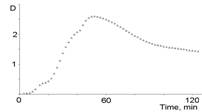
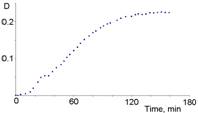
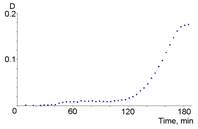
| As the Tc main peaks were masked with HNO3 absorbance, the evolution of kinetics was followed by the shoulder at 400 nm (Fig.1). The initial induction period increased from 5 to 40 min when lower Tc and DTPA concentrations were employed. The intermediate steady state observed for 10 min only for the A and B while it takes 70 min for the most diluted solution. The kinetic parameters could not be deduced as several spectro - indistinguishable species were present. The third stage that could be noted only at high Tc concentration at Fig.1A – partial back oxidation of Tc to Tc(V) (probably containing Tc=O group). The first sediment was formed on the 4-th day of the experiment. It was membrane (Millipore GS 200 mm) filtered, washes with EtOH-H2O (4:1) and dried. The first sediment mass was 7.46 mg. It was finely dispersed and had dark “cacao” color. The same mother solution produced 50 mg more brownish film-like precipitate (II) after 1 year of storage at ambient conditions. |
B |
| |
C |
| |
Fig.1. Tc(VII) reduction with N2H5+ in HNO3 - DTPA; Solution (No from Tab.1) : A - No 2, B No 6, C - No7. |
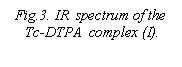
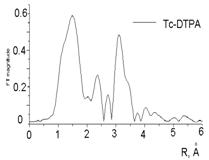
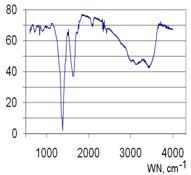
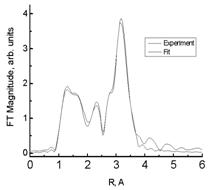
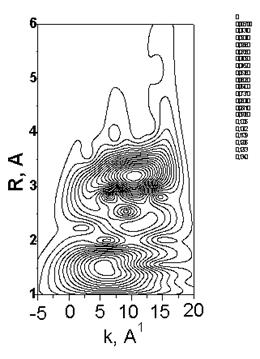
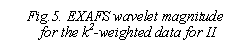
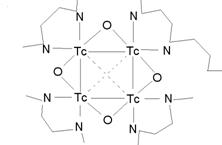
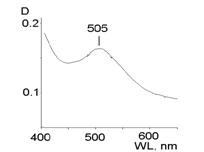 The oxidation of the Tc-DTPA precipitate in 7M HNO3 was very slow and it was possible to characterize the initial dissolution product by its UV-Vis spectrum (Fig.2). The radiometric analyses made after this oxidation has proved the Tc-DTPA ratio 1:1 in the precipitate. According to the ESR the compound was paramagnetic. So at least some part of Tc was present as Tc(IV). The IR spectrum of the precipitate (Fig.3) gave evidence for the presence of strongly coordinated DTPA (characteristic shape in cm-1 region [9]), some Tc(m-O)2Tc groups (715 cm-1), and Tc=O group (840, 936 cm-1). The precipitates I and II were X-ray amorphous, that being a common case for DTPA complexes. This should be due to the possibility for 5 carboxilate groups in DTPA to coordinate differently with the central Tc atom, thus making impossible to form the crystallographic order structures. The EXAFS spectra were registered from the solid precipitates (I and II) and the mother solutions. For both solids no pre-peak characteristic of TcO4- was detected in the spectra while in both mother solutions pertechnetate was an important constituent. The FT of EXAFS for solids I and II are shown in the Fig.4. The interatomic distances are fited without shift correction. It is clear that for for I the Tc=O group is relatively more important while the Tc-Tc interactions at 3-3.5 Å are much stronger in the II. Wavelet transform (WT) recently adapted to EXAFS analysis [10-12] made us possible to visualize the WT modulus in a k-R plot, providing clear information to interpret the results. The wavelet analysis of the Tc-DTPA EXAFS data were performed using the FORTRAN program HAMA employing Morlet wavelet algorithm [12]. The plot at Fig. 5 shows the wavelet magnitude for the k2-weighted data for the II. The EXAFS parameters for the best fit is tabulated in Table 2. EXAFS spectra unumbiguosly indicate the polynuclear and probably polymer nature of the precipitates with a row of inequivalent Tc-Tc distances. Reminding that O and N are not distinguishable by EXAFS the distance 2.13 Å could by attributed to both. One of the simplest possible structures is shown at Fig. 6. According to typical Tc-O and Tc-N distances alternative coordination with carboxylates is also very possible. It is evident that the Tc –Tc distances of 2.66-2.85 Å indicate formation of technetium metal-metal bond [13].
Table 2. EXAFS parameters for the precipitate II. R-factor for this data set = 0.01299
|
Fig.6. Possible structure of the central group in the Tc-DTPA precipitate (II) |
Conclusions.
Simulated Tc-DTPA precipitates were isolated from Tc-N2H5NO3-DTPA-HNO3 solutions and studied by chemical analyses, XRD, IR, Raman and UV-VIS, EXAFS and ESR spectroscopy. The Tc-DTPA ratio was found to be 1:1, the compound was paramagnetic. Possible structures of the formed Tc-DTPA complexes were proposed all including polynuclear structures.
Acknowledgments: The work was supported by Russian Fundation for Basic Research grant .
References.
1. A. B. Melent’ev, V. A. Misharin, A. N. Mashkin, I. G.Tananaev, K. E.German. Abstracts of the 6-th Russian conference on radiochemistry, 12-16 Oct. 2009. Moscow.- Ozersk, FSUE Mayak, 2009, p. 209.
2. W. C. Eckelman, P. Richards, G. Meinken. J. Nucl. Med. 13: 577-579, (1972).
3. K. E. Linder. Aminocarboxilate complexes of technetium. Ph. D. Thesis. (1986) : MIT, Massachusets.
4. K. E. Linder, J. C. Dewan, A. Davison. Inorg. Chem., 28: 3820-3
5. Chilton, H. M.; Pharmaceuticals in Medical Imaging, Macmillan: New York, 1990, p. 305.
6. U. Abram, R. Alberto, J. Braz. Chem. Soc. 17: 1486-1
7. N. C. Schroeder, K. R. Ashley, D. L. Blanchard. Final report. Project Number – 599In : EMSP Project Book. US DOE. Office of scientific and technical information, Oak Ridge, Tennesee.
8. D. K. Shuh, N. M. Edelstein, C. A. Burns, et all. Final report, US DOE. Project number EMSP-60296. In: EMSP Project Book. US DOE. Office of scientific and technical information, Oak Ridge, Tennesee.
9. V. L. da Silva. Determinacao o estrutural de complexos Cd, Cu, Pb e Zn – DTPA. Mestrado Dissertacao. UFLA – Brasil (20p.
10. H. Funke, A. C. Scheinost and M. Chukalina, Phys. Rev. B, 71, 094
11. H. Funke, M. Chukalina and A. C. Scheinost, J. Synchrotron Radiat. 14, 426-
12. www. esrf. fr/exp_facilities/BM20/Software/Wavelets. html .
13. A. P. Sattelberger, J. C. Bryan, Comprehensive Organometallic Chemistry II, Elsevier: Amsterdam (1994) vol. VI.
