

Партнерка на США и Канаду по недвижимости, выплаты в крипто
- 30% recurring commission
- Выплаты в USDT
- Вывод каждую неделю
- Комиссия до 5 лет за каждого referral
EU-DataGrid segment in Russia. Testbed WP6.
V. Ilyin1, N. Kruglov1, A. Kryukov1, V. Korenkov2, V. Kolosov3, V. Mitsyn2,
L. Shamardin1, E. Tikhonenko2.
1SINP MSU, Moscow, Russia
2JINR Dubna, Russia
3ITEP Moscow, Russia
Russia participates in the following work packages of the EU-DataGrid: WP6 Testbed, WP8 HEP Applications. Building of DataGrid infrastructure in Russia started in Moscow region on the base of several institutes (SINP MSU, ITEP, JINR, IHEP and some others). Further development for other regions (St. Petersburg, Novosibirsk) and institutes is under discussion. Main goal for Russian EU-DataGrid segment is to investigate new technologies required for creating Regional center for LHC computing in Russia.
Research directions for the project include
- Data transfer and traffic investigation
- Investigation of local area links traffic speed and performance with different size of buffering disk server Practical implementation and testing of high-speed site-to-site data replication through Moscow region backbone. Practical implementation and testing of site-to-site data replication Moscow-CERN.
- The study of feasibility and robustness of disk-based, tapeless data repositories of data, assembled from low cost industrial mass production components; investigation of novel storage technologies. Investigation of the high capacity storage system implementation (tape robots) at the conditions of medium/long range domestic communications structure.
- Elaboration of elements of cooperative network management for communications, connecting participating institutes. GRID system software tools test in essentially heterogeneous local and wide-area network facilities.
- Investigation of effectiveness of CPU utilization and other computer resources during test data production using distributed OO databases. The study of efficiency of local schedulers of batch tasks and their scalabilities and robustness.
Our team participated in EU-DataGrid WP6 Testbed0, which included Globus installation, configuration of GRIS and GIIS servers for both institute and country levels, creation of own DataGrid Certification Authority.
Now we are participating in WP6 Testbed1, which deals with significant computational resources (about 160 Pentium III 1GHz CPUs and 7.5 TB disk space on IDE fileservers) and wide range of used software. The following institutes are participating in this activity: SINP MSU (Moscow), IHEP (Protvino), JINR (Dubna), ITEP (Moscow).
Software environment for Testbed1 is RedHat Linux 6.2 (with kernels 2.2.14-2.2.19), PBS batch system, NFS & AFS file system servers, ObjectivityDB (GDMP 1.1), Globus toolkit 2 (“EDG” distribution), CONDOR batch system on several farms.
Network solution for Testbed1 includes Fast Ethernet (100Mbit) LANs, 400 Mbps interfaces on fileservers, regional and international links up to 1 Gbps.
Russian National GIIS
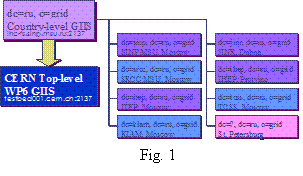 The configuration of Russian national GIIS is shown on Fig. 1. All institutes participating in the EU-DataGrid setup own institute-level GIIS servers. All institute-level GIIS servers are then registered in Russian National GIIS for the EU-DataGrid, which is installed, and running in SINP MSU, Moscow (ldap://lhc‑fs. sinp. *****:2137).
Country-level GIIS is registered in the top-level GIIS server for the Testbed0 which is installed in CERN (ldap://testbed001.cern. ch:2137). GIIS servers use MDS components from Globus Toolkit 1.1.3.
Institutes registered in the country-level GIIS are: SINP MSU (Moscow), SRCC MSU (Moscow), ITEP (Moscow), KIAM (Moscow), JINR (Dubna), IHEP (Protvino). In the nearest future TCSS (Moscow) and several St. Petersburg and Kharkov institutes will setup their GIIS servers and register them in country-level GIIS. SRCC, KIAM and TCSS are not involved in CERN projects, but they are participating in Russian DataGrid project.
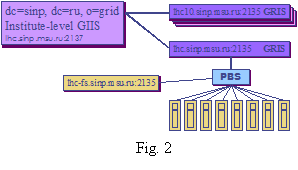 Configuration of SINP MSU GIIS server
SINP MSU GIIS server is an example of a “typical” institute-level GIIS server. Its configuration is shown on Fig. 2.
Server receives information from several nodes running Globus 1.1.3 Gatekeeper and GRIS service. One of the nodes with Gatekeeper is a PBS farm interface node, and job submission can be done to PBS system through this node. Information about fork jobmanager queues is published in GRIS and is available in GIIS. Support for the PBS jobmanager in Globus 1.1.3 is incomplete, so there is no information about running jobs on PBS cluster in the GRIS. We are testing some special software written in KIAM for publishing PBS jobs information in GRIS, but tests results are still incomplete.
Certification Authority
Globus Toolkit uses X509v3 cryptography for authentication and encryption, this means that the Certification Authority (CA) is required for operation. WP6 security team decided not to use the Globus. org CA (/C=US/O=Globus/CN=Globus Certification Authority) for EU-DataGrid and to setup local CAs.
The Russian DataGrid CA (/C=RU/O=DataGrid/CN=Russian DataGrid CA) provides Globus X509v3 certificates for Russian DataGrid Testbed community. The CA is located at SINP MSU.
The certificate identifies the individual as a member of the Russian DataGrid *****ssian DataGrid CA issues certificates for Russian institutes, laboratories and individuals participating in EU-DataGrid project. A certificate identifies authenticy of the owner’s name, but does not guarantee any rights. Only the local administrator of the resource gives or cancels the permission to use the resource. The Russian DataGrid CA is no the only CA for Russia in the EU-DataGrid project. There can be more CAs for different *****ssian DataGrid CA uses registration authorities scheme for issuing certificates.
CAs are trusted by lots of people, so we must guarantee “correct” issuing of the certificates. This means that the CA must be hack proof, and only valid real persons should be able to obtain the certificate. In “classical” CA working scheme CA administrator performs the validation of the certificate requester in some way (by a phone call for example) and after that issues the certificate. This scheme is good for small CAs with small amount of requests, but with large amount of requests per day we can come to performance problems. Phone validation of users is also not the best way for validating the requests, direct contact with person is much more secure.
Registration Authority (RA) is a place where “physical” validation of the certificate requesters is performed. We can setup several RAs in the different institutes and divisions and this should solve the problems with a “classical” CA. CA administrator in this case trusts to the RAs and does not make any validation for the requests signed by a RA. We can also implement revocation mechanisms for RAs so that they can send signed certificate revocation requests to the CA, which again are not validated by the CA Administrator. Not the request generated using grid-cert-request program is sent not to the CA but to the RA (division administrator for example). The administrator validates the request using direct contact with the requester and signs it with his Globus certificate. This signed request is then emailed to the CA. The CA checks the signature on the request, and later CA administrator issues the certificate without any other checks. Our implementation of the RA uses Globus certificates for signing certificate and revocation requests.
The email robot at CA understands not only certificate requests, but also special “revoke” requests that can be used by a RA for certificate revocation. Our CA also supports certificate renewal requests (generated with grid-cert-renew program). CA email robot can also perform several supplementary functions like checking certificate validity, obtaining old issued certificates with given Distinguished Name or serial number. In future the email robot will keep track on certificate expiration dates and will automatically send renew challenge strings for grid‑cert‑renew (challenge in renew requests is currently ignored).
Certificate Revocation Lists
Certificate Revocation Lists (CRLs) are the only way to check the validity of the certificate in Globus Security Infrastructure (GSI). This means that for the best security we must update CRLs on the hosts running Globus as fast as it is possible.
All current CRL update solutions are based on scheduled web update from the CA web sites. These solutions have several problems:
· CRL update frequency on the host often does not match the CRL generation frequency at the CA. This causes too frequent CRL updates or CRL expiration problems.
· In future frequent web updates of the CRLs can cause big load of the CA web servers.
· Signing policies for the CAs are not updated automatically.
We are now developing the new CRL update scheme, which uses notification messages for updating certificates on the Russian DataGrid hosts. When the CA issues a new CRL it sends a special notification to all sites, and after this software on the sites downloads the new CRL. This allows to relinquish the scheduled updates and to update CRLs only when it is really required.
Acknowledgments
The work was supported by CERN-INTAS grant 00-0440.
Conclusions
All grid information services created in Russia were successfully tested during EU-DataGrid WP6 Testbed0 and showed adequate level of services and *****ssian EU-DataGrid segment is now prepared for the next step – Testbed1, which includes job submission tests using grid *****ssian DataGrid Certification Authority started issuing certificates that are accepted in all EU-DataGrid member institutes. Solutions used in the Certification Authority showed good scalability and proper security level.
