

Партнерка на США и Канаду по недвижимости, выплаты в крипто
- 30% recurring commission
- Выплаты в USDT
- Вывод каждую неделю
- Комиссия до 5 лет за каждого referral
Procedures to file a request to the Federal Service for Intellectual Property, of the Russian Federation (ROSPATENT) for the Patent Prosecution Highway Pilot Programs (PPH and PCT-PPH) between the ROSPATENT and the SIPO (State Intellectual Property Office of the
P. R. China)
I. Patent Prosecution Highway Pilot Program
Where Rospatent is the Office of first filing (OFF) and the Russian application contains claims that are determined to be patentable/allowable, the applicant may request accelerated examination at the SIPO for the corresponding application filed with the SIPO as the Office of second filing (OSF). The procedures and requirements for filing a request with the SIPO for participation in the PPH pilot program will be available from the SIPO Web-site.
Where Rospatent is the OSF and the corresponding application filed with the SIPO as the OFF contains claims that are determined to be patentable/allowable, the applicant may request participation in the PPH pilot program in Rospatent and petition to make the RU application special under the PPH pilot program. The procedures and requirements for filing a request in Rospatent for participation in the PPH pilot program are set forth below.
The PCT-PPH pilot program was established to expand the potential of the PPH pilot program and to enable an applicant, who has received a Written Opinion from an International Searching Authority (WO/ISA) (ISA must be ROSPATENT or SIPO), a Written Opinion from an International Preliminary Examining Authority (WO/IPEA) (IPEA must be ROSPATENT or SIPO), or an International Preliminary Examination Report (IPER/IPEA) (IPEA must be ROSPATENT or SIPO) from an International Preliminary Examining Authority to file a corresponding request to the Office of Second Filing and a petition for accelerated examination, allowing the Office of Second Filing to use the result of the international search and examination.
II. Trial Period for the PPH Pilot Program
The PPH pilot program will commence on 01.07.2012 for a period of one year ending on 30.06.2013. The trial period may be extended for up to an additional year if necessary to adequately assess the feasibility of the PPH program. The SIPO and the Rospatent will evaluate the results of the pilot program to determine whether and how the program should be fully implemented after the trial period. The Offices may also terminate the PPH pilot program earlier if the volume of participation exceeds manageable level, or for any other reason. Notice will be published if the PPH pilot program will be terminated before 30.06.2013
Part I
PPH using the national work products from the SIPO
Applicants can request accelerated examination by a prescribed procedure including submission of relevant documents on an application which is filed with the Rospatent and satisfies the following requirements under the Rospatent-SIPO Patent Prosecution Highway pilot program based on the SIPO application.
When filing a request for the PPH pilot program, an applicant must submit a request form “The Explanation of Circumstances Concerning Examination under PPH Program”.
1. Requirements
(a) Both the Rospatent application on which PPH is requested and the SIPO application(s) forming the basis of the PPH request shall have the same earliest date (whether this be a priority date or a filing date).
For example, the Rospatent application (including PCT national phase application) is either:
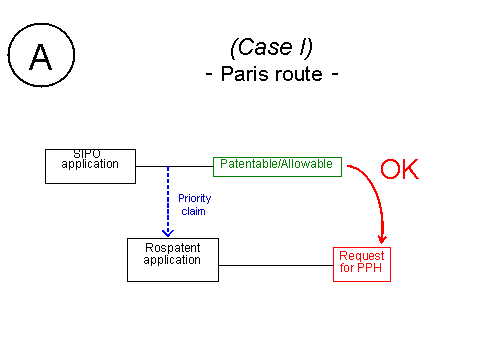
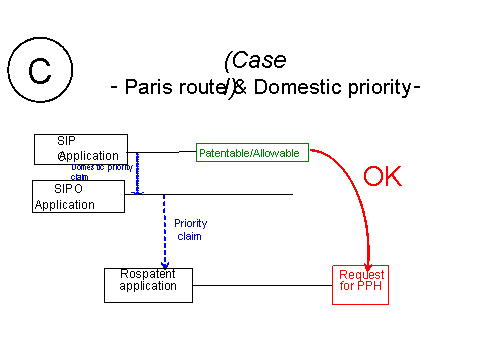
(Case I) an application which validly claims priority under the Paris Convention from the SIPO national application/(s) (examples are provided in ANNEX I, Figure A, B, C), or
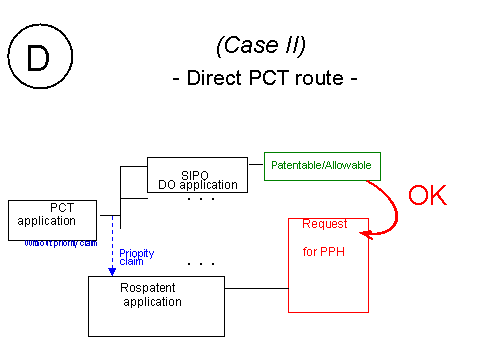
(Case II) a national filed application which validly claims priority under the Paris Convention from a PCT application which has no priority claims (example is provided in ANNEX I, Figure D), or
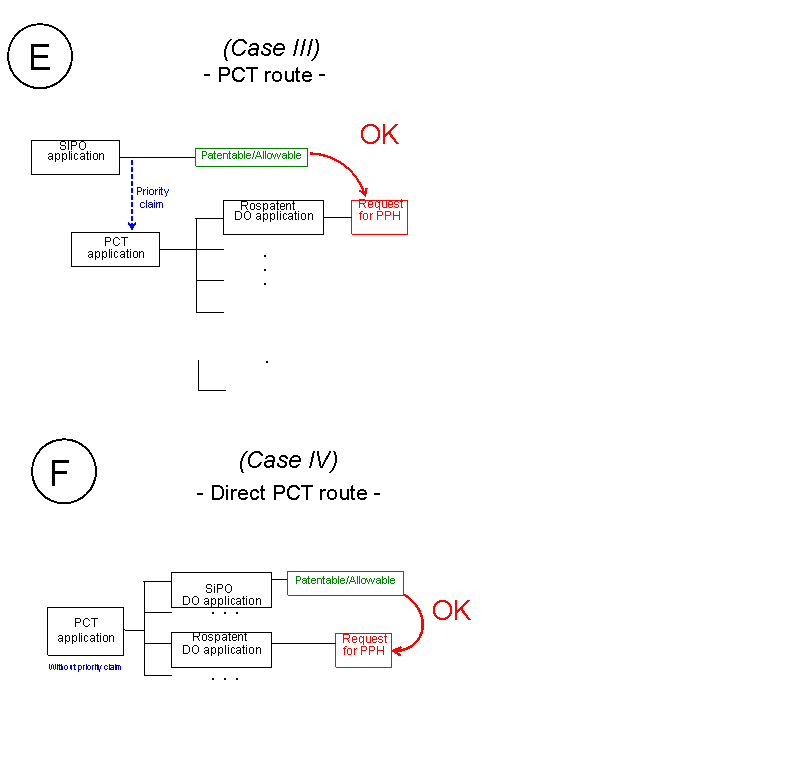
(Case III) a PCT national phase application where the PCT international application has validly claimed priority from the SIPO national application/(s) (example is provided in ANNEX I, Figure E), or
(Case IV) a PCT national phase application where the PCT international application has no priority claims (example is provided in ANNEX I, Figure F)
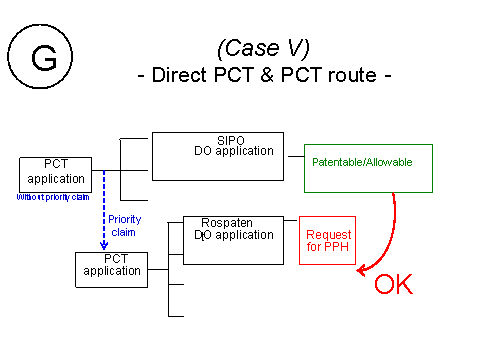
(Case V) a PCT national phase application where the PCT international application has validly claimed priority from the PCT international application which has no priority claims (example is provided in ANNEX I, Figure G)
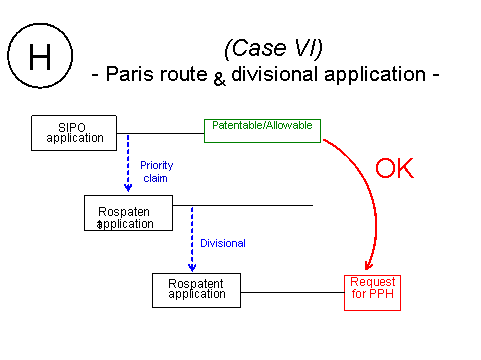
(Case VI) a divisional of an application referred to any of (I) to (V)
(an example is provided in ANNEX I, Figure H).
(b) At least one corresponding application exists in the SIPO and has one or more claims that are determined to be patentable/allowable by the SIPO.
Claims clearly identified to be patentable/allowable in the latest office action at examination stage are able to be a base of a request for an accelerated examination under the PPH pilot program, even if the application, which includes those claims is not granted for patent yet. If the SIPO office action does not explicitly state that a particular claim is allowable, the applicant must include a statement in the request for participation in the PPH program or in the transmittal letter accompanying the request for the participation that no rejection has been made in the SIPO office action regarding that claim, and therefore the claim is deemed allowable/patentable by the SIPO.
(c) All claims on file, as originally filed or as amended, for examination under the PPH must sufficiently correspond to one or more of those claims indicated as patentable/ allowable in the SIPO.
Claims are considered to "sufficiently correspond" where, accounting for differences due to translations and claim format, the claims in the Rospatent are of the same or similar scope as the claims in the SIPO, or the claims in the Rospatent are narrower in scope than the claims in the SIPO.
In this regard, a claim that is narrower in scope occurs when a SIPO claim is amended to be further limited by an additional feature that is supported in the specification (description and/or claims).
A claim in the Rospatent which introduces a new/different category of claims to those claims indicated as patentable/allowable in the SIPO is not considered to sufficiently correspond. For example, where the SIPO claims only contain claims to a process of manufacturing a product, then the claims in the Rospatent are not considered to sufficiently correspond if the Rospatent claims introduce product claims that are dependent on the corresponding process claims.
A request on the amendment of the dossier of the application shall be filed in case the claims of the initial application do not sufficiently correspond to the claims of the invention considered patentable/allowable in the SIPO. If the claims in the initial PPH Rospatent application do not sufficiently correspond to the claims indicated as patentable/allowable in the SIPO, the applicants need to amend the claims. Amendment should meet the requirement of Article 1378 of the Civil Code of Russian Federation (RF) and a request on the amendment of the dossier of the application shall be filed.
Any claims amended or added after the grant of the request for participation in the PPH pilot program but before the Rospatent first action must sufficiently correspond to the claims indicated as patentable/allowable in the in the SIPO application. Any claims amended or added after the first Rospatent action need not to sufficiently correspond to the claims indicated as patentable/allowable in the SIPO in order to overcome the reasons for refusal raised by Rospatent examiners.”
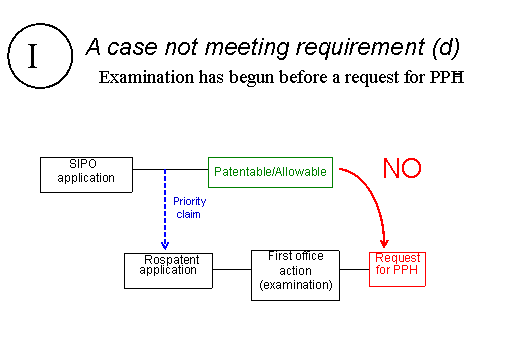
(d) The Rospatent has not begun the examination of the application (an example is provided in ANNEX I, Figure I).
2. Documents to be submitted
Documents (a) to (e) below must be submitted by attaching to “The Explanation of Circumstances Concerning Examination under PPH Program”. Note that even when it is not needed to submit certain documents below, the name of the documents must be listed.
(a) Copies of all office actions[1]in the SIPO, which were sent for the corresponding application by the SIPO, and translations of them[2].
Both Russian and English are acceptable as translation language
(b) Copies of all claims determined to be patentable/allowable by the SIPO, and translations of them[3].
Both Russian and English are acceptable as translation language.
(c) Copies of references cited by SIPO examiner
If the references are patent documents, the applicant doesn’t have to submit them because the Rospatent usually possess them. When the Rospatent does not possess the patent document, the applicant has to submit the patent document at the examiner’s request. Non-patent literature must always be submitted.
The documents to be submitted are those cited in the above-mentioned office actions. Documents which are only referred to as references and consequently do not consist of the reasons for refusal do not have to be submitted.
The translations of the references are unnecessary.
(d) Claim correspondence table
Applicant must submit a claim correspondence table, which indicates how all claims in the Rospatent application sufficiently correspond to the patentable/allowable claims in the SIPO application.
When claims are just literal translation, the applicant can just write down that “they are same” in the table. When claims are not just literal translation, it is necessary to explain the sufficient correspondence of each claim based on the criteria 1.(c).
(e) The applicant must file the request for substantive examination
It is required to file the request for substantive examination and to pay the fee for filing of this request in compliance with paragraph 1 Article 1386 of the Civil Code of the Russian Federation.
When the applicant has already submitted above documents 2.(a) to 2.(e) to the Rospatent through simultaneous or past procedures, the applicant may incorporate the documents by reference and does not have to attach them.
When the application doesn’t fulfill the requirement of 1. and 2. above, the request of an examination is not accepted. In that case, the Rospatent will notify that and the reason for it to the applicant (or the representative).
The applicant will be given one opportunity to perfect the request. As an exception an applicant may have one more opportunity to perfect the PPH request. Action on the application by the examiner will not be suspend awaiting a reply by the applicant to perfect the request in a renewed request for participation. That is, if the application is picked up for examination by the examiner after the applicants has been notified of the defects in the request, any renewed request will be dismissed. If the renewed request is perfected and examination has not begun, the special status will be granted and the Rospatent application will be advanced out of turn for examination. If the request will not perfected the application will await action in its regular turn.
Part II
PPH using the PCT international work products from the SIPO
Applicants can request accelerated examination by a prescribed procedure including submission of relevant documents on an application which is filed with the ROSPATENT and satisfies the following requirements under the Rospatent-SIPO Patent Prosecution Highway pilot program based on PCT international work products (PCT-PPH pilot program).
When filing a request for the PCT-PPH pilot program, an applicant must submit a request form “The Explanation of Circumstances Concerning Examination under PCT-PPH Program”.
1. Requirements
The application which is filed with the Rospatent and on which the applicant files a request under the PCT-PPH must satisfy the following requirements:
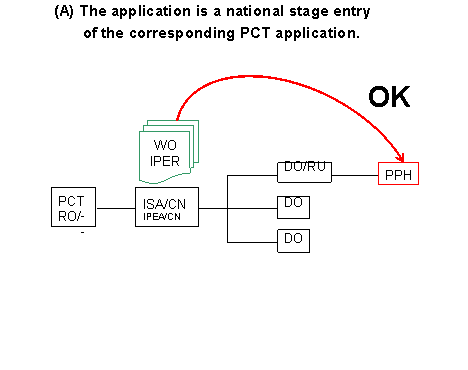
(1) The latest work product in the international phase of a PCT application corresponding to the application (“international work product”), namely the Written Opinion of International Search Authority (WO/ISA), the Written Opinion of International Preliminary Examination Authority (WO/IPEA) or the International Preliminary Examination Report (IPER), indicates at least one claim as patentable/allowable (from the aspect of novelty, inventive steps and industrial applicability).
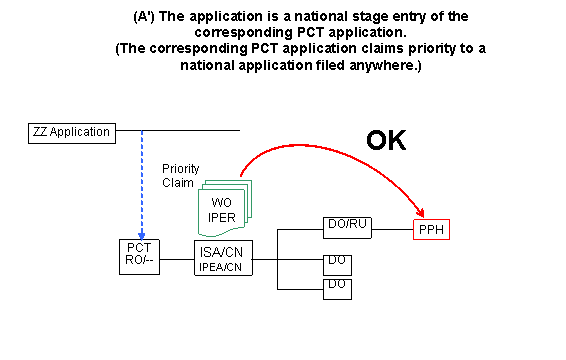
Note that the ISA and the IPEA which produced the WO/ISA, WO/IPEA and the IPER are limited to the SIPO, but, if priority is claimed, the priority claim can be to an application in any Office, see example A’ in Annex II (application ZZ can be any national application).
The applicant cannot file a request under PCT-PPH on the basis of an International Search Report (ISR) only.
In case any observation is described in Box VIII of WO/ISA, WO/IPEA or IPER which forms the basis of a PCT-PPH request, the applicant must explain why the claim(s) is/are not subject to the observation irrespective of whether or not an amendment is submitted to correct the observation noted in Box VIII. The application will not be eligible for participating in PCT-PPH pilot program if the applicant does not explain why the claim(s) is/are not subject to the observation. In this regard, however, it does not affect the decision on the eligibility of the application whether the explanation is adequate and/or whether the amendment submitted overcomes the observation noted in Box VIII.
(2) The relationship between the application and the corresponding international application satisfies one of the following requirements:
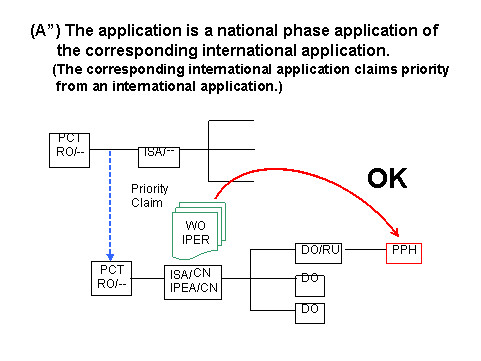
(A) The application is a national phase application of the corresponding international application. (See Diagrams A, A’, and A’’ in Annex II)
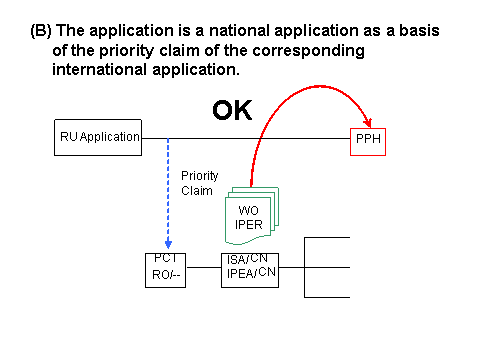
(B) The application is a national application as a basis of the priority claim of the corresponding international application. (See Diagram B in Annex II)
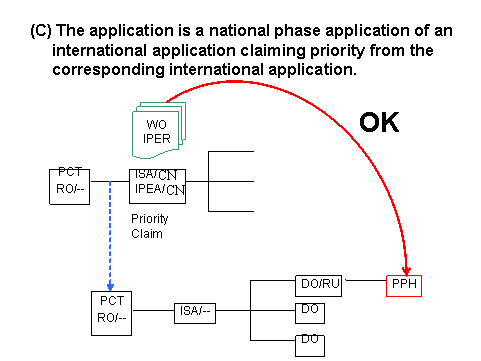
(C) The application is a national phase application of an international application claiming priority from the corresponding international application. (See Diagram C in Annex II)
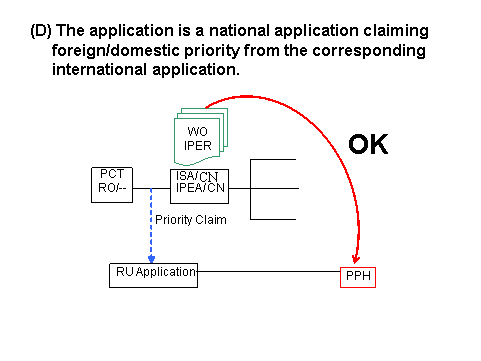
(D) The application is a national application claiming foreign/domestic priority from the corresponding international application. (See Diagram D in Annex II)
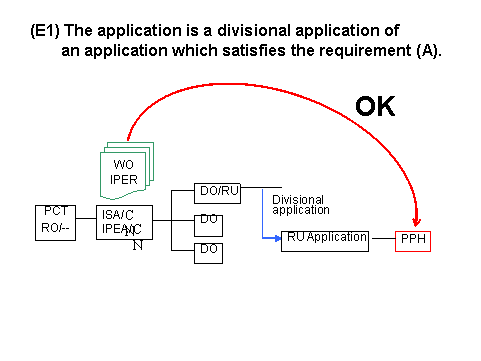
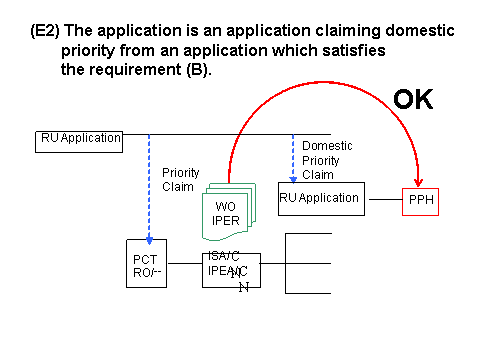
(E) The application is the derivative application (divisional application and application claiming domestic priority etc.) of the application which satisfies one of the above requirements (A) – (D). (See Diagrams E1 and E2 in Annex II)
(3) All claims on file, as originally filed or as amended, for examination under the PCT-PPH must sufficiently correspond to one or more of those claims indicated as allowable/patentable in the SIPO as ISA/IPEA.
Claims are considered to "sufficiently correspond" where, accounting for differences due to translations and claim format, the claims in the Rospatent are of the same or similar scope as the claims indicated to be patentable/allowable in the latest international work product or the claims in the Rospatent are narrower in scope than the claims indicated to be patentable/allowable in the latest international work product.
In this regard, a claim that is narrower in scope occurs when a claim indicated to be patentable/allowable in the latest international work product is amended to be further limited by an additional feature that is supported in the specification (description and/or claims).
A claim in the Rospatent which introduces a new/different category of claims to those claims indicated as patentable/allowable in the latest international work product is not considered to sufficiently correspond. For example, the claims indicated to be patentable/allowable in the latest international work product only contain claims to a process of manufacturing a product, then the claims in the Rospatent are not considered to sufficiently correspond if the Rospatent claims introduce product claims that are dependent on the corresponding process claims.
If the claims in the Rospatent application do not sufficiently correspond to the claims indicated as patentable/allowable in the latest international work product, the applicants need to amend the claims. Amendment should meet the requirement of Article 1378 of the Civil Code of Russian Federation (RF) and a request on the amendment of the dossier of the application shall be filed.
Any claims amended or added after the grant of the request for participation in the PPH pilot program but before the Rospatent first action must sufficiently correspond to the claims indicated as patentable/allowable by the latest international work product. Any claims amended or added after the first Rospatent action need not to sufficiently correspond to the claims indicated as patentable/allowable in latest international work product in order to overcome the reasons for refusal raised by ROSPATENT examiners.
(4) The Rospatent has not begun examination of the application at the time of request under PCT-PPH.
2. Documents to be submitted
The applicant must submit the following documents attached to the request form in filing a request under PCT-PPH.
Some of the documents may not be required to submit in certain cases. Please note that the name of the documents omitted to submit still have to be listed in “The Explanation of Circumstances Concerning Examination under PCT-PPH Program”.
(1). A copy of the latest international work product which indicated the claims to be patentable/allowable and their English or Russian translations.1
In case the application satisfies the relationship I.(2)(A), the applicant need not submit a copy of the International Preliminary Report on Patentability (IPRP) and any English translations thereof because a copy of these documents is already contained in the file-wrapper of the application. In addition, if the copy of the latest international work product and the copy of the translation are available via “PATENTSCOPE (registered trademark)”*, an applicant need not submit these documents, unless otherwise requested by the Rospatent.
(WO/ISA and IPER are usually available as “IPRP Chapter I” and “IPRP Chapter II” respectively in 30 months after the priority date.)
(2). A copy of a set of claims which the latest international work product of the corresponding international application indicated to be patentable/allowable and their Russian and English translations.2
If the copy of the set of claims which are indicated to be patentable/allowable is available via “PATENTSCOPE (registered trademark)” (e. g. the international Patent Gazette has been published), an applicant need not submit this document unless otherwise requested by the Rospatent.
(3).A copy of references cited in the latest international work product of the international application corresponding to the application.
If the reference is a patent document, the applicant is not required to submit it. In case the Rospatent has difficulty in obtaining the document, however, the applicant may be asked to submit it. Non-patent literature must always be submitted.
The documents to be submitted are those cited in the above-mentioned latest international work product. Documents which are only referred to as references and consequently do not consist of the reasons for refusal do not have to be submitted.
Translations of cited documents are unnecessary.
(4). A claims correspondence table which indicates how all claims in the application sufficiently correspond to the claims indicated to be patentable/allowable.
When claims are just literal translation, the applicant can just write down that “they are the same” in the table. When claims are not just literal translation, it is necessary to explain the sufficient correspondence of each claim based on the criteria 1.(3).
(5). It is required to file the request for substantive examination and to pay the fee for filing of this request in compliance with paragraph 1 Article 1386 of the Civil Code of the Russian Federation.
When an applicant has already submitted the above mentioned documents to the Rospatent through simultaneous or past procedures, the applicant may incorporate the documents by reference and is thus not required to attach the documents.
When the application doesn’t fulfill the requirement of 1. and 2. above, the request of an examination is not accepted. In that case, the Rospatent will notify that and the reason for it to the applicant (or the representative).
The applicant will be given one opportunity to perfect the request. As an exception an applicant may have one more opportunity to perfect the PPH request. Action on the application by the examiner will not be suspend awaiting a reply by the applicant to perfect the request in a renewed request for participation. That is, if the application is picked up for examination by the examiner after the applicants has been notified of the defects in the request, any renewed request will be dismissed. If the renewed request is perfected and examination has not begun, the special status will be granted and the Rospatent application will be advanced out of turn for examination. If the request will not perfected the application will await action in its regular turn.
ANNEX I
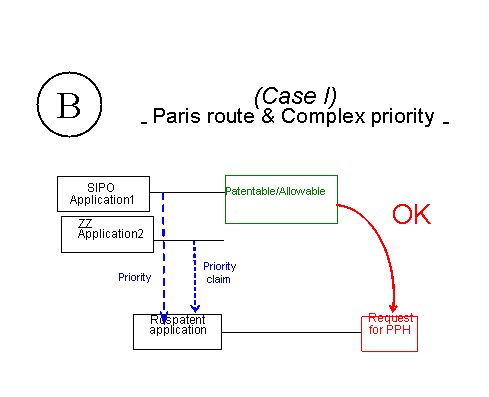 |
ZZ: Patent Office other than SIPO
 |
 |
 |
 |
 |
 |
ANNEX II



ЗАЯВЛЕНИЕ
о проведении экспертизы заявки на изобретение в соответствии с Пилотной программой PPH между
SIPO и Роспатентом
1. Номер заявки | |
2. Дата подачи заявки | |
3. Заявитель | |
4. Название изобретения | |
5. Патентный поверенный/представитель | |
6. Разъяснение обстоятельств в отношении проведения ускоренной экспертизы Поданная в Роспатент заявка на изобретение является заявкой, по которой правомерно испрашивается приоритет в соответствии с Парижской конвенцией по охране промышленной собственности на основании одной или нескольких соответствующих заявок, поданных в ведомство первой подачи, при условии установления ведомством первой подачи соответствия условиям патентоспособности, по крайней мере, одного независимого пункта формулы изобретения, содержащейся в такой заявке. Номер заявки SIPO/PCT_______________________________ Дата подачи заявки SIPO /PCT__________________________ | |
7. Прилагаемые документы: 7.1. Таблица, поясняющая соответствие пунктов формулы соответствующей заявки, признанных патентоспособными в SIPO, и пунктов формулы, содержащейся в заявке, поданной в Роспатент на л. 7.2. Копия отчета о поиске в SIPO на (указать дату) на л. 7.3. Копии и переводы всех действий (уведомлений) SIPO на л. 7.3.1. Копия решения о выдаче патента в SIPO на л. 7.3.2. Публикация описания к патенту SIPO (указать номер патента) на л. 7.3.3. Копия иного действия (уведомления) SIPO (указать действие) на л. 7.4. Копия и перевод пунктов формулы изобретения, признанных патентоспособными в SIPO на л. 7.5. Непатентная литература, цитируемая экспертом SIPO в основаниях для отказа на л. 7.6. Ходатайство о проведении экспертизы заявки по существу и документ, подтверждающий оплату соответствующей патентной пошлины на л. |
ТАБЛИЦА,
соответствия пунктов формулы изобретения, признанных патентоспособными в заявке DKPTO, и пунктов формулы, в заявке, поданной в Роспатент
Пункты формулы изобретения в заявке, поданной в Роспатент | Пункты формулы соответствующей заявки, признанные патентоспособными в DKPTO | Комментарии по соответствию пунктов формул |
Примечание:
Условие соответствия пунктов формул считается соблюденным, если независимый пункт формулы изобретения по заявке, поданной в Роспатент, отличается от пункта формулы соответствующей заявки наличием дополнительного компонента в виде признака (признаков) зависимого (зависимых) пункта (пунктов), либо дополнением зависимого пункта компонентом из описания изобретения в виде признака (признаков) или в виде частной формы выражения признака, выраженного в независимом пункте общим понятием, или исключением признака из зависимого пункта формулы (пункт 2(с) настоящего Порядка).
[1] Office actions are documents which relate to substantive examination.
[2] Machine translations will admissible, but if it is impossible for the examiner to understand the outline of the translated office action due to insufficient translation, the examiner can request the applicant to resubmit translations.
[3] Machine translations will not admissible.
.
[4] Machine translations will admissible, but if it is impossible for the examiner to understand the outline of the translated office action due to insufficient translation, the examiner can request the applicant to resubmit translations.
2 Machine translations will not admissible.
