

Партнерка на США и Канаду по недвижимости, выплаты в крипто
- 30% recurring commission
- Выплаты в USDT
- Вывод каждую неделю
- Комиссия до 5 лет за каждого referral
Hydrocarbon contamination of aquifers by SNMR detection.
O. A. Shushakov1, V. M. Fomenko1, V. I. Yashchuk2, A. S. Krivosheev2, E. Fukushima3, S. A. Altobelli3, V. S. Kuskovsky4
1) Institute of Chemical Kinetics and Combustion SB RAS, 3, Institutskaya St., 630090 - Novosibirsk
2) Yuzhno-Minusinsk Hydrogeological Enterprise, 662801 Krasnoyarsk region, Minusinsk district, Selivanikha
3) New Mexico Resonance, 2301 Yale Blvd, SE, Suite C-1, Albuquerque, NM
4) United Institute of Geology, Geophysics and Mineralogy SB RAS, 3, Ac. Koptyug Av., 630090 - Novosibirsk.
Abstract.
Surface NMR can be used to unambiguously detect subsurface water in suitable geological formations to a depth of 100 meters and more depending on the presence of natural and cultural electromagnetic noise. Mathematical routines yield depth distributions of the liquid, provided that the liquids are present in horizontal layers and not in pores that are too small to be detectable at present. Furthermore, determination of pore size distributions is now possible with relaxation time measurements.
Experiments were performed at shallower depths to detect signals from deposits of subsurface gasoline and diesel fuel near Abakan, Siberia. Surface NMR signals were observed with multiple T2 relaxation times at sites containing both gasoline and water. The identification of gasoline and water signals were made on the basis of making measurements much farther from the apparent source of contamination and obtaining only one T2 component, presumed to be water. We are not aware of any other surface NMR experiments that have detected subsurface organic contaminants, especially in the presence of water.
Introduction
Aquitards and aquifers often have different ranges of electrical resistivity and density. Nevertheless, surface electrical and density technique is often (but not always) able to indirectly delineate the coarse-grained alluvial deposits, which have potential of being aquifers. The SNMR method, on the other hand, allows direct and noninvasive (remote) sounding of groundwater distribution versus depth. Moreover other proton-containing liquids such as hydrocarbons can also be studied.
An earlier study [1] discusses some aspects of the surface nuclear magnetic resonance (SNMR) sounding signal of bulk water detected below the ice surface of Ob reservoir near Novosibirsk. Such SNMR experiments of bulk water are useful for calibration and testing the method. As it was partly reported earlier in [2], investigation of spin relaxation times T2*, T2, T1 is important for information about the microstructure of pores as well as diamagnetic, paramagnetic, and hydrocarbon contamination. The present study identifies hydrocarbon contamination based on SNMR relaxation.
Experimental and test sites
 The SNMR experiments were performed using the Hydroscope-3 equipment made in the Institute of Chemical Kinetics and Combustion of Siberian branch of the Russian Academy of sciences, Novosibirsk. The technique uses maximal pulse moment up to 20000 A*ms (at 40 ms pulse duration), the battery capacitance 0.2 F, and possibility of two-pulse sequence. The 2 17m diameter three-turn loops were connected in a figure-eight configuration [3] to detect hydrocarbon pollution.
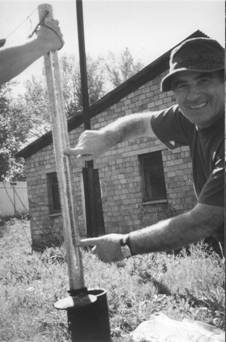
Figure 1. An example of hydrocarbon pollution of groundwater (Abakan).
A team from Siberian Branch of Russian Academy of Sciences (SBRAS), Yuzhno-Minusinsk Hydrogeological Enterprise (YMHE), and New Mexico Resonance studied leaky underground storage (LUST) near Abakan. Anatoly Krivosheev and Vladimir Yashchuk of YMHE had monitored numerous LUST sites near Abakan and south of Krasnoyarsk region from borehole measurements. Figure 1 exemplifies a borehole measurement of a 27-cm thick gasoline layer over water at a site in Abakan. At another location, Borehole #52 near a leaking tank of gas station (Abakan), the depth of the gasoline layer was 1.15 m. The dissolved hydrocarbon content in groundwater was 7.15 mg/l. The lithological log of Borehole #52 is clay sand 1-4 m, medium-grained sand 4-5 m, clay and pebbles 5-9 m, and gravel 9-11 m.
Results and discussion
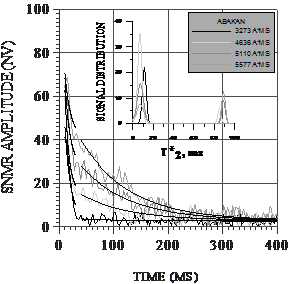 Borehole #52 was located at a gas station on the embankment of Enisei River. Figures 2 and 3 exemplify the hydrocarbon (gasoline) pollution of aquifer detected near the gas station but on the flood plain of the river. Surface NMR signals were observed with two T2* relaxation rates at a site, known to contain both gasoline and water and close to the gas station.
Figure 2. An example of SNMR amplitude versus time at different pulse moments. Near Borehole #52 at leaking tank of gas station in Abakan.
The identification of gasoline and water signals were made on the basis of making measurements 150 meters farther from the source of contamination, and closer to the Enisei River, and obtaining signals with only one T2* component (Fig. 3), presumed to be water [4].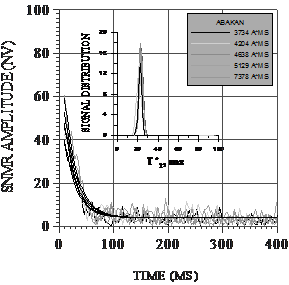
Figure 3. An example of SNMR amplitude versus time at different pulse moments. 150 m away from site of Fig. 2, Abakan.
Since the rock surface is usually water-wetted and the non-wetting phase remains in the bulk, the NMR signal of wetting phase (water) has much shorter relaxation times (~10 ms), while the non-wetting phase (hydrocarbon) exhibits close-to-bulk relaxation behavior (~90 ms). The surface-NMR results obtained are in good agreement with earlier laboratory and NML measurements [5-7]. The pore-surface water-proton relaxation times of ~10 ms (inset, Fig.2) are shorter than the bulk relaxation times of ~20 ms (inset, Fig 3), also in good agreement with past work [5-7].
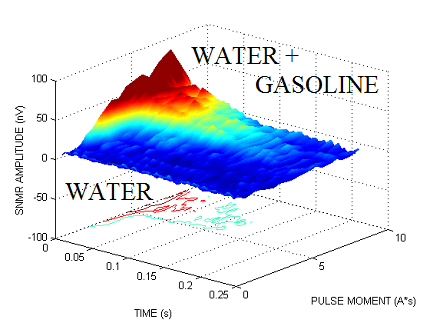 Figure 4. An example of SNMR amplitude versus time and pulse moment. Near Borehole #52, Abakan.
Figure 4 shows a 3-D stacked plot of the SNMR amplitude versus time and pulse moment, the data of Fig. 2, taken near Borehole #52, Abakan. There are only short lifetimes at low moments while there are both short and longer relaxation times at high moments, as can be seen also in Fig. 2. If the shorter relaxation times are due to water, these results indicate that it is at shallow depths while the gasoline with possibly the longer relaxation times occur only for the larger pulse-moments which imply that they are at greater depths. These results are contrary to the situation shown in Fig. 1 or even at borehole #52 where gasoline was over water.
Conclusions
Surface NMR signals were observed with multiple T2 relaxation rates at sites with known deposits of subsurface gasoline and water near Abakan. The identification of gasoline and water was made using measurements much farther from the source of contamination and obtaining only one T2 component.
References.
[1] Trushkin D. V., Shushakov O. A., Legchenko A. V.: Appl. Magn. Res., v. 5,
[2] Shushakov O. A.: Magn. Res. Imaging, v. 14,
[3] Trushkin D. V., Shushakov O. A., Legchenko A. V.: Geoph. Prospecting, v. 42,
[4] Shushakov O. A., Fomenko V. M., Yashchuk V. I., Krivosheev A. S., Fukushima E., Kuskovsky V. S.: Proc. ENVIROMIS, Russia, Tomsk, v. 1,, in Russian).
[5] Straley C., Morris C. E., Kenyon W. E., Howard J. J.: Log Analyst, v. 36,
[6] Hedberg S. A., Knight R. J., McKay A. I., Whittal K. P.: Water Resour. Res., v. 29, 1
[7] Bryar T. R., Knight R. J., Nielsen T. P.: Water Resour. Research, in press.
