


Партнерка на США и Канаду по недвижимости, выплаты в крипто
- 30% recurring commission
- Выплаты в USDT
- Вывод каждую неделю
- Комиссия до 5 лет за каждого referral
Задание для самостоятельно работы
Темы: Денежные лотереи и отношение к риску.
1. На занятии мы рассмотрели следующие определения
(A) «предпочтения агента характеризуются убыванием абсолютной несклонности к риску, если  убывает с ростом богатства для любой лотереи
  »
»
(B) «агент с элементарной функцией полезности  обладает большей степенью абсолютной несклонности к риску нежели агент с функцией
  , если для любой лотереи имеем
  ».
».
Примечание:  ,
,  , где
, где  .
.
Рассмотрите два уровня богатства  и
и  и определите
 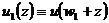 и
и 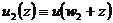 .
.
Покажите, что из определения (B) следует, что, если  , то
, то  , то есть (А) является следствием (В).
2. Верно ли, что для агента – рискофоба гарантированный эквивалент лотереи всегда меньше ожидаемого выигрыша?
3. A farmer can grow wheat or potatoes or both. If the summer is shiny then a unit of land yields a profit of $7 if devoted to wheat, of $3 if devoted to potatoes. Should the summer be rainy, a unit of land yields a profit of $1 if devoted to wheat, of $3 if devoted to potatoes. Good and bad weather is equally likely. Farmer is risk averse and has 40 units of land. Let the farmer’s utility function be given by  , where
  stays for wealth.
(a) What is the optimal allocation of land between potatoes and wheat.
(b) Suppose that farmer is offered to rent his land out for one period for X rubles. Find the smallest X at which the farmer would accept the offer. Denote this sum by  . Compare with the one period expected profit from his business and explain the result.
(c) Now, suppose that the farmer can purchase an insurance against bad weather that pays $1 per unit of insurance in case of bad weather at a price of $0.5 per unit. Find the optimal allocation of land and the quantity of insurance purchased.
