

Партнерка на США и Канаду по недвижимости, выплаты в крипто
- 30% recurring commission
- Выплаты в USDT
- Вывод каждую неделю
- Комиссия до 5 лет за каждого referral
The Queen's Coronation Gown Design Brief
With the day of the coronation set for June 2 1953 the bustle of behind the scenes activity went on for some 16 months. Adequate seating, television coverage and careful route planning might be the making of the day for others, but for the Queen knowing her coronation robes would be comfortable and safely fastened throughout the long arduous day was of vital importance.
The new Queen had listened respectfully to her grandmother's advice about designs for a Coronation gown, but she had firm ideas of her own, especially of what it should not be. Her specifications to Norman Hartnell her chosen British designer were that the coronation dress should be on the lines of her wedding gown and be made of white satin. It was to be both regal and religious without exaggeration of shape. With thoroughness, Hartnell researched the history and tradition of Coronation dresses, visiting the London Museum and the London Library and emerged with factual information.
The coronation gown had to stand out against a competitive background of colour and the brilliance of precious gems. Such a dress would also be destined to be historic and Hartnell wanted it to be his masterpiece that would appear as a great piece of costume history.
His mind teamed with all the possibilities from heraldic and floral emblems to thoughts of heavenly bodies and centuries old religious vestments. The ideas flowed onto paper and he made many trial sketches from which emerged eight painted designs. Together, the Queen and Hartnell discussed the designs which ranged from severely simple to highly elaborate.
Hartnell's Trial Designs for the Coronation Robes
The first coronation dress design was for a very simply styled gown similar to that worn by Queen Victoria at her Coronation. The only decoration on the white satin was a Greek key design which formed an embroidered border on the hem and bodice.
The second design was a modern slim-fitting sheath gown, embroidered in gold and trimmed with black and white ermine tails at the hemline. The Queen rejected this as too form fitting.
The third was a crinoline style coronation dress of white satin, silver tissue and crusty silver lace, the whole shimmering with crystals and diamante.
The fourth was white satin embroidered with Madonna and arum lilies and encrusted with pendant pearls.
The fifth introduced colour and although the Queen was dubious about the design of violets, roses and wheat, she liked the departure from the traditional all white gown with just the addition of gold or silver.
The Queen very much approved of the sixth design which was the first of the emblematic Ideas. Spreading branches of oak leaves with acorns, were embroidered in gold, silver and copper bullion thread on a white satin background.
The seventh introduced the Tudor Rose of England, appliquéd in gold tissue and softly padded amidst looped fringes of golden crystals against white satin.
Finally, the eighth design was a variation of the seventh, but incorporating all the floral emblems of Great Britain. It pleased the Queen, but the fact that it was embroidered in silver and crystal caused her to remark that it closely resembled her wedding dress. Queen Victoria wore all white at her Coronation, but she was only eighteen and unmarried, whereas the Queen would be a twenty seven year old mother of two at her Coronation. The Queen thought the latter design would be ideal if Hartnell could introduce some colour. In a short time the necessary tints were applied and the coronation dress design was approved.
The Final Coronation Dress Design
Then Prince Philip made the observation that his wife was Queen of the Commonwealth as well as Great Britain, so Hartnell was asked to draw up a ninth design which included the Dominion emblems. Hartnell juggled with the eleven emblems until he arrived at a satisfactory arrangement within the design. 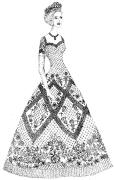
This is a sketch of the Coronation dress I made from looking at Hartnell's drawing which showed the placement of emblems.
If you click the thumbnail and print it out you may use it in school project class work as a Jubilee colouring picture of Her Majesty Queen Elizabeth 2nd's gown.
The Queen wore a Diadem to the Abbey before the coronation ceremony.
