

Партнерка на США и Канаду по недвижимости, выплаты в крипто
- 30% recurring commission
- Выплаты в USDT
- Вывод каждую неделю
- Комиссия до 5 лет за каждого referral
David Christian lectures on the “Big History»
Lecture 1:
Big history from “Big Bang”, it is an expansion of “world history” – not limited to early history of mankind, but includes history of the Universe. But he doesn’t include discussion of the scientific laws and facts according to which the Universe is developing, or includes them only in a superficial manner, as for example in discussing the second law of thermodynamics. Knowledge of everything must include these. Hence, his approach is only “luke warm” scientific.
Proposes to discuss history on “the biggest possible scale”. Adopt an interdisciplinary approach.
Thinks of “maps of time”, looking for “big patterns”
His approach is:
a. not practical, does not include practice, practical knowledge, making or creating anything in physical implication, we want all practical knowledge, not just 1 skill or “profession”. E. g. a captain of a yacht can do many things.
b. Not revolutionary – sees revolutions as only fleeting moments in history of mankind, instead of treating them as “thresholds”, pivoting moments which explain all previous history and struggle and set the agenda for the new period.
c. Does not treat of the history of previous attempts in this direction, and thus is guilty of lack of knowledge of previous achievements.
d. Confines himself to “science”, whereas knowledge is much wider, e. g. music and arts.
Lecture 2:
What happens on one scale illuminates what happens on another.
100 billion stars in the Milky Way. 100 billion galaxies in the Universe.
The smallest possible scale is the Planck Length (what is it? He doesn’t tell). 1.616199(97)Ч10−35 metres
Lecture 3:
Central idea of history : “increasing complexity”
One can study the properties of “H” or “O”, without any idea of the properties of “H^2O”. Hence, to understand knowledge, we need to study the whole, not just its components.
Upper level of complexity in the Universe (U) increases.
a. we see more complex chemical elements and structures arising from them
b. we can measure complexity by means of energy flows (“energy density”). We observe an increase in “energy density” from the Universe, to the stars, to the plants, to the living organisms, to human society.
Society is not the most complex structure. It is the human knowledge, which includes the knowledge of society and all Universe.
According to the second law of thermodynamics, the U. ought to get simpler. However, according to suggestion of Ilya Prigogine, this law is counteracted by hypothetical law of self-organization of matter.
An increase in complexity requires “Goldilocks principle”
1. According to Hegel, development occurs simultaneously in opposite directions. E. g. entropy (breakdown of order) on the one hand, and “growing complexity” (increase in order and structure) on the other hand.
2. Eventually, clashes occur between the opposite tendencies. E. g. negatively and positively charged clouds produce lightening. Warm and cold air currents produce tornado. Right and left parties in politics give rise to a revolution and civil war.
3. These clashes are numerous, not confined to “one” “Big Clash”.
4. In the process of clashes, the opposites get transformed to a new state, or quality. E. g. we no longer speak of “royalists” and “republicans” when discussing the French history, but of “the left” and “the right”, the socialists and nationalists, etc.
5. The opposites give “meaning”, or existence to one another. E. g. physical exercise makes possible mental work. Electricity is a flow from the positive pole to the negative. Everything is a kind of flow, or transition, from one extreme to the other.
6. The opposites are infinite in number. They exist at all levels of complexity of the Universe.
Lecture 4:
Most important topic to research is “self-organization of matter and living organisms, including that of humans”. This has important implications for the future party.
1. “What is truth?”
2. What information to trust?
The guy dabbles in philosophy, adopting modern capitalist discourse: “absolutism” vs. “relativism” as supposedly two opposite alternatives to the above questions. He has no idea of Hegel.
3. To the question 2: a) authority, e. g. trusting a pilot when flying a plane, b) evidence
4. Chronometry – techniques used to date past events. Written records. According to these, the world was started in 4000 B. C., according to Romans, and later Christians. After WWII, development of technique of radioactive dating.
H. G. Wells, “The Outline of History”, 1920
Lecture 5
This lecture gives history of cosmology, from the start of the Christian era.
Greek Aristarchus, 4 century B. C. – proposed a sun-based model of the Universe.
Ptolemy – 2nd century A. D. (?) – earth-based model of the Universe. This was later backed by the Christian church.
1500 years later – Copernicus proposed again a Sun-based model of the Universe, explains epicycles of Ptolemy.
Kepler shows that orbits of planets are elipses.
Galileo – pioneers use of telescope for astronomy
Newton – proposes that the U. operates according to one set of laws, the basic force being gravity.
200 years later: Ed Hubble shows that the U. is expanding.
Lemaitre – proposes a theory of “primeval atom”, or, derisively called at the time, “the Big Bang”. 1920’s. Wasn’t accepted for the first 20 years.
Lecture 6
Cosmology
How did everything begin?
If god made the U., who made god? If it is possible to say that “god” always existed, why not the U.?
Ancient cosmologies universally attribute conscious characteristics to elements of nature.
“The paradox of beginning” – what was there before the Big Bang?
As the U. is expanding, it is cooling.
Out of the “mush”, things start to appear. This is the law of self-organization of matter-energy.
380,000 years after Big Bang – simple atoms are formed.
4 fundamental forces appear
Initially the U. expands faster than the speed of light.
Particles and anti-particles appear. They mutually annihilate each other.
Simple atoms are formed – Hydrogen and Helium (atomic weight of 1 and 2).
“Dark matter” and “dark energy” – make up 95% of the Universe
Evidence for the Big Bang:
· Red shift: galaxies further away from us are flying away faster
· Cosmic background radiation: energy comes from all directions
· Age of the Universe: nothing is found older than 13 billion years
· History of the Universe: when looking far away into space, we’re looking back in time.
· Chemical make up
Lecture 7
How to generate complex things?
How to make a star?
Gravity – a form of energy. Energy-matter – 2 forms of one thing.
Cause of gravity – geometry of space-time.
At 10 million degrees C. 2 hydrogen atoms collide to make Helium, a nuclear explosion results. Stars appear, “hotspots” pumping energy into space.
Matter collapses on itself to form stars. “Star nurseries”
First stars appeared around 200 million years after Big B.
Gravity acts to produce stars. Also, due to gravity: stars -> galaxies -> clusters -> superclusters
Sun: consisted originally of 27% helium, now 62% helium (the rest is H). It is Ѕ through its lifecycle. It is now around 4 billion years old.
Stars are the first complex things in the U.
· They are pre-condition for other complex things
· New chemical elements appear inside stars
Lecture 8
Threshold 3: making new elements
Transition from one scale of the Universe to another -> transition from one discipline to another.
New levels of complexity lead to new disciplines.
Cosmology -> physics -> chemistry
Mendeleev – from Tobolsk. Table of the elements. Allows to predict properties of the elements not discovered. Such predictions are a strong proof of correctness.
Inside stars: H -> He
Originally, all universe 75% H, and 24% He.
As stars run out of H, it dies out. Star collapses. Temperature increases. At 100 million degrees C., He->C. A giant is formed, it burns out again, again a collapse, again temperature rises, until iron is produced, which will no longer burn up.
A supernova is produced. Possible consequences of that may be:
a. a neutron star – very heavy
b. a black hole
Lecture 9
There is nothing eternal, but everything has a history.
4th threshold: creation of a planet
Shift from cosmological scale (“all sand on Earth”) to our stellar system (“one particle of sand”)
In space, other planetary systems are discovered since 1990’s
Planets are by-products of star formations
Kant proposed a nebulae theory. From nebulae, a stellar system is formed, including a star and its planets.
99.9 percent of material goes into making a star, the rest – to planets.
Saturn disks give us an idea of what the solar system was like: same geometry. Saturn is a fractal of the solar system. The atom is a fractal of the solar system too.
There is an asteroid belt between Mars and Jupiter: a remnant of a planet that was being formed, but pulled apart by the gravitation of Jupiter.
Our solar system dates to 4.5 billion years ago, same as sun?
Lecture 10
The early Earth.
Shift from astronomy and cosmology to geology. No boundaries: “unity of scientific knowledge”
Earth’s history is divided into 4 eons:
1. Hadeon – 4.5-3.8 billion years ago
2. Archean – 3.8-2.5 billion years ago
3. Protezoroic – 2.5-550 million years ago
4. Phanerozoic – 550 m. y.a.-today
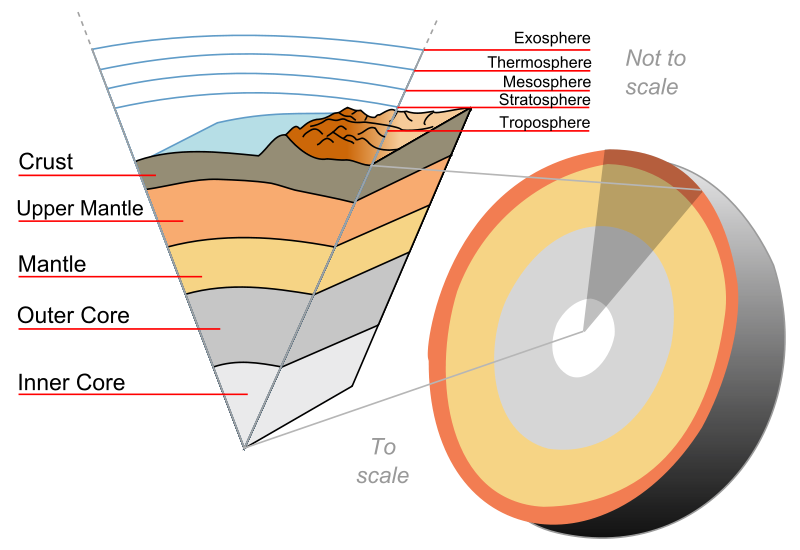
Early Earth – molten. Heavy materials sink to the center: “differentiation”.
Layers of the Earth:
1. The core – iron + nickel, generates magnetic field of our planet
2. Mantle – lighter materials: rocks. Hot, semi-molten
3. Crust – becomes solid due to the cold of outer space
4. Atmosphere
The moon – probably formed when an asteroid collided with the Earth.
In the Archean eon, early lift forms appear, atmosphere changes due to photosynthesis (of plants).
Lecture 11
A. Wegener, Hess – study movement of Earth’s plates
Wegener publishes in 1912 “The Origin of Continents and Oceans”, suggests a theory of continental drift, for which he offers several kinds of evidence. Calls the original continent “Pangaea”
Antarctica was once on tropical region, while Africa was in the glacial region.
The continents move due to the heat at the Earth’s center: “plat tectonics” theory.
Many revolutionary ideas in 1960’s in many fields
Ocean volcanic chains – changes in Earth’s magnetic field every several hundred years. Why?
Lecture 12
Threshold 5: the appearance of life.
What is life? There is no impassable chasm between non-living and living organisms. Chemistry of non-living is the same as in living.
Living organisms = higher level of complexity.
Emergent properties of living organisms:
· Metabolism (use of energy)
· Reproduction
· Adaptation
Viruses – a borderline between non-life and life.
Acquired characteristics are not passed on. But inherited characteristics are passed on.
Lecture 13
Darwin and natural selection
Change is a universal characteristic of the Universe. Hence, “history” is a universal characteristic too, in so far as we become conscious of the change. This may be a new element of dialectics.
How living things adopt?
Darwin was born in a wealthy family and also committed to scientific research. Father prophesized that nothing good will come out of him: CD likes to collect beetles.
In his life and house, there was a rigid routine. CD played a pool in the evening to relax his brains.
At 23 gets an invitation to travel around the world as a naturalist.
Makes a conclusion that “species are not immutable”.
Favorable characteristics are preserved, unfavorable are destroyed. Hence, new species emerge: evolution.
This is a statistical theory.
Resistance to these ideas come from the church, the conservative classes.
Lecture 14
Evidence for natural selection
(This prof. makes me want to sleep, when he talks about something I know too well, or unimportant)
(He quickly recaps on the previous lecture and immediately goes on to new material. Hence, I shouldn’t spend too much on recap, review, especially with advanced students)
Homologies – unexpected similarities between species.
Lecture 15
The topic is “the origin of life”
Fred Hoyle () proposed “Panspermia” theory: life material “rained” on Earth
Pasteur proves that life comes from life only
Creation of life involves:
1. Creation of simple chemicals: amino acids, nucleic acids, carbohydrates, lipids, etc.
2. Creation of complex molecules
3. Creation of DNA
A. Oparin thought that the atmosphere of the early Earth didn’t contain oxygen.
In 1952 Miller, Urey conducted an experiment in creating simple chemicals of life
“Chemical evolution” – certain chemicals become stable and evolve
A good place for origin of life could be deep-sea volcanic vents.
Lecture 16
Single-celled organisms
A great variety of species. All share a DNA, hence all are relatives
Life appears around 3.8 billion years ago. For the first 3 billion years, only single-celled organisms existed.
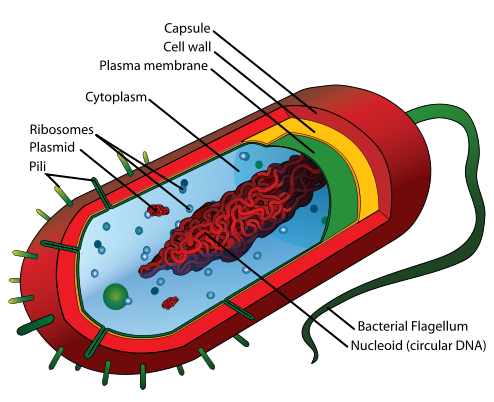
1. Prokaryotes – simplest organisms. Evolution can lead both to greater complexity (multi-celled organisms) and greater simplicity (e. g. viruses). Wikipedia: “Prokaryotes do not have a nucleus,mitochondria, or any other membrane-bound organelles. In other words, all their intracellular water-soluble components (proteins, DNA and metabolites) are located together in the same area enclosed by cell membrane, rather than separated in different cellular compartments.”
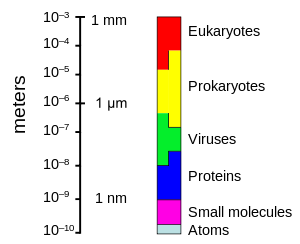
Size comparisons:
2. Photosynthesis – originated 3.5 billion years ago. Conversion of sunlight into energy. Required: CO2 + H2O. Result: glucose + oxygen. O2 builds up in the atmosphere, destroys some prok.
3. Eukaryotes – have organelles inside single-celled organisms. Have DNA inside a nucleus. Bigger than prok. Wikipedia:
“The defining membrane-bound structure that sets eukaryotic cells apart from prokaryotic cells is thenucleus, or nuclear envelope, within which the genetic material is carried.[1][2][3] The presence of a nucleus gives eukaryotes their name, which comes from the Greek ευ (eu, "good") and κάρυον(karyon, "nut" or "kernel"). Most eukaryotic cells also contain other membrane-bound organelles such as mitochondria, chloroplasts and the Golgi apparatus”.
A cell of a plant:
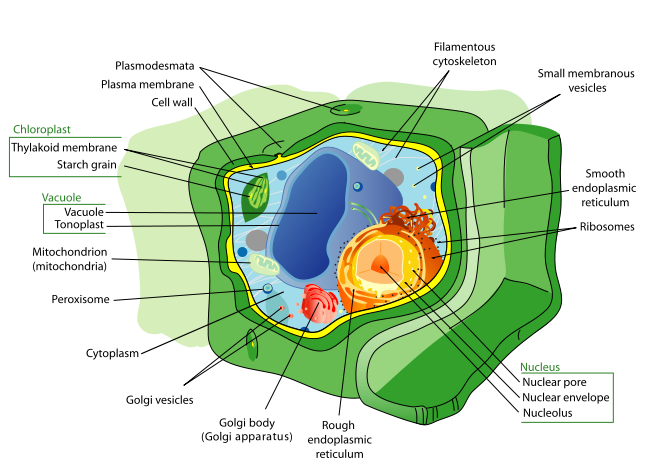
A cell of an animal:
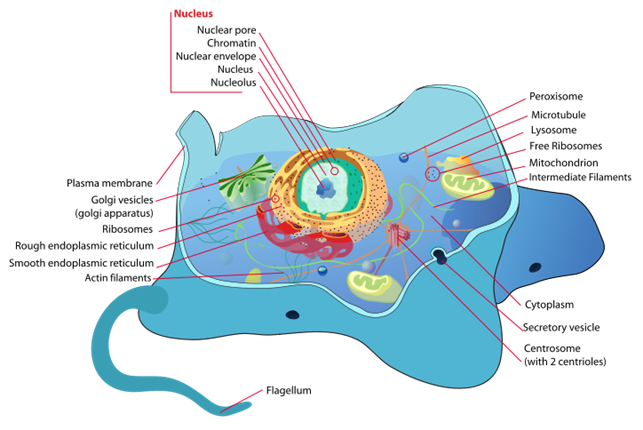
4. Sexual reproduction. Before that: division through cloning. S. r. introduces greater diversity. Works with natural selection to promote evolution. Wikipedia: “a process that creates a new organism by combining the genetic material of two organisms”
Lecture 17
Multi-celled organisms appear 600 million years ago
In a body, there are 100 billion cells. They share the same DNA, and hence don’t compete but cooperate.
5. multi-celled organisms. From independence of cells to cooperation between them. A large range of possibilities. Taxonomy – a grouping of organisms into categories.
6. Vertebrates – have a spinal chord. Evolved 500 million years ago.
7. Learning to live on land, moving out of water. 400 million years ago. Amphibians live on land, but return to water to lay eggs.
8. Mammals – feed the young with milk. 250 million years ago. Primates – tree-dwelling mammals.
Lecture 18
Hominines – bipedal apes
Primates – appear 65 million years ago. Wikipedia:
“Primates arose from ancestors that lived in the trees of tropical forests; many primate characteristics represent adaptations to life in this challenging three-dimensional environment”.
We descend from animals (primates) that climbed trees. That’s why kids like climbing.
- Stereo vision
- Grasping
- Large brains
- Protection
- Longer lives
Hominoids – evolved in Africa 18 million years ago.
(We need to empathize with the object of study to get “inside” picture. E. g. Jane Goodall and the apes. Al Jazeera channel and the Taliban).
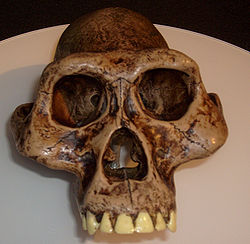
1. Australopithecus (pronounced aw-struh/strey-loh-pith-i-kuhs; fromLatin australis "southern", Greek πίθηκος pithekos "ape") is an extinctgenus of hominids. 4-2 million years ago
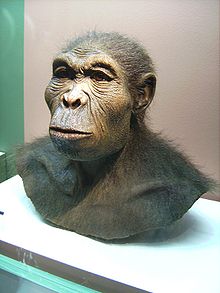
2. Homo habilis – 2.3 million years ago. 5 feet. Brain 600-800 cubic centimeters. Make stone tools and have a better diet. But other species use tools as well. E. g. crows in Japan drop walnuts in front of cars at streetlights, and then pick them up, after they are squashed. Wikipedia: “lived from approximately 2.33 to 1.4 million years ago, during the Gelasian Pleistocene period”
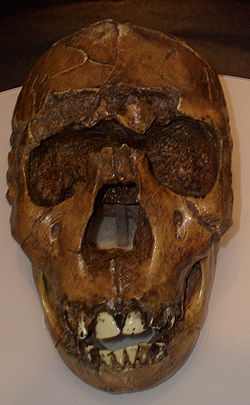
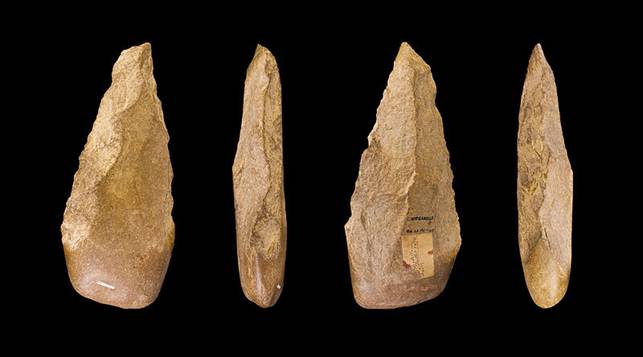
3. Homo erectus – brain is 1000 c. c. Acheulian tools. Wikipedia: “between 1.8 million and 1.3 million years ago” Acheulean industry.
Their distinctive oval and pear-shaped handaxes have been found over a wide area and some examples attained a very high level of sophistication. Although it developed in Africa, the industry is named after the type site of Saint-Acheul, now a suburb ofAmiens in northern France (not to be confused with the rural commune ofSaint Acheul), where some of the first examples were identified in the 19th century.[citation needed]
“Evidence for controlled use of fire has been proposed for burnt bones at the site of Swartkrans in South Africa at 1.5 million years and for patches of dirt at Chesowanja in Kenya at 1.4 million years.”
Lecture 19
Evidence for human evolution
1. Fossils
“Lucy” – 3.2 million years ago., Australopithecus, died in her 20’s, bipedal, 450 cc of brain.
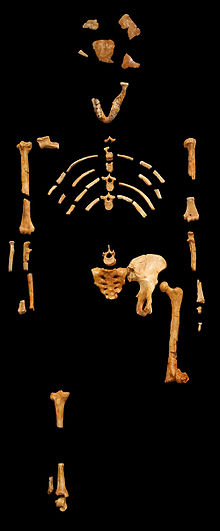
Researchers very excited about the new finding.
Oldowan tools – made of obsidium, volcanic glass
Wikipedia: “ the earliest stone tool industry in prehistory, being used during the Lower Paleolithic period, 2.6 million years ago up until 1.7 million years ago, by Hominines. It was followed by the more sophisticated Acheulean industry”.
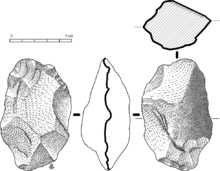 Unreworked edge of a shape found in both Oldowan and Acheulian. This tool is Oldowan.
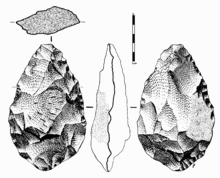 Roughly reworked edge, producing a scalloped effect. This tool is Acheulian.
Knapping – making stone tools.
Diet was dominated by plants and fruits.
2. Direct observation of our closest relatives.
Jane Goodall – first person to study apes in the wild.
3. Genetic dating – DNA of humans and chimps differ by 1%. Hence, we have had a common ancestor around 7 million years ago. G. D. means biological compatibility.
Scavenging – очистка
Lecture 20
What makes humans different?
We appear approx. 250,000 years ago, during the Paleolithic era
D. C. thinks it was control of the energy of the biosphere. Humans are constantly developing new forms of energy.
Forms of learning:
1. natural selection
2. individual learning – not cumulative
3. collective learning – a build up of information. This is possible through human language. It is highly symbolic.
I think there is no basic difference between us and the animal kingdom.
Lecture 21
If a species migrates to a new area -> (perhaps) there is a tech innovation
Neanderthal man – uses Mousterian tools. Size of brain like ours. Disappeared 20,000-30,000 years ago.
Wikipedia: “Mousterian is a name given by archaeologists to a style of predominantly flint tools (or industry) associated primarily withHomo neanderthalensis and dating to the Middle Paleolithic, the middle part of the Old Stone Age
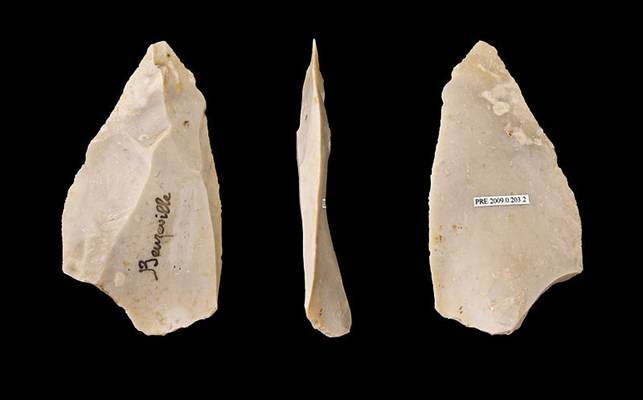
“Out of Africa hypothesis” vs. “multiregional hypothesis” of the origin of our species.
Lecture 22
How did the Paleolithic people live?
Division of human history:
I. Paleolithic era
II. Agrarian era
III. Modern
Human history is divided up according to the types of tools used:
I. Stone
II. Bronze
III. Iron
Originally, this division was proposed by C. J. Thomsen.
And today, the principal emerging tool appears as “knowledge”, this being both a theoretical concept and a practical application one one’s skills to shaping the environment.
Paleolithic era is principally studied by archeologists. Lasts from approx. 2 million years ago to 10,000 years ago.
“The Bronze Age” is what C. D. calls the “agrarian era”. This is from 10,000 – 250 years ago.
The modern is from 250 years ago to today. This is the industrial era, with knowledge emerging is the next era.
Paleolithic life ways:
· Lived in small, kinship groups, perhaps from less than 10 people to 50. (This is like a crew of a sailing vessel)
· Primary technology was foraging, i. e. taking things from the environment, without much processing (similarly to animals)
· Relied on extensive technology
· Nomadic lifestyle
· Plenty of free time
In the primitive society, all members of the society took part in the execution of a guilty member
From Paleolithic art, we learn about their world outlook. It (the world) was alive, e. g. rocks, rivers, etc. has souls. Etc.
Wikipedia: It extends from the earliest known use of stone tools, probably by Hominins such asAustralopithecines, 2.6 million years ago, to the end of the Pleistocene around 10,000 BP
humans grouped together in small societies such as bands, and subsisted by gathering plants and hunting or scavenging wild animals.[2] The Paleolithic is characterized by the use of knapped stone tools, although at the time humans also used wood and bone tools. Other organic commodities were adapted for use as tools, including leatherand vegetable fibers
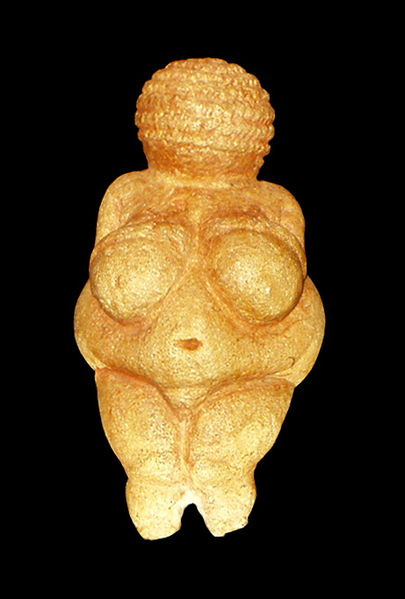
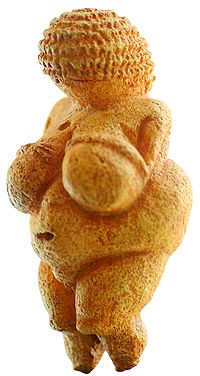
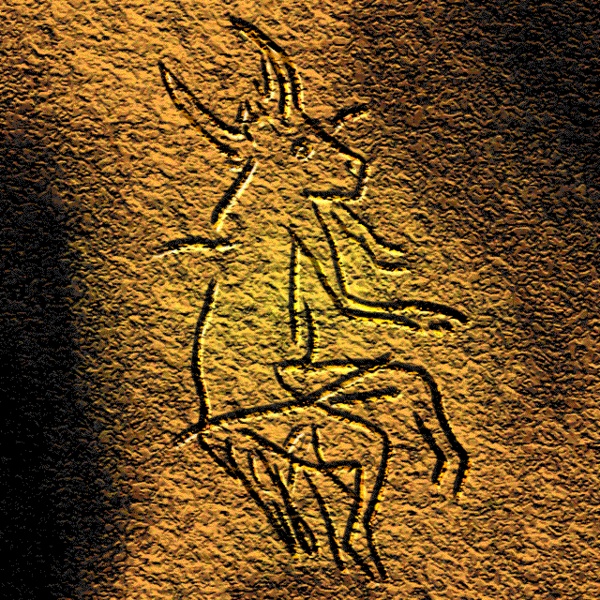
You Tube on the Paleolithic Age:
http://www. /watch? v=MYbDJF_gMtw
When agriculture is discovered, a transition is made from nomadic to settled life. Neolithic age starts, “agrarian society”
Lecture 23
There is an increasing tempo of change in the human society. For example, compare the transition from monkeys to Paleolithic era vs. the transition in the modern era.
Climate change – ice ages followed by interglacial periods. Human species has to adopt.
Global migration – population exits Africa, numbers increase. Huts are made of bones and leather
Some species of animals become extinct, due to our species.
Wikipedia, “nomads”
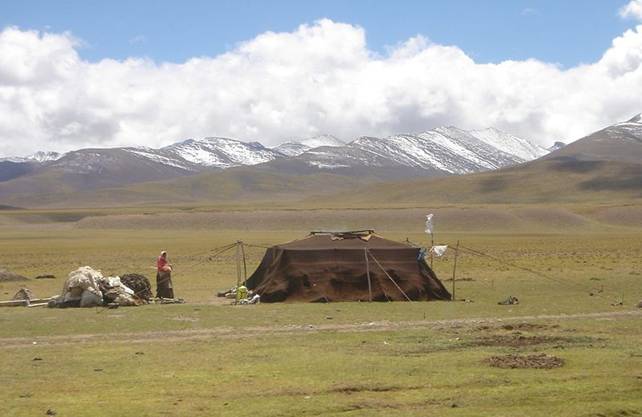
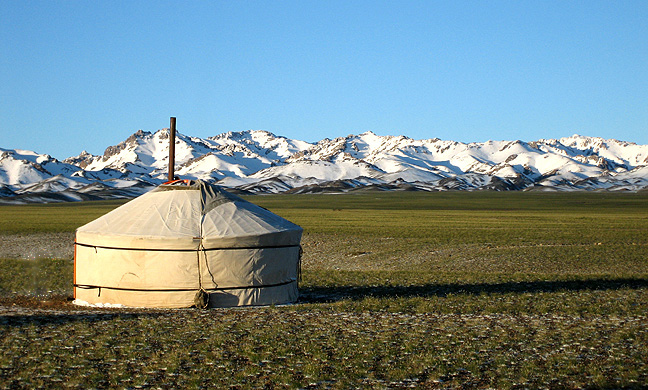
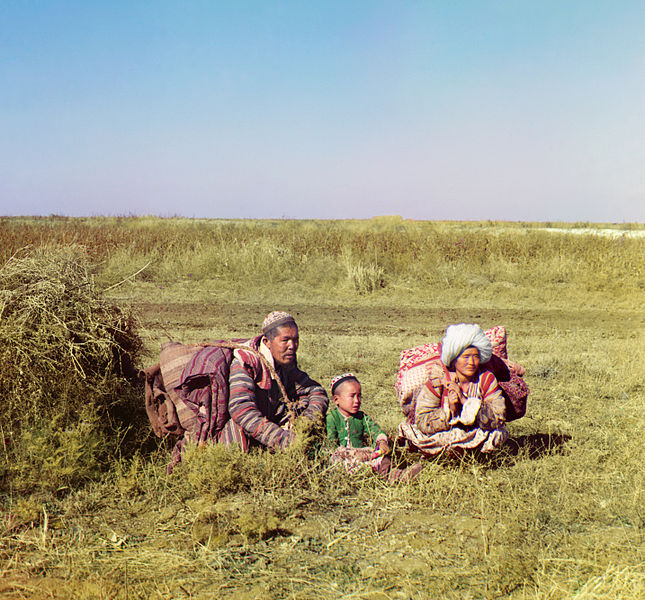
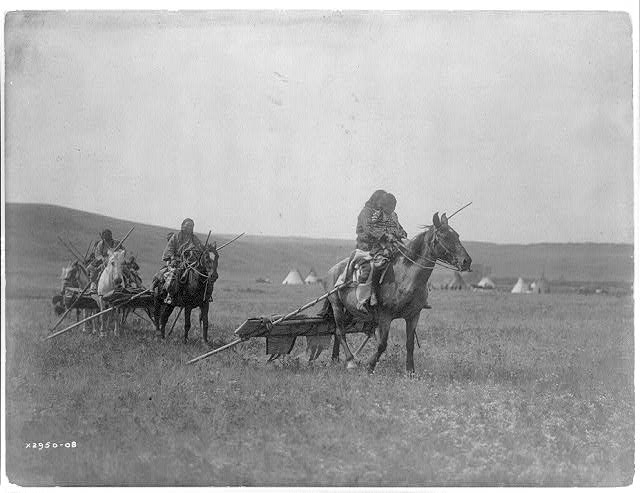
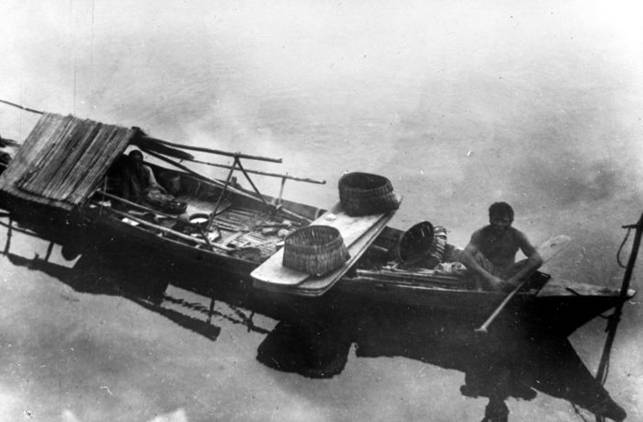
A film on Nomad’s life: http://www. /watch? v=6lycmTmNCBI
Lecture 24
A new threshold: Agriculture (threshold: a sort of revolution, a new quality of life)
A. appears approx. 10,000 yrs ago. Density of population incr. There is an increasing struggle for existence (?) – maybe it should be “an increase in social inequality”?
First cities and states appear approx. 5000 years ago.
A. appears to start simultaneously in several parts of the world.
In the “Fertile Crescent” (modern Middle East) around 11,000 years ago.
Then, in Papua New-Guinea. Then, in China – Yangzi and Yellow rivers. Then India and Pakistan.
4000 years ago – to Africa and America.
What is “agriculture”?
It’s a kind of symbiosis, where both species benefit from a relationship.
Agr. Increases our control of energy and resources. Leads to intensification of tech. change. (Platitudes!)
Wikipedia:
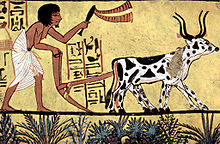
“In 2007, one third of the world's workers were employed in agriculture. The services sector has overtaken agriculture as the economic sector employing the most people worldwide.[11] Despite the size of its workforce, agricultural production accounts for less than five percent of the gross world product “
An agricultural calendar, from 15th century:
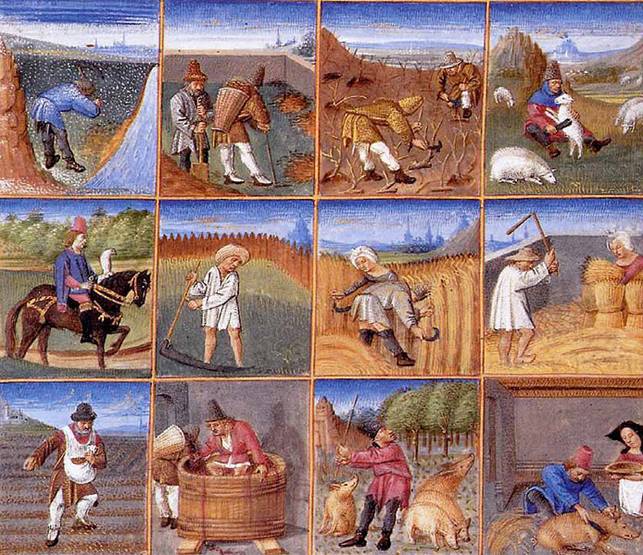
Lecture 25
Origins of agriculture
A. means obtaining food and energy in new ways (for foragers). Today, I am making the transition with the sailboat (solar panels, perhaps fishing…)
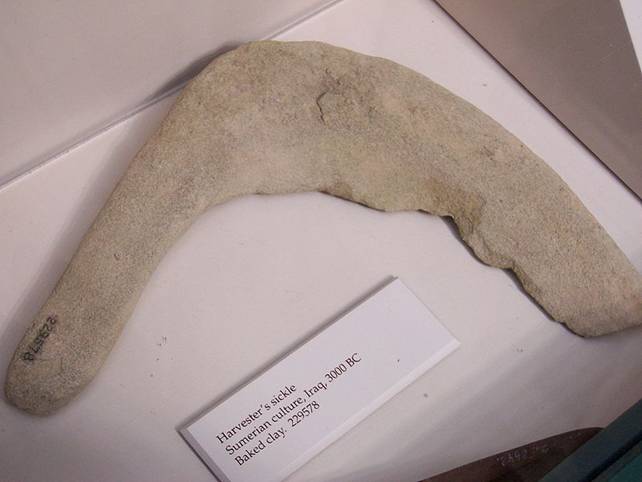
Natufian people – built substantial houses, hunt gazelles, produce a kind of wheat, make sickles.
Wikipedia: The Natufian culture ( /nəˈtjuːfiən/) was an Epipaleolithic culture that existed from 13,000 to 9,800 years ago in theLevant, a region in the Eastern Mediterranean. It was unusual in that it was sedentary, or semi-sedentary, before the introduction of agriculture. The Natufian communities are possibly the ancestors of the builders of the first Neolithicsettlements of the region, which may have been the earliest in the world. There is some evidence for the deliberate cultivation of cereals, specifically rye, by the Natufian culture, at the Tell Abu Hureyra site, the site for earliest evidence of agriculture in the world
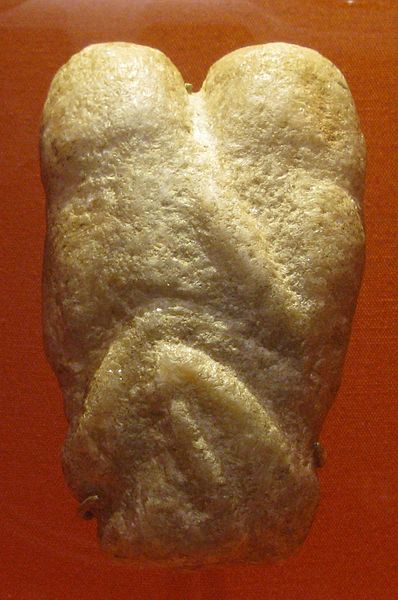
The Ain Sakhri lovers figurine is a sculpture that was found in one of the Ain Sakhri caves near Bethlehem.[1] The sculpture is considered to be 11,000 years old and to be the oldest known representation of two people engaged in sexual intercourse
Near simultaneous appearance of agriculture in different parts of the world. A. was invented several times. Perhaps reason for this was a climate change. “Gardens of Eden” form, leading to a more sedentary life of foragers.
(The method of these “scientists” seems to lack research, careful thinking and large generalizations. Doesn’t go into details, but makes a picture from platitudes in his own mind.)
Lecture 26
First agrarian societies.
Early agriculture – from appearance of A. to the appearance of cities and states.
People lived in villages, small towns. Farming communities grew faster than foragers.
Increase in population means increase in technical innovation.
“Synergy” - two or more things functioning together to produce a result not independently obtainable.
Horticulture – farming using hoes, sticks, etc.
Swidden agriculture – use of stone axes and fire to clear forests, plant crops.
Jericho – one of the earliest permanent communities.
Lecture 27
What is power?
State = coercion, authority by violence.
Appearance of a state – a new threshold in history, coincides with appearance of antagonistic classes and an rise of a class struggle.
Formal vs. informal authority.
People expect to benefit from subordination to informal leaders.
Power from above – depends on coercion, or a threat of it. E. g. thugs in Egypt, at the service of the state.
Lecture 28
Leaders – either: 1) have special skills, or 2) born into the position
Male vs. female leadership. In agricultural societies, women were concerned with providing as many children as possible, for the agricultural work, hence, limiting their role in society at large.
Initially, society was a matriarchy. Later, switched to patriarchy.
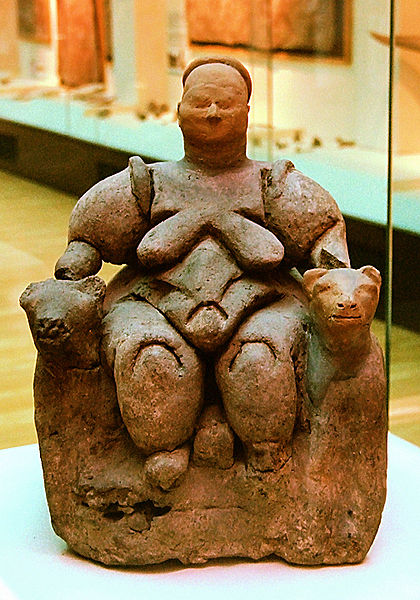
Seated Mother Goddess flanked by two lionesses from Зatalhцyьk (Turkey), Neolithic age (about BCE), today in Museum of Anatolian Civilizations in Ankara
Matriarchy – what is in fact today, with “single-parent household”. A ghetto is a place with no progress.
Lecture 29
Era of agrarian civilizations
Mesopotamia (modern Iraq), Nile river, Northern India, Northern China
· Large communities of millions
· Inhabitants are mostly peasants (around 90%), agricultural labor as prime
· There are cities and tribute-taking states
Secondary products revolution – products that can be used w/out killing the animal
(The more modern this guy gets, the more boring. No discussion of economic/social relationships among the people).
Lecture 30
 Sumer – the first Agrarian civilization, in southern Mesopotamia, in the delta of the Tigris and Euphrates rivers, approx. 4000 years BCE (6000 BP)
“The Epic of Gilgamesh”
Gilgamesh, from wikipedia
1. around 2500 B. C.
2. Gilgamesh is the central character in the Epic of Gilgamesh, the greatest surviving work of early Mesopotamian literature. In the epic his father was Lugalbanda and his mother was Ninsun (whom some call Rimat Ninsun), a goddess. In Mesopotamian mythology, Gilgamesh is a demigod of superhuman strength who built the city walls of Uruk to defend his people from external threats, and travelled to meet the sage Utnapishtim, who had survived the Great Deluge
3. Epic of Gilgamesh - Enkidu (a friend of G.) is a wild man created by the gods as Gilgamesh's equal to distract him from oppressing the citizens of Uruk. Together they undertake dangerous quests that incur the displeasure of the gods. Firstly, they journey to the Cedar Mountain to defeat Humbaba, its monstrous guardian. Later they kill the Bull of Heaven that the goddess Ishtar has sent to punish Gilgamesh for spurning her advances.
4. The latter part of the epic focuses on Gilgamesh's distressed reaction to Enkidu's death, which takes the form of a quest for immortality. Gilgamesh attempts to learn the secret of eternal life by undertaking a long and perilous journey to meet the immortal flood hero, Utnapishtim. Ultimately the poignant words addressed to Gilgamesh in the midst of his quest foreshadow the end result: "The life that you are seeking you will never find. When the gods created man they allotted to him death, but life they retained in their own keeping." Gilgamesh, however, was celebrated by posterity for his building achievements, and for bringing back long-lost cultic knowledge to Uruk as a result of his meeting with Utnapishtim.
5. There are parallels between the epic and the story of the Bible about the genesis of the human race (Adam and Eve)
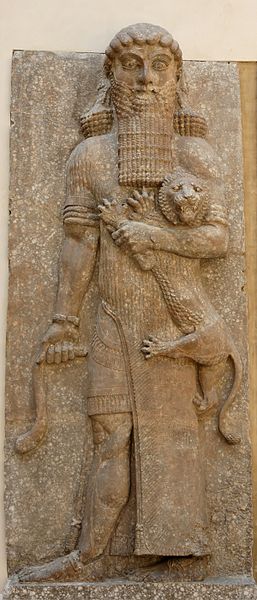
6. On the picture: the hero mastering a lion, 713-706 B. C., from palace of Sargon II at Khorsabad, now in Louvre
Usage of roofs for various purposes
Characteristics of the civilization:
· Division of labor, specialization
· Warfare, armies
· Organized religion
· Bureaucracy
· Writing
· Monumental architecture
First multi-city state was centered in Akkad
Lecture 31
Agrarian civilizations in other regions, i. e. how typical was the Sumer civilization?
Ancient Egypt
Ancient India
a bodhisattva is anyone who, motivated by great compassion, has generated bodhicitta, which is a spontaneous wish to attain Buddhahood for the benefit of all sentient beings
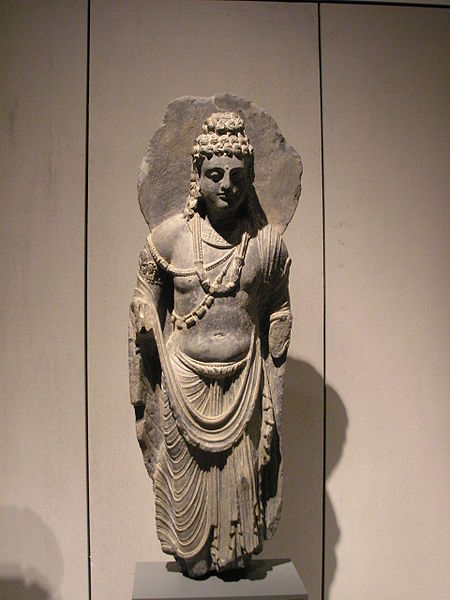
Great Joy: It is said that being close to enlightenment and seeing the benefit for all sentient beings, one achieves great joy, hence the name. In this bhūmithe bodhisattvas practice all perfections (pāramitās), but especially emphasizing generosity (dāna).
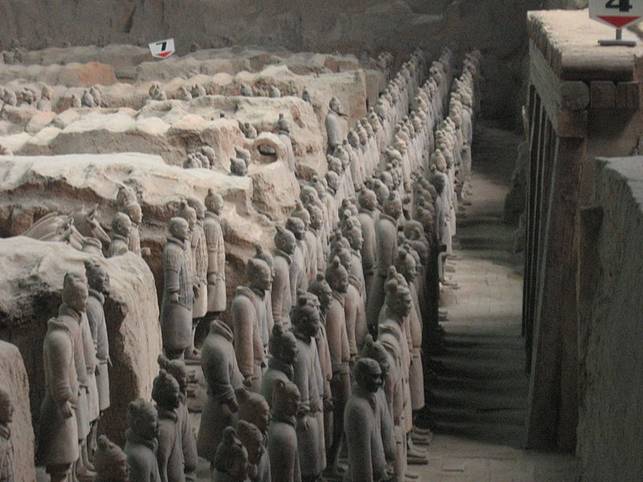
Ancient China
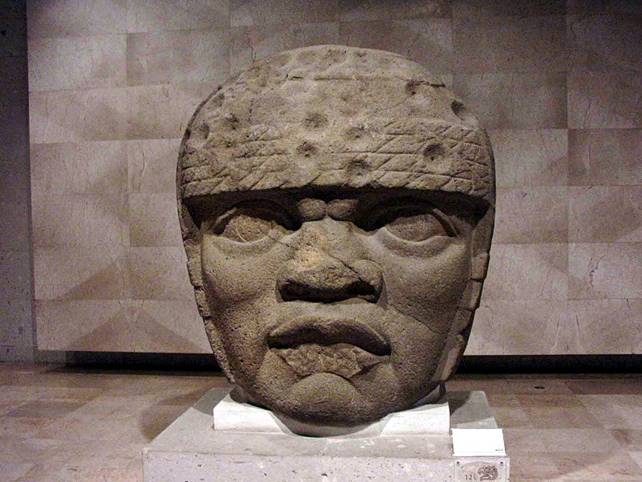
Olmec people (in the Americas)
Lecture 32
Similarities of Agrarian civilizations
Is human history directional? (Teleological)
1. It’s probably true that civilizations of the same type have certain things in common (“same type”)
2. But does it imply a necessary transition from one type of civilization to another?
Teleology - final causes exist in nature, meaning that design and purpose analogous to that found in human actions are inherent also in the rest of nature
Common traits of agrarian civilizations:
· Very large size
· Supported by surplus labor of peasants
· Exists a division of labor
· Tribute-taking states
· Hierarchies
· Women in the background
Lecture 33
Expansion of agricultural states and state power
An 11th century Muslim Persian prince to his son:
“Make it your constant endeavor to improve cultivation and to govern well; for understand this truth: the kingdom can be held by the army, and the army by the gold; and gold is acquired through agricultural development; and agricultural development through justice and equity. Therefore, be just and equitable”.
Lecture 34
Factors that tended to promote growth and innovation
· Population growth
· Networks of exchange
· Increase market exchange
· Increase in state role
Most important for a ruler is the art of war. He can train for that by hunting (or by seafaring)
Lecture 35
Malthusian cycle: population growth outpaces the growth in productivity,
Lecture 36
Natural experiment in history – comparing zones with different conditions
Double-hulled ocean-going canoes
Lecture 37
American in the late agrarian era
In 2000 BCE – Olmec culture develops, big basalt stone heads
Obsidian stone plays a large role in this culture
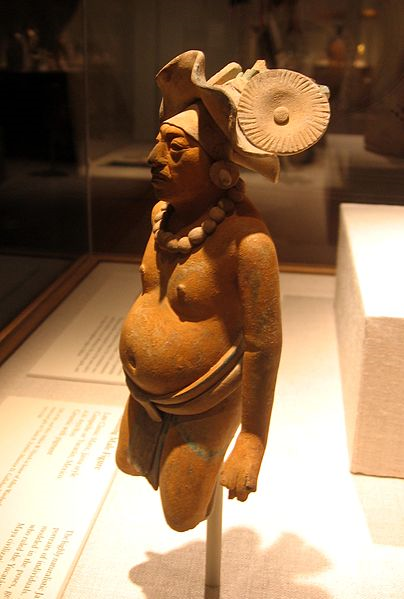
Maya civilization develops – hieroglyphs, decline in 8-9 centuries C. E. DC thinks it’s because of the “Malthusian cycle” (i. e. overpopulation and ecological disasters)
Lecture 38
The modern revolution – a new threshold in history
The Paleolithic era – lasted approx. 200,000 years (I think more than a million)
The Agrarian era – (new stone age, the bronze age) – 10,000 years
The modern era (industrial production) – 200-300 years
What is the essence of the modern era?
· Increase in the speed of innovation
· Peasant farming - > wage earning
· Globalization of human society
· Humans start to change the biosphere
According to DC, Marx was “also an admirer of capitalism”. DC – a “soft Marxist”
Lecture 39
Medieval Malthusian cycle
“Malthusian cycle” – population growth initially stimulates productive forces, but then outpaces these, and this leads in decline in population. Abstract and untrue.
Marco Polo (September 15, 1254 – January 9, 1324) – visits China in late 1200’s
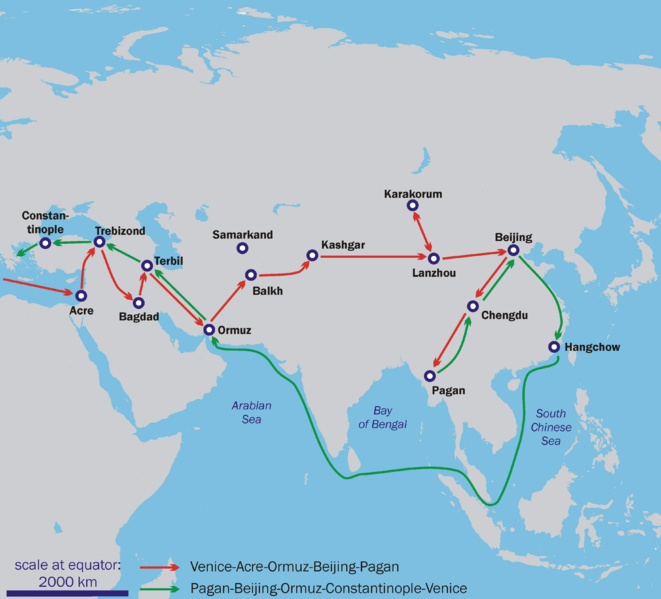
In China – there is a growth of commercial activity around 1400, fleets send on missions all over the world.
National Geographic Marco Polo: Journey from Venice to China – video presentation
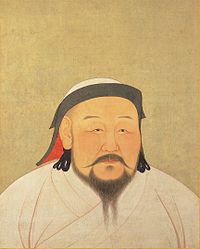
Kublai Khan, Yuan dynasty
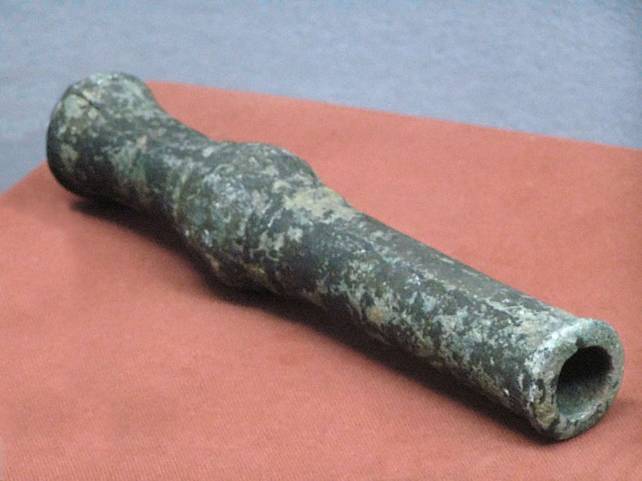
Hand gun of the Yuan dynasty
Lecture 40
The early modern cycle,
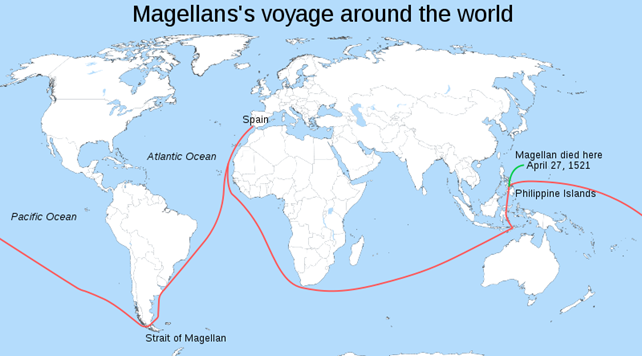
European mariners – Columbus, Juan Sebastian del Elcano (a part of Magellan’s crew who came back home after circumnavigation)
(1476, Getaria, Gipuzkoa, Spain – 4 August 1526, Pacific Ocean) was a Spanish explorer of Basque ethnicity who completed the first circumnavigation of the world. As Ferdinand Magellan's second in command, Elcano took over after Magellan's death in the Philippines.
The Juan Sebastiбn de Elcano is a training ship for the Royal Spanish Navy. She is a four-masted topsail, steel-hulled schooner. At 113 metres (370 feet) long, she is the third-largest Tall Ship in the world.
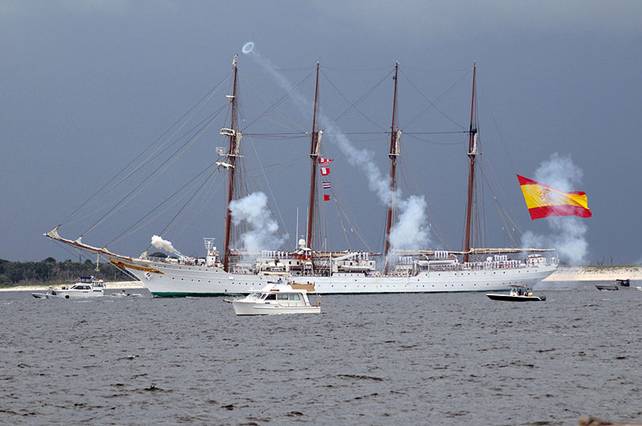
Displacement: | 3673 tons |
Length: | 113 m (371 ft) |
Beam: | 13.11 m (43 ft) |
Height: | 48.5 m (159 ft) |
Draft: | 7 m (23 ft) |
Sail plan: | four-masted barquentine; 21 sails, total sail area of 2,870 mІ (30,892 sq. ft.)[1] |
Speed: | max 13 knots engine, 17.5 knots sail |
Complement: | 300 sailors, 90 midshipmen |
Armament: | 2 Ч 57 mm ceremonial gun mounts |
Potosi, in Bolivia – 1545 – a mountain of silver. Indians die, replaced by Negroes.
Mercantile states in Europe
(Nothing of Renaissance!)
“Revolution” is the essential concept to understanding human history and development in general (dialectics). Those, who fight the revolution cannot understand the development correctly. For example, DC misses on the relationship between the industrial revolution and the social ones.
Lecture 41
The industrial revolution
Production rises faster than the increase in population. However, as there is an increasing inequality, it is not correct to say that “production per person is growing”. Just the opposite: “the rich are getting richer, and the poor poorer”.
Lecture 42
The spread of the Industrial revolution
(This guy babbles incessantly, no innovation, no scientific rigor or method)
The American civil war – the first war of the industrial era.
“learn on the job” – an old (peasant) and new (post-industrial) concept of education
Lecture 43
20th century
DC uses the term “communist world” for the USSR, China, etc. – uncritical adaptation
“War on terrorism” is the modern euphemism for fighting revolution
A rapid increase in population of the Earth in 20th century
Coal, oil and gas = 80% of energy use today. Nuclear power – 6%.
Living standards of the working class in imperialist countries increase. But the living standards of the working class in colonial countries decreases.
Gap between the rich and the poor globally:
1913 – 11:1
1992 – 72:1
e. g. Per capita income in 2000:
USA - $34,000
Burkina Faso, W. Africa - $210
Life expectancy:
Approx. 75 in the USA
45 in Burkina Faso.
Lecture 44
The modern world
Acceleration in the rates of innovation, pace of development increases
Destruction in the previous life ways: basic form of life organization – family structure – breaks down
Break down of patriarchy. Women enter the work force.
194 sovereign states today, 192 in the U. N. (exceptions: Vatican and Taiwan)
Formation of 1 global brain, through networked computers
Домострой – coercion as a norm
Prison population in the U. S. – 2.4 million, approx. 1% of the population
Quality of life vs. an increase in material wealth
Lecture 45
Human history and the biosphere
Biosphere and human history form a single entity – Vernadsky.
In the original theory of Vernadsky, the noosphere is the third in a succession of phases of development of the Earth, after the geosphere (inanimate matter) and the biosphere (biological life). Just as the emergence of life fundamentally transformed the geosphere, the emergence of human cognition fundamentally transforms the biosphere. In contrast to the conceptions of the Gaia theorists, or the promoters of cyberspace, Vernadsky's noosphere emerges at the point where humankind, through the mastery of nuclear processes, begins to create resources through the transmutation of elements.
DC misses the essence of the ecological problem, which is capitalism and no democracy
Gaia hypothesis – the entire biosphere is a single organism.
Gaia theory or Gaia principle, proposes that organisms interact with their inorganic surroundings on Earth to form a self-regulating, complex system that contributes to maintaining the conditions for life on the planet
Lecture 46
The next 100 years
Again: “Malthusian cycle”, capitalism has advantages and disadvantages
Lecture 47
The next 1000 years
Possible scenarios:
1) Nuclear war
2) Natural disaster
3) A close encounter with a nuclear war leading to a better global organization
Pseudo-immortality
New thresholds
1) Formation of one organization (organism?) out of human species
2) Migration beyond the Earth
3) Terraforming – the Moon, the Mars, domestication of other planets
4) Spreading to other stellar systems, especially due to the need of the sun burning out
5) Milky way galaxy collides with Andromeda galaxy
6) The Universe collides on itself (“the Big Crunch”) vs. the Universe that expands infinitely
“multiverse”
Lecture 48
Humans in space
Big History approach to knowledge provides maps of time and space
We’re creatures capable of seeking meaning, of having “a sense of purpose”
Therefore, humans are goal-capable beings.
“The strangest things in the Universe”, a documentary video, http://www. /watch? v=u-i_Q9eVAhE
